cooling CADILLAC DTS 2011 1.G User Guide
[x] Cancel search | Manufacturer: CADILLAC, Model Year: 2011, Model line: DTS, Model: CADILLAC DTS 2011 1.GPages: 470, PDF Size: 4.72 MB
Page 337 of 470

Black plate (27,1)Cadillac DTS Owner Manual - 2011
Checking Coolant
The vehicle must be on a level surface when checking
the coolant level.
Check to see if coolant is visible in the coolant recovery
tank. If the coolant inside the coolant recovery tank is
boiling, do not do anything else until it cools down.
If coolant is visible but the coolant level is not at or
above the FULL COLD mark, add a 50/50 mixture of
clean, drinkable water and DEX-COOL
®coolant at the
coolant recovery tank, but be sure the cooling system is
cool before this is done. See Engine Coolant
on
page 6‑26for more information.
How to Add Coolant to the Surge Tank
{WARNING:
You can be burned if you spill coolant on hot
engine parts. Coolant contains ethylene glycol
and it will burn if the engine parts are hot enough.
Do not spill coolant on a hot engine.
Notice: This vehicle has a specific coolant fill
procedure. Failure to follow this procedure could
cause the engine to overheat and be severely
damaged.
{WARNING:
An electric engine cooling fan under the hood can
start up even when the engine is not running and
can cause injury. Keep hands, clothing, and tools
away from any underhood electric fan.
6-27
Page 338 of 470

Black plate (28,1)Cadillac DTS Owner Manual - 2011
{WARNING:
Steam and scalding liquids from a hot cooling
system can blow out and burn you badly. They are
under pressure, and if you turn the surge tank
pressure cap—even a little —they can come out
at high speed. Never turn the cap when the
cooling system, including the surge tank pressure
cap, is hot. Wait for the cooling system and surge
tank pressure cap to cool if you ever have to turn
the pressure cap.
If no coolant is visible in the surge tank, add coolant as
follows:
1. Remove the coolant surge tank pressure
cap when the cooling
system, including the
coolant surge tank
pressure cap and
upper radiator hose, is
no longer hot. Turn the pressure cap slowly counterclockwise.
If you hear a hiss, wait for that to stop. A hiss
means there is still some pressure left.
2. Keep turning the cap and remove it.
3. Fill the coolant surge tank with the proper
mixture to the FULL
COLD mark on the
side of the coolant
surge tank.
6-28
Page 339 of 470

Black plate (29,1)Cadillac DTS Owner Manual - 2011
4.6L L37 Engine shown, 4.6L LD8 Engine similar
4. With the coolant surge tank cap off, start the engine and let it run until you can feel the upper
radiator hose getting hot. Watch out for the engine
cooling fans.
By this time, the coolant level inside the coolant
surge tank may be lower. If the level is lower, add
more of the proper mixture to the coolant surge
tank until the level reaches the FULL COLD mark
on the side of the coolant surge tank.
5. Replace the cap. Be sure the cap is hand‐tight and fully seated. Notice:
If the pressure cap is not tightly installed,
coolant loss and possible engine damage may
occur. Be sure the cap is properly and tightly
secured.
If coolant is needed, add the proper DEX-COOL
®
coolant mixture at the coolant recovery tank.
Engine Overheating
The vehicle has several indicators to warn of engine
overheating.
There is an engine temperature warning light and/or
gauge on the instrument panel cluster. See Engine
Coolant Temperature Warning Light
on page 4‑53and
Engine Coolant Temperature Gauge on page 4‑53.
The vehicle may also display a ENGINE OVERHEATED
IDLE ENGINE message or an ENGINE OVERHEATED
STOP ENGINE message displayed in the Driver
Information Center (DIC). See DIC Warnings and
Messages
on page 4‑65for more information. You will
also hear a chime.
The decision may be made not to lift the hood when
this warning appears, but instead get service help right
away. See Roadside Service on page 8‑7.
If the decision is made to lift the hood , make sure the
vehicle is parked on a level surface.
6-29
Page 340 of 470

Black plate (30,1)Cadillac DTS Owner Manual - 2011
Then check to see if the engine cooling fans are
running. If the engine is overheating, both fans should
be running. If they are not, do not continue to run the
engine and have the vehicle serviced.
Notice:Engine damage from running the engine
without coolant is not covered by the warranty.
Notice: If the engine catches fire while driving with
no coolant, the vehicle can be badly damaged. The
costly repairs would not be covered by the vehicle
warranty. See Overheated Engine Protection
Operating Mode
on page 6‑31for information on
driving to a safe place in an emergency.
If Steam Is Coming From The Engine
Compartment
{WARNING:
Steam from an overheated engine can burn you
badly, even if you just open the hood. Stay away
from the engine if you see or hear steam coming
from it. Turn it off and get everyone away from
the vehicle until it cools down. Wait until there is
no sign of steam or coolant before you open
the hood.
(Continued)
WARNING: (Continued)
If you keep driving when the vehicles engine is
overheated, the liquids in it can catch fire. You or
others could be badly burned. Stop the engine if
it overheats, and get out of the vehicle until the
engine is cool.
SeeOverheated Engine Protection Operating
Mode
on page 6‑31for information on driving to
a safe place in an emergency.
If No Steam Is Coming From The
Engine Compartment
If an engine overheat warning is displayed but no steam
can be seen or heard, the problem may not be too
serious. Sometimes the engine can get a little too hot
when the vehicle:
.Climbs a long hill on a hot day.
.Stops after high-speed driving.
.Idles for long periods in traffic.
.Tows a trailer.
6-30
Page 382 of 470

Black plate (72,1)Cadillac DTS Owner Manual - 2011
Wheel Alignment and Tire Balance
The tires and wheels on your vehicle were aligned and
balanced carefully at the factory to give you the longest
tire life and best overall performance. Adjustments
to wheel alignment and tire balancing will not be
necessary on a regular basis. However, if you notice
unusual tire wear or your vehicle pulling to one side or
the other, the alignment might need to be checked.
If you notice your vehicle vibrating when driving on a
smooth road, the tires and wheels might need to be
rebalanced. See your dealer for proper diagnosis.
Wheel Replacement
Replace any wheel that is bent, cracked or badly rusted
or corroded. If wheel nuts keep coming loose, the
wheel, wheel bolts and wheel nuts should be replaced.
If the wheel leaks air, replace it. Some aluminum wheels
can sometimes be repaired. See your GM dealer if any
of these conditions exist.
Your GM dealer will know the kind of wheel you need.
Each new wheel should have the same load-carrying
capacity, diameter, width, offset and be mounted the
same way as the one it replaces.
If you need to replace any of your wheels, wheel bolts,
wheel nuts, or Tire Pressure Monitor System (TPMS)
sensors, replace them only with new GM originalequipment parts. This way, you will be sure to have the
right wheel, wheel bolts, wheel nuts, and TPMS sensors
for your vehicle.
{WARNING:
Using the wrong replacement wheels, wheel bolts,
or wheel nuts on your vehicle can be dangerous.
It could affect the braking and handling of your
vehicle, make your tires lose air and make you
lose control. You could have a collision in which
you or others could be injured. Always use the
correct wheel, wheel bolts, and wheel nuts for
replacement.
Notice: The wrong wheel can also cause problems
with bearing life, brake cooling, speedometer or
odometer calibration, headlamp aim, bumper height,
vehicle ground clearance, and tire or tire chain
clearance to the body and chassis.
If your vehicle is a professional model, the wheels have
a unique offset and bolt hole diameter. Each of the
wheels on the professional vehicle have eight wheels
nuts. The wheels on the non-professional vehicle
have five wheel nuts. See Changing a Flat Tire
on
page 6‑83for more information.
6-72
Page 416 of 470

Black plate (106,1)Cadillac DTS Owner Manual - 2011
Fuses Usage
9Engine Control Module (ECM),
Powertrain Control Module (PCM)
10 Climate Control System, Instrument
Panel Cluster Ignition 1
11 Airbag System
12 Horn
13 Windshield Wiper
14 Fog Lamps
15 Right High-Beam Headlamp
16 Left High-Beam Headlamp
17 Left Low-Beam Headlamp
18 Right Low-Beam Headlamp
19 Windshield Washer Pump Motor
20 Left Front Cornering Lamp
21 Right Front Cornering Lamp
22 Air Pump (J-Case)
23 Antilock Brake System (ABS)
(J-Case)
Fuses Usage
24 Starter (J-Case)
25Antilock Brake System (ABS) Motor
(J-Case)
26 Cooling Fan 2 (J-Case)
27 Cooling Fan 1 (J-Case)
Relays Usage
29 Powertrain
30 Starter
31 Cooling Fan 2
32 Cooling Fan 3
33 Cooling Fan 1
34 Air Conditioning Clutch
35 Air Injection Reactor (AIR) Solenoid
36 Ignition
37 Air Pump
6-106
Page 422 of 470
Black plate (112,1)Cadillac DTS Owner Manual - 2011
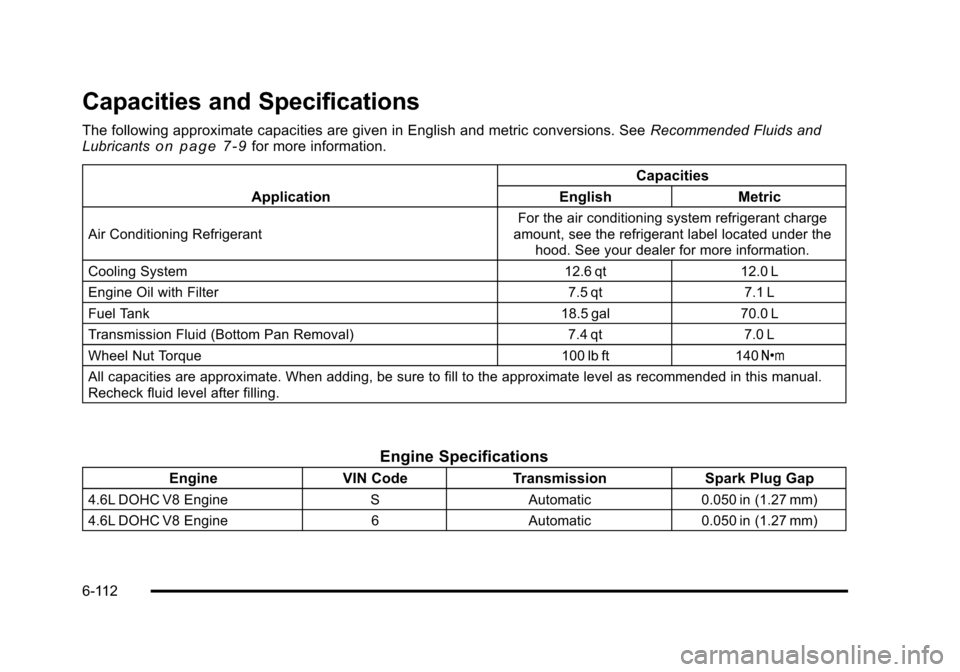
Capacities and Specifications
The following approximate capacities are given in English and metric conversions. SeeRecommended Fluids and
Lubricantson page 7‑9for more information.
Application Capacities
English Metric
Air Conditioning Refrigerant For the air conditioning system refrigerant charge
amount, see the refrigerant label located under the hood. See your dealer for more information.
Cooling System 12.6 qt12.0 L
Engine Oil with Filter 7.5 qt7.1 L
Fuel Tank 18.5 gal70.0 L
Transmission Fluid (Bottom Pan Removal) 7.4 qt7.0 L
Wheel Nut Torque 100 lb ft140Y
All capacities are approximate. When adding, be sure to fill to the approximate level as recommended in this manual.
Recheck fluid level after filling.
Engine Specifications
Engine VIN CodeTransmission Spark Plug Gap
4.6L DOHC V8 Engine SAutomatic 0.050 in (1.27 mm)
4.6L DOHC V8 Engine 6Automatic 0.050 in (1.27 mm)
6-112
Page 426 of 470

Black plate (4,1)Cadillac DTS Owner Manual - 2011
Every Engine Oil Change
.Change engine oil and filter. Reset oil life system.
SeeEngine Oilon page 6‑15andEngine Oil Life
Systemon page 6‑18. An Emission Control
Service.
.Engine coolant level check. See Engine Coolanton page 6‑26.
.Engine cooling system inspection. Visual
inspection of hoses, pipes, fittings, and clamps
and replacement, if needed.
.Windshield washer fluid level check. See
Windshield Washer Fluid on page 6‑32.
.Windshield wiper blade inspection for wear,
cracking, or contamination and windshield and
wiper blade cleaning, if contaminated. See
Windshield and Wiper Blades
on page 6‑99.
Worn or damaged wiper blade replacement. See
Windshield Wiper Blade Replacement
on
page 6‑46.
.Tire inflation pressures check. See Inflation - Tire
Pressure on page 6‑57.
.Tire wear inspection. See Tire Inspection and
Rotation on page 6‑65.
.Rotate tires if necessary. See Tire Inspection and
Rotation on page 6‑65.
.Fluids visual leak check (or every 12 months,
whichever occurs first). A leak in any system must
be repaired and the fluid level checked.
.Engine air cleaner filter inspection. See Engine Air
Cleaner/Filter on page 6‑19.
.Brake system inspection (or every 12 months,
whichever occurs first).
.Steering and suspension inspection. Visual
inspection for damaged, loose, or missing parts or
signs of wear.
.Body hinges and latches, key lock cylinders,
console hinges, and glove box door hinges
lubrication. See Recommended Fluids and
Lubricants
on page 7‑9. More frequent
lubrication may be required when the vehicle is
exposed to a corrosive environment. Applying
silicone grease on weatherstrips with a clean cloth
makes them last longer, seal better, and not stick
or squeak.
.Restraint system component check. See Checking
the Restraint Systems on page 2‑70.
.Fuel system inspection for damage or leaks.
.Exhaust system and nearby heat shields
inspection for loose or damaged components.
7-4
Page 428 of 470
Black plate (6,1)Cadillac DTS Owner Manual - 2011
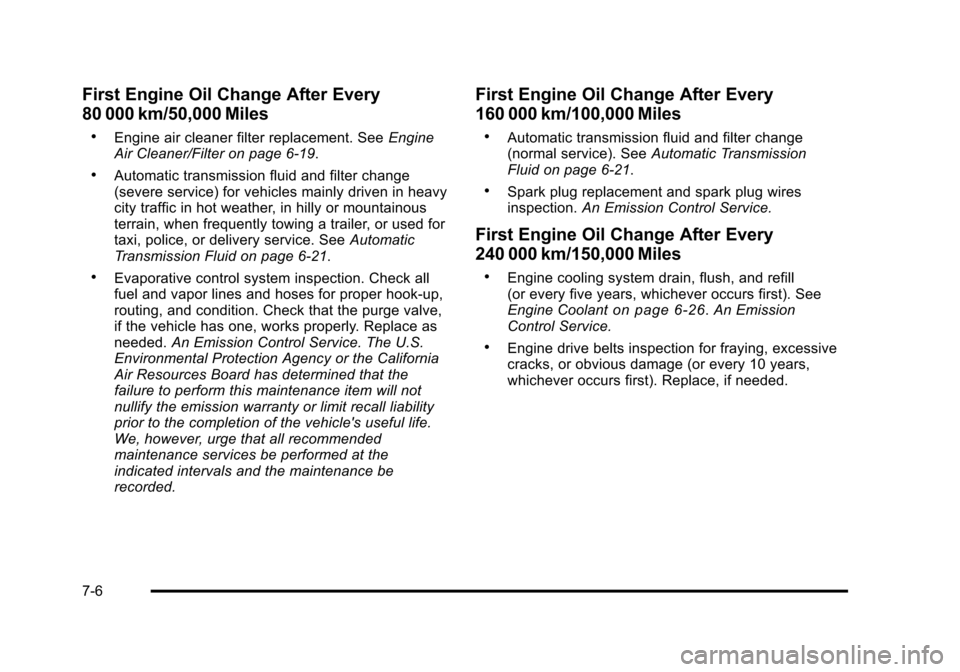
First Engine Oil Change After Every
80 000 km/50,000 Miles
.Engine air cleaner filter replacement. SeeEngine
Air Cleaner/Filter on page 6‑19.
.Automatic transmission fluid and filter change
(severe service) for vehicles mainly driven in heavy
city traffic in hot weather, in hilly or mountainous
terrain, when frequently towing a trailer, or used for
taxi, police, or delivery service. See Automatic
Transmission Fluid on page 6‑21.
.Evaporative control system inspection. Check all
fuel and vapor lines and hoses for proper hook‐up,
routing, and condition. Check that the purge valve,
if the vehicle has one, works properly. Replace as
needed. An Emission Control Service. The U.S.
Environmental Protection Agency or the California
Air Resources Board has determined that the
failure to perform this maintenance item will not
nullify the emission warranty or limit recall liability
prior to the completion of the vehicle's useful life.
We, however, urge that all recommended
maintenance services be performed at the
indicated intervals and the maintenance be
recorded.
First Engine Oil Change After Every
160 000 km/100,000 Miles
.Automatic transmission fluid and filter change
(normal service). See Automatic Transmission
Fluid on page 6‑21.
.Spark plug replacement and spark plug wires
inspection. An Emission Control Service.
First Engine Oil Change After Every
240 000 km/150,000 Miles
.Engine cooling system drain, flush, and refill
(or every five years, whichever occurs first). See
Engine Coolant
on page 6‑26.An Emission
Control Service.
.Engine drive belts inspection for fraying, excessive
cracks, or obvious damage (or every 10 years,
whichever occurs first). Replace, if needed.
7-6
Page 458 of 470

Black plate (4,1)Cadillac DTS Owner Manual - 2011
Compressor Kit, Tire Sealant . . . . . . . . . . . . . . . . . . . . . . 6-75
Content Theft-Deterrent . . . . . . . . . . . . . . . . . . . . . . . . . . . 3-19
Control of a Vehicle . . . . . . . . . . . . . . . . . . . . . . . . . . . . . . . . . .5-3
Convenience Net . . . . . . . . . . . . . . . . . . . . . . . . . . . . . . . . . . 3-56
CoolantEngine . . . . . . . . . . . . . . . . . . . . . . . . . . . . . . . . . . . . . . . . . . . . 6-26
Engine Temperature Gauge . . . . . . . . . . . . . . . . . . . . . . 4-53
Engine Temperature Warning Light . . . . . . . . . . . . . . . 4-53
Cooling System . . . . . . . . . . . . . . . . . . . . . . . . . . . . . . . . . . . . 6-24
Cornering Lamps . . . . . . . . . . . . . . . . . . . . . . . . . . . . . . . . . . 4-29
Courtesy Lamps . . . . . . . . . . . . . . . . . . . . . . . . . . . . . . . . . . . 4-30
Courtesy Transportation Program . . . . . . . . . . . . . . . . . . 8-10
Cruise Control . . . . . . . . . . . . . . . . . . . . . . . . . . . . . . . . . . . . . 4-12 Light . . . . . . . . . . . . . . . . . . . . . . . . . . . . . . . . . . . . . . . . . . . . . . 4-58
Cruise Control, Active . . . . . . . . . . . . . . . . . . . . . . . . . . . . . 4-14
Cruise Control, Forward Collision Alert (FCA) System . . . . . . . . . . . . . . . . . . . . . . . . . . . . . . . . . . . . . . . . . . . . .4-6
Cupholders . . . . . . . . . . . . . . . . . . . . . . . . . . . . . . . . . . . . . . . . 3-54
Customer Assistance . . . . . . . . . . . . . . . . . . . . . . . . . . . . . . . .8-6 Text Telephone (TTY) Users . . . . . . . . . . . . . . . . . . . . . . . 8-6
Customer Assistance Offices . . . . . . . . . . . . . . . . . . . . . . . .8-6
Customer Information
Service Publications Ordering Information . . . . . . . . 8-15
Customer Satisfaction Procedure . . . . . . . . . . . . . . . . . . . .8-2D
Damage Repair, Collision . . . . . . . . . . . . . . . . . . . . . . . . . . 8-12
Data Recorders, Event . . . . . . . . . . . . . . . . . . . . . . . . . . . . 8-17
Daytime Running Lamps (DRL) . . . . . . . . . . . . . . . . . . . . 4-28
Defensive Driving . . . . . . . . . . . . . . . . . . . . . . . . . . . . . . . . . . . .5-2
Disc, MP3 . . . . . . . . . . . . . . . . . . . . . . . . . . . . . . . . . . . . . . . . 4-100
Doing Your Own Service Work . . . . . . . . . . . . . . . . . . . . . . .6-4
Door Central Door Unlocking System . . . . . . . . . . . . . . . . . . 3-10
Locks . . . . . . . . . . . . . . . . . . . . . . . . . . . . . . . . . . . . . . . . . . . . . . 3-9
Power Locks . . . . . . . . . . . . . . . . . . . . . . . . . . . . . . . . . . . . . . 3-10
Programmable Automatic Door Locks . . . . . . . . . . . . 3-10
Rear Door Security Locks . . . . . . . . . . . . . . . . . . . . . . . . 3-10
Driver Information Center (DIC) . . . . . . . . . . . . . . . . . . . . 4-59 DIC Operation and Displays . . . . . . . . . . . . . . . . . . . . . . 4-60
DIC Vehicle Customization . . . . . . . . . . . . . . . . . . . . . . . 4-77
DIC Warnings and Messages . . . . . . . . . . . . . . . . . . . . . 4-65
Driving At Night . . . . . . . . . . . . . . . . . . . . . . . . . . . . . . . . . . . . . . . . . . . 5-12
Before a Long Trip . . . . . . . . . . . . . . . . . . . . . . . . . . . . . . . . 5-13
Defensive . . . . . . . . . . . . . . . . . . . . . . . . . . . . . . . . . . . . . . . . . . 5-2
Drunk . . . . . . . . . . . . . . . . . . . . . . . . . . . . . . . . . . . . . . . . . . . . . . 5-2
Highway Hypnosis . . . . . . . . . . . . . . . . . . . . . . . . . . . . . . . . 5-14
i - 4