brake CADILLAC ELDORADO 1994 10.G Owner's Manual
[x] Cancel search | Manufacturer: CADILLAC, Model Year: 1994, Model line: ELDORADO, Model: CADILLAC ELDORADO 1994 10.GPages: 398, PDF Size: 21.2 MB
Page 187 of 398
Downloaded from www.Manualslib.com manuals search engine P
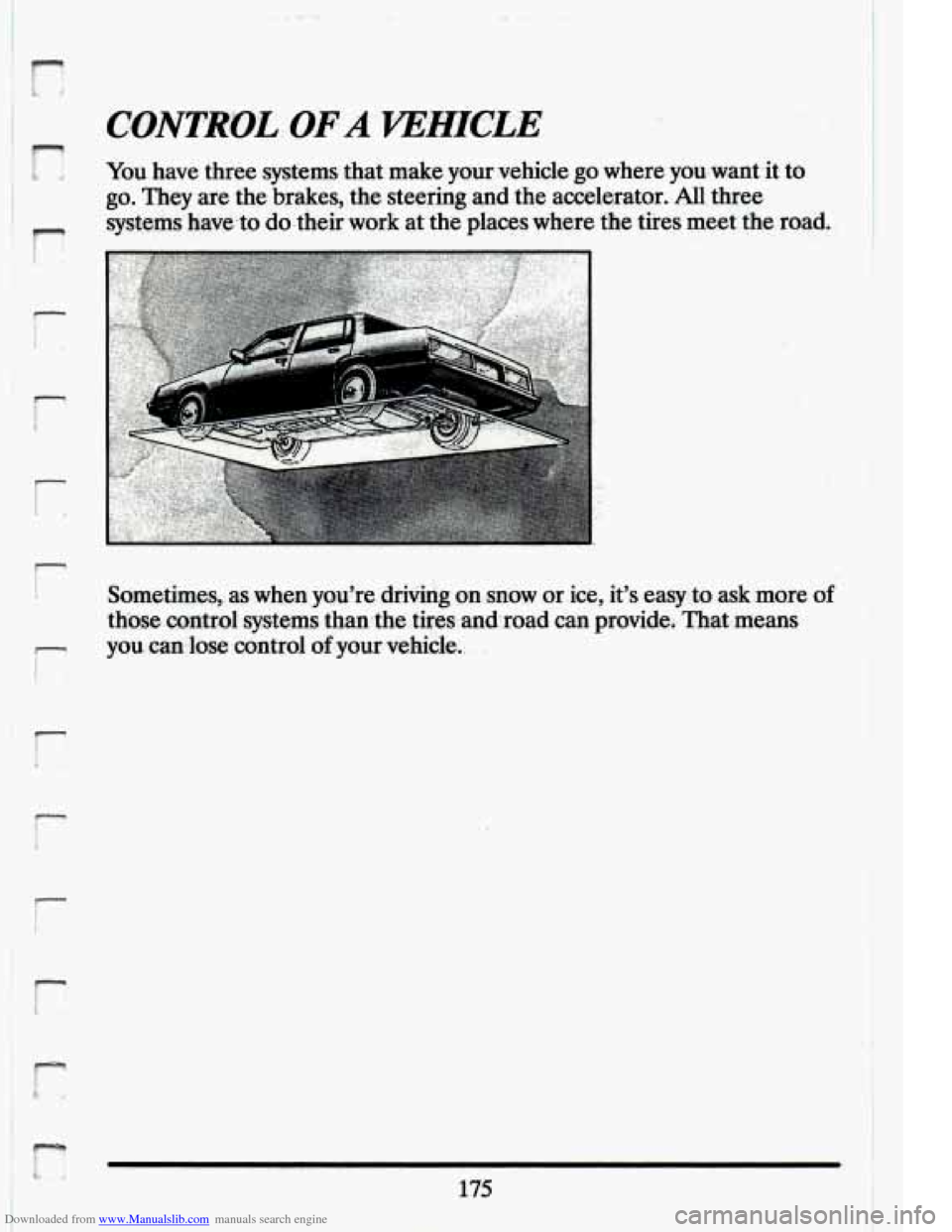
You have three systems that make your vehicle go where youwant it to
go. They .are the brakes, the. steering and the accelerator. All three
systems haveto do. their work at the places where the tires meet the road.
~
,
,
~
Sometimes, as when you're driving on snow or ice, it's easy to-ask more of
those control systems thanthe tires and.road can provide. That. means
you can.lose control
of your vehide.. .
175
Page 188 of 398
Downloaded from www.Manualslib.com manuals search engine BRAKING
Braking action involves perception time and reaction time. First, you have to decide to push on the brake pedal. That’s perception
time. Then you have to bring up your foot and do it. That’s reaction time.
Average reaction time is about
3/4 of a second. But that’s only an
average. It might be less with
one driver and as long as two or three
seconds or more with another. Age, physical condition, alertness,
coordination, and eyesight all play a part.
So do alcohol, drugs and
frustration. But even in
3/4 of a second, a vehicle moving at 60 mph
(100 km/h) travels 66 feet (20 m). That could be a lot -of-distance in an
emergency,
so keeping enough space between your vehicle and others is
important.
And, of course, actual stopping distances vary greatly with the surface of
the road (whether it’s pavement or gravel); the condition of the road
(wet, dry, icy); tire tread; and the condition
of your brakes.
Avoid needless heavy braking. Some people drive in spurts
-- heavy
acceleration followed by heavy braking
-- rather than keeping pace with
traffic. This
is a mistake. Your brakes may not have time to cool between
hard stops. Your brakes will wear out much faster
if you do a lot of heavy
braking. If you keep pace with the traffic and allow realistic following
distances, you will eliminate a lot
of unnecessary braking. That means
better braking and longer brake
life.
If your engine ever stops while you’re driving, brake normally \
but don’t
pump your brakes. If you
do, the pedal may get harder to push down. If
your engine stops, you will still have some power brake assist. But you will -
use it when you brake. Once the power assist is used up, it may take
longer to stop and the brake pedal will be harder to push.
c-
176
Page 189 of 398
Downloaded from www.Manualslib.com manuals search engine PI
Anti=Lock Brakes (ABS)
Your Cadillac has an advanced electronic braking system that will help
prevent skidding.
r
i
r
t
ANTI-
LOCK (@)
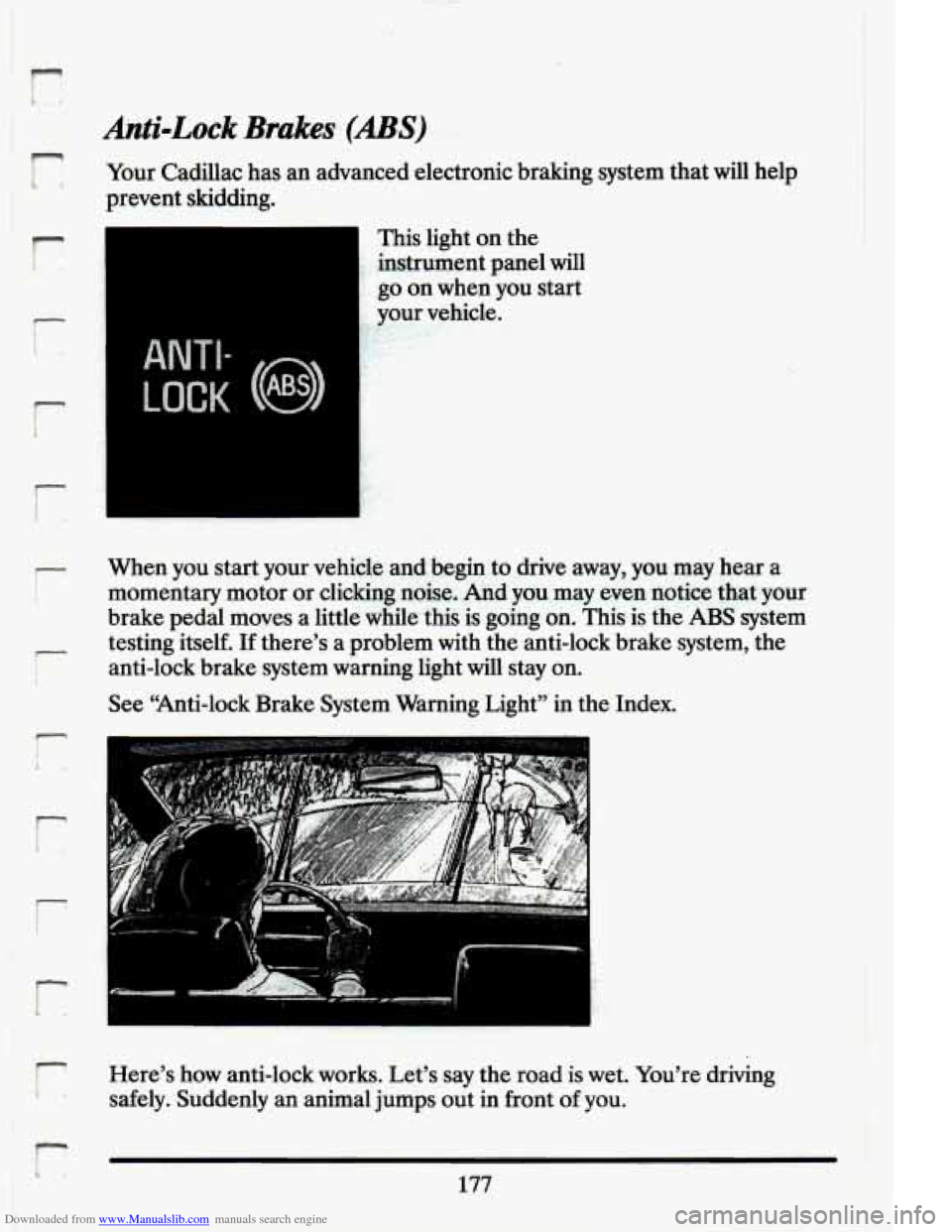
This light on the
instrument panel will
go on when you start
.. your vehicle. ,, .. v I- I‘ 1
?
When you start your vehicle and begin to drive away, you may hear a
momentary motor or clicking noise, And you may even notice that your
brake pedal moves a little while this is going on. This is the
ABS system
testing itself.
If there’s a problem with the anti-lock brake system, the
anti-lock brake system warning light
will stay on.
See “Anti-lock Brake System Warning Light” in the Index.
F;/ - ’r
Here’s how anti-lock works. Let’s say the road is wet. You’re driving
safely. Suddenly an animal jumps out in front
of you.
L 177
Page 190 of 398
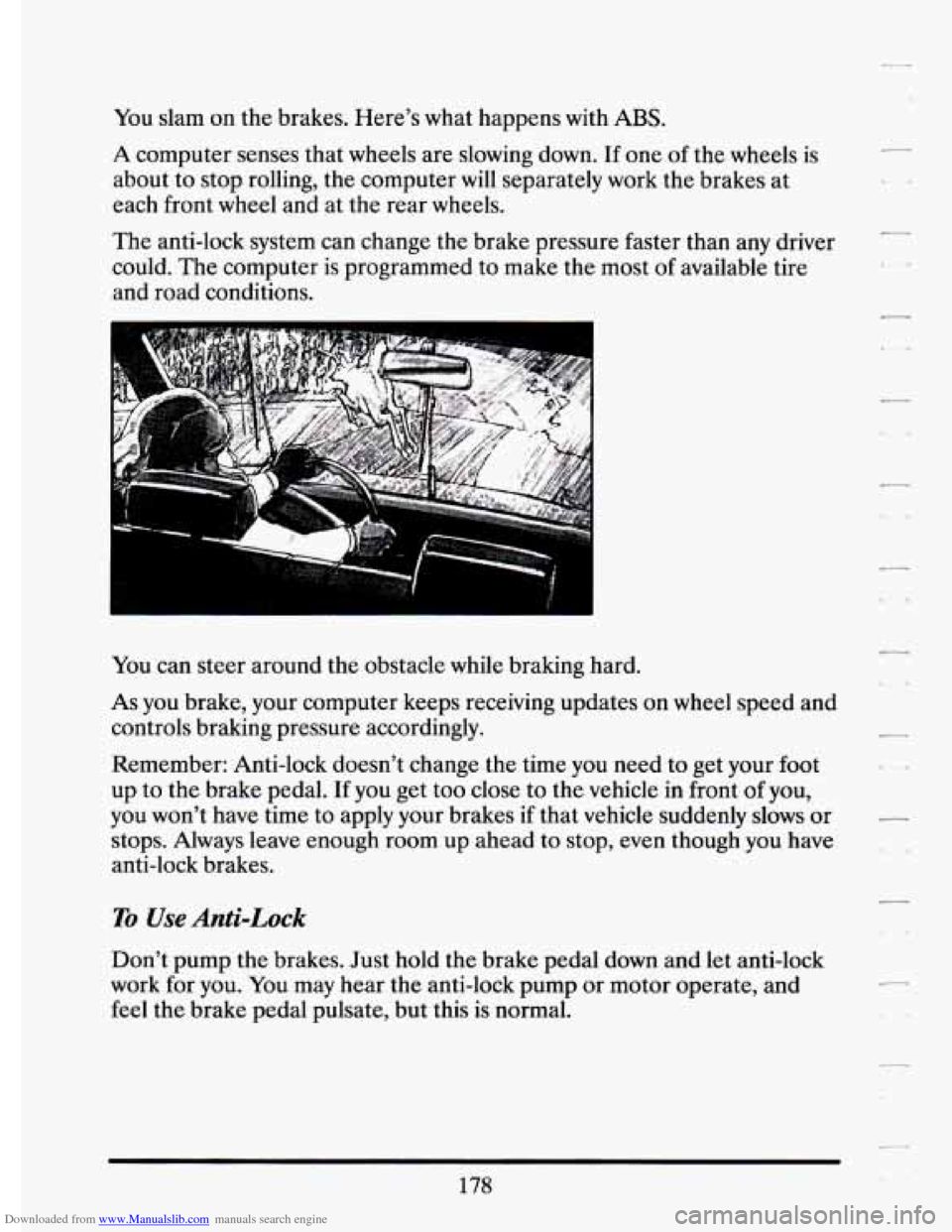
Downloaded from www.Manualslib.com manuals search engine You slam on the brakes. Here’s what happens with ABS.
A computer senses that wheels are slowing down. If one of the wheels is
about to stop rolling, the computer will separately work the brakes at
each front
wheel and at the rear wheels.
The anti-lock system can change the brake pressure faster than any driver
could.
The computer is programmed to make the most of available tire
and road conditions.
-
fou can steer around the obstacle while braking hard.
As you brake, your computer keeps receiving updates on wheel speed and
controls braking pressure accordingly.
Remember: Anti-lock doesn’t change the time you need to get your
foot
up to the brake pedal. If you get too close to the vehicle in front of you,
you won’t have time to apply your brakes
if that vehicle suddenly slows or
stops. Always leave enough room up ahead to stop, even though you have
anti-lock brakes.
1
To Use Anti-Lock
Don’t pump the brakes. Just hold the brake pedal down and let anti-lock
work for you. You may hear the anti-lock pump or motor operate, and
feel the brake pedal pulsate, but this
is normal.
c
..
178
Page 191 of 398
Downloaded from www.Manualslib.com manuals search engine I
r
i .’
r
r
L
r
i
r I
Your vehicle has traction control system that limits wheel spin. This is
especially useful in slippery road conditions. The system operates only
if
it senses that one or both of the front wheels are spinning or- beginning to
lose traction. When .this happens, the system works the front brakes and
reduces engine power (by shutting
off fuel injectors) to limit wheel spin.
The “TRACTION ACTIVE” message will display on the Driver
Information Center when the traction control system is limiting wheel
spin. See “Driver Information Center Messages” in the Index. You may
feel the system working, or you may notice some noise, but this
is nomal.
If your vehicle is in cruise control when the traction control system begins
to limit wheel spin, the cruise control will automatically disengage. When
road conditions allow you to safely use it again, you may
turn the cruise
control back on. (See “Cruise Control” in the Index.)
The “TRACTION DISABLED” message
will display on the Driver
Information Center
if there’s a problem with your traction control system.
See “D,river Information Center Messages” in the Index. When. this
message is displayed, the system will not limit wheel spin. Adjust your
driving accordingly.
Braking in Emergencies
Use your anti-lock braking system when you need to. With anti-lock, you
can steer and brake at the same time. In many emergencies, steering can
help you more than even the very best braking.
179
Page 193 of 398
Downloaded from www.Manualslib.com manuals search engine ‘I
r td
r
r
!
-
I- t>
Try to adjust your speed so you can ‘‘d&xCY through.thecurve. Maintain a
reasonable,. steady speed, Wait to .accelerate until you are out of the
curve,
and then accelerate-gently into the straightaway.
.. .:r 5.
Steering in Emergencies
There are times when steering canbe more effective.than braking. For
example, you. come over a hill and, find a truck stopped
in your lane, .or a
car suddenly pulls. out from nowhere, ox a child darts out €rm betwe
you. You can avoid these pxoblems
by braking.
-- if you can stop in time. But sometimes you can’t; there isn’t
room. That’s the time for evasive action
-- steering around the problem.
Your Cadillac can perform verywell
in. emergencies like these. First apply
your brakes. It
is better to remove as much speed as you can from a,
possible collision. Then steer around the problem, to the left orright
depending on the space available.
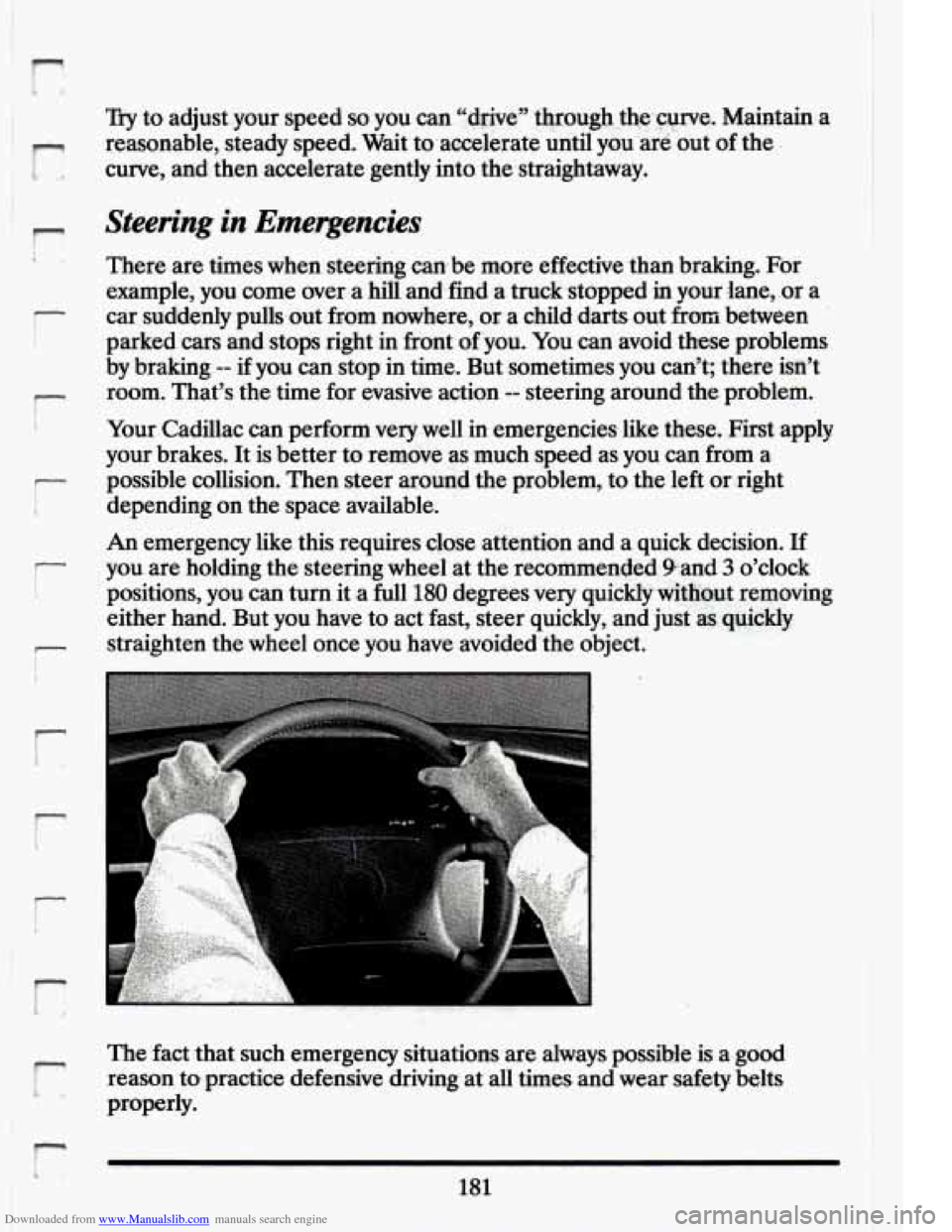
An emergency like this requires close attention and a quick decision. If
you. are holding the steering wheel’ at the recommended Pand-3’o’clock
positions, you can turn
it a full 180 degrees very quickly without removing
either hand. But you have to act fast, steer quickly, and just aslquickly
straighten the wheel once
you have avoided-:the object.
The fact that such emergency situations are always possible
is a.good
reason to practice defensive driving at all times. and wear safety belts
properly.
r c
181.
Page 196 of 398
Downloaded from www.Manualslib.com manuals search engine Try not to pass more than one vehicle at a time on two-lane roads.
Reconsider before passing the next vehicle.
Don’t overtake a slowly moving vehicle too rapidly. Even though the
brake lights are not flashing, it may be slowing down or starting to
turn.
If you’re being passed, make it easy for the following driver to get
ahead
of you. Perhaps you can ease a little to the right.
LOSS OF CONTROL
Let’s review what driving experts say about what happens whe\
n the three
control systems (brakes, steering and acceleration) don’t ha\
ve enough
friction where the tires meet the road to do what the driver has asked.
In any emergency, don’t give up. Keep trying to steer and constantly seek
an escape route or area of less danger.
Skidding
In a skid, a driver can lose control of the vehicle. Defensive drivers avoid
most skids by taking reasonable care suited to existing conditions, and by
not “overdriving” those conditions. But skids are always possible.
The three types of skids correspond
to your Cadillac’s three control
systems. In the braking skid your wheels aren’t rolling.
In the steering or
cornering skid, too much speed or steering
in a curve causes tires to slip
and lose cornering force. And in the acceleration skid too much throttle
causes the driving wheels to spin.
A cornering skid is best handled by easing your foot off the accelerator
pedal.
If your vehicle starts to slide, ease your foot off the accelerator pedal and
quickly steer the way you want the vehicle
to go. If you start steering
quickly enough, your vehicle may straighten out. Always be ready for a
second skid if it occurs.
Of course, traction is reduced
when water, snow, ice, gravel, or other
material is on the road. For safety, you’ll want
to slow down .md adjust
your driving
to these conditions. It is important to slow dowr on slippery
surfaces because stopping distance will be longer and vehicle control
more limited.
184
Page 200 of 398
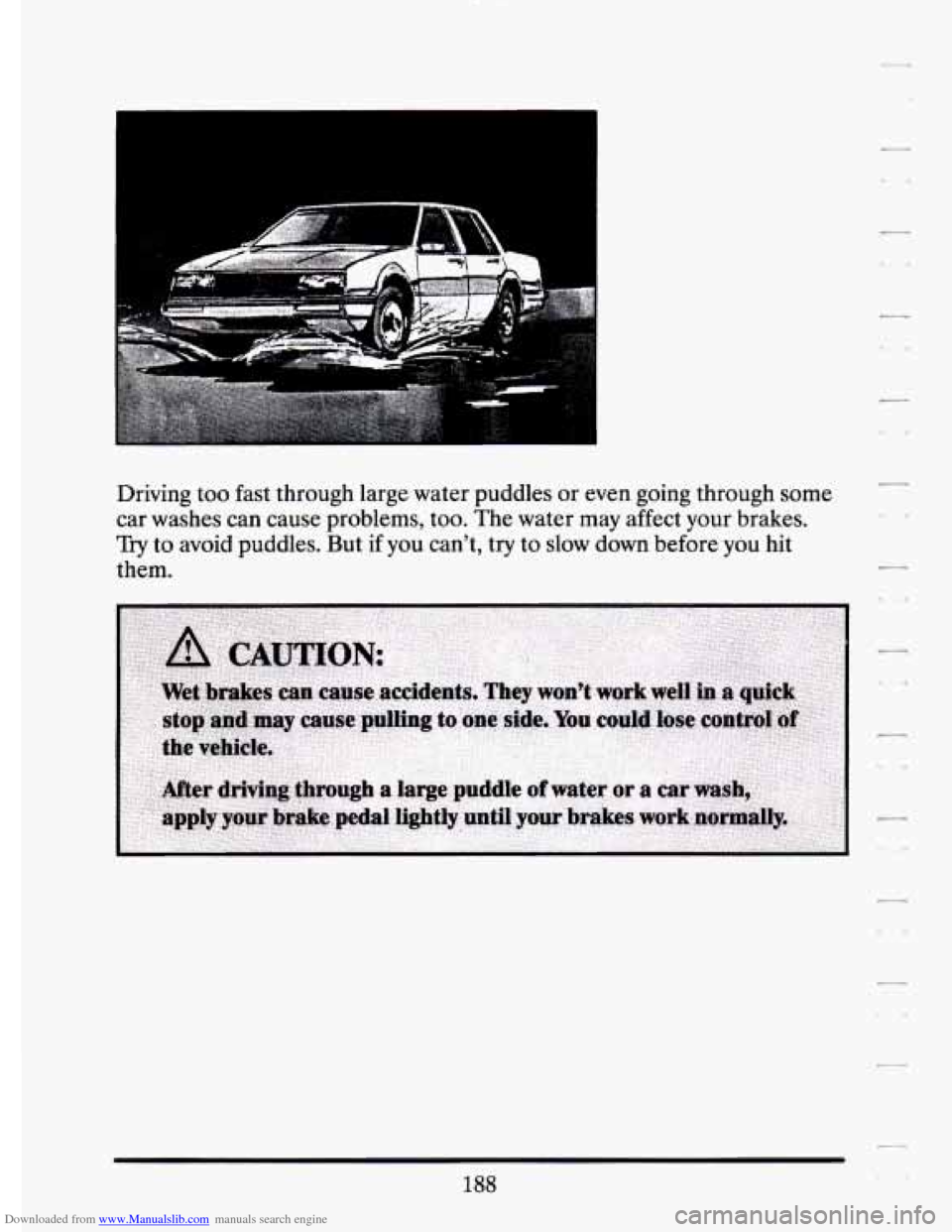
Downloaded from www.Manualslib.com manuals search engine Driving too fast through large water puddles or even going through some
car washes can cause problems,
too. The water may affect your brakes.
Try to avoid puddles. But if you can't, try to slow down before you hit
them.
-
Page 206 of 398
Downloaded from www.Manualslib.com manuals search engine HILL AND MOUNTMN ROADS
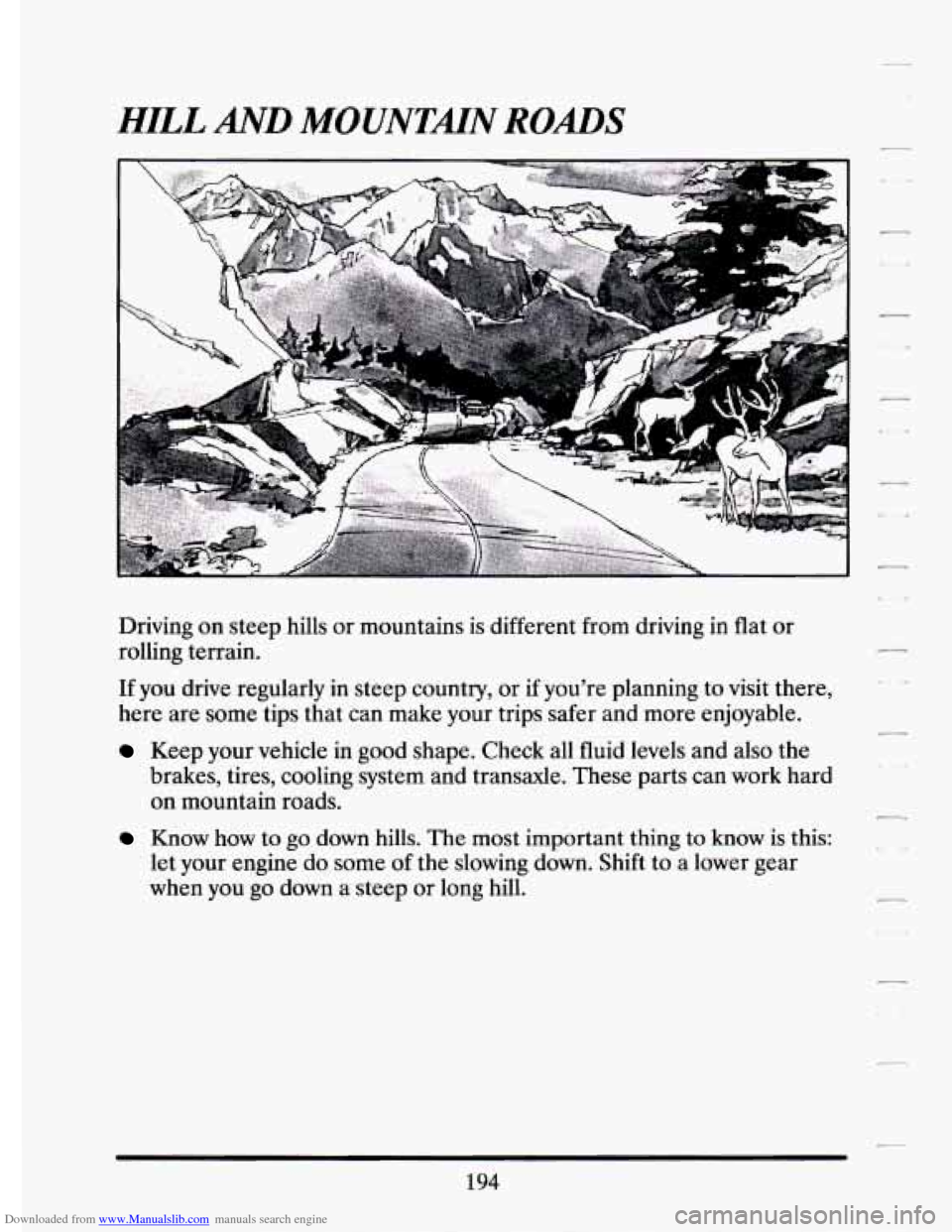
Driving on steep hills or mountains is different from driving in flat or
rolling terrain.
If you drive regularly in steep country, or if you’re planning to visit there,
here are some tips that can make your trips safer and more enjoyable.
Keep your vehicle in good shape. Check all fluid levels and a\
lso the
brakes, tires, cooling system and transaxle. These parts can work hard
on mountain roads.
Know how to go down hills. The most important thing to know is this:
let your engine do some of the slowing down. Shift to a lower gear
when you go down a steep
or long hill.
194
Page 210 of 398
Downloaded from www.Manualslib.com manuals search engine Most of the time, those places where your tires meet the:roaa probably
have good traction.
However,
if there is snow or ice between your tires and the road, you can
have
a very slippery situation. You’ll have a lot less traction or “grip” and
will need to be
very careful.
What’s the worst time for this? “Wet ice.” Very cold snow or ice can be
slick and hard to drive on. But wet ice can be even more trouble because
it may offer the least traction of all. You can get “wet
ice” when it’s about
freezing
(32 F; 0 C) and freezing rain begins to fall. Try to avoid driving
on wet ice untihalt and sand crews can get there.
Whatever the condition -=smooth ice, packed, blowing or loose snow
--
drive with caution.
If you have the traction control system, it will improve your ability to
accelerate when driving on a slippery road. Even though your vehicle has
a traction control system, you’ll want to slow down and adjust your
driving to the road conditions. See “Traction Control System” in the
Index.
Your anti-lock brakes improve your ability to make a hard stop on a
slippery road. Even though you have the anti-lock braking system, you’ll
want
to begin stopping sooner than you would on dry pavement. See
“Anti-lock” in the Index.
Allow greater following distance on any slippery road.
Watch for slippery spots. The road might be fine until you hit a spot
that’s covered with ice. Oman otherwise clear road, ice patc\
hes may appear in shaded areas where the sun can’t reach: around clumps
of
trees, behind buildings, or under bridges. Sometimes the surface of a
curve or an overpass may remain icy when the surrounding roads are
clear.
If you see a patch of ice ahead of you, brake before you are on
it.
Try not to brake while you’re actually on the ice, and avoid sudden
steering maneuvers.
198