tow CADILLAC ELDORADO 1997 10.G User Guide
[x] Cancel search | Manufacturer: CADILLAC, Model Year: 1997, Model line: ELDORADO, Model: CADILLAC ELDORADO 1997 10.GPages: 361, PDF Size: 22.85 MB
Page 91 of 361
Downloaded from www.Manualslib.com manuals search engine . , .. (P):
It can be dangerous to get. out of your vehicle if
the shift lever is not fully in PARK (P) with the
parking brake
firmly set. Your vehicle can roll.
If you have left the engine running, the vehicle
can move suddenly..You
or others could be
injured.
To be sure your vehicle won’t move, even
when you’re on fairly level ground, use. the steps
that follow.
If you’re pulling a trailer, see
“Towing a Trailer’, in the Index.
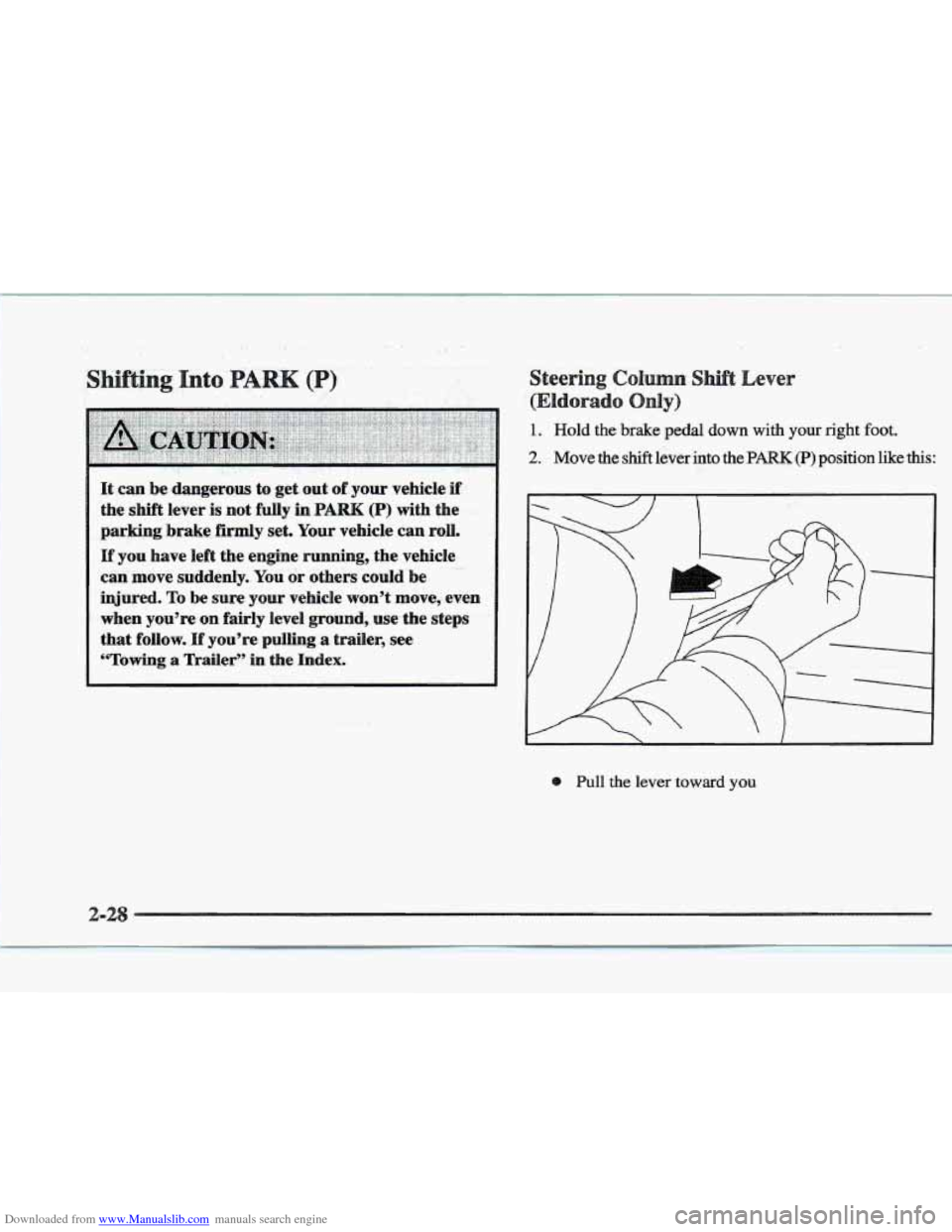
1. Hold the brake pedal down with your right foot.
2. Move the shift lever into the PARK (P) position like this:
J
e Pull the lever toward you
Page 92 of 361
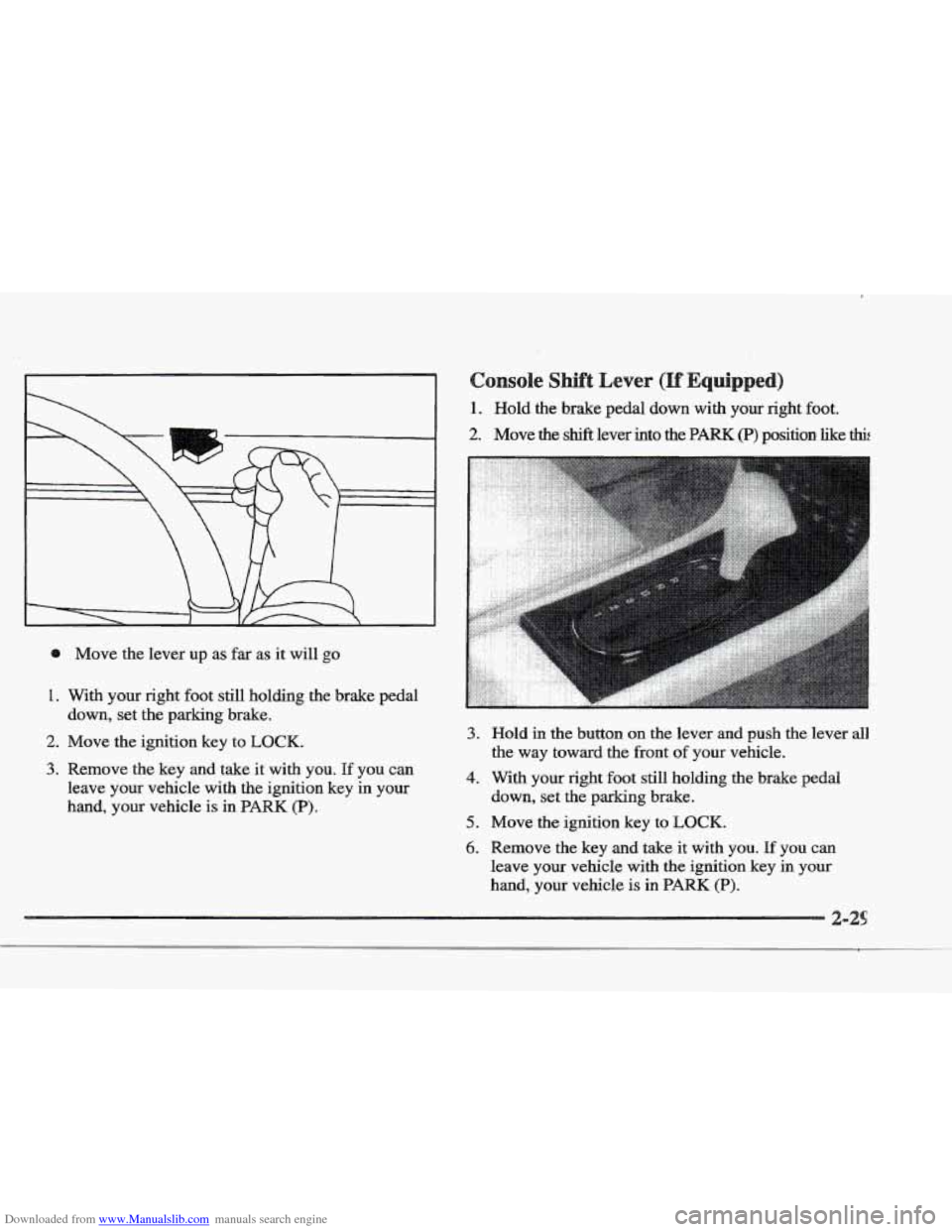
Downloaded from www.Manualslib.com manuals search engine 6 Move the lever up as far as it will go
1. With your right foot still holding the brake pedal
down, set the parking brake.
2. Move the ignition key to LOCK.
3. Remove the key and take it with you. If you can
leave your vehicle with the ignition key in your
hand, your vehicle
is in PARK (P).
1. Hold the brake pedal down with your right foot.
2. Move the shift lever into the PARK (P) position like thi:
3.
4.
5.
6.
Hold in the button on the lever and push the lever all
the way toward the front of your vehicle.
With your right foot still holding the brake pedal
down, set the parking brake.
Move the ignition key to
LOCK.
Remove the key and take it with you. If you can
leave your vehicle with the ignition key in your
hand, your vehicle
is in PARK (P).
Page 93 of 361
Downloaded from www.Manualslib.com manuals search engine It can be dangerous to leave your vehicle with
the engine running.
Your vehicle could move
suddedy i€ the shift lever is not fully in PARK (
with the parking brake firmly set. And, if you
leave the vehicle with the engine running, it cdd
overheat and even catch fire. You or others could
be injured. Don’t leave your vehicle with the
engine running unless you have to.
If you have to leave your vehicle with the engine
running, be sure your vehicle
is in PARK (P) and your
parking brake
is firmly set before you leave it. After
you’ve moved the shift lever into the
PARK (P)
position, hold the regular brake pedal down. Then, see
if you can move the shift lever away from PARK (P)
without first pulling it toward you (or, if you have the
console shift lever, without first pushing the button).
If
you can, it means that the shift lever wasn’t fully locked
into
PARK (I?).
If you are parking on a hill and you don’t shift you
transaxle into PARK (PI properly, the weight of the
vehicle may put too much force on the parking pawl in
the transaxle. You
may find it difficult to pull the shift
lever out of
PARK (P). This is called “torque lock.” To
prevent torque lock, set the parking brake and then shift
into
PARK (I?) properly before you leave the driver’s
seat.
To find out how, see “Shifting Into PARK (P)”
in the Index.
If torque lock does occur, you may need to have another
vehicle
push yours a little uphill to take some of the
pressure from the parking pawl
in the transaxle, so you
can pull the
shift lever out of PARK (P).
Page 96 of 361
Downloaded from www.Manualslib.com manuals search engine It can be dangerous to get out of your vehicle if
the shift lever is not fully in PARK (P) with the
parking brake firmly
set. Your vehicle can roll.
Don’t leave your vehicle when the engine
is
running unless you have to. If ydve left the
engine running, the vehicle can move
suddenly.
You or others cou%d be injured. TQ be sure your
vehicle move, even when you’re on fairly
level ground, always set your parking brake after
Follow the proper steps to be sure your vehicle won’t
move. See “Shifting Into
PARK (P)” in the Index.
If you are parking on a hill and if you’re pulling a
trailer, also see “Towing a Trailer” in the Index.
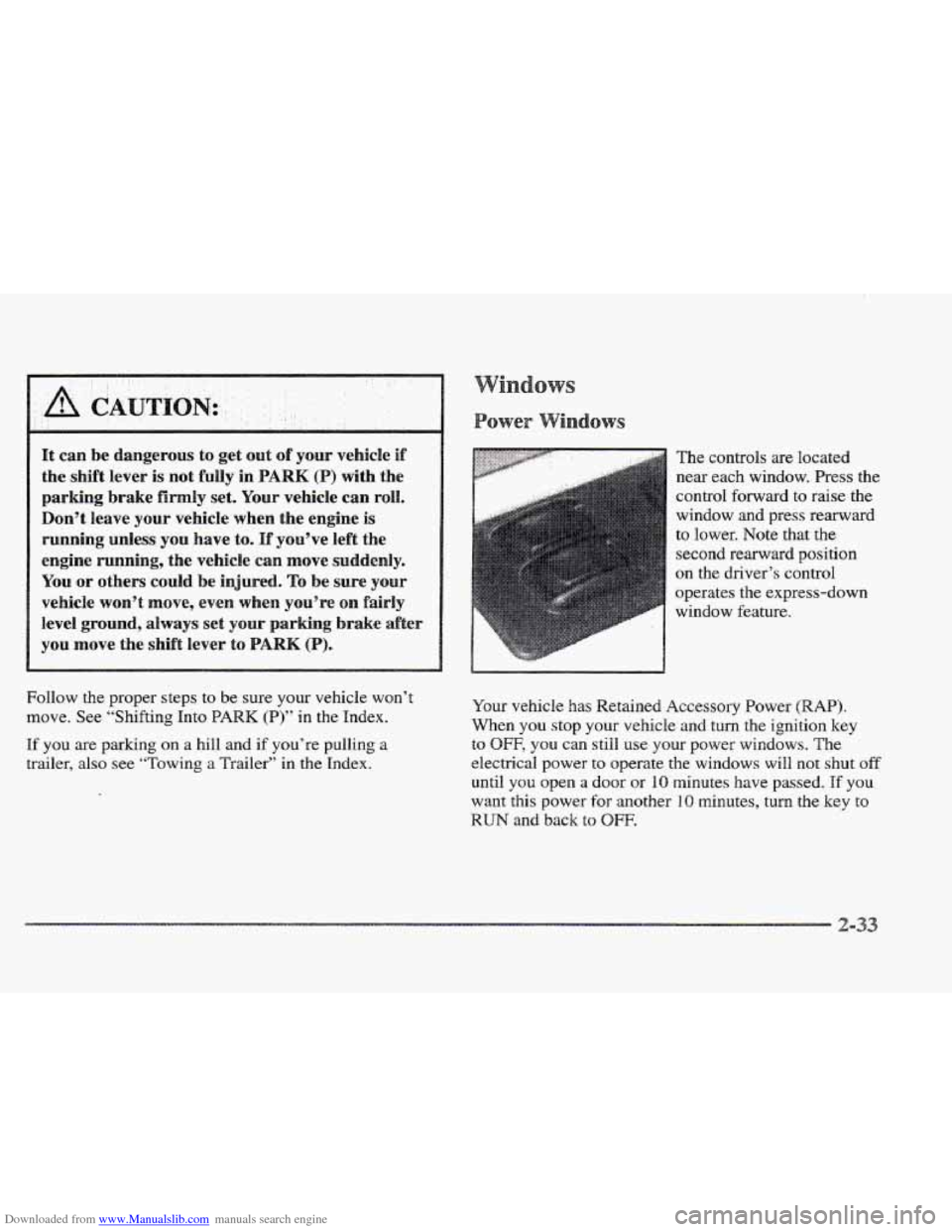
:rat~~~~~j,~.~.~.~~~:..i .I... . , .. :-., The controls are located
near each window. Press
the
control forward to raise the
window
and press rearward
to lower. Note that the
second rearward position
on the driver’s control
operates
the express-down
window feature.
Your vehicle has Retained Accessory Power (RAP).
When you stop your vehicle and turn the ignition key
to
OFF, YOU can still use your power windows. The
electrical power
to operate the windows will not shut off
until you open a door or 10 minutes have passed. If you
want this power
for another 10 minutes, turn the key BQ
RUN and back to OFF.
Page 97 of 361
Downloaded from www.Manualslib.com manuals search engine EX~ESS-DOWR Whdow
This feature is present on the driver’s power window.
Pressing the control rearward into the second
position
then releasing it will lower the window completely.
If you want to stop the window as it is lowering, press
the control forward. Press the control, .. forward to raise
the window.
Note that
the first position on the control operates the
driver’s power window in the non-express mode.
The
horn can be sounded by pressing on the center of
the steering wheel pad.
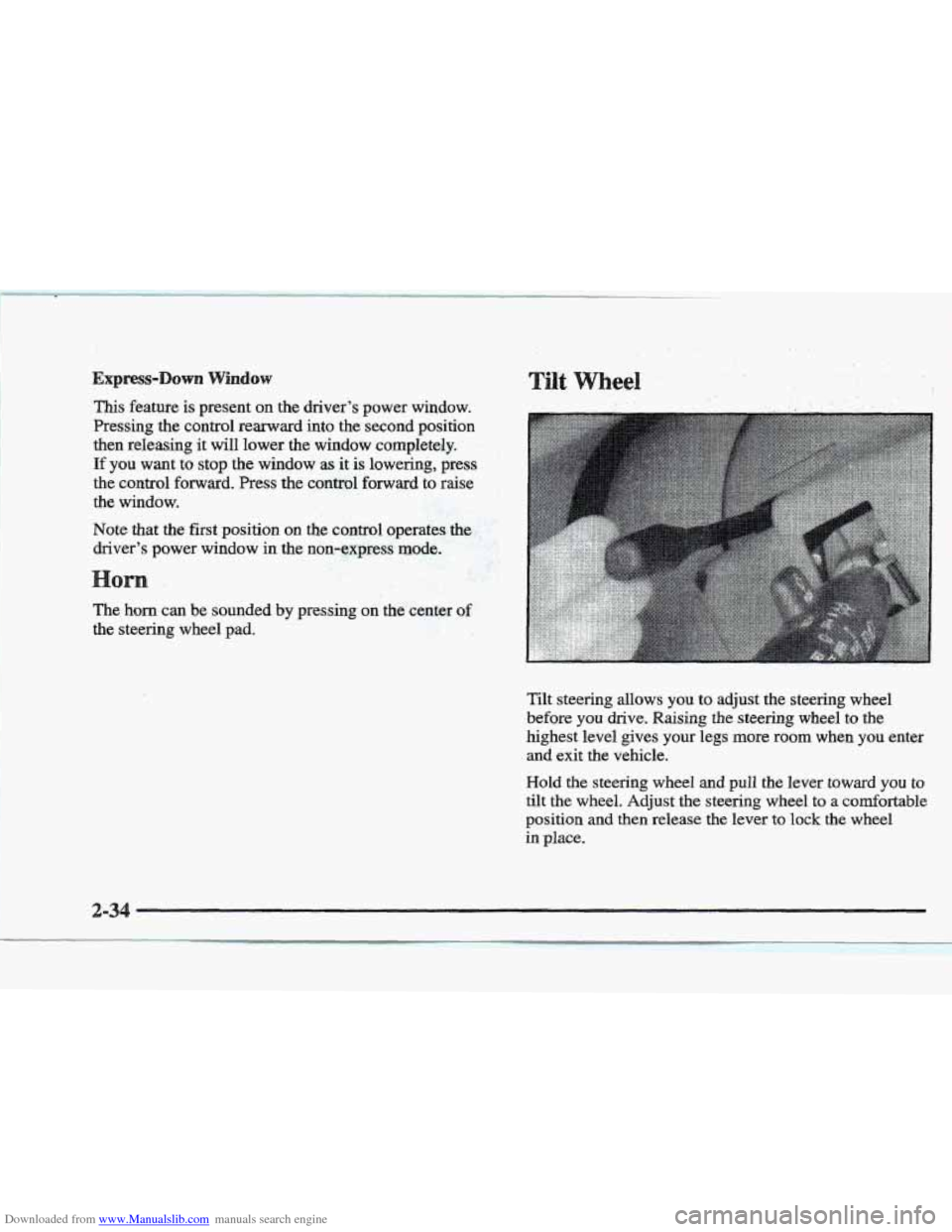
Tilt steering allows you to adjust the steering wheel
before
you drive. Raising the steering wheel to the
highest level gives your legs more room when you enter
and exit the vehicle.
Hold the steering wheel and pull the lever toward you to
tilt the wheel. Adjust the steering wheel to a comfortable
position
and then release the lever to lock the wheel
in place.
2-34
I
Page 98 of 361
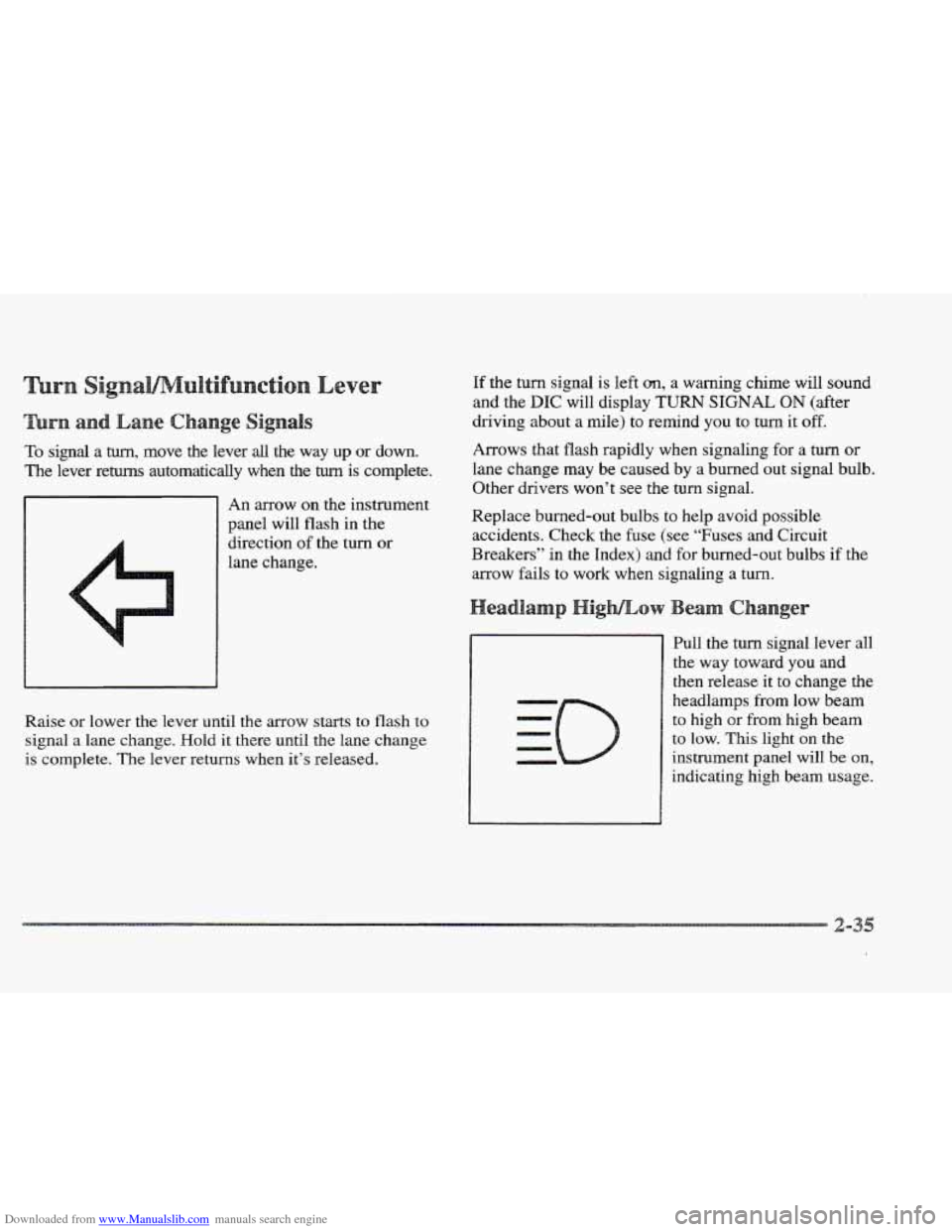
Downloaded from www.Manualslib.com manuals search engine To signal a turn, move the lever all the way up or down.
The lever returns automatically when the turn is complete.
An arrow on the instrument
panel will flash in the
direction of
the turn or
lane change.
Raise or lower the
lever until the arrow starts to flash to
signal a lane change. Hold
it there until the lane change
is complete. The lever returns when it’s released.
If the turn signal is left an, a warning chime will sound
and the
DIC will display TURN SIGNAL ON (after
driving about a mile) to remind you to turn it
off.
Arrows that flash rapidly when signaling for a turn or
lane change may be caused by a burned out signal bulb.
Other drivers won’t see the
turn signal.
Replace burned-out bulbs to help avoid possible
accidents. Check the fuse (see “Fuses and Circuit
Breakers”
in the Index) and for burned-out bulbs if the
arrow fails to work when signaling
a turn.
Pull the turn signal lever all
the way toward you and
then release it to change the
headlamps
from low beam
to high or from high beam
to low. This light on the
instrument panel will be on,
indicating high beam usage.
Page 99 of 361
Downloaded from www.Manualslib.com manuals search engine s
This lets you use the high-beam headlamps to signal the
driver in front of you that you want to pass.
Pull the turn signal lever toward
you to use. When
you do:
a
e
e
If the headlamps are either off or in the DRL mode,
the high-beam headlamps will turn
on. They’ll stay
on as long as you hold the lever there. Release the
lever to turn them off.
If the headlamps are on low beam, they will shift to
high beam and stay there. Pull the lever toward you
to return to low beam.
If the headlamps are on high beam, they will switch
to low beam.
To return to high beam, pull the lever
toward you.
I
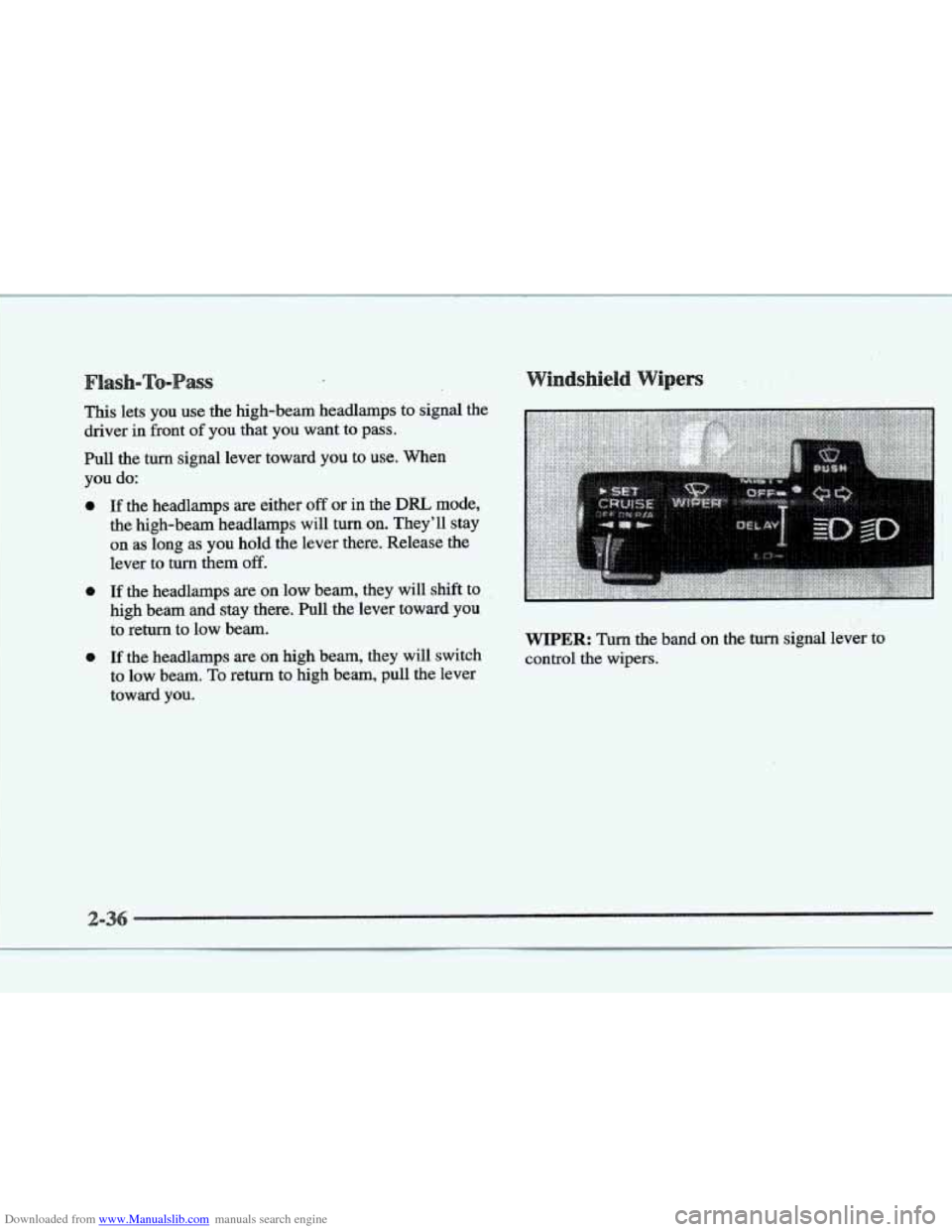
WIPER: Turn the band on the tum signal lever to
control the wipers.
Page 100 of 361
Downloaded from www.Manualslib.com manuals search engine MIST: Turn the band toward you and then release it for.
a single wipe cycle. For more cycles, hold the band on
MIST longer.
LO or HI: Turn the band away from you to either LO
(low speed) or to HI (high speed), depending on the
wiper speed
you want.
DELAY: You can set the wiper speed for a long or short
delay between wipes with this setting. Move the band to
the
DELAY position. The closer you move it to LO, the
longer
the delay. (Eldorado Only)
OFF’: Tun the band to OFF to turn off the wipers.
Be sure to clear ice and snow from the wiper blades
before
using them. If they’re frozen to the windshield,
carefully loosen or thaw them.
If the blades do become
damaged, get new blades or blade inserts.
Heavy snow or ice can overload the wiper motor.
A
circuit breaker will stop the motor until it cools. Clear
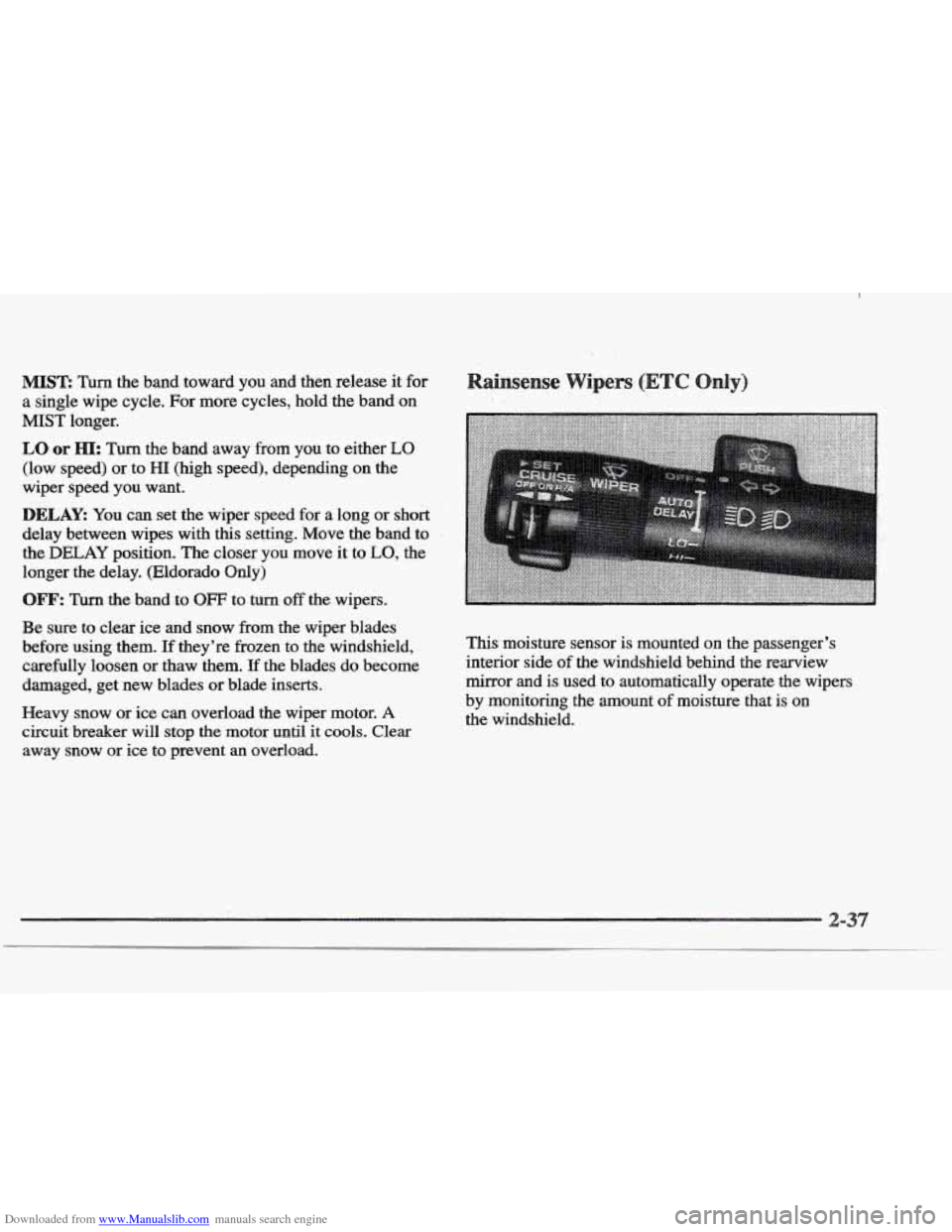
away snow or ice to prevent an overload. This-moisture
sensor
is mounted on the passenger’s
interior side
of the windshield behind the rearview
mirror and
is used to automatically operate the wipers
by monitoring
the amount of moisture that is on
the windshield.
Page 135 of 361
Downloaded from www.Manualslib.com manuals search engine sake System
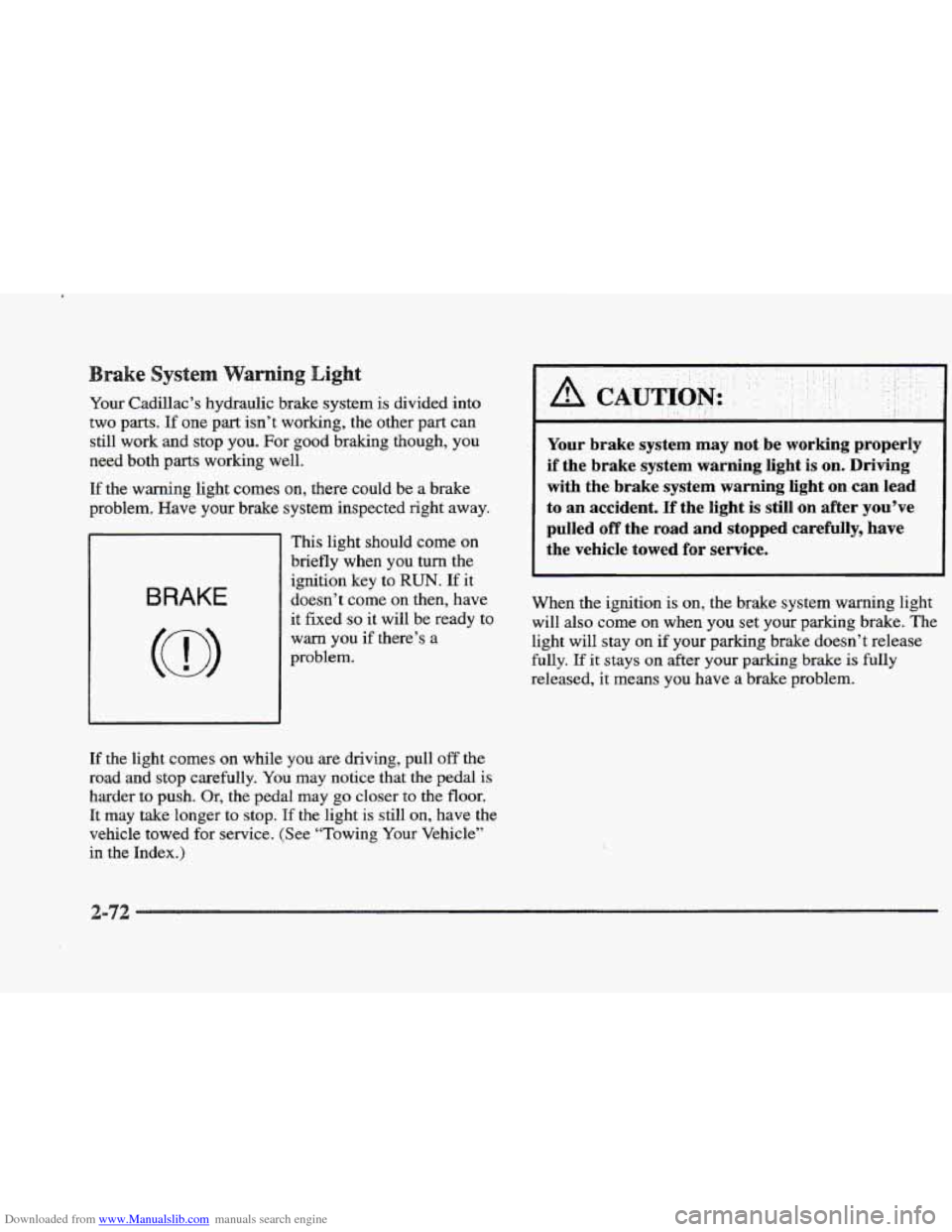
Your Cadillac’s hydraulic brake system is divided into
two parts. If
one part isn’t working, the other part can
still
work and stop you. For good braking though, you
need both parts working well.
If the warning light comes on, there could be a brake
problem.
Have your brake system inspected right away.
BRAKE
This light should come on
briefly when you turn the
ignition key to
RUN. If it
doesn’t come on then, have
it
fixed so it will be ready to
warn you if there’s a
problem.
If the light comes on while you are driving, pull off the
road and stop carefully. You may notice that the pedal is
harder
to push. Or, the pedal may go closer to the floor.
It
may take longer to stop. Tf the light is still on, have the
vehicle
towed for service. (See “Towing Your Vehicle’’
in the Index.)
Your brake system may not be working properly
if the brake system warning light is on. Driving
with the brake system
warning light on can lead
to an accident. If the light
is still on after you’ve
pulled
off the road and stopped carefully, have
the vehicle towed
for service.
When the ignition is on, the brake system warning light
will also come
on when you set your parking brake. The
light will stay on if your parking brake doesn’t release
fully.
If it stays on after your parking brake is fully
released, it means you have a brake problem.
Page 140 of 361
Downloaded from www.Manualslib.com manuals search engine the Light Is Flashing
The following may prevent more serious damage to
your vehicle:
Reducing
vehicle speed.
9 Avoiding hard accelerations.
e Avoiding steep uphill grades.
@ If you are towing a trailer, reduce the amount of
cargo being hauled as soon as it is possible.
If the light stops flashing and remains on steady, see “If
the Light
Is On Steady” following.
If the light continues to flash, when it is safe to do so,
stop the vehicle. Find a safe place to park your vehicle.
Turn the key off, wait at least 10 seconds and restart the
engine.
If the light remains on steady, see “If the Light
Is Qn Steady” following. If the light is still flashing,
follow
the previous steps, and drive the vehicle to your
dealer or qualified service center for service.
You may
be able to correct the emission system
malfunction
by considering the following:
Did you just drive through a deep puddle
of water?
If so, your electrical system may be wet. The condition
will usually be corrected when the electrical system
dries out. A few driving trips should turn the light off.
Are you low on fuel?
As your engine starts to run out of fuel, your engine may
not run as efficiently as designed since small amounts of
air are sucked into the fuel line causing
a misfire. The
system can detect this. Adding fuel should correct this
condition. Make sure
to install the fuel cap properly. It
will take a few driving trips to turn the light off.
Have you recently changed brands of fuel?
If
so, be sure to fuel your vehicle with quality fuel (see
“Fuel” in
the Index). Poor fuel quality will cause your
engine not to run as efficiently as designed. You may
notice
this as stalling after start-up, stalling when you put
the vehicle into gear,
misfiring, hesitation on acceleration
or stumbling
on acceleration. (These conditions may go
away once the engine is warmed
up.) This will be
detected
by the system and cause the light to turn on.
If you experience one or more of these conditions,
change the fuel brand you use.
It will require at least one
full
tank of the proper fuel to turn the light off.
If none of the above steps have made the light turn off,
have your dealer or qualified service center check the
vehicle. Your dealer has the proper test equipment and
diagnostic tools
to fix any mechanical or electrical
problems that may have developed.