warning light CADILLAC ELDORADO 1997 10.G User Guide
[x] Cancel search | Manufacturer: CADILLAC, Model Year: 1997, Model line: ELDORADO, Model: CADILLAC ELDORADO 1997 10.GPages: 361, PDF Size: 22.85 MB
Page 149 of 361
Downloaded from www.Manualslib.com manuals search engine CHECK BRAKE FLUID LEVEL - 37: This message
will display if
the ignition is in the RUN position to
inform the driver that the brake fluid level is low. Check
the brake reservoir
level and add fluid as needed. Have
the brake system serviced by
a Cadillac technician as
soon as possible. If the brake warning light is on, follow
the directions in that part.
CHECK COOLANT LEVEL - 02: This message will
appear when there is a low level of engi.ne coolant. Have
the cooling system serviced by
a Cadillac technician as
soon as possible.
CHECK FUEL GAGE - 39: This message will appear
when the
fuel supply is less than four gallons ( 15.2 L)
and the display is turned off (digital clusters only).
A single chime will also sound when this message
is displayed.
CHECK OIL LEVEL - 36: For correct operation of
the low oil sensing system, your vehicle should be on a
level surface.
A false CHECK OIL LEVEL message
may appear
if the vehicle is parked on grades. The oil
level sensing system does not check for actual oil level
if the engine has been
off for a short period of time, and
the oil level is never sensed while the engine is running.
If the CHECK OIL LEVEL message appears, and your vehicle has been parked
on level ground with the engine
off for at least 30 minutes, the oil level should be
checked by observing the oil dipstick. Prior to checking
the oil level, be sure the engine has been
off for five
minutes and your vehicle
is on a level surface. Then
check
the dipstick and add oil if necessary. See “Engine
Oil” in
the Index.
CHECK WASHER FLUID - 25: This message will
appear
for several seconds indicating that you need
washer solvent.
CRUISE ENGAGED - 43: This message will appear
for a few seconds when you select a speed at which
to cruise.
DOOR OPEN - 141: The passenger’s door is open
or ajar when
this message appears. The vehicle’s engine
must be running and the transaxle not
in PARK (P) for
this message to display.
A chime will also sound when
the vehicle’s speed
is greater than 5 mph (8.1 km/h).
DRIVER DOOR OPEN - 140: This message
will display when the vehicle is being shifted out of
PARK (P) with the engine running to signal that
the driver’s door
is open or ajar. A chime will also
sound when the vehicle’s speed is greater
than 5 mph
(8.1 km/h).
Page 150 of 361
Downloaded from www.Manualslib.com manuals search engine ENGINE COOLANT HOT-IDLE ENGINE - 44:
This message will appear when the engine coolant
temperature is over
248 OF (1 26 O C). To avoid added
strain
on a hot engine, turn off the climate control system.
Stop and allow your vehcle to idle until it cools down or
the message is removed. If it does not cool down, turn
off
the engine and have it serviced before driving it again.
Severe engine damage can result
from an overheated
engine. See “Engine Overheating”
in the Index.
ENGINE MISFIRE -- EASE OFF GAS
PEDAL - 1114: An engine misfire has occurred.
You’ll need to ease
off the gas pedal.
FUEL LEVEE LOW - 11: This message serves as a
warning that the
fuel level in the tank is critically low.
Stop for fuel soon.
ICE POSSIBLE - 13: This message appears when
the outside air temperature
is cold enough to create icy
road conditions.
HEADLAMBS SUGGESTED - 23: If it’s dark enough
outside and the twilight sentinel control is
off, a
FEADLAMPS SUGGESTED message will display on the
DIC. This message informs the driver that turning on the
exterior
lamps is recommended even though the DRL are
still illuminated. (It has become dark enough outside to
require the headlamps and/or other exterior lamps.)
MONITORED SYSTEMS OK - I: This message only
appears
in the “recall” mode by pressing the RESET
button. It lets you know that no other messages are
stored or currently active.
FASS KEY NOT PROGRAMMED - 31: This
warning message displays when the PASS-Key pellet
information has not been programmed into your vehicle.
See your Cadillac dealership for service.
PCM FAULT - 110: The circuit in the Powertrain
Control Module (PCM) has shorted or
is loose when this
message appears. Have your Cadillac serviced by your
dealership at once.
REDUCED ENGINE POWER - 41: This message
informs the driver, that due to wheel slippage, your
vehicle is reducing engine power to compensate for
the loss of traction. Accelerating too fast, causing the
tires to spin, is an example of when this message
would display.
IREMOVE KEY - 70: This message will appear when
the Personalized Automotive Security System
(PASS-Key 11) is unable to read the pellet on the
ignition key or an improper key pellet has been inserted.
Wait for the
DIC to display STARTING DISABLED
DUE TO THEFT
SYSTEM REMOVE IGNITION
KEY. The instrument panel cluster will then run a timer
and change the messages
to WAIT 3 MINUTES, WAIT
Page 151 of 361
Downloaded from www.Manualslib.com manuals search engine 2 MINUTES, WAIT 1 MINUTE and then STAKT CAR.
When the REMOVE KEY message is displayed, remove
the ignition key. Check the ignition key for damage. If it
is damaged, it may need to be replaced. If you see no
damage, clean
the pellet contacts with a soft cloth or
napkin before inserting the key back into
the ignition.
Have your vehicle serviced if the message still appears.
SERVICE A/C SYSTEM A/C COMPRESSOR
OFF - 14: This message appears when the electronic
sensors that control the air conditioning and heating
systems
are no longer working. Have the climate control
system serviced if you notice a drop in heating and air
conditioning efficiency.
SERVICE AIR BAG - 83: There is a problem with the
Supplemental Inflatable Restraint (air bag) system when
this message appears. Let only
a qualified technician
work on your vehicle.
See your Cadillac dealership for
service at once.
SERVICE BRAKE FLUID SWITCH - 37: A defect
in the brake fluid detection circuit causes this message
to display
if the ignition is in the RUN position. Have
the brake system serviced by a Cadillac technician as
soon as possible. If the brake warning light is on, refer
to the directions listed in that part.
SERVICE CHARGING SYSTEM - 102: This
message will display when a problem
with the charging system
has been detected. Have your vehicle serviced at
your Cadillac dealership.
SERVICE ELECTRICAL SYSTEM - 106: This
message will display if
an electrical problem has
occurred within the PCM. Have your vehicle serviced
by your Cadillac dealership.
SERVICE EMISSIONS SYSTEM - 104: A problem in
the emission5 system has occurred when this message
appears. Have your Cadillac dealershp service your vehicle.
SERVICE ENGINE COOLING SYSTEM - 103: A
problem within the engine cooling system has been
detected when this message displays. See your Cadillac
dealership for service.
SERVICE FUEL SYSTEM - 101: The PCM has
detected
a problem withm the fuel system when this
message appears. See your Cadillac dealership for service.
SERVICE IDLE CONTROL SYSTEM - 187: A
problem with the idle control has occurred when this
message displays.
Bring your vehicle to your Cadillac
dealership for service.
SERVICE IGNITION SYSTEM - 105: This message
displays when
a failure in the ignition system has
been detected. Have your vehicle serviced by your
Cadillac dealership.
Page 192 of 361
Downloaded from www.Manualslib.com manuals search engine Avoid needless heavy braking. Some people drive in
spurts -- heavy acceleration followed by heavy
braking
-- rather than keeping pace with traffic. This is a
mistake. Your brakes
may not have time to cool between
hard stops. Your brakes will wear out much faster if you
do a lot of heavy braking.
If you keep pace with the
traffic and allow realistic following distances, you will
eliminate
a lot of unnecessary braking. That means
better braking and longer brake
life.
If your engine ever stops while you’re driving, brake
normally but don’t pump your brakes.
If you do, the
pedal may get harder to push down.
If your engine
stops, you will still have some power brake assist. But
you will use
it when you brake. Once the power assist is
used up, it may take longer to stop and the brake pedal
will be harder to push. Your
vehicle
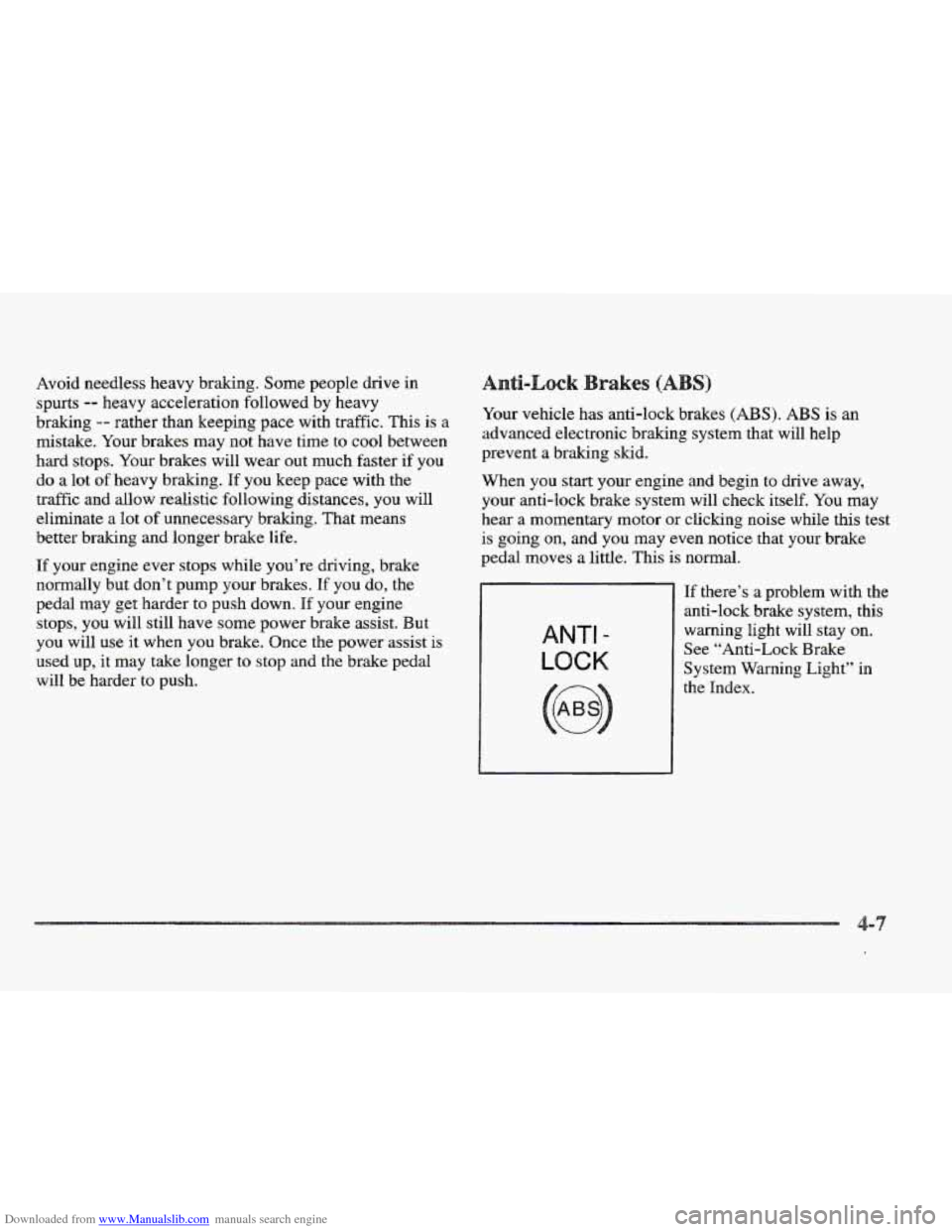
has anti-lock brakes (ABS). ABS is an
advanced electronic braking system that will help
prevent a braking skid.
When
you start your engine and begin to drive away,
your anti-lock brake system will check itself. You may
hear a momentary motor or clicking noise while this test
is going on, and you may even notice that your brake
pedal moves a little. This
is normal.
ANTI -
LOCK
If there’s a problem with the
anti-lock brake system, this
warning light will stay on.
See “Anti-Lock Brake
System Warning Light” in
Page 194 of 361
Downloaded from www.Manualslib.com manuals search engine Remember: Anti-lock doesn’t change the time you need
to get your foot up to the brake pedal
or always decrease
stopping distance. If you get too close to the vehicle
in
front of you, you won’t have time to apply your brakes
if that vehicle suddenly slows or stops. Always leave
enough room up ahead
to stop, even though YOU have
anti-lock brakes.
using Anti-Lock
Don’t pump the brakes. Just hold the brake pedal down
and
let anti-lock work for YOU. You may hear the
anti-lock pump or motor operate, and feel
the brake
pedal pulsate, but this is normal.
Your vehicle has a traction control system that limits wheel
spin.
This is especially useful in slippery road conditions.
The system operates only
if it senses that one or both of
the front wheels are spinning or beginning to lose traction.
When
this happens, the system works the front brakes and
reduces engine power to limit wheel spin.
The TRACTION
ENGAGED message will display on
the Driver Information Center when the traction control
system is limiting wheel spin. See “Driver Information
Center Messages”
in the Index. You may feel or hear the
system working, but this is normal.
If your vehicle is in cruise control when the traction
control system begins to limit wheel spin, the cruise
control will automatically disengage. When road
Conditions allow you
to safely use it again, you may
re-engage the cruise control. (See “Cruise Control” in
the Index.)
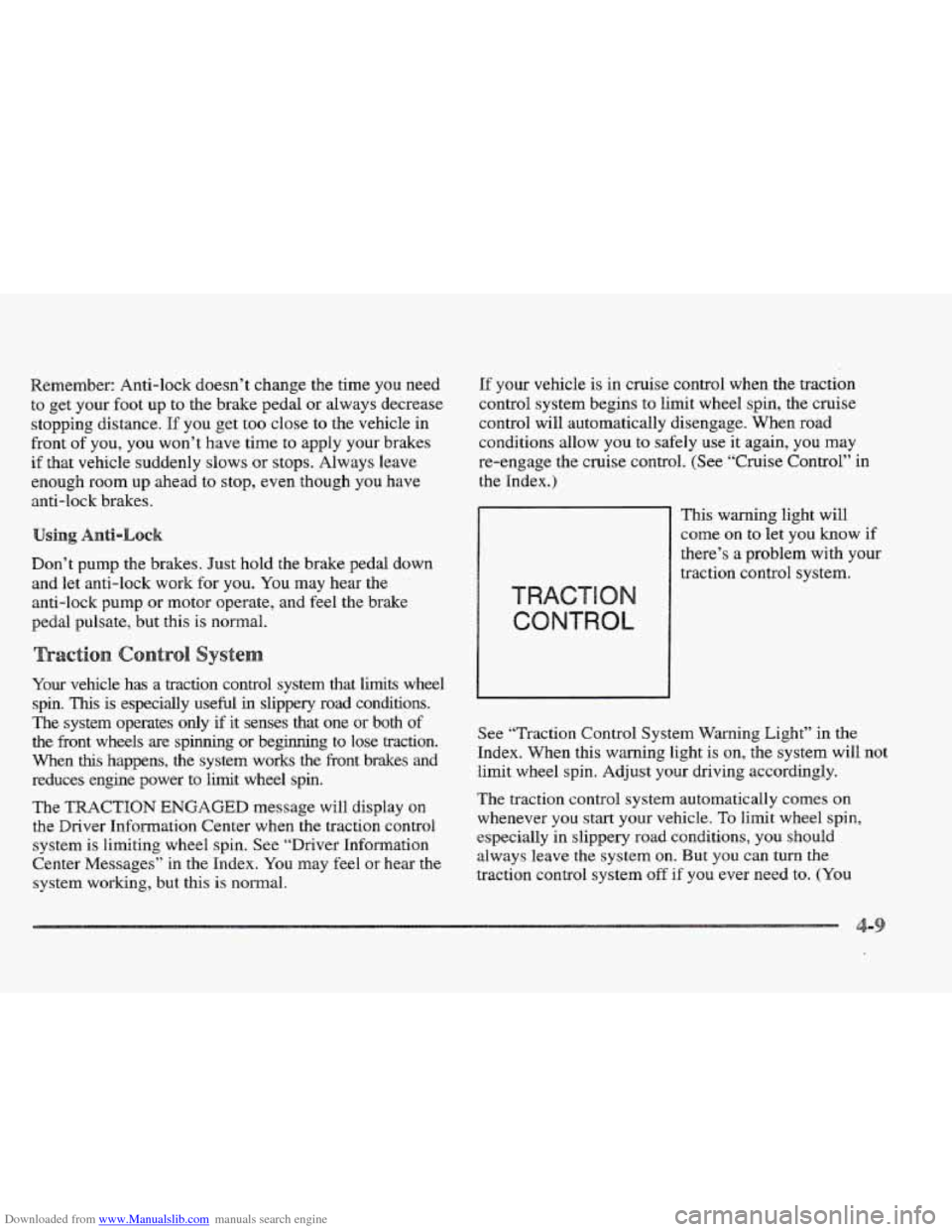
This warning light will
come
on to let you know if
there’s a problem with your
traction control system.
See “Traction Control System Warning Light” in the
Index. When this
warning light is on, the system will not
limit wheel
spin. Adjust your driving accordingly.
The traction control system automatically comes on
whenever you start your vehicle.
To liHnit wheel spin,
especially in slippery
road conditions, you should
always leave
the system on. But you can turn the
traction control system
off if you ever need to. (You
Page 206 of 361
Downloaded from www.Manualslib.com manuals search engine .. .. . t. . :.
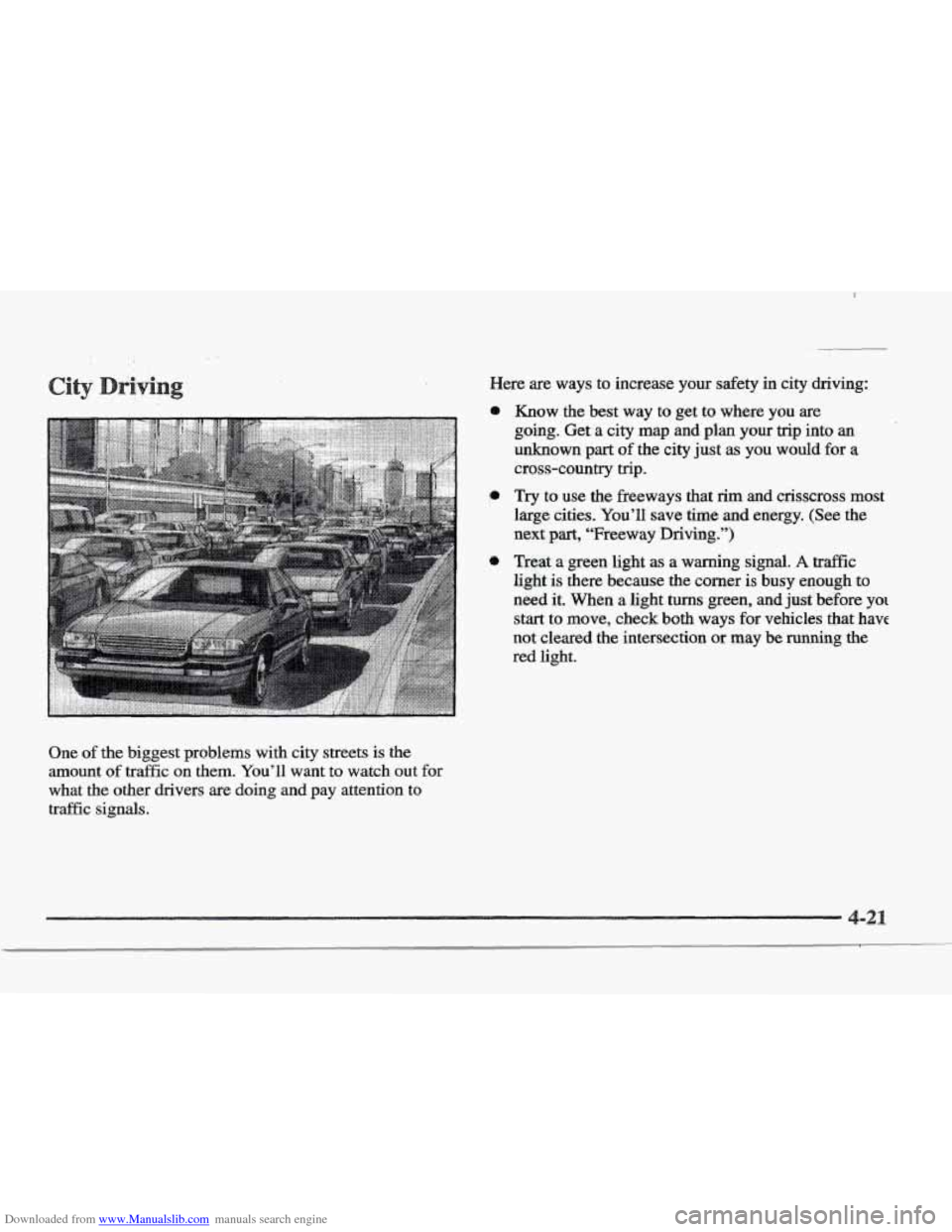
One of the biggest problems with city streets is the
amount
of traffic on them. You’ll want to watch out for
what the other drivers are doing and pay attention to
traffic
signals.
Here are ways to increase your safety in city driving:
a
a
Know the best way to get to where you are
going. Get
a city map and plan your trip into an
unknown part of the city just as you would for a
cross-country trip.
Try to use the freeways that rim and crisscross most
large cities.
You’ll save time and energy. (See the
next part, “Freeway Driving.”)
Treat a green light as a warning signal. A traffic
light
is there because the comer is busy enough to
need
it. When a light turns green, and just.before yo[
start to move, check both ways for vehicles that have
not cleared the intersection
or may be running the
red light.
Page 211 of 361
Downloaded from www.Manualslib.com manuals search engine .. . . .. .
Here are some tips for winter driving:
@ Have your vehicle in good shape for winter.
0 You may want to put winter emergency supplies in
your trunk.
. ...
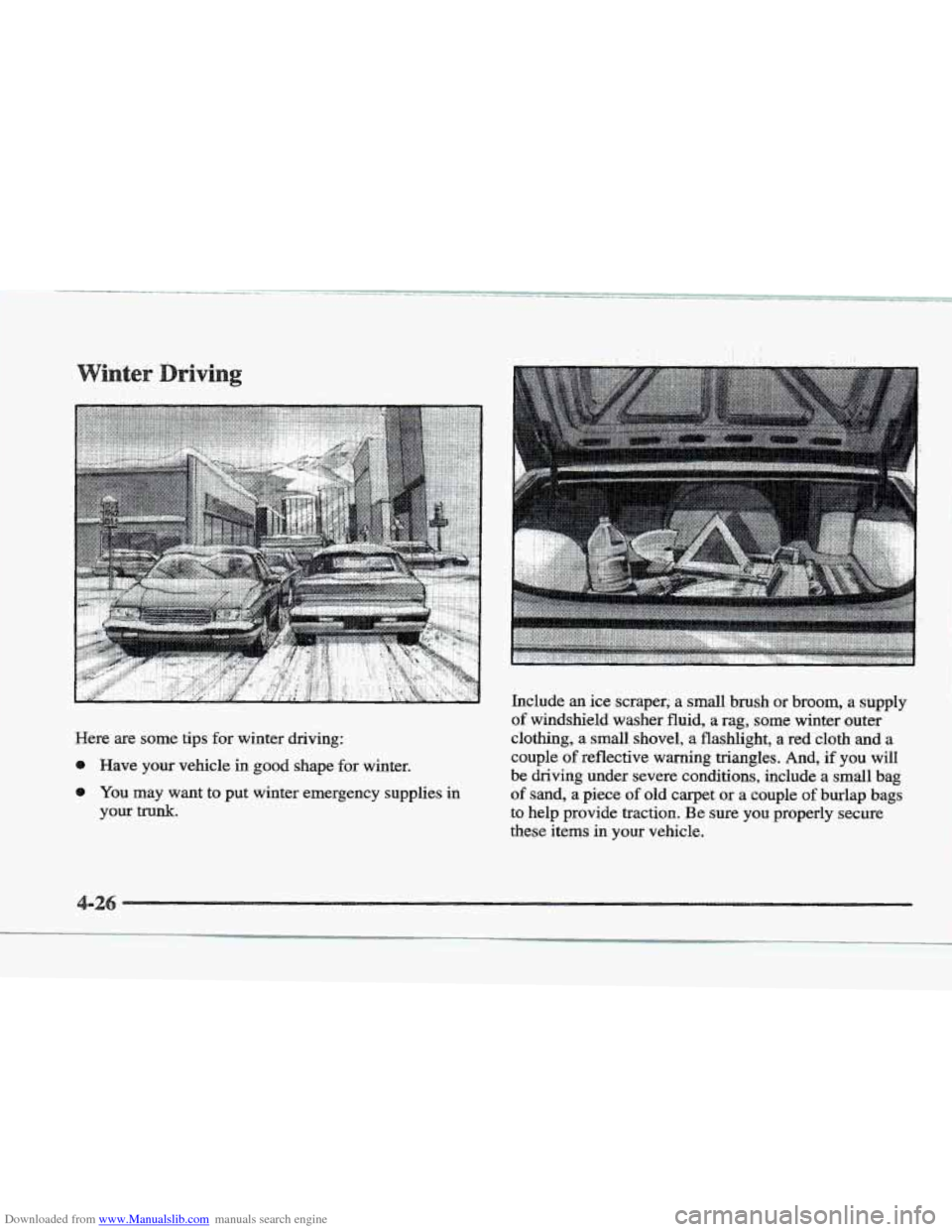
Include an ice scraper; a small brush or broom, a supply
of windshield washer fluid, a rag, some winter outer
clothing, a small shovel, a flashlight, a red cloth and a
couple
of reflective warning triangles. And, if you will
be driving under severe conditions,
include a small bag
of sand, a piece of old carpet or a couple of burlap bags
to help provide traction. Be sure you properly secure
these items
in your vehicle.
Page 228 of 361
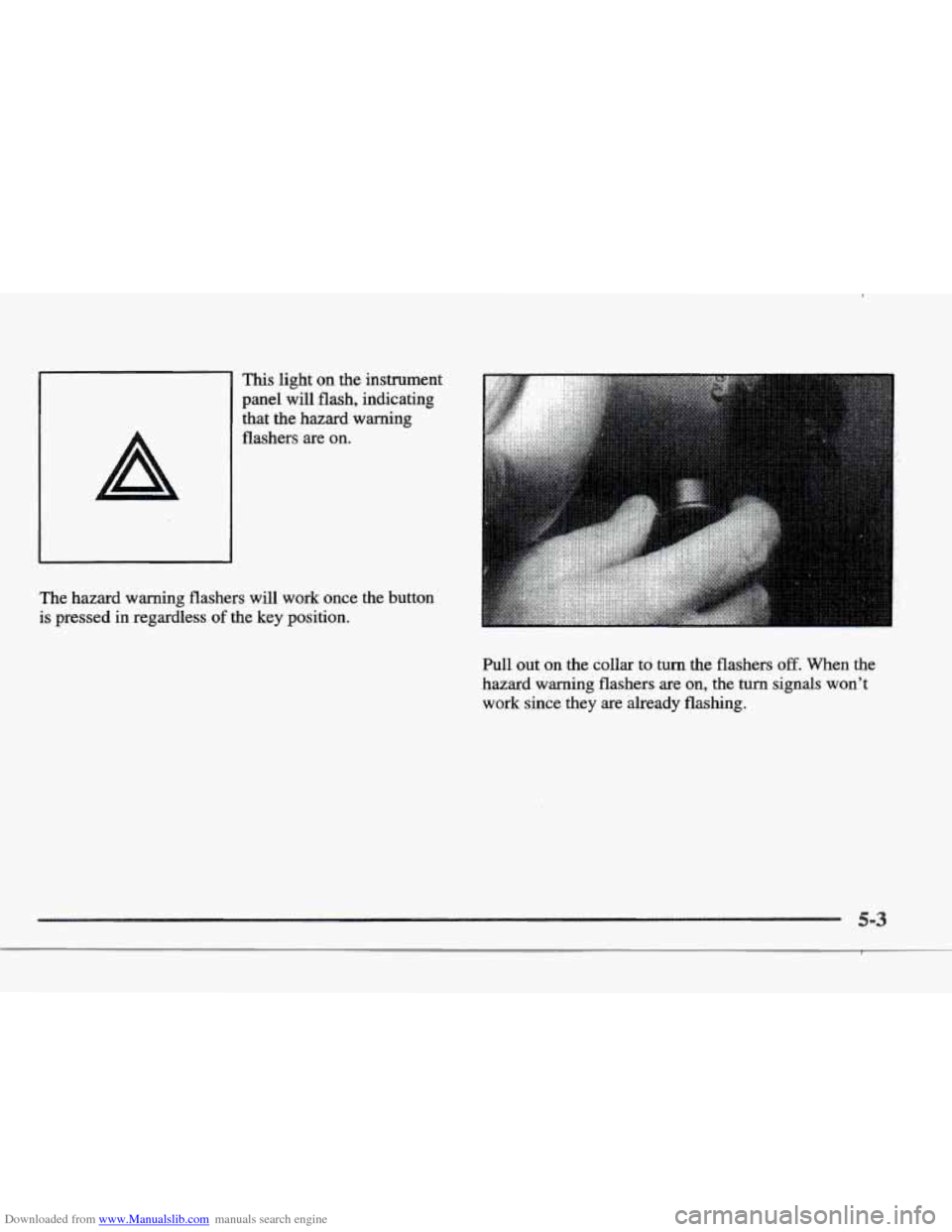
Downloaded from www.Manualslib.com manuals search engine This light on the instrument
I panel will flash, indicating
The hazard warning flashers will work once the button
is pressed in regardless
of the key position.
hll out on the collar to turn the flashers off. When the
hazard warning flashers are on, the turn signals won’t
work since they are already flashing.
Page 241 of 361
Downloaded from www.Manualslib.com manuals search engine . -.-
You will find an ENGINE COOLANT HOT-IDLE
ENGINE message or a STOP ENGINE ENGINE
OVERHEATED message on the Driver Information
Center
(IDIC). There is also an engine temperature
warning light andor gage on
the instrument panel.
See “Engine Coolant Temperature
Warning Light” or
“Engine Coolant Temperature Gage” in the Index.
Overheated Engine Protection
Should a low coolant condition exist and the message
STOP ENGINE ENGINE OVERHEATED is displayed,
an overheat protection mode which alternates firing
groups
of four cylinders helps prevent engine damage.
In this mode, you will notice a loss in power and engine
performance.
This operating mode allows your vehicle
to be driven to
a safe place in an emergency; you may
drive up to
50 miles (80 km). Towing a trailer in the
overheat protection mode
should be avoided.
NOTICE:
After driving in the overheated engine protection
operating mode, to avoid engine damage, allow the engine to cool before attempting
any repair.
The engine
oil will be severely degraded. Repair
the cause of coolant loss, change the
oil and reset
the
oil life indicator. See “Engine Oil, When to
Change” in the Index.
Page 284 of 361
Downloaded from www.Manualslib.com manuals search engine Your vehicle is equipped with a transaxle fluid change
indicator.
A CHANGE TRANS FLUID message will
display on
the Driver Information Center (DIC) when
the powertrain computer determines that the transaxle
fluid needs to be changed or at each
100,080 miles
(160 080 km) interval, whichever occurs first. See your
Maintenance Schedule booklet for more information.
When this message appears, change the transaxle fluid
and reset the transaxle fluid life indicator as follows:
I. Turn the ignition on but do not start the engine.
2. Press and hold the OFF and rear defog buttons on the
climate control at the same time until the
TRANS
FLUID RESET message appears on the DHC.
The cooling s stern in your vehicle is filled with
DEX-COOL engine coolant. This coolant is designed
to remain
in your vehicle for 5 years or 150,000 miles
(240 000 km) whichever occurs first, if you add only
DEX-COOL‘ extended life coolant.
2
The following explains your cooling system and how to
add coolant when
it is low. If YOU have a problem with
engine overheating, see “Engine Overheating”
in
the Index.
A 50/50 mixture of water and DEX-COOL@
coolant will:
@ Give freezing protection down to -34” F (-37°C).
Give boiling protection up to 265 OF (1 29°C).
Protect against rust and corrosion.
Help keep the proper engine temperature.
Let the warning lights and gages work as
they should.
When adding coolant, it is important that you use
only DEX-COOL~ (silicate-free) coolant.
If coolant other than DEX-COOL@is added t~
the system, premature engine, heater core or
radiator corrosion may result. In addition, the
engine coolant
will require change SOQWW 0- at
34b,8(Bo miles (50 000 km) or 24 months,
whichever CD~CUP’S first. Damage caused
of coolant other than
covered
by your new vehicle warranty.