engine oil CADILLAC ELDORADO 1998 10.G User Guide
[x] Cancel search | Manufacturer: CADILLAC, Model Year: 1998, Model line: ELDORADO, Model: CADILLAC ELDORADO 1998 10.GPages: 380, PDF Size: 21.39 MB
Page 221 of 380
Downloaded from www.Manualslib.com manuals search engine Is your vehicle ready for a long trip? If you keep it
serviced and maintained. it's ready to go. If it needs
service, have
it done before starting out. Of course.
you'll find experienced and able service experts in
Cadillac dealerships ail across North America. They'll
be ready and willing to help if you need it.
Here are some things you can check before a trip:
0
0
0
0
a
0
a
Windshield Washer Fluid: Is the reservoir full? Are
all windows clean inside and outside'?
Wiper Blcrdes: Are they in good shape?
Fuel, Engine Oil, Other Fluids: Have you checked
all levels?
Lamps: Are they all working? Are the lenses clean'?
Tires: They are vitally important to a safe,
trouble-free trip. Is the tread good enough for
long-distance driving? Are the tires all inflated to the
recommended pressure'?
Wenfher- Forecusts: What's the weather outlook
along
your route? Should you delay your trip a short
time to avoid a major storm system?
Mups: Do you have up-to-date maps?
Highway Hypnosis
Is there actually such a condition as "highway hypnosis"?
Or
is it just plain t'alling asleep at the wheel? Cali it
highway hypnosis, lack of awareness, or whatever.
There
is something about an easy stretch of road with the
same scenery, along with the hum of the tires on the road,
the drone of the engine. and the rush of the wind against
the vehicle thdt can make you sleepy. Don't let it happen
to
you! If it does. your vehicle can leave the road in less
th~~ a second, and you could crash and be injured.
What can you
do about highway hypnosis? First, be
aware that
it can happen.
Then here are some tips:
0 Make sure your vehicle is well ventilated, with a
comfortabiy cool interior.
Keep your eyes moving. Scan the road ahead and to
the sides.
Check your rearview mirrors and your
instruments frequently.
a If you get sleepy, pull off the road into a rest, service
or parking
area and take a nap, get some exercise. or
both. For safety, treat drowsiness on the highway as
an emergency.
4-23
Page 236 of 380
Downloaded from www.Manualslib.com manuals search engine Parking on Hills Shift into a gear; and
a Be sure the parking brake has released.
You really should not park your vehicle, with a trailer
attached, on
a hill. If something goes wrong, your rig
could start
to move. People can be injured, and both
your vehicle and the trailer can be damaged.
But if you ever
have to park your rig on a hill, here’s
how to
do it:
1. Apply your regular brakes, but do not shift into
PARK (P).
2. Have someone place chocks under the trailer wheels.
3. When the wheel chocks are in place, release the
regular brakes until the chocks absorb the load.
4. Reapply the regular brakes. Then shift into
5. Release the regular brakes.
PARK (P) firmly and apply your parking brake.
When You Are Ready to Leave After
Parking on
a Hill
1. Apply your regular brakes and hold the pedal down
while you:
Start your engine;
2. Let up on the brake pedal.
3. Drive slowly until the trailer is clear of the chocks.
4. Stop and have someone pick up and store the chocks.
Maintenance When Trailer Towing
Your vehicle will need service more often when you’re
pulling a trailer. See the Maintenance Schedule for more
on this. Things that are especially important in trailer
operation are automatic transaxle fluid (don’t overfill),
engine oil, belt, cooling system and brake adjustment.
Each
of these is covered in this manual, and the Index
will help you find them quickly. If you’re trailering, it’s
a good idea to review these sections before you start
your trip.
Check periodically
to see that all hitch nuts and bolts
are tight.
Engine Cooling When Trailer Towing
Your cooling system may temporarily overheat during
severe operating conditions. See “Engine Overheating”
in the Index.
4-38
Page 255 of 380
Downloaded from www.Manualslib.com manuals search engine Engine Overheating
You will find an ENGINE COOLANT HOT, IDLE
ENGINE message or an ENGINE OVERHEATED,
STOP ENGINE message
on the Driver Information
Center (DIC).
You will also hear a chime. There is also
an engine temperature warning light and/or gage
on the
instrument panel. See “Engine Coolant Temperature
Warning Light” or “Engine Coolant Temperature Gage”
in the Index.
Overheated Engine Protection
Operating
Mode
Should an overheated engine condition exist and the
message ENGINE OVERHEATED
STOP ENGINE is
displayed, an overheat protection mode which alternates
firing groups
of four cylinders helps prevent engine
damage. In this mode, you will notice a loss in power and
engine performance. This operating mode allows
your vehicle to be driven to a safe place
in an
emergency; you may drive
up to 50 miles (80 km).
Towing a trailer in the overheat protection mode
should be avoided.
-~
NOTICE:
After driving in the overheated engine protection
operating mode, to avoid engine damage, allow
the engine to cool before attempting any repair.
The engine oil will be severely degraded. Repair
the cause of coolant loss, change the oil and reset
the oil life indicator. See “Engine Oil, When to
Change”
in the Index.
5-15
Page 258 of 380
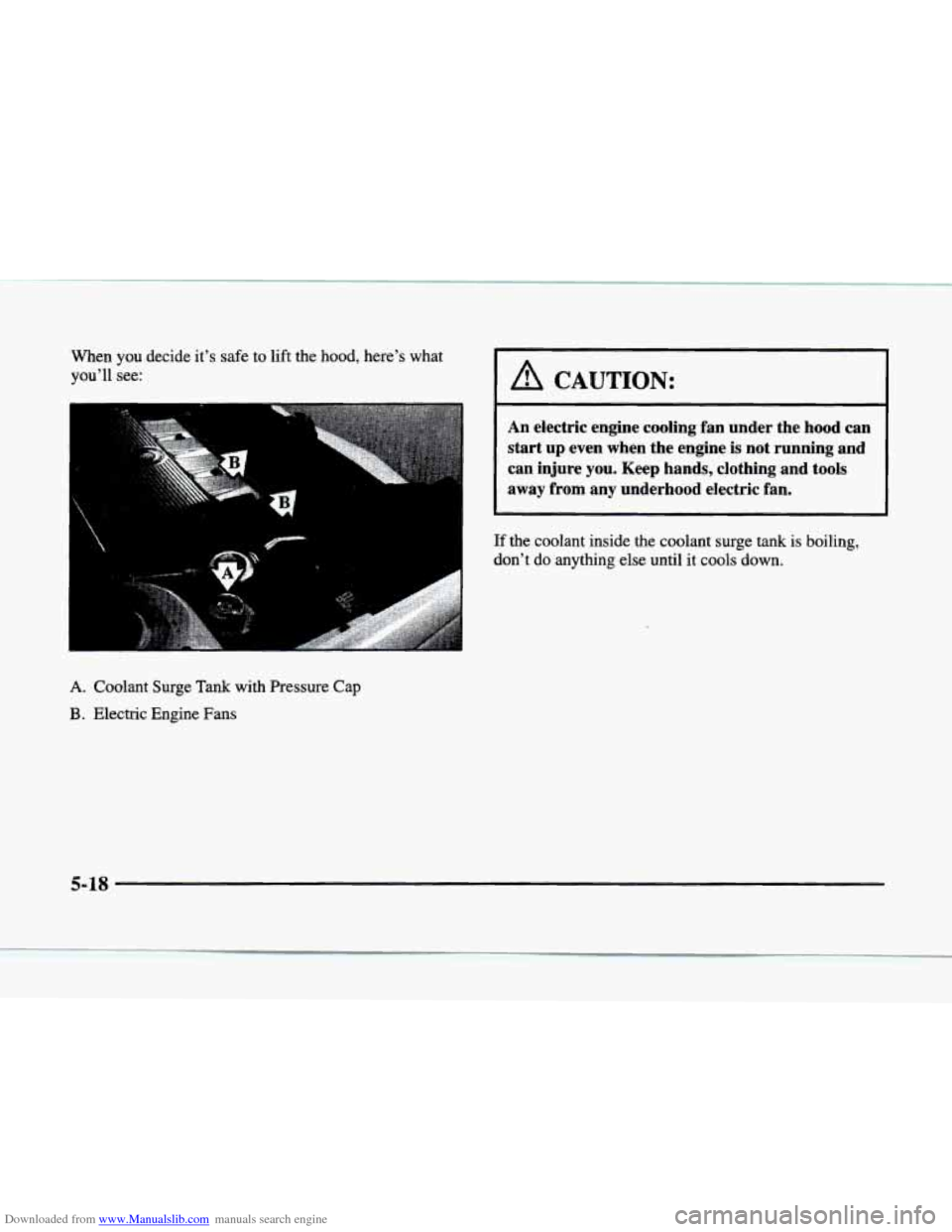
Downloaded from www.Manualslib.com manuals search engine When you decide it’s safe to lift the hood, here’s what
you’ll see:
A CAUTION:
An electric engine cooling fan under the hood can
start
up even when the engine is not running and
can injure you. Keep hands, clothing and tools
away
from any underhood electric fan.
A. Coolant Surge Tank with Pressure Cap
B. Electric Engine Fans
If the coolant inside the coolant surge tank is boiling,
don’t do anything else until it cools down.
5-18
Page 260 of 380
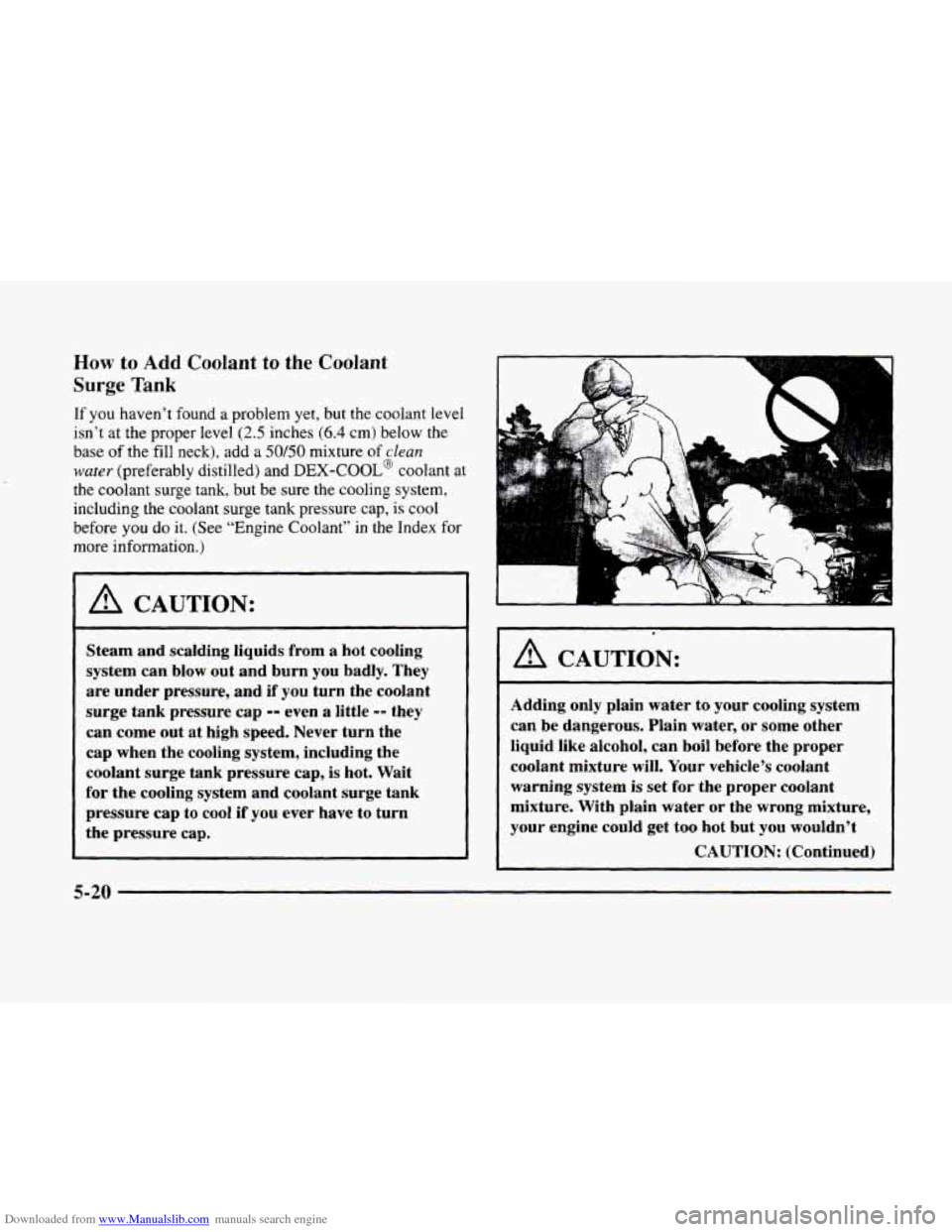
Downloaded from www.Manualslib.com manuals search engine How to Add Coolant to the Coolant
Surge
Tank
If you haven’t found a problem yet, but the coolant level
isn’t at the proper level
(2.5 inches (6.4 cm) below the
base
of the fill neck), add a 50/50 mixture of clean
water (preferably distilled) and DEX-COOL@ coolant at
the coolant surge tank, but be sure the cooling system,
including the coolant surge tank pressure cap,
is cool
before you do it. (See “Engine Coolant’‘ in
the Index for
more information.)
A CAUTION:
Steam and scalding liquids from a hot cooling
system can blow out and burn you badly. They
are under pressure, and if
you turn the coolant
surge tank pressure cap
-0 even a little -- they
can come out at high speed. Never turn the
cap when the cooling system, including the
coolant surge tank pressure cap, is hot. Wait
for the cooling system and coolant surge tank
pressure cap to cool
if you ever have to turn
the pressure cap.
I
Adding only plain water to your cooling system
can be dangerous. Plain water, or some other
liquid like alcohol, can boil before the proper
coolant mixture will. Your vehicle’s coolant
warning system
is set for the proper coolant
mixture. With plain water or the wrong mixture,
your engine could get too hot but you wouldn’t
CAUTION: (Continued)
5-20
Page 271 of 380
Downloaded from www.Manualslib.com manuals search engine A CAUTION:
Never use oil or grease on studs or nuts. If you
do, the nuts might come loose. Your wheel could
fall
off, causing a serious accident.
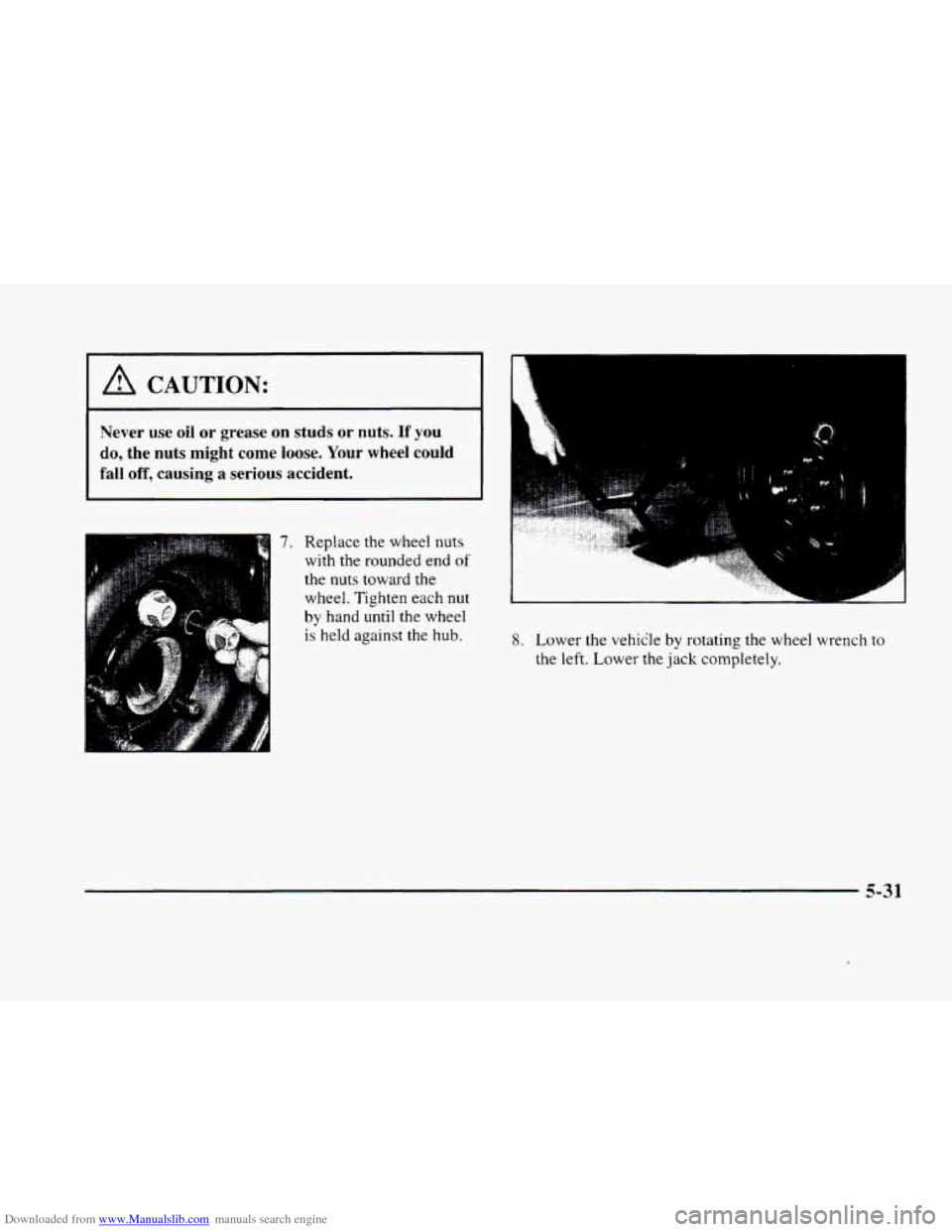
7. Replace the wheel nuts
with the rounded end
of
the nuts toward the
wheel. Tighten each
nut
by hand until the wheel
is held against the hub.
2. . , \I .r
8. Lower the vehide by rotating the wheel wrench to
the
left. Lower the jack completely.
5-31
Page 281 of 380
Downloaded from www.Manualslib.com manuals search engine ,<+ --\,
Section 6 Service and Appearance Care
Here you will find information about the care of your vehicle. This section begins with service and fuel infomation,
and then it shows how
to check important fluid and lubricant levels. There is also technical information about your
vehicle, and a part devoted to its appearance care.
6-2
6-3
6-5
6-8
6-8
6-1 1
6- 15
6-18
6-22
6-26
6-28
6-3 1
6-32
6-38
6-3 8
6-47
6-47
6-49 Service
Fuel
Filling Your Tank
Filling a Portable Fuel Tank
Checking Things Under the Hood
Engine Oil
Air Cleaner
Automatic Transaxle Fluid
Engine Coolant
Windshield Washer Fluid
Brakes
Battery
Bulb Replacement
Windshield Wiper Blade Replacement
Tires Appearance Care
Cleaning the Inside
of Your Vehicle
Care
of Safety Belts 6-50
6-50
6-50
6-50
6-52
6-52
6-52
6-53
6-5
3
6-54
6-55
6-55
6-64
6-64
6-65
6-65 Cleaning
Glass Surfaces
Cleaning the Outside of the Windshield and
Wiper Blades
Weatherstrips
Cleaning the Outside
of Your Vehicle
Cleaning Aluminum or Chrome Wheels
(If Equipped)
Cleaning Tires
Sheet Metal Damage
Underbody Maintenance
Chemical Paint Spotting
Appearance Care Materials Chart
Vehicle Identification Number (VIN)
Electrical System
Replacement Bulbs Capacities and Specifications
Air Conditioning Refrigerants
Normal Maintenance Replacement
Parts
6-1
Page 285 of 380
Downloaded from www.Manualslib.com manuals search engine Fuels in Foreign Countries
If you plan on driving in another country outside the
United States
or Canada, the proper fuel may be hard to
find. Never use leaded gasoline or any other fuel not
recommended
in the previous text on fuel. Costly repairs
caused by use
of improper fuel wouldn’t be covered by
your warranty.
To check on fuel availability, ask an auto club, or
contact a major oil company that does business in the
country where you’ll be driving.
You can also write us at the following address for
advice. Just tell us where you’re going and give your
Vehicle Identification Number (VN).
General Motors Overseas Distribution Corporation
1908 Colonel Sam Drive
Oshawa, Ontario
Ll H 8P7
Filling Your Tank
. ..
. ‘7
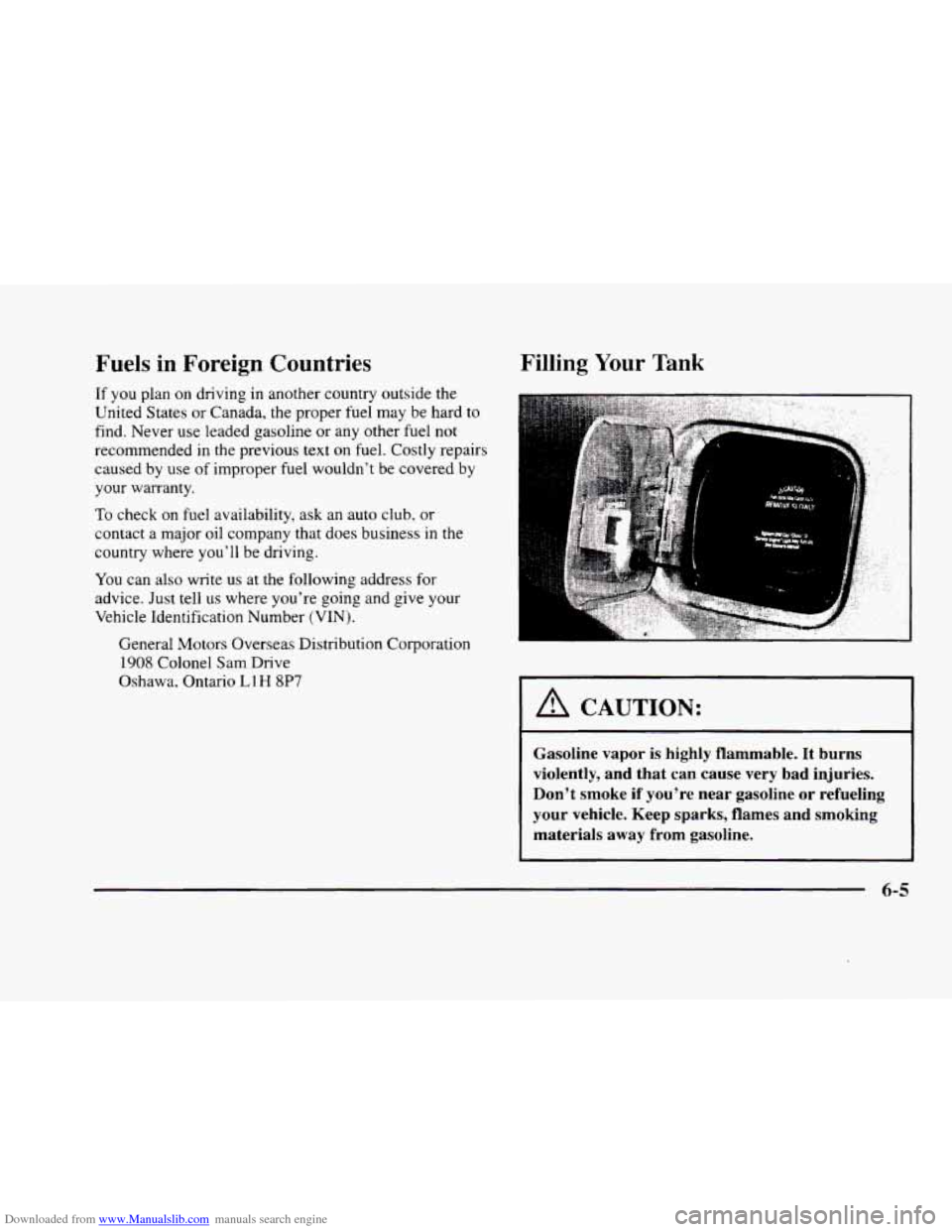
1 A CAUTION:
Gasoline vapor is highly flammable. It burns
violently, and that
can cause very bad injuries.
Don’t smoke if you’re near gasoline or refueling
your vehicle. Keep sparks, flames and
smoking
materials away from gasoline.
6-5
Page 288 of 380
Downloaded from www.Manualslib.com manuals search engine Filling a Portable Fuel Container
A CAUTION:
Never fill a portable fuel container while it is in
your vehicle. Static electricity discharge from the
container can ignite the gasoline vapor. You can
be badly burned and your vehicle damaged if this
occurs.
To help avoid injury to you and others:
Dispense gasoline only into approved
containers.
Do not fill a container while it is inside a
vehicle, in a vehicle’s trunk, pickup bed or
on any surface other than the ground.
inside of the
fill opening before operating
the nozzle. Contact should be maintained
until the filling is complete.
Bring the fill nozzle in contact with the
Don’t smoke while pumping gasoline.
Checking Things Under the Hood
A CAUTION:
An electric fan under the hood can start up and
injure you even when the engine is not running.
Keep hands, clothing and tools away from
any
underhood electric fan.
A CAUTION:
Things that burn can get on hot engine parts and
start a fire. These include liquids like gasoline,
oil, coolant, brake fluid, windshield washer and
other fluids, and plastic or rubber. You or others
could be burned. Be careful not to drop or spill
things that will burn onto a hot engine.
6-8
Page 290 of 380
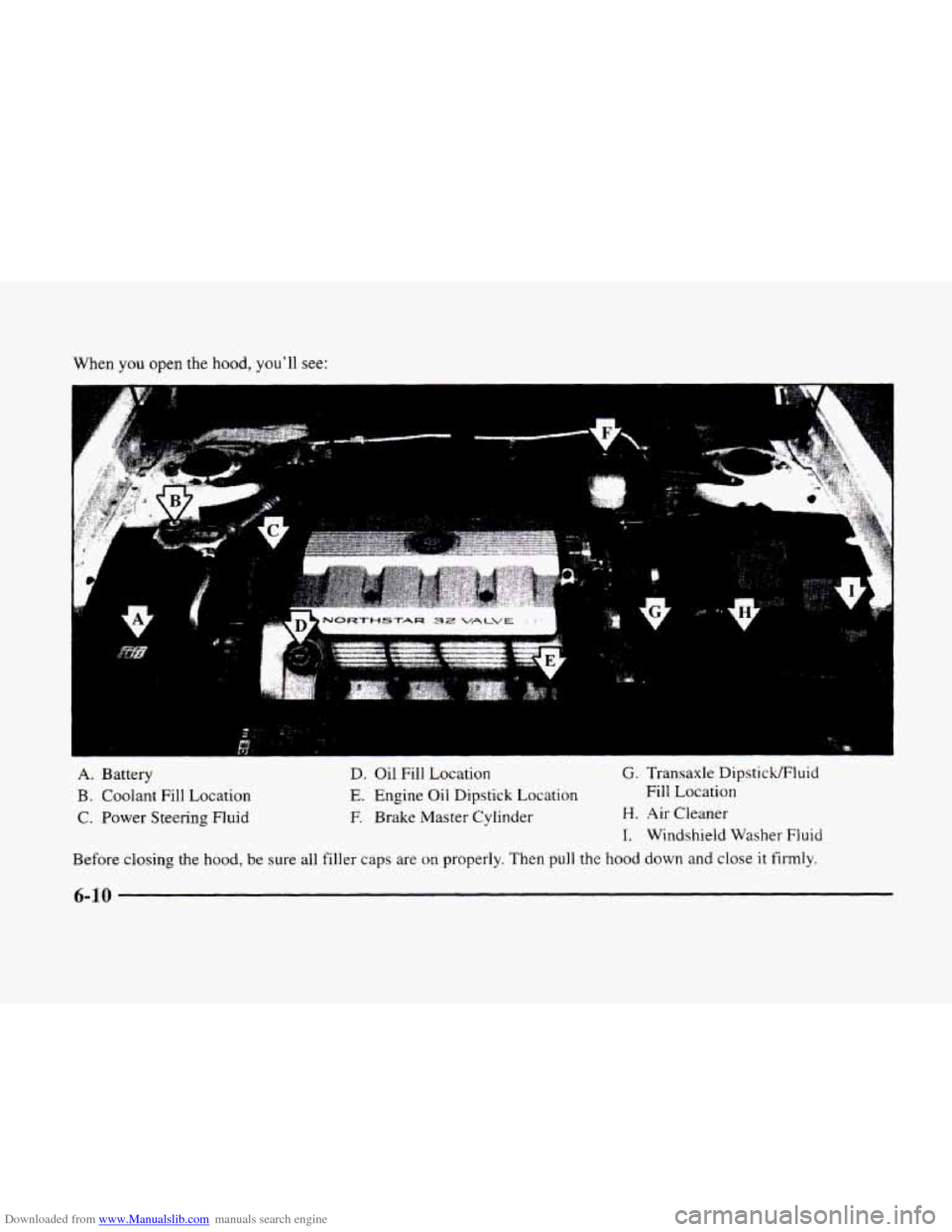
Downloaded from www.Manualslib.com manuals search engine A. Battery D. Oil
Fill Location G. Transaxle DipsticWluid
B. Coolant Fill Location E. Engine Oil Dipstick Location Fill Location
C. Power
Steering Fluid E Brake Master Cylinder H. Air Cleaner
Before
closing the hood, be sure all filler caps are on properly. Then pull the hood down and close it firmly.
I. Windshield Washer Fluid
6-10