engine oil CADILLAC ELDORADO 1998 10.G Owner's Manual
[x] Cancel search | Manufacturer: CADILLAC, Model Year: 1998, Model line: ELDORADO, Model: CADILLAC ELDORADO 1998 10.GPages: 380, PDF Size: 21.39 MB
Page 291 of 380
Downloaded from www.Manualslib.com manuals search engine Underhood Lamp
Turn the parking lamps on to operate the underhood
lamp.
The underhood lamp will come on when the
hood is opened.
Engine Oil
1
iMlUM UNLEADED
FUEL ONLY TRIP fl fl.
@BMaBUD
.......................... .............. ....... ............ ....... .... ..... ........... ... ....... :;if i i.. *: :-i.. : i : ......................................... .".......
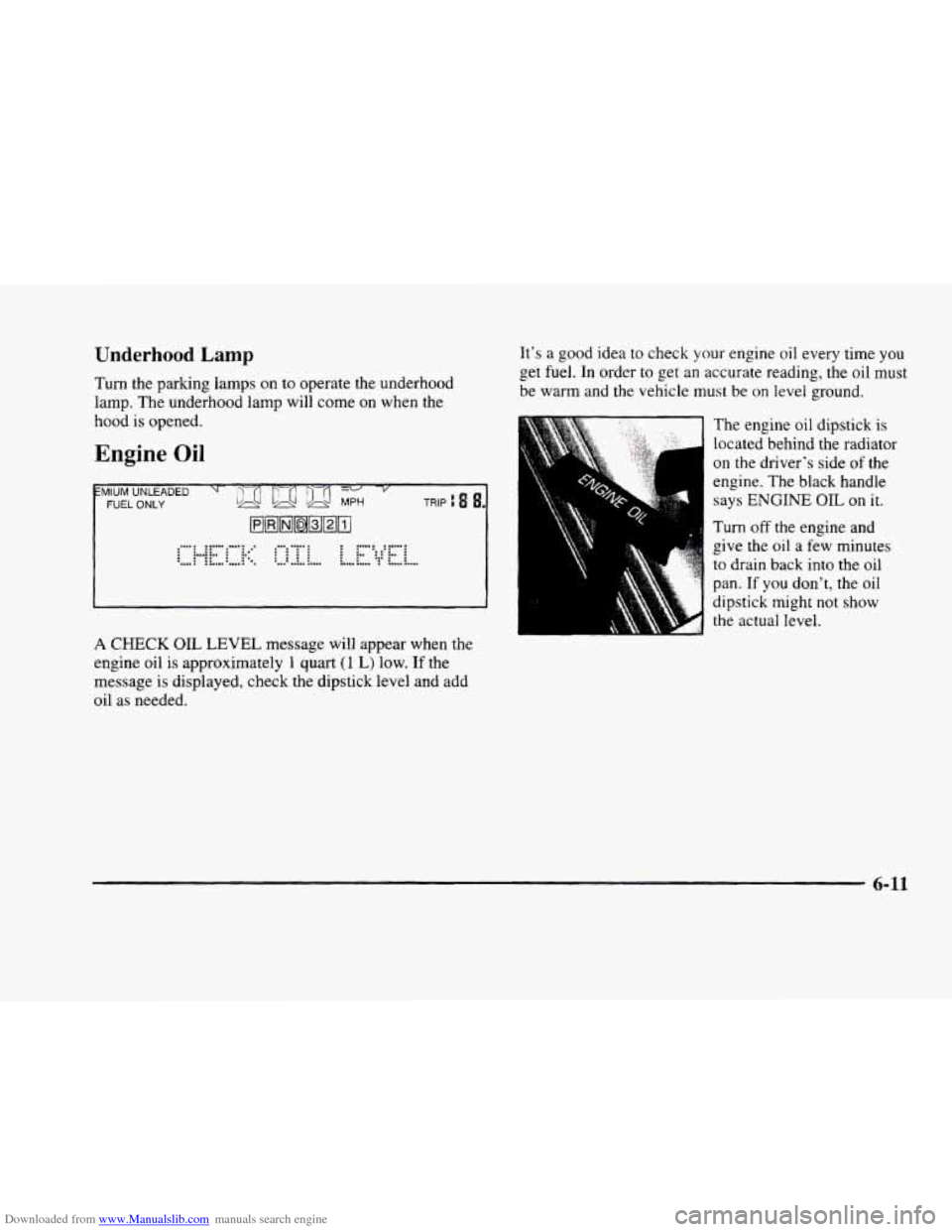
1 CHECK OIL LEVEL message will appear when the
engine oil is approximately
1 quart (1 L) low. If the
message is displayed, check the dipstick level and add
oil
as needed.
It's a good idea to check your engine oil every time you
get fuel. In order to get an accurate reading, the oil must
be warm and the vehicle must be on level ground.
The engine oil dipstick is
located behind
the radiator
on the driver's side of the
engine. The black handle
says ENGINE OIL on it.
Turn off the engine and
give
the oil a few minutes
to drain back into the oil
pan.
If you don't, the oil
dipstick might not show
the actual level.
6-11
Page 292 of 380
Downloaded from www.Manualslib.com manuals search engine Checking Engine Oil
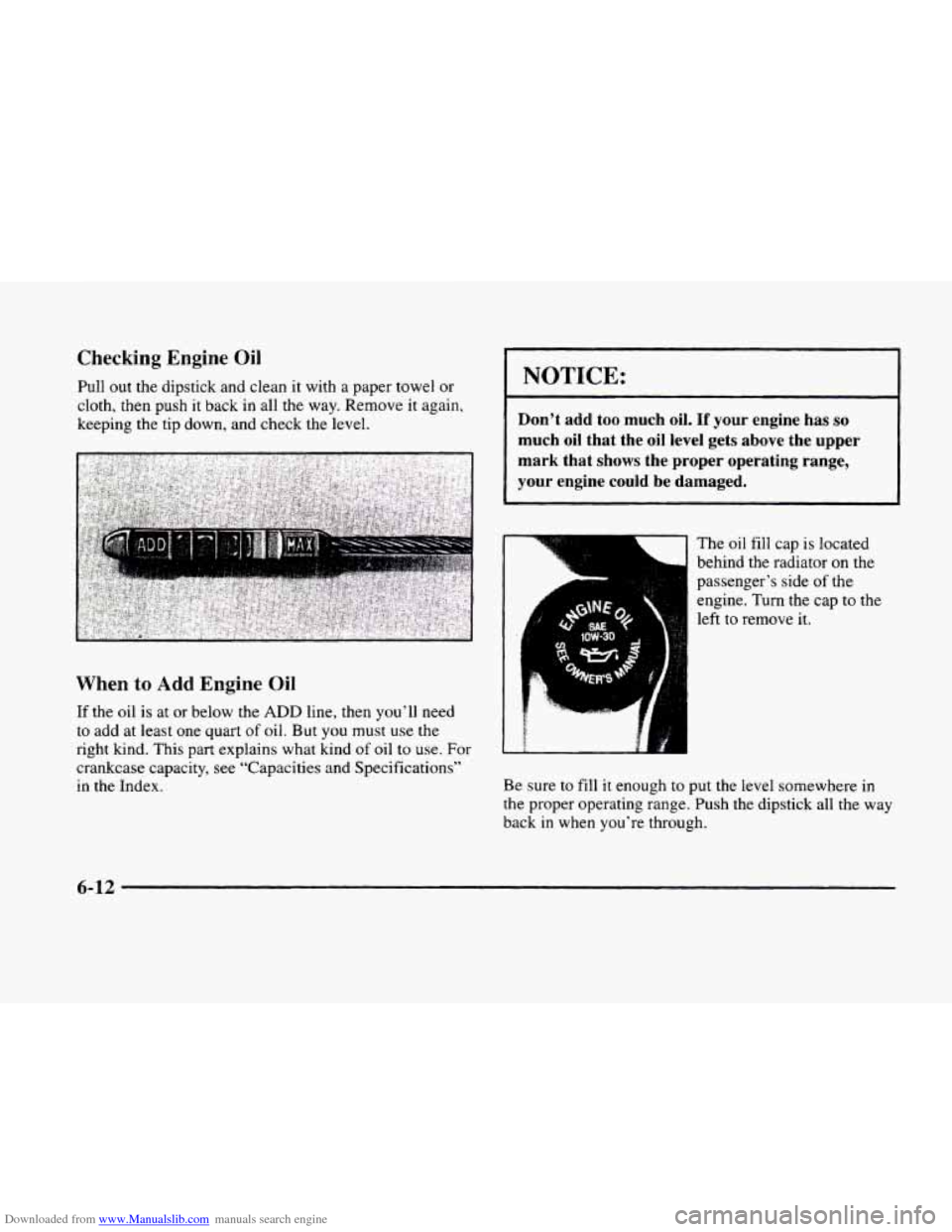
Pull out the dipstick and clean it with a paper towel or
cloth, then push it back in all the way. Remove
it again,
keeping the tip down, and check the level.
When to Add Engine Oil
If the oil is at or below the ADD line, then you’ll need
to add at
least one quart of oil. But you must use the
right kind. This part explains what kind of oil to use. For
crankcase capacity,
see “Capacities and Specifications”
in the
Index.
NOTICE:
Don’t add too much oil. If your engine has so
much oil that the oil level gets above the upper
mark that shows the proper operating range,
your engine could be damaged.
A
The oil fill cap is located
behind the radiator
on the
passenger’s side
of the
engine.
Turn the cap to the
left to remove it.
Be sure to
fill it enough to put the level somewhere in
the proper operating range. Push the dipstick all the way
back in when you’re through.
6-12
Page 293 of 380
Downloaded from www.Manualslib.com manuals search engine What Kind of Engine Oil to Use
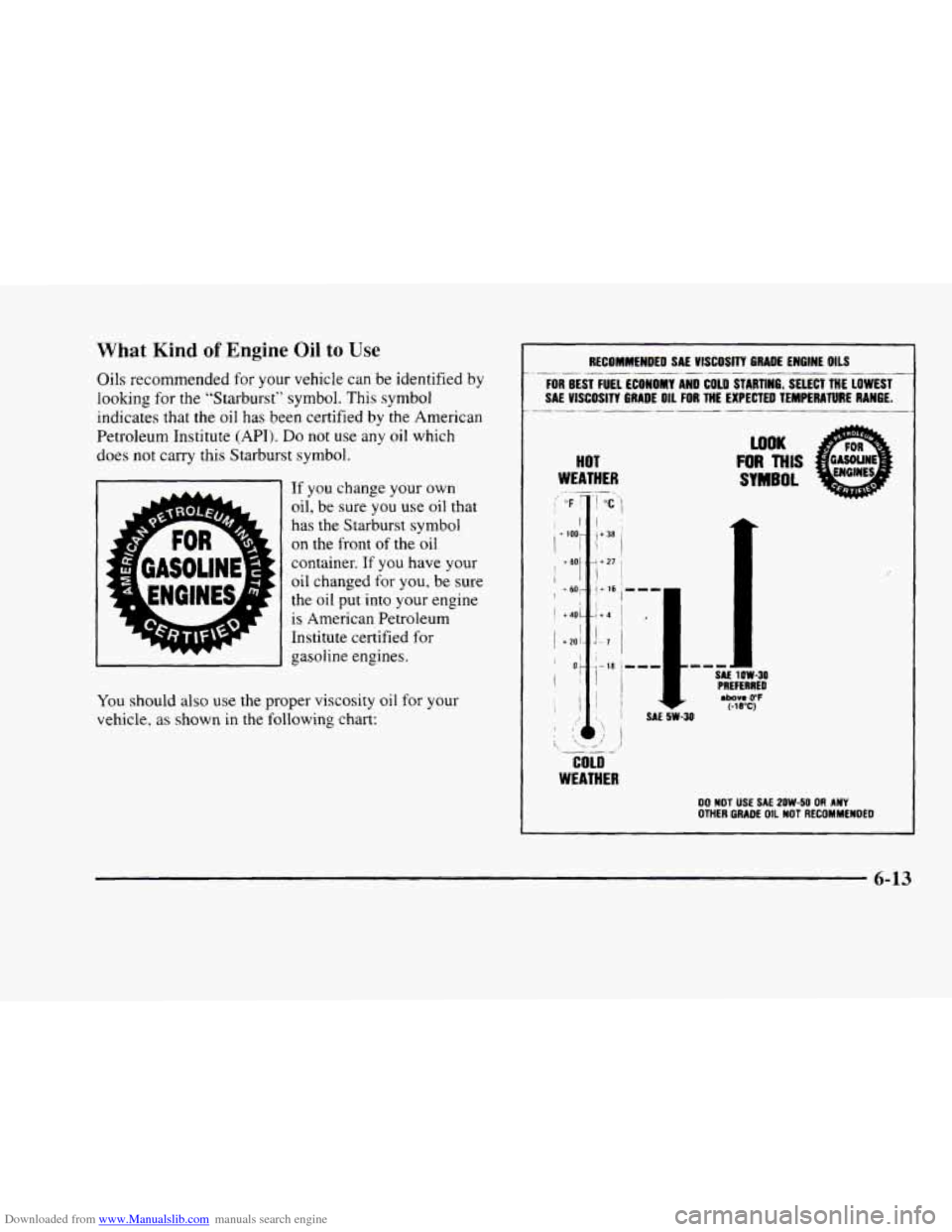
Oils recommended for your vehicle can be identified by
looking for
the "Starburst" symbol. This symbol
indicates that
the oil has been certified by the American
Petroleum Institute
(API). Do not use any oil which
does
not carry this Starburst symbol.
If you change your own
oil, be
sure you use oil that
has the Starburst symbol
on the front of the oil
container. If you have your
oil changed for you,
be sure
the oil put into your engine
is American Petroleum
Institute certified for
gasoline engines.
I .I I
You should also use the proper viscosity oil for your
vehicle, as shown in the following
chart:
RECOMMENOED SAL VISCOSITY GRADE ENGINE OILS
FOR BEST FUEL ECONOMY AND COLD STARTINB, SELECT T&-LOWEST
SAE
VISCOSITY GRADE OIL FOR THE EXPECTED TEMPERATURE RANGE. -. I
HOT
WEATHER
I- SAE I 1OW-30
PREFERRED abovo QF (- 18%)
DO NOT USE SA€ 20W-50 OR ANY OTHER GRADE OIL NOT RECOMMENDED
6-13
Page 294 of 380
Downloaded from www.Manualslib.com manuals search engine As shown in the chart, SAE 1OW-30 is best for your
vehicle. However,
you can use SAE 5W-30 if it’s going
to be colder than
60°F (16°C) before your next oil
change. When it’s very cold, you should use
SAE
5W-30. These numbers on an oil container show its
viscosity, or thickness.
Do not use other viscosity oils,
such as SAE 20W-50.
NOTICE:
Use only engine oil with the American Petroleum
Institute Certified For Gasoline Engines
“Starburst”
symbol. Failure to use the
recommended oil can result in engine damage not
covered
by your warranty.
GM Goodwrench@ oil meets all the requirements for
your vehicle.
If you are in an area where the temperature falls
below
-20°F (-29”C), consider using either an
SAE 5W-30 synthetic oil or an SAE OW-30 oil. Both
will provide easier cold starting and better protection
for your engine at extremely low temperatures.
Engine Oil Additives
Don’t add anything to your oil. Your dealer is ready to
advise if
you think something should be added.
When to Change Engine Oil
Your vehicle has an Oil Life Indicator. This feature
will let
you know when to change your oil and
filter
-- usually between 3,000 miles (5 000 km) and
7,500 miles (12 500 km) since your last oil change.
Under severe conditions, the indicator may come on
before
3,000 miles (5 000 km). Never drive your vehicle
more than
7,500 miles (12 500 km) or 12 months
(whichever occurs first) without an oil change.
The system won’t dete.ct dust in the
oil. So, if you
drive in
a dusty area, be sure to change your oil
every
3,000 miles (5 000 krn) or sooner. Remember
to reset the Oil Life Indicator when the oil has been
changed. For more information, see “Oil Life Indicator”
in the Index.
6-14
Page 295 of 380
Downloaded from www.Manualslib.com manuals search engine How to Reset the Oil Life Indicator
After the oil has been changed, display the OIL LIFE
LEFT message by pressing the INFO button. Then press
and hold the INFO
RESET button until the display
shows
“100.” This resets the oil life index. The message
will remain off until the next oil change is needed. The
percentage of oil life remaining may be checked at
any time by pressing
the INFO button several times
until the
OIL LIFE LEFT message appears. For more
information on the Oil Life feature, see “Oil Life
Indicator”
in the Index.
What to Do with Used Oil
Did you know that used engine oil contains certain
elements that may be unhealthy for your skin and could
even cause cancer? Don‘t let used oil stay on your
skin
for very long. Clean your skin and nails with soap and
water, or
a good hand cleaner. Wash or properly throw
away clothing or rags containing used engine
oil. (See
the manufacturer’s warnings about the use and disposal
of oil products.)
Used oil can be a real threat to the environment. If you
change your own oil, be sure
to drain all free-flowing oil
from the filter before disposal. Don’t ever dispose of oiI
by putting it in the trash, pouring it on the ground, into
sewers, or into streams or bodies
of water. Instead, recycle
it by taking
it to a place that collects used oil. If
you have a problem properly disposing of your used oil.
ask your dealer,
a service station or a local recycling
center for help.
Air Cleaner
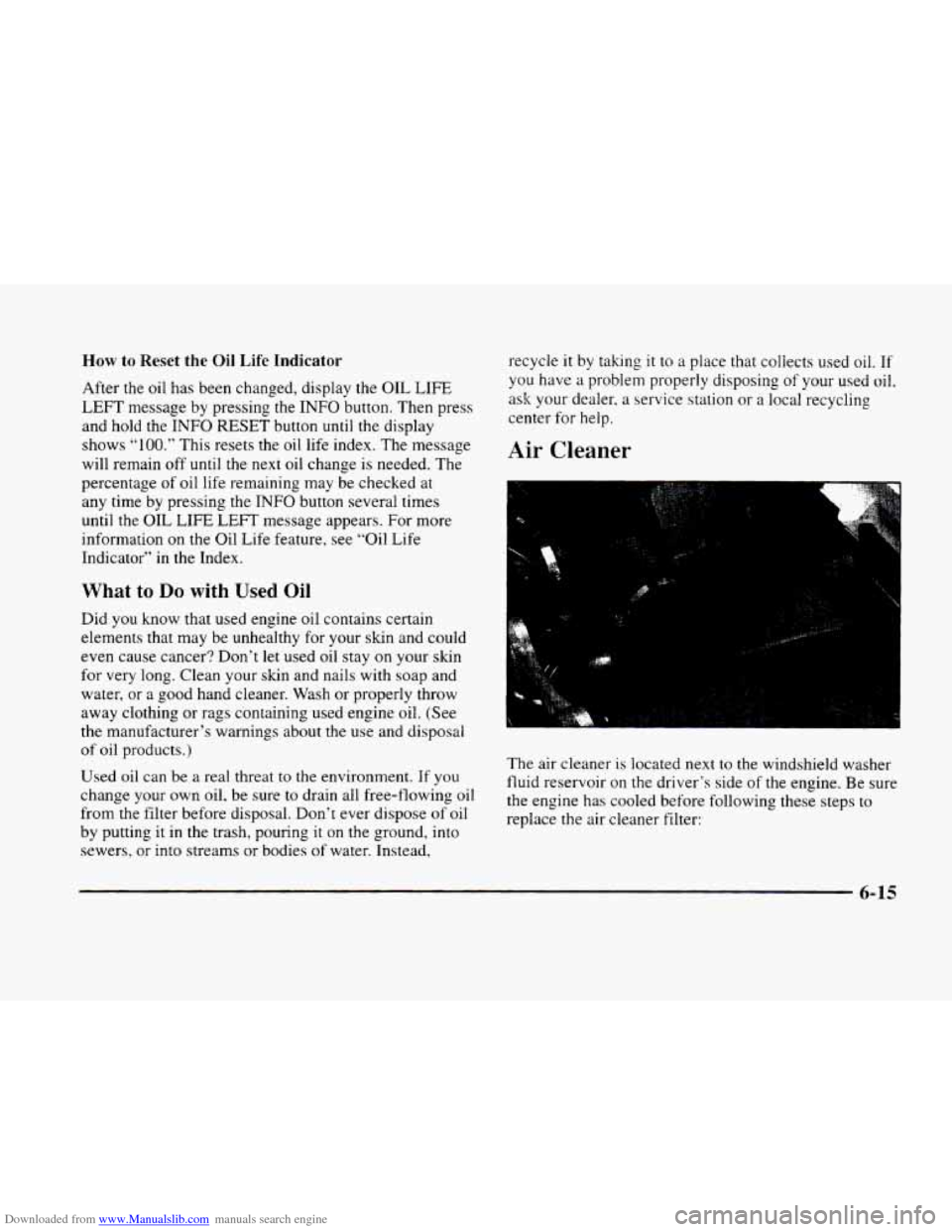
The air cleaner is located next to the windshield washer
fluid reservoir on the driver’s side
of the engine. Be sure
the engine has cooled before following these steps to
replace
the air cleaner filter:
6-15
Page 298 of 380
Downloaded from www.Manualslib.com manuals search engine A CAUTION:
Operating the engine with the air cleaner off can
cause you or others to be burned. The air cleaner
not only cleans the air, it stops flame
if the engine
backfires.
If it isn’t there, and the engine
backfires,
you could be burned. Don’t drive with
it
off, and be careful working on the engine with
the air cleaner off.
NOTICE:
If the air cleaner is off, a backfire can cause a
damaging engine fire. And, dirt can easily get
into your engine, which will damage it. Always
have the air cleaner in place when you’re driving.
Automatic Transaxle Fluid
When to Check and Change
A good time to check your automatic transaxle fluid
level is when the engine oil is changed.
Change both the fluid and filter every
50,000 miles
(83 000 km) if the vehicle is mainly driven under one
or more
of these conditions:
0 In heavy city traffic where the outside temperature
0 In hilly or mountainous terrain.
0 When doing frequent trailer towing.
0 Uses such as found in taxi, police or delivery service.
If you do not use your vehicle under any
of these
conditions, the fluid and filter do not require change
until the message
CHANGE TRANS FLUID appears
on the Driver Information Center.
See “Scheduled Maintenance Services” in the
Maintenance Schedule booklet.
regularly
reaches
90” F (32 O C j or higher.
6-18
Page 302 of 380
Downloaded from www.Manualslib.com manuals search engine Engine Coolant
The cooling s stem in your vehicle is filled with
DEX-COOL engine coolant. This coolant is designed
to remain in your vehicle for
5 years or 150,000 miles
(240 000 km) whichever occurs first, if you add only
DEX-COOL’ extended life coolant.
J
The following explains your cooling system and
how
to add coolant when it is low. If you have a
problem with engine overheating, see “Engine
Overheating” in the Index.
A 50/50 mixture of water and DEX-COOL@
coolant will:
0 Give freezing protection down to -34°F (-37°C).
Give boiling protection up to 265 “F (1 29°C).
Protect against rust and corrosion.
0 Help keep the proper engine temperature.
0 Let the warning lights and gages work as
they should.
NOTICE:
When adding coolant, it is important that you
use only
DEX-COOL@ (silicate-free) coolant.
If coolant other than DEX-COOL is added to
the system, premature engine, heater core or radiator corrosion may result. In addition, the
engine coolant will require change sooner
-0 at
30,000 miles (50 000 km) or 24 months,
whichever occurs first. Damage caused by the
use
of coolant other than DEX-COOL@ is not
covered by your new vehicle warranty.
6-32
Page 303 of 380
Downloaded from www.Manualslib.com manuals search engine What to Use
Use a mixture of one-half clean water (preferably
distilled) and one-half
DEX-COOL” coolant which
won’t damage aluminum parts.
If you use this mixture.
you don’t need
to add anything else.
A CAUTION:
Adding only plain water to your cooling system
can be dangerous. Plain water, or some other liquid like alcohol, can boil before the proper
coolant mixture will. Your vehicle’s coolant
warning system is set for the proper coolant
mixture. With plain water
or the wrong mixture,
your engine could get too hot but you wouldn’t
get the overheat warning. Your engine could
catch fire and you or others could be burned.
Use a
50/50 mixture of clean water and
DEX-COOL@ coolant.
NOTICE:
If you use an improper coolant mixture, your
engine could overheat and be badly damaged. The repair cost wouldn’t be covered by your
warranty.
Too much water in the mixture can
freeze and crack the engine, radiator, heater
core and other parts.
If you have to add coolant more than four times a year,
have your dealer check your cooling system.
I NOTICE:
~~~~~
If you use the proper coolant, you don’t have to
add extra inhibitors or additives which claim to
improve the system. These can be harmful.
6-23
Page 309 of 380
Downloaded from www.Manualslib.com manuals search engine What to Add
When
you do need brake fluid. use only DOT-3
brake fluid -- such as Delco Supreme 11 ‘’ (GM Part
No. 12377967). Use new brake fluid from a sealed
container only.
Always clean the brake fluid reservoir cap and the area
around the cap before removing
it. This will help keep
dirt from entering
the reservoir.
I A CAUTION:
With the wrong kind of fluid in your brake
system, your brakes may not work well, or they
may not even work
at all. This could cause a
crash. Always use the proper brake fluid.
NOTICE:
0
0
Using the wrong fluid can badly damage
brake system parts. For example, just
a few
drops
of‘ mineral-based oil, such as engine
oil, in your brake system can damage brake
system parts
so badly that they’ll have to
be replaced. Don’t let someone put in the
wrong kind
of fluid.
If you spill brake fluid on your vehicle’s
painted surfaces, the paint finish can be
damaged. Be careful not to spill brake fluid
on your vehicle.
If you do, wash it off
immediately. See “Appearance Care” in
the Index.
6-29
Page 327 of 380
Downloaded from www.Manualslib.com manuals search engine Appearance Care
Remember, cleaning products can be hazardous. Some
are toxic. Others can burst into flame if you strike a
match or get them on a hot part of the vehicle. Some are
dangerous if you breathe their fumes in a closed space.
When you use anything from a container
to clean your
vehicle. be sure to follow the manufacturer‘s warnings
and instructions. And always open your doors or
windows when you’re cleaning the inside.
Never use these to clean your vehicle:
Gasoline
0 Benzene
Naphtha
0 Carbon Tetrachloride
Acetone
0 Paint Thinner
0 Turpentine
0 Lacquer Thinner
0 Nail Polish Remover
They can all be hazardous
-- some more than others --
and they can all damage your vehicle, too. Don’t
use any
of these unless this manual says you can.
In many uses: these will damage your vehicle:
0 Alcohol
Laundry Soap
Bleach
0 Reducing Agents
Cleaning the Inside of Your Vehicle
Use a vacuum cleaner often to get rid of dust and loose
dirt. Wipe vinyl or leather with a clean, damp cloth.
Your dealer has two cleaners, Multi-Purpose Interior
Cleaner and Capture Non-Solvent Dry Spot and
Soil
Remover. They will clean normal spots and stains very
well. You can get GM-approved cleaning products from
your dealer. (See “Appearance Care and Materials” in
the Index.)
Here are some cleaning tips:
Always read the instructions on the cleaner label.
0 Clean up stains as soon as you can -- before they set.
Carefully scrape off any excess stain.
Use a clean cloth or sponge, and change to a clean area
0 If a ring forms after spot cleaning, clean the entire
often.
A
soft brush may be used if stains are stubborn.
area immediately or
it will set.
6-47