ECU CADILLAC ELDORADO 1998 10.G Owners Manual
[x] Cancel search | Manufacturer: CADILLAC, Model Year: 1998, Model line: ELDORADO, Model: CADILLAC ELDORADO 1998 10.GPages: 380, PDF Size: 21.39 MB
Page 13 of 380
Downloaded from www.Manualslib.com manuals search engine finest documents ever written. It was published following
the introduction
of the first production V8 engine,
which
was standard in all Cadillacs beginning with the
1915 model.
Many Cadillac “firsts” have followed over the years,
inciuding the synchro-mech clashless transmission, a
nationwide comprehensive service policy. security plate
glass. chrome plating and the first car to be designed
by
a stylist ( 1927 LaSalle/Harley Earl). The ’30s witnessed
production
of the powerful, smooth and quiet V12 and
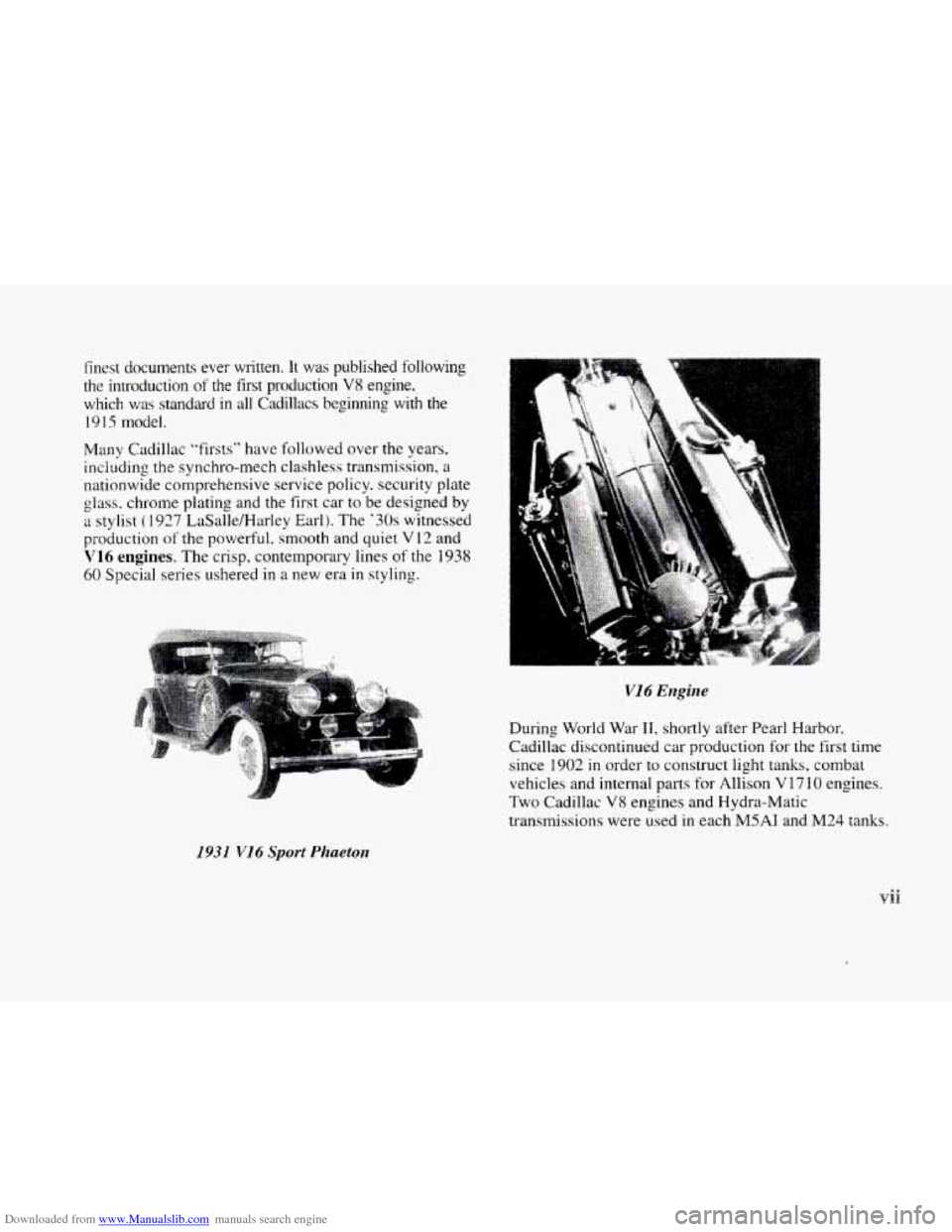
V16 engines. The crisp, contemporary lines of the 1938
60 Special series ushered in a new era in styling.
VI 6 Engin e
During World War 11, shortly after Pearl Harbor.
Cadillac discontinued car production
for the first time
since
1902 in order to construct light tanks, combat
vehicles and internal parts for Allison V17 10 engines.
Two Cadillac V8 engines and Hydra-Matic
transmissions were used
in each M5AI and M24 tanks.
1931 VI6 Sport Phaeton
Page 32 of 380
Downloaded from www.Manualslib.com manuals search engine How to Wear Safety Belts Properly
Adults
This part is only for people of adult size.
Be aware that there are special things to know about
safety belts and children. And there are different
rules for smaller children and babies. If
a child will be
riding in your vehicle,
see the part of this manual
called “Children.”
Follow those rules for
everyone’s protection.
First, you’ll want to
know which restraint systems your
vehicle has.
We’ll start with the driver position.
Driver Position
This part describes the driver’s restraint system.
Lap-Shoulder Belt
The driver has a lap-shoulder belt. Here’s how to wear
it properly.
1. Close and lock the door.
2. Adjust the seat (to see how. see “Seats” in the Index)
so you can sit up straight.
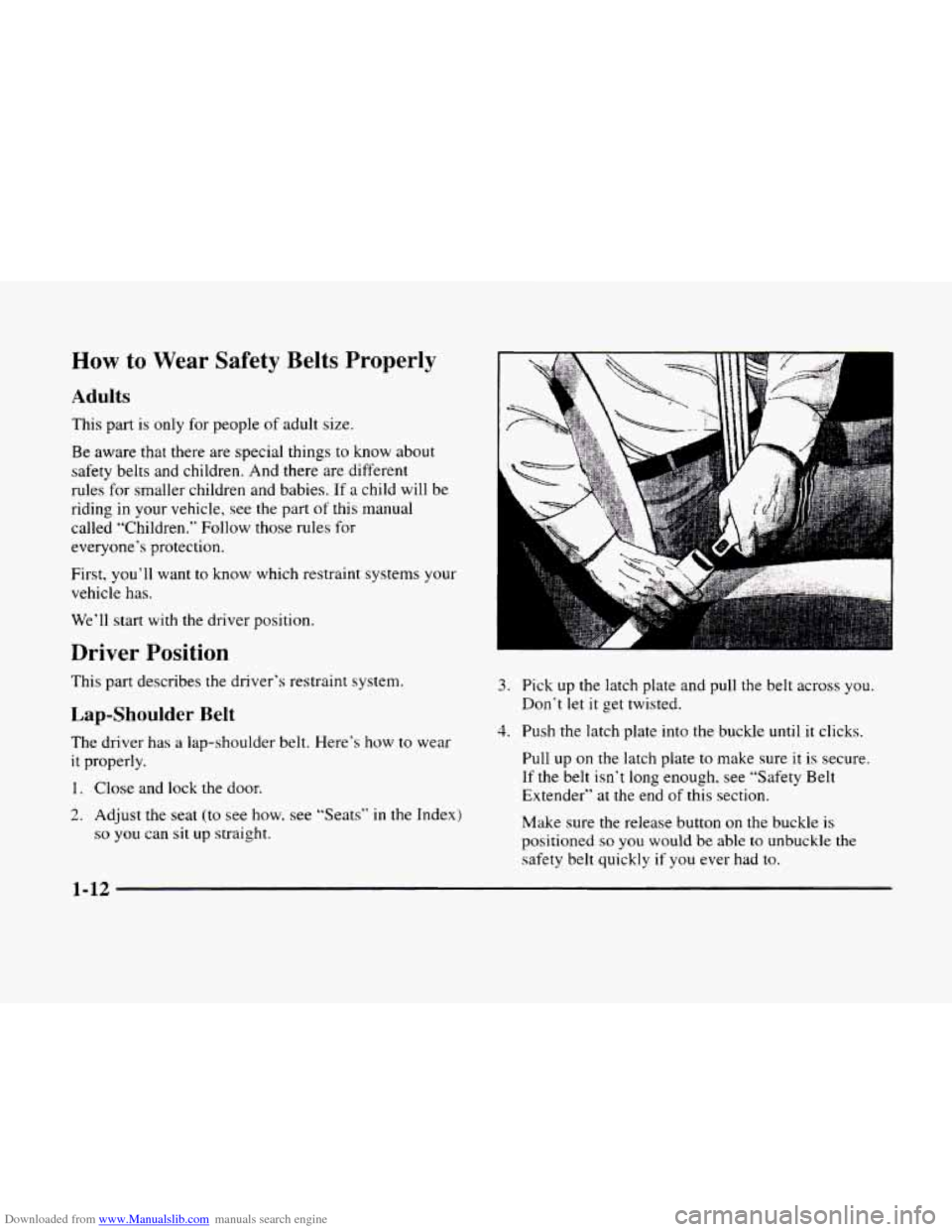
3. Pick up the latch plate and pull the belt across you.
Don’t let
it get twisted.
4. Push the latch plate into the buckle until it clicks.
Pull up on
the latch plate to make sure it is secure.
If the belt isn’t long enough. see “Safety Belt
Extender” at the end of this section.
Make sure the release button
on the buckle is
positioned
so you would be able to unbuckle the
safety belt quickly if you ever had to.
1-12
Page 41 of 380
Downloaded from www.Manualslib.com manuals search engine r
r !
r
r
r
r
f- t
i
A CAUTION:
Air bags inflate with great force, faster than the
blink
of an eye. If you’re too close to an inflating
air bag, it could seriously injure you. Safety belts
help keep you in position before and during a
crash. Always wear your safety belt, even with
air
bags. The driver should sit as far back as possible
while
still maintaining control of the vehicle.
A CAUTION:
Children who are up against, or very close to, an
air bag when it inflates can be seriously injured
or killed. Air bags plus lap-shoulder belts offer
the best protection for adults and older children,
but not for young children and infants. Neither
CAUTION: (Continued) CAUTION: (Continued)
the vehicle’s safety belt system
nor its air bag
system
is designed for them. Young children and
infants need the protection that
a child restraint
system can provide. Always secure children
properly in your vehicle. To read how, see the
part of this manual called “Children” and see the
caution labels
on the sunvisors and the right front
passenger’s safety belt.
There is an air bag
readiness light on the
instrument panel, which
shows AlR BAG.
The system checks the air bag electrical system for
malfunctions. The light tells you if there is an electrical
problem. See “Air Bag Readiness Light” in
the Index
for more information.
1-21
Page 47 of 380
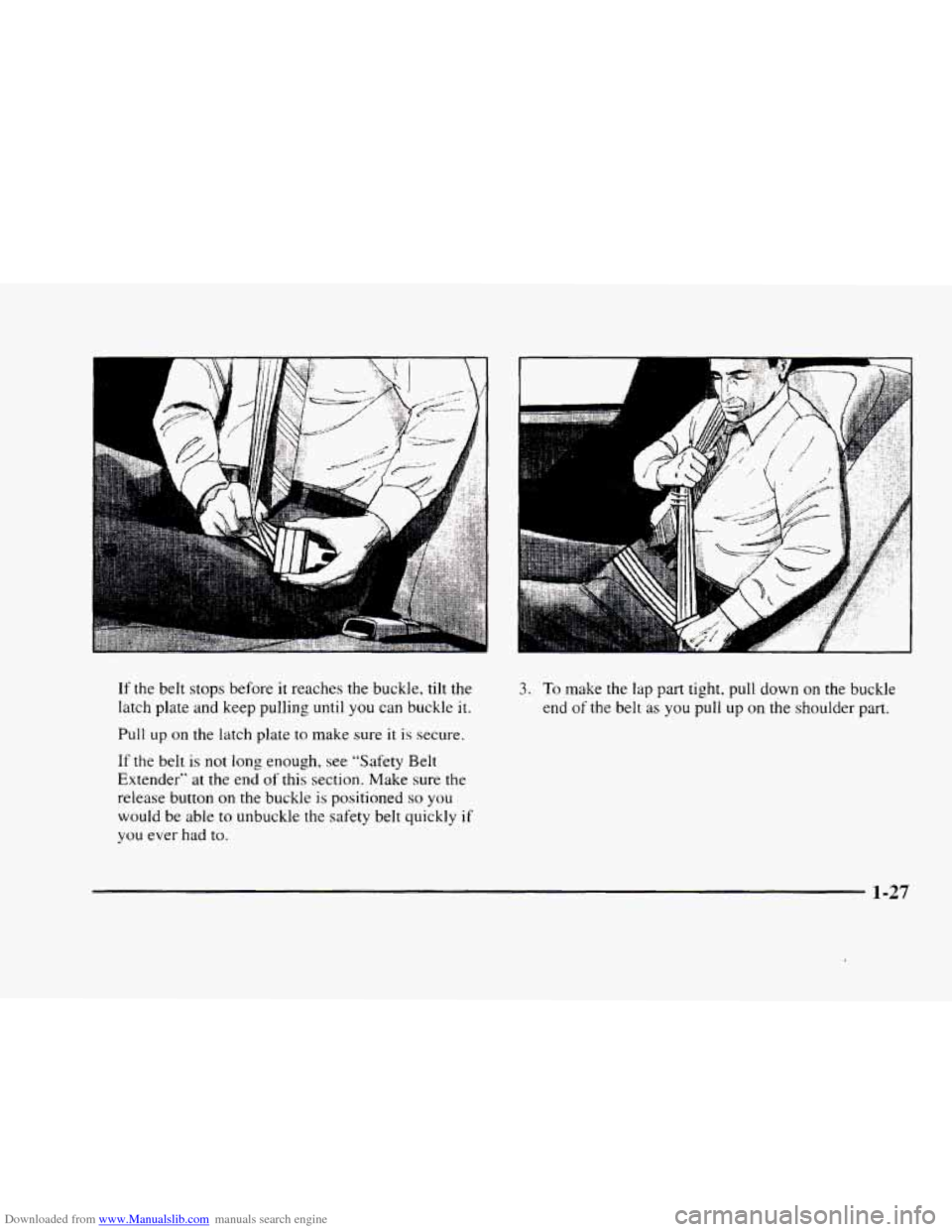
Downloaded from www.Manualslib.com manuals search engine If the belt stops before it reaches the buckle. tilt the
latch plate and keep pulling until
you can buckle it.
Pull up on the latch plate to make sure it is secure.
If the belt is not long enough, see “Safety Belt
Extender” at the end
of this section. Make sure the
release button
on the buckle is positioned so you
would be able to unbuckle the safety belt quickly if
you ever had to.
3. To make the lap part tight, pull down on the buckle
end
of the belt as you pull up on the shoulder part.
1-27
Page 50 of 380
Downloaded from www.Manualslib.com manuals search engine Children
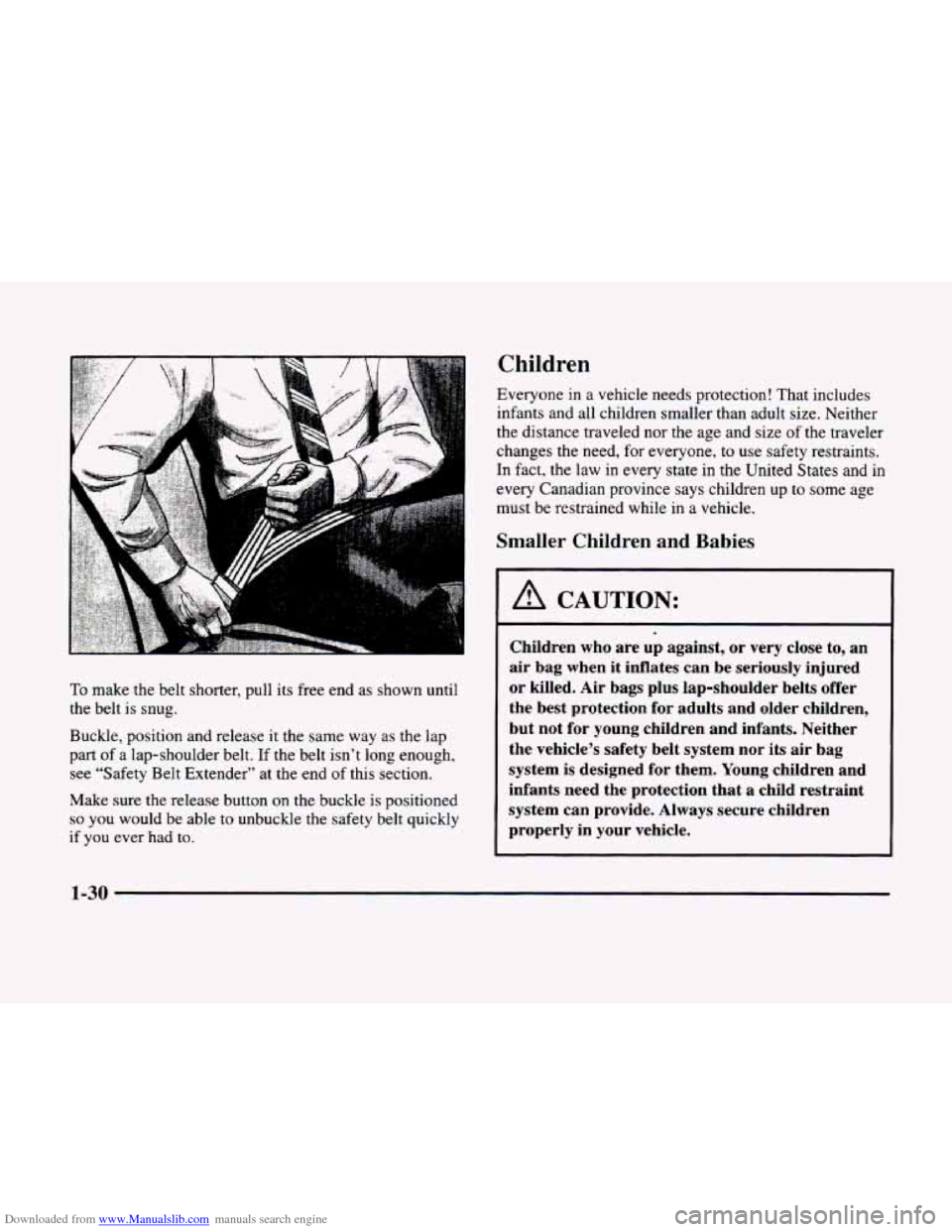
To make the belt shorter, pull its free end as shown until
the belt is snug.
Buckle, position and release it the same way as the lap
part of a lap-shoulder belt.
If the belt isn’t long enough,
see “Safety Belt Extender’’ at the end of this section.
Make sure the release button
on the buckle is positioned
so you would be able to unbuckle the safety belt quickly
if you ever had to. Everyone
in a vehicle needs protection! That includes
infants and all children smaller than adult size. Neither
the distance traveled nor the age and size
of the traveler
changes the need, for everyone,
to use safety restraints.
In fact. the law in every state in the United States and in
every Canadian province says children up to some age
must be restrained while in a vehicle.
Smaller Children and Babies
I A CAUTION:
Children who are up against, or very close to, an
air bag when
it inflates can be seriously injured
or killed. Air bags plus lap-shoulder belts offer
the best protection for adults and older children,
but not for young children and infants. Neither
the vehicle’s safety belt system nor
its air bag
system is designed for them. Young children and
infants need the protection that a child restraint
system can provide. Always secure children
properly in your vehicle.
1-30
Page 51 of 380
Downloaded from www.Manualslib.com manuals search engine I
f
r
s
r
r
I A CAUTION:
Smaller children and babies should always be
restrained in a child or infant restraint. The
instructions for the restraint
will say whether it is
the right type and size for your child.
A very
young child’s hip bones are
so small that a
regular belt might not stay low on the hips,
as it
should. Instead, the belt will likely be over the
child’s abdomen.
In a crash, the belt would apply
force right on the child’s abdomen, which could
cause serious or
fatal injuries. So, be sure that
any child small enough for one
is always properly
restrained in a child
or infant restraint. Infants need complete support, including support for
the head and neck.
This is necessary because an infant’s
neck is weak and its head weighs
so much compared
with the rest of its body. In a crash, an infant in a
rear-facing restraint settles into the restraint,
so the
crash forces can be distributed across the strongest part
of the infant’s body, the back and shoulders. A baby
should be secured
in an appropriate infant restraint.
This is so important that many hospitals today won’t
release a newborn infant to its parents unless there
is
an infant restraint available for the baby’s first trip in a
motor vehicle.
1-31
Page 52 of 380
Downloaded from www.Manualslib.com manuals search engine I CAUTION: (Continued) I
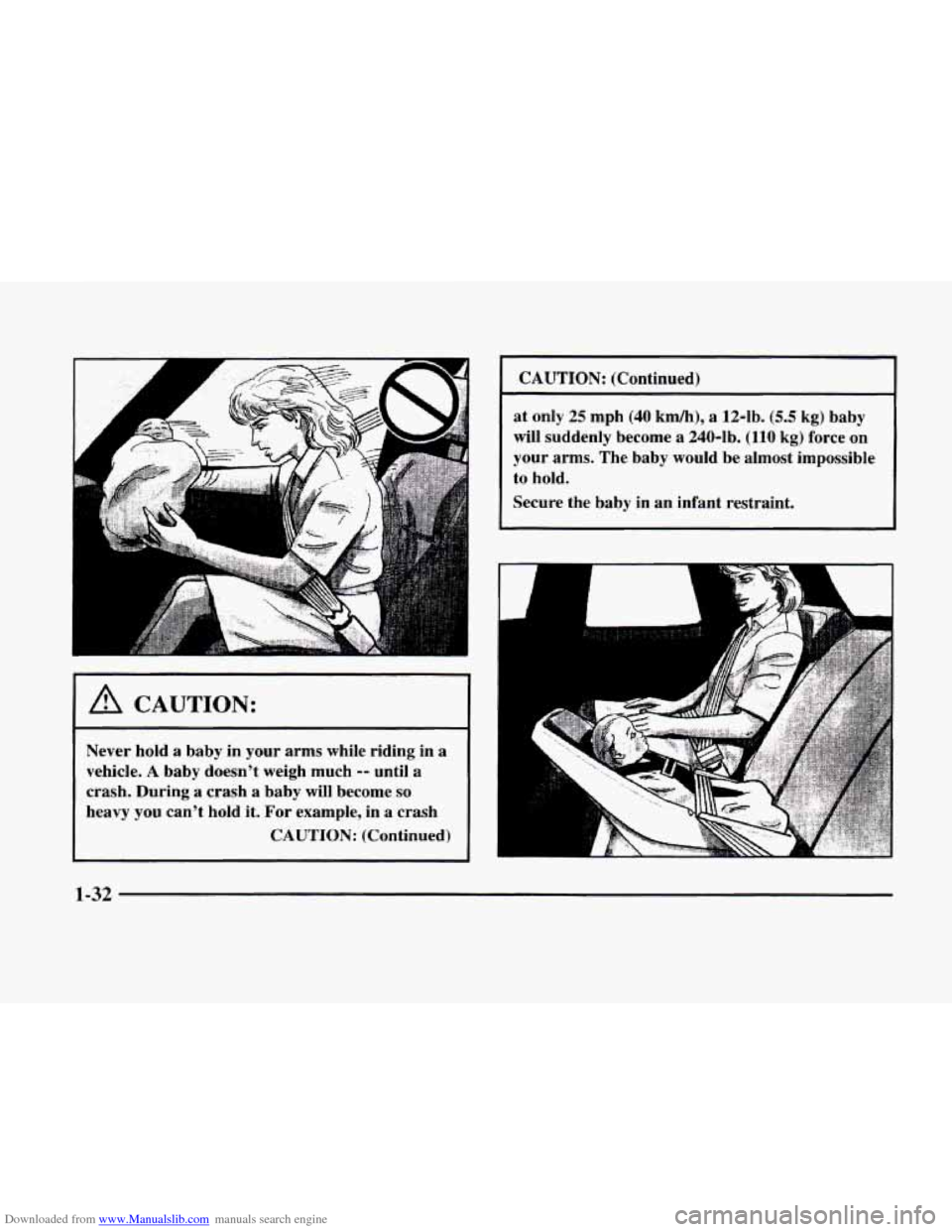
at only 25 mph (40 km/h), a 12-1b. (5.5 kg) baby
will suddenly become
a 240-lb. (110 kg) force on
your arms. The baby would be almost impossible
to hold.
Secure the baby in an infant restraint.
A CAUTION:
Never hold a baby in your arms while riding in a
vehicle. A baby doesn’t weigh much -- until a
crash. During a crash a baby will become so
heavy you can’t hold it. For example, in a crash
CAUTION: (Continued)
1-32
Page 54 of 380
Downloaded from www.Manualslib.com manuals search engine YX
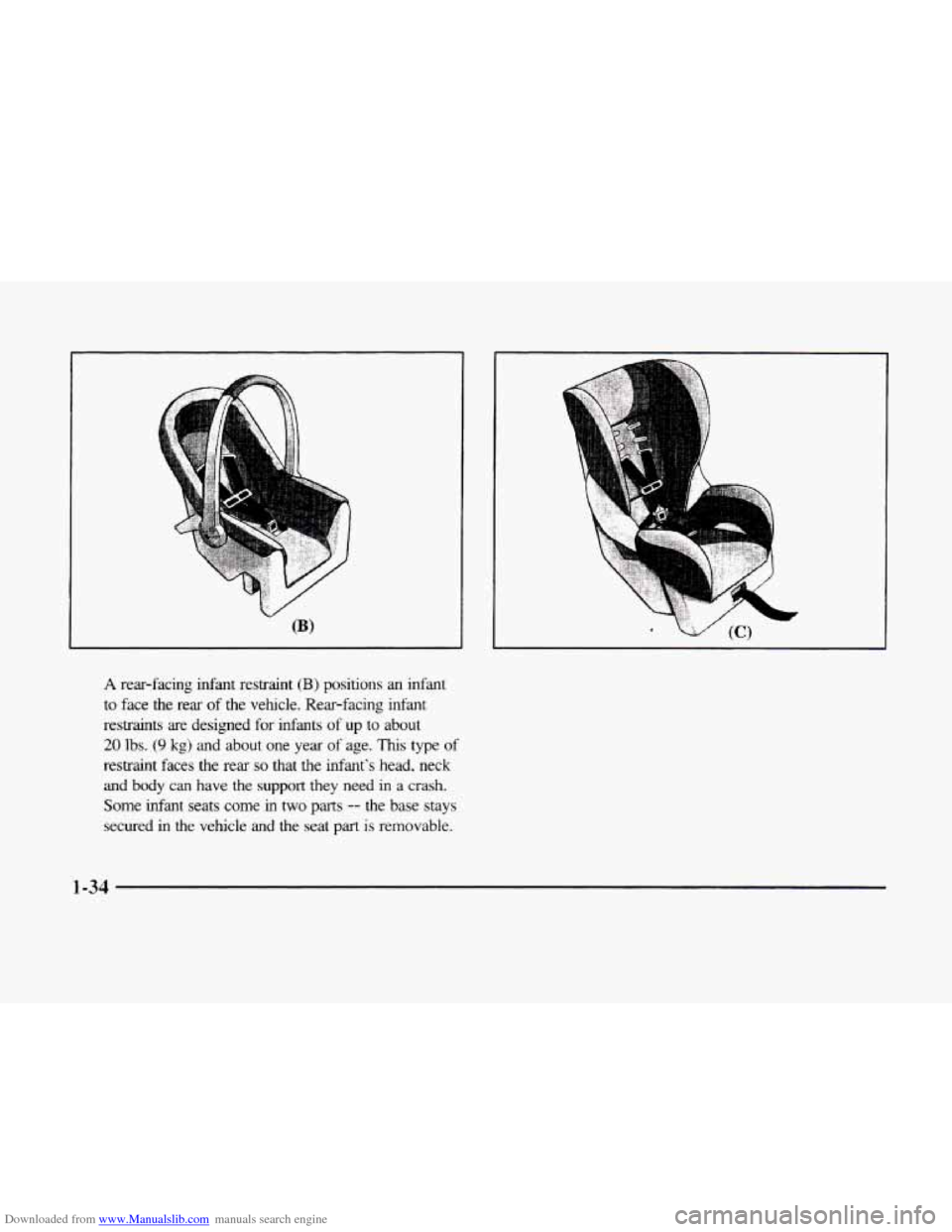
A rear-facing infant restraint (B) positions an infant
to face the rear of the vehcle. Rear-facing infant
restraints are designed for infants of up to about
20 lbs. (9 kg) and about one year of age. This type of
restraint faces the rear so that the infant's head. neck
and body can have the
support they need in a crash.
Some &ant seats
come in two parts -- the base stays
secured
in the vehicle and the seat part is removable.
1-34
Page 57 of 380
Downloaded from www.Manualslib.com manuals search engine When choosing a child restraint, be sure the child
restraint
is designed to be used in a vehicle. If it is. it
will have a label saying that
it meets Federal Motor
Vehicle Safety Standards.
Then follow the instructions for
the restraint. You may
find these instructions on the restraint itself or in
a
booklet, or both. These restraints use the belt system in
your vehicle, but the child also has to be secured within
the restraint
to help reduce the chance of personal injury.
The instructions that come with the infant or child
restraint will show
you how to do that. Both the owner’s
manual and
the child restraint instructions are important,
so if either one of these is not available, obtain a
replacement copy from the manufacturer.
Where to Put the Restraint
Accident statistics show that children are safer if they
are restrained in the rear rather than the front seat. We at
General Motors therefore recommend that
you put your
child restraint in the rear seat. Never put a rear-facing
child restraint in the front passenger seat. Here‘s why:
A CAUTION:
A child in a rear-facing child restraint can be
seriously injured if the right front passenger’s air
bag inflates. This
is because the back of a
rear-facing child restraint would be very close to
the inflating air bag. Always secure a rear-facing
child restraint in the rear seat.
You may, however, secure a forward-facing child
restraint in the right front seat. Before you secure
a forward-facing child restraint, always move the
front passenger seat
as far back as it will go. Or,
secure the child restraint in the rear seat.
Wherever
you install it, be sure to secure the child
restraint properly.
Keep in
mind that an unsecured child restraint can move
around
in a collision or sudden stop and injure people in
the vehicle. Be sure to properly secure any child
restraint
in your vehicle -- even when no child is in it.
1-37
Page 59 of 380
Downloaded from www.Manualslib.com manuals search engine r
i-
f
r
I
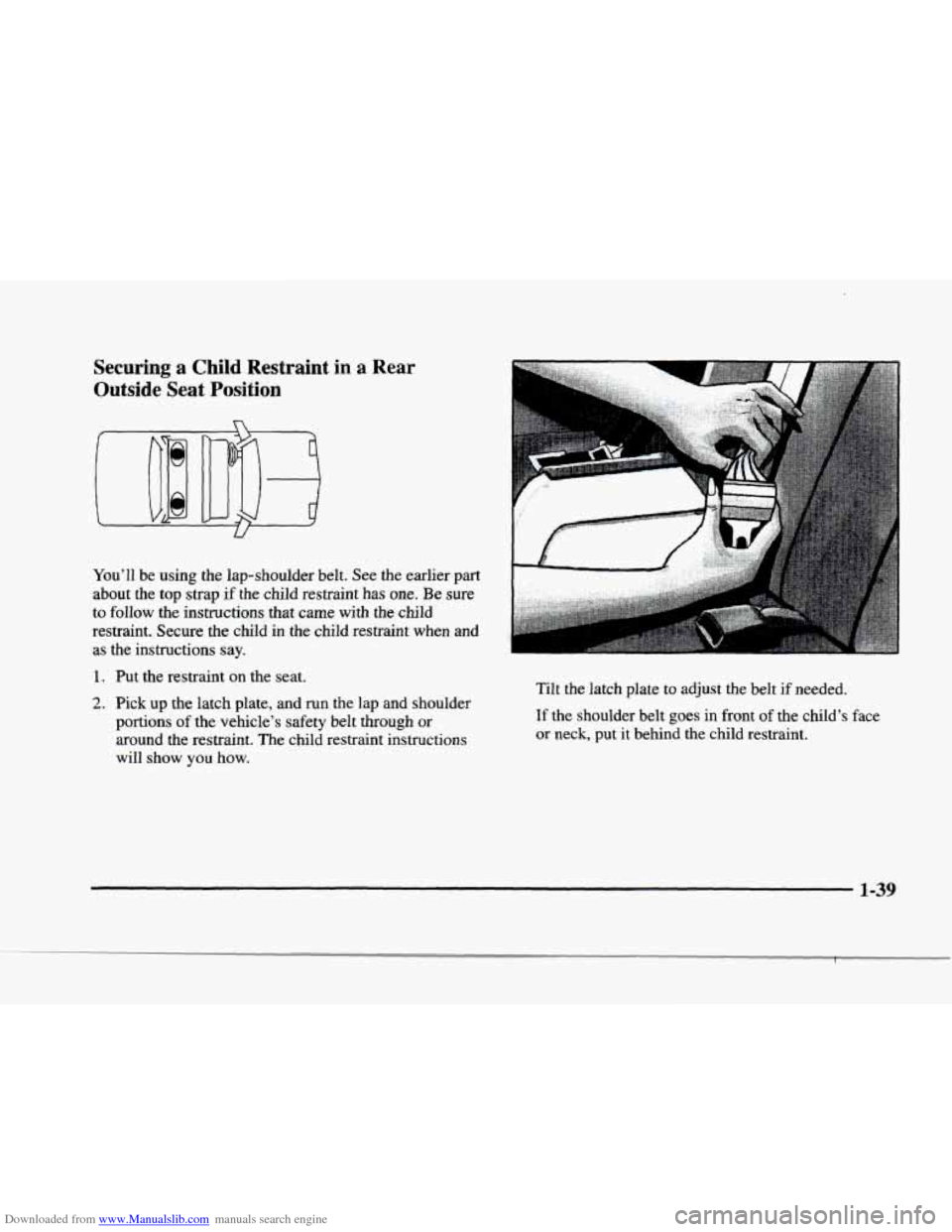
Securing a Child Restraint in a Rear
Outside Seat Position
n
You’ll be using the lap-shoulder belt. See the earlier part
about the
top strap if the child restraint has one. Be sure
to
follow the instructions that came with the child
restraint. Secure the child
in the child restraint when and
as the instructions say.
1. Put the restraint on the seat.
2. Pick up the latch plate, and run the lap and shoulder
portions of the vehicle’s
safety belt through or
around the restraint. The child restraint instructions
will show you
how.
Tilt the latch plate to adjust the belt if needed.
If the shoulder belt goes in front of the child’s face
or neck, put
it behind the child restraint.
1-39
I