service CADILLAC ESCALADE 2006 2.G Manual PDF
[x] Cancel search | Manufacturer: CADILLAC, Model Year: 2006, Model line: ESCALADE, Model: CADILLAC ESCALADE 2006 2.GPages: 484, PDF Size: 2.84 MB
Page 388 of 484
The Tire Pressure Monitor System (TPMS) operates
on a radio frequency and complies with RSS-210
of Industry and Science Canada. Operation is subject to
the following two conditions:
1. This device may not cause interference.
2. This device must accept any interference received,
including interference that may cause undesired
operation of the device.
Changes or modications to this system by other than
an authorized service facility could void authorization to
use this equipment.
Tire Inspection and Rotation
Tires should be rotated every 5,000 to 8,000 miles
(8 000 to 13 000 km).
Any time you notice unusual wear, rotate your tires as
soon as possible and check wheel alignment. Also
check for damaged tires or wheels. SeeWhen It Is Time
for New Tires on page 5-71andWheel Replacement
on page 5-76for more information.
Make sure the spare tire is stored securely. Push,
pull, and then try to rotate or turn the tire. If it moves,
use the ratchet/wheel wrench to tighten the cable.
SeeChanging a Flat Tire on page 5-78.The purpose of regular rotation is to achieve more
uniform wear for all tires on the vehicle. The rst rotation
is the most important. SeeScheduled Maintenance
on page 6-4.
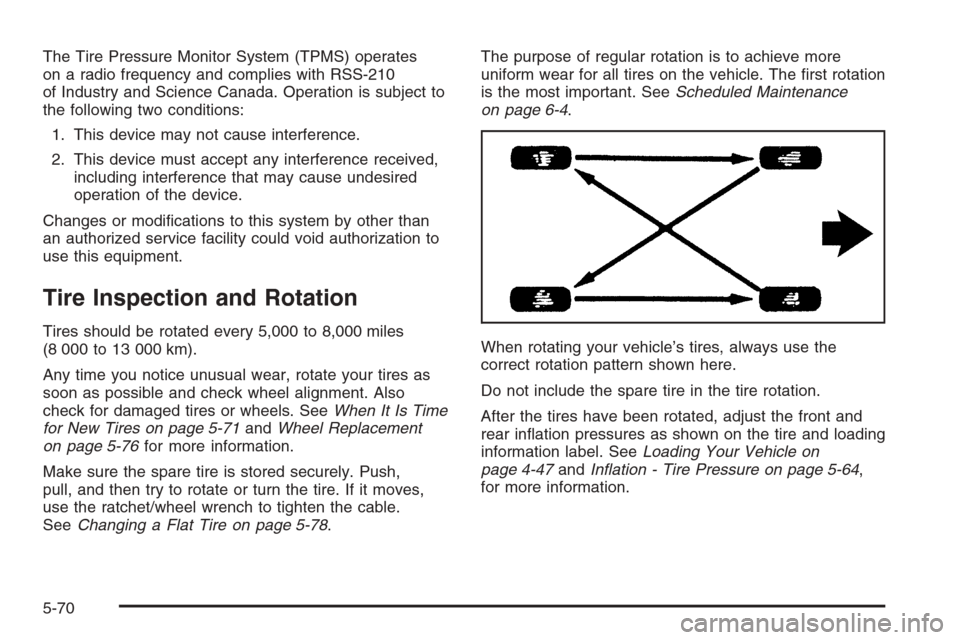
When rotating your vehicle’s tires, always use the
correct rotation pattern shown here.
Do not include the spare tire in the tire rotation.
After the tires have been rotated, adjust the front and
rear ination pressures as shown on the tire and loading
information label. SeeLoading Your Vehicle on
page 4-47andInation - Tire Pressure on page 5-64,
for more information.
5-70
Page 392 of 484
Uniform Tire Quality Grading
Quality grades can be found where applicable on the
tire sidewall between tread shoulder and maximum
section width. For example:
Treadwear 200 Traction AA Temperature A
The following information relates to the system
developed by the United States National Highway
Traffic Safety Administration (NHTSA), which grades
tires by treadwear, traction, and temperature
performance. This applies only to vehicles sold in the
United States. The grades are molded on the sidewalls
of most passenger car tires. The Uniform Tire Quality
Grading (UTQG) system does not apply to deep
tread, winter-type snow tires, space-saver, or temporary
use spare tires, tires with nominal rim diameters of
10 to 12 inches (25 to 30 cm), or to some
limited-production tires.
While the tires available on General Motors passenger
cars and light trucks may vary with respect to these
grades, they must also conform to federal safety
requirements and additional General Motors Tire
Performance Criteria (TPC) standards.
Treadwear
The treadwear grade is a comparative rating based on
the wear rate of the tire when tested under controlled
conditions on a specied government test course.
For example, a tire graded 150 would wear one and
a half (1.5) times as well on the government course as
a tire graded 100. The relative performance of tires
depends upon the actual conditions of their use,
however, and may depart signicantly from the norm
due to variations in driving habits, service practices, and
differences in road characteristics and climate.
Traction – AA, A, B, C
The traction grades, from highest to lowest, are AA, A,
B, and C. Those grades represent the tire’s ability
to stop on wet pavement as measured under controlled
conditions on specied government test surfaces of
asphalt and concrete. A tire marked C may have poor
traction performance.
Warning:The traction grade assigned to this tire is
based on straight-ahead braking traction tests, and does
not include acceleration, cornering, hydroplaning, or
peak traction characteristics.
5-74
Page 423 of 484
Description Usage
Swirl Remover PolishRemoves swirl marks, ne
scratches, and other light
surface contamination.
Cleaner WaxRemoves light scratches
and protects nish.
Foaming Tire Shine
Low GlossCleans, shines, and
protects in one step.
No wiping necessary.
Wash Wax ConcentrateMedium foaming
shampoo. Cleans
and lightly waxes.
Biodegradable and
phosphate free.
Spot LifterQuickly removes spots
and stains from carpets,
vinyl, and cloth
upholstery.
Odor EliminatorOdorless spray odor
eliminator used on fabrics,
vinyl, leather and carpet.Vehicle Identication
Vehicle Identication Number (VIN)
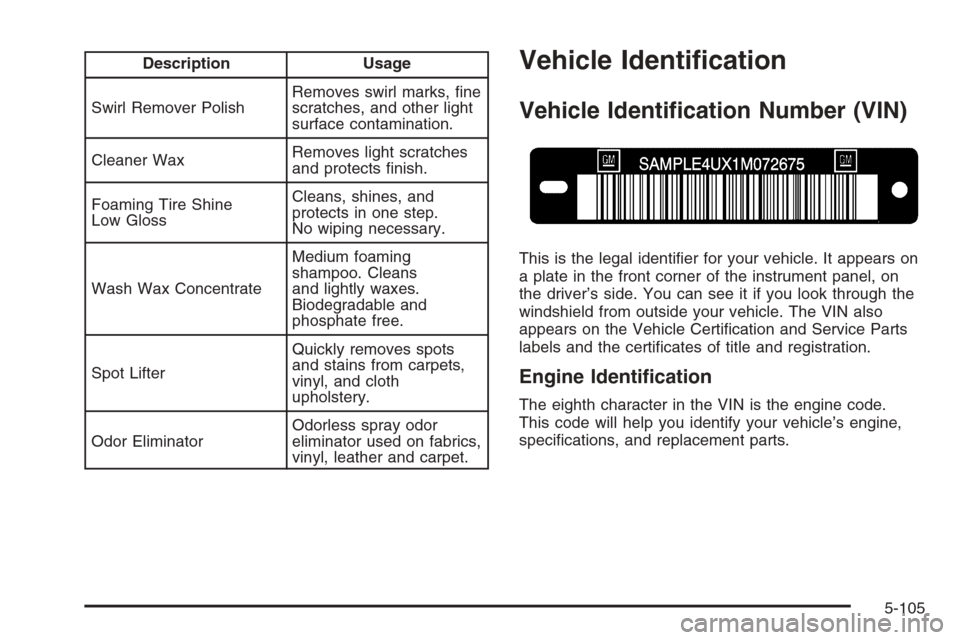
This is the legal identier for your vehicle. It appears on
a plate in the front corner of the instrument panel, on
the driver’s side. You can see it if you look through the
windshield from outside your vehicle. The VIN also
appears on the Vehicle Certication and Service Parts
labels and the certicates of title and registration.
Engine Identication
The eighth character in the VIN is the engine code.
This code will help you identify your vehicle’s engine,
specications, and replacement parts.
5-105
Page 424 of 484
Service Parts Identication Label
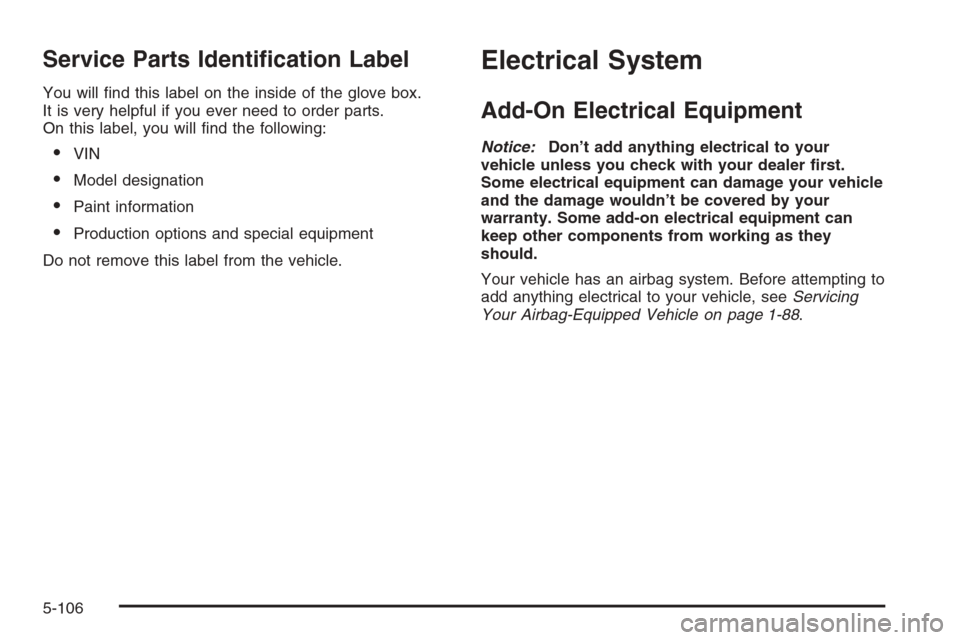
You will nd this label on the inside of the glove box.
It is very helpful if you ever need to order parts.
On this label, you will nd the following:
VIN
Model designation
Paint information
Production options and special equipment
Do not remove this label from the vehicle.
Electrical System
Add-On Electrical Equipment
Notice:Don’t add anything electrical to your
vehicle unless you check with your dealer rst.
Some electrical equipment can damage your vehicle
and the damage wouldn’t be covered by your
warranty. Some add-on electrical equipment can
keep other components from working as they
should.
Your vehicle has an airbag system. Before attempting to
add anything electrical to your vehicle, seeServicing
Your Airbag-Equipped Vehicle on page 1-88.
5-106
Page 435 of 484
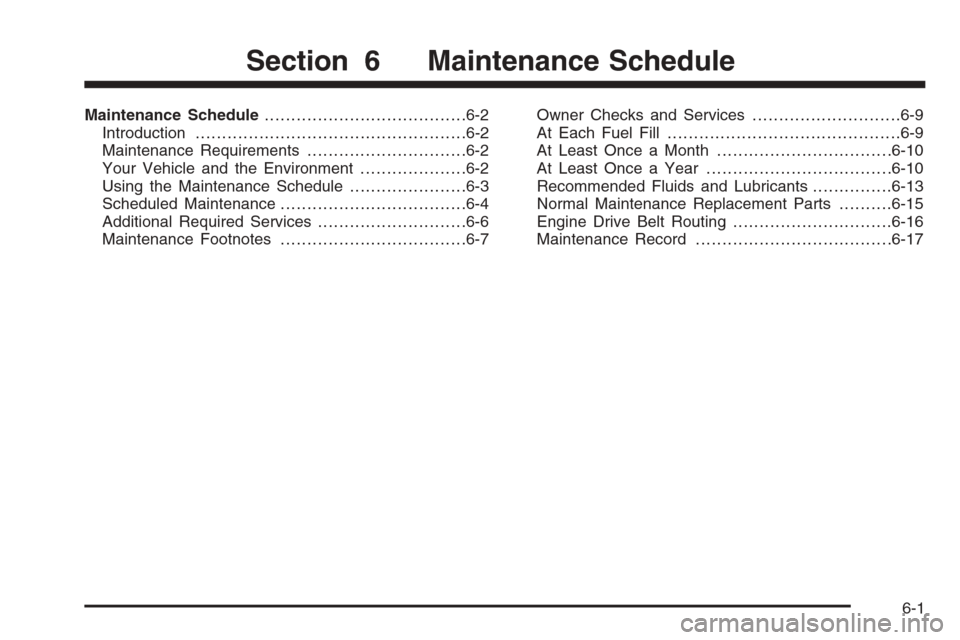
Maintenance Schedule......................................6-2
Introduction...................................................6-2
Maintenance Requirements..............................6-2
Your Vehicle and the Environment....................6-2
Using the Maintenance Schedule......................6-3
Scheduled Maintenance...................................6-4
Additional Required Services............................6-6
Maintenance Footnotes...................................6-7Owner Checks and Services............................6-9
At Each Fuel Fill............................................6-9
At Least Once a Month.................................6-10
At Least Once a Year...................................6-10
Recommended Fluids and Lubricants...............6-13
Normal Maintenance Replacement Parts..........6-15
Engine Drive Belt Routing..............................6-16
Maintenance Record.....................................6-17
Section 6 Maintenance Schedule
6-1
Page 437 of 484
Using the Maintenance Schedule
We at General Motors want to help you keep your
vehicle in good working condition. But we do not know
exactly how you will drive it. You may drive very
short distances only a few times a week. Or you may
drive long distances all the time in very hot, dusty
weather. You may use your vehicle in making deliveries.
Or you may drive it to work, to do errands, or in many
other ways.
Because of all the different ways people use their
vehicles, maintenance needs vary. You may need more
frequent checks and replacements. So please read
the following and note how you drive. If you have any
questions on how to keep your vehicle in good condition,
see your GM Goodwrench
®dealer.
This schedule is for vehicles that:
carry passengers and cargo within recommended
limits. You will nd these limits on the tire and
loading information label. SeeLoading Your Vehicle
on page 4-47.
are driven on reasonable road surfaces within legal
driving limits.
are driven off-road in the recommended manner.
SeeOff-Road Driving on page 4-18.
use the recommended fuel. SeeGasoline Octane
on page 5-4.The services inScheduled Maintenance on page 6-4
should be performed when indicated. SeeAdditional
Required Services on page 6-6andMaintenance
Footnotes on page 6-7for further information.
{CAUTION:
Performing maintenance work on a vehicle
can be dangerous. In trying to do some jobs,
you can be seriously injured. Do your own
maintenance work only if you have the
required know-how and the proper tools and
equipment for the job. If you have any doubt,
see your GM Goodwrench
®dealer to have a
qualied technician do the work. SeeDoing
Your Own Service Work on page 5-4.
Some maintenance services can be complex. So,
unless you are technically qualied and have the
necessary equipment, you should have your GM
Goodwrench
®dealer do these jobs.
When you go to your GM Goodwrench
®dealer for your
service needs, you will know that GM-trained and
supported service technicians will perform the work
using genuine GM parts.
6-3
Page 438 of 484
If you want to purchase service information, seeService
Publications Ordering Information on page 7-15.
Owner Checks and Services on page 6-9tells you what
should be checked, when to check it, and what you can
easily do to help keep your vehicle in good condition.
The proper replacement parts, uids, and lubricants to
use are listed inRecommended Fluids and Lubricants
on page 6-13andNormal Maintenance Replacement
Parts on page 6-15. When your vehicle is serviced,
make sure these are used. All parts should be replaced
and all necessary repairs done before you or anyone
else drives the vehicle. We recommend the use of
genuine GM parts.
Scheduled Maintenance
When the CHANGE ENGINE OIL message comes on,
it means that service is required for your vehicle. Have
your vehicle serviced as soon as possible within the next
600 miles (1 000 km). It is possible that, if you are driving
under the best conditions, the engine oil life system may
not indicate that vehicle service is necessary for over a
year. However, your engine oil and lter must be changed
at least once a year and at this time the system must be
reset. Your GM Goodwrench
®dealer has GM-trained
service technicians who will perform this work using
genuine GM parts and reset the system.If the engine oil life system is ever reset accidentally, you
must service your vehicle within 3,000 miles (5 000 km)
since your last service. Remember to reset the oil life
system whenever the oil is changed. SeeEngine Oil Life
System on page 5-14for information on the Engine Oil
Life System and resetting the system.
When the CHANGE ENGINE OIL message appears,
certain services, checks, and inspections are required.
Required services are described in the following for
“MaintenanceI” and “MaintenanceII.” Generally, it is
recommended that your rst service be MaintenanceI,
your second service be MaintenanceII, and that you
alternate MaintenanceIand MaintenanceIIthereafter.
However, in some cases, MaintenanceIImay be
required more often.
MaintenanceI— Use MaintenanceIif the CHANGE
ENGINE OIL message comes on within 10 months since
the vehicle was purchased or MaintenanceIIwas
performed.
MaintenanceII— Use MaintenanceIIif the previous
service performed was MaintenanceI. Always use
MaintenanceIIwhenever the message comes on
10 months or more since the last service or if the
message has not come on at all for one year.
6-4
Page 439 of 484
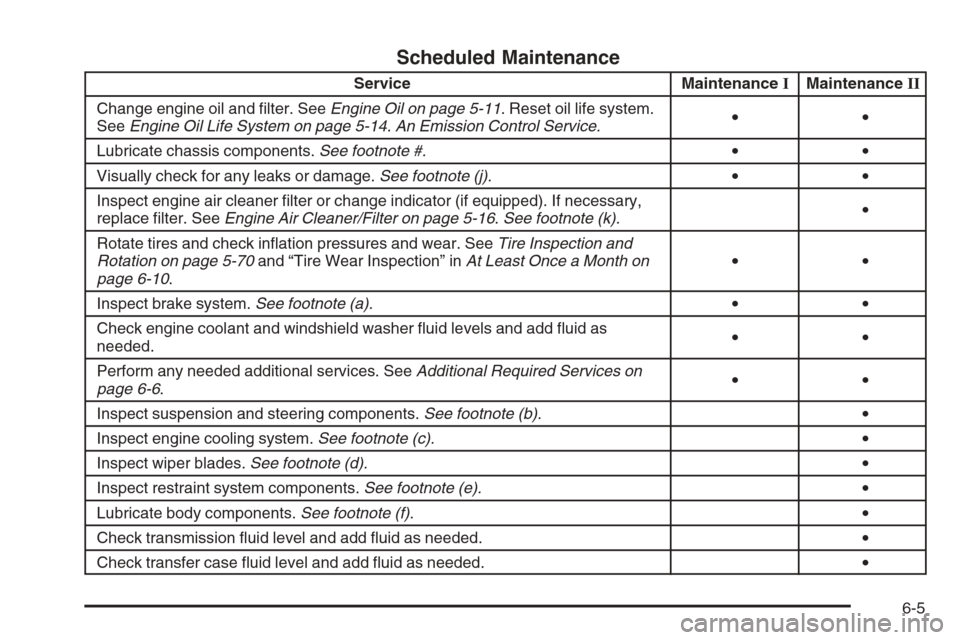
Scheduled Maintenance
Service MaintenanceIMaintenanceII
Change engine oil and lter. SeeEngine Oil on page 5-11. Reset oil life system.
SeeEngine Oil Life System on page 5-14.An Emission Control Service.••
Lubricate chassis components.See footnote #.••
Visually check for any leaks or damage.See footnote (j).••
Inspect engine air cleaner lter or change indicator (if equipped). If necessary,
replace lter. SeeEngine Air Cleaner/Filter on page 5-16.See footnote (k).•
Rotate tires and check ination pressures and wear. SeeTire Inspection and
Rotation on page 5-70and “Tire Wear Inspection” inAt Least Once a Month on
page 6-10.••
Inspect brake system.See footnote (a).••
Check engine coolant and windshield washer uid levels and add uid as
needed.••
Perform any needed additional services. SeeAdditional Required Services on
page 6-6.••
Inspect suspension and steering components.See footnote (b).•
Inspect engine cooling system.See footnote (c).•
Inspect wiper blades.See footnote (d).•
Inspect restraint system components.See footnote (e).•
Lubricate body components.See footnote (f).•
Check transmission uid level and add uid as needed.•
Check transfer case uid level and add uid as needed.•
6-5
Page 440 of 484
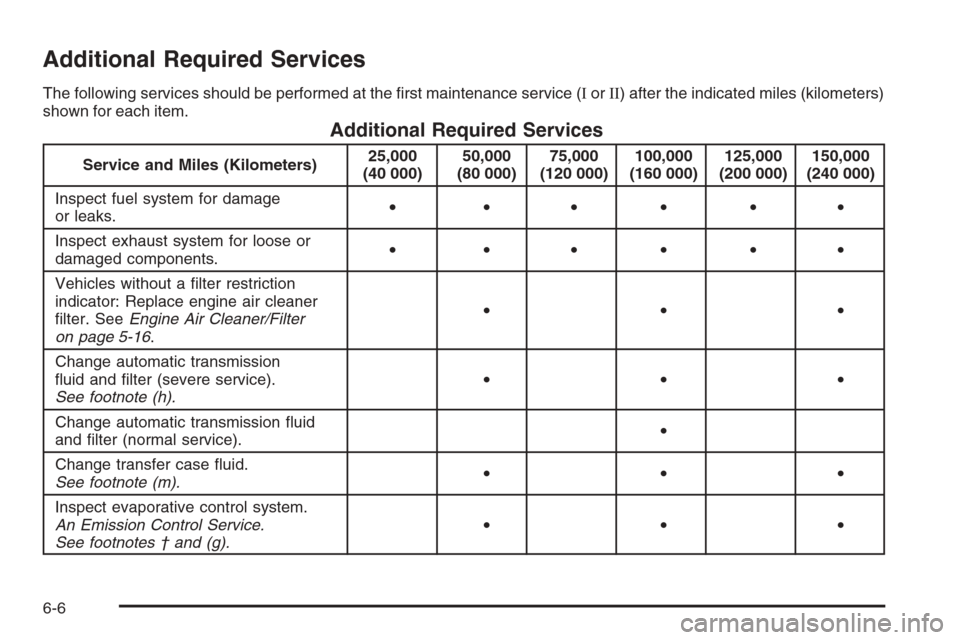
Additional Required Services
The following services should be performed at the rst maintenance service (IorII) after the indicated miles (kilometers)
shown for each item.
Additional Required Services
Service and Miles (Kilometers)25,000
(40 000)50,000
(80 000)75,000
(120 000)100,000
(160 000)125,000
(200 000)150,000
(240 000)
Inspect fuel system for damage
or leaks.• •••••
Inspect exhaust system for loose or
damaged components.• •••••
Vehicles without a lter restriction
indicator: Replace engine air cleaner
lter. SeeEngine Air Cleaner/Filter
on page 5-16.•••
Change automatic transmission
uid and lter (severe service).
See footnote (h).•••
Change automatic transmission uid
and lter (normal service).•
Change transfer case uid.
See footnote (m).•••
Inspect evaporative control system.
An Emission Control Service.
See footnotes † and (g).•••
6-6
Page 441 of 484
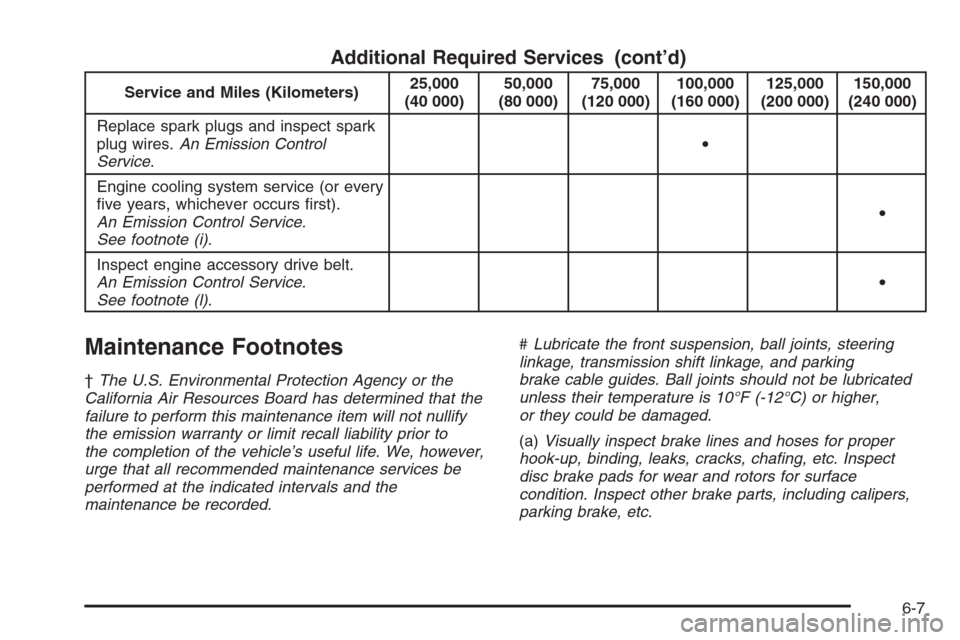
Additional Required Services (cont’d)
Service and Miles (Kilometers)25,000
(40 000)50,000
(80 000)75,000
(120 000)100,000
(160 000)125,000
(200 000)150,000
(240 000)
Replace spark plugs and inspect spark
plug wires.An Emission Control
Service.•
Engine cooling system service (or every
ve years, whichever occurs rst).
An Emission Control Service.
See footnote (i).•
Inspect engine accessory drive belt.
An Emission Control Service.
See footnote (l).•
Maintenance Footnotes
†The U.S. Environmental Protection Agency or the
California Air Resources Board has determined that the
failure to perform this maintenance item will not nullify
the emission warranty or limit recall liability prior to
the completion of the vehicle’s useful life. We, however,
urge that all recommended maintenance services be
performed at the indicated intervals and the
maintenance be recorded.#Lubricate the front suspension, ball joints, steering
linkage, transmission shift linkage, and parking
brake cable guides. Ball joints should not be lubricated
unless their temperature is 10°F (-12°C) or higher,
or they could be damaged.
(a)Visually inspect brake lines and hoses for proper
hook-up, binding, leaks, cracks, chang, etc. Inspect
disc brake pads for wear and rotors for surface
condition. Inspect other brake parts, including calipers,
parking brake, etc.
6-7