lock CADILLAC ESCALADE 2009 3.G Owners Manual
[x] Cancel search | Manufacturer: CADILLAC, Model Year: 2009, Model line: ESCALADE, Model: CADILLAC ESCALADE 2009 3.GPages: 586, PDF Size: 4.47 MB
Page 400 of 586
Loading the Vehicle
It is very important to know how much weight
your vehicle can carry. This weight is called the
vehicle capacity weight and includes the weight of
all occupants, cargo, and all nonfactory-installed
options. Two labels on your vehicle show how
much weight it was designed to carry, the Tire and
Loading Information label and the Certication/Tire
label.
{CAUTION:
Do not load the vehicle any heavier than the
Gross Vehicle Weight Rating (GVWR), or
either the maximum front or rear Gross Axle
Weight Rating (GAWR). If you do, parts on
the vehicle can break, and it can change the
way your vehicle handles. These could cause
you to lose control and crash. Also,
overloading can shorten the life of the
vehicle.Tire and Loading Information Label
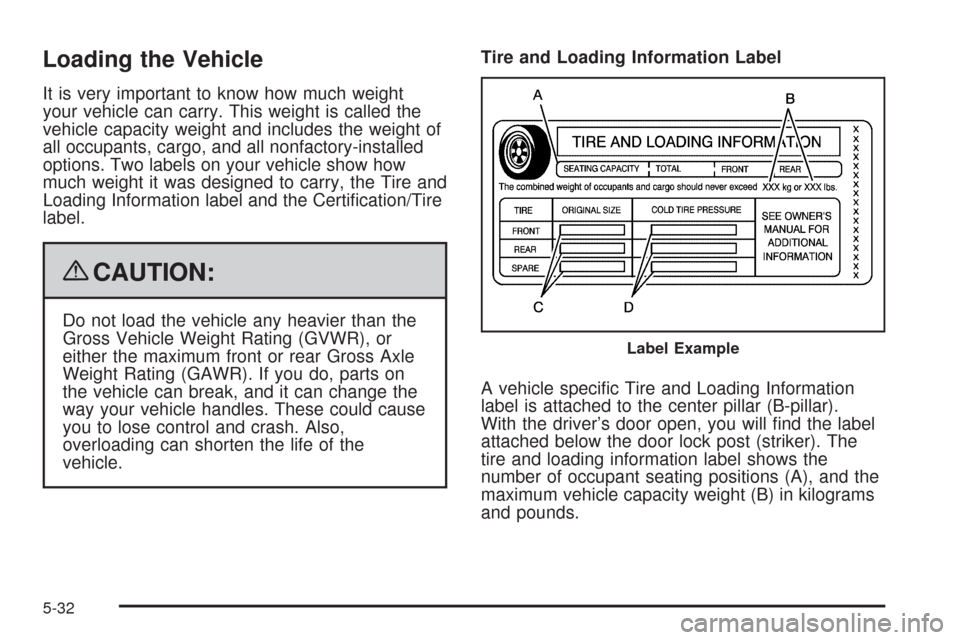
A vehicle specic Tire and Loading Information
label is attached to the center pillar (B-pillar).
With the driver’s door open, you will nd the label
attached below the door lock post (striker). The
tire and loading information label shows the
number of occupant seating positions (A), and the
maximum vehicle capacity weight (B) in kilograms
and pounds.
Label Example
5-32
Page 406 of 586
The system is activated when the ignition key is
turned to RUN and will automatically adjust vehicle
height thereafter. The system may exhaust (lower
vehicle height) for up to 10 minutes after the ignition
key has been turned to LOCK. You may hear the air
compressor operating when the height is being
adjusted.
If a weight-distributing hitch is being used, it is
recommended to allow the shocks to inate,
thereby leveling the vehicle prior to adjusting the
height. See “Weight distributing Hitches and
Weight Carrying Hitches” underTowing a Trailer
on page 5-42
.
Towing
Towing Your Vehicle
To avoid damage, the disabled vehicle should be towed
with all four wheels off the ground. Consult your
dealer/retailer or a professional towing service if the
disabled vehicle must be towed. SeeRoadside Service
on page 8-7.
To tow the vehicle behind another vehicle for
recreational purposes (such as behind a motorhome),
see “Recreational Vehicle Towing” following.
Recreational Vehicle Towing
Recreational vehicle towing means towing the vehicle
behind another vehicle – such as behind a motorhome.
The two most common types of recreational vehicle
towing are known as “dinghy towing” (towing the vehicle
with all four wheels on the ground) and “dolly towing”
(towing the vehicle with two wheels on the ground
and two wheels up on a device known as a “dolly”).
Here are some important things to consider before
recreational vehicle towing:
What is the towing capacity of the towing vehicle?
Be sure to read the tow vehicle manufacturer’s
recommendations.
What is the distance that will be travelled? Some
vehicles have restrictions on how far and how
long they can tow.
Is the proper towing equipment going to be used?
See your dealer/retailer or trailering professional
for additional advice and equipment
recommendations.
Is the vehicle ready to be towed? Just as preparing
the vehicle for a long trip, make sure the vehicle is
prepared to be towed. SeeBefore Leaving on a
Long Trip on page 5-26.
5-38
Page 409 of 586
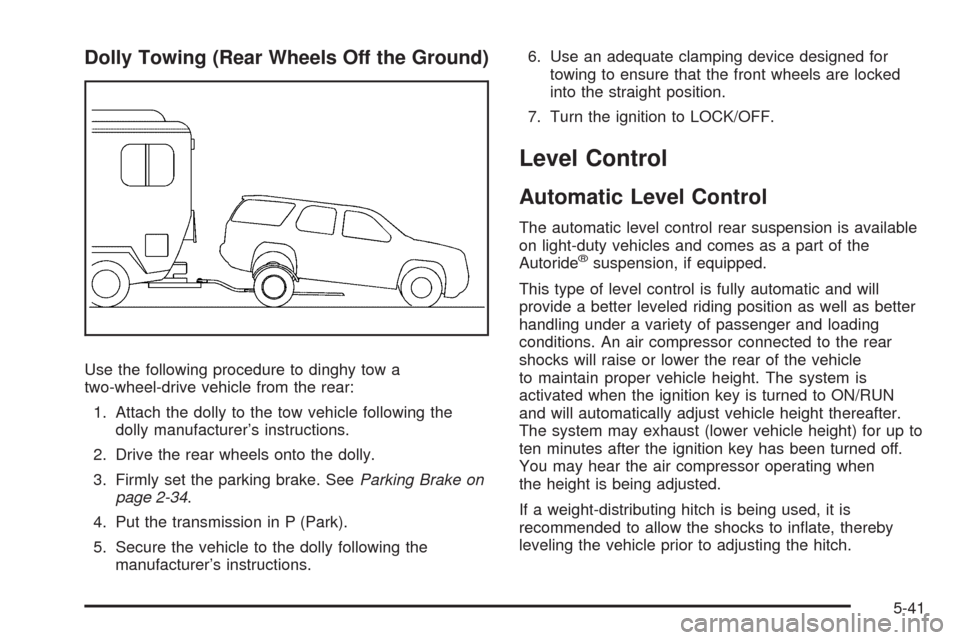
Dolly Towing (Rear Wheels Off the Ground)
Use the following procedure to dinghy tow a
two-wheel-drive vehicle from the rear:
1. Attach the dolly to the tow vehicle following the
dolly manufacturer’s instructions.
2. Drive the rear wheels onto the dolly.
3. Firmly set the parking brake. SeeParking Brake on
page 2-34.
4. Put the transmission in P (Park).
5. Secure the vehicle to the dolly following the
manufacturer’s instructions.6. Use an adequate clamping device designed for
towing to ensure that the front wheels are locked
into the straight position.
7. Turn the ignition to LOCK/OFF.
Level Control
Automatic Level Control
The automatic level control rear suspension is available
on light-duty vehicles and comes as a part of the
Autoride
®suspension, if equipped.
This type of level control is fully automatic and will
provide a better leveled riding position as well as better
handling under a variety of passenger and loading
conditions. An air compressor connected to the rear
shocks will raise or lower the rear of the vehicle
to maintain proper vehicle height. The system is
activated when the ignition key is turned to ON/RUN
and will automatically adjust vehicle height thereafter.
The system may exhaust (lower vehicle height) for up to
ten minutes after the ignition key has been turned off.
You may hear the air compressor operating when
the height is being adjusted.
If a weight-distributing hitch is being used, it is
recommended to allow the shocks to inate, thereby
leveling the vehicle prior to adjusting the hitch.
5-41
Page 416 of 586
When pulling a trailer that, when loaded, will weigh
more than 5,000 lbs (2 270 kg) be sure to use a properly
mounted weight-distributing hitch and sway control of
the proper size. This equipment is very important
for proper vehicle loading and good handling when
driving. Always use sway control if the trailer will weigh
more than these limits. Ask a hitch dealer about
sway controls.
Hitch Cover
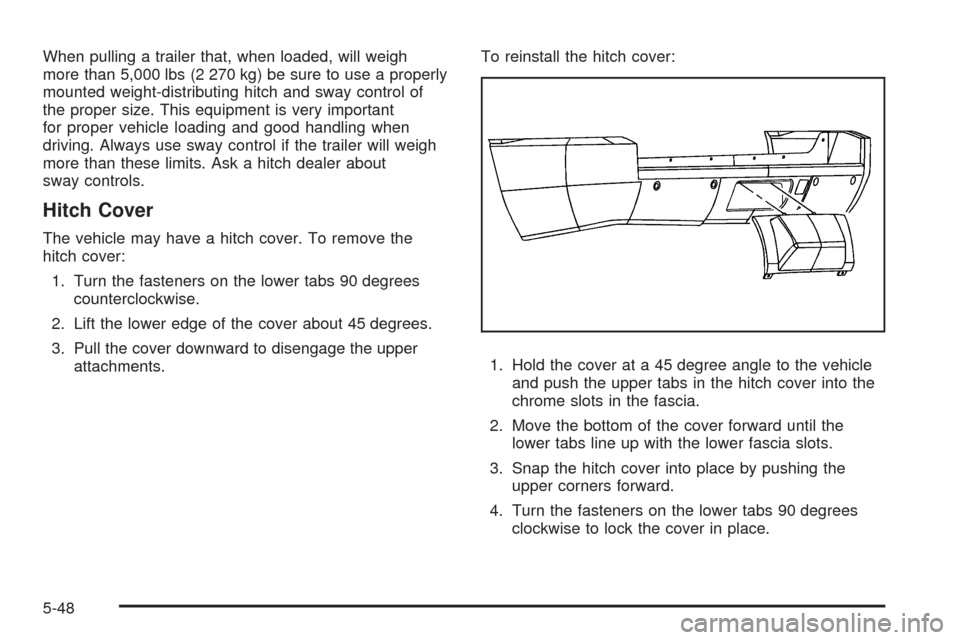
The vehicle may have a hitch cover. To remove the
hitch cover:
1. Turn the fasteners on the lower tabs 90 degrees
counterclockwise.
2. Lift the lower edge of the cover about 45 degrees.
3. Pull the cover downward to disengage the upper
attachments.To reinstall the hitch cover:
1. Hold the cover at a 45 degree angle to the vehicle
and push the upper tabs in the hitch cover into the
chrome slots in the fascia.
2. Move the bottom of the cover forward until the
lower tabs line up with the lower fascia slots.
3. Snap the hitch cover into place by pushing the
upper corners forward.
4. Turn the fasteners on the lower tabs 90 degrees
clockwise to lock the cover in place.
5-48
Page 426 of 586
Tire Pressure Monitor Operation.....................6-65
Tire Inspection and Rotation...........................6-68
When It Is Time for New Tires.......................6-69
Buying New Tires.........................................6-70
Different Size Tires and Wheels......................6-72
Uniform Tire Quality Grading..........................6-72
Wheel Alignment and Tire Balance..................6-74
Wheel Replacement......................................6-74
Tire Chains..................................................6-75
If a Tire Goes Flat........................................6-76
Changing a Flat Tire.....................................6-76
Removing the Spare Tire and Tools................6-78
Removing the Flat Tire and Installing
the Spare Tire..........................................6-82
Secondary Latch System...............................6-86
Storing a Flat or Spare Tire
and Tools.................................................6-89
Spare Tire...................................................6-93
Appearance Care............................................6-94
Interior Cleaning...........................................6-94
Fabric/Carpet...............................................6-95
Leather.......................................................6-96
Instrument Panel, Vinyl, and Other
Plastic Surfaces........................................6-96
Wood Panels...............................................6-97
Speaker Covers............................................6-97Care of Safety Belts......................................6-97
Weatherstrips...............................................6-97
Washing Your Vehicle...................................6-98
Cleaning Exterior Lamps/Lenses.....................6-98
Finish Care..................................................6-98
Windshield, Backglass, and Wiper Blades.........6-99
Aluminum or Chrome-Plated Wheels
and Trim................................................6-100
Tires.........................................................6-101
Sheet Metal Damage...................................6-101
Finish Damage
...........................................6-101
Underbody Maintenance...............................6-101
Chemical Paint Spotting...............................6-101
Vehicle Identication.....................................6-102
Vehicle Identication Number (VIN)................6-102
Service Parts Identication Label...................6-102
Electrical System..........................................6-102
Add-On Electrical Equipment.........................6-102
Windshield Wiper Fuses...............................6-103
Power Windows and Other Power Options......6-103
Fuses and Circuit Breakers..........................6-103
Instrument Panel Fuse Block........................6-103
Center Instrument Panel Fuse Block..............6-105
Underhood Fuse Block................................6-106
Capacities and Specications........................6-110
Section 6 Service and Appearance Care
6-2
Page 427 of 586
Service
For service and parts needs, visit your dealer/retailer.
You will receive genuine GM parts and GM-trained and
supported service people.
Genuine GM parts have one of these marks:
Accessories and Modications
When non-dealer/non-retailer accessories are added to
the vehicle, they can affect vehicle performance and
safety, including such things as airbags, braking, stability,
ride and handling, emissions systems, aerodynamics,
durability, and electronic systems like antilock brakes,
traction control, and stability control. Some of these
accessories could even cause malfunction or damage not
covered by the vehicle warranty.
Damage to vehicle components resulting from the
installation or use of non-GM certied parts, including
control module modications, are not covered under the
terms of the vehicle warranty and may affect remaining
warranty coverage for affected parts.
GM Accessories are designed to complement and
function with other systems on the vehicle. Your GM
dealer/retailer can accessorize the vehicle using genuine
GM Accessories. When you go to your GM
dealer/retailer and ask for GM Accessories, you will
know that GM-trained and supported service technicians
will perform the work using genuine GM Accessories.
Also, seeAdding Equipment to Your Airbag-Equipped
Vehicle on page 1-91.
6-3
Page 434 of 586
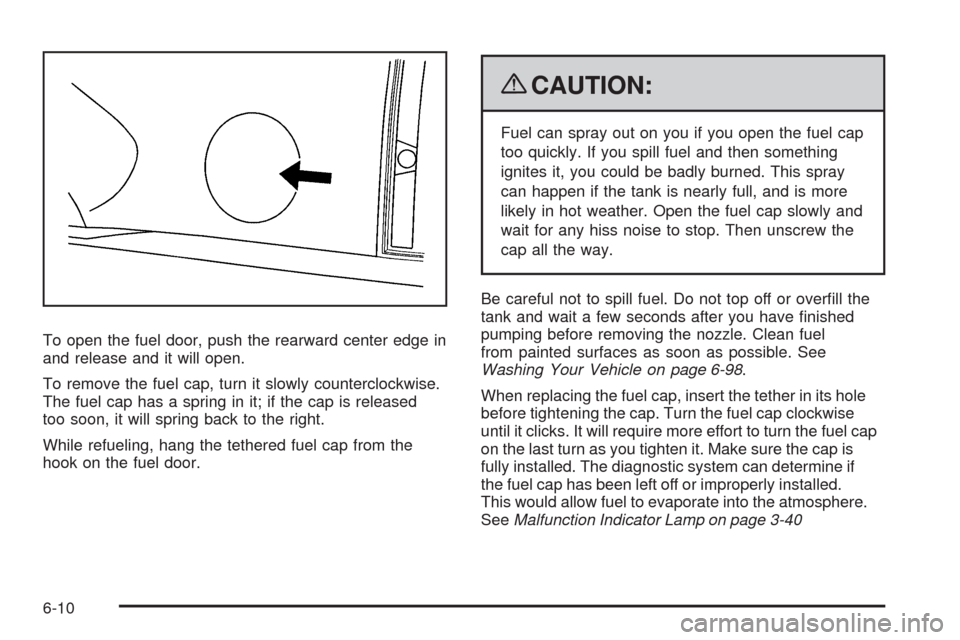
To open the fuel door, push the rearward center edge in
and release and it will open.
To remove the fuel cap, turn it slowly counterclockwise.
The fuel cap has a spring in it; if the cap is released
too soon, it will spring back to the right.
While refueling, hang the tethered fuel cap from the
hook on the fuel door.
{CAUTION:
Fuel can spray out on you if you open the fuel cap
too quickly. If you spill fuel and then something
ignites it, you could be badly burned. This spray
can happen if the tank is nearly full, and is more
likely in hot weather. Open the fuel cap slowly and
wait for any hiss noise to stop. Then unscrew the
cap all the way.
Be careful not to spill fuel. Do not top off or overll the
tank and wait a few seconds after you have nished
pumping before removing the nozzle. Clean fuel
from painted surfaces as soon as possible. See
Washing Your Vehicle on page 6-98.
When replacing the fuel cap, insert the tether in its hole
before tightening the cap. Turn the fuel cap clockwise
until it clicks. It will require more effort to turn the fuel cap
on the last turn as you tighten it. Make sure the cap is
fully installed. The diagnostic system can determine if
the fuel cap has been left off or improperly installed.
This would allow fuel to evaporate into the atmosphere.
SeeMalfunction Indicator Lamp on page 3-40
6-10
Page 439 of 586
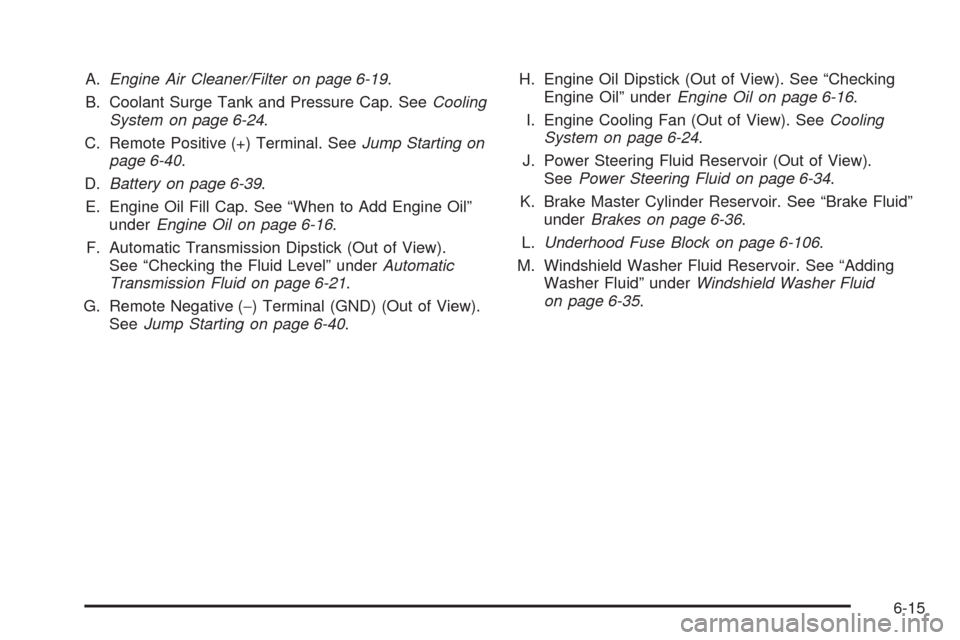
A.Engine Air Cleaner/Filter on page 6-19.
B. Coolant Surge Tank and Pressure Cap. SeeCooling
System on page 6-24.
C. Remote Positive (+) Terminal. SeeJump Starting on
page 6-40.
D.Battery on page 6-39.
E. Engine Oil Fill Cap. See “When to Add Engine Oil”
underEngine Oil on page 6-16.
F. Automatic Transmission Dipstick (Out of View).
See “Checking the Fluid Level” underAutomatic
Transmission Fluid on page 6-21.
G. Remote Negative (−) Terminal (GND) (Out of View).
SeeJump Starting on page 6-40.H. Engine Oil Dipstick (Out of View). See “Checking
Engine Oil” underEngine Oil on page 6-16.
I. Engine Cooling Fan (Out of View). SeeCooling
System on page 6-24.
J. Power Steering Fluid Reservoir (Out of View).
SeePower Steering Fluid on page 6-34.
K. Brake Master Cylinder Reservoir. See “Brake Fluid”
underBrakes on page 6-36.
L.Underhood Fuse Block on page 6-106.
M. Windshield Washer Fluid Reservoir. See “Adding
Washer Fluid” underWindshield Washer Fluid
on page 6-35.
6-15
Page 447 of 586
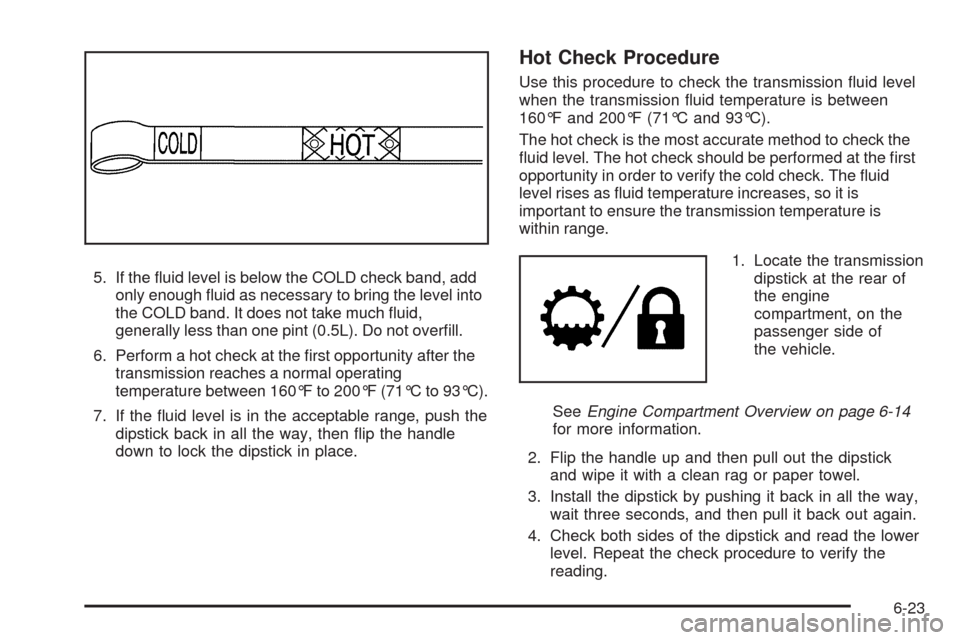
5. If the uid level is below the COLD check band, add
only enough uid as necessary to bring the level into
the COLD band. It does not take much uid,
generally less than one pint (0.5L). Do not overll.
6. Perform a hot check at the rst opportunity after the
transmission reaches a normal operating
temperature between 160°F to 200°F (71°C to 93°C).
7. If the uid level is in the acceptable range, push the
dipstick back in all the way, then ip the handle
down to lock the dipstick in place.
Hot Check Procedure
Use this procedure to check the transmission uid level
when the transmission uid temperature is between
160°F and 200°F (71°C and 93°C).
The hot check is the most accurate method to check the
uid level. The hot check should be performed at the rst
opportunity in order to verify the cold check. The uid
level rises as uid temperature increases, so it is
important to ensure the transmission temperature is
within range.
1. Locate the transmission
dipstick at the rear of
the engine
compartment, on the
passenger side of
the vehicle.
SeeEngine Compartment Overview on page 6-14
for more information.
2. Flip the handle up and then pull out the dipstick
and wipe it with a clean rag or paper towel.
3. Install the dipstick by pushing it back in all the way,
wait three seconds, and then pull it back out again.
4. Check both sides of the dipstick and read the lower
level. Repeat the check procedure to verify the
reading.
6-23
Page 448 of 586
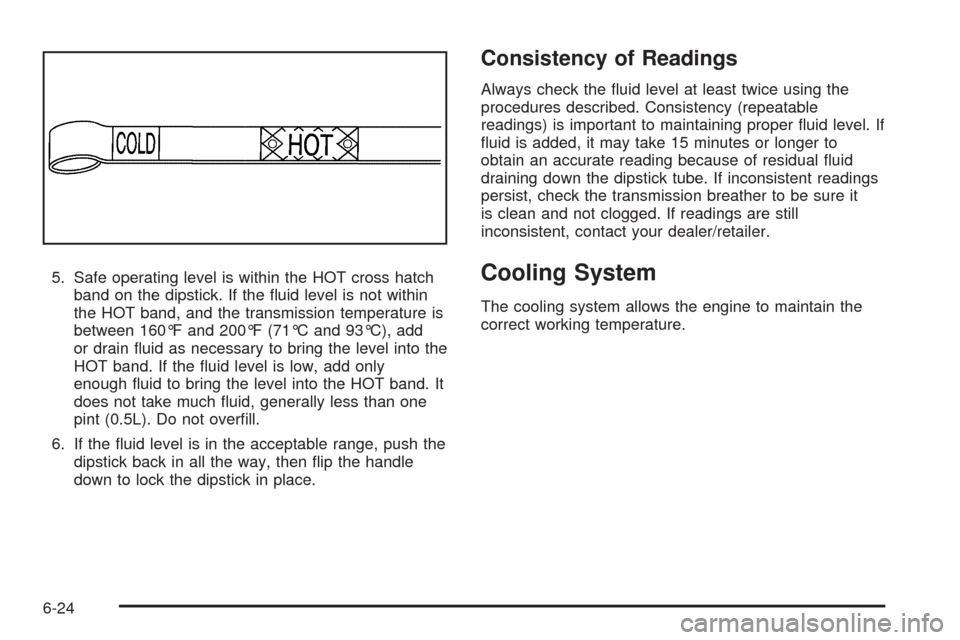
5. Safe operating level is within the HOT cross hatch
band on the dipstick. If the uid level is not within
the HOT band, and the transmission temperature is
between 160°F and 200°F (71°C and 93°C), add
or drain uid as necessary to bring the level into the
HOT band. If the uid level is low, add only
enough uid to bring the level into the HOT band. It
does not take much uid, generally less than one
pint (0.5L). Do not overll.
6. If the uid level is in the acceptable range, push the
dipstick back in all the way, then ip the handle
down to lock the dipstick in place.
Consistency of Readings
Always check the uid level at least twice using the
procedures described. Consistency (repeatable
readings) is important to maintaining proper uid level. If
uid is added, it may take 15 minutes or longer to
obtain an accurate reading because of residual uid
draining down the dipstick tube. If inconsistent readings
persist, check the transmission breather to be sure it
is clean and not clogged. If readings are still
inconsistent, contact your dealer/retailer.
Cooling System
The cooling system allows the engine to maintain the
correct working temperature.
6-24