maintenance CADILLAC ESCALADE 2010 3.G Owner's Manual
[x] Cancel search | Manufacturer: CADILLAC, Model Year: 2010, Model line: ESCALADE, Model: CADILLAC ESCALADE 2010 3.GPages: 616, PDF Size: 39.41 MB
Page 495 of 616
3. Disconnect the red positive (+) cable from thevehicle with the good battery.
4. Disconnect the red positive (+) cable from theother vehicle.
5. Return the remote positive (+) terminal cover,if the vehicle has one, to its original position.
All-Wheel Drive
Transfer Case
If your vehicle is equipped with All-Wheel Drive, be sureto perform the lubricant checks described in thissection. There are two additional systems that needlubrication.
When to Check Lubricant
Refer to the Maintenance Schedule to determine howoften to check the lubricant. SeeScheduledMaintenance on page 8!3.
How to Check Lubricant
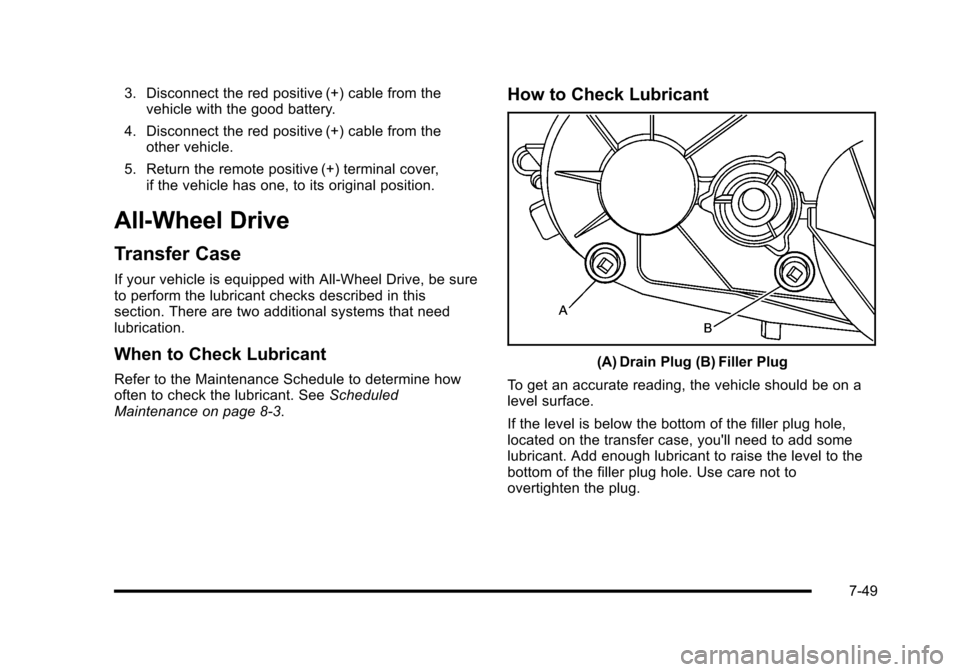
(A) Drain Plug (B) Filler Plug
To get an accurate reading, the vehicle should be on alevel surface.
If the level is below the bottom of the filler plug hole,located on the transfer case, you'll need to add somelubricant. Add enough lubricant to raise the level to thebottom of the filler plug hole. Use care not toovertighten the plug.
7-49
Page 496 of 616
What to Use
Refer to the Maintenance Schedule to determine whatkind of lubricant to use. SeeRecommended Fluids andLubricants on page 8!10.
Rear Axle
When to Check Lubricant
It is not necessary to regularly check rear axle fluidunless you suspect there is a leak or you hear anunusual noise. A fluid loss could indicate a problem.Have it inspected and repaired.
All axle assemblies are filled by volume of fluid duringproduction. They are not filled to reach a certain level.When checking the fluid level on any axle, variations inthe readings can be caused by factory fill differencesbetween the minimum and the maximum fluid volume.Also, if a vehicle has just been driven before checkingthe fluid level, it may appear lower than normal becausefluid has traveled out along the axle tubes and has notdrained back to the sump area. Therefore, a readingtaken five minutes after the vehicle has been driven willappear to have a lower fluid level than a vehicle thathas been stationary for an hour or two. Remember thatthe rear axle assembly must be supported to get a truereading.
How to Check Lubricant
To get an accurate reading, the vehicle should be on alevel surface.
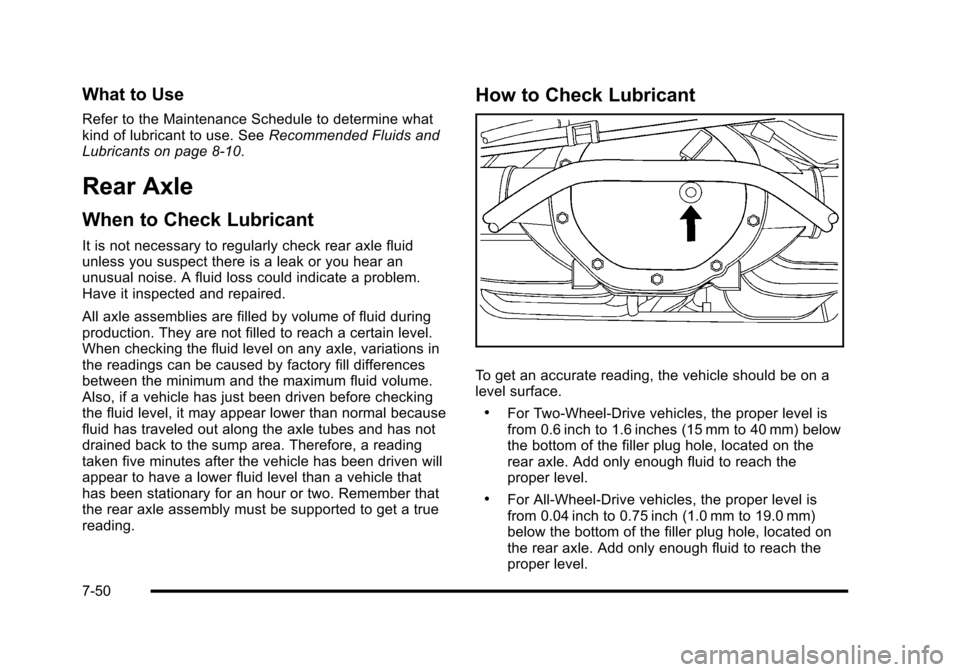
.For Two-Wheel-Drive vehicles, the proper level isfrom 0.6 inch to 1.6 inches (15 mm to 40 mm) belowthe bottom of the filler plug hole, located on therear axle. Add only enough fluid to reach theproper level.
.For All-Wheel-Drive vehicles, the proper level isfrom 0.04 inch to 0.75 inch (1.0 mm to 19.0 mm)below the bottom of the filler plug hole, located onthe rear axle. Add only enough fluid to reach theproper level.
7-50
Page 497 of 616
What to Use
Refer to the Maintenance Schedule to determine whatkind of lubricant to use. SeeRecommended Fluids andLubricants on page 8!10.
Front Axle
When to Check and Change Lubricant
It is not necessary to regularly check front axle fluidunless you suspect there is a leak or you hear anunusual noise. A fluid loss could indicate a problem.Have it inspected and repaired.
How to Check Lubricant
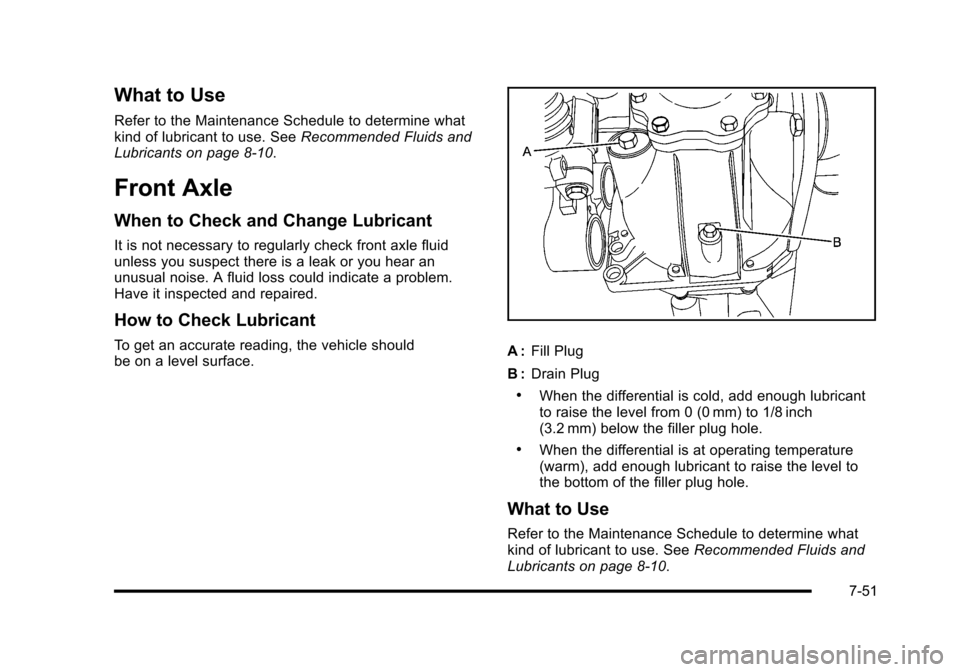
To get an accurate reading, the vehicle shouldbe on a level surface.A:Fill Plug
B:Drain Plug
.When the differential is cold, add enough lubricantto raise the level from 0 (0 mm) to 1/8 inch(3.2 mm) below the filler plug hole.
.When the differential is at operating temperature(warm), add enough lubricant to raise the level tothe bottom of the filler plug hole.
What to Use
Refer to the Maintenance Schedule to determine whatkind of lubricant to use. SeeRecommended Fluids andLubricants on page 8!10.
7-51
Page 503 of 616
Windshield Wiper Blade
Replacement
Windshield wiper blades should be inspected for wearor cracking. SeeScheduled Maintenance on page 8!3.
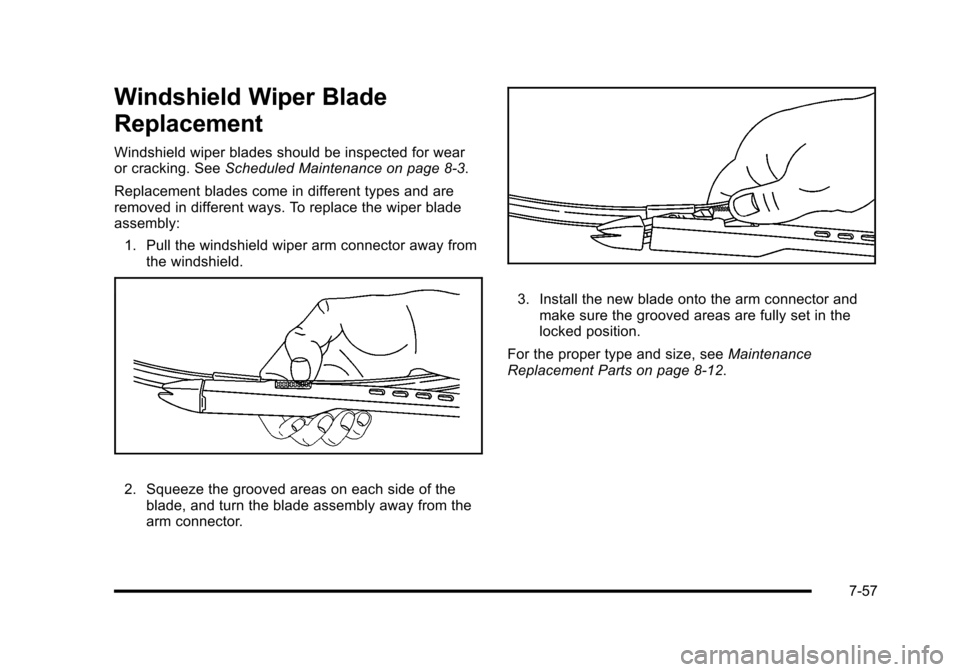
Replacement blades come in different types and areremoved in different ways. To replace the wiper bladeassembly:
1. Pull the windshield wiper arm connector away fromthe windshield.
2. Squeeze the grooved areas on each side of theblade, and turn the blade assembly away from thearm connector.
3. Install the new blade onto the arm connector andmake sure the grooved areas are fully set in thelocked position.
For the proper type and size, seeMaintenanceReplacement Parts on page 8!12.
7-57
Page 513 of 616
Tire Pressure Monitor System
The Tire Pressure Monitor System (TPMS) uses radioand sensor technology to check tire pressure levels.The TPMS sensors monitor the air pressure in yourvehicle's tires and transmit tire pressure readings to areceiver located in the vehicle.
Each tire, including the spare (if provided), should bechecked monthly when cold and inflated to the inflationpressure recommended by the vehicle manufactureron the vehicle placard or tire inflation pressure label.(If your vehicle has tires of a different size than the sizeindicated on the vehicle placard or tire inflation pressurelabel, you should determine the proper tire inflationpressure for those tires.)
As an added safety feature, your vehicle has beenequipped with a tire pressure monitoring system(TPMS) that illuminates a low tire pressure telltale whenone or more of your tires is significantly under!inflated.
Accordingly, when the low tire pressure telltaleilluminates, you should stop and check your tires assoon as possible, and inflate them to the properpressure. Driving on a significantly under!inflated tirecauses the tire to overheat and can lead to tire failure.Under!inflation also reduces fuel efficiency and tiretread life, and may affect the vehicle's handling andstopping ability.
Please note that the TPMS is not a substitute for propertire maintenance, and it is the driver's responsibility tomaintain correct tire pressure, even if under!inflationhas not reached the level to trigger illumination of theTPMS low tire pressure telltale.
Your vehicle has also been equipped with a TPMSmalfunction indicator to indicate when the system isnot operating properly. The TPMS malfunction indicatoris combined with the low tire pressure telltale. Whenthe system detects a malfunction, the telltale will flashfor approximately one minute and then remaincontinuously illuminated. This sequence will continueupon subsequent vehicle start!ups as long as themalfunction exists.
When the malfunction indicator is illuminated, thesystem may not be able to detect or signal low tirepressure as intended. TPMS malfunctions may occurfor a variety of reasons, including the installation ofreplacement or alternate tires or wheels on the vehiclethat prevent the TPMS from functioning properly.Always check the TPMS malfunction telltale afterreplacing one or more tires or wheels on your vehicle toensure that the replacement or alternate tires andwheels allow the TPMS to continue to function properly.
SeeTire Pressure Monitor Operationon page 7!68foradditional information.
7-67
Page 515 of 616
Your vehicle's TPMS can warn you about a low tirepressure condition but it does not replace normal tiremaintenance. SeeTire Inspection and Rotationonpage 7!71andTires on page 7!58.
Notice:Liquid tire sealants could damage the TirePressure Monitor System (TPMS) sensors. Sensordamage caused by using a tire sealant is notcovered by your warranty. Do not use liquid tiresealants.
TPMS Malfunction Light and Message
The TPMS will not function properly if one or more ofthe TPMS sensors are missing or inoperable. When thesystem detects a malfunction, the low tire warning lightflashes for about one minute and then stays on for theremainder of the ignition cycle. A DIC warning messageis also displayed. The low tire warning light and DICwarning message come on at each ignition cycle untilthe problem is corrected. Some of the conditions thatcan cause the malfunction light and DIC message tocome on are:
.One of the road tires has been replaced with thespare tire. The spare tire does not have a TPMSsensor. The TPMS malfunction light and DICmessage should go off once you re!install theroad tire containing the TPMS sensor.
.The TPMS sensor matching process was startedbut not completed or not completed successfullyafter rotating the vehicle's tires. The DIC messageand TPMS malfunction light should go off once theTPMS sensor matching process is performedsuccessfully. See“TPMS Sensor MatchingProcess”later in this section.
.One or more TPMS sensors are missing ordamaged. The DIC message and the TPMSmalfunction light should go off when the TPMSsensors are installed and the sensor matchingprocess is performed successfully. See yourdealer/retailer for service.
.Replacement tires or wheels do not match yourvehicle's original equipment tires or wheels. Tiresand wheels other than those recommended foryour vehicle could prevent the TPMS fromfunctioning properly. SeeBuying New Tiresonpage 7!73.
.Operating electronic devices or being near facilitiesusing radio wave frequencies similar to the TPMScould cause the TPMS sensors to malfunction.
If the TPMS is not functioning it cannot detect or signala low tire condition. See your dealer/retailer for serviceif the TPMS malfunction light and DIC message comeson and stays on.
7-69
Page 517 of 616
5. Remove the valve cap from the valve cap stem.Activate the TPMS sensor by increasing ordecreasing the tire's air pressure for five seconds,or until a horn chirp sounds. The horn chirp, whichmay take up to 30 seconds to sound, confirms thatthe sensor identification code has been matched tothis tire and wheel position.
6. Proceed to the passenger side front tire, andrepeat the procedure in Step 5.
7. Proceed to the passenger side rear tire, and repeatthe procedure in Step 5.
8. Proceed to the driver side rear tire, and repeat theprocedure in Step 5. The horn sounds two times toindicate the sensor identification code has beenmatched to the driver side rear tire, and the TPMSsensor matching process is no longer active. TheTIRE LEARNING ACTIVE message on the DICdisplay screen goes off.
9. Turn the ignition switch to LOCK/OFF.
10. Set all four tires to the recommended air pressurelevel as indicated on the Tire and LoadingInformation label.
11. Put the valve caps back on the valve stems.
Tire Inspection and Rotation
We recommend that you regularly inspect your
vehicle's tires, including the spare tire, for signs of
wear or damage. SeeWhen It Is Time for New
Tireson page 7!73for more information.
Tires should be rotated every 5,000 to 8,000 miles
(8 000 to 13 000 km). SeeScheduled Maintenance
on page 8!3.
The purpose of a regular tire rotation is to achieve
a uniform wear for all tires on the vehicle. This will
ensure that your vehicle continues to perform
most like it did when the tires were new.
7-71
Page 519 of 616
When It Is Time for New Tires
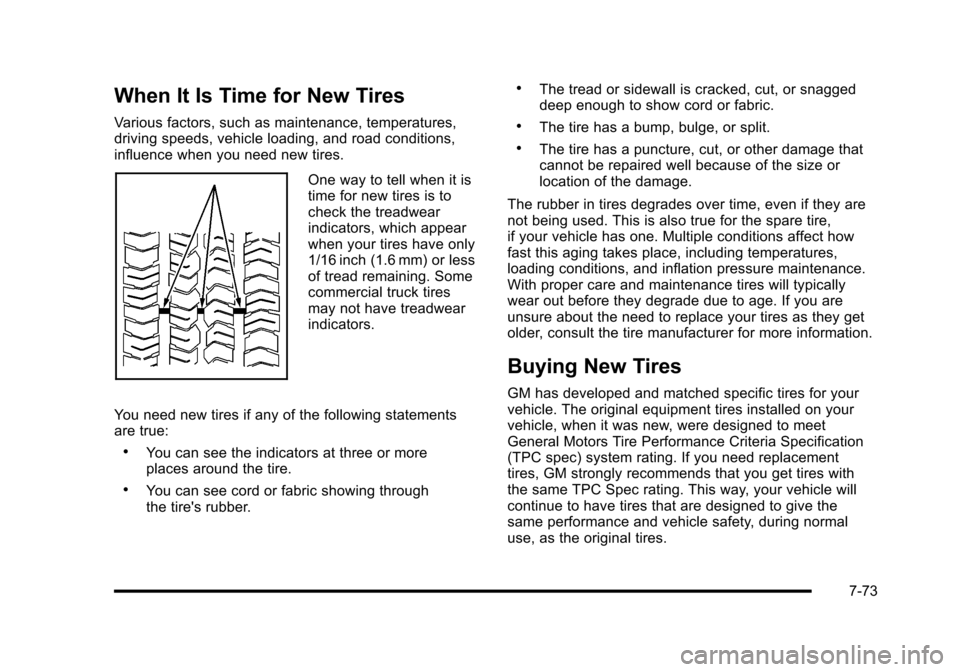
Various factors, such as maintenance, temperatures,driving speeds, vehicle loading, and road conditions,influence when you need new tires.
One way to tell when it istime for new tires is tocheck the treadwearindicators, which appearwhen your tires have only1/16 inch (1.6 mm) or lessof tread remaining. Somecommercial truck tiresmay not have treadwearindicators.
You need new tires if any of the following statementsare true:
.You can see the indicators at three or moreplaces around the tire.
.You can see cord or fabric showing throughthe tire's rubber.
.The tread or sidewall is cracked, cut, or snaggeddeep enough to show cord or fabric.
.The tire has a bump, bulge, or split.
.The tire has a puncture, cut, or other damage thatcannot be repaired well because of the size orlocation of the damage.
The rubber in tires degrades over time, even if they arenot being used. This is also true for the spare tire,if your vehicle has one. Multiple conditions affect howfast this aging takes place, including temperatures,loading conditions, and inflation pressure maintenance.With proper care and maintenance tires will typicallywear out before they degrade due to age. If you areunsure about the need to replace your tires as they getolder, consult the tire manufacturer for more information.
Buying New Tires
GM has developed and matched specific tires for yourvehicle. The original equipment tires installed on yourvehicle, when it was new, were designed to meetGeneral Motors Tire Performance Criteria Specification(TPC spec) system rating. If you need replacementtires, GM strongly recommends that you get tires withthe same TPC Spec rating. This way, your vehicle willcontinue to have tires that are designed to give thesame performance and vehicle safety, during normaluse, as the original tires.
7-73
Page 525 of 616
WARNING: (Continued)
vehicle and tire size combination and road
conditions. Follow that manufacturer's
instructions. To help avoid damage to the vehicle,
drive slowly, re!adjust or remove the device if it is
contacting the vehicle, and do not spin the
wheels. If you do find traction devices that will fit,
install them on the rear tires.
If a Tire Goes Flat
It is unusual for a tire to blowout while you are driving,especially if you maintain your vehicle's tires properly.If air goes out of a tire, it is much more likely to leak outslowly. But if you should ever have a blowout, here area few tips about what to expect and what to do:
If a front tire fails, the flat tire creates a drag that pullsthe vehicle toward that side. Take your foot off theaccelerator pedal and grip the steering wheel firmly.Steer to maintain lane position, and then gently braketo a stop well out of the traffic lane.
A rear blowout, particularly on a curve, acts much like askid and may require the same correction you woulduse in a skid. In any rear blowout remove your foot fromthe accelerator pedal. Get the vehicle under control bysteering the way you want the vehicle to go. It may bevery bumpy and noisy, but you can still steer. Gentlybrake to a stop, well off the road if possible.
{WARNING:
Lifting a vehicle and getting under it to do
maintenance or repairs is dangerous without the
appropriate safety equipment and training. If a
jack is provided with the vehicle, it is designed
only for changing a flat tire. If it is used for
anything else, you or others could be badly
injured or killed if the vehicle slips off the jack.
If a jack is provided with the vehicle, only use
it for changing a flat tire.
If a tire goes flat, the next part shows how to use thejacking equipment to change a flat tire safely.
7-79
Page 552 of 616
Finish Damage
Any stone chips, fractures or deep scratches in thefinish should be repaired right away. Bare metal willcorrode quickly and may develop into major repairexpense.
Minor chips and scratches can be repaired withtouch-up materials available from your dealer/retailer.Larger areas of finish damage can be corrected in yourdealer's/retailer's body and paint shop.
Underbody Maintenance
Chemicals used for ice and snow removal and dustcontrol can collect on the underbody. If these are notremoved, corrosion and rust can develop on theunderbody parts such as fuel lines, frame, floor pan,and exhaust system even though they have corrosionprotection.
At least every spring, flush these materials from theunderbody with plain water. Clean any areas wheremud and debris can collect. Dirt packed in close areasof the frame should be loosened before being flushed.Your dealer/retailer or an underbody car washingsystem can do this.
Chemical Paint Spotting
Some weather and atmospheric conditions can create achemical fallout. Airborne pollutants can fall upon andattack painted surfaces on the vehicle. This damagecan take two forms: blotchy, ring-shaped discolorations,and small, irregular dark spots etched into the paintsurface.
Although no defect in the paint job causes this, we willrepair, at no charge to the owner, the surfaces of newvehicles damaged by this fallout condition within12 months or 12,000 miles (20 000 km) of purchase,whichever occurs first.
7-106