wheel CADILLAC ESCALADE 2010 3.G Workshop Manual
[x] Cancel search | Manufacturer: CADILLAC, Model Year: 2010, Model line: ESCALADE, Model: CADILLAC ESCALADE 2010 3.GPages: 616, PDF Size: 39.41 MB
Page 398 of 616
It is recommended to leave the system on for normaldriving conditions, but it may be necessary to turn thesystem off if the vehicle is stuck in sand, mud, ice orsnow, and you want to“rock”the vehicle to attempt tofree it. It may also be necessary to turn off the systemwhen driving in extreme off-road conditions where highwheel spin is required. SeeIf Your Vehicle is Stuck inSand, Mud, Ice, or Snow on page 6!30.
Traction Control Operation
The traction control system is part of the StabiliTraksystem. Traction control limits wheel spin by reducingengine power to the wheels (engine speedmanagement) and by applying brakes to each individualwheel (brake-traction control) as necessary.
The traction control system is enabled automaticallywhen the vehicle is started. It will activate and theStabiliTrak light will flash if it senses that any of thewheels are spinning or beginning to lose tractionwhile driving. If traction control is turned off, only thebrake-traction control portion of traction control willwork. The engine speed management will be disabled.In this mode, engine power is not reduced automaticallyand the driven wheels can spin more freely. This cancause the brake-traction control to activate constantly.
Notice:If the wheel(s) of one axle is allowed to spinexcessively while the StabiliTrak, ABS and brakewarning lights and any relevant DIC messages aredisplayed, the transfer case could be damaged.The repairs would not be covered by the vehiclewarranty. Reduce engine power and do not spin thewheel(s) excessively while these lights andmessages are displayed.
The traction control system may activate on dry orrough roads or under conditions such as heavyacceleration while turning or abrupt upshifts/downshiftsof the transmission. When this happens, a reduction inacceleration may be noticed, or a noise or vibration maybe heard. This is normal.
If cruise control is being used when the systemactivates, the StabiliTrak light will flash and cruisecontrol will automatically disengage. Cruise control maybe reengaged when road conditions allow. SeeCruiseControl on page 4!8.
StabiliTrak may also turn off automatically if itdetermines that a problem exists with the system.If the problem does not clear itself after restarting thevehicle, see your dealer/retailer for service.
6-8
Page 399 of 616

Magnetic Ride Control™
The vehicle may have the MagneRide control system.MagneRide constantly checks speed, wheel position,lift/dive and steering of the vehicle. The damping forcefor each shock absorber and adjustment level is chosenfor the best ride and handling.
MagneRide also works with the tow/haul switch that,when engaged, will provide more firmness from theshock absorbers. This added control gives better rideand handling when carrying heavy loads or towinga trailer. SeeTow/Haul Modeon page 3!36formore information.
Road Sensing Suspension
The Road Sensing Suspension (RSS) feature providessuperior vehicle ride and handling under a variety ofpassenger and loading conditions.
The system is fully automatic and uses a computercontroller to continuously monitor vehicle speed, wheelto body position, lift/dive and steering position of thevehicle. The controller then sends signals to each shockabsorber to independently adjust the damping level toprovide the optimum vehicle ride.
RSS also interacts with the tow/haul mode that, whenengaged, will provide additional control of the shockabsorbers. This additional control results in better rideand handling characteristics when the vehicle is loadedor towing a trailer. See“Tow/Haul Mode”underTowing aTrailer on page 6!42.
Locking Rear Axle
Vehicles with a locking rear axle can give more tractionon snow, mud, ice, sand or gravel. It works like astandard axle most of the time, but when traction is low,this feature will allow the rear wheel with the mosttraction to move the vehicle.
All-Wheel Drive (AWD) System
If the vehicle has this feature, engine power is sent toall four wheels when extra traction is needed. This islike four-wheel drive, but there is no separate lever orswitch to engage or disengage the front axle. It is fullyautomatic, and adjusts itself as needed for roadconditions.
If the vehicle is a Two-mode Hybrid, see“Four-WheelDrive”in the Two-mode Hybrid Supplement.
6-9
Page 400 of 616
Steering
Power Steering
If the vehicle is a Two!mode Hybrid, see the Two!modeHybrid manual for more information.
If power steering assist is lost because the engine stopsor the system is not functioning, the vehicle can besteered but it will take more effort.
Steering Tips
It is important to take curves at a reasonable speed.
Traction in a curve depends on the condition of the tiresand the road surface, the angle at which the curve isbanked, and vehicle speed. While in a curve, speed isthe one factor that can be controlled.
If there is a need to reduce speed, do it before enteringthe curve, while the front wheels are straight.
Try to adjust the speed so you can drive through thecurve. Maintain a reasonable, steady speed. Wait toaccelerate until out of the curve, and then accelerategently into the straightaway.
Steering in Emergencies
There are times when steering can be more effectivethan braking. For example, you come over a hill andfind a truck stopped in your lane, or a car suddenly pullsout from nowhere, or a child darts out from betweenparked cars and stops right in front of you. Theseproblems can be avoided by braking—if you can stopin time. But sometimes you cannot stop in time becausethere is no room. That is the time for evasiveaction—steering around the problem.
The vehicle can perform very well in emergencieslike these. First, apply the brakes. SeeBrakingonp a g e 6!4. It is better to remove as much speed aspossible from a collision. Then steer around theproblem, to the left or right depending on thespace available.
6-10
Page 401 of 616
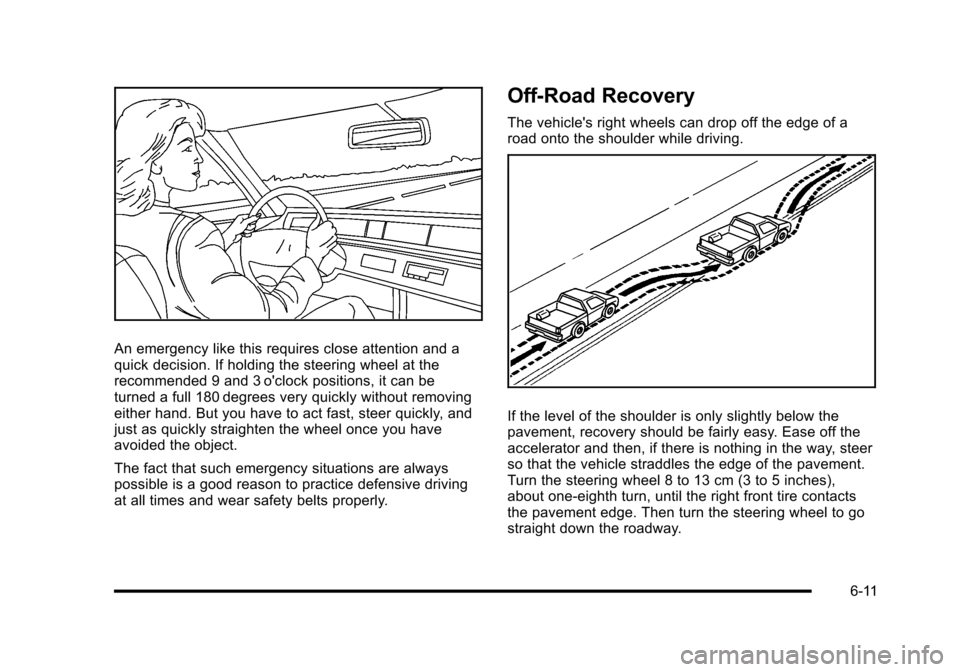
An emergency like this requires close attention and aquick decision. If holding the steering wheel at therecommended 9 and 3 o'clock positions, it can beturned a full 180 degrees very quickly without removingeither hand. But you have to act fast, steer quickly, andjust as quickly straighten the wheel once you haveavoided the object.
The fact that such emergency situations are alwayspossible is a good reason to practice defensive drivingat all times and wear safety belts properly.
Off-Road Recovery
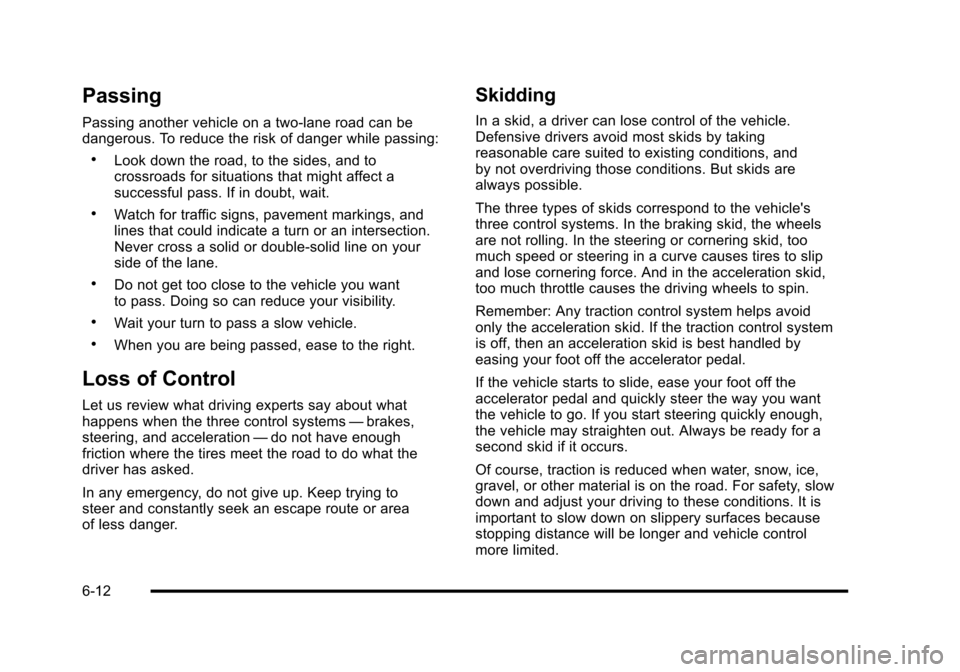
The vehicle's right wheels can drop off the edge of aroad onto the shoulder while driving.
If the level of the shoulder is only slightly below thepavement, recovery should be fairly easy. Ease off theaccelerator and then, if there is nothing in the way, steerso that the vehicle straddles the edge of the pavement.Turn the steering wheel 8 to 13 cm (3 to 5 inches),about one-eighth turn, until the right front tire contactsthe pavement edge. Then turn the steering wheel to gostraight down the roadway.
6-11
Page 402 of 616
Passing
Passing another vehicle on a two-lane road can bedangerous. To reduce the risk of danger while passing:
.Look down the road, to the sides, and tocrossroads for situations that might affect asuccessful pass. If in doubt, wait.
.Watch for traffic signs, pavement markings, andlines that could indicate a turn or an intersection.Never cross a solid or double!solid line on yourside of the lane.
.Do not get too close to the vehicle you wantto pass. Doing so can reduce your visibility.
.Wait your turn to pass a slow vehicle.
.When you are being passed, ease to the right.
Loss of Control
Let us review what driving experts say about whathappens when the three control systems—brakes,steering, and acceleration—do not have enoughfriction where the tires meet the road to do what thedriver has asked.
In any emergency, do not give up. Keep trying tosteer and constantly seek an escape route or areaof less danger.
Skidding
In a skid, a driver can lose control of the vehicle.Defensive drivers avoid most skids by takingreasonable care suited to existing conditions, andby not overdriving those conditions. But skids arealways possible.
The three types of skids correspond to the vehicle'sthree control systems. In the braking skid, the wheelsare not rolling. In the steering or cornering skid, toomuch speed or steering in a curve causes tires to slipand lose cornering force. And in the acceleration skid,too much throttle causes the driving wheels to spin.
Remember: Any traction control system helps avoidonly the acceleration skid. If the traction control systemis off, then an acceleration skid is best handled byeasing your foot off the accelerator pedal.
If the vehicle starts to slide, ease your foot off theaccelerator pedal and quickly steer the way you wantthe vehicle to go. If you start steering quickly enough,the vehicle may straighten out. Always be ready for asecond skid if it occurs.
Of course, traction is reduced when water, snow, ice,gravel, or other material is on the road. For safety, slowdown and adjust your driving to these conditions. It isimportant to slow down on slippery surfaces becausestopping distance will be longer and vehicle controlmore limited.
6-12
Page 403 of 616
While driving on a surface with reduced traction, tryyour best to avoid sudden steering, acceleration,or braking, including reducing vehicle speed by shiftingto a lower gear. Any sudden changes could cause thetires to slide. You may not realize the surface is slipperyuntil the vehicle is skidding. Learn to recognize warningclues—such as enough water, ice, or packed snow onthe road to make a mirrored surface—and slow downwhen you have any doubt.
Remember: Antilock brakes help avoid only thebraking skid.
Off-Road Driving
Vehicles with all!wheel drive can be used for off!roaddriving. Vehicles without all!wheel drive and vehicleswith 22!inch tire/wheel assemblies should not be drivenoff-road except on a level, solid surface.
Many of the vehicle design features that help make thevehicle more responsive on paved roads during poorweather conditions also help make it better suited foroff!road use than conventional passenger vehicles.The vehicle does not have features usually thought tobe necessary for extended or severe off!road use suchas special underbody shielding and transfer case lowgear range.
The airbag system is designed to work properly under awide range of conditions, including off!road usage.Always wear your safety belt and observe safe drivingspeeds, especially on rough terrain.
Drinking and driving can be very dangerous on anyroad and this is certainly true for off-road driving.At the very time you need special alertness and drivingskills, your reflexes, perceptions, and judgment can beaffected by even a small amount of alcohol. You couldhave a serious—or even fatal—accident if you drinkand drive or ride with a driver who has been drinking.
Off-roading can be great fun but has some definitehazards. The greatest of these is the terrain itself. Whenoff-road driving, traffic lanes are not marked, curves arenot banked, and there are no road signs. Surfaces canbe slippery, rough, uphill, or downhill.
Avoid sharp turns and abrupt maneuvers. Failure tooperate the vehicle correctly off!road could result in lossof vehicle control or vehicle rollover.
Off-roading involves some new skills. That is why it isvery important that you read these driving tips andsuggestions to help make off-road driving safer andmore enjoyable.
6-13
Page 404 of 616

Before You Go Off-Roading
.Have all necessary maintenance and servicework done.
.Make sure there is enough fuel, that fluid levels arewhere they should be, and that the spare tire, if thevehicle has one, is fully inflated.
.Be sure to read all the information aboutall-wheel-drive vehicles in this manual.
.Make sure all underbody shields, if the vehicle hasthem, are properly attached.
.Know the local laws that apply to off-roading whereyou will be driving or check with law enforcementpeople in the area.
.Be sure to get the necessary permission if you willbe on private land.
If you think you will need some more ground clearanceat the front of your vehicle, you can remove the frontfascia lower air dam. The air dam is held in place bytwo bolts and 10 snaps accessible from underneaththe front fascia.
To remove the air dam:
1. Remove the two outboard air dam bolts.
2. With a flat!blade tool, disengage the snaps.
3. After the bolts are removed and the snaps aredisengaged, push forward on the air dam untilit is free.
Notice:Operating your vehicle for extended periodswithout the front fascia lower air dam installed cancause improper air flow to the engine. Always besure to replace the front fascia air dam when youare finished off-road driving.
After off-roading, be sure to reinstall the air dam:
1. Line up the snaps and push the air dam rearwardto engage the snaps.
2. Install the two outboard bolts.
6-14
Page 405 of 616
Loading Your Vehicle for Off-Road
Driving
{WARNING:
.Cargo on the load floor piled higher than the
seatbacks can be thrown forward during a
sudden stop. You or your passengers could
be injured. Keep cargo below the top of
the seatbacks.
.Unsecured cargo on the load floor can be
tossed about when driving over rough terrain.
You or your passengers can be struck by
flying objects. Secure the cargo properly.
.Heavy loads on the roof raise the vehicle's
center of gravity, making it more likely to roll
over. You can be seriously or fatally injured if
the vehicle rolls over. Put heavy loads inside
the cargo area, not on the roof. Keep cargo
in the cargo area as far forward and low
as possible.
There are some important things to remember abouthow to load your vehicle.
.The heaviest things should be on the floor, forwardof the rear axle. Put heavier items as far forwardas you can.
.Be sure the load is properly secured, so things arenot tossed around.
You will find other important information underLoadingthe Vehicleon page 6!32andTires on page 7!58.
Environmental Concerns
Off-road driving can provide wholesome and satisfyingrecreation. However, it also raises environmentalconcerns. We recognize these concerns and urgeevery off-roader to follow these basic rules forprotecting the environment:
.Always use established trails, roads, and areasthat have been specially set aside for publicoff-road recreational driving and obey allposted regulations.
.Avoid any driving practice that could damageshrubs, flowers, trees, or grasses or disturbwildlife. This includes wheel-spinning, breakingdown trees, or unnecessary driving throughstreams or over soft ground.
6-15
Page 407 of 616
{WARNING:
When you are driving off-road, bouncing and
quick changes in direction can easily throw you
out of position. This could cause you to lose
control and crash. So, whether you are driving on
or off the road, you and your passengers should
wear safety belts.
Scanning the Terrain
Off-road driving can take you over many different kindsof terrain. Be familiar with the terrain and its manydifferent features.
Surface Conditions :Off-roading surfaces can behard-packed dirt, gravel, rocks, grass, sand, mud, snow,or ice. Each of these surfaces affects the vehicle'ssteering, acceleration, and braking in different ways.Depending on the surface, slipping, sliding, wheelspinning, delayed acceleration, poor traction, andlonger braking distances can occur.
Surface Obstacles :Unseen or hidden obstacles canbe hazardous. A rock, log, hole, rut, or bump can startleyou if you are not prepared for them. Often theseobstacles are hidden by grass, bushes, snow, or eventhe rise and fall of the terrain itself.
Some things to consider:
.Is the path ahead clear?
.Will the surface texture change abruptly up ahead?
.Does the travel take you uphill or downhill?
.Will you have to stop suddenly or change directionquickly?
When driving over obstacles or rough terrain, keep afirm grip on the steering wheel. Ruts, troughs, or othersurface features can jerk the wheel out of your hands.
When driving over bumps, rocks, or other obstacles, thewheels can leave the ground. If this happens, even withone or two wheels, you cannot control the vehicle aswell or at all.
Because you will be on an unpaved surface, it isespecially important to avoid sudden acceleration,sudden turns, or sudden braking.
Off-roading requires a different kind of alertness fromdriving on paved roads and highways. There are noroad signs, posted speed limits, or signal lights. Usegood judgment about what is safe and what is not.
6-17
Page 409 of 616
Driving Uphill
Once you decide it is safe to drive up the hill:
.Use a low gear and get a firm grip on thesteering wheel.
.Get a smooth start up the hill and try to maintainspeed. Not using more power than needed canavoid spinning the wheels or sliding.
{WARNING:
Turning or driving across steep hills can be
dangerous. You could lose traction, slide
sideways, and possibly roll over. You could be
seriously injured or killed. When driving up hills,
always try to go straight up.
.Try to drive straight up the hill if at all possible.If the path twists and turns, you might want to findanother route.
.Ease up on the speed as you approach the top ofthe hill.
.Attach a flag to the vehicle to be more visible toapproaching traffic on trails or hills.
.Sound the horn as you approach the top of the hillto let opposing traffic know you are there.
.Use headlamps even during the day to make thevehicle more visible to oncoming traffic.
{WARNING:
Driving to the top (crest) of a hill at full speed can
cause an accident. There could be a drop-off,
embankment, cliff, or even another vehicle. You
could be seriously injured or killed. As you near
the top of a hill, slow down and stay alert.
If the vehicle stalls, or is about to stall, and you cannotmake it up the hill:
.Push the brake pedal to stop the vehicle andkeep it from rolling backwards and apply theparking brake.
.If the engine is still running, shift the transmissionto R (Reverse), release the parking brake, andslowly back down the hill in R (Reverse).
6-19