wheel CADILLAC ESCALADE 2010 3.G Repair Manual
[x] Cancel search | Manufacturer: CADILLAC, Model Year: 2010, Model line: ESCALADE, Model: CADILLAC ESCALADE 2010 3.GPages: 616, PDF Size: 39.41 MB
Page 410 of 616

.If the engine has stopped running, you need torestart it. With the brake pedal pressed and theparking brake still applied, shift the transmissionto P (Park) and restart the engine. Then, shift toR (Reverse), release the parking brake, andslowly back down the hill as straight as possiblein R (Reverse).
.While backing down the hill, put your left handon the steering wheel at the 12 o'clock positionso you can tell if the wheels are straight and canmaneuver as you back down. It is best to backdown the hill with the wheels straight rather thanin the left or right direction. Turning the wheel toofar to the left or right will increase the possibilityof a rollover.
Things not to do if the vehicle stalls, or is about to stall,when going up a hill:
.Never attempt to prevent a stall by shifting intoN (Neutral) to rev-up the engine and regain forwardmomentum. This will not work. The vehicle can rollbackward very quickly and could go out of control.
.Never try to turn around if about to stall whengoing up a hill. If the hill is steep enough to stallthe vehicle, it is steep enough to cause it to rollover. If you cannot make it up the hill, back straightdown the hill.
If, after stalling, you try to back down the hill and decideyou just cannot do it, set the parking brake, put yourtransmission in P (Park), and turn off the engine. Leavethe vehicle and go get some help. Exit on the uphill sideand stay clear of the path the vehicle would take if itrolled downhill.
Driving Downhill
When off-roading takes you downhill, consider:
.How steep is the downhill? Will I be able tomaintain vehicle control?
.What is the surface like? Smooth? Rough?Slippery? Hard-packed dirt? Gravel?
.Are there hidden surface obstacles? Ruts? Logs?Boulders?
.What is at the bottom of the hill? Is there a hiddencreek bank or even a river bottom with largerocks?
If you decide you can go down a hill safely, try to keepthe vehicle headed straight down. Use a low gear soengine drag can help the brakes so they do not have todo all the work. Descend slowly, keeping the vehicleunder control at all times.
6-20
Page 411 of 616
{WARNING:
Heavy braking when going down a hill can cause
your brakes to overheat and fade. This could
cause loss of control and a serious accident.
Apply the brakes lightly when descending a
hill and use a low gear to keep vehicle speed
under control.
Things not to do when driving down a hill:
.When driving downhill, avoid turns that take youacross the incline of the hill. A hill that is not toosteep to drive down might be too steep to driveacross. The vehicle could roll over.
.Never go downhill with the transmission inN (Neutral), called free-wheeling. The brakes willhave to do all the work and could overheatand fade.
Vehicles are much more likely to stall when going uphill,but if it happens when going downhill:
1. Stop the vehicle by applying the regular brakesand apply the parking brake.
2. Shift to P (Park) and, while still braking, restartthe engine.
3. Shift back to a low gear, release the parking brake,and drive straight down.
4. If the engine will not start, get out and get help.
6-21
Page 412 of 616
Driving Across an Incline
An off-road trail will probably go across the incline of ahill. To decide whether to try to drive across the incline,consider the following:
{WARNING:
Driving across an incline that is too steep
will make your vehicle roll over. You could be
seriously injured or killed. If you have any doubt
about the steepness of the incline, do not drive
across it. Find another route instead.
.A hill that can be driven straight up or downmight be too steep to drive across. When goingstraight up or down a hill, the length of the wheelbase—the distance from the front wheels to therear wheels—reduces the likelihood the vehiclewill tumble end over end. But when driving acrossan incline, the narrower track width—the distancebetween the left and right wheels—might notprevent the vehicle from tilting and rolling over.Driving across an incline puts more weight on thedownhill wheels which could cause a downhill slideor a rollover.
.Surface conditions can be a problem. Loosegravel, muddy spots, or even wet grass cancause the tires to slip sideways, downhill. If thevehicle slips sideways, it can hit something thatwill trip it—a rock, a rut, etc.—and roll over.
.Hidden obstacles can make the steepness of theincline even worse. If you drive across a rock withthe uphill wheels, or if the downhill wheels dropinto a rut or depression, the vehicle can tilteven more.
For these reasons, carefully consider whether to try todrive across an incline. Just because the trail goesacross the incline does not mean you have to drive it.The last vehicle to try it might have rolled over.
If you feel the vehicle starting to slide sideways, turndownhill. This should help straighten out the vehicle andprevent the side slipping. The best way to prevent thisis to“walk the course”first, so you know what thesurface is like before driving it.
6-22
Page 413 of 616
Stalling on an Incline
{WARNING:
Getting out on the downhill (low) side of a vehicle
stopped across an incline is dangerous. If the
vehicle rolls over, you could be crushed or killed.
Always get out on the uphill (high) side of the
vehicle and stay well clear of the rollover path.
If the vehicle stalls when crossing an incline, be sureyou, and any passengers, get out on the uphill side,even if the door there is harder to open. If you get outon the downhill side and the vehicle starts to roll over,you will be right in its path.
If you have to walk down the slope, stay out of the paththe vehicle will take if it does roll over.
Driving in Mud, Sand, Snow, or Ice
When you drive in mud, snow, or sand, the wheelsdo not get good traction. Acceleration is not asquick, turning is more difficult, and braking distancesare longer.
It is best to use a low gear when in mud—thedeeper the mud, the lower the gear. In really deep mud,keep the vehicle moving so it does not get stuck.
When driving on sand, wheel traction changes.On loosely packed sand, such as on beaches orsand dunes, the tires will tend to sink into the sand.This affects steering, accelerating, and braking.Drive at a reduced speed and avoid sharp turns orabrupt maneuvers.
Hard packed snow and ice offer the worst tire traction.On these surfaces, it is very easy to lose control. Onwet ice, for example, the traction is so poor that you willhave difficulty accelerating. And, if the vehicle does getmoving, poor steering and difficult braking can cause itto slide out of control.
{WARNING:
Driving on frozen lakes, ponds, or rivers can be
dangerous. Underwater springs, currents under
the ice, or sudden thaws can weaken the ice. Your
vehicle could fall through the ice and you and your
passengers could drown. Drive your vehicle on
safe surfaces only.
6-23
Page 414 of 616
Driving in Water
{WARNING:
Driving through rushing water can be dangerous.
Deep water can sweep your vehicle downstream
and you and your passengers could drown. If it is
only shallow water, it can still wash away the
ground from under your tires, and you could lose
traction and roll the vehicle over. Do not drive
through rushing water.
Heavy rain can mean flash flooding, and flood watersdemand extreme caution.
Find out how deep the water is before driving throughit. Do not try it if it is deep enough to cover the wheelhubs, axles, or exhaust pipe—you probably will not getthrough. Deep water can damage the axle and othervehicle parts.
If the water is not too deep, drive slowly through it.At faster speeds, water splashes on the ignition systemand the vehicle can stall. Stalling can also occur if youget the tailpipe under water. If the tailpipe is underwater, you will never be able to start the engine. Whengoing through water, remember that when the brakesget wet, it might take longer to stop. SeeDriving in Rainand on Wet Roads on page 6!25.
After Off-Road Driving
Remove any brush or debris that has collectedon the underbody, chassis, or under the hood.These accumulations can be a fire hazard.
After operation in mud or sand, have the brake liningscleaned and checked. These substances can causeglazing and uneven braking. Check the body structure,steering, suspension, wheels, tires, and exhaust systemfor damage and check the fuel lines and cooling systemfor any leakage.
The vehicle requires more frequent service due tooff-road use. Refer to the Maintenance Schedule foradditional information.
Driving at Night
Night driving is more dangerous than day drivingbecause some drivers are likely to be impaired—byalcohol or drugs, with night vision problems, or byfatigue.
Night driving tips include:
.Drive defensively.
.Do not drink and drive.
.Reduce headlamp glare by adjusting the insiderearview mirror.
6-24
Page 418 of 616
Winter Driving
Driving on Snow or Ice
Drive carefully when there is snow or ice between thetires and the road, creating less traction or grip. Wet icecan occur at about 0°C (32°F) when freezing rainbegins to fall, resulting in even less traction. Avoiddriving on wet ice or in freezing rain until roads can betreated with salt or sand.
Drive with caution, whatever the condition. Accelerategently so traction is not lost. Accelerating too quicklycauses the wheels to spin and makes the surface underthe tires slick, so there is even less traction.
Try not to break the fragile traction. If you accelerate toofast, the drive wheels will spin and polish the surfaceunder the tires even more.
TheStabiliTrak®Systemo n p a g e 6!6improves theability to accelerate on slippery roads, but slow downand adjust your driving to the road conditions. Whendriving through deep snow, turn off the traction controlpart of the StabiliTrak®System to help maintain vehiclemotion at lower speeds.
TheAntilock Brake System (ABS)o n p a g e 6!5improves vehicle stability during hard stops on aslippery roads, but apply the brakes sooner than whenon dry pavement.
Allow greater following distance on any slippery roadand watch for slippery spots. Icy patches can occur onotherwise clear roads in shaded areas. The surfaceof a curve or an overpass can remain icy when thesurrounding roads are clear. Avoid sudden steeringmaneuvers and braking while on ice.
Turn off cruise control, if equipped, on slippery surfaces.
Blizzard Conditions
Being stuck in snow can be in a serious situation. Staywith the vehicle unless there is help nearby. If possible,use theRoadside Serviceo n p a g e 9!8. To get helpand keep everyone in the vehicle safe:
.Turn on theHazard Warning Flashersonp a g e 4!3.
.Tie a red cloth to an outside mirror.
6-28
Page 420 of 616
If Your Vehicle is Stuck in Sand,
Mud, Ice, or Snow
Slowly and cautiously spin the wheels to free thevehicle when stuck in sand, mud, ice, or snow. SeeRocking Your Vehicle to Get It Out on page 6!30.
If the vehicle has a traction system, it can often helpto free a stuck vehicle. Refer to the vehicle's tractionsystem in the Index. If stuck too severely for the tractionsystem to free the vehicle, turn the traction system offand use the rocking method.
{WARNING:
If the vehicle's tires spin at high speed, they
can explode, and you or others could be injured.
The vehicle can overheat, causing an engine
compartment fire or other damage. Spin the
wheels as little as possible and avoid going above
55 km/h (35 mph) as shown on the speedometer.
For information about using tire chains on the vehicle,seeTire Chains on page 7!78.
Rocking Your Vehicle to Get It Out
Turn the steering wheel left and right to clear the areaaround the front wheels. Turn off any traction or stabilitysystem. Shift back and forth between R (Reverse) and aforward gear, spinning the wheels as little as possible.To prevent transmission wear, wait until the wheels stopspinning before shifting gears. Release the acceleratorpedal while shifting, and press lightly on the acceleratorpedal when the transmission is in gear. Slowly spinningthe wheels in the forward and reverse directions causesa rocking motion that could free the vehicle. If that doesnot get the vehicle out after a few tries, it might needto be towed out. Recovery hooks can be used, if thevehicle has them. If the vehicle does need to betowed out, seeTowing Your Vehicle on page 6!38.
6-30
Page 428 of 616
The system is activated when the ignition key
is turned to RUN and will automatically adjust
vehicle height thereafter. The system may exhaust
(lower vehicle height) for up to 10 minutes after
the ignition key has been turned to LOCK. You
may hear the air compressor operating when the
height is being adjusted.
If a weight-distributing hitch is being used, it is
recommended to allow the shocks to inflate,
thereby leveling the vehicle prior to adjusting the
height. See“Weight distributing Hitches and
Weight Carrying Hitches”underTowing a Trailer
on page 6!42.
Towing
Towing Your Vehicle
To avoid damage, the disabled vehicle should betowed with all four wheels off the ground. Consult yourdealer/retailer or a professional towing service if thedisabled vehicle must be towed. SeeRoadside Serviceo n p a g e 9!8.
To tow the vehicle behind another vehicle forrecreational purposes (such as behind a motorhome),see“Recreational Vehicle Towing”following.
Recreational Vehicle Towing
If the vehicle has a two–mode hybrid engine, see theTwo–mode Hybrid manual for more information.
Recreational vehicle towing means towing the vehiclebehind another vehicle–such as behind a motorhome.The two most common types of recreational vehicletowing are known as“dinghy towing”(towing the vehiclewith all four wheels on the ground) and“dolly towing”(towing the vehicle with two wheels on the ground andtwo wheels up on a device known as a“dolly”).
Here are some important things to consider beforerecreational vehicle towing:
.What is the towing capacity of the towing vehicle?Be sure to read the tow vehicle manufacturer'srecommendations.
.What is the distance that will be travelled? Somevehicles have restrictions on how far and how longthey can tow.
.Is the proper towing equipment going to be used?See your dealer/retailer or trailering professionalfor additional advice and equipmentrecommendations.
.Is the vehicle ready to be towed? Just as preparingthe vehicle for a long trip, make sure the vehicle isprepared to be towed. SeeBefore Leaving on aLong Trip on page 6!26.
6-38
Page 429 of 616
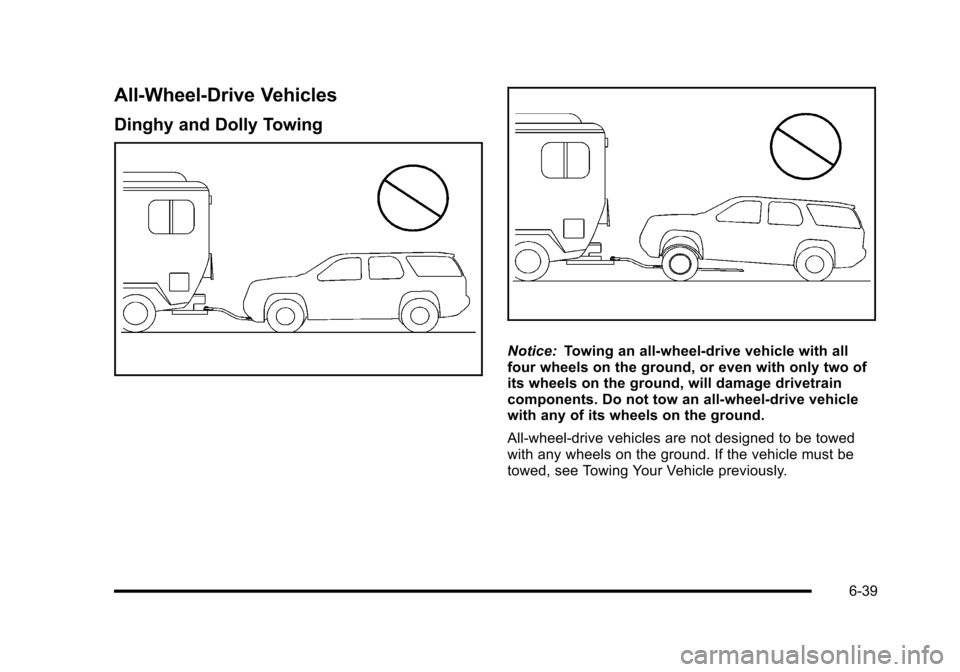
All-Wheel-Drive Vehicles
Dinghy and Dolly Towing
Notice:Towing an all-wheel-drive vehicle with allfour wheels on the ground, or even with only two ofits wheels on the ground, will damage drivetraincomponents. Do not tow an all-wheel-drive vehiclewith any of its wheels on the ground.
All-wheel-drive vehicles are not designed to be towedwith any wheels on the ground. If the vehicle must betowed, see Towing Your Vehicle previously.
6-39
Page 430 of 616
Two-Wheel-Drive Vehicles
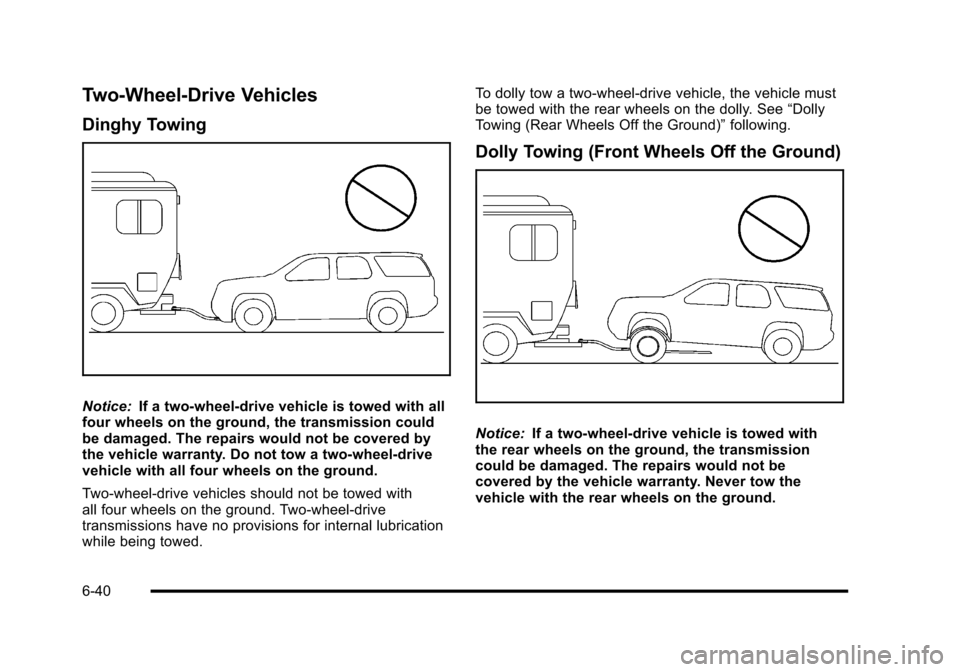
Dinghy Towing
Notice:If a two-wheel-drive vehicle is towed with allfour wheels on the ground, the transmission couldbe damaged. The repairs would not be covered bythe vehicle warranty. Do not tow a two-wheel-drivevehicle with all four wheels on the ground.
Two-wheel-drive vehicles should not be towed withall four wheels on the ground. Two-wheel-drivetransmissions have no provisions for internal lubricationwhile being towed.
To dolly tow a two!wheel!drive vehicle, the vehicle mustbe towed with the rear wheels on the dolly. See“DollyTowing (Rear Wheels Off the Ground)”following.
Dolly Towing (Front Wheels Off the Ground)
Notice:If a two-wheel-drive vehicle is towed withthe rear wheels on the ground, the transmissioncould be damaged. The repairs would not becovered by the vehicle warranty. Never tow thevehicle with the rear wheels on the ground.
6-40