ignition CADILLAC ESCALADE 2010 3.G Repair Manual
[x] Cancel search | Manufacturer: CADILLAC, Model Year: 2010, Model line: ESCALADE, Model: CADILLAC ESCALADE 2010 3.GPages: 616, PDF Size: 39.41 MB
Page 431 of 616
Two-wheel-drive vehicles should not be towed withthe rear wheels on the ground. Two-wheel-drivetransmissions have no provisions for internal lubricationwhile being towed.
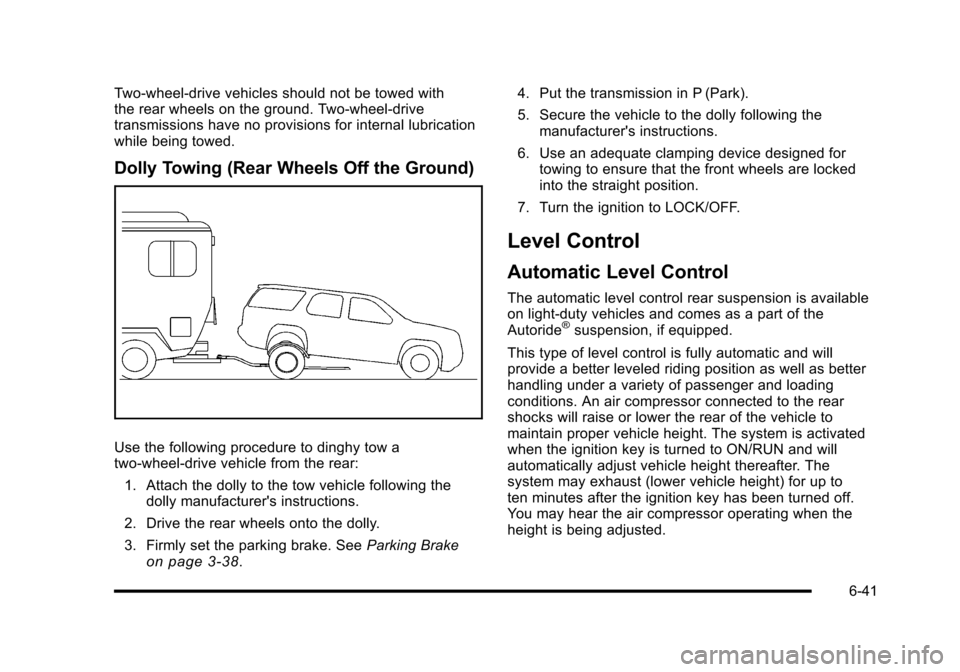
Dolly Towing (Rear Wheels Off the Ground)
Use the following procedure to dinghy tow atwo-wheel-drive vehicle from the rear:
1. Attach the dolly to the tow vehicle following thedolly manufacturer's instructions.
2. Drive the rear wheels onto the dolly.
3. Firmly set the parking brake. SeeParking Brakeon page 3!38.
4. Put the transmission in P (Park).
5. Secure the vehicle to the dolly following themanufacturer's instructions.
6. Use an adequate clamping device designed fortowing to ensure that the front wheels are lockedinto the straight position.
7. Turn the ignition to LOCK/OFF.
Level Control
Automatic Level Control
The automatic level control rear suspension is availableon light!duty vehicles and comes as a part of theAutoride®suspension, if equipped.
This type of level control is fully automatic and willprovide a better leveled riding position as well as betterhandling under a variety of passenger and loadingconditions. An air compressor connected to the rearshocks will raise or lower the rear of the vehicle tomaintain proper vehicle height. The system is activatedwhen the ignition key is turned to ON/RUN and willautomatically adjust vehicle height thereafter. Thesystem may exhaust (lower vehicle height) for up toten minutes after the ignition key has been turned off.You may hear the air compressor operating when theheight is being adjusted.
6-41
Page 485 of 616
Windshield Washer Fluid
What to Use
When windshield washer fluid needs to be added, besure to read the manufacturer's instructions before use.Use a fluid that has sufficient protection against freezingin an area where the temperature may fall belowfreezing.
Adding Washer Fluid
The vehicle has a low washer fluid message in the DICthat comes on when the washer fluid is low. Themessage is displayed for 15 seconds at the start ofeach ignition cycle. When the WASHER FLUID LOWADD FLUID message displays, you will need to addwasher fluid to the windshield washer fluid reservoir.
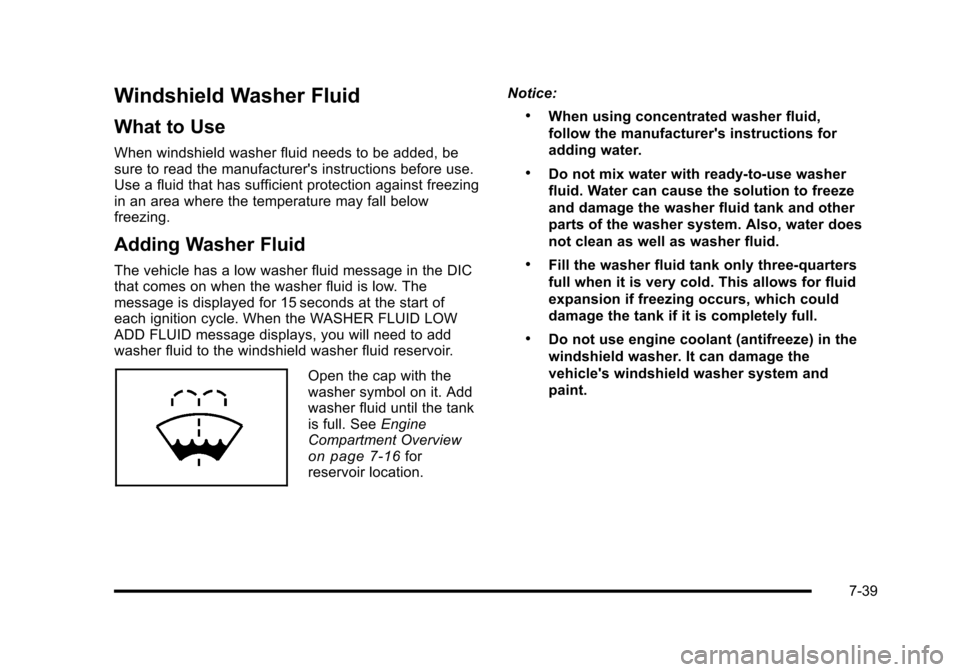
Open the cap with thewasher symbol on it. Addwasher fluid until the tankis full. SeeEngineCompartment Overviewon page 7!16forreservoir location.
Notice:
.When using concentrated washer fluid,
follow the manufacturer's instructions for
adding water.
.Do not mix water with ready-to-use washer
fluid. Water can cause the solution to freeze
and damage the washer fluid tank and other
parts of the washer system. Also, water does
not clean as well as washer fluid.
.Fill the washer fluid tank only three-quarters
full when it is very cold. This allows for fluid
expansion if freezing occurs, which could
damage the tank if it is completely full.
.Do not use engine coolant (antifreeze) in the
windshield washer. It can damage the
vehicle's windshield washer system and
paint.
7-39
Page 491 of 616
Notice:Ignoring these steps could result in costlydamage to the vehicle that would not be covered bythe warranty.
Trying to start the vehicle by pushing or pulling itwill not work, and it could damage the vehicle.
1. Check the other vehicle. It must have a 12-voltbattery with a negative ground system.
Notice:If the other vehicle's system is not a 12-voltsystem with a negative ground, both vehicles canbe damaged. Only use vehicles with 12-volt systemswith negative grounds to jump start your vehicle.
2. Get the vehicles close enough so the jumpercables can reach, but be sure the vehicles are nottouching each other. If they are, it could cause aground connection you do not want. You would notbe able to start your vehicle, and the badgrounding could damage the electrical systems.
To avoid the possibility of the vehicles rolling, setthe parking brake firmly on both vehicles involvedin the jump start procedure. Put the automatictransmission in P (Park) or a manual transmissionin Neutral before setting the parking brake. If youhave a four-wheel-drive vehicle, be sure thetransfer case is in a drive gear, not in Neutral.
Notice:If you leave the radio or other accessorieson during the jump starting procedure, they couldbe damaged. The repairs would not be covered bythe warranty. Always turn off the radio and otheraccessories when jump starting the vehicle.
3. Turn off the ignition on both vehicles. Unplugunnecessary accessories plugged into thecigarette lighter or the accessory power outlets.Turn off the radio and all the lamps that are notneeded. This avoids sparks and helps save bothbatteries. And it could save the radio!
4. Open the hood on the other vehicle and locate thepositive (+) and negative (!) terminal locations onthat vehicle.
Your vehicle has a remote positive (+) jump startingterminal and a remote negative (!) jump startingterminal. You should always use these remoteterminals instead of the terminals on the battery.
If the vehicle has a remote positive (+) terminal, itis located under a red plastic cover at the positivebattery post. To uncover the remote positive (+)terminal, open the red plastic cover.
7-45
Page 514 of 616
Federal Communications Commission
(FCC) and Industry and Science Canada
SeeRadio Frequency Statementon page 9!20forinformation regarding Part 15 of the FederalCommunications Commission (FCC) Rules andRSS-210/211 of Industry and Science Canada.
Tire Pressure Monitor Operation
If your vehicle is a Two!mode Hybrid, see theTwo!mode Hybrid manual for more information.
This vehicle may have a Tire Pressure Monitor System(TPMS). The TPMS is designed to warn the driver whena low tire pressure condition exists. TPMS sensors aremounted onto each tire and wheel assembly, excludingthe spare tire and wheel assembly. The TPMS sensorsmonitor the air pressure in the vehicle's tires andtransmit the tire pressure readings to a receiver locatedin the vehicle.
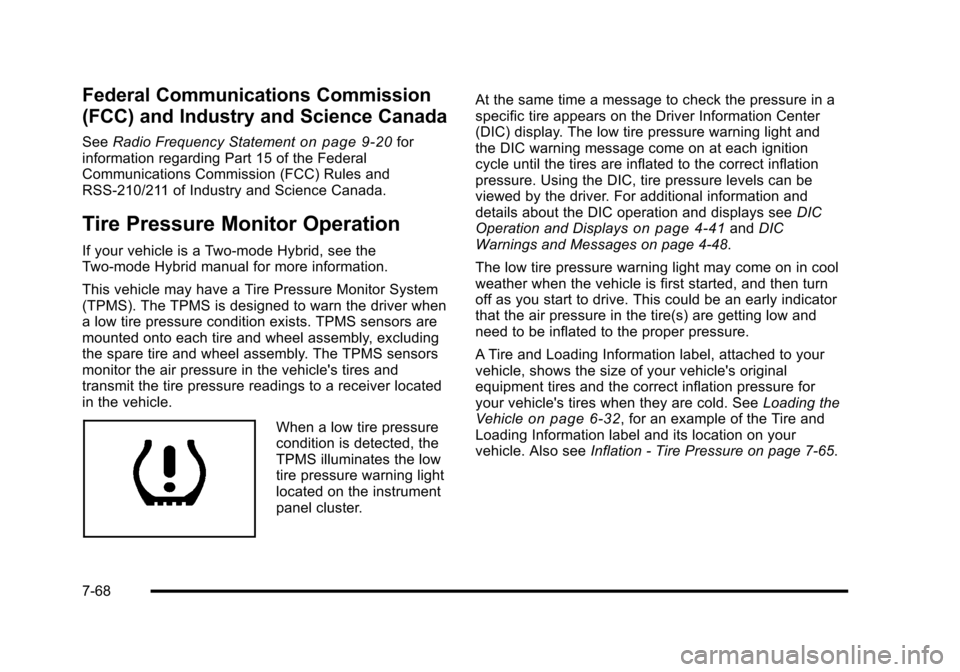
When a low tire pressurecondition is detected, theTPMS illuminates the lowtire pressure warning lightlocated on the instrumentpanel cluster.
At the same time a message to check the pressure in aspecific tire appears on the Driver Information Center(DIC) display. The low tire pressure warning light andthe DIC warning message come on at each ignitioncycle until the tires are inflated to the correct inflationpressure. Using the DIC, tire pressure levels can beviewed by the driver. For additional information anddetails about the DIC operation and displays seeDICOperation and Displayson page 4!41andDICWarnings and Messages on page 4!48.
The low tire pressure warning light may come on in coolweather when the vehicle is first started, and then turnoff as you start to drive. This could be an early indicatorthat the air pressure in the tire(s) are getting low andneed to be inflated to the proper pressure.
A Tire and Loading Information label, attached to yourvehicle, shows the size of your vehicle's originalequipment tires and the correct inflation pressure foryour vehicle's tires when they are cold. SeeLoading theVehicleon page 6!32, for an example of the Tire andLoading Information label and its location on yourvehicle. Also seeInflation - Tire Pressure on page 7!65.
7-68
Page 515 of 616
Your vehicle's TPMS can warn you about a low tirepressure condition but it does not replace normal tiremaintenance. SeeTire Inspection and Rotationonpage 7!71andTires on page 7!58.
Notice:Liquid tire sealants could damage the TirePressure Monitor System (TPMS) sensors. Sensordamage caused by using a tire sealant is notcovered by your warranty. Do not use liquid tiresealants.
TPMS Malfunction Light and Message
The TPMS will not function properly if one or more ofthe TPMS sensors are missing or inoperable. When thesystem detects a malfunction, the low tire warning lightflashes for about one minute and then stays on for theremainder of the ignition cycle. A DIC warning messageis also displayed. The low tire warning light and DICwarning message come on at each ignition cycle untilthe problem is corrected. Some of the conditions thatcan cause the malfunction light and DIC message tocome on are:
.One of the road tires has been replaced with thespare tire. The spare tire does not have a TPMSsensor. The TPMS malfunction light and DICmessage should go off once you re!install theroad tire containing the TPMS sensor.
.The TPMS sensor matching process was startedbut not completed or not completed successfullyafter rotating the vehicle's tires. The DIC messageand TPMS malfunction light should go off once theTPMS sensor matching process is performedsuccessfully. See“TPMS Sensor MatchingProcess”later in this section.
.One or more TPMS sensors are missing ordamaged. The DIC message and the TPMSmalfunction light should go off when the TPMSsensors are installed and the sensor matchingprocess is performed successfully. See yourdealer/retailer for service.
.Replacement tires or wheels do not match yourvehicle's original equipment tires or wheels. Tiresand wheels other than those recommended foryour vehicle could prevent the TPMS fromfunctioning properly. SeeBuying New Tiresonpage 7!73.
.Operating electronic devices or being near facilitiesusing radio wave frequencies similar to the TPMScould cause the TPMS sensors to malfunction.
If the TPMS is not functioning it cannot detect or signala low tire condition. See your dealer/retailer for serviceif the TPMS malfunction light and DIC message comeson and stays on.
7-69
Page 516 of 616

TPMS Sensor Matching Process
Each TPMS sensor has a unique identification code.Any time you rotate your vehicle's tires or replace oneor more of the TPMS sensors, the identification codeswill need to be matched to the new tire/wheel position.The sensors are matched to the tire/wheel positionsin the following order: driver side front tire, passengerside front tire, passenger side rear tire, and driverside rear tire using a TPMS diagnostic tool. See yourdealer/retailer for service.
The TPMS sensors can also be matched to each tire/wheel position by increasing or decreasing the tire's airpressure. If increasing the tire's air pressure, do notexceed the maximum inflation pressure indicated on thetire's sidewall.
To decrease air-pressure out of a tire you can use thepointed end of the valve cap, a pencil-style air pressuregage, or a key.
You have two minutes to match the first tire/wheelposition, and five minutes overall to match all four tire/wheel positions. If it takes longer than two minutes, tomatch the first tire and wheel, or more than five minutesto match all four tire and wheel positions the matchingprocess stops and you need to start over.
The TPMS sensor matching process is outlined below:
1. Set the parking brake.
2. Turn the ignition switch to ON/RUN with theengine off.
3. PressQandKon the Remote Keyless Entry
(RKE) transmitter at the same time forapproximately five seconds. The horn sounds twiceto signal the receiver is in relearn mode and TIRELEARNING ACTIVE message displays on the DICscreen.
4. Start with the driver side front tire.
7-70
Page 517 of 616
5. Remove the valve cap from the valve cap stem.Activate the TPMS sensor by increasing ordecreasing the tire's air pressure for five seconds,or until a horn chirp sounds. The horn chirp, whichmay take up to 30 seconds to sound, confirms thatthe sensor identification code has been matched tothis tire and wheel position.
6. Proceed to the passenger side front tire, andrepeat the procedure in Step 5.
7. Proceed to the passenger side rear tire, and repeatthe procedure in Step 5.
8. Proceed to the driver side rear tire, and repeat theprocedure in Step 5. The horn sounds two times toindicate the sensor identification code has beenmatched to the driver side rear tire, and the TPMSsensor matching process is no longer active. TheTIRE LEARNING ACTIVE message on the DICdisplay screen goes off.
9. Turn the ignition switch to LOCK/OFF.
10. Set all four tires to the recommended air pressurelevel as indicated on the Tire and LoadingInformation label.
11. Put the valve caps back on the valve stems.
Tire Inspection and Rotation
We recommend that you regularly inspect your
vehicle's tires, including the spare tire, for signs of
wear or damage. SeeWhen It Is Time for New
Tireson page 7!73for more information.
Tires should be rotated every 5,000 to 8,000 miles
(8 000 to 13 000 km). SeeScheduled Maintenance
on page 8!3.
The purpose of a regular tire rotation is to achieve
a uniform wear for all tires on the vehicle. This will
ensure that your vehicle continues to perform
most like it did when the tires were new.
7-71
Page 529 of 616
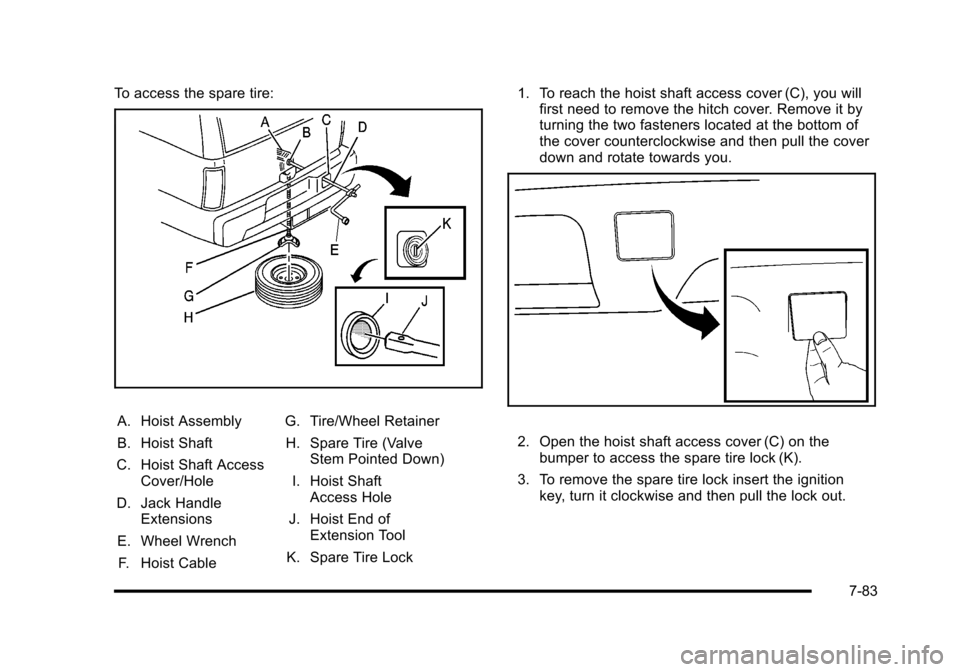
To access the spare tire:
A. Hoist Assembly
B. Hoist Shaft
C. Hoist Shaft AccessCover/Hole
D. Jack HandleExtensions
E. Wheel Wrench
F. Hoist Cable
G. Tire/Wheel Retainer
H. Spare Tire (ValveStem Pointed Down)
I. Hoist ShaftAccess Hole
J. Hoist End ofExtension Tool
K. Spare Tire Lock
1. To reach the hoist shaft access cover (C), you willfirst need to remove the hitch cover. Remove it byturning the two fasteners located at the bottom ofthe cover counterclockwise and then pull the coverdown and rotate towards you.
2. Open the hoist shaft access cover (C) on thebumper to access the spare tire lock (K).
3. To remove the spare tire lock insert the ignitionkey, turn it clockwise and then pull the lock out.
7-83
Page 558 of 616

FusesUsage
1Right Trailer Stop/Turn Lamp
2Electronic Stability SuspensionControl, Automatic Level ControlExhaust
3Left Trailer Stop/Turn Lamp
4Engine Controls
5Engine Control Module, ThrottleControl
6Trailer Brake Controller
7Front Washer
8Oxygen Sensors
9Antilock Brakes System 2
10Trailer Back-up Lamps
11Driver Side Low-Beam Headlamp
12Engine Control Module (Battery)
13Fuel Injectors, Ignition Coils(Right Side)
14Transmission Control Module(Battery)
15Vehicle Back-up Lamps
16Passenger Side Low-Beam Headlamp
7-112
Page 559 of 616
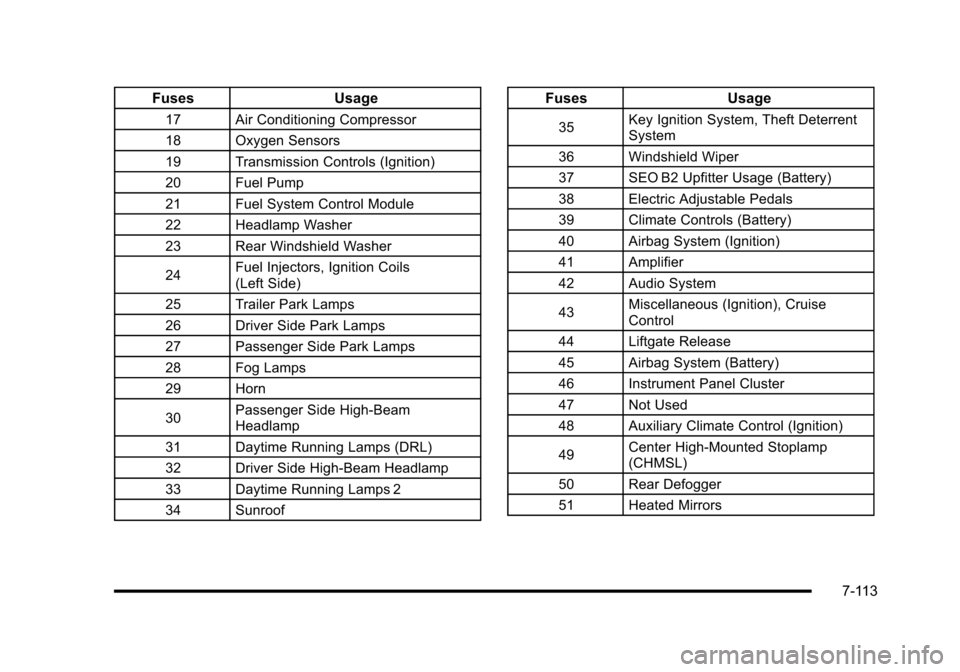
FusesUsage
17Air Conditioning Compressor
18Oxygen Sensors
19Transmission Controls (Ignition)
20Fuel Pump
21Fuel System Control Module
22Headlamp Washer
23Rear Windshield Washer
24Fuel Injectors, Ignition Coils(Left Side)
25Trailer Park Lamps
26Driver Side Park Lamps
27Passenger Side Park Lamps
28Fog Lamps
29Horn
30Passenger Side High-BeamHeadlamp
31Daytime Running Lamps (DRL)
32Driver Side High-Beam Headlamp
33Daytime Running Lamps 2
34Sunroof
FusesUsage
35Key Ignition System, Theft DeterrentSystem
36Windshield Wiper
37SEO B2 Upfitter Usage (Battery)
38Electric Adjustable Pedals
39Climate Controls (Battery)
40Airbag System (Ignition)
41Amplifier
42Audio System
43Miscellaneous (Ignition), CruiseControl
44Liftgate Release
45Airbag System (Battery)
46Instrument Panel Cluster
47Not Used
48Auxiliary Climate Control (Ignition)
49Center High-Mounted Stoplamp(CHMSL)
50Rear Defogger
51Heated Mirrors
7-113