lock CADILLAC ESCALADE 2011 3.G Owners Manual
[x] Cancel search | Manufacturer: CADILLAC, Model Year: 2011, Model line: ESCALADE, Model: CADILLAC ESCALADE 2011 3.GPages: 558, PDF Size: 7.59 MB
Page 485 of 558
Black plate (81,1)Cadillac Escalade/Escalade ESV Owner Manual - 2011
Vehicle Care 10-81
{WARNING
Rust or dirt on a wheel, or on the
parts to which it is fastened, can
make wheel nuts become loose
after time. The wheel could come
off and cause an accident. When
changing a wheel, remove any
rust or dirt from places where
the wheel attaches to the vehicle.
In an emergency, use a cloth or a
paper towel to do this; but be sure
to use a scraper or wire brush
later, if needed, to get all the rust
or dirt off. SeeIf a Tire Goes Flat
on page 10‑73.
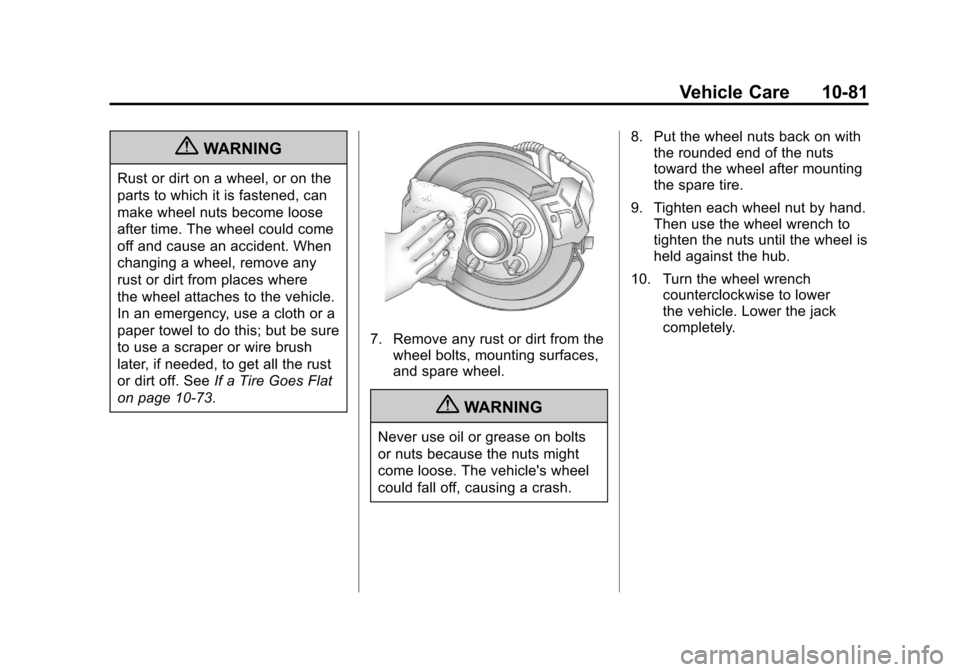
7. Remove any rust or dirt from the wheel bolts, mounting surfaces,
and spare wheel.
{WARNING
Never use oil or grease on bolts
or nuts because the nuts might
come loose. The vehicle's wheel
could fall off, causing a crash. 8. Put the wheel nuts back on with
the rounded end of the nuts
toward the wheel after mounting
the spare tire.
9. Tighten each wheel nut by hand. Then use the wheel wrench to
tighten the nuts until the wheel is
held against the hub.
10. Turn the wheel wrench counterclockwise to lower
the vehicle. Lower the jack
completely.
Page 486 of 558
Black plate (82,1)Cadillac Escalade/Escalade ESV Owner Manual - 2011
10-82 Vehicle Care
{WARNING
Wheel nuts that are improperly or
incorrectly tightened can cause
the wheels to become loose or
come off. The wheel nuts should
be tightened with a torque wrench
to the proper torque specification
after replacing. Follow the torque
specification supplied by the
aftermarket manufacturer when
using accessory locking wheel
nuts. SeeCapacities and
Specifications on page 12‑2 for
original equipment wheel nut
torque specifications.
Notice: Improperly tightened
wheel nuts can lead to brake
pulsation and rotor damage.
To avoid expensive brake repairs,
evenly tighten the wheel nuts
in the proper sequence and to
the proper torque specification.
See Capacities and Specifications
on page 12‑2 for the wheel nut
torque specification.
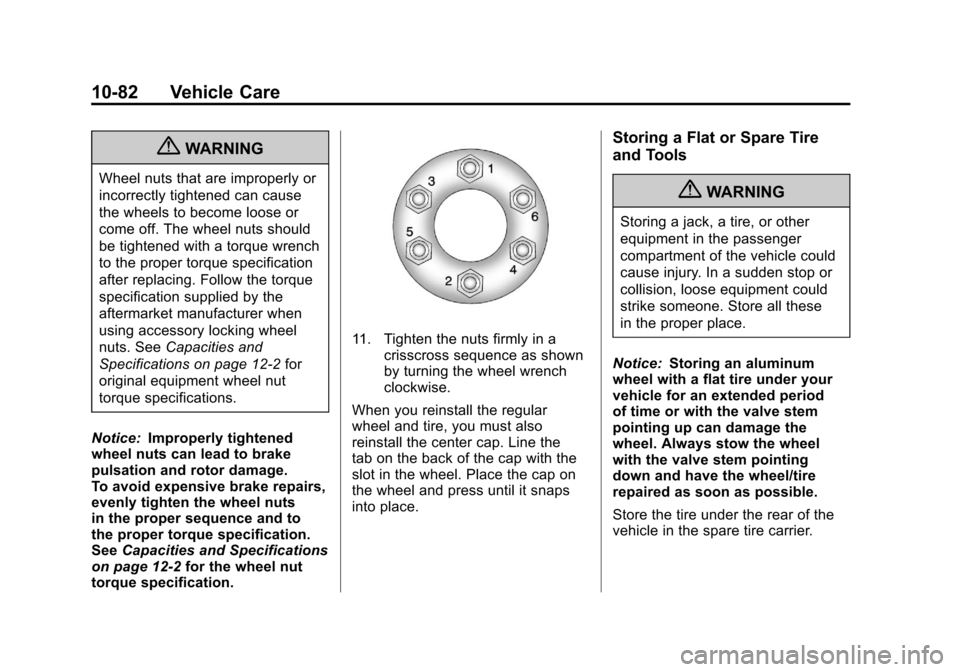
11. Tighten the nuts firmly in a crisscross sequence as shown
by turning the wheel wrench
clockwise.
When you reinstall the regular
wheel and tire, you must also
reinstall the center cap. Line the
tab on the back of the cap with the
slot in the wheel. Place the cap on
the wheel and press until it snaps
into place.
Storing a Flat or Spare Tire
and Tools
{WARNING
Storing a jack, a tire, or other
equipment in the passenger
compartment of the vehicle could
cause injury. In a sudden stop or
collision, loose equipment could
strike someone. Store all these
in the proper place.
Notice: Storing an aluminum
wheel with a flat tire under your
vehicle for an extended period
of time or with the valve stem
pointing up can damage the
wheel. Always stow the wheel
with the valve stem pointing
down and have the wheel/tire
repaired as soon as possible.
Store the tire under the rear of the
vehicle in the spare tire carrier.
Page 487 of 558
Black plate (83,1)Cadillac Escalade/Escalade ESV Owner Manual - 2011
Vehicle Care 10-83
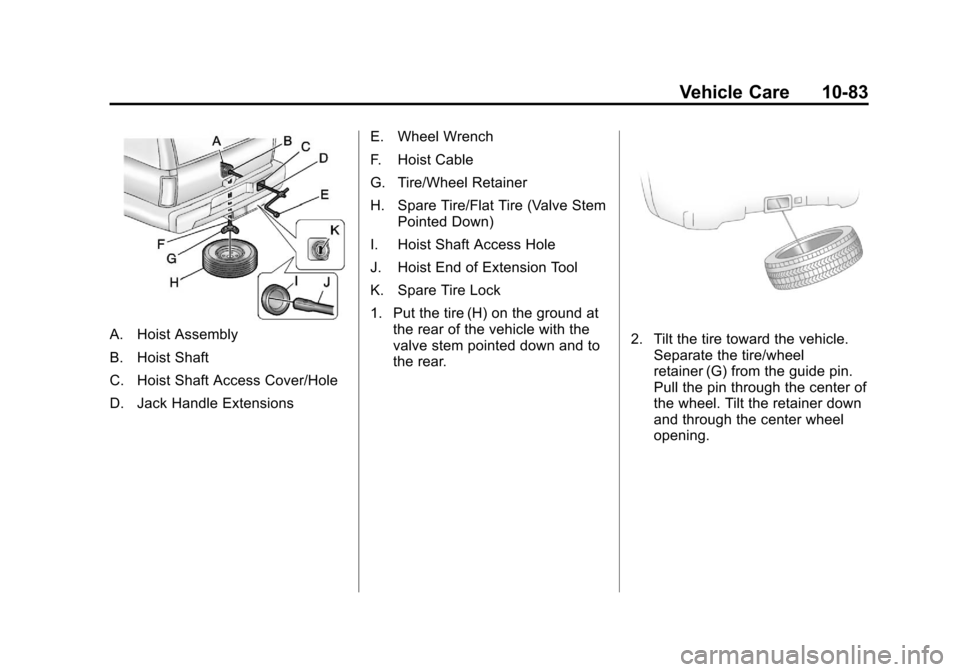
A. Hoist Assembly
B. Hoist Shaft
C. Hoist Shaft Access Cover/Hole
D. Jack Handle ExtensionsE. Wheel Wrench
F. Hoist Cable
G. Tire/Wheel Retainer
H. Spare Tire/Flat Tire (Valve Stem
Pointed Down)
I. Hoist Shaft Access Hole
J. Hoist End of Extension Tool
K. Spare Tire Lock
1. Put the tire (H) on the ground at the rear of the vehicle with the
valve stem pointed down and to
the rear.2. Tilt the tire toward the vehicle.Separate the tire/wheel
retainer (G) from the guide pin.
Pull the pin through the center of
the wheel. Tilt the retainer down
and through the center wheel
opening.
Page 488 of 558
Black plate (84,1)Cadillac Escalade/Escalade ESV Owner Manual - 2011
10-84 Vehicle Care
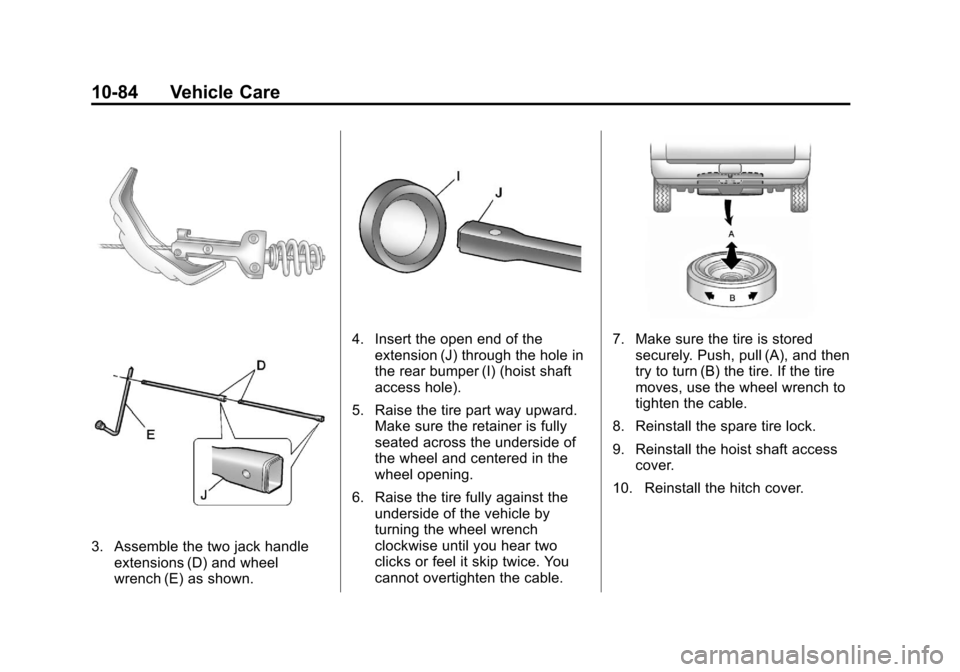
3. Assemble the two jack handleextensions (D) and wheel
wrench (E) as shown.
4. Insert the open end of theextension (J) through the hole in
the rear bumper (I) (hoist shaft
access hole).
5. Raise the tire part way upward. Make sure the retainer is fully
seated across the underside of
the wheel and centered in the
wheel opening.
6. Raise the tire fully against the underside of the vehicle by
turning the wheel wrench
clockwise until you hear two
clicks or feel it skip twice. You
cannot overtighten the cable.7. Make sure the tire is storedsecurely. Push, pull (A), and then
try to turn (B) the tire. If the tire
moves, use the wheel wrench to
tighten the cable.
8. Reinstall the spare tire lock.
9. Reinstall the hoist shaft access cover.
10. Reinstall the hitch cover.
Page 489 of 558
Black plate (85,1)Cadillac Escalade/Escalade ESV Owner Manual - 2011
Vehicle Care 10-85
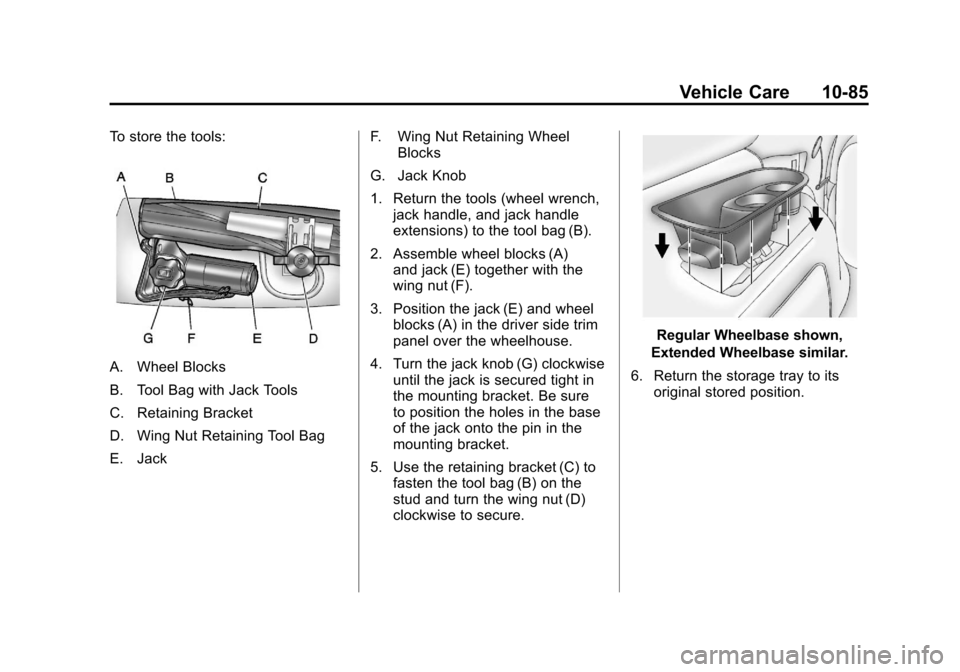
To store the tools:
A. Wheel Blocks
B. Tool Bag with Jack Tools
C. Retaining Bracket
D. Wing Nut Retaining Tool Bag
E. JackF. Wing Nut Retaining Wheel
Blocks
G. Jack Knob
1. Return the tools (wheel wrench, jack handle, and jack handle
extensions) to the tool bag (B).
2. Assemble wheel blocks (A) and jack (E) together with the
wing nut (F).
3. Position the jack (E) and wheel blocks (A) in the driver side trim
panel over the wheelhouse.
4. Turn the jack knob (G) clockwise until the jack is secured tight in
the mounting bracket. Be sure
to position the holes in the base
of the jack onto the pin in the
mounting bracket.
5. Use the retaining bracket (C) to fasten the tool bag (B) on the
stud and turn the wing nut (D)
clockwise to secure.
Regular Wheelbase shown,
Extended Wheelbase similar.
6. Return the storage tray to its original stored position.
Page 490 of 558
Black plate (86,1)Cadillac Escalade/Escalade ESV Owner Manual - 2011
10-86 Vehicle Care
Secondary Latch System
This vehicle has an
underbody-mounted tire
hoist assembly equipped
with a secondary latch system.
It is designed to stop the spare
tire from suddenly falling off your
vehicle. For the secondary latch to
work, the spare must be installed
with the valve stem pointing down.
See“Storing a Flat or Spare Tire
and Tools” underTire Changing on
page 10‑75.
{WARNING
Before beginning this procedure
read all the instructions. Failure
to read and follow the instructions
could damage the hoist assembly
and you and others could get
hurt. Read and follow the
instructions listed next. To release the spare tire from the
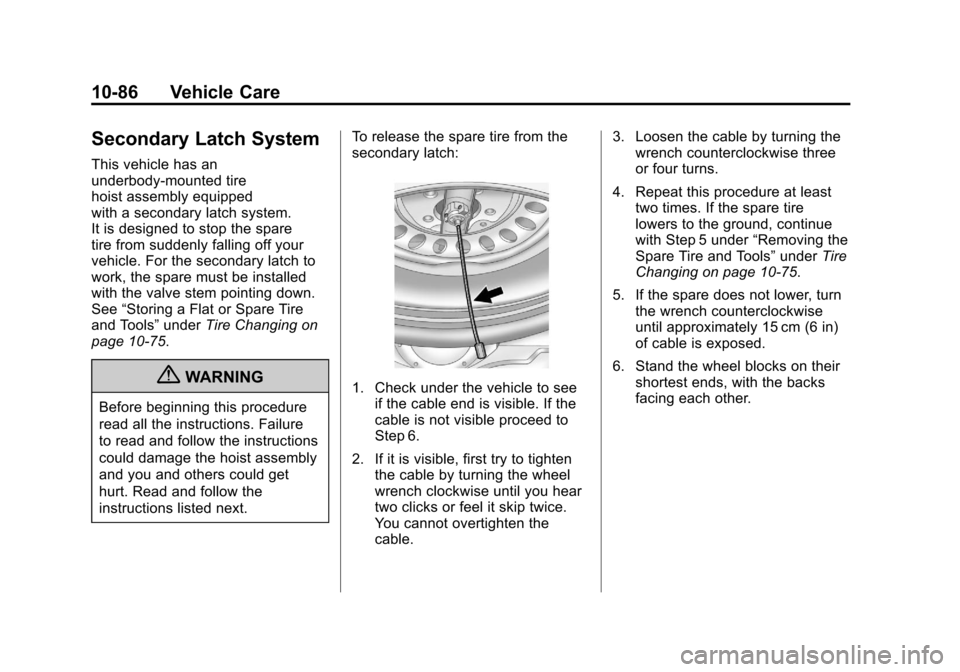
secondary latch:
1. Check under the vehicle to see
if the cable end is visible. If the
cable is not visible proceed to
Step 6.
2. If it is visible, first try to tighten the cable by turning the wheel
wrench clockwise until you hear
two clicks or feel it skip twice.
You cannot overtighten the
cable. 3. Loosen the cable by turning the
wrench counterclockwise three
or four turns.
4. Repeat this procedure at least two times. If the spare tire
lowers to the ground, continue
with Step 5 under “Removing the
Spare Tire and Tools” underTire
Changing on page 10‑75.
5. If the spare does not lower, turn the wrench counterclockwise
until approximately 15 cm (6 in)
of cable is exposed.
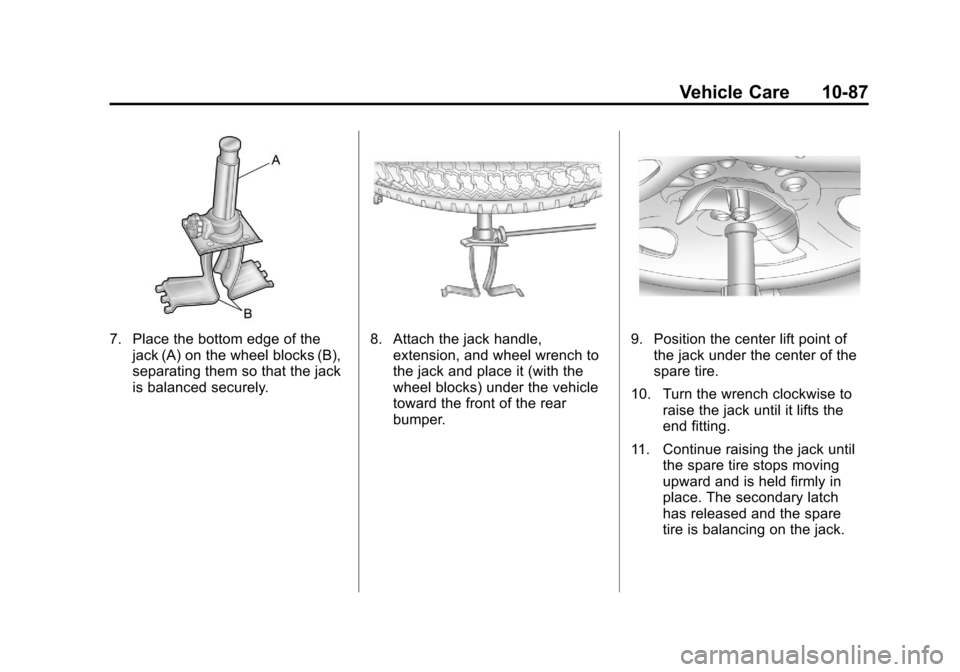
6. Stand the wheel blocks on their shortest ends, with the backs
facing each other.
Page 491 of 558
Black plate (87,1)Cadillac Escalade/Escalade ESV Owner Manual - 2011
Vehicle Care 10-87
7. Place the bottom edge of thejack (A) on the wheel blocks (B),
separating them so that the jack
is balanced securely.8. Attach the jack handle,extension, and wheel wrench to
the jack and place it (with the
wheel blocks) under the vehicle
toward the front of the rear
bumper.9. Position the center lift point ofthe jack under the center of the
spare tire.
10. Turn the wrench clockwise to raise the jack until it lifts the
end fitting.
11. Continue raising the jack until the spare tire stops moving
upward and is held firmly in
place. The secondary latch
has released and the spare
tire is balancing on the jack.
Page 492 of 558
Black plate (88,1)Cadillac Escalade/Escalade ESV Owner Manual - 2011
10-88 Vehicle Care
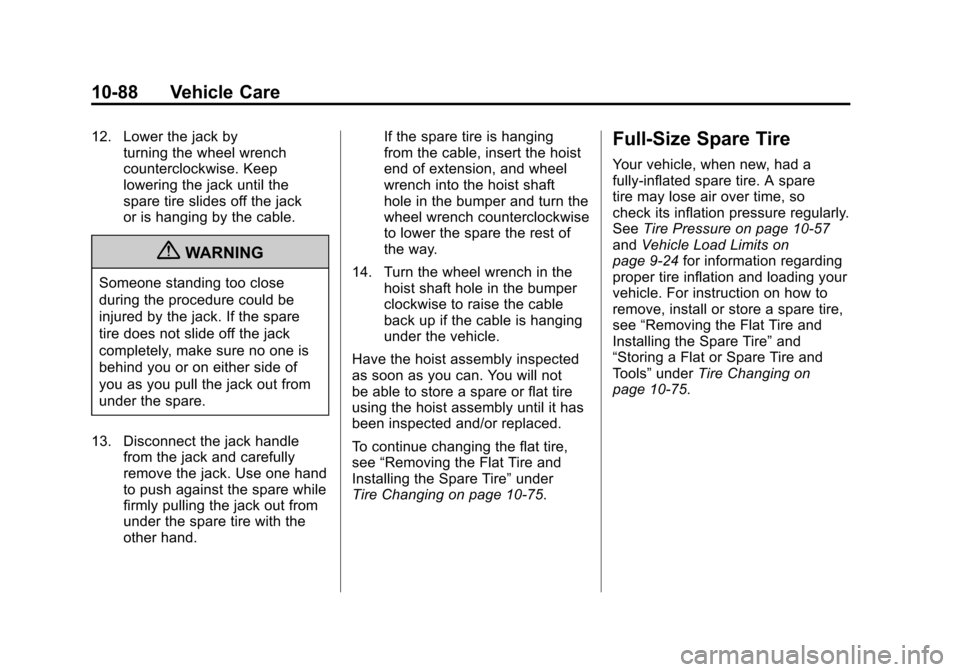
12. Lower the jack byturning the wheel wrench
counterclockwise. Keep
lowering the jack until the
spare tire slides off the jack
or is hanging by the cable.
{WARNING
Someone standing too close
during the procedure could be
injured by the jack. If the spare
tire does not slide off the jack
completely, make sure no one is
behind you or on either side of
you as you pull the jack out from
under the spare.
13. Disconnect the jack handle from the jack and carefully
remove the jack. Use one hand
to push against the spare while
firmly pulling the jack out from
under the spare tire with the
other hand. If the spare tire is hanging
from the cable, insert the hoist
end of extension, and wheel
wrench into the hoist shaft
hole in the bumper and turn the
wheel wrench counterclockwise
to lower the spare the rest of
the way.
14. Turn the wheel wrench in the hoist shaft hole in the bumper
clockwise to raise the cable
back up if the cable is hanging
under the vehicle.
Have the hoist assembly inspected
as soon as you can. You will not
be able to store a spare or flat tire
using the hoist assembly until it has
been inspected and/or replaced.
To continue changing the flat tire,
see “Removing the Flat Tire and
Installing the Spare Tire” under
Tire Changing on page 10‑75.
Full-Size Spare Tire
Your vehicle, when new, had a
fully-inflated spare tire. A spare
tire may lose air over time, so
check its inflation pressure regularly.
See Tire Pressure on page 10‑57
and Vehicle Load Limits on
page 9‑24 for information regarding
proper tire inflation and loading your
vehicle. For instruction on how to
remove, install or store a spare tire,
see “Removing the Flat Tire and
Installing the Spare Tire” and
“Storing a Flat or Spare Tire and
Tools” underTire Changing on
page 10‑75.
Page 501 of 558
Black plate (97,1)Cadillac Escalade/Escalade ESV Owner Manual - 2011
Vehicle Care 10-97
3. Firmly set the parking brake.See Parking Brake on
page 9‑46.
4. Put the transmission in P (Park).
5. Secure the vehicle to the dolly following the manufacturer's
instructions.
6. Use an adequate clamping device designed for towing to
ensure that the front wheels are
locked into the straight position.
7. Turn the ignition to LOCK/OFF.Appearance Care
Exterior Care
Weatherstrips
Silicone grease on weatherstrips
will make them last longer, seal
better, and not stick or squeak.
Apply silicone grease with a clean
cloth. During very cold, damp
weather frequent application may
be required. See Recommended
Fluids and Lubricants on page 11‑7.
Washing the Vehicle
The best way to preserve the
vehicle's finish is to keep it clean
by washing it often.
Notice: Certain cleaners contain
chemicals that can damage the
emblems or nameplates on the
vehicle. Check the cleaning
product label. If it states that it
should not be used on plastic
parts, do not use it on the vehicle or damage may occur and it
would not be covered by the
warranty.
Do not wash the vehicle in
direct sunlight. Use a car washing
soap. Do not use cleaning agents
that are petroleum based or that
contain acid or abrasives, as they
can damage the paint, metal or
plastic on the vehicle. Approved
cleaning products can be obtained
from your dealer. Follow all
manufacturers' directions regarding
correct product usage, necessary
safety precautions and appropriate
disposal of any vehicle care
product.
Rinse the vehicle well, before
washing and after to remove all
cleaning agents completely. If they
are allowed to dry on the surface,
they could stain.
Dry the finish with a soft, clean
chamois or an all-cotton towel to
avoid surface scratches and water
spotting.
Page 514 of 558
Black plate (4,1)Cadillac Escalade/Escalade ESV Owner Manual - 2011
11-4 Service and Maintenance
.Steering and suspension
inspection. Visual inspection
for damaged, loose, or missing
parts or signs of wear.
.Body hinges and latches,
key lock cylinders, rear
compartment hinges, outer
tailgate handle pivot points,
and folding seat hardware
lubrication. SeeRecommended
Fluids and Lubricants on
page 11‑7. More frequent
lubrication may be required
when the vehicle is exposed
to a corrosive environment.
Applying silicone grease on
weatherstrips with a clean cloth
makes them last longer, seal
better, and not stick or squeak.
.Restraint system component
check. See Safety System
Check on page 3‑38.
.Fuel system inspection for
damage or leaks.
.Exhaust system and nearby heat
shields inspection for loose or
damaged components.
Additional Required Services
Every 12 000 km/7,500 Miles
.Rotate tires. Tires should
be rotated every 12 000 km/
7,500 miles. See Tire Rotation
on page 10‑64. At Each Fuel Stop
.Engine oil level check.
See
Engine Oil on page 10‑7.
.Engine coolant level check.
SeeEngine Coolant on
page 10‑18.
.Windshield washer fluid level
check. See Washer Fluid on
page 10‑26.
Once a Month
.Tire inflation pressures check.
See Tire Pressure on
page 10‑57.
.Tire wear inspection. See Tire
Inspection on page 10‑64.
.Sunroof track and seal
inspection, if equipped.
See Sunroof on page 2‑22.