lock CADILLAC ESCALADE 2011 3.G Owners Manual
[x] Cancel search | Manufacturer: CADILLAC, Model Year: 2011, Model line: ESCALADE, Model: CADILLAC ESCALADE 2011 3.GPages: 558, PDF Size: 7.59 MB
Page 452 of 558
Black plate (48,1)Cadillac Escalade/Escalade ESV Owner Manual - 2011
10-48 Vehicle Care
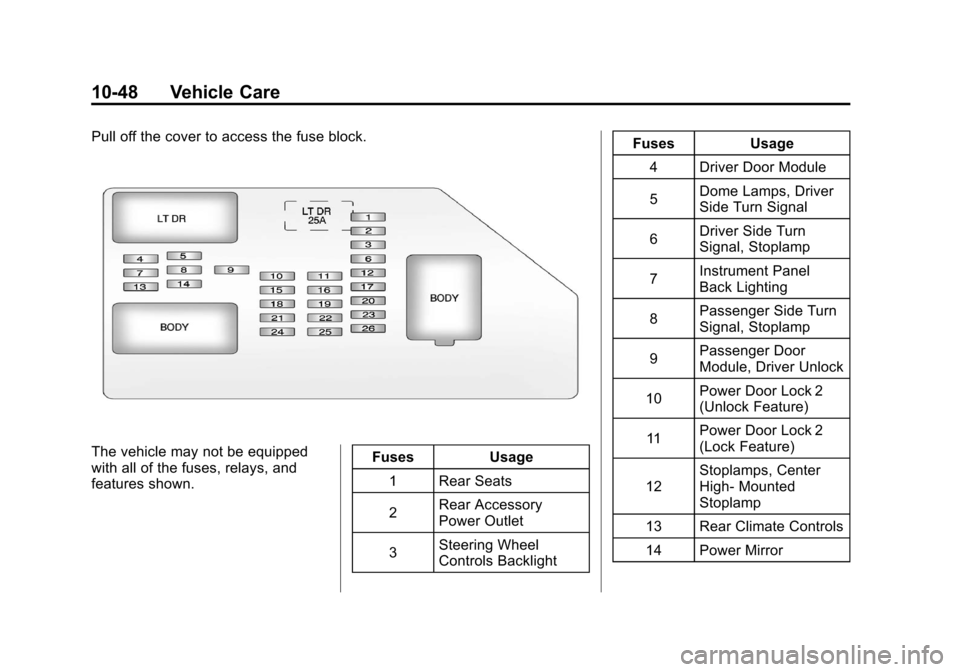
Pull off the cover to access the fuse block.
The vehicle may not be equipped
with all of the fuses, relays, and
features shown.Fuses Usage
1 Rear Seats
2 Rear Accessory
Power Outlet
3 Steering Wheel
Controls Backlight Fuses Usage
4 Driver Door Module
5 Dome Lamps, Driver
Side Turn Signal
6 Driver Side Turn
Signal, Stoplamp
7 Instrument Panel
Back Lighting
8 Passenger Side Turn
Signal, Stoplamp
9 Passenger Door
Module, Driver Unlock
10 Power Door Lock 2
(Unlock Feature)
11 Power Door Lock 2
(Lock Feature)
12 Stoplamps, Center
High‐
Mounted
Stoplamp
13 Rear Climate Controls
14 Power Mirror
Page 453 of 558
Black plate (49,1)Cadillac Escalade/Escalade ESV Owner Manual - 2011
Vehicle Care 10-49
FusesUsage
15 Body Control
Module (BCM)
16 Accessory Power
Outlets
17 Interior Lamps
18 Power Door Lock 1
(Unlock Feature)
19 Rear Seat
Entertainment
20 Ultrasonic Rear
Parking Assist,
Power Liftgate Fuses
Usage
21 Power Door Lock 1
(Lock Feature)
22 Driver Information
Center (DIC)
23 Rear Wiper
24 Cooled Seats
25 Driver Seat Module,
Remote Keyless Entry
System
26 Driver Power Door
Lock (Unlock Feature)
Circuit
Breaker Usage
LT DR Driver Side Power
Window Circuit
Breaker Harness
Connector Usage
LT DR Driver Door
Harness
Connection
BODY Harness Connector
BODY Harness Connector
Center Instrument Panel Fuse
Block
The center instrument panel fuse
block is located underneath the
instrument panel, to the left of the
steering column.
Page 467 of 558
Black plate (63,1)Cadillac Escalade/Escalade ESV Owner Manual - 2011
Vehicle Care 10-63
To decrease air-pressure out of a
tire you can use the pointed end of
the valve cap, a pencil-style air
pressure gauge, or a key.
You have two minutes to match
the first tire/wheel position, and
five minutes overall to match all
four tire/wheel positions. If it takes
longer than two minutes, to match
the first tire and wheel, or more than
five minutes to match all four tire
and wheel positions the matching
process stops and you need to
start over.
The TPMS sensor matching process
is outlined below:
1. Set the parking brake.
2. Turn the ignition switch toON/RUN with the engine off. 3. PressQandKon the
Remote Keyless Entry (RKE)
transmitter at the same time
for approximately five seconds.
The horn sounds twice to signal
the receiver is in relearn mode
and TIRE LEARNING ACTIVE
message displays on the DIC
screen.
4. Start with the driver side front tire.
5. Remove the valve cap from the valve cap stem. Activate the
TPMS sensor by increasing
or decreasing the tire's air
pressure for five seconds,
or until a horn chirp sounds.
The horn chirp, which may
take up to 30 seconds to
sound, confirms that the sensor
identification code has been
matched to this tire and wheel
position.
6. Proceed to the passenger side front tire, and repeat the
procedure in Step 5. 7. Proceed to the passenger
side rear tire, and repeat the
procedure in Step 5.
8. Proceed to the driver side rear tire, and repeat the procedure in
Step 5. The horn sounds two
times to indicate the sensor
identification code has been
matched to the driver side rear
tire, and the TPMS sensor
matching process is no longer
active. The TIRE LEARNING
ACTIVE message on the DIC
display screen goes off.
9. Turn the ignition switch to LOCK/OFF.
10. Set all four tires to the recommended air pressure
level as indicated on the Tire
and Loading Information label.
11. Put the valve caps back on the valve stems.
Page 472 of 558
Black plate (68,1)Cadillac Escalade/Escalade ESV Owner Manual - 2011
10-68 Vehicle Care
{WARNING
If you use bias-ply tires on the
vehicle, the wheel rim flanges
could develop cracks after
many miles of driving. A tire
and/or wheel could fail
suddenly, causing a crash.
Use only radial-ply tires with
the wheels on the vehicle.
If you must replace your vehicle's
tires with those that do not have a
TPC Spec number, make sure they
are the same size, load range,
speed rating, and construction type
(radial and bias‐belted tires) as your
vehicle's original tires. Vehicles that have a tire pressure
monitoring system may give an
inaccurate low‐pressure warning
if non‐TPC Spec-rated tires are
installed on your vehicle. Non‐TPC
Spec-rated tires may give a
low‐pressure warning that is higher
or lower than the proper warning
level you would get with TPC
Spec-rated tires. See
Tire Pressure
Monitor System on page 10‑59.
Your vehicle's original equipment
tires are listed on the Tire
and Loading Information label.
See Vehicle Load Limits on
page 9‑24 for more information
about the Tire and Loading
Information label and its location
on your vehicle.
Different Size Tires and
Wheels
If you add wheels or tires that are
a different size than your original
equipment wheels and tires, this
could affect the way your vehicle
performs, including its braking,
ride and handling characteristics,
stability, and resistance to rollover.
Additionally, if your vehicle has
electronic systems such as antilock
brakes, rollover airbags, traction
control, and electronic stability
control, the performance of these
systems can be affected.
Page 478 of 558
Black plate (74,1)Cadillac Escalade/Escalade ESV Owner Manual - 2011
10-74 Vehicle Care
If a tire goes flat, avoid further tire
and wheel damage by driving slowly
to a level place, well off the road,
if possible. Turn on the hazard
warning flashers. SeeHazard
Warning Flashers on page 6‑8.
{WARNING
Changing a tire can be
dangerous. The vehicle can
slip off the jack and roll over
or fall on you or other people.
You and they could be badly
injured or even killed. Find a level
place to change your tire. To help
prevent the vehicle from moving:
1. Set the parking brake firmly.
2. Put an automatic transmission shift lever in
P (Park), or shift a manual
transmission to 1 (First) or
R (Reverse).
(Continued)
WARNING (Continued)
3. Turn off the engine and donot restart while the vehicle
is raised.
4. Do not allow passengers to remain in the vehicle.
To be even more certain the
vehicle will not move, you should
put blocks at the front and rear of
the tire farthest away from the
one being changed. That would
be the tire on the other side, at
the opposite end of the vehicle.
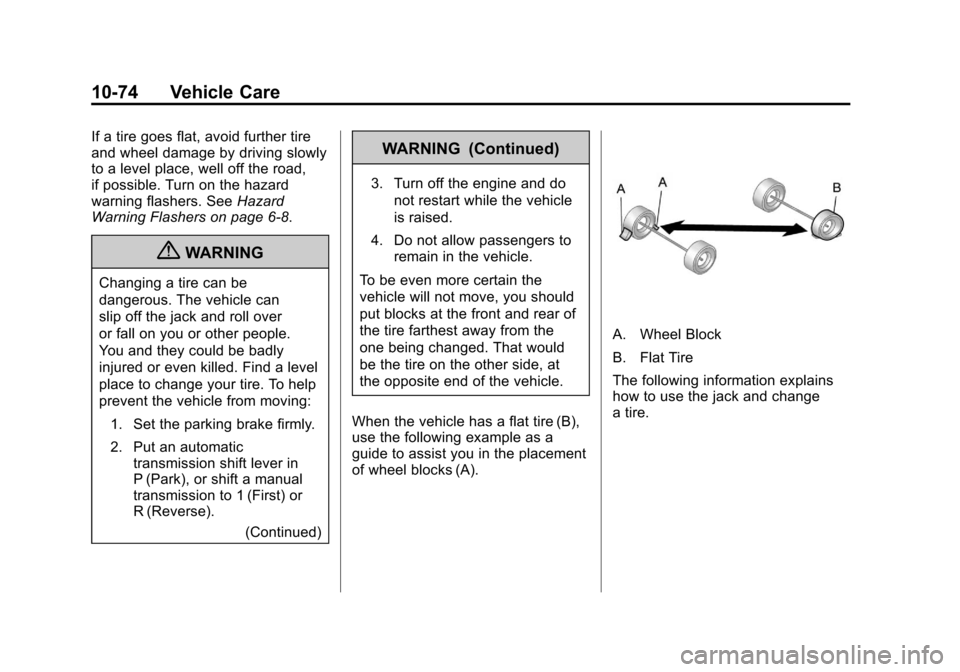
When the vehicle has a flat tire (B),
use the following example as a
guide to assist you in the placement
of wheel blocks (A).
A. Wheel Block
B. Flat Tire
The following information explains
how to use the jack and change
a tire.
Page 479 of 558
Black plate (75,1)Cadillac Escalade/Escalade ESV Owner Manual - 2011
Vehicle Care 10-75
Tire Changing
Removing the Spare Tire and
Tools
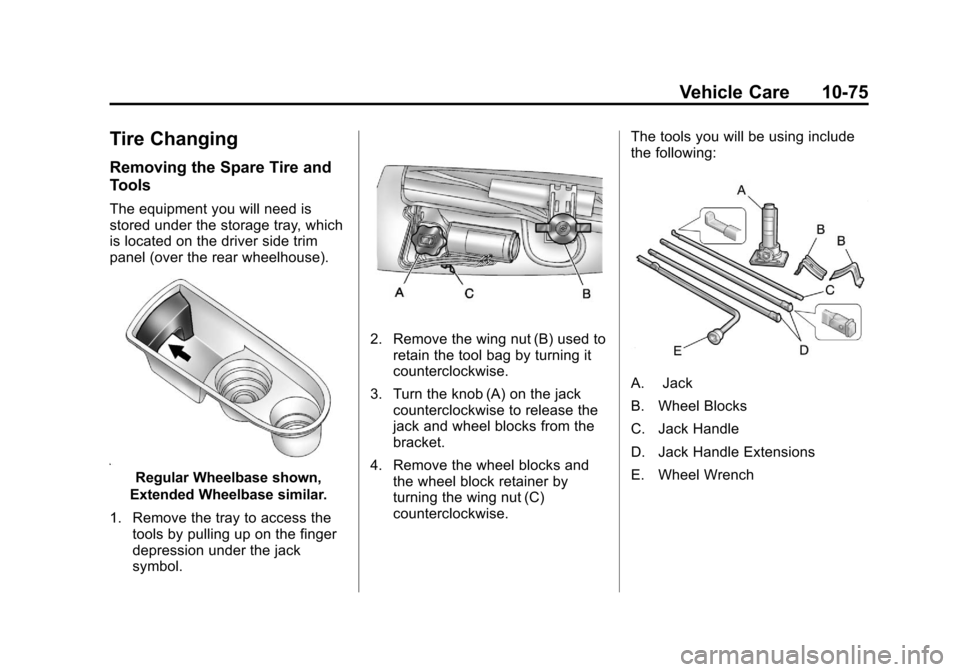
The equipment you will need is
stored under the storage tray, which
is located on the driver side trim
panel (over the rear wheelhouse).
Regular Wheelbase shown,
Extended Wheelbase similar.
1. Remove the tray to access the tools by pulling up on the finger
depression under the jack
symbol.
2. Remove the wing nut (B) used toretain the tool bag by turning it
counterclockwise.
3. Turn the knob (A) on the jack counterclockwise to release the
jack and wheel blocks from the
bracket.
4. Remove the wheel blocks and the wheel block retainer by
turning the wing nut (C)
counterclockwise. The tools you will be using include
the following:
A. Jack
B. Wheel Blocks
C. Jack Handle
D. Jack Handle Extensions
E. Wheel Wrench
Page 480 of 558
Black plate (76,1)Cadillac Escalade/Escalade ESV Owner Manual - 2011
10-76 Vehicle Care
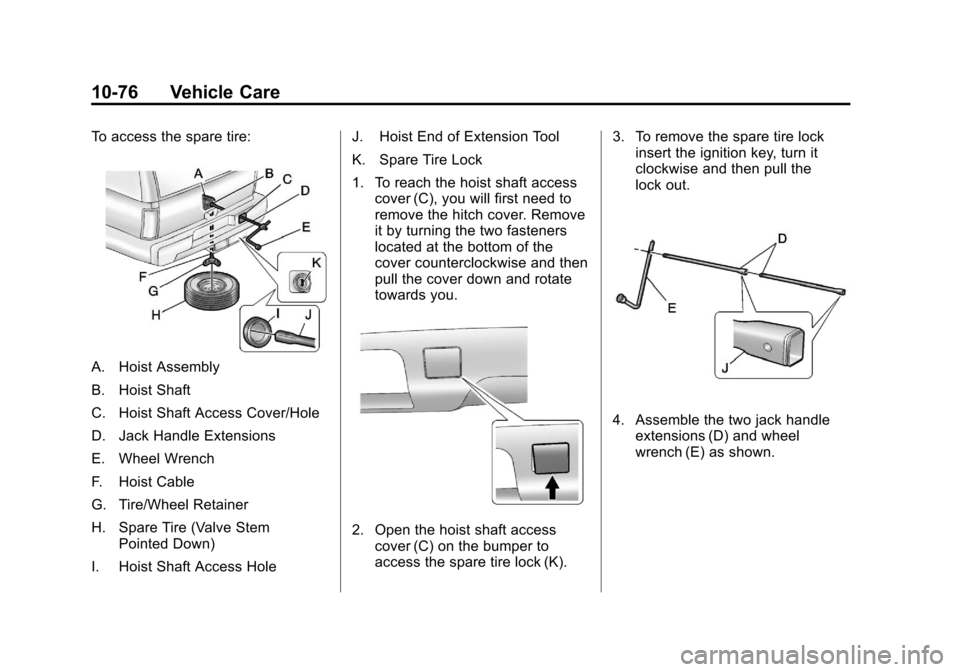
To access the spare tire:
A. Hoist Assembly
B. Hoist Shaft
C. Hoist Shaft Access Cover/Hole
D. Jack Handle Extensions
E. Wheel Wrench
F. Hoist Cable
G. Tire/Wheel Retainer
H. Spare Tire (Valve StemPointed Down)
I. Hoist Shaft Access Hole J. Hoist End of Extension Tool
K. Spare Tire Lock
1. To reach the hoist shaft access
cover (C), you will first need to
remove the hitch cover. Remove
it by turning the two fasteners
located at the bottom of the
cover counterclockwise and then
pull the cover down and rotate
towards you.
2. Open the hoist shaft accesscover (C) on the bumper to
access the spare tire lock (K). 3. To remove the spare tire lock
insert the ignition key, turn it
clockwise and then pull the
lock out.
4. Assemble the two jack handle
extensions (D) and wheel
wrench (E) as shown.
Page 481 of 558
Black plate (77,1)Cadillac Escalade/Escalade ESV Owner Manual - 2011
Vehicle Care 10-77
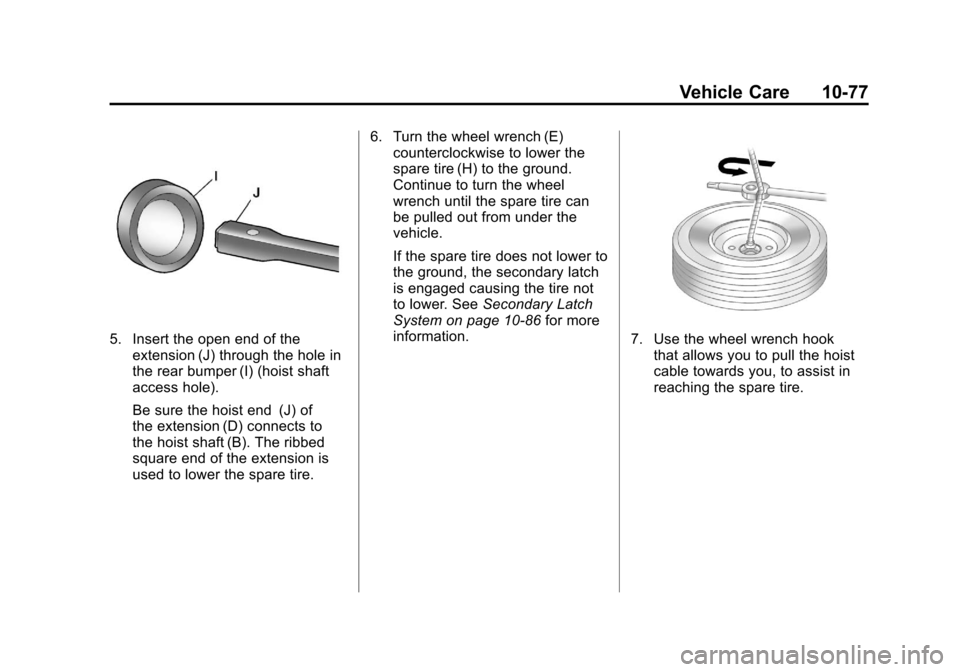
5. Insert the open end of theextension (J) through the hole in
the rear bumper (I) (hoist shaft
access hole).
Be sure the hoist end (J) of
the extension (D) connects to
the hoist shaft (B). The ribbed
square end of the extension is
used to lower the spare tire. 6. Turn the wheel wrench (E)
counterclockwise to lower the
spare tire (H) to the ground.
Continue to turn the wheel
wrench until the spare tire can
be pulled out from under the
vehicle.
If the spare tire does not lower to
the ground, the secondary latch
is engaged causing the tire not
to lower. See Secondary Latch
System on page 10‑86 for more
information.7. Use the wheel wrench hook
that allows you to pull the hoist
cable towards you, to assist in
reaching the spare tire.
Page 483 of 558
Black plate (79,1)Cadillac Escalade/Escalade ESV Owner Manual - 2011
Vehicle Care 10-79
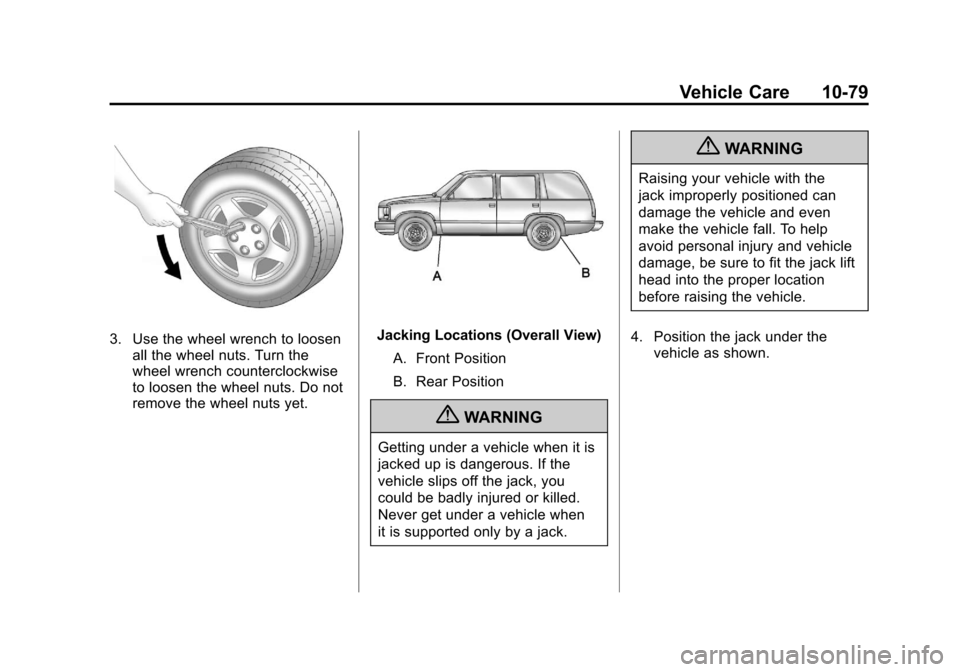
3. Use the wheel wrench to loosenall the wheel nuts. Turn the
wheel wrench counterclockwise
to loosen the wheel nuts. Do not
remove the wheel nuts yet.Jacking Locations (Overall View)
A. Front Position
B. Rear Position
{WARNING
Getting under a vehicle when it is
jacked up is dangerous. If the
vehicle slips off the jack, you
could be badly injured or killed.
Never get under a vehicle when
it is supported only by a jack.
{WARNING
Raising your vehicle with the
jack improperly positioned can
damage the vehicle and even
make the vehicle fall. To help
avoid personal injury and vehicle
damage, be sure to fit the jack lift
head into the proper location
before raising the vehicle.
4. Position the jack under the vehicle as shown.
Page 484 of 558
Black plate (80,1)Cadillac Escalade/Escalade ESV Owner Manual - 2011
10-80 Vehicle Care
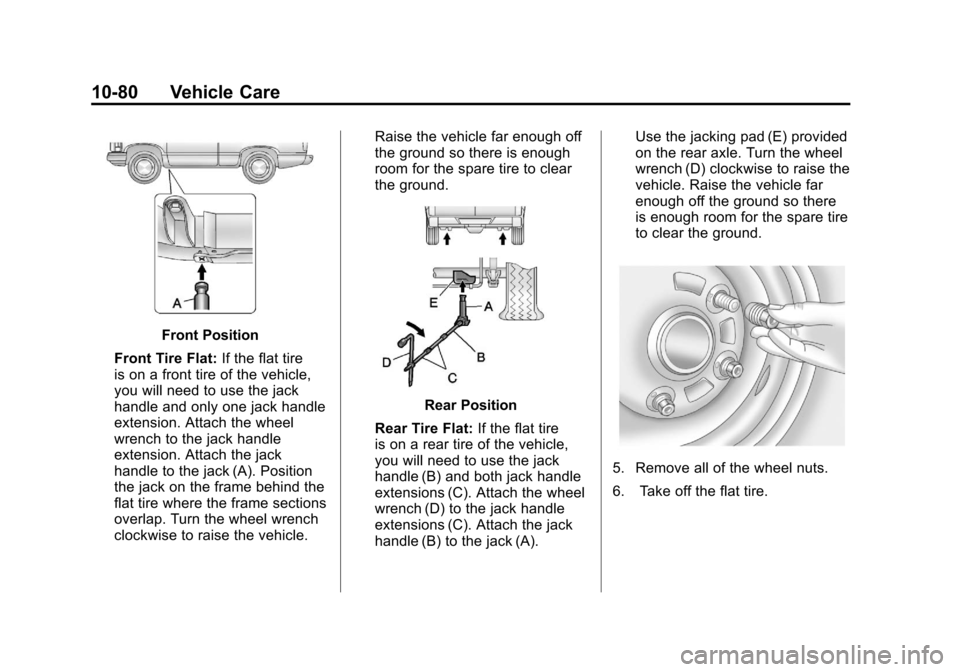
Front Position
Front Tire Flat: If the flat tire
is on a front tire of the vehicle,
you will need to use the jack
handle and only one jack handle
extension. Attach the wheel
wrench to the jack handle
extension. Attach the jack
handle to the jack (A). Position
the jack on the frame behind the
flat tire where the frame sections
overlap. Turn the wheel wrench
clockwise to raise the vehicle. Raise the vehicle far enough off
the ground so there is enough
room for the spare tire to clear
the ground.
Rear Position
Rear Tire Flat: If the flat tire
is on a rear tire of the vehicle,
you will need to use the jack
handle (B) and both jack handle
extensions (C). Attach the wheel
wrench (D) to the jack handle
extensions (C). Attach the jack
handle (B) to the jack (A). Use the jacking pad (E) provided
on the rear axle. Turn the wheel
wrench (D) clockwise to raise the
vehicle. Raise the vehicle far
enough off the ground so there
is enough room for the spare tire
to clear the ground.
5. Remove all of the wheel nuts.
6. Take off the flat tire.