lock CADILLAC ESCALADE 2021 Owner's Manual
[x] Cancel search | Manufacturer: CADILLAC, Model Year: 2021, Model line: ESCALADE, Model: CADILLAC ESCALADE 2021Pages: 492, PDF Size: 7.92 MB
Page 327 of 492
Cadillac Escalade Owner Manual (GMNA-Localizing-U.S./Canada/Mexico-
13690472) - 2021 - CRC - 8/10/21
326 DRIVING AND OPERATING
Take Steering
The LKA system does not
continuously steer the vehicle. If LKA
does not detect active driver steering,
an alert and chime may be provided.
Steer the vehicle to dismiss. LKA may
become temporarily unavailable after
repeated take steering alerts.
When the System Does Not
Seem to Work Properly
The system performance may be
affected by:
.Close vehicles ahead.
.Sudden lighting changes, such as
when driving through tunnels.
.Banked roads.
.Roads with poor lane markings,
such as two-lane roads.
If the LKA system is not functioning
properly when lane markings are
clearly visible, cleaning the windshield
may help.
A camera blocked message may
display if the camera is blocked. Some
driver assistance systems may have
reduced performance or not work at
all. An LKA or LDW unavailable message may display if the systems
are temporarily unavailable. This
message could be due to a blocked
camera. The LKA system does not
need service. Clean the outside of the
windshield behind the rearview mirror.
LKA assistance and/or LDW alerts
may occur due to tar marks, shadows,
cracks in the road, temporary or
construction lane markings, or other
road imperfections. This is normal
system operation; the vehicle does not
need service. Turn LKA off if these
conditions continue.
Fuel
Top Tier Fuel
GM recommends the use of TOP TIER
Detergent Gasoline to keep the engine
clean, reduce engine deposits, and
maintain optimal vehicle performance.
Look for the TOP TIER Logo or see
www.toptiergas.com for a list of TOP
TIER Detergent Gasoline marketers
and applicable countries.
Recommended Fuel
For diesel engine vehicles, see
“Fuel
for Diesel Engines” in the Duramax
diesel supplement.
Premium unleaded gasoline meeting
ASTM specification D4814 with a
posted octane rating of 93 —(R+M)/2
— is highly recommended for best
performance and fuel economy.
Unleaded gasoline with an octane
Page 329 of 492
Cadillac Escalade Owner Manual (GMNA-Localizing-U.S./Canada/Mexico-
13690472) - 2021 - CRC - 8/10/21
328 DRIVING AND OPERATING
Warning (Continued)
Follow these guidelines to help
avoid injuries to you and others:
.Read and follow all the
instructions on the fuel pump
island.
.Turn off the engine when
refueling.
.Keep sparks, flames, and
smoking materials away
from fuel.
.Do not leave the fuel pump
unattended.
.Avoid using electronic devices
while refueling.
.Do not re-enter the vehicle while
pumping fuel.
.Keep children away from the fuel
pump and never let children
pump fuel.
.Before touching the fill nozzle,
touch a metallic object to
discharge static electricity from
your body.(Continued)
Warning (Continued)
.Fuel can spray out if the fill
nozzle is inserted too quickly.
This spray can happen if the
tank is nearly full, and is more
likely in hot weather. Insert the
fill nozzle slowly and wait for any
hiss noise to stop before
beginning to flow fuel.
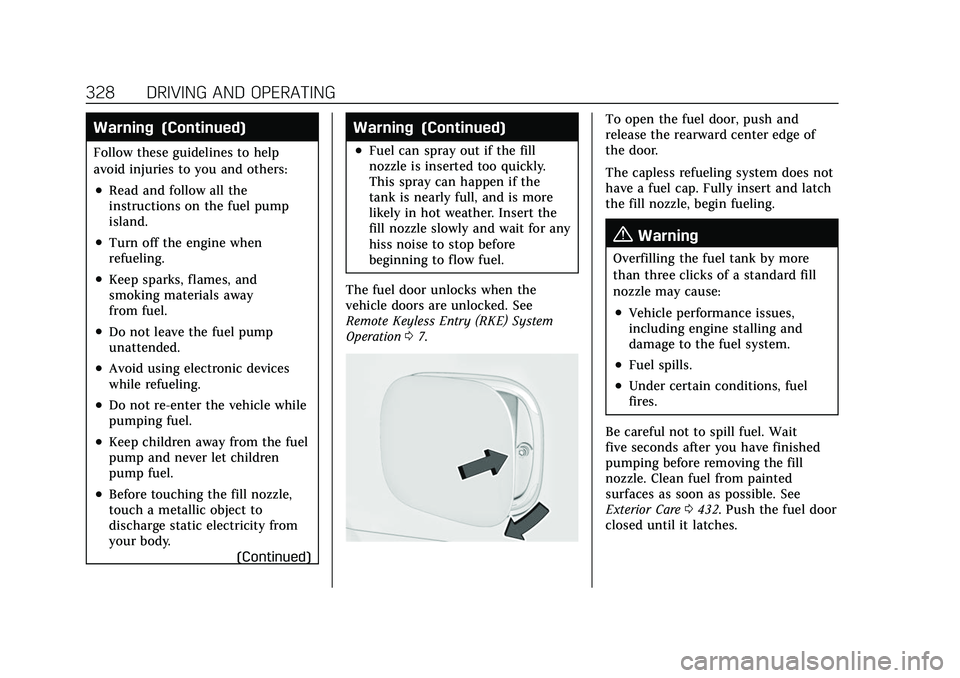
The fuel door unlocks when the
vehicle doors are unlocked. See
Remote Keyless Entry (RKE) System
Operation 07.
To open the fuel door, push and
release the rearward center edge of
the door.
The capless refueling system does not
have a fuel cap. Fully insert and latch
the fill nozzle, begin fueling.
{Warning
Overfilling the fuel tank by more
than three clicks of a standard fill
nozzle may cause:
.Vehicle performance issues,
including engine stalling and
damage to the fuel system.
.Fuel spills.
.Under certain conditions, fuel
fires.
Be careful not to spill fuel. Wait
five seconds after you have finished
pumping before removing the fill
nozzle. Clean fuel from painted
surfaces as soon as possible. See
Exterior Care 0432. Push the fuel door
closed until it latches.
Page 339 of 492

Cadillac Escalade Owner Manual (GMNA-Localizing-U.S./Canada/Mexico-
13690472) - 2021 - CRC - 8/10/21
338 DRIVING AND OPERATING
Rear Gross Axle Weight Rating
(GAWR-RR)
The GAWR-RR is the total weight that
can be supported by the rear axle of
the vehicle. Do not exceed the
GAWR-RR for the vehicle, with the
tow vehicle and trailer fully loaded for
the trip including the weight of the
trailer tongue. If using a
weight-distributing hitch, do not
exceed the GAWR-RR after applying
the weight distribution spring bars.
The GAWR-RR for the vehicle is on
the Trailering Information Label.
Ask your dealer for trailering
information or assistance.
Towing Equipment
Hitches
{Warning
In order to avoid serious injury or
property damage, always follow the
hitch manufacturer's instructions
when securing your draw bar/
coupling device to the vehicle's
hitch receiver.
Ensure that the draw bar/coupling
device is secured with a locking
retainer pin or other means such
that rotation of the pin or locking
mechanism will not cause the pin
to back out or loosen during use.
Failure to correctly secure the draw
bar/coupling device to the receiver
can result in separation of the
hitch/receiver while towing.
Conventional Hitch
A conventional hitch is bolted to the
frame or cross member of the tow
vehicle, and is generally rated Class 2,
3, or 4. Always use the correct hitch
equipment for your vehicle.
Crosswinds, large trucks going by, and
rough roads can affect the trailer and
the hitch.
Proper hitch equipment for your
vehicle helps maintain control of the
vehicle-trailer combination. Many
trailers can be towed using a
weight-carrying hitch which has a
coupler latched to the hitch ball, or a
tow eye latched to a pintle hook.
Other trailers may require a
weight-distributing hitch that uses
spring bars to distribute the trailer
tongue weight between your vehicle
and trailer axles. See
“Maximum
Trailer Tongue Weight Rating” under
Trailer Towing 0334 for weight limits
with various hitch types.
Avoid sharp turns when using a
step-bumper hitch to prevent damage.
Make wider turns to prevent contact
between your trailer and your bumper.
Page 343 of 492
Cadillac Escalade Owner Manual (GMNA-Localizing-U.S./Canada/Mexico-
13690472) - 2021 - CRC - 8/10/21
342 DRIVING AND OPERATING
MeasurementHeight Example 1500 (mm)
H1 1 000
H2 1 060
H2−H1 60
(H2−H1)/3 20
H2−[(H2−H1)/3] 1 040
Tires
.Do not tow a trailer while using a
compact spare tire on the vehicle.
.Tires must be properly inflated to
support loads while towing a trailer.
SeeTires 0393 for instructions on
proper tire inflation.
Safety Chains
Always attach chains between the
vehicle and the trailer, and attach the
chains to the holes on the trailer hitch
platform. Instructions about safety
chains may be provided by the hitch
manufacturer or by the trailer
manufacturer. If the trailer being towed weighs up to
2 271 kg (5,000 lb) with a
factory-installed step bumper, safety
chains may be attached to the
attaching points on the bumper;
otherwise, safety chains should be
attached to holes on the trailer hitch.
Cross the safety chains under the
tongue of the trailer to help prevent
the tongue from contacting the road if
it becomes separated from the hitch.
Always leave just enough slack so the
combination can turn. Never allow
safety chains to drag on the ground.
Trailer Brakes
Loaded trailers over 900 kg (2,000 lb)
must be equipped with brake systems
and with brakes for each axle. Trailerbraking equipment conforming to
Canadian Standards Association (CSA)
requirement CAN3-D313, or its
equivalent, is recommended.
State or local regulations may require
trailers to have their own braking
system if the loaded weight of the
trailer exceeds certain minimums that
can vary from state to state. Read and
follow the instructions for the trailer
brakes so they are installed, adjusted,
and maintained properly. Never
attempt to tap into your vehicle's
hydraulic brake system. If you do,
both the vehicle anti-lock brakes and
the trailer brakes may not function,
which could result in a crash.
Page 345 of 492
Cadillac Escalade Owner Manual (GMNA-Localizing-U.S./Canada/Mexico-
13690472) - 2021 - CRC - 8/10/21
344 DRIVING AND OPERATING
Turn Signals When Towing a
Trailer
When properly connected, the trailer
turn signals should will illuminate to
indicate the vehicle is turning,
changing lanes, or stopping. When
towing a trailer, the arrows on the
instrument cluster will illuminate
even if the trailer is not properly
connected or the bulbs are
burned out.
Tow/Haul Mode
For instructions on how to enter Tow/
Haul mode, seeTow/Haul Mode0256.
Tow/Haul assists when pulling a
heavy trailer or a large or heavy load.
Tow/Haul Mode is designed to be
most effective when the vehicle and
trailer combined weight is at least
75% of the vehicle's Gross Combined
Weight Rating (GCWR). See
“Maximum Trailer Weight ”under
Trailer Towing 0334.
Tow/Haul Mode is most useful when
towing a heavy trailer or carrying a
large or heavy load:
.through rolling terrain
.in stop-and-go traffic
.in busy parking lots
Operating the vehicle in Tow/Haul
Mode when lightly loaded or not
towing will not cause damage;
however, it is not recommended and
may result in unpleasant engine and
transmission driving characteristics
and reduced fuel economy.
Integrated Trailer Brake Control
System
The vehicle may have an Integrated
Trailer Brake Control (ITBC) system
for use with electric trailer brakes or
most electric over hydraulic trailer
brake systems. These instructions
apply to both types of electric trailer
brakes.
This symbol is on the Trailer Brake
Control Panel on vehicles with an
ITBC system. The power output to the
trailer brakes is proportional to the amount of vehicle braking. This
available power output to the trailer
brakes can be adjusted to a wide
range of trailering situations.
The ITBC system is integrated with
the vehicle’s brake, anti-lock brake,
and StabiliTrak/Electronic Stability
Control (ESC) systems. In trailering
conditions that cause the vehicle’s
anti-lock brake or StabiliTrak/ESC
systems to activate, power sent to the
trailer's brakes will be automatically
adjusted to minimize trailer wheel
lock-up. This does not imply that the
trailer has StabiliTrak/ESC.
If the vehicle’s brake, anti-lock brake,
or StabiliTrak systems are not
functioning properly, the ITBC system
may not function fully or at all. Make
sure all of these systems are fully
operational to allow the ITBC system
to function properly.
The ITBC system is powered through
the vehicle's electrical system. Turning
the ignition off will also turn off the
ITBC system. The ITBC system is fully
functional only when the ignition is in
ON/RUN.
Page 347 of 492
Cadillac Escalade Owner Manual (GMNA-Localizing-U.S./Canada/Mexico-
13690472) - 2021 - CRC - 8/10/21
346 DRIVING AND OPERATING
.There is a fault present in the
wiring to the trailer brakes, a
CHECK TRAILER WIRING message
displays on the DIC
.The ITBC system is not working due
to a fault, a SERVICE TRAILER
BRAKE SYSTEM message displays
in the DIC
Manual Trailer Brake Apply Lever
Slide this lever right to apply the
trailer’s electric brakes independent of
the vehicle’s brakes. Use this lever to
adjust Trailer Gain to achieve the
proper power output to the trailer
brakes. The trailer's and the vehicle's
brake lamps will come on when either
vehicle brakes or manual trailer brakes
are applied and properly connected.
Trailer Gain Adjustment Procedure
Trailer Gain should be set for a
specific trailering condition and it
must be readjusted anytime vehicle
loading, trailer loading, or road surface
conditions change.
{Warning
Trailer brakes that are over-gained
or under-gained may not stop the
vehicle and the trailer as intended
and can result in a crash. Always
follow the instructions to set the
Trailer Gain for the proper trailer
stopping performance.
To adjust Trailer Gain for each towing
condition: 1. Drive the vehicle with the trailer attached on a level road surface
representative of the towing
condition and free of traffic at
about 32 to 40 km/h (20 to 25 mph)
and fully apply the Manual Trailer
Brake apply lever.
Note
Adjusting Trailer Gain at speeds lower
than 32 to 40 km/h (20 to 25 mph)
may result in an incorrect gain
setting. 2. Adjust the Trailer Gain, using the Trailer Gain adjustment buttons, to
just below the point of trailer wheel lock-up, indicated by trailer
wheel squeal or tire smoke when a
trailer wheel locks.
Note
Trailer wheel lock-up may not occur if
towing a heavily loaded trailer. In this
case, adjust the Trailer Gain to the
highest allowable setting for the
towing condition. 3. Readjust Trailer Gain any time vehicle loading, trailer loading,
or road surface conditions change
or if trailer wheel lock-up is
noticed at any time while towing.
Other ITBC-Related DIC Messages
TRAILER BRAKES CONNECTED: This
message will briefly display when a
trailer with electric brakes is first
connected to the vehicle. This
message will automatically turn off in
about 10 seconds. This message can
be acknowledged before it
automatically turns off.
CHECK TRAILER WIRING: This
message will display if:
Page 363 of 492
Cadillac Escalade Owner Manual (GMNA-Localizing-U.S./Canada/Mexico-
13690472) - 2021 - CRC - 8/10/21
362 VEHICLE CARE
Vehicle Care
General Information
General Information . . . . . . . . . . . . . 363
California Proposition65 Warning . . . . . . . . . . . . . . . . . . . . . 363
California Perchlorate Materials Requirements . . . . . . . . . . . . . . . . . . . 363
Accessories and Modifications . . . . . . . . . . . . . . . . . . . 364
Vehicle Checks
Doing Your OwnService Work . . . . . . . . . . . . . . . . . . . . 364
Hood . . . . . . . . . . . . . . . . . . . . . . . . . . . . . . 365
Engine Compartment Overview . . . . . . . . . . . . . . . . . . . . . . . . . 366
Engine Oil . . . . . . . . . . . . . . . . . . . . . . . . . 367
Engine Oil Life System . . . . . . . . . . . 369
Automatic Transmission Fluid . . . . . . . . . . . . . . . . . . . . . . . . . . . . . 370
Engine Air Filter Life System . . . . 371
Engine Air Cleaner/Filter . . . . . . . . . 371
Cooling System . . . . . . . . . . . . . . . . . . . 372
Engine Overheating . . . . . . . . . . . . . . 375
Engine Fan . . . . . . . . . . . . . . . . . . . . . . . . 376
Washer Fluid . . . . . . . . . . . . . . . . . . . . . 377
Brakes . . . . . . . . . . . . . . . . . . . . . . . . . . . . . 377
Brake Pad Life System . . . . . . . . . . . 378
Brake Fluid . . . . . . . . . . . . . . . . . . . . . . . 379 Battery - North America . . . . . . . . . 380
Four-Wheel Drive . . . . . . . . . . . . . . . . 380
Front Axle . . . . . . . . . . . . . . . . . . . . . . . . 381
Rear Axle . . . . . . . . . . . . . . . . . . . . . . . . . 381
Park Brake and P (Park)
Mechanism Check . . . . . . . . . . . . . . 381
Wiper Blade Replacement . . . . . . . 382
Glass Replacement . . . . . . . . . . . . . . . 383
Windshield Replacement . . . . . . . . 383
Gas Strut(s) . . . . . . . . . . . . . . . . . . . . . . . 383
Headlamp Aiming
Front Headlamp Aiming . . . . . . . . . 384
Bulb Replacement
Bulb Replacement . . . . . . . . . . . . . . . . 384
LED Lighting . . . . . . . . . . . . . . . . . . . . . 384
Electrical System
Electrical System Overload . . . . . . 385
Fuses and Circuit Breakers . . . . . . 385
Engine Compartment Fuse Block . . . . . . . . . . . . . . . . . . . . . . . . . . . . 386
Instrument Panel Fuse Block . . . . 389
Rear Compartment Fuse Block . . . . . . . . . . . . . . . . . . . . . . . . . . . . 391
Wheels and Tires
Tires . . . . . . . . . . . . . . . . . . . . . . . . . . . . . . . 393
All-Season Tires . . . . . . . . . . . . . . . . . . 394
Winter Tires . . . . . . . . . . . . . . . . . . . . . . 394
Low-Profile Tires . . . . . . . . . . . . . . . . . 395 All-Terrain Tires . . . . . . . . . . . . . . . . . . 395
Tire Sidewall Labeling . . . . . . . . . . . 395
Tire Designations . . . . . . . . . . . . . . . . . 397
Tire Terminology and
Definitions . . . . . . . . . . . . . . . . . . . . . . 397
Tire Pressure . . . . . . . . . . . . . . . . . . . . . . 400
Tire Pressure for High-Speed Operation . . . . . . . . . . . . . . . . . . . . . . . . 401
Tire Pressure Monitor System . . . 402
Tire Pressure Monitor Operation . . . . . . . . . . . . . . . . . . . . . . . . 403
Tire Inspection . . . . . . . . . . . . . . . . . . . 406
Tire Rotation . . . . . . . . . . . . . . . . . . . . . 406
When It Is Time for New Tires . . . . . . . . . . . . . . . . . . . . . . . . . . . . . 407
Buying New Tires . . . . . . . . . . . . . . . . 408
Different Size Tires and Wheels . . . . . . . . . . . . . . . . . . . . . . . . . . 409
Uniform Tire Quality Grading . . . 410
Wheel Alignment and Tire Balance . . . . . . . . . . . . . . . . . . . . . . . . . . 411
Wheel Replacement . . . . . . . . . . . . . . 411
Tire Chains . . . . . . . . . . . . . . . . . . . . . . . 412
If a Tire Goes Flat . . . . . . . . . . . . . . . . 412
Tire Changing . . . . . . . . . . . . . . . . . . . . . 413
Full-Size Spare Tire . . . . . . . . . . . . . . 424Jump Starting
Jump Starting - North America . . . . . . . . . . . . . . . . . . . . . . . . . 425
Page 365 of 492
Cadillac Escalade Owner Manual (GMNA-Localizing-U.S./Canada/Mexico-
13690472) - 2021 - CRC - 8/10/21
364 VEHICLE CARE
may contain perchlorate materials.
Perchlorate Material–special
handling may apply. See
www.dtsc.ca.gov/hazardouswaste/
perchlorate.
Accessories and
Modifications
Adding non-dealer accessories or
making modifications to the vehicle
can affect vehicle performance and
safety, including such things as
airbags, braking, stability, ride and
handling, emissions systems,
aerodynamics, durability, and
electronic systems like antilock
brakes, traction control, and stability
control. These accessories or
modifications could even cause
malfunction or damage not covered by
the vehicle warranty.
Damage to suspension components
caused by modifying vehicle height
outside of factory settings will not be
covered by the vehicle warranty.
Damage to vehicle components
resulting from modifications or the
installation or use of non-GM certified
parts, including control module or software modifications, is not covered
under the terms of the vehicle
warranty and may affect remaining
warranty coverage for affected parts.
GM Accessories are designed to
complement and function with other
systems on the vehicle. See your
dealer to accessorize the vehicle using
genuine GM Accessories installed by a
dealer technician.
Also, see
Adding Equipment to the
Airbag-Equipped Vehicle 075.
Vehicle Checks
Doing Your Own
Service Work
{Warning
It can be dangerous to work on
your vehicle if you do not have the
proper knowledge, service manual,
tools, or parts. Always follow
owner’s manual procedures and
consult the service manual for your
vehicle before doing any
service work. If doing some of your own service
work, use the proper service manual.
It tells you much more about how to
service the vehicle than this manual
can. To order the proper service
manual, see
Publication Ordering
Information 0467.
This vehicle has an airbag system.
Before attempting to do your own
service work, see Servicing the
Airbag-Equipped Vehicle 075.
If equipped with remote vehicle start,
open the hood before performing any
service work to prevent remote
starting the vehicle accidentally. See
Remote Vehicle Start 014.
Keep a record with all parts receipts
and list the mileage and the date of
any service work performed. See
Maintenance Records 0453.
Caution
Even small amounts of
contamination can cause damage to
vehicle systems. Do not allow
contaminants to contact the fluids,
reservoir caps, or dipsticks.
Page 366 of 492

Cadillac Escalade Owner Manual (GMNA-Localizing-U.S./Canada/Mexico-
13690472) - 2021 - CRC - 8/10/21
VEHICLE CARE 365
Hood
{Warning
For vehicles with auto engine stop/
start, turn the vehicle off before
opening the hood. If the vehicle is
on, the engine will start when the
hood is opened. You or others could
be injured.
{Warning
Components under the hood can
get hot from running the engine. To
help avoid the risk of burning
unprotected skin, never touch these
components until they have cooled,
and always use a glove or towel to
avoid direct skin contact.
Clear any snow from the hood before
opening.
To open the hood: 1. Pull the hood release lever with the
isymbol. It is on the lower left
side of the instrument panel.
2. Go to the front of the vehicle and locate the secondary release lever
under the front center of the hood.
Push the secondary hood release
lever to the right to release.
3. After you have partially lifted the hood, the gas strut system will
automatically lift the hood and
hold it in the fully open position.
To close the hood: 1. Before closing the hood, be sure all filler caps are on properly, and all
tools are removed.
2. Pull the hood down until the strut system is no longer holding up
the hood. 3. Allow the hood to fall. Check to
make sure the hood is latched
completely. Repeat this process
with additional force if necessary.
{Warning
Do not drive the vehicle if the hood
is not latched completely. The hood
could open fully, block your vision,
and cause a crash. You or others
could be injured. Always close the
hood completely before driving.
The Driver Information Center (DIC)
will display a message if the hood is
not fully closed, and the vehicle is
moving. Stop and turn off the vehicle,
check the hood for obstructions, and
close the hood again. Check to see if
the message still appears on the DIC.
Page 368 of 492
Cadillac Escalade Owner Manual (GMNA-Localizing-U.S./Canada/Mexico-
13690472) - 2021 - CRC - 8/10/21
VEHICLE CARE 367
1. Remote Negative (–) Location. SeeJump Starting - North America
0425.
2. Positive (+) Terminal (Under Cover). See Jump Starting - North America
0 425.
3. Battery - North America 0380.
4. Engine Compartment Fuse Block
0386.
5. Engine Oil Dipstick. See “Checking
Engine Oil” underEngine Oil 0367.
6. Engine Cooling Fans (Out of View). See Cooling System 0372.
7. Engine Oil Fill Cap. See “When to
Add Engine Oil” underEngine Oil
0 367.
8. Coolant Surge Tank and Pressure Cap. See Cooling System 0372.
9. Engine Air Cleaner/Filter 0371.
10. Brake Fluid Reservoir. See Brake
Fluid 0379.
11. Windshield Washer Fluid Reservoir. See “Adding Washer Fluid” under
Washer Fluid 0377.Engine Oil
For diesel engine vehicles, see “Engine
Oil” in the Duramax diesel
supplement.
To ensure proper engine performance
and long life, careful attention must
be paid to engine oil. Following these
simple, but important steps will help
protect your investment:
.Use engine oil approved to the
proper specification and of the
proper viscosity grade. See
“Selecting the Right Engine Oil” in
this section.
.Check the engine oil level regularly
and maintain the proper oil level.
See “Checking Engine Oil” and
“When to Add Engine Oil” in this
section.
.Change the engine oil at the
appropriate time. See Engine Oil Life
System 0369.
.Always dispose of engine oil
properly. See “What to Do with Used
Oil” in this section.
Checking Engine Oil
Check the engine oil level regularly,
every 650 km (400 mi), especially prior
to a long trip. The engine oil dipstick
handle is a loop. See Engine
Compartment Overview 0366 for the
location.
{Warning
The engine oil dipstick handle may
be hot; it could burn you. Use a
towel or glove to touch the dipstick
handle.
If a low oil Driver Information Center
(DIC) message displays, check the oil
level.
Follow these guidelines:
.To get an accurate reading, park the
vehicle on level ground. Check the
engine oil level after the engine has
been off for at least two hours.
Checking the engine oil level on
steep grades or too soon after
engine shutoff can result in
incorrect readings. Accuracy