wheel CADILLAC ESCALADE 2021 Repair Manual
[x] Cancel search | Manufacturer: CADILLAC, Model Year: 2021, Model line: ESCALADE, Model: CADILLAC ESCALADE 2021Pages: 492, PDF Size: 7.92 MB
Page 267 of 492
Cadillac Escalade Owner Manual (GMNA-Localizing-U.S./Canada/Mexico-
13690472) - 2021 - CRC - 8/10/21
266 DRIVING AND OPERATING
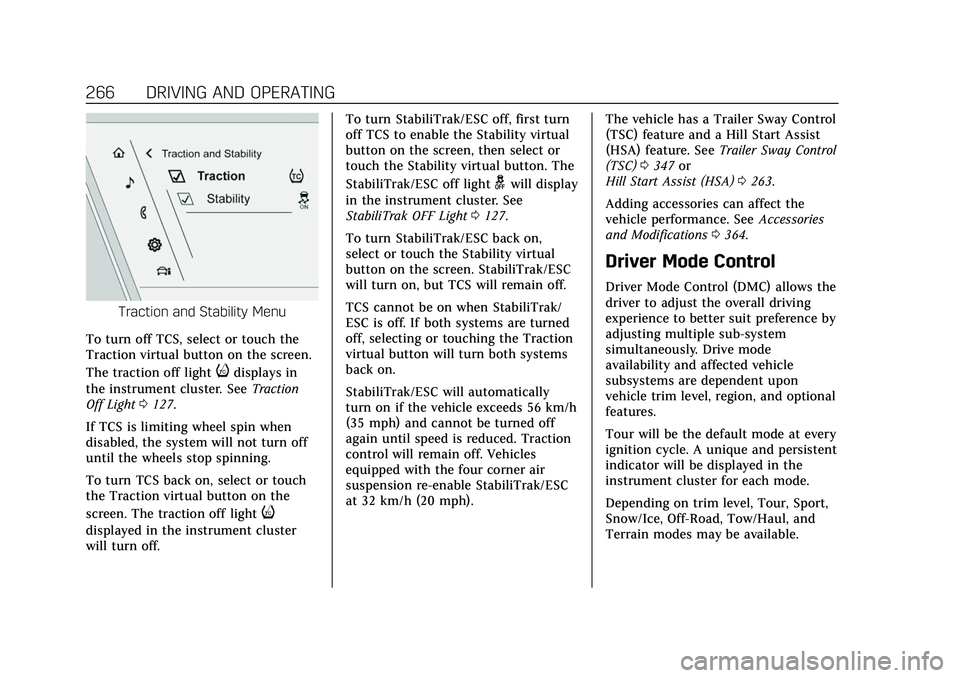
Traction and Stability Menu
To turn off TCS, select or touch the
Traction virtual button on the screen.
The traction off light
idisplays in
the instrument cluster. See Traction
Off Light 0127.
If TCS is limiting wheel spin when
disabled, the system will not turn off
until the wheels stop spinning.
To turn TCS back on, select or touch
the Traction virtual button on the
screen. The traction off light
i
displayed in the instrument cluster
will turn off. To turn StabiliTrak/ESC off, first turn
off TCS to enable the Stability virtual
button on the screen, then select or
touch the Stability virtual button. The
StabiliTrak/ESC off light
gwill display
in the instrument cluster. See
StabiliTrak OFF Light 0127.
To turn StabiliTrak/ESC back on,
select or touch the Stability virtual
button on the screen. StabiliTrak/ESC
will turn on, but TCS will remain off.
TCS cannot be on when StabiliTrak/
ESC is off. If both systems are turned
off, selecting or touching the Traction
virtual button will turn both systems
back on.
StabiliTrak/ESC will automatically
turn on if the vehicle exceeds 56 km/h
(35 mph) and cannot be turned off
again until speed is reduced. Traction
control will remain off. Vehicles
equipped with the four corner air
suspension re-enable StabiliTrak/ESC
at 32 km/h (20 mph). The vehicle has a Trailer Sway Control
(TSC) feature and a Hill Start Assist
(HSA) feature. See
Trailer Sway Control
(TSC) 0347 or
Hill Start Assist (HSA) 0263.
Adding accessories can affect the
vehicle performance. See Accessories
and Modifications 0364.
Driver Mode Control
Driver Mode Control (DMC) allows the
driver to adjust the overall driving
experience to better suit preference by
adjusting multiple sub-system
simultaneously. Drive mode
availability and affected vehicle
subsystems are dependent upon
vehicle trim level, region, and optional
features.
Tour will be the default mode at every
ignition cycle. A unique and persistent
indicator will be displayed in the
instrument cluster for each mode.
Depending on trim level, Tour, Sport,
Snow/Ice, Off-Road, Tow/Haul, and
Terrain modes may be available.
Page 268 of 492
Cadillac Escalade Owner Manual (GMNA-Localizing-U.S./Canada/Mexico-
13690472) - 2021 - CRC - 8/10/21
DRIVING AND OPERATING 267
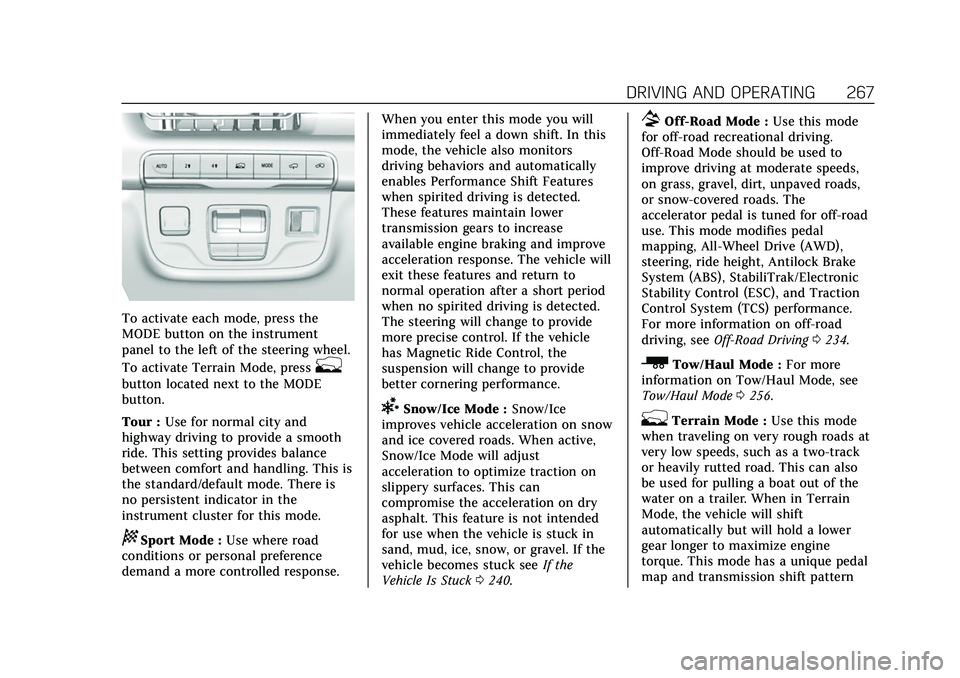
To activate each mode, press the
MODE button on the instrument
panel to the left of the steering wheel.
To activate Terrain Mode, press
g
button located next to the MODE
button.
Tour :Use for normal city and
highway driving to provide a smooth
ride. This setting provides balance
between comfort and handling. This is
the standard/default mode. There is
no persistent indicator in the
instrument cluster for this mode.
8Sport Mode : Use where road
conditions or personal preference
demand a more controlled response. When you enter this mode you will
immediately feel a down shift. In this
mode, the vehicle also monitors
driving behaviors and automatically
enables Performance Shift Features
when spirited driving is detected.
These features maintain lower
transmission gears to increase
available engine braking and improve
acceleration response. The vehicle will
exit these features and return to
normal operation after a short period
when no spirited driving is detected.
The steering will change to provide
more precise control. If the vehicle
has Magnetic Ride Control, the
suspension will change to provide
better cornering performance.
6Snow/Ice Mode :
Snow/Ice
improves vehicle acceleration on snow
and ice covered roads. When active,
Snow/Ice Mode will adjust
acceleration to optimize traction on
slippery surfaces. This can
compromise the acceleration on dry
asphalt. This feature is not intended
for use when the vehicle is stuck in
sand, mud, ice, snow, or gravel. If the
vehicle becomes stuck see If the
Vehicle Is Stuck 0240.
7Off-Road Mode : Use this mode
for off-road recreational driving.
Off-Road Mode should be used to
improve driving at moderate speeds,
on grass, gravel, dirt, unpaved roads,
or snow-covered roads. The
accelerator pedal is tuned for off-road
use. This mode modifies pedal
mapping, All-Wheel Drive (AWD),
steering, ride height, Antilock Brake
System (ABS), StabiliTrak/Electronic
Stability Control (ESC), and Traction
Control System (TCS) performance.
For more information on off-road
driving, see Off-Road Driving 0234.
_Tow/Haul Mode : For more
information on Tow/Haul Mode, see
Tow/Haul Mode 0256.
gTerrain Mode : Use this mode
when traveling on very rough roads at
very low speeds, such as a two-track
or heavily rutted road. This can also
be used for pulling a boat out of the
water on a trailer. When in Terrain
Mode, the vehicle will shift
automatically but will hold a lower
gear longer to maximize engine
torque. This mode has a unique pedal
map and transmission shift pattern
Page 269 of 492

Cadillac Escalade Owner Manual (GMNA-Localizing-U.S./Canada/Mexico-
13690472) - 2021 - CRC - 8/10/21
268 DRIVING AND OPERATING
for better control at lower speeds and
over rough terrain. This mode
modifies accelerator pedal mapping,
transmission shift pattern, ride height,
suspension, steering, AWD, Electronic
Limited-Slip Differential (eSLD), ESC
performance and TCS performance.
When the vehicle comes to a stop on
an upward grade, Automatic Vehicle
Hold is engaged until the driver
presses the accelerator pedal. Stop/
Start and cruise control are disabled
in Terrain Mode.
Active Braking during lift throttle will
be engaged. This feature automatically
applies light braking to simulate
heavy engine braking of
four-wheel-dive low. It also applies
light braking in D (Drive) until the
vehicle is at idle speeds. In M1 and
M2 light braking will typically bring
the vehicle to a stop. Active Braking
during lift throttle will also reduce
trailer braking.
Terrain Mode will automatically exit
to Tour Mode if the brake
temperatures become too hot,electronic parking brake becomes
inoperable or the vehicle cannot
perform braking or vehicle hold.
For more information on off-road
driving, see
Off-Road Driving 0234 and
Hill and Mountain Roads 0238.
Magnetic Ride Control
This vehicle may have a semi-active
damping system called Magnetic Ride
Control. With this feature, improved
vehicle ride and handling is provided
under a variety of passenger and
loading conditions.
Locking Rear Axle
Vehicles with a locking rear axle can
give more traction on snow, mud, ice,
sand, or gravel. It works like a
standard axle most of the time, but
when traction is low, this feature will
allow the rear wheel with the most
traction to move the vehicle.
Four Corner Air Suspension
System
The Four Corner Air Suspension
feature provides full time load leveling
capability along with the benefit of
adjusting ride height for increased
convenience and capability.
{Warning
To help avoid personal injury or
death, make sure the area
underneath the vehicle and inside
the wheel wells is clear when
lowering the vehicle.
{Warning
To help avoid personal injury or
death, always select the lowest ride
height for the current driving
conditions. Higher ride heights raise
the vehicle's center of gravity,
increasing the chance of a rollover
during extreme maneuvers.
Page 272 of 492

Cadillac Escalade Owner Manual (GMNA-Localizing-U.S./Canada/Mexico-
13690472) - 2021 - CRC - 8/10/21
DRIVING AND OPERATING 271
Service Mode
Service Mode will disable all air
suspension operation including raising
and lowering the vehicle and
operation of the air compressor. This
mode is useful when the vehicle is
being towed on a flat bed or when any
work under the vehicle is being
performed.
Service Mode is automatically enabled
when the vehicle is put on a hoist or a
floor jack is used to raise a corner.
Service Mode automatically disables
when vehicle speed exceeds 16 km/h
(10 mph).
Alignment Mode
Alignment Mode will optimize the
vehicle height to provide the most
accurate wheel alignment. This mode
should be enabled once the vehicle is
driven onto the alignment station.
To enable Alignment Mode, ensure
the vehicle is at Normal Height and
shift the vehicle to Neutral. Alignment
Mode automatically disables when
vehicle speed exceeds 16 km/h
(10 mph).Air Suspension Operation with
Door(s) or Hood Open
The air suspension will temporarily
suspend all height changes while the
hood or any door is open.
System Over-Temperature
If the air suspension is under heavy
use, the system may temporarily
suspend all height changes to allow
compressor cooldown. When this
occurs and a height change is
requested, a
‘Leveling System
Unavailable’ message will be displayed
in the instrument cluster.
Suspension Lowered for Stability
In the event of a loss of Electronic
Stability Control, the air suspension
will lower the vehicle at higher speeds
to provide increased stability. This will
be accompanied by a ‘Vehicle
Lowering for Stability’ message in the
instrument cluster.
Excessive Vehicle Loading
If the air suspension detects excessive
vehicle loading, it will not raise above
Normal Height. Air Suspension Service
If a
‘Service Leveling System’ message
is displayed in the instrument cluster,
see your authorized dealer
immediately.
Cruise Control
{
Warning
Cruise control can be dangerous
where you cannot drive safely at a
steady speed. Do not use cruise
control on winding roads or in
heavy traffic.
Cruise control can be dangerous on
slippery roads. On such roads, fast
changes in tire traction can cause
excessive wheel slip, and you could
lose control. Do not use cruise
control on slippery roads.
If equipped with cruise control, a
speed of about 40 km/h (25 mph) or
more can be maintained without
keeping your foot on the accelerator.
Cruise control does not work at speeds
below about 40 km/h (25 mph).
Page 273 of 492

Cadillac Escalade Owner Manual (GMNA-Localizing-U.S./Canada/Mexico-
13690472) - 2021 - CRC - 8/10/21
272 DRIVING AND OPERATING
If the Traction Control/Electronic
Stability Control system begins to
limit wheel spin while using cruise
control, the cruise control
automatically disengages. SeeTraction
Control/Electronic Stability Control
0 264. If a collision alert occurs when
cruise control is activated, cruise
control is disengaged. See Forward
Collision Alert (FCA) System 0313.
When road conditions allow you to
safely use it again, the cruise control
can be turned back on.
If the brakes are applied, cruise
control disengages.J: Press to turn the system on and
off. A white indicator appears in the
instrument cluster when cruise is
turned on.
RES+ : If there is a set speed in
memory, press the control up briefly
to resume that speed or press and
hold to accelerate. If the cruise control
is already active, use to increase
vehicle speed.
SET− :Press the control down briefly
to set the speed and activate cruise
control. If the cruise control is already
active, use to decrease vehicle speed.
*: Press to disengage cruise control
without erasing the set speed from
memory.
Setting Cruise Control
If
Jis on when not in use, SET− or
RES+ could get pressed and go into
cruise when not desired. Keep
Joff
when cruise is not being used.
To set cruise control:
1. Press
J.
2. Get up to the desired speed.
3. Press and release SET−. 4. Remove your foot from the
accelerator.
When the cruise control has been set
to the desired speed, a green cruise
control indicator appears on the
instrument cluster and a cruise set
speed message appears on the Driver
Information Center (DIC) and
Head-Up Display (HUD), if equipped.
Resuming a Set Speed
If the cruise control is set at a desired
speed and then the brakes are applied
or
*is pressed, the cruise control is
disengaged without erasing the set
speed from memory.
Once the vehicle speed reaches about
40 km/h (25 mph) or more, press RES+
up briefly. The vehicle returns to the
previous set speed.
Increasing Speed While Cruise
Control is at a Set Speed
If the cruise control system is already
activated:
.Press and hold RES+ up until the
vehicle accelerates to the desired
speed, then release it.
Page 275 of 492

Cadillac Escalade Owner Manual (GMNA-Localizing-U.S./Canada/Mexico-
13690472) - 2021 - CRC - 8/10/21
274 DRIVING AND OPERATING
Adaptive Cruise Control
(Advanced)
If equipped, Adaptive Cruise Control
(ACC) allows the cruise control set
speed and following gap to be
selected. Read this entire section
before using this system. The
following gap is the following time (or
distance) between your vehicle and a
vehicle detected directly ahead in your
path, moving in the same direction.
If no vehicle is detected in your path,
ACC works like regular cruise control.
ACC uses camera and radar sensors.
SeeRadio Frequency Statement 0467.
If a vehicle is detected in your path,
ACC can speed up the vehicle or apply
limited, moderate braking to maintain
the selected following gap. To
disengage ACC, apply the brake. If the
Traction Control System (TCS) or
StabiliTrak/Electronic Stability Control
(ESC) activates while ACC is engaged,
ACC may automatically disengage. See
Traction Control/Electronic Stability
Control 0264. When road conditions
allow ACC to be safely used, ACC can
be turned back on. Turning off the TCS or StabiliTrak/
ESC system will disengage the cruise
control.
ACC can reduce the need for you to
frequently brake and accelerate,
especially when used on expressways,
freeways, and interstate highways.
When used on other roads, you may
need to take over the control of
braking or acceleration more often.
{Warning
ACC has limited braking ability and
may not have time to slow the
vehicle down enough to avoid a
collision with another vehicle you
are following. This can occur when
vehicles suddenly slow or stop
ahead, or enter your lane. Also see
“Alerting the Driver”
in this section.
Complete attention is always
required while driving and you
should be ready to take action and
apply the brakes. See Defensive
Driving 0231.
{Warning
ACC will not detect or brake for
children, pedestrians, animals,
or other objects.
Do not use ACC when:
.On winding and hilly roads or
when the sensors are blocked by
snow, ice, or dirt. The system
may not detect a vehicle ahead.
Keep the entire front of the
vehicle clean.
.Visibility is low, such as in fog,
rain, or snow conditions. ACC
performance is limited under
these conditions.
.On slippery roads where fast
changes in tire traction can
cause excessive wheel slip.
.When towing a trailer.
Page 279 of 492
Cadillac Escalade Owner Manual (GMNA-Localizing-U.S./Canada/Mexico-
13690472) - 2021 - CRC - 8/10/21
278 DRIVING AND OPERATING
With ACC active, press[on the
steering wheel to adjust the following
gap. Each press cycles the gap button
through three settings: Far, Medium,
or Near.
When pressed, the current gap setting
displays briefly on the instrument
cluster and HUD (if equipped). The
gap setting will be maintained until it
is changed.
Since each gap setting corresponds to
a following time (Far, Medium,
or Near), the following distance will
vary based on vehicle speed. The
faster the vehicle speed, the further
back your vehicle will follow a vehicle
detected ahead. Consider traffic and
weather conditions when selecting the
following gap. The range of selectable
gaps may not be appropriate for all
drivers and driving conditions.
Changing the gap setting
automatically changes the alert timing
sensitivity (Far, Medium, or Near) for
the Forward Collision Alert (FCA)
feature. See Forward Collision Alert
(FCA) System 0313. Courtesy Gap
Press and hold
[on the steering
wheel when vehicle is moving to
temporarily increase the gap with the
vehicle ahead to allow for merging
traffic.
Press and hold
[when stopped to
cancel ACC from resuming
automatically (if the stop is brief) and
remain stationary. This can be used to
allow traffic to merge between you
and the vehicle ahead. Press RES+ or
the accelerator pedal to resume ACC.
Following distance gap will return to
the original selection after hold.
Alerting the Driver
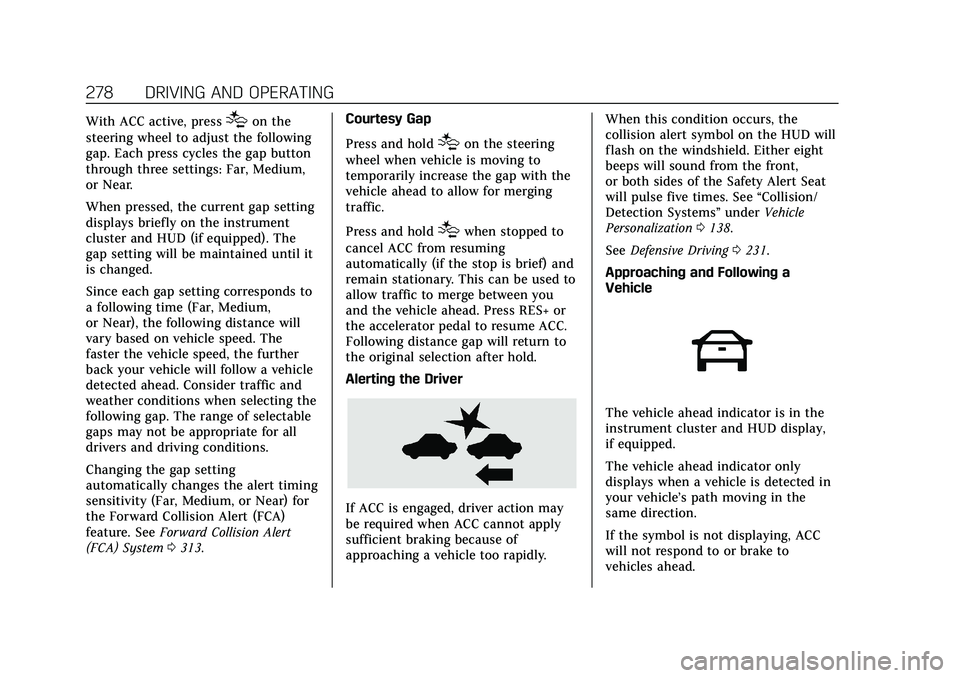
If ACC is engaged, driver action may
be required when ACC cannot apply
sufficient braking because of
approaching a vehicle too rapidly. When this condition occurs, the
collision alert symbol on the HUD will
flash on the windshield. Either eight
beeps will sound from the front,
or both sides of the Safety Alert Seat
will pulse five times. See
“Collision/
Detection Systems” underVehicle
Personalization 0138.
See Defensive Driving 0231.
Approaching and Following a
Vehicle
The vehicle ahead indicator is in the
instrument cluster and HUD display,
if equipped.
The vehicle ahead indicator only
displays when a vehicle is detected in
your vehicle’s path moving in the
same direction.
If the symbol is not displaying, ACC
will not respond to or brake to
vehicles ahead.
Page 285 of 492

Cadillac Escalade Owner Manual (GMNA-Localizing-U.S./Canada/Mexico-
13690472) - 2021 - CRC - 8/10/21
284 DRIVING AND OPERATING
An active Super Cruise service plan is
required to use Super Cruise.
{Warning
Super Cruise does not perform all
aspects of driving, nor does it do
everything a driver can do. Super
Cruise only steers to maintain
vehicle position in the current lane
or, under some circumstances, to
change lanes. Super Cruise can only
be used with Adaptive Cruise
Control.
Super Cruise does:
.Not prevent crashes or warn of
possible crashes.
.Not steer to avoid stopped or
slow-moving vehicles,
cross-traffic, construction
barriers or cones, motorcycles,
children, pedestrians, animals,
or other objects on the road.
.Not steer in response to vehicles
or objects next to your vehicle,
including vehicles attempting to
enter your lane.(Continued)
Warning (Continued)
.Not respond to traffic lights, stop
signs, or other traffic control
devices.
.Not respond to crossing traffic.
.Not make turns.
.Not steer to merge onto or to
exit highways.
.Not detect, steer to avoid,
or steer through construction
zones.
.Not function on surface streets.
.Not respond to crossing or
oncoming traffic.
.Not function in city driving
conditions.
{Warning
Some state and local laws may
require hands to be kept on the
steering wheel at all times. Only
remove your hands from the
steering wheel if Super Cruise is
engaged, it is safe to do so, and it is
(Continued)
Warning (Continued)
permitted by state and local laws.
Failure to do so may result in a
crash involving serious injury or
death.
{Warning
Failure to supervise the driving task
and to respond appropriately, even
while Super Cruise is operating, can
cause a crash. Super Cruise may not
respond as you would to all driving
situations and may not maintain
lane position under all conditions.
It is extremely important to pay
attention to the operation of the
vehicle, even while using Super
Cruise. Do not use a hand-held
device while driving, even with
Super Cruise engaged. To prevent
serious injury or death:
.Always remain properly seated in
the driver seat with your seat
belt fastened.(Continued)
Page 286 of 492

Cadillac Escalade Owner Manual (GMNA-Localizing-U.S./Canada/Mexico-
13690472) - 2021 - CRC - 8/10/21
DRIVING AND OPERATING 285
Warning (Continued)
.Never remove your hands from
the steering wheel when Super
Cruise is not operating.
.Always make sure traffic
conditions are safe before using
Super Cruise.
.Always keep the entire vehicle
and the sensors clean. Sensors
are on the front, sides, and rear
of the vehicle.
.Always observe posted speed
limits. Only use Super Cruise at
or below the posted speed limit.
Super Cruise should not be used in
complex or uncertain driving
conditions, including:
.Not in construction zones.
.Not when approaching or exiting
toll plazas.
.Not when approaching an
intersection that is controlled
with a traffic light, stop sign,
or other traffic control device. (Continued)
Warning (Continued)
.Not when lane markings are not
present or cannot be detected.
For example, there is too much
glare, weather conditions are
poor, or lanes are poorly marked.
.Not on slippery or icy roads.
.Not in adverse weather
conditions, including rain, sleet,
fog, ice, or snow.
.Not on winding or hilly roads.
.Not for city driving.
.Not during heavy or emergency
braking.
.Not on surface streets.
.Not on a road shoulder, service
drive, or under an elevated
freeway.
.Not when towing a trailer.
.Not in a highway exit lane. When Super Cruise is Available
Super Cruise Indicator
Super Cruise is designed to operate
only when:
.ACC is on. See Adaptive Cruise
Control (Advanced) 0274.
.Teen Driver is not active.
.The GPS detects the vehicle is on a
compatible highway.
.Both the camera and the radar
sensors are functioning and not
covered, obstructed, or damaged.
.The Driver Attention System (DAS)
detects the driver's head and eyes
are directed toward the road.
.The lane markings are clearly visible
and able to be detected by the
system.
Page 287 of 492
Cadillac Escalade Owner Manual (GMNA-Localizing-U.S./Canada/Mexico-
13690472) - 2021 - CRC - 8/10/21
286 DRIVING AND OPERATING
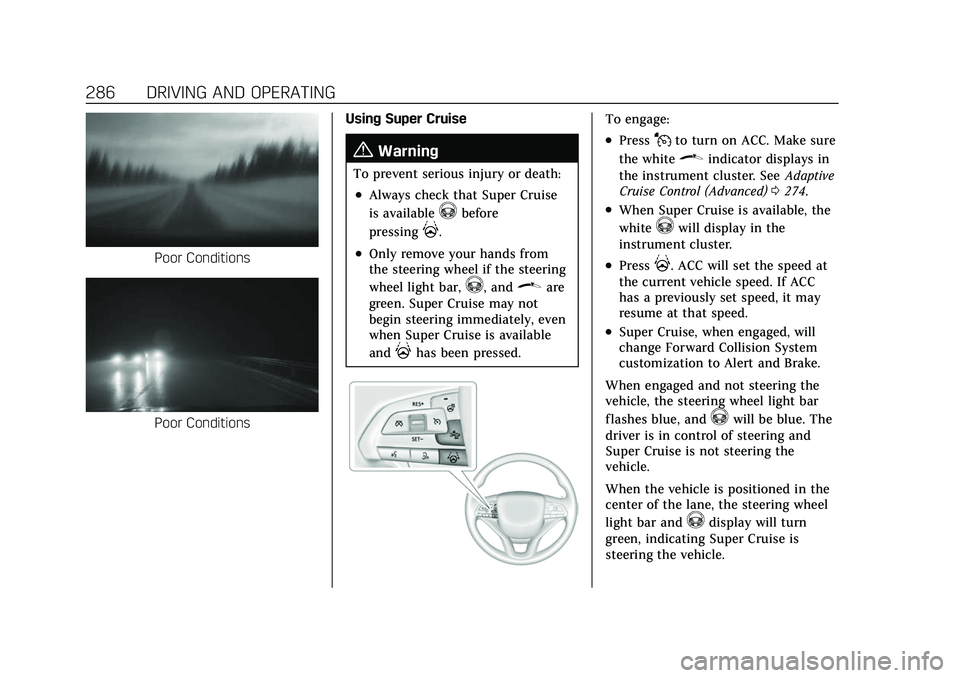
Poor Conditions
Poor ConditionsUsing Super Cruise
{Warning
To prevent serious injury or death:
.Always check that Super Cruise
is available
^before
pressing
].
.Only remove your hands from
the steering wheel if the steering
wheel light bar,
^, and\are
green. Super Cruise may not
begin steering immediately, even
when Super Cruise is available
and
]has been pressed.
To engage:
.PressJto turn on ACC. Make sure
the white
\indicator displays in
the instrument cluster. See Adaptive
Cruise Control (Advanced) 0274.
.When Super Cruise is available, the
white
^will display in the
instrument cluster.
.Press]. ACC will set the speed at
the current vehicle speed. If ACC
has a previously set speed, it may
resume at that speed.
.Super Cruise, when engaged, will
change Forward Collision System
customization to Alert and Brake.
When engaged and not steering the
vehicle, the steering wheel light bar
flashes blue, and
^will be blue. The
driver is in control of steering and
Super Cruise is not steering the
vehicle.
When the vehicle is positioned in the
center of the lane, the steering wheel
light bar and
^display will turn
green, indicating Super Cruise is
steering the vehicle.