key CADILLAC ESCALADE ESV 2007 2.G Repair Manual
[x] Cancel search | Manufacturer: CADILLAC, Model Year: 2007, Model line: ESCALADE ESV, Model: CADILLAC ESCALADE ESV 2007 2.GPages: 574, PDF Size: 2.89 MB
Page 324 of 574
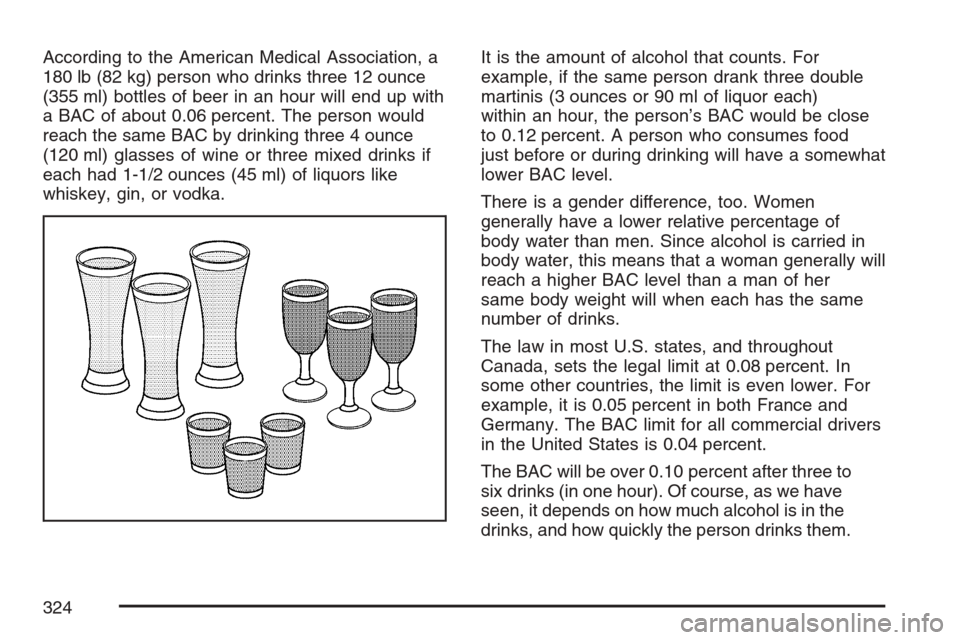
According to the American Medical Association, a
180 lb (82 kg) person who drinks three 12 ounce
(355 ml) bottles of beer in an hour will end up with
a BAC of about 0.06 percent. The person would
reach the same BAC by drinking three 4 ounce
(120 ml) glasses of wine or three mixed drinks if
each had 1-1/2 ounces (45 ml) of liquors like
whiskey, gin, or vodka.It is the amount of alcohol that counts. For
example, if the same person drank three double
martinis (3 ounces or 90 ml of liquor each)
within an hour, the person’s BAC would be close
to 0.12 percent. A person who consumes food
just before or during drinking will have a somewhat
lower BAC level.
There is a gender difference, too. Women
generally have a lower relative percentage of
body water than men. Since alcohol is carried in
body water, this means that a woman generally will
reach a higher BAC level than a man of her
same body weight will when each has the same
number of drinks.
The law in most U.S. states, and throughout
Canada, sets the legal limit at 0.08 percent. In
some other countries, the limit is even lower. For
example, it is 0.05 percent in both France and
Germany. The BAC limit for all commercial drivers
in the United States is 0.04 percent.
The BAC will be over 0.10 percent after three to
six drinks (in one hour). Of course, as we have
seen, it depends on how much alcohol is in the
drinks, and how quickly the person drinks them.
324
Page 342 of 574

Getting Familiar with Off-Road Driving
It is a good idea to practice in an area that is
safe and close to home before you go into the
wilderness. Off-road driving does require some new
and different driving skills. Here is what we mean.
Tune your senses to different kinds of signals. Your
eyes, for example, need to constantly sweep the
terrain for unexpected obstacles. Your ears need to
listen for unusual tire or engine sounds. With your
arms, hands, feet, and body, you will need to
respond to vibrations and vehicle bounce.
Controlling your vehicle is the key to successful
off-road driving. One of the best ways to control
your vehicle is to control your speed. Here are
some things to keep in mind. At higher speeds:
You approach things faster and you have less
time to scan the terrain for obstacles.
You have less time to react.
You have more vehicle bounce when you
drive over obstacles.
You will need more distance for braking,
especially since you are on an unpaved
surface.
{CAUTION:
When you are driving off-road, bouncing
and quick changes in direction can easily
throw you out of position. This could cause
you to lose control and crash. So, whether
you are driving on or off the road, you and
your passengers should wear safety belts.
Scanning the Terrain
Off-road driving can take you over many different
kinds of terrain. You need to be familiar with
the terrain and its many different features. Here
are some things to consider.
Surface Conditions:Off-roading can take you
over hard-packed dirt, gravel, rocks, grass, sand,
mud, snow, or ice. Each of these surfaces affects
the steering, acceleration, and braking of your
vehicle in different ways. Depending upon the kind
of surface you are on, you may experience slipping,
sliding, wheel spinning, delayed acceleration, poor
traction, and longer braking distances.
342
Page 375 of 574
{CAUTION:
Things you put inside your vehicle can
strike and injure people in a sudden stop
or turn, or in a crash.
Put things in the cargo area of your
vehicle. Try to spread the weight
evenly.
Never stack heavier things, like
suitcases, inside the vehicle so that
some of them are above the tops of
the seats.
Do not leave an unsecured child
restraint in your vehicle.
When you carry something inside the
vehicle, secure it whenever you can.
Do not leave a seat folded down
unless you need to.
There is also important loading information for
off-road driving in this manual. See “Loading Your
Vehicle for Off-Road Driving” underOff-Road
Driving on page 338.
Add-On Equipment
When you carry removable items, you may need
to put a limit on how many people you can
carry inside your vehicle. Be sure to weigh your
vehicle before you buy and install the new
equipment.
Notice:Overloading your vehicle may cause
damage. Repairs would not be covered by your
warranty. Do not overload your vehicle.
Remember not to exceed the Gross Axle Weight
Rating (GAWR) of the front or rear axle.
Automatic Level Control
The automatic level control rear suspension
comes as a part of the Road Sensing Suspension.
SeeRoad Sensing Suspension on page 329.
This type of level control is fully automatic and will
provide a better leveled riding position as well
as better handling under a variety of passenger
and loading conditions. An air compressor
connected to the rear shocks will raise or lower
the rear of the vehicle to maintain proper vehicle
height. The system is activated when the
ignition key is turned to RUN and will automatically
adjust vehicle height thereafter.
375
Page 376 of 574
The system may exhaust (lower vehicle height) for
up to 10 minutes after the ignition key has been
turned to LOCK. You may hear the air compressor
operating when the height is being adjusted.
If a weight-distributing hitch is being used, it is
recommended to allow the shocks to inate,
thereby leveling the vehicle prior to adjusting the
height. See “Weight distributing Hitches and
Weight Carrying Hitches” underTowing a Trailer
on page 379.
Towing
Towing Your Vehicle
Consult your dealer or a professional towing
service if you need to have your disabled vehicle
towed. SeeRoadside Service on page 545.
If you want to tow your vehicle behind another
vehicle for recreational purposes (such as behind
a motorhome), see Recreational Vehicle Towing
following.
Recreational Vehicle Towing
Recreational vehicle towing means towing your
vehicle behind another vehicle — such as behind
a motorhome. The two most common types of
recreational vehicle towing are known as “dinghy
towing” (towing your vehicle with all four wheels
on the ground) and “dolly towing” (towing
your vehicle with two wheels on the ground and
two wheels up on a device known as a “dolly”).
With the proper preparation and equipment, many
vehicles can be towed in these ways. See
“Dinghy Towing” and “Dolly Towing”, following.
Here are some important things to consider before
you do recreational vehicle towing:
What’s the towing capacity of the towing
vehicle? Be sure you read the tow vehicle
manufacturer’s recommendations.
How far will you tow? Some vehicles have
restrictions on how far and how long they
can tow.
376
Page 431 of 574
How to Check Power Steering Fluid
To check the power steering uid, do the following:
1. Turn the key off and let the engine
compartment cool down.
2. Wipe the cap and the top of the reservoir
clean.
3. Unscrew the cap and wipe the dipstick with a
clean rag.
4. Replace the cap and completely tighten it.
5. Remove the cap again and look at the
uid level on the dipstick.
The level should be at the FULL COLD mark. If
necessary, add only enough uid to bring the level
up to the mark.
What to Use
To determine what kind of uid to use, see
Recommended Fluids and Lubricants on page 531.
Always use the proper uid. Failure to use the
proper uid can cause leaks and damage hoses
and seals.
Windshield Washer Fluid
What to Use
When you need windshield washer uid, be sure
to read the manufacturer’s instructions before
use. If you will be operating your vehicle in an area
where the temperature may fall below freezing,
use a uid that has sufficient protection against
freezing.
431
Page 466 of 574
4. Press the set/reset button. The horn will
sound twice to indicate the TPMS receiver
is ready, and the TIRE LEARNING ACTIVE
message will display.
5. Start with the driver’s side front tire.
6. Remove the valve cap from the valve cap
stem. Activate the TPMS sensor by
increasing or decreasing the tire’s air pressure
for ve seconds, or until a horn chirp
sounds. The horn chirp, which make take up
to 30 seconds to sound, conrms that the
sensor identication code has been matched
to this tire and wheel position. To decrease
air-pressure out of a tire you can use the
pointed end of the valve cap, a pencil-style air
pressure gage, or a key.
7. Proceed to the passenger’s side front tire, and
repeat the procedure in Step 6.
8. Proceed to the passenger’s side rear tire, and
repeat the procedure in Step 6.9. Proceed to the driver’s side rear tire, and
repeat the procedure in Step 6.
10. After hearing the conrming horn chirp for the
driver’s side rear tire, the horn chirp will sound
two more times to signal the tire learning
mode is no longer active. Turn the ignition
switch to LOCK.
11. Set all four tires to the recommended air
pressure level as indicated on the Tire
and Loading Information label.
12. Put the valve caps back on the valve stems.
The spare tire does not have a TPMS sensor.
If you replace one of the road tires with the spare,
the SERVICE TIRE MONITOR message will be
displayed on the DIC screen. This message should
go off once you re-install the road tire containing
the TPMS sensor.
466
Page 480 of 574
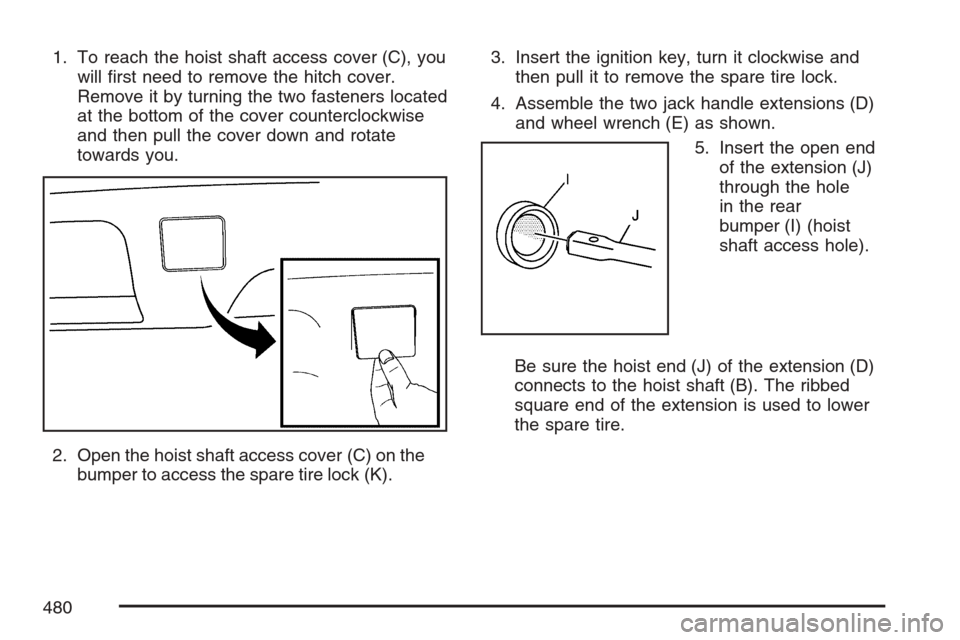
1. To reach the hoist shaft access cover (C), you
will rst need to remove the hitch cover.
Remove it by turning the two fasteners located
at the bottom of the cover counterclockwise
and then pull the cover down and rotate
towards you.
2. Open the hoist shaft access cover (C) on the
bumper to access the spare tire lock (K).3. Insert the ignition key, turn it clockwise and
then pull it to remove the spare tire lock.
4. Assemble the two jack handle extensions (D)
and wheel wrench (E) as shown.
5. Insert the open end
of the extension (J)
through the hole
in the rear
bumper (I) (hoist
shaft access hole).
Be sure the hoist end (J) of the extension (D)
connects to the hoist shaft (B). The ribbed
square end of the extension is used to lower
the spare tire.
480
Page 509 of 574

Fuses Usage
UNLCK2 Power Door Lock 2 (Unlock Feature)
LCK2 Power Door Lock 2 (Lock Feature)
STOP LAMPSStoplamps, Center-High Mounted
Stoplamp
REAR HVAC Rear Climate Controls
PDMPassenger Door Module, Universal
Home Remote System
AUX PWR Accessory Power Outlets
IS LPS Interior Lamps
UNLCK1 Power Door Lock 1 (Unlock Feature)Fuses Usage
OBS DETUltrasonic Rear Parking Assist,
Power Liftgate
LCK1 Power Door Lock 1 (Lock Feature)
REAR WPR Rear Wiper
COOLED
SEATSCooled Seats
DSMDriver Seat Module, Remote
Keyless Entry System
Harness
ConnectorUsage
LT DR Driver’s Door Harness Connection
BODY Harness Connector
BODY Harness Connector
509
Page 513 of 574
Fuses Usage
8 Oxygen Sensors
9 Anti-lock Brakes System 2
10 Trailer Back-up Lamps
11Driver’s High Intensity Discharge
Lamp
12 Engine Control Module (Battery)
13Fuel Injectors, Ignition Coils
(Right Side)
14Transmission Control Module
(Battery)
15 Vehicle Back-up Lamps
16Passenger’s Side High Intensity
Discharge Lamp
17 Air Conditioning Compressor
18 Oxygen Sensors
19 Transmission Controls (Ignition)
20 Fuel Pump
21 Not Used
22 Rear Washer
23Fuel Injectors, Ignition Coils
(Left Side)
24 Trailer Park Lamps
25 Driver’s Side Park Lamps
26 Passenger’s Side Park Lamps
27 Fog LampsFuses Usage
28 Horn
29Passenger’s Side High-Beam
Headlamp Solenoid
30 Daytime Running Lamps
31Driver’s Side High-Beam Headlamp
Solenoid
32 Not Used
33 Sunroof
34Key Ignition System, Theft Deterrent
System
35 Windshield Wiper
36 SEO B2 Uptter Usage (Battery)
37 Electric Adjustable Pedals
38 Climate Controls (Battery)
39 Airbag System (Ignition)
40 Amplier
41 Audio System
42 Not Used
43Miscellaneous (Ignition), Rear Vision
Camera (If Equipped), Cooled
Seats, Cruise Control
44 Liftgate Release
45OnStar
®, Rear Seat Entertainment
Display
46 Instrument Panel Cluster
513
Page 526 of 574
(b)Visually inspect front and rear suspension and
steering system for damaged, loose, or missing
parts, signs of wear or lack of lubrication. Inspect
power steering lines and hoses for proper
hook-up, binding, leaks, cracks, chang, etc.
Visually check constant velocity joints, rubber
boots, and axle seals for leaks.
(c)Visually inspect hoses and have them replaced
if they are cracked, swollen, or deteriorated.
Inspect all pipes, ttings, and clamps; replace with
genuine GM parts as needed. To help ensure
proper operation, a pressure test of the cooling
system and pressure cap and cleaning the outside
of the radiator and air conditioning condenser is
recommended at least once a year.
(d)Visually inspect wiper blades for wear or
cracking. Replace wiper blades that appear worn
or damaged or that streak or miss areas of
the windshield.(e)Make sure the safety belt reminder light and all
your belts, buckles, latch plates, retractors, and
anchorages are working properly. Look for
any other loose or damaged safety belt system
parts. If you see anything that might keep a safety
belt system from doing its job, have it repaired.
Have any torn or frayed safety belts replaced. Also
look for any opened or broken airbag coverings,
and have them repaired or replaced. The
airbag system does not need regular maintenance.
(f)Lubricate all key lock cylinders, hood latch
assembly, secondary latch, pivots, spring anchor,
release pawl, rear compartment hinges, outer
tailgate handle pivot points, latch bolt, fuel door
hinge, and folding seat hardware. More frequent
lubrication may be required when exposed to
a corrosive environment. Applying silicone grease
on weatherstrips with a clean cloth will make
them last longer, seal better, and not stick
or squeak.
(g)Inspect system. Check all fuel and vapor lines
and hoses for proper hook-up, routing, and
condition. Check that the purge valve works
properly, if equipped. Replace as needed.
526