tires CADILLAC ESCALADE ESV 2008 Owner's Manual
[x] Cancel search | Manufacturer: CADILLAC, Model Year: 2008, Model line: ESCALADE ESV, Model: CADILLAC ESCALADE ESV 2008Pages: 500, PDF Size: 6.65 MB
Page 305 of 500
Accelerate gently. Try not to break the fragile traction.
If you accelerate too fast, the drive wheels will spin
and polish the surface under the tires even more. See
StabiliTrak ®
System on page 4-6 , If Your Vehicle is Stuck
in Sand, Mud, Ice, or Snow on page 4-33 , and Rocking
Your Vehicle to Get It Out on page 4-34 .
The Antilock Brake System (ABS) improves your
vehicle’s stability when you make a hard stop on a
slippery road. Even though you have ABS, begin
stopping sooner than you would on dry pavement.
See Antilock Brake System (ABS) on page 4-4 .
Allow greater following distance on any slippery road.
Watch for slippery spots. The road might be ne until
you hit a spot that is covered with ice. On an
otherwise clear road, ice patches can appear in
shaded areas where the sun cannot reach, such as
around clumps of trees, behind buildings, or under
bridges. Sometimes the surface of a curve or an
overpass can remain icy when the surrounding roads
are clear. If you see a patch of ice ahead of you,
brake before you are on it. Try not to brake while you
are actually on the ice, and avoid sudden steering
maneuvers. If You Are Caught in a Blizzard If you are stopped by heavy snow, you could be in
a serious situation. You should probably stay with your
vehicle unless you know for sure that you are near
help and you can hike through the snow. Here are some
things to do to summon help and keep yourself and
your passengers safe:
Turn on the hazard warning ashers.
Tie a red cloth to your vehicle to alert police that
you have been stopped by the snow.
Put on extra clothing or wrap a blanket around you.
If you do not have blankets or extra clothing, make
body insulators from newspapers, burlap bags,
rags, oor mats — anything you can wrap around
yourself or tuck under your clothing to keep warm.
4-31
Page 307 of 500
Then, shut the engine off and close the window almost all
the way to preserve the heat. Start the engine again and
repeat this only when you feel really uncomfortable from
the cold. But do it as little as possible. Preserve the fuel
as long as you can. To help keep warm, you can get out
of the vehicle and do some fairly vigorous exercises
every half hour or so until help comes.
If Your Vehicle is Stuck in Sand,
Mud, Ice, or Snow Slowly and cautiously spin the wheels to free your
vehicle when stuck in sand, mud, ice, or snow. See
Rocking Your Vehicle to Get It Out on page 4-34 .
If your vehicle has a traction system, it can often help
to free a stuck vehicle. Refer to your vehicle’s traction
system in the Index. If the stuck condition is too
severe for the traction system to free the vehicle, turn
the traction system off and use the rocking method. { CAUTION: If you let your vehicle’s tires spin at high
speed, they can explode, and you or others
could be injured. The vehicle can overheat,
causing an engine compartment re or other
damage. Spin the wheels as little as possible
and avoid going above 35 mph (55 km/h) as
shown on the speedometer.
For information about using tire chains on your vehicle,
see Tire Chains on page 5-77 .
4-33
Page 310 of 500
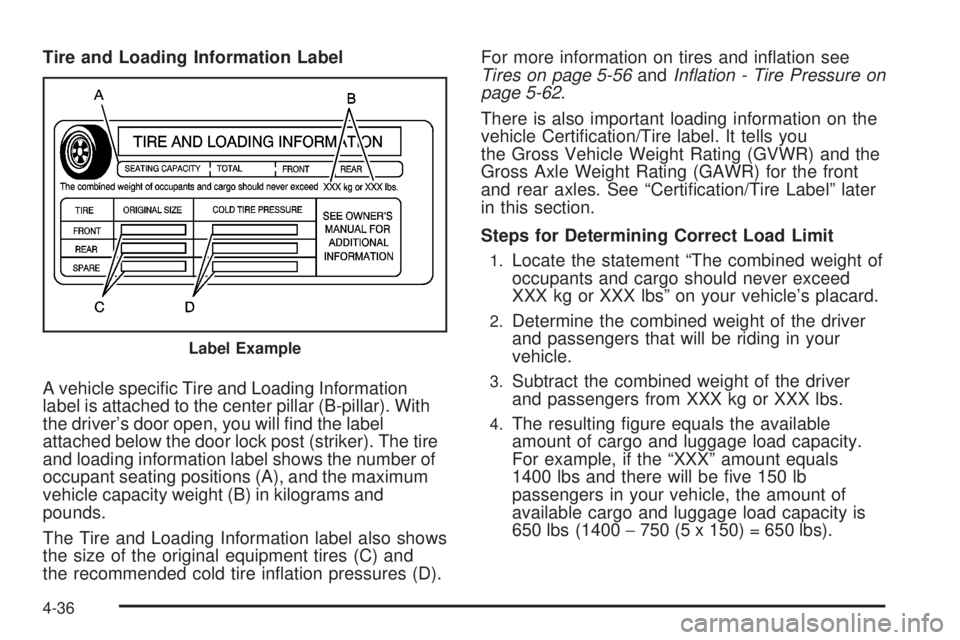
Tire and Loading Information Label
A vehicle specic Tire and Loading Information
label is attached to the center pillar (B-pillar). With
the driver’s door open, you will nd the label
attached below the door lock post (striker). The tire
and loading information label shows the number of
occupant seating positions (A), and the maximum
vehicle capacity weight (B) in kilograms and
pounds.
The Tire and Loading Information label also shows
the size of the original equipment tires (C) and
the recommended cold tire ination pressures (D). For more information on tires and ination see
Tires on page 5-56 and Inflation - Tire Pressure on
page 5-62 .
There is also important loading information on the
vehicle Certication/Tire label. It tells you
the Gross Vehicle Weight Rating (GVWR) and the
Gross Axle Weight Rating (GAWR) for the front
and rear axles. See “Certication/Tire Label” later
in this section.
Steps for Determining Correct Load Limit 1.
Locate the statement “The combined weight of
occupants and cargo should never exceed
XXX kg or XXX lbs” on your vehicle’s placard. 2.
Determine the combined weight of the driver
and passengers that will be riding in your
vehicle. 3.
Subtract the combined weight of the driver
and passengers from XXX kg or XXX lbs.
4.
The resulting gure equals the available
amount of cargo and luggage load capacity.
For example, if the “XXX” amount equals
1400 lbs and there will be ve 150 lb
passengers in your vehicle, the amount of
available cargo and luggage load capacity is
650 lbs (1400 − 750 (5 x 150) = 650 lbs).Label Example
4-36
Page 313 of 500
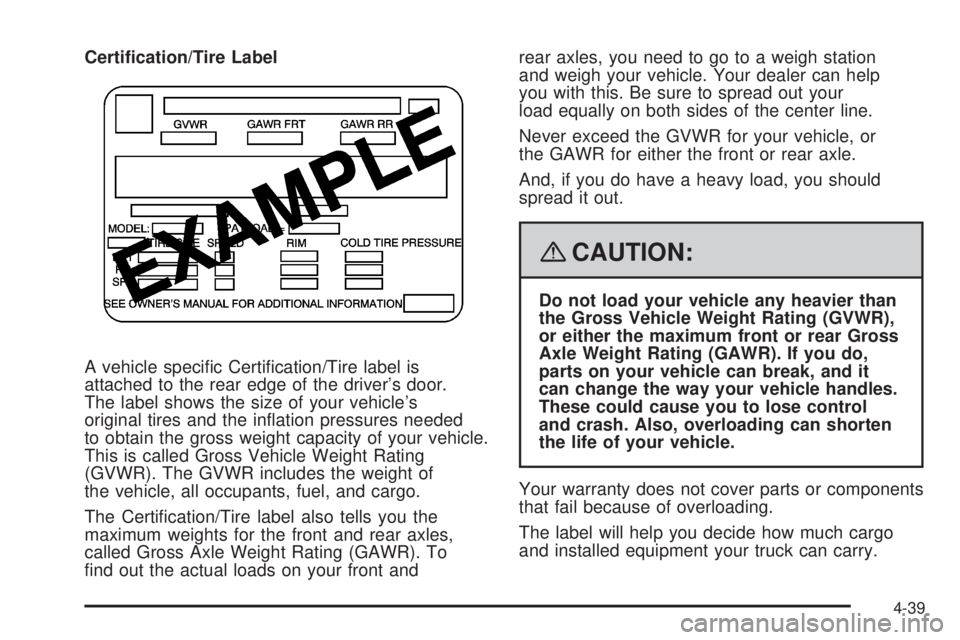
Certication/Tire Label
A vehicle specic Certication/Tire label is
attached to the rear edge of the driver’s door.
The label shows the size of your vehicle’s
original tires and the ination pressures needed
to obtain the gross weight capacity of your vehicle.
This is called Gross Vehicle Weight Rating
(GVWR). The GVWR includes the weight of
the vehicle, all occupants, fuel, and cargo.
The Certication/Tire label also tells you the
maximum weights for the front and rear axles,
called Gross Axle Weight Rating (GAWR). To
nd out the actual loads on your front and rear axles, you need to go to a weigh station
and weigh your vehicle. Your dealer can help
you with this. Be sure to spread out your
load equally on both sides of the center line.
Never exceed the GVWR for your vehicle, or
the GAWR for either the front or rear axle.
And, if you do have a heavy load, you should
spread it out.
{ CAUTION: Do not load your vehicle any heavier than
the Gross Vehicle Weight Rating (GVWR),
or either the maximum front or rear Gross
Axle Weight Rating (GAWR). If you do,
parts on your vehicle can break, and it
can change the way your vehicle handles.
These could cause you to lose control
and crash. Also, overloading can shorten
the life of your vehicle.
Your warranty does not cover parts or components
that fail because of overloading.
The label will help you decide how much cargo
and installed equipment your truck can carry.
4-39
Page 319 of 500
If You Do Decide To Pull A Trailer If you do, here are some important points:
There are many different laws, including speed limit
restrictions, having to do with trailering. Make sure
your rig will be legal, not only where you live
but also where you’ll be driving. A good source for
this information can be state or provincial police.
Consider using a sway control. See “Hitches” later
in this section.
Don’t tow a trailer at all during the rst 500 miles
(800 km) your new vehicle is driven. Your engine,
axle or other parts could be damaged.
Then, during the rst 500 miles (800 km) that you
tow a trailer, don’t drive over 50 mph (80 km/h)
and don’t make starts at full throttle. This helps your
engine and other parts of your vehicle wear in at
the heavier loads.
You can tow in DRIVE (D). You may want to shift
the transmission to THIRD (3) or, if necessary, a
lower gear selection if the transmission shifts
too often (e.g., under heavy loads and/or hilly
conditions). See “Tow/Haul Mode” next. Three important considerations have to do with weight:
the weight of the trailer
the weight of the trailer tongue
and the weight on your vehicle’s tires
Tow/Haul Mode Tow/haul is designed to assist while your vehicle is
pulling a large or heavy load or trailer. Tow/haul is most
useful while pulling such a load in rolling terrain, in
stop-and-go traffic, or when you need improved
low-speed control, such as when parking. The purpose
of the tow/haul mode is to do the following:
Reduce the frequency and improve the predictability
of transmission shifts when pulling a heavy trailer or
a large or heavy load.
Provide the same solid shift feel when pulling a
heavy trailer or a large or heavy load as when
the vehicle is unloaded.
Improve control of vehicle speed while requiring
less throttle pedal activity when pulling a heavy
trailer or a large or heavy load.
4-45
Page 324 of 500
It is important that you make sure your vehicle does
not exceed any of its ratings — GCWR, GVWR,
RGAWR, Maximum Trailer Rating or Tongue Weight.
The only way to be sure you are not exceeding any
of these ratings is to weigh your vehicle and trailer.
Total Weight on Your Vehicle’s Tires Be sure your vehicle’s tires are inated to the upper
limit for cold tires. You’ll nd these numbers on
the Certication label at the rear edge of the driver’s
door or see Loading Your Vehicle on page 4-35 .
Then be sure you don’t go over the GVW limit for your
vehicle, or the GAWR, including the weight of the
trailer tongue. If you use a weight distributing hitch,
make sure you don’t go over the rear axle limit before
you apply the weight distribution spring bars.
Hitches It’s important to have the correct hitch equipment.
Crosswinds, large trucks going by and rough roads are
a few reasons why you’ll need the right hitch. Weight-Distributing Hitches and Weight
Carrying Hitches
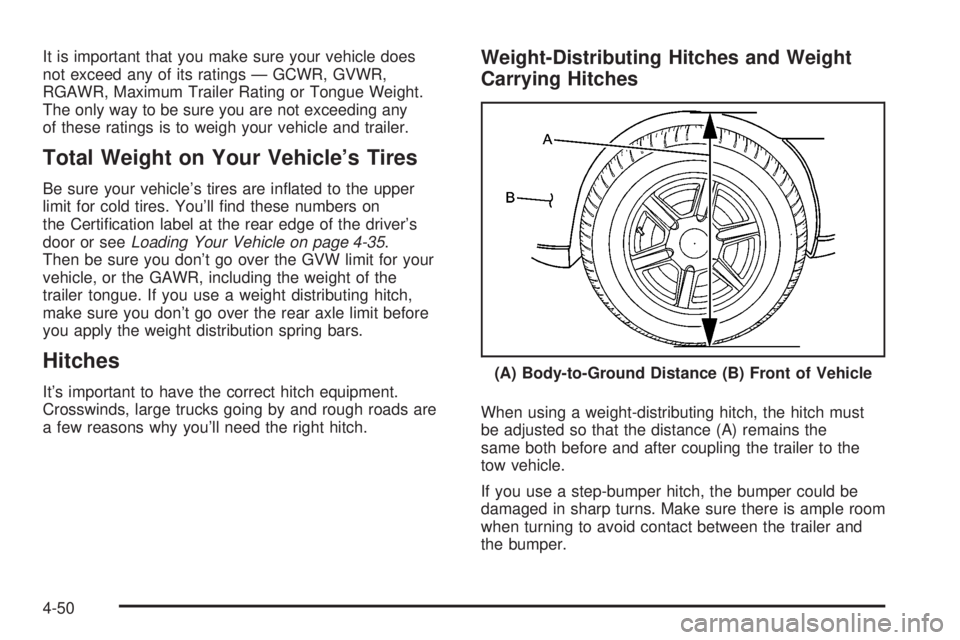
When using a weight-distributing hitch, the hitch must
be adjusted so that the distance (A) remains the
same both before and after coupling the trailer to the
tow vehicle.
If you use a step-bumper hitch, the bumper could be
damaged in sharp turns. Make sure there is ample room
when turning to avoid contact between the trailer and
the bumper. (A) Body-to-Ground Distance (B) Front of Vehicle
4-50
Page 327 of 500
Towing a trailer requires a certain amount of experience.
Before setting out for the open road, you’ll want to get
to know your rig. Acquaint yourself with the feel of
handling and braking with the added weight of the trailer.
And always keep in mind that the vehicle you are
driving is now a good deal longer and not nearly as
responsive as your vehicle is by itself.
Before you start, check all trailer hitch parts and
attachments, safety chains, electrical connector, lamps,
tires and mirror adjustment. If the trailer has electric
brakes, start your vehicle and trailer moving and then
apply the trailer brake controller by hand to be sure
the brakes are working. This lets you check your
electrical connection at the same time.
During your trip, check occasionally to be sure that the
load is secure, and that the lamps and any trailer
brakes are still working.
Following Distance Stay at least twice as far behind the vehicle ahead as
you would when driving your vehicle without a trailer.
This can help you avoid situations that require
heavy braking and sudden turns. Passing You’ll need more passing distance up ahead when
you’re towing a trailer. And, because you’re a good deal
longer, you’ll need to go much farther beyond the
passed vehicle before you can return to your lane.
Backing Up Hold the bottom of the steering wheel with one hand.
Then, to move the trailer to the left, just move that hand
to the left. To move the trailer to the right, move your
hand to the right. Always back up slowly and, if possible,
have someone guide you.
Making Turns Notice: Making very sharp turns while trailering
could cause the trailer to come in contact with the
vehicle. Your vehicle could be damaged. Avoid
making very sharp turns while trailering.
When you’re turning with a trailer, make wider turns than
normal. Do this so your trailer won’t strike soft shoulders,
curbs, road signs, trees or other objects. Avoid jerky or
sudden maneuvers. Signal well in advance.
4-53
Page 333 of 500
Service ........................................................... .5-3
Accessories and Modications ......................... .5-3
California Proposition 65 Warning .................... .5-3
California Perchlorate Materials Requirements .... .5-4
Doing Your Own Service Work ........................ .5-4
Adding Equipment to the Outside of Your
Vehicle ..................................................... .5-4
Fuel ............................................................... .5-5
Gasoline Octane ........................................... .5-5
Gasoline Specications ................................... .5-5
California Fuel .............................................. .5-5
Additives ...................................................... .5-6
Fuels in Foreign Countries .............................. .5-6
Filling the Tank ............................................. .5-7
Filling a Portable Fuel Container .................... .5-10
Checking Things Under the Hood ................... .5-10
Hood Release ............................................. .5-11
Engine Compartment Overview ...................... .5-12
Engine Oil .................................................. .5-14
Engine Oil Life System ................................. .5-16
Engine Air Cleaner/Filter ............................... .5-17
Automatic Transmission Fluid ........................ .5-20
Engine Coolant ............................................ .5-24
Coolant Surge Tank Pressure Cap ................. .5-26
Engine Overheating ...................................... .5-26 Overheated Engine Protection
Operating Mode ....................................... .5-28
Cooling System ........................................... .5-29
Engine Fan Noise ........................................ .5-33
Power Steering Fluid .................................... .5-34
Windshield Washer Fluid ............................... .5-35
Brakes ....................................................... .5-36
Battery ....................................................... .5-39
Jump Starting .............................................. .5-40
All-Wheel Drive ............................................. .5-45
Rear Axle ...................................................... .5-46
Front
Axle ..................................................... .5-47
Headlamp Aiming .......................................... .5-48
Bulb Replacement ......................................... .5-51
High Intensity Discharge (HID) Lighting ........... .5-51
Back-Up Lamps ........................................... .5-51
License Plate Lamp ..................................... .5-53
Replacement Bulbs ...................................... .5-53
Windshield Wiper Blade Replacement ............. .5-54
Tires ............................................................. .5-56
Tire Sidewall Labeling .................................. .5-57
Tire Terminology and Denitions .................... .5-59
Ination - Tire Pressure ................................ .5-62
High-Speed Operation .................................. .5-63
Tire Pressure Monitor System ........................ .5-64Section 5 Service and Appearance Care
5-1
Page 334 of 500
Tire Pressure Monitor Operation .................... .5-65
Tire Inspection and Rotation .......................... .5-69
When It Is Time for New Tires ...................... .5-71
Buying New Tires ........................................ .5-72
Different Size Tires and Wheels ..................... .5-73
Uniform Tire Quality Grading ......................... .5-74
Wheel Alignment and Tire Balance ................. .5-75
Wheel Replacement ..................................... .5-76
Tire Chains ................................................. .5-77
If a Tire Goes Flat ....................................... .5-78
Changing a Flat Tire .................................... .5-79
Removing the Spare Tire and Tools ............... .5-80
Removing the Flat Tire and Installing the
Spare Tire ............................................... .5-85
Secondary Latch System .............................. .5-90
Storing a Flat or Spare Tire and Tools ........... .5-94
Spare Tire .................................................. .5-98
Appearance Care ........................................... .5-98
Interior Cleaning .......................................... .5-98
Fabric/Carpet ............................................. .5-100
Leather ..................................................... .5-100
Instrument Panel, Vinyl, and Other Plastic
Surfaces ................................................ .5-101
Wood Panels ............................................. .5-101
Speaker Covers ......................................... .5-101
Care of Safety Belts ................................... .5-101 Weatherstrips ............................................ .5-101
Washing Your Vehicle ................................. .5-102
Cleaning Exterior Lamps/Lenses ................... .5-102
Finish Care ............................................... .5-102
Windshield, Backglass, and Wiper Blades ...... .5-103
Aluminum or Chrome-Plated Wheels
and Trim ............................................... .5-104
Tires ........................................................ .5-105
Sheet Metal Damage .................................. .5-105
Finish Damage .......................................... .5-105
Underbody
Maintenance .............................. .5-105
Chemical Paint Spotting .............................. .5-105
Vehicle Care/Appearance Materials ............... .5-106
Vehicle Identication .................................... .5-107
Vehicle Identication Number (VIN) ............... .5-107
Service Parts Identication Label .................. .5-107
Electrical System ......................................... .5-108
Add-On Electrical Equipment ........................ .5-108
Windshield Wiper Fuses .............................. .5-108
Power Windows and Other Power Options ..... .5-108
Fuses and Circuit Breakers ......................... .5-108
Instrument Panel Fuse Block ....................... .5-109
Center Instrument Panel Fuse Block ............. .5-110
Underhood Fuse Block ............................... .5-111
Capacities and Specications ....................... .5-115Section 5 Service and Appearance Care
5-2
Page 370 of 500
Brake Wear Your vehicle has disc brakes. Disc brake pads have
built-in wear indicators that make a high-pitched warning
sound when the brake pads are worn and new pads
are needed. The sound can come and go or be heard all
the time your vehicle is moving, except when you are
pushing on the brake pedal rmly.
{ CAUTION: The brake wear warning sound means that soon
the brakes will not work well. That could lead to
an accident. When you hear the brake wear
warning sound, have your vehicle serviced.
Notice: Continuing to drive with worn-out brake
pads could result in costly brake repair.
Some driving conditions or climates can cause a brake
squeal when the brakes are rst applied or lightly
applied. This does not mean something is wrong with
the brakes. Properly torqued wheel nuts are necessary to help
prevent brake pulsation. When tires are rotated, inspect
brake pads for wear and evenly tighten wheel nuts in
the proper sequence to torque specications in
Capacities and Specifications on page 5-115 .
Brake linings should always be replaced as complete
axle sets.
Brake Pedal Travel See your dealer/retailer if the brake pedal does not
return to normal height, or if there is a rapid increase in
pedal travel. This could be a sign that brake service
might be required.
Brake Adjustment Every time you make a brake stop, the disc brakes
adjust for wear.
Replacing Brake System Parts The braking system on a vehicle is complex. Its many
parts have to be of top quality and work well together if
the vehicle is to have really good braking. Your vehicle
was designed and tested with top-quality brake parts.
5-38