service CADILLAC ESCALADE ESV 2009 Repair Manual
[x] Cancel search | Manufacturer: CADILLAC, Model Year: 2009, Model line: ESCALADE ESV, Model: CADILLAC ESCALADE ESV 2009Pages: 602, PDF Size: 5.18 MB
Page 406 of 602

Blizzard Conditions Being stuck in snow can be in a serious situation. Stay
with the vehicle unless there is help nearby. If possible,
use the Roadside Service on page 8-7 . To get help and
keep everyone in the vehicle safe:
Turn on the Hazard Warning Flashers on page 3-6 .
Tie a red cloth to an outside mirror.
{ CAUTION: Snow can trap engine exhaust under the vehicle.
This may cause exhaust gases to get inside.
Engine exhaust contains carbon monoxide (CO)
which cannot be seen or smelled. It can cause
unconsciousness and even death.
If the vehicle is stuck in the snow:
Clear away snow from around the base of
your vehicle, especially any that is blocking
the exhaust pipe.
Check again from time to time to be sure
snow does not collect there.
CAUTION: (Continued) CAUTION: (Continued)
Open a window about two inches (5 cm) on
the side of the vehicle that is away from the
wind to bring in fresh air.
Fully open the air outlets on or under the
instrument panel.
Adjust the Climate Control system to a setting
that circulates the air inside the vehicle and
set the fan speed to the highest setting.
See Climate Control System in the Index.
For more information about carbon monoxide, see
Engine Exhaust on page 2-38 .
Snow can trap exhaust gases under your vehicle.
This can cause deadly CO (carbon monoxide) gas
to get inside. CO could overcome you and kill you.
You cannot see it or smell it, so you might not
know it is in your vehicle. Clear away snow from
around the base of your vehicle, especially any
that is blocking the exhaust.
Run the engine for short periods only as needed to
keep warm, but be careful.
To save fuel, run the engine for only short periods as
needed to warm the vehicle and then shut the engine off
and close the window most of the way to save heat.
5-30
Page 416 of 602

The system is activated when the ignition key is
turned to RUN and will automatically adjust vehicle
height thereafter. The system may exhaust (lower
vehicle height) for up to 10 minutes after the ignition
key has been turned to LOCK. You may hear the air
compressor operating when the height is being
adjusted.
If a weight-distributing hitch is being used, it is
recommended to allow the shocks to inate,
thereby leveling the vehicle prior to adjusting the
height. See “Weight distributing Hitches and Weight
Carrying Hitches” under Towing a Trailer on
page 5-44 .
Towing
Towing Your Vehicle To avoid damage, the disabled vehicle should be towed
with all four wheels off the ground. Consult your dealer/
retailer or a professional towing service if the disabled
vehicle must be towed. See Roadside Service on
page 8-7 .
To tow the vehicle behind another vehicle for
recreational purposes (such as behind a motorhome),
see “Recreational Vehicle Towing” following. Recreational Vehicle Towing Recreational vehicle towing means towing the vehicle
behind another vehicle – such as behind a motorhome.
The two most common types of recreational vehicle
towing are known as “dinghy towing” (towing the vehicle
with all four wheels on the ground) and “dolly towing”
(towing the vehicle with two wheels on the ground
and two wheels up on a device known as a “dolly”).
Here are some important things to consider before
recreational vehicle towing:
What is the towing capacity of the towing vehicle?
Be sure to read the tow vehicle manufacturer’s
recommendations.
What is the distance that will be travelled? Some
vehicles have restrictions on how far and how
long they can tow.
Is the proper towing equipment going to be used?
See your dealer/retailer or trailering professional
for additional advice and equipment
recommendations.
Is the vehicle ready to be towed? Just as preparing
the vehicle for a long trip, make sure the vehicle is
prepared to be towed. See Before Leaving on a
Long Trip on page 5-27 .
5-40
Page 432 of 602

Maintenance When Trailer Towing The vehicle needs service more often when pulling a
trailer. See this manual’s Maintenance Schedule or Index
for more information. Things that are especially important
in trailer operation are automatic transmission uid,
engine oil, axle lubricant, belts, cooling system and brake
system. It is a good idea to inspect these before and
during the trip.
Check periodically to see that all hitch nuts and bolts
are tight.
Trailer Wiring Harness Heavy-Duty Trailer Wiring Package
The vehicle is equipped with the seven-wire trailer
towing harness. This harness with a seven-pin universal
heavy-duty trailer connector is attached to the rear
bumper beam. It is located next to the integrated trailer
hitch. The seven-wire harness contains the following trailer
circuits:
Yellow: Left Stop/Turn Signal
Dark Green: Right Stop/Turn Signal
Brown: Taillamps
White: Ground
Light Green: Back-up Lamps
Red w/ Black Stripe: Battery Feed*
Dark Blue: Trailer Brake*
*The fuses for these two circuits are installed in the
underhood electrical center, but the circuits are
not connected. They should be installed by your dealer
or a qualied service center.
If charging a remote (non-vehicle) battery, press the
Tow/Haul mode button, if equipped, located at the end of
the shift lever. This will boost the vehicle system voltage
and properly charge the battery. If the trailer is too light
for Tow/Haul mode, or the vehicle is not equipped with
Tow/Haul, turn on the headlamps as a second way to
boost the vehicle system and charge the battery.
5-56
Page 433 of 602
Electric Brake Control Wiring
Provisions These wiring provisions are included with the vehicle
as part of the heavy-duty trailer wiring package.
These provisions are for an electric brake controller.
The red/black stripe power feed will not be connected
to the battery until the ring terminal is unstowed and
connected to the underhood electrical center. The
instrument panel contains blunt cut wires near the data
link connector for the trailer brake controller. The harness
contains the following wires:
Dark Blue: Auxiliary
Red/Black: Battery
Light Blue/White: Brake Switch
White: Ground
The trailer brake controller should be installed by your
dealer/retailer or a qualied service center. Trailer Recommendations Subtract the hitch loads from the Cargo Weight Rating
(CWR). CWR is the maximum weight of the load
the vehicle can carry. It does not include the weight of
the people inside, but you can gure about 150 lbs.
(68 kg) for each passenger. The total cargo load must
not be more than the vehicles CWR.
Weigh the vehicle with the trailer attached, so the
GVWR or GAWR are not exceeded. If using a
weight-distributing hitch, weigh the vehicle without
the spring bars in place.
The best performance is obtained by correctly spreading
out the weight of the load and choosing the correct
hitch and trailer brakes.
For more information see Towing a Trailer on page 5-44 .
5-57
Page 435 of 602
Service ........................................................... .6-3
Accessories and Modications ......................... .6-3
California Proposition 65 Warning .................... .6-4
California Perchlorate Materials Requirements .... .6-4
Doing Your Own Service Work ........................ .6-4
Adding Equipment to the Outside of
the Vehicle ................................................ .6-5
Fuel ............................................................... .6-5
Gasoline Octane ........................................... .6-5
Gasoline Specications ................................... .6-6
California Fuel .............................................. .6-6
Additives ...................................................... .6-6
Fuel E85 (85% Ethanol) ................................. .6-7
Fuels in Foreign Countries .............................. .6-8
Filling the Tank ............................................. .6-9
Filling a Portable Fuel Container .................... .6-11
Checking Things Under the Hood ................... .6-12
Hood Release ............................................. .6-13
Engine Compartment Overview ...................... .6-14
Engine Oil .................................................. .6-15
Engine Oil Life System ................................. .6-18
Engine Air Cleaner/Filter ............................... .6-19
Automatic Transmission Fluid ........................ .6-20
Cooling System ........................................... .6-24
Engine Coolant ............................................ .6-25
Engine Overheating ...................................... .6-30 Overheated Engine Protection
Operating Mode ........................................ .6-33
Engine Fan Noise ........................................ .6-33
Power Steering Fluid .................................... .6-33
Windshield Washer Fluid ............................... .6-34
Brakes ....................................................... .6-36
Battery ....................................................... .6-39
Jump Starting .............................................. .6-40
All-Wheel Drive ............................................. .6-45
Rear Axle ...................................................... .6-46
Front
Axle ..................................................... .6-47
Headlamp Aiming .......................................... .6-48
Bulb Replacement ......................................... .6-51
High Intensity Discharge (HID) Lighting ........... .6-51
LED Lighting ............................................... .6-51
Back-Up Lamps ........................................... .6-51
License Plate Lamp ..................................... .6-53
Replacement Bulbs ...................................... .6-53
Windshield Wiper Blade Replacement ............. .6-54
Tires ............................................................. .6-56
Tire Sidewall Labeling .................................. .6-57
Tire Terminology and Denitions .................... .6-59
Ination - Tire Pressure ................................ .6-62
High-Speed Operation .................................. .6-63Section 6 Service and Appearance Care
6-1
Page 436 of 602
Tire Pressure Monitor System ........................ .6-64
Tire Pressure Monitor Operation .................... .6-65
Tire Inspection and Rotation .......................... .6-69
When It Is Time for New Tires ...................... .6-70
Buying New Tires ........................................ .6-71
Different Size Tires and Wheels ..................... .6-73
Uniform Tire Quality Grading ......................... .6-73
Wheel Alignment and Tire Balance ................. .6-75
Wheel Replacement ..................................... .6-75
Tire Chains ................................................. .6-76
If a Tire Goes Flat ....................................... .6-77
Changing a Flat Tire .................................... .6-78
Removing the Spare Tire and Tools ............... .6-79
Removing the Flat Tire and Installing the
Spare Tire ............................................... .6-84
Secondary Latch System .............................. .6-89
Storing a Flat or Spare Tire and Tools ........... .6-92
Spare Tire .................................................. .6-96
Appearance Care ........................................... .6-96
Interior Cleaning .......................................... .6-96
Fabric/Carpet .............................................. .6-98
Leather ...................................................... .6-98
Instrument Panel, Vinyl, and Other
Plastic Surfaces ....................................... .6-99
Wood Panels ............................................. .6-100
Speaker Covers ......................................... .6-100 Care of Safety Belts ................................... .6-100
Weatherstrips ............................................ .6-100
Washing Your Vehicle ................................. .6-100
Cleaning Exterior Lamps/Lenses ................... .6-101
Finish Care ............................................... .6-101
Windshield, Backglass, and Wiper Blades ...... .6-102
Aluminum or Chrome-Plated Wheels
and Trim ............................................... .6-102
Tires ........................................................ .6-103
Sheet Metal Damage .................................. .6-103
Finish
Damage .......................................... .6-103
Underbody Maintenance .............................. .6-104
Chemical Paint Spotting .............................. .6-104
Vehicle Identication .................................... .6-104
Vehicle Identication Number (VIN) ............... .6-104
Service Parts Identication Label .................. .6-105
Electrical System ......................................... .6-105
Add-On Electrical Equipment ........................ .6-105
Windshield Wiper Fuses .............................. .6-105
Power Windows and Other Power Options ..... .6-105
Fuses and Circuit Breakers ......................... .6-106
Instrument Panel Fuse Block ....................... .6-106
Center Instrument Panel Fuse Block ............. .6-108
Underhood Fuse Block ............................... .6-109
Capacities and Specications ....................... .6-113Section 6 Service and Appearance Care
6-2
Page 437 of 602
Service For service and parts needs, visit your dealer/retailer.
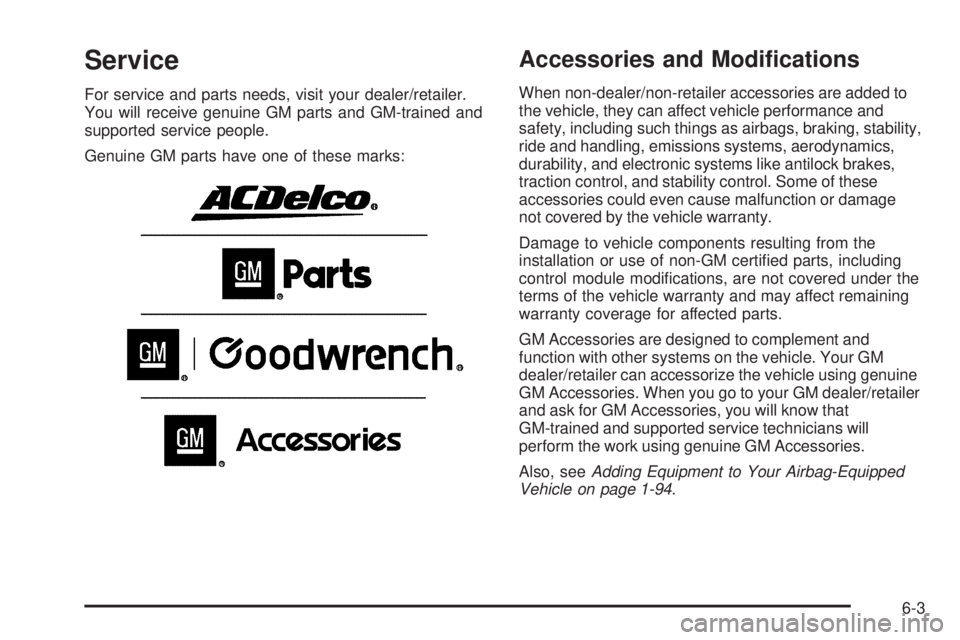
You will receive genuine GM parts and GM-trained and
supported service people.
Genuine GM parts have one of these marks:
Accessories and Modications When non-dealer/non-retailer accessories are added to
the vehicle, they can affect vehicle performance and
safety, including such things as airbags, braking, stability,
ride and handling, emissions systems, aerodynamics,
durability, and electronic systems like antilock brakes,
traction control, and stability control. Some of these
accessories could even cause malfunction or damage
not covered by the vehicle warranty.
Damage to vehicle components resulting from the
installation or use of non-GM certied parts, including
control module modications, are not covered under the
terms of the vehicle warranty and may affect remaining
warranty coverage for affected parts.
GM Accessories are designed to complement and
function with other systems on the vehicle. Your GM
dealer/retailer can accessorize the vehicle using genuine
GM Accessories. When you go to your GM dealer/retailer
and ask for GM Accessories, you will know that
GM-trained and supported service technicians will
perform the work using genuine GM Accessories.
Also, see Adding Equipment to Your Airbag-Equipped
Vehicle on page 1-94 .
6-3
Page 438 of 602

California Proposition 65 Warning Most motor vehicles, including this one, contain and/or
emit chemicals known to the State of California to
cause cancer and birth defects or other reproductive
harm. Engine exhaust, many parts and systems
(including some inside the vehicle), many uids, and
some component wear by-products contain and/or emit
these chemicals.
California Perchlorate Materials
Requirements Certain types of automotive applications, such as
airbag initiators, seat belt pretensioners, and lithium
batteries contained in remote keyless transmitters,
may contain perchlorate materials. Special handling
may be necessary. For additional information, see
www.dtsc.ca.gov/hazardouswaste/perchlorate. Doing Your Own Service Work If this vehicle is a Two-mode Hybrid, see the Two-mode
Hybrid manual for more information.
{ CAUTION: You can be injured and the vehicle could be
damaged if you try to do service work on a vehicle
without knowing enough about it.
Be sure you have sufficient knowledge,
experience, the proper replacement parts,
and tools before attempting any vehicle
maintenance task.
Be sure to use the proper nuts, bolts, and
other fasteners. English and metric fasteners
can be easily confused. If the wrong fasteners
are used, parts can later break or fall off.
You could be hurt.
If doing some of your own service work, use the proper
service manual. It tells you much more about how to
service the vehicle than this manual can. To order
the proper service manual, see Service Publications
Ordering Information on page 8-15 .
6-4
Page 439 of 602

This vehicle has an airbag system. Before attempting
to do your own service work, see Servicing Your
Airbag-Equipped Vehicle on page 1-93 .
Keep a record with all parts receipts and list the
mileage and the date of any service work performed.
See Maintenance Record on page 7-17 .
Adding Equipment to the Outside of
the Vehicle Things added to the outside of the vehicle can affect the
airow around it. This can cause wind noise and can
affect fuel economy and windshield washer performance.
Check with your dealer/retailer before adding equipment
to the outside of the vehicle.
Fuel Use of the recommended fuel is an important part of
the proper maintenance of this vehicle. To help keep the
engine clean and maintain optimum vehicle performance,
we recommend the use of gasoline advertised as
TOP TIER Detergent Gasoline.
The 8th digit of the Vehicle Identication Number (VIN)
shows the code letter or number that identies the
vehicle’s engine. The VIN is at the top left of the
instrument panel. See Vehicle Identification Number
(VIN) on page 6-104 . If the vehicle has the 6.2L V8 engine (VIN Code 2),
you can use either unleaded gasoline or ethanol fuel
containing up to 85% ethanol (E85); also see Fuel E85
(85% Ethanol) on page 6-7 . In all other engines, use only
unleaded gasoline. See Gasoline Octane on page 6-5 .
Gasoline Octane If the vehicle has the 6.0L V8 engine (VIN Code 5),
use regular unleaded gasoline with a posted octane
rating of 87 or higher. If the octane rating is less than 87,
you might notice an audible knocking noise when you
drive, commonly referred to as spark knock. If this occurs,
use a gasoline rated at 87 octane or higher as soon as
possible. If you are using gasoline rated at 87 octane or
higher and you hear heavy knocking, the engine needs
service.
If the vehicle has the 6.2L V8 engine (VIN Code 2),
use premium unleaded gasoline with a posted octane
rating of 91 or higher. You can also use regular unleaded
gasoline rated at 87 octane or higher, but the vehicle’s
acceleration could be slightly reduced, and you might
notice a slight audible knocking noise, commonly referred
to as spark knock. If the octane is less than 87, you might
notice a heavy knocking noise when you drive. If this
occurs, use a gasoline rated at 87 octane or higher as
soon as possible. Otherwise, you could damage the
engine. If you are using gasoline rated at 87 octane or
higher and you hear heavy knocking, the engine needs
service.
6-5
Page 441 of 602
However, E85 (85% ethanol) and other fuels containing
more than 10% ethanol must not be used in vehicles that
were not designed for those fuels.
Notice: This vehicle was not designed for fuel that
contains methanol. Do not use fuel containing
methanol. It can corrode metal parts in the fuel
system and also damage plastic and rubber parts.
That damage would not be covered under the
vehicle warranty.
Some gasolines that are not reformulated for low
emissions can contain an octane-enhancing additive
called methylcyclopentadienyl manganese tricarbonyl
(MMT); ask the attendant where you buy gasoline
whether the fuel contains MMT. We recommend
against the use of such gasolines. Fuels containing
MMT can reduce the life of spark plugs and the
performance of the emission control system could be
affected. The malfunction indicator lamp might turn on.
If this occurs, return to your dealer/retailer for service. Fuel E85 (85% Ethanol) The 8th digit of the Vehicle Identication Number (VIN)
shows the code letter or number that identies the
vehicle’s engine. The VIN is at the top left of the
instrument panel. See Vehicle Identification Number
(VIN) on page 6-104 .
If the vehicle has the 6.2L V8 engine (VIN Code 2),
you can use either unleaded gasoline or ethanol fuel
containing up to 85% ethanol (E85). See Fuel on
page 6-5 . In all other engines, use only the unleaded
gasoline described under Gasoline Octane on page 6-5 .
Only vehicles that have the 6.2L V8 engine (VIN Code 2)
can use 85% ethanol fuel (E85). We encourage the use
of E85 in vehicles that are designed to use it. The ethanol
in E85 is a “renewable” fuel, meaning it is made from
renewable sources such as corn and other crops.
Many service stations will not have an 85% ethanol
fuel (E85) pump available. The U. S. Department
of Energy has an alternative fuels website
(www.eere.energy.gov/afdc/infrastructure/locator.html)
that can help you nd E85 fuel. Those stations that
do have E85 should have a label indicating ethanol
content. Do not use the fuel if the ethanol content
is greater than 85%.
6-7