towing CADILLAC ESCALADE ESV 2010 User Guide
[x] Cancel search | Manufacturer: CADILLAC, Model Year: 2010, Model line: ESCALADE ESV, Model: CADILLAC ESCALADE ESV 2010Pages: 620, PDF Size: 7.4 MB
Page 166 of 620

Black plate (42,1)Cadillac Escalade/Escalade ESV Owner Manual - 2010
Running the Vehicle While Parked It is better not to park with the engine running. But if you
ever have to, here are some things to know.
{ WARNING: Idling a vehicle in an enclosed area with poor
ventilation is dangerous. Engine exhaust may
enter the vehicle. Engine exhaust contains
Carbon Monoxide (CO) which cannot be seen or
smelled. It can cause unconsciousness and even
death. Never run the engine in an enclosed area
that has no fresh air ventilation. For more
information, see Engine Exhaust on page 3 ‑ 41 .
{ WARNING: It can be dangerous to get out of the vehicle if the
automatic transmission shift lever is not fully in
P (Park) with the parking brake firmly set. The
vehicle can roll. Do not leave the vehicle when the
engine is running unless you have to. If you have
left the engine running, the vehicle can move
suddenly. You or others could be injured. To be
sure the vehicle will not move, even when you are
on fairly level ground, always set the parking
brake and move the shift lever to P (Park).
Follow the proper steps to be sure the vehicle will not
move. See Shifting Into Park on page 3 ‑ 39 .
If parking on a hill and pulling a trailer, see Towing a
Trailer on page 6 ‑ 42 .
3-42
Page 173 of 620

Black plate (49,1)Cadillac Escalade/Escalade ESV Owner Manual - 2010
SBZA Detection Zones The SBZA sensor covers a zone of approximately one
lane over from both sides of the vehicle, 3.5 m (11 ft).
This zone starts at each side mirror and goes back
approximately 16 ft. (5.0 m). The height of the zone is
approximately between 0.5 m (1.5 ft) and 2.0 m (6 ft) off
the ground.
Use caution while changing lanes when towing a trailer,
as the SBZA detection zones do not change when a
trailer is towed.
How the System Works
Left Side Mirror Display Right Side Mirror Display
When the vehicle is started, both outside mirror
displays will briefly come on to indicate that the system
is operating. When the vehicle is moving forward, the
left or right side mirror SBZA display will light up if a
vehicle is detected in that blind zone. If the turn signal is activated and a vehicle is also
detected on the same side, the SBZA display will flash
to give you extra warning not to change lanes.
SBZA displays do not come on while the vehicle is
approaching or passing other vehicles. At speeds
greater then 32 km/h (20 mph), SBZA displays may
come on when a vehicle you have passed remains in or
drops back into the detection zone.
SBZA can be disabled through the Driver Information
Center (DIC). See Driver Information Center (DIC)
on
page 4 ‑ 41 for more information. If the SBZA is disabled
by the driver, the SBZA mirror displays will not light up
during normal driving.
When the System Does Not Seem To Work
Properly Occasional missed alerts can occur under normal
circumstances and will increase in wet conditions.
The system does not need to be serviced due to an
occasional missed alert. The number of missed alerts
will increase with increased rainfall or road spray.
If the SBZA displays do not light up when the system is
on and vehicles are in the blind zone, the system may
need service. Take the vehicle to your dealer.
3-49
Page 225 of 620
Black plate (33,1)Cadillac Escalade/Escalade ESV Owner Manual - 2010
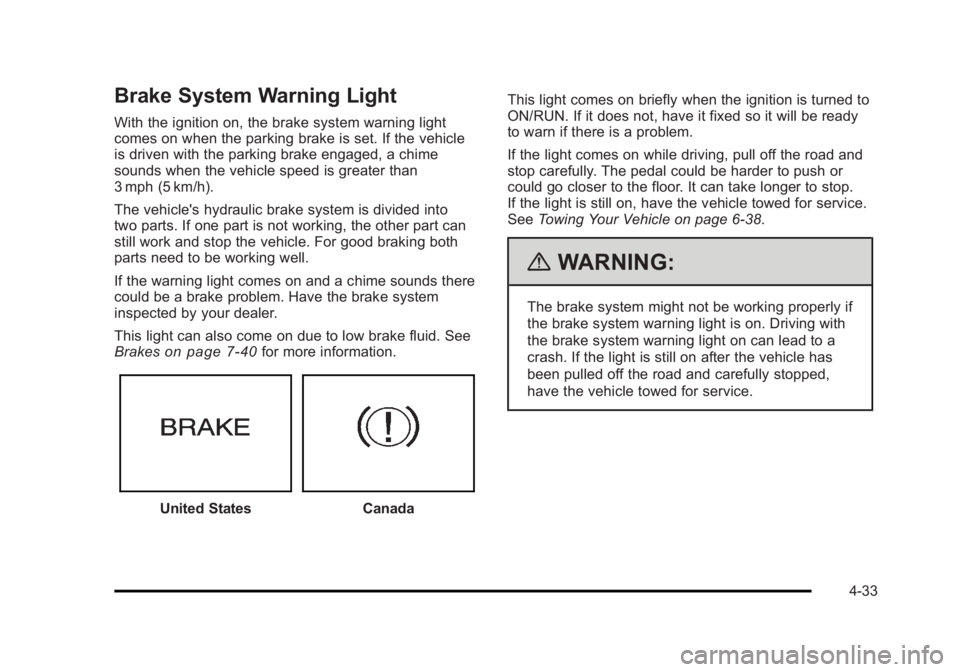
Brake System Warning Light With the ignition on, the brake system warning light
comes on when the parking brake is set. If the vehicle
is driven with the parking brake engaged, a chime
sounds when the vehicle speed is greater than
3 mph (5 km/h).
The vehicle's hydraulic brake system is divided into
two parts. If one part is not working, the other part can
still work and stop the vehicle. For good braking both
parts need to be working well.
If the warning light comes on and a chime sounds there
could be a brake problem. Have the brake system
inspected by your dealer.
This light can also come on due to low brake fluid. See
Brakes
on page 7 ‑ 40 for more information.
United States Canada This light comes on briefly when the ignition is turned to
ON/RUN. If it does not, have it fixed so it will be ready
to warn if there is a problem.
If the light comes on while driving, pull off the road and
stop carefully. The pedal could be harder to push or
could go closer to the floor. It can take longer to stop.
If the light is still on, have the vehicle towed for service.
See Towing Your Vehicle on page 6 ‑ 38 .
{ WARNING: The brake system might not be working properly if
the brake system warning light is on. Driving with
the brake system warning light on can lead to a
crash. If the light is still on after the vehicle has
been pulled off the road and carefully stopped,
have the vehicle towed for service.
4-33
Page 229 of 620

Black plate (37,1)Cadillac Escalade/Escalade ESV Owner Manual - 2010
This light comes on during a malfunction in one of
two ways:
Light Flashing: A misfire condition has been detected.
A misfire increases vehicle emissions and could
damage the emission control system on the vehicle.
Diagnosis and service might be required.
To prevent more serious damage to the vehicle: .
Reduce vehicle speed. .
Avoid hard accelerations. .
Avoid steep uphill grades. .
If towing a trailer, reduce the amount of cargo
being hauled as soon as it is possible.
If the light continues to flash, when it is safe to do so,
stop the vehicle. Find a safe place to park the vehicle.
Turn the vehicle off, wait at least 10 seconds, and
restart the engine. If the light is still flashing, follow the
previous steps and see your dealer for service as soon
as possible.
Light On Steady: An emission control system
malfunction has been detected on the vehicle.
Diagnosis and service might be required.
An emission system malfunction might be corrected by
doing the following: .
Make sure the fuel cap is fully installed. See Filling
the Tank on page 7 ‑ 11 . The diagnostic system
can determine if the fuel cap has been left off or improperly installed. A loose or missing fuel cap
allows fuel to evaporate into the atmosphere. A few
driving trips with the cap properly installed should
turn the light off. .
If the vehicle has been driven through a deep
puddle of water, the vehicle's electrical system
might be wet. The condition is usually corrected
when the electrical system dries out. A few driving
trips should turn the light off. .
Make sure to fuel the vehicle with quality fuel. Poor
fuel quality causes the engine not to run as
efficiently as designed and can cause: stalling after
start-up, stalling when the vehicle is changed into
gear, misfiring, hesitation on acceleration,
or stumbling on acceleration. These conditions
might go away once the engine is warmed up.
If one or more of these conditions occurs, change
the fuel brand used. It will require at least one full
tank of the proper fuel to turn the light off.
See Gasoline Octane on page 7 ‑ 8 .
If none of the above have made the light turn off, your
dealer can check the vehicle. The dealer has the proper
test equipment and diagnostic tools to fix any
mechanical or electrical problems that might have
developed.
4-37
Page 393 of 620
Black plate (1,1)Cadillac Escalade/Escalade ESV Owner Manual - 2010
Section 6 Driving Your VehicleYour Driving, the Road, and the Vehicle . . . . . . . . . . 6-2
Defensive Driving . . . . . . . . . . . . . . . . . . . . . . . . . . . . . . . 6-2
Drunk Driving . . . . . . . . . . . . . . . . . . . . . . . . . . . . . . . . . . . 6-2
Control of a Vehicle . . . . . . . . . . . . . . . . . . . . . . . . . . . . . 6-3
Braking . . . . . . . . . . . . . . . . . . . . . . . . . . . . . . . . . . . . . . . . . 6-4
Antilock Brake System (ABS) . . . . . . . . . . . . . . . . . . . 6-5
Braking in Emergencies . . . . . . . . . . . . . . . . . . . . . . . . . 6-6
StabiliTrak ®
System . . . . . . . . . . . . . . . . . . . . . . . . . . . . . 6-6
Magnetic Ride Control ™ . . . . . . . . . . . . . . . . . . . . . . . . 6-9
Road Sensing Suspension . . . . . . . . . . . . . . . . . . . . . . 6-9
Locking Rear Axle . . . . . . . . . . . . . . . . . . . . . . . . . . . . . . 6-9
All-Wheel Drive (AWD) System . . . . . . . . . . . . . . . . . 6-9
Steering . . . . . . . . . . . . . . . . . . . . . . . . . . . . . . . . . . . . . . . 6-10
Off-Road Recovery . . . . . . . . . . . . . . . . . . . . . . . . . . . . . 6-11
Passing . . . . . . . . . . . . . . . . . . . . . . . . . . . . . . . . . . . . . . . . 6-12
Loss of Control . . . . . . . . . . . . . . . . . . . . . . . . . . . . . . . . 6-12
Off-Road Driving . . . . . . . . . . . . . . . . . . . . . . . . . . . . . . . 6-13 Driving at Night . . . . . . . . . . . . . . . . . . . . . . . . . . . . . . . . 6-24
Driving in Rain and on Wet Roads . . . . . . . . . . . . . 6-25
Before Leaving on a Long Trip . . . . . . . . . . . . . . . . . 6-26
Highway Hypnosis . . . . . . . . . . . . . . . . . . . . . . . . . . . . . 6-26
Hill and Mountain Roads . . . . . . . . . . . . . . . . . . . . . . . 6-27
Winter Driving . . . . . . . . . . . . . . . . . . . . . . . . . . . . . . . . . 6-28
If Your Vehicle is Stuck in Sand, Mud, Ice,
or Snow . . . . . . . . . . . . . . . . . . . . . . . . . . . . . . . . . . . . . 6-30
Rocking Your Vehicle to Get It Out . . . . . . . . . . . . . 6-30
Recovery Hooks . . . . . . . . . . . . . . . . . . . . . . . . . . . . . . . 6-31
Loading the Vehicle . . . . . . . . . . . . . . . . . . . . . . . . . . . . 6-32
Towing . . . . . . . . . . . . . . . . . . . . . . . . . . . . . . . . . . . . . . . . . . . . 6-38
Towing Your Vehicle . . . . . . . . . . . . . . . . . . . . . . . . . . . 6-38
Recreational Vehicle Towing . . . . . . . . . . . . . . . . . . . 6-38
Level Control . . . . . . . . . . . . . . . . . . . . . . . . . . . . . . . . . . 6-41
Autoride ®
. . . . . . . . . . . . . . . . . . . . . . . . . . . . . . . . . . . . . . 6-42
Towing a Trailer . . . . . . . . . . . . . . . . . . . . . . . . . . . . . . . . 6-42
Trailer Recommendations . . . . . . . . . . . . . . . . . . . . . . 6-55
6-1
Page 401 of 620

Black plate (9,1)Cadillac Escalade/Escalade ESV Owner Manual - 2010
Magnetic Ride Control ™The vehicle may have the MagneRide control system.
MagneRide constantly checks speed, wheel position,
lift/dive and steering of the vehicle. The damping force
for each shock absorber and adjustment level is chosen
for the best ride and handling.
MagneRide also works with the tow/haul switch that,
when engaged, will provide more firmness from the
shock absorbers. This added control gives better ride
and handling when carrying heavy loads or towing a
trailer. See Tow/Haul Mode
on page 3 ‑ 36 for more
information.
Road Sensing Suspension The Road Sensing Suspension (RSS) feature provides
superior vehicle ride and handling under a variety of
passenger and loading conditions.
The system is fully automatic and uses a computer
controller to continuously monitor vehicle speed, wheel
to body position, lift/dive and steering position of the
vehicle. The controller then sends signals to each shock
absorber to independently adjust the damping level to
provide the optimum vehicle ride. RSS also interacts with the tow/haul mode that, when
engaged, will provide additional control of the shock
absorbers. This additional control results in better ride
and handling characteristics when the vehicle is loaded
or towing a trailer. See “ Tow/Haul Mode ” under Towing a
Trailer on page 6 ‑ 42 .
Locking Rear Axle Vehicles with a locking rear axle can give more traction
on snow, mud, ice, sand or gravel. It works like a
standard axle most of the time, but when traction is low,
this feature will allow the rear wheel with the most
traction to move the vehicle.
All-Wheel Drive (AWD) System If the vehicle has this feature, engine power is sent to
all four wheels when extra traction is needed. This is
like four-wheel drive, but there is no separate lever or
switch to engage or disengage the front axle. It is fully
automatic, and adjusts itself as needed for road
conditions.
If the vehicle is a Two-mode Hybrid, see “ Four-Wheel
Drive ” in the Two-mode Hybrid Supplement.
6-9
Page 422 of 620

Black plate (30,1)Cadillac Escalade/Escalade ESV Owner Manual - 2010
If Your Vehicle is Stuck in Sand,
Mud, Ice, or Snow Slowly and cautiously spin the wheels to free the
vehicle when stuck in sand, mud, ice, or snow. See
Rocking Your Vehicle to Get It Out on page 6 ‑ 30 .
If the vehicle has a traction system, it can often help to
free a stuck vehicle. Refer to the vehicle's traction
system in the Index. If stuck too severely for the traction
system to free the vehicle, turn the traction system off
and use the rocking method.
{ WARNING: If the vehicle's tires spin at high speed, they can
explode, and you or others could be injured.
The vehicle can overheat, causing an engine
compartment fire or other damage. Spin the
wheels as little as possible and avoid going above
55 km/h (35 mph) as shown on the speedometer.
For information about using tire chains on the vehicle,
see Tire Chains on page 7 ‑ 78 . Rocking Your Vehicle to Get It Out Turn the steering wheel left and right to clear the area
around the front wheels. Turn off any traction or stability
system. Shift back and forth between R (Reverse) and a
forward gear, spinning the wheels as little as possible.
To prevent transmission wear, wait until the wheels stop
spinning before shifting gears. Release the accelerator
pedal while shifting, and press lightly on the accelerator
pedal when the transmission is in gear. Slowly spinning
the wheels in the forward and reverse directions causes
a rocking motion that could free the vehicle. If that does
not get the vehicle out after a few tries, it might need to
be towed out. Recovery hooks can be used, if the
vehicle has them. If the vehicle does need to be towed
out, see Towing Your Vehicle on page 6 ‑ 38 .
6-30
Page 425 of 620

Black plate (33,1)Cadillac Escalade/Escalade ESV Owner Manual - 2010
The Tire and Loading Information label also
shows the size of the original equipment tires (C)
and the recommended cold tire inflation
pressures (D). For more information on tires and
inflation see Tires
on page 7 ‑ 58 and Inflation - Tire
Pressure
on page 7 ‑ 65 .
There is also important loading information on the
vehicle Certification/Tire label. It tells you the
Gross Vehicle Weight Rating (GVWR) and the
Gross Axle Weight Rating (GAWR) for the front
and rear axles. See “ Certification/Tire Label ” later
in this section.
Steps for Determining Correct Load Limit 1.
Locate the statement “ The combined weight
of occupants and cargo should never exceed
XXX kg or XXX lbs ” on your vehicle's placard.2.
Determine the combined weight of the driver
and passengers that will be riding in your
vehicle.
3.
Subtract the combined weight of the driver
and passengers from XXX kg or XXX lbs. 4.
The resulting figure equals the available
amount of cargo and luggage load capacity.
For example, if the “ XXX ” amount equals
1400 lbs and there will be five 150 lb
passengers in your vehicle, the amount of
available cargo and luggage load capacity is
650 lbs (1400 − 750 (5 x 150) = 650 lbs).5.
Determine the combined weight of luggage
and cargo being loaded on the vehicle. That
weight may not safely exceed the available
cargo and luggage load capacity calculated in
Step 4. 6.
If your vehicle will be towing a trailer, the load
from your trailer will be transferred to your
vehicle. Consult this manual to determine
how this reduces the available cargo and
luggage load capacity of your vehicle. See
Towing a Trailer
on page 6 ‑ 42 for important
information on towing a trailer, towing safety
rules and trailering tips.
6-33
Page 430 of 620

Black plate (38,1)Cadillac Escalade/Escalade ESV Owner Manual - 2010
The system is activated when the ignition key is
turned to RUN and will automatically adjust
vehicle height thereafter. The system may exhaust
(lower vehicle height) for up to 10 minutes after
the ignition key has been turned to LOCK. You
may hear the air compressor operating when the
height is being adjusted.
If a weight-distributing hitch is being used, it is
recommended to allow the shocks to inflate,
thereby leveling the vehicle prior to adjusting the
height. See “ Weight distributing Hitches and
Weight Carrying Hitches ” under Towing a Trailer
on page 6 ‑ 42 .
Towing Towing Your Vehicle To avoid damage, the disabled vehicle should be towed
with all four wheels off the ground. Consult your dealer
or a professional towing service if the disabled vehicle
must be towed. See Roadside Service on page 9 ‑ 8 .
To tow the vehicle behind another vehicle for
recreational purposes (such as behind a motorhome),
see “ Recreational Vehicle Towing ” following. Recreational Vehicle Towing If the vehicle has a two – mode hybrid engine, see the
Two – mode Hybrid manual for more information.
Recreational vehicle towing means towing the vehicle
behind another vehicle – such as behind a motorhome.
The two most common types of recreational vehicle
towing are known as “ dinghy towing ” (towing the vehicle
with all four wheels on the ground) and “ dolly towing ”
(towing the vehicle with two wheels on the ground and
two wheels up on a device known as a “ dolly ” ).
Here are some important things to consider before
recreational vehicle towing: .
What is the towing capacity of the towing vehicle?
Be sure to read the tow vehicle manufacturer's
recommendations. .
What is the distance that will be travelled? Some
vehicles have restrictions on how far and how long
they can tow. .
Is the proper towing equipment going to be used?
See your dealer or trailering professional for
additional advice and equipment
recommendations. .
Is the vehicle ready to be towed? Just as preparing
the vehicle for a long trip, make sure the vehicle is
prepared to be towed. See Before Leaving on a
Long Trip on page 6 ‑ 26 .
6-38
Page 431 of 620
Black plate (39,1)Cadillac Escalade/Escalade ESV Owner Manual - 2010
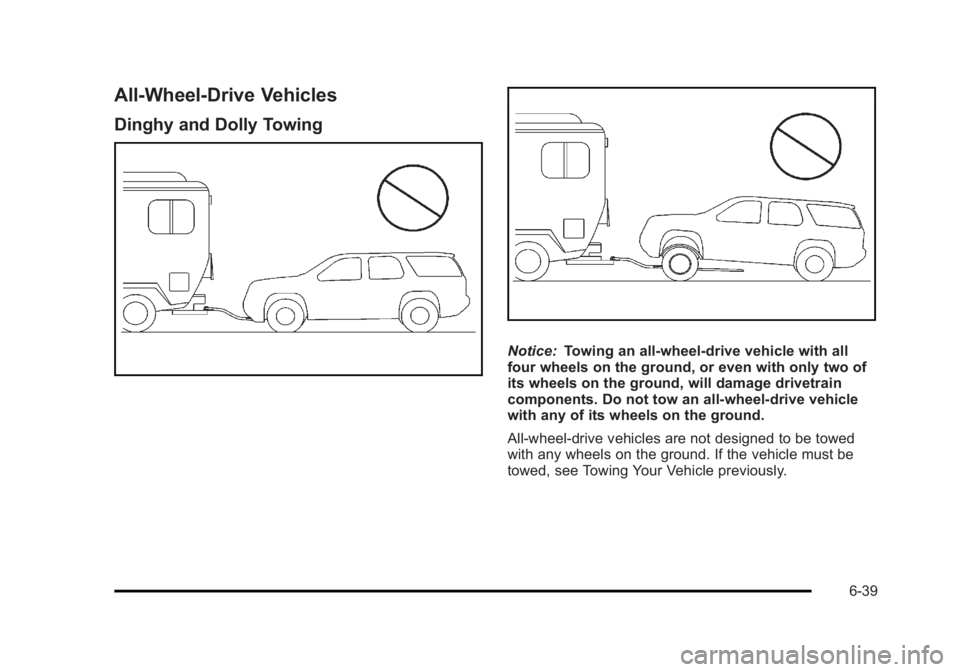
All-Wheel-Drive Vehicles Dinghy and Dolly Towing
Notice: Towing an all-wheel-drive vehicle with all
four wheels on the ground, or even with only two of
its wheels on the ground, will damage drivetrain
components. Do not tow an all-wheel-drive vehicle
with any of its wheels on the ground.
All-wheel-drive vehicles are not designed to be towed
with any wheels on the ground. If the vehicle must be
towed, see Towing Your Vehicle previously.
6-39