ECU CADILLAC ESCALADE ESV 2010 Workshop Manual
[x] Cancel search | Manufacturer: CADILLAC, Model Year: 2010, Model line: ESCALADE ESV, Model: CADILLAC ESCALADE ESV 2010Pages: 620, PDF Size: 7.4 MB
Page 407 of 620
Black plate (15,1)Cadillac Escalade/Escalade ESV Owner Manual - 2010
Loading Your Vehicle for Off-Road
Driving
{ WARNING: .
Cargo on the load floor piled higher than the
seatbacks can be thrown forward during a
sudden stop. You or your passengers could
be injured. Keep cargo below the top of the
seatbacks. .
Unsecured cargo on the load floor can be
tossed about when driving over rough terrain.
You or your passengers can be struck by
flying objects. Secure the cargo properly. .
Heavy loads on the roof raise the vehicle's
center of gravity, making it more likely to roll
over. You can be seriously or fatally injured if
the vehicle rolls over. Put heavy loads inside
the cargo area, not on the roof. Keep cargo in
the cargo area as far forward and low as
possible. There are some important things to remember about
how to load your vehicle. .
The heaviest things should be on the floor, forward
of the rear axle. Put heavier items as far forward
as you can. .
Be sure the load is properly secured, so things are
not tossed around.
You will find other important information under Loading
the Vehicle
on page 6 ‑ 32 and Tires on page 7 ‑ 58 .
Environmental Concerns Off-road driving can provide wholesome and satisfying
recreation. However, it also raises environmental
concerns. We recognize these concerns and urge every
off-roader to follow these basic rules for protecting the
environment: .
Always use established trails, roads, and areas
that have been specially set aside for public
off-road recreational driving and obey all posted
regulations. .
Avoid any driving practice that could damage
shrubs, flowers, trees, or grasses or disturb
wildlife. This includes wheel-spinning, breaking
down trees, or unnecessary driving through
streams or over soft ground.
6-15
Page 429 of 620
Black plate (37,1)Cadillac Escalade/Escalade ESV Owner Manual - 2010
If you put things inside your vehicle — like
suitcases, tools, packages, or anything
else — they will go as fast as the vehicle goes.
If you have to stop or turn quickly, or if there is a
crash, they will keep going.
{ WARNING: Things you put inside your vehicle can strike
and injure people in a sudden stop or turn,
or in a crash. .
Put things in the cargo area of your
vehicle. Try to spread the weight evenly. .
Never stack heavier things, like
suitcases, inside the vehicle so that some
of them are above the tops of the seats. .
Do not leave an unsecured child restraint
in your vehicle. .
When you carry something inside the
vehicle, secure it whenever you can. .
Do not leave a seat folded down unless
you need to. There is also important loading information for
off-road driving in this manual. See “ Loading Your
Vehicle for Off-Road Driving ” under Off-Road
Driving on page 6 ‑ 13 .
Add-On Equipment When you carry removable items, you may need
to put a limit on how many people you can carry
inside your vehicle. Be sure to weigh your vehicle
before you buy and install the new equipment. Notice :
Overloading the vehicle may cause
damage. Repairs would not be covered by the
vehicle warranty. Do not overload the vehicle.
Remember not to exceed the Gross Axle Weight
Rating (GAWR) of the front or rear axle.
Automatic Level Control The automatic level control rear suspension
comes as a part of the Road Sensing Suspension.
See Road Sensing Suspension
on page 6 ‑ 9 .
This type of level control is fully automatic and will
provide a better leveled riding position as well as
better handling under a variety of passenger and
loading conditions. An air compressor connected
to the rear shocks will raise or lower the rear of
the vehicle to maintain proper vehicle height.
6-37
Page 433 of 620
Black plate (41,1)Cadillac Escalade/Escalade ESV Owner Manual - 2010
Two-wheel-drive vehicles should not be towed with
the rear wheels on the ground. Two-wheel-drive
transmissions have no provisions for internal lubrication
while being towed.
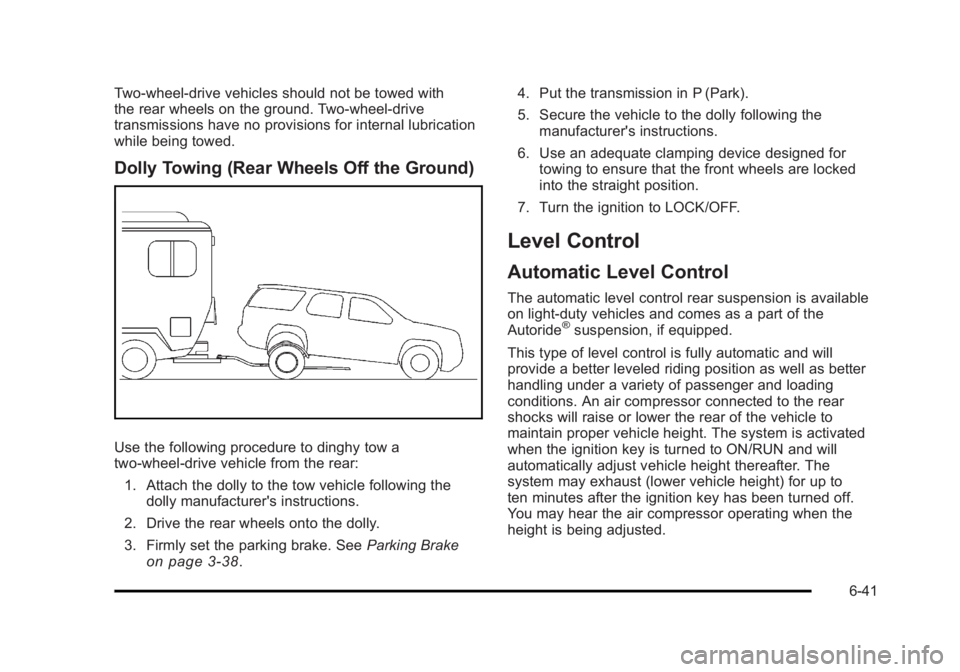
Dolly Towing (Rear Wheels Off the Ground)
Use the following procedure to dinghy tow a
two-wheel-drive vehicle from the rear:
1. Attach the dolly to the tow vehicle following the
dolly manufacturer's instructions.
2. Drive the rear wheels onto the dolly.
3. Firmly set the parking brake. See Parking Brake
on page 3 ‑ 38 . 4. Put the transmission in P (Park).
5. Secure the vehicle to the dolly following the
manufacturer's instructions.
6. Use an adequate clamping device designed for
towing to ensure that the front wheels are locked
into the straight position.
7. Turn the ignition to LOCK/OFF.
Level Control Automatic Level Control The automatic level control rear suspension is available
on light ‐ duty vehicles and comes as a part of the
Autoride ®
suspension, if equipped.
This type of level control is fully automatic and will
provide a better leveled riding position as well as better
handling under a variety of passenger and loading
conditions. An air compressor connected to the rear
shocks will raise or lower the rear of the vehicle to
maintain proper vehicle height. The system is activated
when the ignition key is turned to ON/RUN and will
automatically adjust vehicle height thereafter. The
system may exhaust (lower vehicle height) for up to
ten minutes after the ignition key has been turned off.
You may hear the air compressor operating when the
height is being adjusted.
6-41
Page 443 of 620
Black plate (51,1)Cadillac Escalade/Escalade ESV Owner Manual - 2010
Before starting, check all trailer hitch parts and
attachments, safety chains, electrical connectors,
lamps, tires and mirrors. If the trailer has electric
brakes, start the combination moving and then apply
the trailer brake controller by hand to be sure the
brakes work.
During the trip, check occasionally to be sure that the
load is secure and the lamps and any trailer brakes
still work.
Following Distance Stay at least twice as far behind the vehicle ahead as
you would when driving the vehicle without a trailer.
This can help to avoid heavy braking and sudden turns.
Passing More passing distance is needed when towing a trailer.
The combination will not accelerate as quickly and is
longer so it is necessary to go much farther beyond the
passed vehicle before returning to the lane. Backing Up Hold the bottom of the steering wheel with one hand.
Then, to move the trailer to the left, move that hand to
the left. To move the trailer to the right, move your hand
to the right. Always back up slowly and, if possible,
have someone guide you.
Making Turns Notice: Making very sharp turns while trailering
could cause the trailer to come in contact with the
vehicle. The vehicle could be damaged. Avoid
making very sharp turns while trailering.
When turning with a trailer, make wider turns than
normal. Do this so the trailer will not strike soft
shoulders, curbs, road signs, trees or other objects.
Avoid jerky or sudden maneuvers. Signal well in
advance.
If the trailer turn signal bulbs burn out, the arrows on the
instrument panel will still flash for turns. It is important to
check occasionally to be sure the trailer bulbs are still
working.
6-51
Page 482 of 620

Black plate (34,1)Cadillac Escalade/Escalade ESV Owner Manual - 2010
4. With the coolant surge tank pressure cap off, start
the engine and let it run until you can feel the
upper radiator hose getting hot. Watch out for the
engine cooling fan.
By this time, the coolant level inside the coolant
surge tank may be lower. If the level is lower, add
more of the proper mixture to the coolant surge
tank until the level reaches the FULL COLD mark. 5. Replace the pressure cap. Be sure the pressure
cap is hand-tight and fully seated.
6. Verify coolant level after engine is shut off and the
coolant is cold. If necessary, repeat coolant fill
procedure Steps 1 through 6.
Notice: If the pressure cap is not tightly installed,
coolant loss and possible engine damage may
occur. Be sure the cap is properly and tightly
secured.
Engine Overheating The vehicle has several indicators to warn of engine
overheating.
There is a coolant temperature gauge on your vehicle's
instrument panel. See Engine Coolant Temperature
Gauge on page 4 ‑ 35 .
In addition, ENGINE OVERHEATED STOP ENGINE,
ENGINE OVERHEATED IDLE ENGINE, and a ENGINE
POWER IS REDUCED message comes on in the Driver
Information Center (DIC) on the instrument panel. See
DIC Warnings and Messages on page 4 ‑ 49 .
You may decide not to lift the hood when this warning
appears, but instead get service help right away. See
Roadside Service on page 9 ‑ 8 .
7-34
Page 520 of 620

Black plate (72,1)Cadillac Escalade/Escalade ESV Owner Manual - 2010
Any time you notice unusual wear, rotate your
tires as soon as possible and check wheel
alignment. Also check for damaged tires or
wheels. See When It Is Time for New Tires
on
page 7 ‑ 73
and Wheel Replacement on page 7 ‑ 77 .
When rotating your vehicle's tires, always use the
correct rotation pattern shown here.
Do not include the spare tire in the tire rotation.
After the tires have been rotated, adjust the front
and rear inflation pressures as shown on the Tire
and Loading Information label. See Inflation - Tire
Pressure
on page 7 ‑ 65 and Loading the Vehicle on
page 6 ‑ 32
. Reset the Tire Pressure Monitor System. See Tire
Pressure Monitor Operation
on page 7 ‑ 68 .
Make certain that all wheel nuts are properly
tightened. See “ Wheel Nut Torque ” under
Capacities and Specifications
on page 7 ‑ 117 .
{ WARNING: Rust or dirt on a wheel, or on the parts to
which it is fastened, can make wheel nuts
become loose after time. The wheel could
come off and cause an accident. When you
change a wheel, remove any rust or dirt
from places where the wheel attaches to
the vehicle. In an emergency, you can use
a cloth or a paper towel to do this; but be
sure to use a scraper or wire brush later,
if needed, to get all the rust or dirt off. See
Changing a Flat Tire
on page 7 ‑ 80 .
Make sure the spare tire is stored securely. Push,
pull, and then try to rotate or turn the tire. If it
moves, tighten the cable. See Storing a Flat or
Spare Tire and Tools
on page 7 ‑ 94 .
7-72
Page 540 of 620
Black plate (92,1)Cadillac Escalade/Escalade ESV Owner Manual - 2010
4. Repeat this procedure at least two times. If the
spare tire lowers to the ground, continue with
Step 5 of Removing the Spare Tire and Tools
on
page 7 ‑ 81 .
5. If the spare does not lower, turn the wrench
counterclockwise until approximately 6 inches
(15 cm) of cable is exposed.
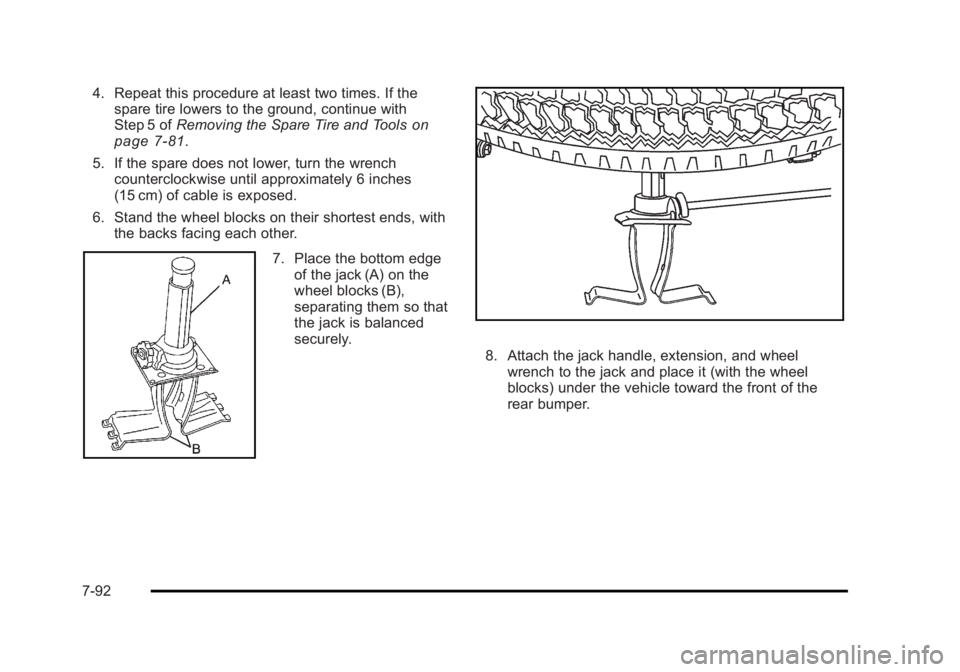
6. Stand the wheel blocks on their shortest ends, with
the backs facing each other.
7. Place the bottom edge
of the jack (A) on the
wheel blocks (B),
separating them so that
the jack is balanced
securely.
8. Attach the jack handle, extension, and wheel
wrench to the jack and place it (with the wheel
blocks) under the vehicle toward the front of the
rear bumper.
7-92
Page 544 of 620
Black plate (96,1)Cadillac Escalade/Escalade ESV Owner Manual - 2010
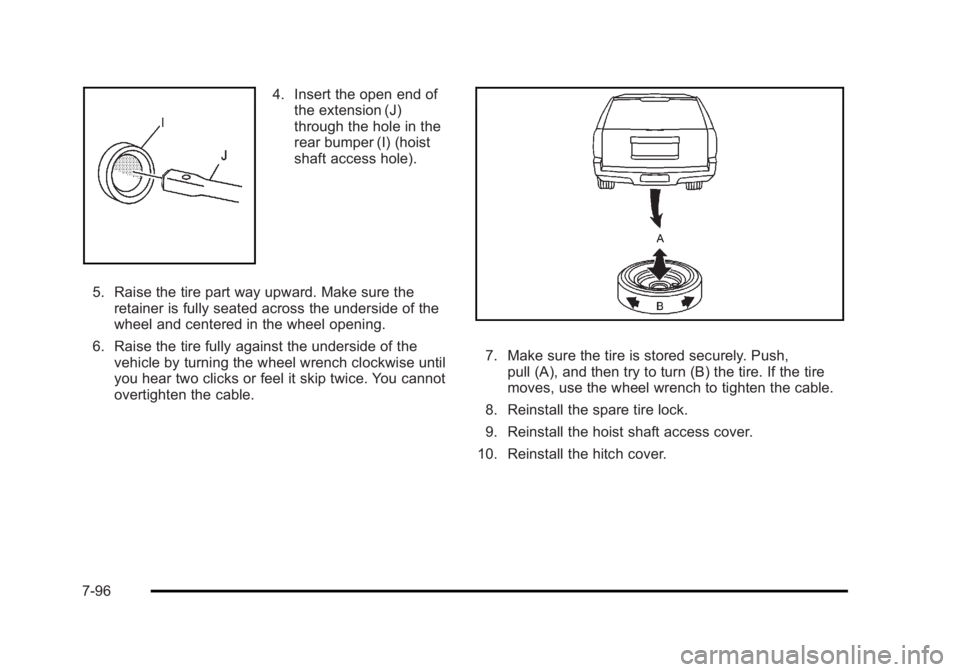
4. Insert the open end of
the extension (J)
through the hole in the
rear bumper (I) (hoist
shaft access hole).
5. Raise the tire part way upward. Make sure the
retainer is fully seated across the underside of the
wheel and centered in the wheel opening.
6. Raise the tire fully against the underside of the
vehicle by turning the wheel wrench clockwise until
you hear two clicks or feel it skip twice. You cannot
overtighten the cable. 7. Make sure the tire is stored securely. Push,
pull (A), and then try to turn (B) the tire. If the tire
moves, use the wheel wrench to tighten the cable.
8. Reinstall the spare tire lock.
9. Reinstall the hoist shaft access cover.
10. Reinstall the hitch cover.
7-96
Page 545 of 620
Black plate (97,1)Cadillac Escalade/Escalade ESV Owner Manual - 2010
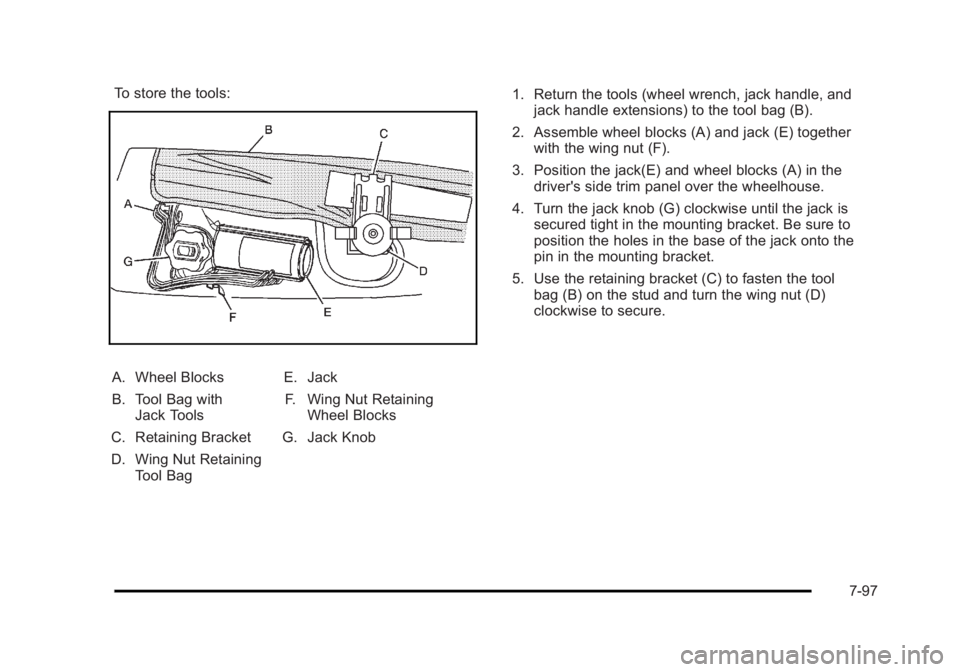
To store the tools:
A. Wheel Blocks
B. Tool Bag with
Jack Tools
C. Retaining Bracket
D. Wing Nut Retaining
Tool Bag E. Jack
F. Wing Nut Retaining
Wheel Blocks
G. Jack Knob 1. Return the tools (wheel wrench, jack handle, and
jack handle extensions) to the tool bag (B).
2. Assemble wheel blocks (A) and jack (E) together
with the wing nut (F).
3. Position the jack(E) and wheel blocks (A) in the
driver's side trim panel over the wheelhouse.
4. Turn the jack knob (G) clockwise until the jack is
secured tight in the mounting bracket. Be sure to
position the holes in the base of the jack onto the
pin in the mounting bracket.
5. Use the retaining bracket (C) to fasten the tool
bag (B) on the stud and turn the wing nut (D)
clockwise to secure.
7-97
Page 591 of 620

Black plate (9,1)Cadillac Escalade/Escalade ESV Owner Manual - 2010
Cadillac Owner Privileges ™.
Emergency Fuel Delivery: Delivery of enough
fuel for the vehicle to get to the nearest service
station. .
Lock ‐ Out Service: Service to unlock the vehicle if
you are locked out. A remote unlock may be
available if you have OnStar ®
. For security
reasons, the driver must present identification
before this service is given. .
Emergency Tow From a Public Road or
Highway: Tow to the nearest Cadillac dealer for
warranty service, or if the vehicle was in a crash
and cannot be driven. Assistance is also given
when the vehicle is stuck in the sand, mud,
or snow. .
Flat Tire Change: Service to change a flat tire
with spare tire. The spare tire, if equipped, must be
in good condition and properly inflated. It is your
responsibility for the repair or replacement of the
tire if it is not covered by the warranty. .
Battery Jump Start: Service to jump start a dead
battery. .
Trip Routing Service: Detailed maps of North
America are provided when requested either with
the most direct route or the most scenic route.
Additional travel information is also available. Allow
three weeks for delivery. .
Trip Interruption Benefits and Service: If your
trip is interrupted due to a warranty failure,
incidental expenses may be reimbursed during the
5 years/160 000 km (100,000 miles) Powertrain
warranty period. Items considered are hotel,
meals, and rental car.
9-9