steering CADILLAC ESCALADE ESV 2010 Repair Manual
[x] Cancel search | Manufacturer: CADILLAC, Model Year: 2010, Model line: ESCALADE ESV, Model: CADILLAC ESCALADE ESV 2010Pages: 620, PDF Size: 7.4 MB
Page 463 of 620
Black plate (15,1)Cadillac Escalade/Escalade ESV Owner Manual - 2010
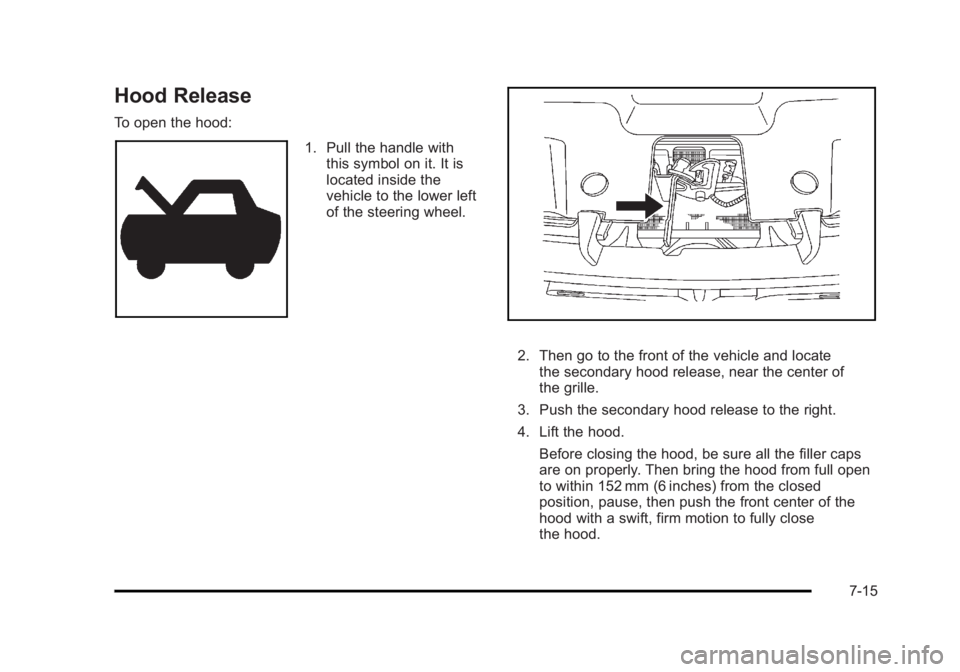
Hood Release To open the hood:
1. Pull the handle with
this symbol on it. It is
located inside the
vehicle to the lower left
of the steering wheel.
2. Then go to the front of the vehicle and locate
the secondary hood release, near the center of
the grille.
3. Push the secondary hood release to the right.
4. Lift the hood.
Before closing the hood, be sure all the filler caps
are on properly. Then bring the hood from full open
to within 152 mm (6 inches) from the closed
position, pause, then push the front center of the
hood with a swift, firm motion to fully close
the hood.
7-15
Page 465 of 620

Black plate (17,1)Cadillac Escalade/Escalade ESV Owner Manual - 2010
A. Engine Air Cleaner/Filter on page 7 ‑ 22 .
B. Coolant Surge Tank and Pressure Cap. See
Cooling System on page 7 ‑ 27 .
C. Remote Positive (+) Terminal. See Jump Starting
on page 7 ‑ 44 .
D. Battery on page 7 ‑ 43 .
E. Engine Oil Fill Cap. See “ When to Add Engine Oil ”
under Engine Oil on page 7 ‑ 17 .
F. Automatic Transmission Dipstick (Out of View).
See “ Checking the Fluid Level ” under Automatic
Transmission Fluid on page 7 ‑ 24 .
G. Remote Negative ( − ) Terminal (GND) (Out of
View). See Jump Starting on page 7 ‑ 44 .
H. Engine Oil Dipstick (Out of View). See “ Checking
Engine Oil ” under Engine Oil on page 7 ‑ 17 .
I. Engine Cooling Fan (Out of View). See Cooling
System on page 7 ‑ 27 .
J. Power Steering Fluid Reservoir (Out of View). See
Power Steering Fluid on page 7 ‑ 38 .
K. Brake Master Cylinder Reservoir. See “ Brake
Fluid ” under Brakes on page 7 ‑ 40 . L. Underhood Fuse Block on page 7 ‑ 113 .
M. Windshield Washer Fluid Reservoir. See “ Adding
Washer Fluid ” under Windshield Washer Fluid
on
page 7 ‑ 39 .
Engine Oil Checking Engine Oil It is a good idea to check the engine oil level at each
fuel fill. In order to get an accurate reading, the oil must
be warm and the vehicle must be on level ground.
The engine oil dipstick handle is a yellow loop. See
Engine Compartment Overview on page 7 ‑ 16 for the
location of the engine oil dipstick.
1. Turn off the engine and give the oil several minutes
to drain back into the oil pan. If this is not done, the
oil dipstick might not show the actual level.
2. Pull out the dipstick and clean it with a paper towel
or cloth, then push it back in all the way. Remove it
again, keeping the tip down, and check the level.
7-17
Page 486 of 620

Black plate (38,1)Cadillac Escalade/Escalade ESV Owner Manual - 2010
Power Steering Fluid See Engine Compartment
Overview on page 7 ‑ 16
for reservoir location.
When to Check Power Steering Fluid It is not necessary to regularly check power steering
fluid unless you suspect there is a leak in the system or
you hear an unusual noise. A fluid loss in this system
could indicate a problem. Have the system inspected
and repaired. How to Check Power Steering Fluid To check the power steering fluid:
1. Turn the key off and let the engine compartment
cool down.
2. Wipe the cap and the top of the reservoir clean.
3. Unscrew the cap and wipe the dipstick with a
clean rag.
4. Replace the cap and completely tighten it.
5. Remove the cap again and look at the fluid level
on the dipstick.
The level should be at the FULL COLD mark.
If necessary, add only enough fluid to bring the level up
to the mark.
What to Use To determine what kind of fluid to use, see
Recommended Fluids and Lubricants
on page 8 ‑ 10 .
Always use the proper fluid.
Notice: Use of the incorrect fluid may damage the
vehicle and the damages may not be covered by the
vehicle's warranty. Always use the correct fluid
listed in Recommended Fluids and Lubricants
on
page 8 ‑ 10 .
7-38
Page 510 of 620

Black plate (62,1)Cadillac Escalade/Escalade ESV Owner Manual - 2010
Tire Terminology and Definitions Air Pressure :
The amount of air inside the tire
pressing outward on each square inch of the tire.
Air pressure is expressed in pounds per square
inch (psi) or kilopascal (kPa).
Accessory Weight :
This means the combined
weight of optional accessories. Some examples of
optional accessories are, automatic transmission,
power steering, power brakes, power windows,
power seats, and air conditioning.
Aspect Ratio :
The relationship of a tire's height to
its width.
Belt :
A rubber coated layer of cords that is
located between the plies and the tread. Cords
may be made from steel or other reinforcing
materials.
Bead :
The tire bead contains steel wires wrapped
by steel cords that hold the tire onto the rim.
Bias Ply Tire :
A pneumatic tire in which the plies
are laid at alternate angles less than 90 degrees
to the centerline of the tread. Cold Tire Pressure :
The amount of air pressure
in a tire, measured in pounds per square inch (psi)
or kilopascals (kPa) before a tire has built up heat
from driving. See Inflation - Tire Pressure
on
page 7 ‑ 65
.
Curb Weight :
The weight of a motor vehicle with
standard and optional equipment including the
maximum capacity of fuel, oil, and coolant, but
without passengers and cargo.
DOT Markings :
A code molded into the sidewall
of a tire signifying that the tire is in compliance
with the U.S. Department of Transportation (DOT)
motor vehicle safety standards. The DOT code
includes the Tire Identification Number (TIN), an
alphanumeric designator which can also identify
the tire manufacturer, production plant, brand, and
date of production.
GVWR :
Gross Vehicle Weight Rating.
See Loading the Vehicle
on page 6 ‑ 32 .
GAWR FRT :
Gross Axle Weight Rating for the
front axle. See Loading the Vehicle on page 6 ‑ 32 .
GAWR RR :
Gross Axle Weight Rating for the rear
axle. See Loading the Vehicle
on page 6 ‑ 32 .
7-62
Page 527 of 620

Black plate (79,1)Cadillac Escalade/Escalade ESV Owner Manual - 2010
WARNING: (Continued) vehicle and tire size combination and road
conditions. Follow that manufacturer's
instructions. To help avoid damage to the vehicle,
drive slowly, re ‐ adjust or remove the device if it is
contacting the vehicle, and do not spin the
wheels. If you do find traction devices that will fit,
install them on the rear tires.
If a Tire Goes Flat It is unusual for a tire to blowout while you are driving,
especially if you maintain your vehicle's tires properly.
If air goes out of a tire, it is much more likely to leak out
slowly. But if you should ever have a blowout, here are
a few tips about what to expect and what to do:
If a front tire fails, the flat tire creates a drag that pulls
the vehicle toward that side. Take your foot off the
accelerator pedal and grip the steering wheel firmly.
Steer to maintain lane position, and then gently brake to
a stop well out of the traffic lane. A rear blowout, particularly on a curve, acts much like a
skid and may require the same correction you would
use in a skid. In any rear blowout remove your foot from
the accelerator pedal. Get the vehicle under control by
steering the way you want the vehicle to go. It may be
very bumpy and noisy, but you can still steer. Gently
brake to a stop, well off the road if possible.
{ WARNING: Lifting a vehicle and getting under it to do
maintenance or repairs is dangerous without the
appropriate safety equipment and training. If a
jack is provided with the vehicle, it is designed
only for changing a flat tire. If it is used for
anything else, you or others could be badly
injured or killed if the vehicle slips off the jack. If a
jack is provided with the vehicle, only use it for
changing a flat tire.
If a tire goes flat, the next part shows how to use the
jacking equipment to change a flat tire safely.
7-79
Page 559 of 620

Black plate (111,1)Cadillac Escalade/Escalade ESV Owner Manual - 2010
The vehicle may not use all of the fuses shown.
Fuses Usage
1 Rear Seats
2 Rear Accessory Power Outlet
3 Steering Wheel Controls Backlight
4 Driver Door Module
5 Dome Lamps, Driver Side Turn Signal
6 Driver Side Turn Signal, Stoplamp Fuses Usage
7 Instrument Panel Back Lighting
8 Passenger Side Turn Signal,
Stoplamp
9 Passenger Door Module, Driver
Unlock
10 Power Door Lock 2 (Unlock Feature)
11 Power Door Lock 2 (Lock Feature)
12 Stoplamps, Center-High Mounted
Stoplamp
13 Rear Climate Controls
14 Power Mirror
15 Body Control Module (BCM)
16 Accessory Power Outlets
17 Interior Lamps
18 Power Door Lock 1 (Unlock Feature)
19 Rear Seat Entertainment
20 Ultrasonic Rear Parking Assist, Power
Liftgate
21 Power Door Lock 1 (Lock Feature)
7-111
Page 560 of 620

Black plate (112,1)Cadillac Escalade/Escalade ESV Owner Manual - 2010
Fuses Usage
22 Driver Information Center (DIC)
23 Rear Wiper
24 Cooled Seats
25 Driver Seat Module, Remote Keyless
Entry System
26 Driver Power Door Lock (Unlock
Feature)
Circuit Breaker Usage
LT DR Driver Side Power Window Circuit
Breaker
Harness
Connector Usage
LT DR Driver Door Harness Connection
BODY Harness Connector
BODY Harness Connector Center Instrument Panel Fuse Block The center instrument panel fuse block is located
underneath the instrument panel, to the left of the
steering column.
Top View
Harness
Connector Usage
BODY 2 Body Harness Connector 2
BODY 1 Body Harness Connector 1
BODY 3 Body Harness Connector 3
7-112
Page 570 of 620
Black plate (4,1)Cadillac Escalade/Escalade ESV Owner Manual - 2010
Every Engine Oil Change .
Change engine oil and filter. See Engine Oil on
page 7 ‑ 17 . An Emission Control Service..
Engine coolant level check. See Engine Coolant
on page 7 ‑ 29 ..
Windshield washer fluid level check. See
Windshield Washer Fluid on page 7 ‑ 39 ..
Tire inflation check. See Inflation - Tire Pressure
on page 7 ‑ 65 ..
Tire wear inspection. See Tire Inspection and
Rotation on page 7 ‑ 71 ..
Rotate tires. See Tire Inspection and Rotation on
page 7 ‑ 71 ..
Fluids visual leak check (or every 12 months,
whichever occurs first). A leak in any system must
be repaired and the fluid level checked. .
Engine air cleaner filter inspection. See Engine Air
Cleaner/Filter on page 7 ‑ 22 ..
Brake system inspection (or every 12 months,
whichever occurs first). .
Lubricate the front suspension, steering linkage,
and parking brake cable guides. Control arm ball
joints are maintenance ‐ free..
Steering and suspension inspection. Visual
inspection for damaged, loose, or missing parts or
signs of wear. .
Engine cooling system inspection. Visual
inspection of hoses, pipes, fittings, and clamps and
replacement, if needed. .
Windshield wiper blade inspection for wear,
cracking, or contamination and windshield and
wiper blade cleaning, if contaminated. See
Windshield, Backglass, and Wiper Blades
on
page 7 ‑ 105 . Worn or damaged wiper blade
replacement. See Windshield Wiper Blade
Replacement on page 7 ‑ 57 . .
Body hinges and latches, key lock cylinders, rear
compartment hinges, outer tailgate handle pivot
points, and folding seat hardware lubrication.
See Recommended Fluids and Lubricants on
page 8 ‑ 10
. More frequent lubrication may be
required when vehicle is exposed to a corrosive
environment. Applying silicone grease on
weatherstrips with a clean cloth makes them last
longer, seal better, and not stick or squeak. .
Restraint system component check. See Checking
the Restraint Systems on page 2 ‑ 91 . .
Automatic transmission fluid level check and
adding fluid, if needed. See Automatic
Transmission Fluid on page 7 ‑ 24 .
8-4
Page 576 of 620

Black plate (10,1)Cadillac Escalade/Escalade ESV Owner Manual - 2010
Recommended Fluids and
Lubricants Fluids and lubricants identified below by name, part
number, or specification can be obtained from your
dealer.
Usage Fluid/Lubricant
Engine Oil The engine requires a special engine
oil meeting GM Standard GM4718M.
Oils meeting this standard can be
identified as synthetic, and should
also be identified with the American
Petroleum Institute (API) Certified for
Gasoline Engines starburst symbol.
However, not all synthetic API oils
with the starburst symbol will meet
this GM standard. Look for and use
only oil that meets GM Standard
GM4718M. For the proper viscosity,
see Engine Oil on page 7 ‑ 17 . Usage Fluid/Lubricant
Engine Coolant 50/50 mixture of clean, drinkable
water and use only DEX-COOL ®
Coolant. See Engine Coolant on
page 7 ‑ 29
.
Hydraulic Brake
System DOT 3 Hydraulic Brake Fluid
(GM Part No. U.S. 12377967, in
Canada 89021320).
Windshield
Washer Optikleen ®
Washer Solvent.
Power Steering
System GM Power Steering Fluid
(GM Part No. U.S. 89021184, in
Canada 89021186).
Automatic
Transmission DEXRON ®
-VI Automatic Transmission
Fluid.
Key Lock
Cylinders Multi-Purpose Lubricant, Superlube
(GM Part No. U.S. 12346241, in
Canada 10953474).
8-10
Page 600 of 620
Black plate (18,1)Cadillac Escalade/Escalade ESV Owner Manual - 2010
Reporting Safety Defects to General
Motors In addition to notifying NHTSA (or Transport Canada) in
a situation like this, notify General Motors.
Call 1-800-458-8006, or write:
Cadillac Customer Assistance Center
Cadillac Motor Car Division
P.O. Box 33169
Detroit, MI 48232-5169
In Canada, call 1 ‐ 888 ‐ 446 ‐ 2000, or write:
Canadian Cadillac Customer Communication
Centre, Mail Code: CA1-163-005
General Motors of Canada Limited
1908 Colonel Sam Drive
Oshawa, Ontario L1H 8P7 Service Publications Ordering
Information Service Manuals Service Manuals have the diagnosis and repair
information on the engines, transmission, axle,
suspension, brakes, electrical, steering, body, etc.
Service Bulletins Service Bulletins give additional technical service
information needed to knowledgeably service
General Motors cars and trucks. Each bulletin
contains instructions to assist in the diagnosis and
service of your vehicle.
Owner Information Owner publications are written specifically for owners
and intended to provide basic operational information
about the vehicle. The Owner Manual includes the
Maintenance Schedule for all models.
In-Portfolio: Includes a Portfolio, Owner Manual, and
Warranty Booklet.
RETAIL SELL PRICE: $35.00 (U.S.) plus handling and
shipping fees
9-18