lock CADILLAC ESCALADE ESV 2011 Owners Manual
[x] Cancel search | Manufacturer: CADILLAC, Model Year: 2011, Model line: ESCALADE ESV, Model: CADILLAC ESCALADE ESV 2011Pages: 548, PDF Size: 8.45 MB
Page 355 of 548

Black plate (35,1)Cadillac Escalade/Escalade ESV Owner Manual - 2011
Driving and Operating 9-35
Engine Heater The engine coolant heater can
provide easier starting and better
fuel economy during engine
warm-up in cold weather conditions
at or below − 18°C (0°F). Vehicles
with an engine heater should be
plugged in at least four hours before
starting. An internal thermostat in
the plug-end of the cord may exist
which will prevent engine coolant
heater operation at temperatures
above − 18°C (0°F).
To Use the Engine Coolant
Heater 1. Turn off the engine.
2. Open the hood and unwrap
the electrical cord. The cord
is secured to the Engine
Compartment Fuse Block with a
clip. Carefully remove the wire
tie which secures the electrical
cord. Do not cut the
electrical cord.
3. Plug the cord into a normal,
grounded 110-volt AC outlet. { WARNINGPlugging the cord into an
ungrounded outlet could cause
an electrical shock. Also, the
wrong kind of extension cord
could overheat and cause a fire.
You could be seriously injured.
Plug the cord into a properly
grounded three-prong 110-volt
AC outlet. If the cord will not
reach, use a heavy-duty
three-prong extension cord rated
for at least 15 amps.
4. Before starting the engine, be
sure to unplug and store the
cord as it was before to keep it
away from moving engine parts.
If you do not, it could be
damaged.
The length of time the heater should
remain plugged in depends on
several factors. Ask a dealer in the
area where you will be parking the
vehicle for the best advice on this. Retained Accessory
Power (RAP) The following vehicle accessories
can be used for up to 10 minutes
after the engine is turned off: .
Audio System .
Power Windows .
OnStar System (if equipped) .
Sunroof (if equipped)
These features work when the key
is in ON/RUN or ACC/
ACCESSORY. Once the key is
turned from ON/RUN to LOCK/OFF,
the windows and sunroof continue
to work up to 10 minutes until any
door is opened. The radio continues
to work for up to 10 minutes or until
the driver door is opened.
Page 356 of 548
Black plate (36,1)Cadillac Escalade/Escalade ESV Owner Manual - 2011
9-36 Driving and Operating
Shifting Into Park
{ WARNINGIt can be dangerous to get out of
the vehicle if the shift lever is not
fully in P (Park) with the parking
brake firmly set. The vehicle can
roll. If you have left the engine
running, the vehicle can move
suddenly. You or others could be
injured. To be sure the vehicle will
not move, even when you are on
fairly level ground, use the steps
that follow. If you are pulling a
trailer, see Driving Characteristics
and Towing Tips on page 9 ‑ 71 .
1. Hold the brake pedal down, then
set the parking brake.
2. Move the shift lever into the
P (Park) position by pulling the
shift lever toward you and
moving it up as far as it will go. 3. Turn the ignition key to
LOCK/OFF.
4. Remove the key and take it with
you. If you can leave the vehicle
with the ignition key in your
hand, the vehicle is in P (Park).
Leaving the Vehicle with the
Engine Running
{ WARNINGIt can be dangerous to leave the
vehicle with the engine running.
The vehicle could move suddenly
if the shift lever is not fully in
P (Park) with the parking brake
firmly set. And, if you leave the
vehicle with the engine running, it
could overheat and even catch
fire. You or others could be
injured. Do not leave the vehicle
with the engine running. If you have to leave the vehicle with
the engine running, be sure the
vehicle is in P (Park) and the
parking brake is firmly set. After the
shift lever is moved into P (Park),
hold the regular brake pedal down.
Then, see if you can move the shift
lever away from P (Park) without
first pulling it toward you. If you can,
it means that the shift lever was not
fully locked into P (Park).
Page 357 of 548
Black plate (37,1)Cadillac Escalade/Escalade ESV Owner Manual - 2011
Driving and Operating 9-37Torque Lock If you are parking on a hill and
you do not shift the transmission
into P (Park) properly, the weight
of the vehicle can put too much
force on the parking pawl in the
transmission. It might be difficult to
pull the shift lever out of P (Park).
This is called torque lock. To
prevent torque lock, set the parking
brake and then shift into P (Park)
properly before you leave the driver
seat. To find out how, see Shifting
Into Park on page 9 ‑ 36 .
When you are ready to drive, move
the shift lever out of P (Park) before
releasing the parking brake.
If torque lock does occur, you might
need to have another vehicle push
yours a little uphill to take some
of the pressure from the parking
pawl in the transmission. Then
you should be able to pull the shift
lever out of P (Park). Shifting Out of Park This vehicle is equipped with an
electronic shift lock release system.
The shift lock release is
designed to: .
Prevent ignition key removal
unless the shift lever is in
P (Park) with the shift lever
button fully released. .
Prevent movement of the shift
lever out of P (Park), unless the
ignition is in ON/RUN or ACC/
ACCESSORY and the regular
brake pedal is applied.
The shift lock release is always
functional except in the case of
an uncharged or low voltage (less
than 9 volt) battery.
If the vehicle has an uncharged
battery or a battery with low voltage,
try charging or jump starting the
battery. See Jump Starting on
page 10 ‑ 82 for more information. To shift out of P (Park) use the
following:
1. Apply the brake pedal.
2. Move the shift lever to the
desired position.
If you still are unable to shift out
of P (Park):
1. Ease the pressure on the shift
lever.
2. While holding down the brake
pedal, press the shift lever all
the way into P (Park).
3. Move the shift lever to the
desired position.
If you are still having a problem
shifting, then have the vehicle
serviced soon.
Page 358 of 548

Black plate (38,1)Cadillac Escalade/Escalade ESV Owner Manual - 2011
9-38 Driving and Operating
Parking Over Things
That Burn
{ WARNINGThings that can burn could touch
hot exhaust parts under the
vehicle and ignite. Do not park
over papers, leaves, dry grass,
or other things that can burn. Active Fuel Management ®
Vehicles with V8 engines may have
Active Fuel Management ™ . This
system allows the engine to operate
on either all or half of its cylinders,
depending on the driving conditions.
When less power is required, such
as cruising at a constant vehicle
speed, the system will operate in
the half cylinder mode, allowing the
vehicle to achieve better fuel
economy. When greater power
demands are required, such as
accelerating from a stop, passing,
or merging onto a freeway, the
system will maintain full-cylinder
operation.
If the vehicle has an Active Fuel
Management ™ indicator, see
Driver Information Center (DIC) on
page 5 ‑ 26 for more information on
using this display. Engine Exhaust
{ WARNINGEngine exhaust contains carbon
monoxide (CO) which cannot be
seen or smelled. Exposure to CO
can cause unconsciousness and
even death.
Exhaust may enter the vehicle if: .
The vehicle idles in areas
with poor ventilation (parking
garages, tunnels, deep snow
that may block underbody
airflow or tail pipes). .
The exhaust smells or
sounds strange or different. .
The exhaust system leaks
due to corrosion or damage. .
The vehicle exhaust system
has been modified, damaged
or improperly repaired.
(Continued)
Page 360 of 548

Black plate (40,1)Cadillac Escalade/Escalade ESV Owner Manual - 2011
9-40 Driving and Operating
Automatic
Transmission If the vehicle is a hybrid, see
the hybrid supplement for more
information.
The vehicle has a
Hydra-Matic ®
6L80 automatic
transmission, and has an electronic
shift position indicator within the
instrument panel cluster. The
electronic shift position indicator
displays when the shift lever is
moved out of P (Park).
There are several different positions
for the shift lever. P (Park): This position locks the
rear wheels. It is the best position
to use when you start the engine
because the vehicle cannot move
easily.
When parked on a hill, especially
when the vehicle has a heavy load,
you may notice an increase in the
effort to shift out of P (Park). See
“ Torque Lock ” under Shifting Into
Park on page 9 ‑ 36 for more
information. { WARNINGIt is dangerous to get out of the
vehicle if the shift lever is not fully
in P (Park) with the parking brake
firmly set. The vehicle can roll.
Do not leave the vehicle when
the engine is running unless
you have to. If you have left the
engine running, the vehicle can
move suddenly. You or others
could be injured. To be sure the
vehicle will not move, even when
you are on fairly level ground,
always set the parking brake and
move the shift lever to P (Park).
See Shifting Into Park on
page 9 ‑ 36 . If you are pulling a
trailer, see Driving Characteristics
and Towing Tips on page 9 ‑ 71 .
Page 365 of 548

Black plate (45,1)Cadillac Escalade/Escalade ESV Owner Manual - 2011
Driving and Operating 9-45
Drive Systems All-Wheel Drive If the vehicle has this feature,
engine power is sent to all four
wheels when extra traction is
needed. This is like four-wheel
drive, but there is no separate lever
or switch to engage or disengage
the front axle. It is fully automatic,
and adjusts itself as needed for road
conditions.
If the vehicle is a hybrid, see
“ Four-Wheel Drive ” in the hybrid
supplement. Brakes Antilock Brake
System (ABS) This vehicle has the Antilock
Brake System (ABS), an advanced
electronic braking system that helps
prevent a braking skid.
When the engine is started and the
vehicle begins to drive away, ABS
checks itself. A momentary motor or
clicking noise might be heard while
this test is going on, and it might
even be noticed that the brake
pedal moves a little. This is normal. If there is a problem with ABS, this
warning light stays on. See Antilock
Brake System (ABS) Warning Light
on page 5 ‑ 22 .
If driving safely on a wet road
and it becomes necessary to slam
on the brakes and continue braking
to avoid a sudden obstacle, a
computer senses that the wheels
are slowing down. If one of the
wheels is about to stop rolling, the
computer will separately work the
brakes at each wheel.
Page 369 of 548

Black plate (49,1)Cadillac Escalade/Escalade ESV Owner Manual - 2011
Driving and Operating 9-49Traction Control Operation The traction control system is
part of the StabiliTrak system.
Traction control limits wheel
spin by reducing engine power
to the wheels (engine speed
management) and by applying
brakes to each individual wheel
(brake-traction control) as
necessary.
The traction control system is
enabled automatically when the
vehicle is started. It will activate and
the StabiliTrak light will flash if it
senses that any of the wheels are
spinning or beginning to lose
traction while driving. If traction
control is turned off, only the
brake-traction control portion of
traction control will work. The
engine speed management will be
disabled. In this mode, engine
power is not reduced automatically
and the driven wheels can spin
more freely. This can cause the
brake-traction control to activate
constantly. Notice: If the wheel(s) of one axle
is allowed to spin excessively
while the StabiliTrak ®
, ABS, brake
warning lights, and any relevant
DIC messages are displayed, the
transfer case could be damaged.
The repairs would not be covered
by the vehicle warranty. Reduce
engine power and do not spin the
wheel(s) excessively while these
lights and messages are
displayed.
The traction control system may
activate on dry or rough roads or
under conditions such as heavy
acceleration while turning or
abrupt upshifts/downshifts of the
transmission. When this happens, a
reduction in acceleration may be
noticed, or a noise or vibration may
be heard. This is normal. If cruise control is being used when
the system activates, the StabiliTrak
light will flash and cruise control will
automatically disengage. Cruise
control may be reengaged when
road conditions allow. See Cruise
Control on page 9 ‑ 51 .
StabiliTrak may also turn off
automatically if it determines
that a problem exists with the
system. If the problem does not
clear itself after restarting the
vehicle, see your dealer for service.
Locking Rear Axle Vehicles with a locking rear axle can
give more traction on snow, mud,
ice, sand, or gravel. It works like a
standard axle most of the time, but
when traction is low, this feature will
allow the rear wheel with the most
traction to move the vehicle.
Page 375 of 548

Black plate (55,1)Cadillac Escalade/Escalade ESV Owner Manual - 2011
Driving and Operating 9-55
The system can be disabled by
pressing the rear park aid disable
button located next to the radio.
The indicator light will come on and
PARK ASSIST OFF displays on the
Driver Information Center (DIC) to
indicate that URPA is off, see Object
Detection System Messages on
page 5 ‑ 36 .
When the System Does Not
Seem to Work Properly If the URPA system will not activate
due to a temporary condition, the
messages PARK ASSIST OFF or
PARK ASST BLOCKED SEE
OWNERS MANUAL will be
displayed on the DIC. SERVICE PARK ASSIST: If this
message occurs, take the vehicle
to your dealer to repair the system.
PARK ASSIST OFF: This message
occurs if the driver disables the
system.
PARK ASST BLOCKED SEE
OWNERS MANUAL: This
message can occur under the
following conditions: .
The ultrasonic sensors are not
clean. Keep the vehicle's rear
bumper free of mud, dirt, snow,
ice and slush. For cleaning
instructions, see “ Washing the
Vehicle ” under Exterior Care on
page 10 ‑ 90 . .
The park assist sensors are
covered by frost or ice. Frost or
ice can form around and behind
the sensors and may not always
be seen; this can occur after
washing the vehicle in cold
weather. The message may
not clear until the frost or ice
has melted. .
A trailer was attached to the
vehicle, or a bicycle or an object
was hanging out of the liftgate
during the last drive cycle. Once
the attached object is removed,
URPA will return to normal
operation. .
A tow bar is attached to the
vehicle. .
The vehicle's bumper is
damaged. Take the vehicle to
your dealer to repair the system. .
Other conditions may affect
system performance, such as
vibrations from a jackhammer or
the compression of air brakes on
a very large truck.
Page 378 of 548
Black plate (58,1)Cadillac Escalade/Escalade ESV Owner Manual - 2011
9-58 Driving and Operating The SBZA displays may remain on
if a trailer is attached to the vehicle,
or a bicycle or object is extending
out to either side of the vehicle.
When SBZA is disabled for any
reason other than the driver turning
it off, the driver will not be able to
turn SBZA back on using the DIC.
The SIDE BLIND ZONE ALERT
ON option will not be selectable if
the conditions for normal system
operation are not met. Until normal
operating conditions for SBZA are
met, you should not rely upon SBZA
while driving.
SBZA Error Messages
The following messages may
appear in the DIC:
SIDE BLIND ZONE ALERT
SYSTEM OFF: This message
indicates that the driver has turned
the system off. SIDE BLIND ZONE SYS.
UNAVAILABLE: This message
indicates that the SBZA system is
disabled either because the sensor
is blocked and cannot detect
vehicles in your blind zone, or the
vehicle is passing through an open
field of view area, such as the
desert, where there is insufficient
data for operation. The sensor may
be blocked by mud, dirt, snow, ice,
slush, or even heavy rainstorms.
This message may also activate
during heavy rain or due to road
spray. The vehicle does not need
service. For cleaning, see “ Washing
the Vehicle ” under Exterior Care on
page 10 ‑ 90 .
SERVICE SIDE BLIND ZONE
ALERT SYSTEM: If this message
appears, both SBZA displays will
remain on indicating there is a
problem with the SBZA system.
If these displays remain on after
continued driving, the system needs
service. Take the vehicle to your
dealer. FCC Information See Radio Frequency Statement on
page 13 ‑ 19 for information
regarding Part 15 of the Federal
Communications Commission (FCC)
rules and Industry Canada
Standards RSS-210/220/310.
Frequency of operation:
24.05GHz – 24.25GHz
Field Strength: Not greater than
2.5V/m peak (0.25V/m average)
at a distance of 3m
The manufacturer is not
responsible for any radio or
TV interference caused by
unauthorized modifications to this
equipment. Such modifications
could void the user's authority to
operate the equipment.
Page 388 of 548
Black plate (68,1)Cadillac Escalade/Escalade ESV Owner Manual - 2011
9-68 Driving and Operating
Filling the Tank
{ WARNINGFuel vapor burns violently and a
fuel fire can cause bad injuries.
To help avoid injuries to you and
others, read and follow all the
instructions on the fuel pump
island. Turn off the engine when
refueling. Do not smoke near fuel
or when refueling the vehicle. Do
not use cellular phones. Keep
sparks, flames, and smoking
materials away from fuel. Do not
leave the fuel pump unattended
when refueling the vehicle. This is
against the law in some places.
Do not re-enter the vehicle while
pumping fuel. Keep children away
from the fuel pump; never let
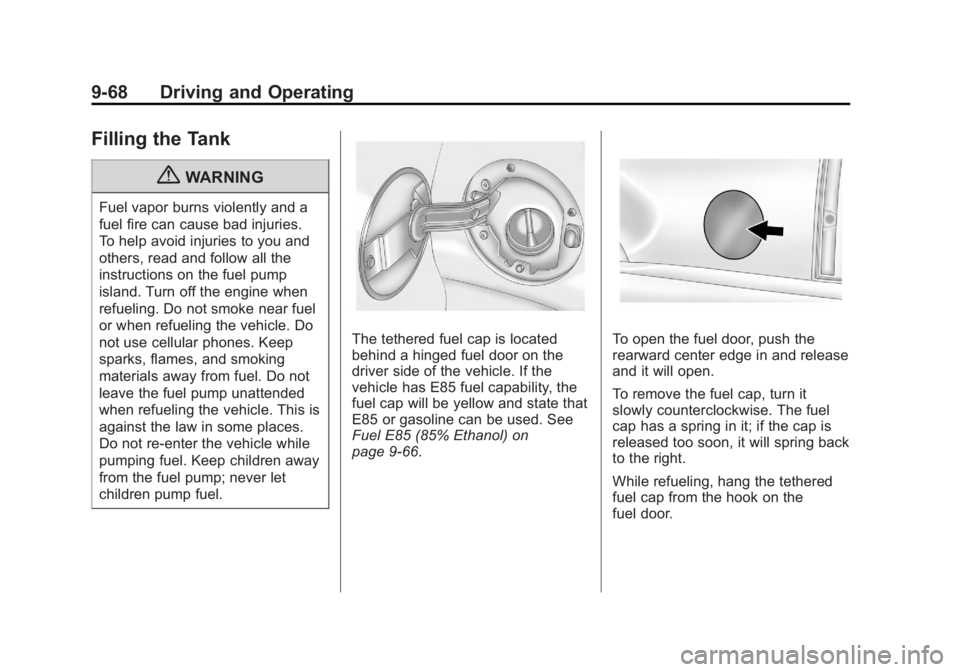
children pump fuel. The tethered fuel cap is located
behind a hinged fuel door on the
driver side of the vehicle. If the
vehicle has E85 fuel capability, the
fuel cap will be yellow and state that
E85 or gasoline can be used. See
Fuel E85 (85% Ethanol) on
page 9 ‑ 66 . To open the fuel door, push the
rearward center edge in and release
and it will open.
To remove the fuel cap, turn it
slowly counterclockwise. The fuel
cap has a spring in it; if the cap is
released too soon, it will spring back
to the right.
While refueling, hang the tethered
fuel cap from the hook on the
fuel door.