lock CADILLAC ESCALADE ESV 2011 Owners Manual
[x] Cancel search | Manufacturer: CADILLAC, Model Year: 2011, Model line: ESCALADE ESV, Model: CADILLAC ESCALADE ESV 2011Pages: 548, PDF Size: 8.45 MB
Page 480 of 548
Black plate (78,1)Cadillac Escalade/Escalade ESV Owner Manual - 2011
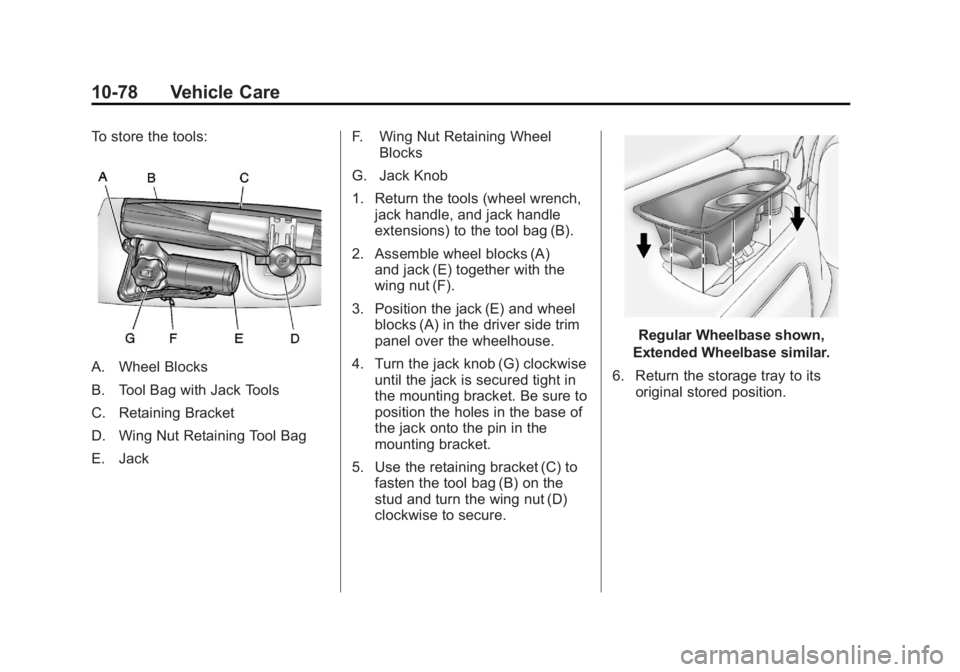
10-78 Vehicle Care To store the tools:
A. Wheel Blocks
B. Tool Bag with Jack Tools
C. Retaining Bracket
D. Wing Nut Retaining Tool Bag
E. Jack F. Wing Nut Retaining Wheel
Blocks
G. Jack Knob
1. Return the tools (wheel wrench,
jack handle, and jack handle
extensions) to the tool bag (B).
2. Assemble wheel blocks (A)
and jack (E) together with the
wing nut (F).
3. Position the jack (E) and wheel
blocks (A) in the driver side trim
panel over the wheelhouse.
4. Turn the jack knob (G) clockwise
until the jack is secured tight in
the mounting bracket. Be sure to
position the holes in the base of
the jack onto the pin in the
mounting bracket.
5. Use the retaining bracket (C) to
fasten the tool bag (B) on the
stud and turn the wing nut (D)
clockwise to secure. Regular Wheelbase shown,
Extended Wheelbase similar.
6. Return the storage tray to its
original stored position.
Page 481 of 548
Black plate (79,1)Cadillac Escalade/Escalade ESV Owner Manual - 2011
Vehicle Care 10-79
Secondary Latch System This vehicle has an
underbody-mounted tire hoist
assembly equipped with a
secondary latch system. It is
designed to stop the spare tire from
suddenly falling off your vehicle.
For the secondary latch to work,
the spare must be installed with the
valve stem pointing down. See
“ Storing a Flat or Spare Tire and
Tools ” under Tire Changing on
page 10 ‑ 68 .
{ WARNING
Before beginning this procedure
read all the instructions. Failure to
read and follow the instructions
could damage the hoist assembly
and you and others could get
hurt. Read and follow the
instructions listed next. To release the spare tire from the
secondary latch:
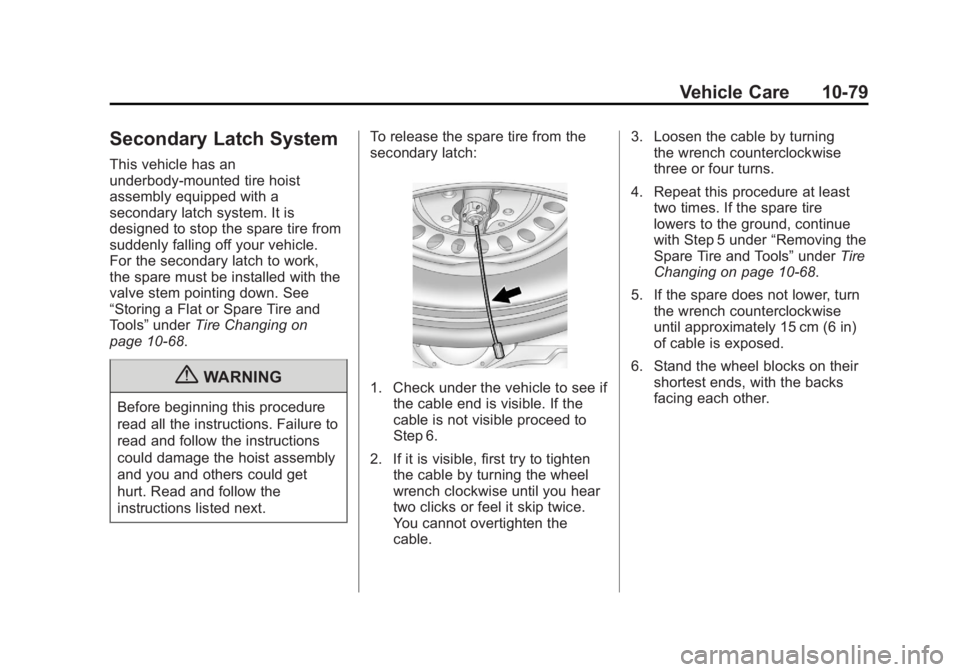
1. Check under the vehicle to see if
the cable end is visible. If the
cable is not visible proceed to
Step 6.
2. If it is visible, first try to tighten
the cable by turning the wheel
wrench clockwise until you hear
two clicks or feel it skip twice.
You cannot overtighten the
cable. 3. Loosen the cable by turning
the wrench counterclockwise
three or four turns.
4. Repeat this procedure at least
two times. If the spare tire
lowers to the ground, continue
with Step 5 under “ Removing the
Spare Tire and Tools ” under Tire
Changing on page 10 ‑ 68 .
5. If the spare does not lower, turn
the wrench counterclockwise
until approximately 15 cm (6 in)
of cable is exposed.
6. Stand the wheel blocks on their
shortest ends, with the backs
facing each other.
Page 482 of 548
Black plate (80,1)Cadillac Escalade/Escalade ESV Owner Manual - 2011
10-80 Vehicle Care
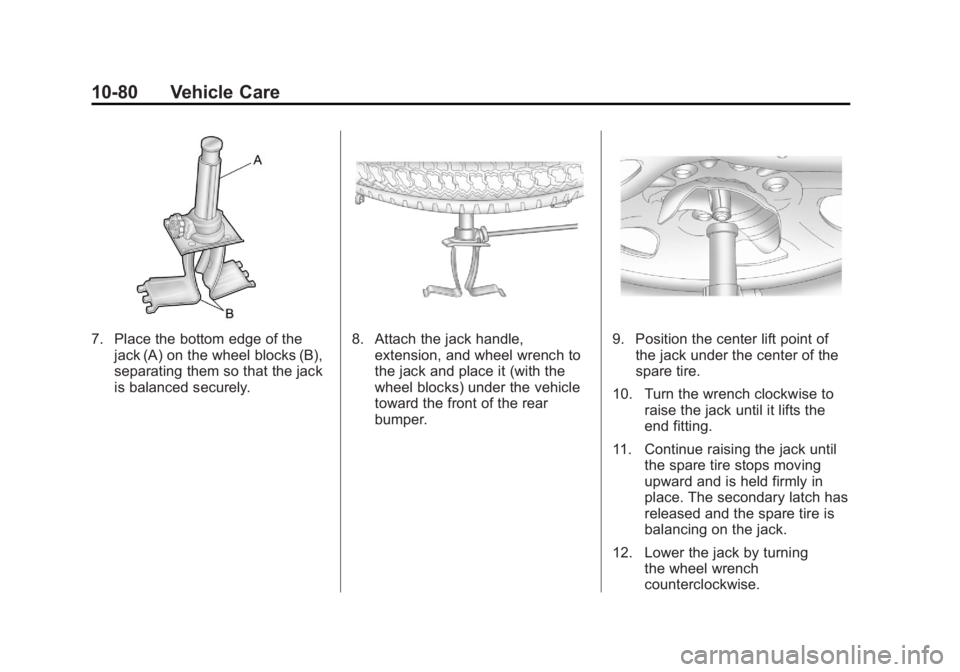
7. Place the bottom edge of the
jack (A) on the wheel blocks (B),
separating them so that the jack
is balanced securely. 8. Attach the jack handle,
extension, and wheel wrench to
the jack and place it (with the
wheel blocks) under the vehicle
toward the front of the rear
bumper. 9. Position the center lift point of
the jack under the center of the
spare tire.
10. Turn the wrench clockwise to
raise the jack until it lifts the
end fitting.
11. Continue raising the jack until
the spare tire stops moving
upward and is held firmly in
place. The secondary latch has
released and the spare tire is
balancing on the jack.
12. Lower the jack by turning
the wheel wrench
counterclockwise.
Page 483 of 548
Black plate (81,1)Cadillac Escalade/Escalade ESV Owner Manual - 2011
Vehicle Care 10-81Keep lowering the jack until the
spare tire slides off the jack or
is hanging by the cable.
{ WARNINGSomeone standing too close
during the procedure could be
injured by the jack. If the spare
tire does not slide off the jack
completely, make sure no one is
behind you or on either side of
you as you pull the jack out from
under the spare.
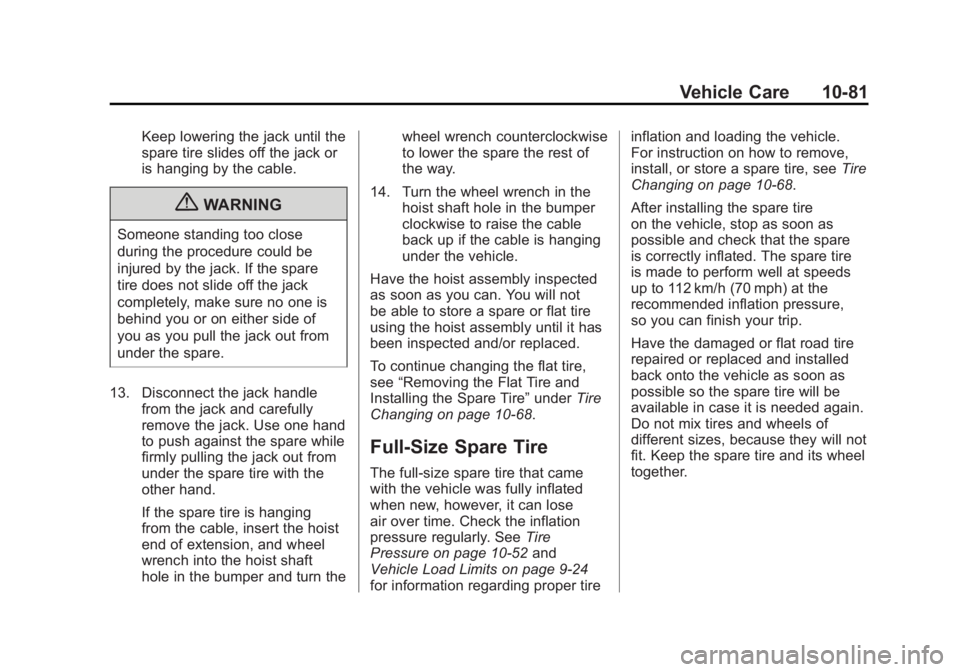
13. Disconnect the jack handle
from the jack and carefully
remove the jack. Use one hand
to push against the spare while
firmly pulling the jack out from
under the spare tire with the
other hand.
If the spare tire is hanging
from the cable, insert the hoist
end of extension, and wheel
wrench into the hoist shaft
hole in the bumper and turn the wheel wrench counterclockwise
to lower the spare the rest of
the way.
14. Turn the wheel wrench in the
hoist shaft hole in the bumper
clockwise to raise the cable
back up if the cable is hanging
under the vehicle.
Have the hoist assembly inspected
as soon as you can. You will not
be able to store a spare or flat tire
using the hoist assembly until it has
been inspected and/or replaced.
To continue changing the flat tire,
see “ Removing the Flat Tire and
Installing the Spare Tire ” under Tire
Changing on page 10 ‑ 68 .
Full-Size Spare Tire The full-size spare tire that came
with the vehicle was fully inflated
when new, however, it can lose
air over time. Check the inflation
pressure regularly. See Tire
Pressure on page 10 ‑ 52 and
Vehicle Load Limits on page 9 ‑ 24
for information regarding proper tire inflation and loading the vehicle.
For instruction on how to remove,
install, or store a spare tire, see Tire
Changing on page 10 ‑ 68 .
After installing the spare tire
on the vehicle, stop as soon as
possible and check that the spare
is correctly inflated. The spare tire
is made to perform well at speeds
up to 112 km/h (70 mph) at the
recommended inflation pressure,
so you can finish your trip.
Have the damaged or flat road tire
repaired or replaced and installed
back onto the vehicle as soon as
possible so the spare tire will be
available in case it is needed again.
Do not mix tires and wheels of
different sizes, because they will not
fit. Keep the spare tire and its wheel
together.
Page 492 of 548
Black plate (90,1)Cadillac Escalade/Escalade ESV Owner Manual - 2011
10-90 Vehicle Care 3. Firmly set the parking brake.
See Parking Brake on
page 9 ‑ 46 .
4. Put the transmission in P (Park).
5. Secure the vehicle to the dolly
following the manufacturer's
instructions.
6. Use an adequate clamping
device designed for towing to
ensure that the front wheels are
locked into the straight position.
7. Turn the ignition to LOCK/OFF. Appearance Care Exterior Care Weatherstrips Silicone grease on weatherstrips will
make them last longer, seal better,
and not stick or squeak. Apply
silicone grease with a clean cloth.
During very cold, damp weather
frequent application may be
required. See Recommended Fluids
and Lubricants on page 11 ‑ 7 .
Washing the Vehicle The best way to preserve the
vehicle's finish is to keep it clean by
washing it often.
Notice: Certain cleaners contain
chemicals that can damage the
emblems or nameplates on the
vehicle. Check the cleaning
product label. If it states that it
should not be used on plastic
parts, do not use it on the vehicle or damage may occur and it
would not be covered by the
warranty.
Do not wash the vehicle in direct
sunlight. Use a car washing soap.
Do not use cleaning agents that are
petroleum based or that contain
acid or abrasives, as they can
damage the paint, metal or plastic
on the vehicle. Approved cleaning
products can be obtained from your
dealer. Follow all manufacturers'
directions regarding correct
product usage, necessary safety
precautions and appropriate
disposal of any vehicle care
product.
Rinse the vehicle well, before
washing and after to remove all
cleaning agents completely. If they
are allowed to dry on the surface,
they could stain.
Dry the finish with a soft, clean
chamois or an all-cotton towel to
avoid surface scratches and water
spotting.
Page 504 of 548
Black plate (4,1)Cadillac Escalade/Escalade ESV Owner Manual - 2011
11-4 Service and Maintenance .
Steering and suspension
inspection. Visual inspection
for damaged, loose, or missing
parts or signs of wear. .
Body hinges and latches, key
lock cylinders, rear compartment
hinges, outer tailgate handle
pivot points, and folding seat
hardware lubrication. See
Recommended Fluids and
Lubricants on page 11 ‑ 7 . More
frequent lubrication may be
required when the vehicle is
exposed to a corrosive
environment. Applying silicone
grease on weatherstrips with a
clean cloth makes them last
longer, seal better, and not
stick or squeak. .
Restraint system component
check. See Safety System
Check on page 3 ‑ 34 . .
Fuel system inspection for
damage or leaks. .
Exhaust system and nearby heat
shields inspection for loose or
damaged components.
Additional Required Services Every 12 000 km/7,500 Miles .
Rotate tires. Tires should be
rotated every 12 000 km/
7,500 miles. See Tire Rotation
on page 10 ‑ 59 . At Each Fuel Stop .
Engine oil level check. See
Engine Oil on page 10 ‑ 7 . .
Engine coolant level check. See
Engine Coolant on page 10 ‑ 16 . .
Windshield washer fluid level
check. See Washer Fluid on
page 10 ‑ 24 .
Once a Month .
Tire inflation pressures check.
See Tire Pressure on
page 10 ‑ 52 . .
Tire wear inspection. See Tire
Inspection on page 10 ‑ 58 . .
Sunroof track and seal
inspection, if equipped. See
Sunroof on page 2 ‑ 22 .
Page 505 of 548
Black plate (5,1)Cadillac Escalade/Escalade ESV Owner Manual - 2011
Service and Maintenance 11-5Once a Year .
See Starter Switch Check on
page 10 ‑ 30 ..
See Automatic Transmission
Shift Lock Control Function
Check on page 10 ‑ 31 ..
See Ignition Transmission Lock
Check on page 10 ‑ 31 ..
See Park Brake and P (Park)
Mechanism Check on
page 10 ‑ 32 ..
Accelerator pedal check for
damage, high effort, or binding.
Replace if needed. .
Underbody flushing service. .
Hood/Decklid/Liftgate/Liftglass
Support Gas Strut Service:
Visually inspect gas strut,
if equipped, for signs of wear,
cracks, or other damage. Check
the hold open ability of the gas
strut. Contact your dealer if
service is required. First Engine Oil Change After
Every 80 000 km/50,000 Miles .
Engine air cleaner filter
replacement. See Engine Air
Cleaner/Filter on page 10 ‑ 14 ..
Automatic transmission fluid and
filter change (severe service) for
vehicles mainly driven in heavy
city traffic in hot weather, in hilly
or mountainous terrain, when
frequently towing a trailer,
or used for taxi, police,
or delivery service. See
Automatic Transmission Fluid on
page 10 ‑ 11 . .
All ‐ wheel drive only: Transfer
case fluid change (severe
service) for vehicles mainly
driven when frequently towing a
trailer, or used for taxi, police,
or delivery service. Check vent
hose at transfer case for kinks
and proper installation.
Check to be sure vent hose is
unobstructed, clear, and free of
debris. During any maintenance,
if a power washer is used to
clean mud and dirt from the
underbody, care should be taken
to not directly spray the transfer
case output seals. High pressure
water can overcome the seals
and contaminate the transfer
case fluid. Contaminated fluid
will decrease the life of the
transfer case and should be
replaced.
Page 507 of 548
Black plate (7,1)Cadillac Escalade/Escalade ESV Owner Manual - 2011
Service and Maintenance 11-7
Recommended Fluids, Lubricants, and Parts Recommended Fluids and Lubricants Fluids and lubricants identified below by name, part number, or specification can be obtained from your dealer.
Usage Fluid/Lubricant
Engine Oil The engine requires engine oil approved to the dexos specification. Oils
meeting this specification can be identified with the dexos certification
mark. Look for and use only an engine oil that displays the dexos
certification mark of the proper viscosity grade. See Engine Oil on
page 10 ‑ 7 .
Engine Coolant 50/50 mixture of clean, drinkable water and use only DEX-COOL Coolant.
See Engine Coolant on page 10 ‑ 16 .
Hydraulic Brake System DOT 3 Hydraulic Brake Fluid (GM Part No. 12377967, in
Canada 89021320).
Windshield Washer Optikleen ®
Washer Solvent.
Power Steering System GM Power Steering Fluid (GM Part No. 89021184, in Canada 89021186).
Automatic Transmission DEXRON ®
-VI Automatic Transmission Fluid.
Key Lock Cylinders Multi-Purpose Lubricant, Superlube (GM Part No. 12346241, in
Canada 10953474).
Chassis Lubrication Chassis Lubricant (GM Part No. 12377985, in Canada 88901242) or
lubricant meeting requirements of NLGI #2, Category LB or GC-LB.
Page 524 of 548
Black plate (8,1)Cadillac Escalade/Escalade ESV Owner Manual - 2011
13-8 Customer Information Calling for Service When calling Roadside Service,
have the following information
ready: .
Your name, home address, and
home telephone number. .
Telephone number of your
location. .
Location of the vehicle. .
Model, year, color, and license
plate number of the vehicle. .
Odometer reading, Vehicle
Identification Number (VIN),
and delivery date of the vehicle. .
Description of the problem. Coverage Services are provided up to
5 years/160 000 km (100,000 mi),
whichever comes first.
In the U.S., anyone driving the
vehicle is covered. In Canada, a
person driving the vehicle without
permission from the owner is not
covered.
Roadside Service is not a part of
the New Vehicle Limited Warranty.
Cadillac and General Motors of
Canada Limited reserve the right to
make any changes or discontinue
the Roadside Service program at
any time without notification.
Cadillac and General Motors of
Canada Limited reserve the right to
limit services or payment to an
owner or driver if they decide the
claims are made too often, or the
same type of claim is made many
times. Cadillac Owner Privileges ™ .
Emergency Fuel Delivery:
Delivery of enough fuel for the
vehicle to get to the nearest
service station. .
Lock ‐ Out Service: Service to
unlock the vehicle if you are
locked out. A remote unlock may
be available if you have OnStar.
For security reasons, the driver
must present identification
before this service is given. .
Emergency Tow From a Public
Road or Highway: Tow to the
nearest Cadillac dealer for
warranty service, or if the vehicle
was in a crash and cannot be
driven. Assistance is also given
when the vehicle is stuck in the
sand, mud, or snow.
Page 525 of 548

Black plate (9,1)Cadillac Escalade/Escalade ESV Owner Manual - 2011
Customer Information 13-9.
Flat Tire Change: Service to
change a flat tire with spare
tire. The spare tire, if equipped,
must be in good condition and
properly inflated. It is your
responsibility for the repair or
replacement of the tire if it is
not covered by the warranty. .
Battery Jump Start: Service to
jump start a dead battery. .
Trip Routing Service: Detailed
maps of North America are
provided when requested either
with the most direct route or the
most scenic route. Additional
travel information is also
available. Allow three weeks
for delivery. .
Trip Interruption Benefits
and Service: If your trip is
interrupted due to a warranty
failure, incidental expenses
may be reimbursed during the
5 years/160 000 km (100,000 mi)
Powertrain warranty period.
Items considered are hotel,
meals, and rental car. Cadillac Technician Roadside
Service (U.S. only) Cadillac's exceptional Roadside
Service is more than an auto club
or towing service. It provides every
Cadillac owner in the United States
with the advantage of contacting
a Cadillac advisor and, where
available, a Cadillac trained dealer
technician who can provide on-site
service.
A dealer technician will travel to
your location within a 30 mile
radius of a participating Cadillac
dealership. If beyond this radius, we
will arrange to have your car towed
to the nearest Cadillac dealership.
Each technician travels with a
specially equipped service vehicle
complete with the necessary
Cadillac parts and tools required to
handle most roadside repairs. Services Not Included in
Roadside Service .
Impound towing caused by
violation of any laws. .
Legal fines. .
Mounting, dismounting,
or changing of snow tires,
chains, or other traction devices. .
Towing or services for vehicles
driven on a non-public road or
highway.
Services Specific to
Canadian ‐ Purchased Vehicles .
Fuel delivery: Reimbursement
is approximately $5 Canadian.
Diesel fuel delivery may be
restricted. Propane and other
fuels are not provided through
this service. .
Lock-Out Service: Vehicle
registration is required. .
Trip Routing Service: Limit of
six requests per year.