brake light CADILLAC ESCALADE ESV 2011 Owner's Manual
[x] Cancel search | Manufacturer: CADILLAC, Model Year: 2011, Model line: ESCALADE ESV, Model: CADILLAC ESCALADE ESV 2011Pages: 548, PDF Size: 8.45 MB
Page 375 of 548

Black plate (55,1)Cadillac Escalade/Escalade ESV Owner Manual - 2011
Driving and Operating 9-55
The system can be disabled by
pressing the rear park aid disable
button located next to the radio.
The indicator light will come on and
PARK ASSIST OFF displays on the
Driver Information Center (DIC) to
indicate that URPA is off, see Object
Detection System Messages on
page 5 ‑ 36 .
When the System Does Not
Seem to Work Properly If the URPA system will not activate
due to a temporary condition, the
messages PARK ASSIST OFF or
PARK ASST BLOCKED SEE
OWNERS MANUAL will be
displayed on the DIC. SERVICE PARK ASSIST: If this
message occurs, take the vehicle
to your dealer to repair the system.
PARK ASSIST OFF: This message
occurs if the driver disables the
system.
PARK ASST BLOCKED SEE
OWNERS MANUAL: This
message can occur under the
following conditions: .
The ultrasonic sensors are not
clean. Keep the vehicle's rear
bumper free of mud, dirt, snow,
ice and slush. For cleaning
instructions, see “ Washing the
Vehicle ” under Exterior Care on
page 10 ‑ 90 . .
The park assist sensors are
covered by frost or ice. Frost or
ice can form around and behind
the sensors and may not always
be seen; this can occur after
washing the vehicle in cold
weather. The message may
not clear until the frost or ice
has melted. .
A trailer was attached to the
vehicle, or a bicycle or an object
was hanging out of the liftgate
during the last drive cycle. Once
the attached object is removed,
URPA will return to normal
operation. .
A tow bar is attached to the
vehicle. .
The vehicle's bumper is
damaged. Take the vehicle to
your dealer to repair the system. .
Other conditions may affect
system performance, such as
vibrations from a jackhammer or
the compression of air brakes on
a very large truck.
Page 400 of 548
Black plate (80,1)Cadillac Escalade/Escalade ESV Owner Manual - 2011
9-80 Driving and Operating Safety Chains Always attach chains between the
vehicle and the trailer. Cross the
safety chains under the tongue
of the trailer to help prevent the
tongue from contacting the road
if it becomes separated from the
hitch. Instructions about safety
chains may be provided by the
hitch manufacturer or by the trailer
manufacturer. Safety chains should
be attached to holes on the trailer
hitch platform. Always leave just
enough slack so the combination
can turn. Never allow safety chains
to drag on the ground.
Trailer Brakes A loaded trailer that weighs more
than 900 kg (2,000 lbs) needs to
have its own brake system that is
adequate for the weight of the
trailer. Be sure to read and follow
the instructions for the trailer brakes
so they are installed, adjusted and
maintained properly. Since the vehicle is equipped with
StabiliTrak, the trailer brakes cannot
tap into the vehicle's hydraulic
system.
Trailer Wiring Harness Heavy-Duty Trailer Wiring Harness
Package
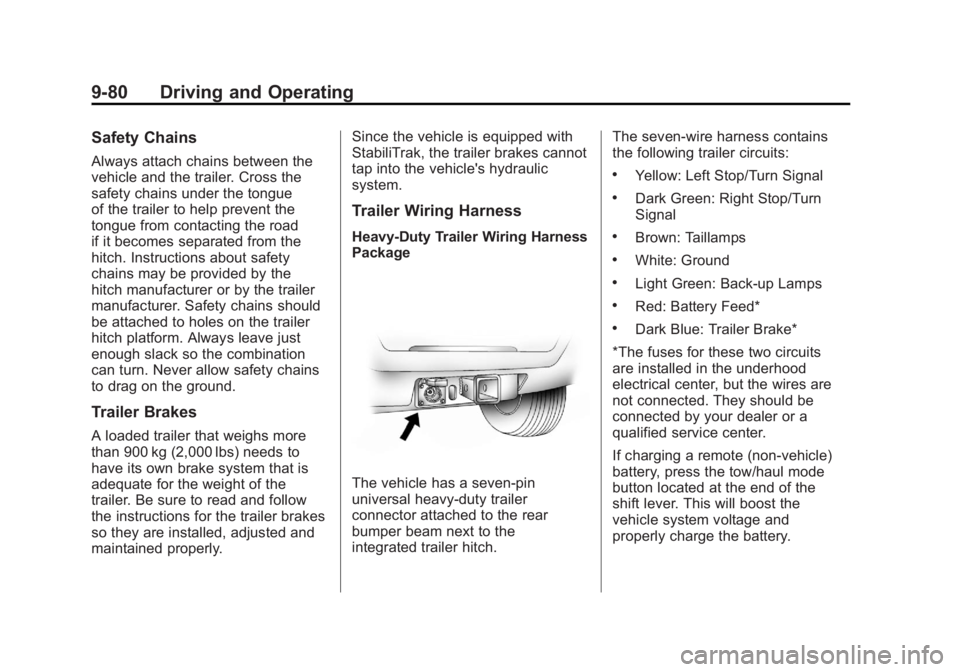
The vehicle has a seven-pin
universal heavy-duty trailer
connector attached to the rear
bumper beam next to the
integrated trailer hitch. The seven-wire harness contains
the following trailer circuits: .
Yellow: Left Stop/Turn Signal .
Dark Green: Right Stop/Turn
Signal .
Brown: Taillamps .
White: Ground .
Light Green: Back-up Lamps .
Red: Battery Feed* .
Dark Blue: Trailer Brake*
*The fuses for these two circuits
are installed in the underhood
electrical center, but the wires are
not connected. They should be
connected by your dealer or a
qualified service center.
If charging a remote (non-vehicle)
battery, press the tow/haul mode
button located at the end of the
shift lever. This will boost the
vehicle system voltage and
properly charge the battery.
Page 401 of 548
Black plate (81,1)Cadillac Escalade/Escalade ESV Owner Manual - 2011
Driving and Operating 9-81If the trailer is too light for tow/haul
mode, turn on the headlamps as a
second way to boost the vehicle
system and charge the battery.
Electric Brake Control Wiring
Provisions These wiring provisions are
included with the vehicle as part of
the trailer wiring package. These
provisions are for an electric brake
controller. The instrument panel
contains blunt cut wires near the
data link connector for the trailer
brake controller. The harness
contains the following wires: .
Dark Blue: Brake Signal to
Trailer Connector .
Red/Black: Battery .
Light Blue/White: Brake Switch .
White: Ground
It should be installed by your dealer
or a qualified service center. Tow/Haul Mode
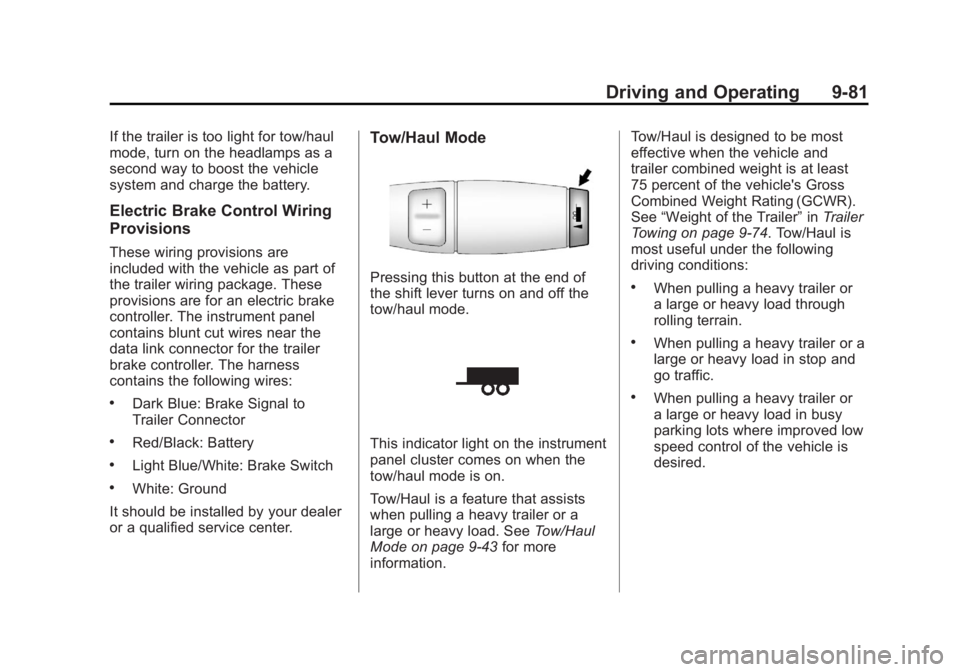
Pressing this button at the end of
the shift lever turns on and off the
tow/haul mode.
This indicator light on the instrument
panel cluster comes on when the
tow/haul mode is on.
Tow/Haul is a feature that assists
when pulling a heavy trailer or a
large or heavy load. See Tow/Haul
Mode on page 9 ‑ 43 for more
information. Tow/Haul is designed to be most
effective when the vehicle and
trailer combined weight is at least
75 percent of the vehicle's Gross
Combined Weight Rating (GCWR).
See “ Weight of the Trailer ” in Trailer
Towing on page 9 ‑ 74 . Tow/Haul is
most useful under the following
driving conditions: .
When pulling a heavy trailer or
a large or heavy load through
rolling terrain. .
When pulling a heavy trailer or a
large or heavy load in stop and
go traffic. .
When pulling a heavy trailer or
a large or heavy load in busy
parking lots where improved low
speed control of the vehicle is
desired.
Page 403 of 548

Black plate (1,1)Cadillac Escalade/Escalade ESV Owner Manual - 2011
Vehicle Care 10-1
Vehicle Care General Information General Information . . . . . . . . . . 10-2
California Proposition
65 Warning . . . . . . . . . . . . . . . . . 10-2
California Perchlorate
Materials Requirements . . . . 10-3
Accessories and
Modifications . . . . . . . . . . . . . . . 10-3
Vehicle Checks Doing Your Own
Service Work . . . . . . . . . . . . . . . 10-4
Hood . . . . . . . . . . . . . . . . . . . . . . . . 10-5
Engine Compartment
Overview . . . . . . . . . . . . . . . . . . . 10-6
Engine Oil . . . . . . . . . . . . . . . . . . . 10-7
Engine Oil Life System . . . . . 10-10
Automatic Transmission
Fluid . . . . . . . . . . . . . . . . . . . . . . 10-11
Engine Air Cleaner/Filter . . . . 10-14
Cooling System . . . . . . . . . . . . 10-16
Engine Coolant . . . . . . . . . . . . . 10-16
Engine Overheating . . . . . . . . 10-20
Overheated Engine
Protection
Operating Mode . . . . . . . . . . . 10-22 Engine Fan . . . . . . . . . . . . . . . . . 10-22
Power Steering Fluid . . . . . . . 10-23
Washer Fluid . . . . . . . . . . . . . . . 10-24
Brakes . . . . . . . . . . . . . . . . . . . . . 10-24
Brake Fluid . . . . . . . . . . . . . . . . . 10-26
Battery . . . . . . . . . . . . . . . . . . . . . 10-27
All-Wheel Drive . . . . . . . . . . . . . 10-28
Front Axle . . . . . . . . . . . . . . . . . . 10-29
Rear Axle . . . . . . . . . . . . . . . . . . 10-29
Starter Switch Check . . . . . . . 10-30
Automatic Transmission Shift
Lock Control Function
Check . . . . . . . . . . . . . . . . . . . . . 10-31
Ignition Transmission Lock
Check . . . . . . . . . . . . . . . . . . . . . 10-31
Park Brake and P (Park)
Mechanism Check . . . . . . . . 10-32
Wiper Blade
Replacement . . . . . . . . . . . . . . 10-32
Glass Replacement . . . . . . . . 10-33
Headlamp Aiming Headlamp Aiming . . . . . . . . . . 10-34
Bulb Replacement
Bulb Replacement . . . . . . . . . . 10-36
High Intensity Discharge
(HID) Lighting . . . . . . . . . . . . . 10-36
LED Lighting . . . . . . . . . . . . . . . 10-36 Back-Up Lamps . . . . . . . . . . . . 10-36
License Plate Lamp . . . . . . . . 10-37
Replacement Bulbs . . . . . . . . . 10-38
Electrical System Electrical System
Overload . . . . . . . . . . . . . . . . . . 10-38
Fuses and Circuit
Breakers . . . . . . . . . . . . . . . . . . 10-39
Engine Compartment Fuse
Block . . . . . . . . . . . . . . . . . . . . . 10-39
Instrument Panel Fuse
Block . . . . . . . . . . . . . . . . . . . . . 10-44
Wheels and Tires Tires . . . . . . . . . . . . . . . . . . . . . . . . 10-46
Tire Sidewall Labeling . . . . . . 10-48
Tire Designations . . . . . . . . . . . 10-49
Tire Terminology and
Definitions . . . . . . . . . . . . . . . . 10-49
Tire Pressure . . . . . . . . . . . . . . . 10-52
Tire Pressure for High-Speed
Operation . . . . . . . . . . . . . . . . . 10-54
Tire Pressure Monitor
System . . . . . . . . . . . . . . . . . . . 10-54
Tire Pressure Monitor
Operation . . . . . . . . . . . . . . . . . 10-56
Tire Inspection . . . . . . . . . . . . . . 10-58
Tire Rotation . . . . . . . . . . . . . . . 10-59
Page 427 of 548
Black plate (25,1)Cadillac Escalade/Escalade ESV Owner Manual - 2011
Vehicle Care 10-25
{ WARNINGThe brake wear warning sound
means that soon the brakes will
not work well. That could lead to
a crash. When the brake wear
warning sound is heard, have the
vehicle serviced.
Notice: Continuing to drive with
worn-out brake pads could result
in costly brake repair.
Some driving conditions or climates
can cause a brake squeal when
the brakes are first applied or
lightly applied. This does not mean
something is wrong with the brakes. Properly torqued wheel nuts are
necessary to help prevent brake
pulsation. When tires are rotated,
inspect brake pads for wear and
evenly tighten wheel nuts in
the proper sequence to torque
specifications in Capacities and
Specifications on page 12 ‑ 2 .
Brake linings should always be
replaced as complete axle sets.
Brake Pedal Travel See your dealer if the brake pedal
does not return to normal height,
or if there is a rapid increase in
pedal travel. This could be a
sign that brake service might be
required.
Brake Adjustment
Every time the brakes are applied,
with or without the vehicle moving,
the brakes adjust for wear. Replacing Brake System Parts The braking system on a vehicle is
complex. Its many parts have to be
of top quality and work well together
if the vehicle is to have really good
braking. The vehicle was designed
and tested with top-quality brake
parts. When parts of the braking
system are replaced, be sure to get
new, approved replacement parts.
If this is not done, the brakes might
not work properly. For example,
installing disc brake pads that are
wrong for the vehicle, can change
the balance between the front and
rear brakes — for the worse. The
braking performance expected can
change in many other ways if the
wrong replacement brake parts are
installed.
Page 428 of 548

Black plate (26,1)Cadillac Escalade/Escalade ESV Owner Manual - 2011
10-26 Vehicle Care
Brake Fluid
The brake master cylinder reservoir
is filled with DOT 3 brake fluid. See
Engine Compartment Overview on
page 10 ‑ 6 for the location of the
reservoir.
There are only two reasons why
the brake fluid level in the reservoir
might go down: .
The brake fluid level goes down
because of normal brake lining
wear. When new linings are
installed, the fluid level goes
back up. .
A fluid leak in the brake
hydraulic system can also cause
a low fluid level. Have the brake
hydraulic system fixed, since a
leak means that sooner or later
the brakes will not work well. Do not top off the brake fluid.
Adding fluid does not correct a leak.
If fluid is added when the linings
are worn, there will be too much
fluid when new brake linings are
installed. Add or remove brake fluid,
as necessary, only when work is
done on the brake hydraulic system.
{ WARNINGIf too much brake fluid is added, it
can spill on the engine and burn,
if the engine is hot enough. You
or others could be burned, and
the vehicle could be damaged.
Add brake fluid only when work
is done on the brake hydraulic
system. See “ Checking Brake
Fluid ” in this section.
When the brake fluid falls to a low
level, the brake warning light comes
on. See Brake System Warning
Light on page 5 ‑ 21 . Refer to the Maintenance Schedule
to determine when to check the
brake fluid. See Scheduled
Maintenance on page 11 ‑ 2 .
Checking Brake Fluid Check brake fluid by looking at the
brake fluid reservoir. See Engine
Compartment Overview on
page 10 ‑ 6 .
The fluid level should be above
MIN. If it is not, have the brake
hydraulic system checked to see if
there is a leak.
Page 444 of 548

Black plate (42,1)Cadillac Escalade/Escalade ESV Owner Manual - 2011
10-42 Vehicle Care Fuses Usage
32 Driver Side
High-Beam Headlamp
33 Daytime Running
Lamps 2 (If Equipped)
34 Sunroof
35 Key Ignition System,
Theft Deterrent
System
36 Windshield Wiper
37 SEO B2 Upfitter
Usage (Battery)
38 Electric Adjustable
Pedals
39 Climate Controls
(Battery)
40 Airbag System
(Ignition)
41 Amplifier
42 Audio System Fuses Usage
43 Miscellaneous
(Ignition), Cruise
Control
44 Liftgate Release
45 Airbag System
(Battery)
46 Instrument Panel
Cluster
47 Not Used
48 Auxiliary Climate
Control (Ignition)
49 Center High-Mounted
Stoplamp (CHMSL)
50 Rear Defogger
51 Heated Mirrors
52 SEO B1 Upfitter
Usage (Battery)
53 Cigarette Lighter,
Auxiliary Power Outlet Fuses Usage
54 Automatic Level
Control Compressor
Relay
55 Climate Controls
(Ignition)
56 Engine Control
Module, Secondary
Fuel Pump (Ignition)
J-Case
Fuses Usage
57 Cooling Fan 1
58 Automatic Level
Control Compressor
59 Heavy Duty Antilock
Braking System
60 Cooling Fan 2
61 Antilock Brake
System 1
Page 452 of 548

Black plate (50,1)Cadillac Escalade/Escalade ESV Owner Manual - 2011
10-50 Vehicle Care Accessory Weight :
The
combined weight of optional
accessories. Some examples
of optional accessories are
automatic transmission, power
steering, power brakes, power
windows, power seats, and air
conditioning.
Aspect Ratio :
The relationship
of a tire's height to its width.
Belt :
A rubber coated layer of
cords that is located between
the plies and the tread. Cords
may be made from steel or other
reinforcing materials.
Bead :
The tire bead contains
steel wires wrapped by steel
cords that hold the tire onto
the rim.
Bias Ply Tire :
A pneumatic tire
in which the plies are laid at
alternate angles less than
90 degrees to the centerline of
the tread. Cold Tire Pressure :
The
amount of air pressure in a tire,
measured in kPa (kilopascal)
or psi (pounds per square inch)
before a tire has built up heat
from driving. See Tire Pressure
on page 10 ‑ 52 .
Curb Weight :
The weight of a
motor vehicle with standard and
optional equipment including
the maximum capacity of fuel,
oil, and coolant, but without
passengers and cargo.
DOT Markings :
A code
molded into the sidewall of
a tire signifying that the tire
is in compliance with the U.S.
Department of Transportation
(DOT) Motor Vehicle Safety
Standards. The DOT code
includes the Tire Identification
Number (TIN), an alphanumeric
designator which can also identify the tire manufacturer,
production plant, brand, and
date of production.
GVWR :
Gross Vehicle Weight
Rating. See Vehicle Load Limits
on page 9 ‑ 24 .
GAWR FRT :
Gross Axle Weight
Rating for the front axle. See
Vehicle Load Limits on
page 9 ‑ 24 .
GAWR RR :
Gross Axle Weight
Rating for the rear axle. See
Vehicle Load Limits on
page 9 ‑ 24 .
Intended Outboard Sidewall :
The side of an asymmetrical tire,
that must always face outward
when mounted on a vehicle.
Kilopascal (kPa) :
The metric
unit for air pressure.
Light Truck (LT ‐ Metric) Tire :
A
tire used on light duty trucks and
some multipurpose passenger
vehicles.
Page 460 of 548

Black plate (58,1)Cadillac Escalade/Escalade ESV Owner Manual - 2011
10-58 Vehicle Care The malfunction light and the DIC
message should go off at the next
ignition cycle. The sensors are
matched to the tire/wheel positions,
using a TPMS relearn tool, in the
following order: driver side front tire,
passenger side front tire, passenger
side rear tire, and driver side rear.
See your dealer for service or to
purchase a relearn tool.
There are two minutes to match
the first tire/wheel position, and
five minutes overall to match all
four tire/wheel positions. If it takes
longer, the matching process stops
and must be restarted.
The TPMS sensor matching process
is outlined below:
1. Set the parking brake.
2. Turn the ignition to ON/RUN with
the engine off. 3. Press
Q and
K on the
Remote Keyless Entry (RKE)
transmitter at the same time for
approximately five seconds. The
horn sounds twice to signal the
receiver is in relearn mode and
TIRE LEARNING ACTIVE
message displays on the DIC
screen.
4. Start with the driver side
front tire.
5. Place the relearn tool against
the tire sidewall, near the valve
stem. Then press the button
to activate the TPMS sensor.
A horn chirp confirms that the
sensor identification code has
been matched to this tire and
wheel position.
6. Proceed to the passenger
side front tire, and repeat the
procedure in Step 5.
7. Proceed to the passenger
side rear tire, and repeat the
procedure in Step 5. 8. Proceed to the driver side rear
tire, and repeat the procedure
in Step 5. The horn sounds
two times to indicate the sensor
identification code has been
matched to the driver side rear
tire, and the TPMS sensor
matching process is no longer
active. The TIRE LEARNING
ACTIVE message on the DIC
display screen goes off.
9. Turn the ignition to LOCK/OFF.
10. Set all four tires to the
recommended air pressure
level as indicated on the Tire
and Loading Information label.
Tire Inspection GM recommends that the tires,
including the spare tire, if the
vehicle has one, be inspected
for signs of wear or damage at
least once a month.
Page 463 of 548
Black plate (61,1)Cadillac Escalade/Escalade ESV Owner Manual - 2011
Vehicle Care 10-61loading conditions, and inflation
pressure maintenance. Tires will
typically need to be replaced due to
wear before they may need to be
replaced due to age. Consult the tire
manufacturer for more information
on when tires should be replaced.
Vehicle Storage Tires age when stored normally
mounted on a parked vehicle. Park
a vehicle that will be stored for at
least a month in a cool, dry, clean
area away from direct sunlight to
slow aging. This area should be
free of grease, gasoline or other
substances that can deteriorate
rubber.
Parking for an extended period can
cause flat spots on the tires that
may result in vibrations while
driving. When storing a vehicle for
at least a month, remove the tires
or raise the vehicle to reduce the
weight from the tires. Buying New Tires GM has developed and matched
specific tires for the vehicle. The
original equipment tires installed
on the vehicle, when it was new,
were designed to meet General
Motors Tire Performance Criteria
Specification (TPC Spec) system
rating. If you need replacement
tires, GM strongly recommends that
you get tires with the same TPC
Spec rating. This way, the vehicle
will continue to have tires that
are designed to give the same
performance and vehicle safety,
during normal use, as the original
tires.
GM's exclusive TPC Spec system
considers over a dozen critical
specifications that impact the
overall performance of the
vehicle, including brake system
performance, ride and handling,
traction control, and tire pressure
monitoring performance. GM's TPC
Spec number is molded onto the
tire's sidewall near the tire size. If the tires have an all ‐ season
tread design, the TPC spec number
will be followed by an MS for mud
and snow. See Tire Sidewall
Labeling on page 10 ‑ 48 for
additional information.
GM recommends replacing tires in
sets of four. This is because uniform
tread depth on all tires will help
keep the vehicle performing most
like it did when the tires were new.
Replacing less than a full set of tires
can affect the braking and handling
performance of the vehicle. See
Tire Inspection on page 10 ‑ 58 and
Tire Rotation on page 10 ‑ 59 for
information on proper tire rotation.
{ WARNING
Tires could explode during
improper service. Attempting to
mount or dismount a tire could
cause injury or death. Only your
dealer or authorized tire service
center should mount or dismount
the tires.