turn CADILLAC ESCALADE EXT 2004 2.G Owners Manual
[x] Cancel search | Manufacturer: CADILLAC, Model Year: 2004, Model line: ESCALADE EXT, Model: CADILLAC ESCALADE EXT 2004 2.GPages: 478, PDF Size: 3.43 MB
Page 9 of 478
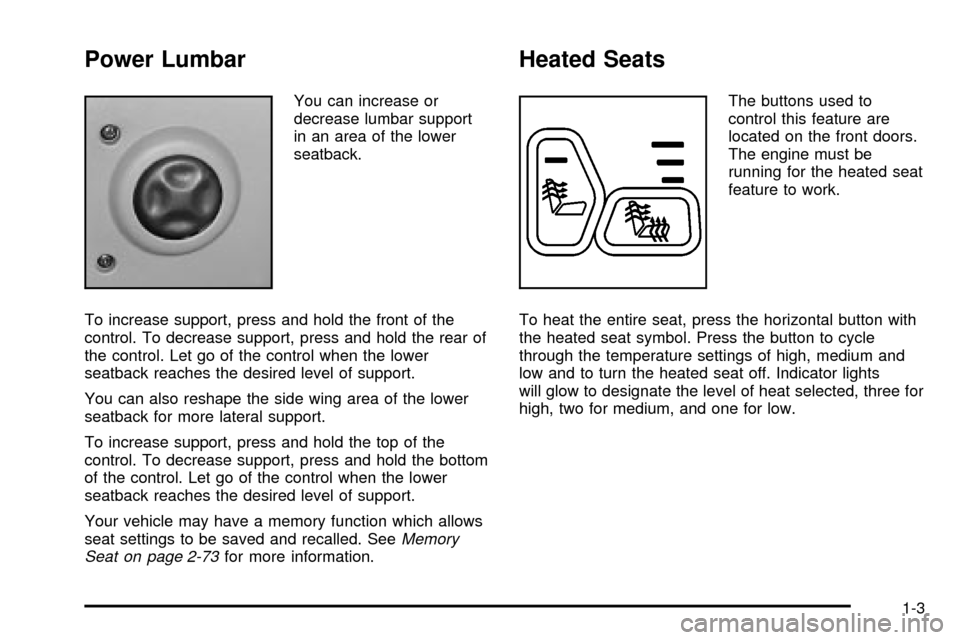
Power Lumbar
You can increase or
decrease lumbar support
in an area of the lower
seatback.
To increase support, press and hold the front of the
control. To decrease support, press and hold the rear of
the control. Let go of the control when the lower
seatback reaches the desired level of support.
You can also reshape the side wing area of the lower
seatback for more lateral support.
To increase support, press and hold the top of the
control. To decrease support, press and hold the bottom
of the control. Let go of the control when the lower
seatback reaches the desired level of support.
Your vehicle may have a memory function which allows
seat settings to be saved and recalled. See
Memory
Seat on page 2-73for more information.
Heated Seats
The buttons used to
control this feature are
located on the front doors.
The engine must be
running for the heated seat
feature to work.
To heat the entire seat, press the horizontal button with
the heated seat symbol. Press the button to cycle
through the temperature settings of high, medium and
low and to turn the heated seat off. Indicator lights
will glow to designate the level of heat selected, three for
high, two for medium, and one for low.
1-3
Page 10 of 478
The low setting warms the seatback and cushion until
the seat temperature is near body temperature. The
medium and high settings heat the seatback and seat
cushion to a slightly higher temperature. You will be able
to feel heat in about two minutes.
To heat only the seatback, press the vertical button with
the heated seatback symbol. An indicator light on the
seatback button will glow to designate that only the
seatback is being heated. Additional presses of
the seatback button will cycle through the heat levels for
the seatback only. Press the horizontal button again
to heat the whole seat.
The heated front seats will shut off automatically when
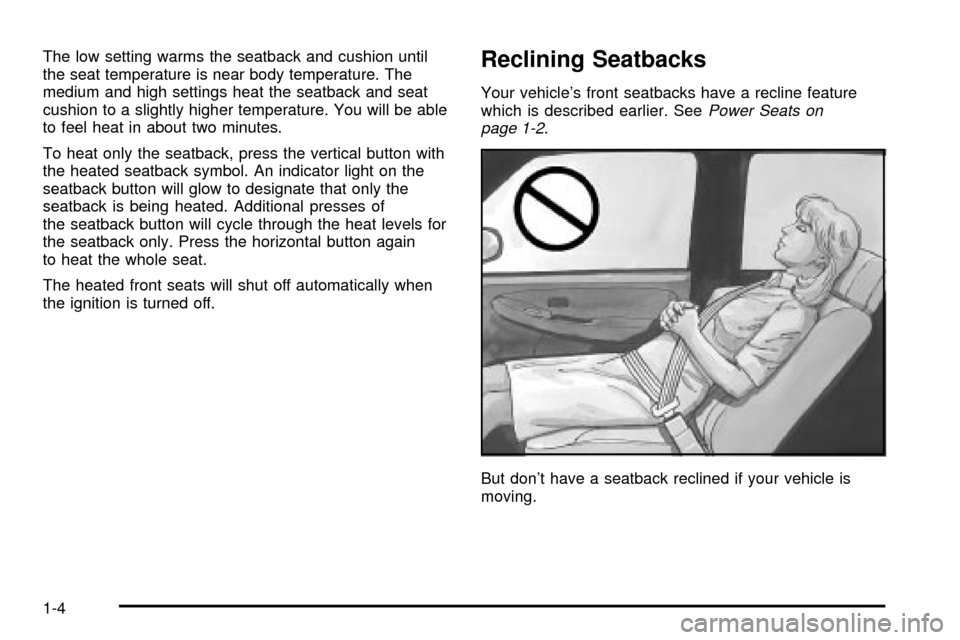
the ignition is turned off.Reclining Seatbacks
Your vehicle's front seatbacks have a recline feature
which is described earlier. SeePower Seats on
page 1-2.
But don't have a seatback reclined if your vehicle is
moving.
1-4
Page 13 of 478
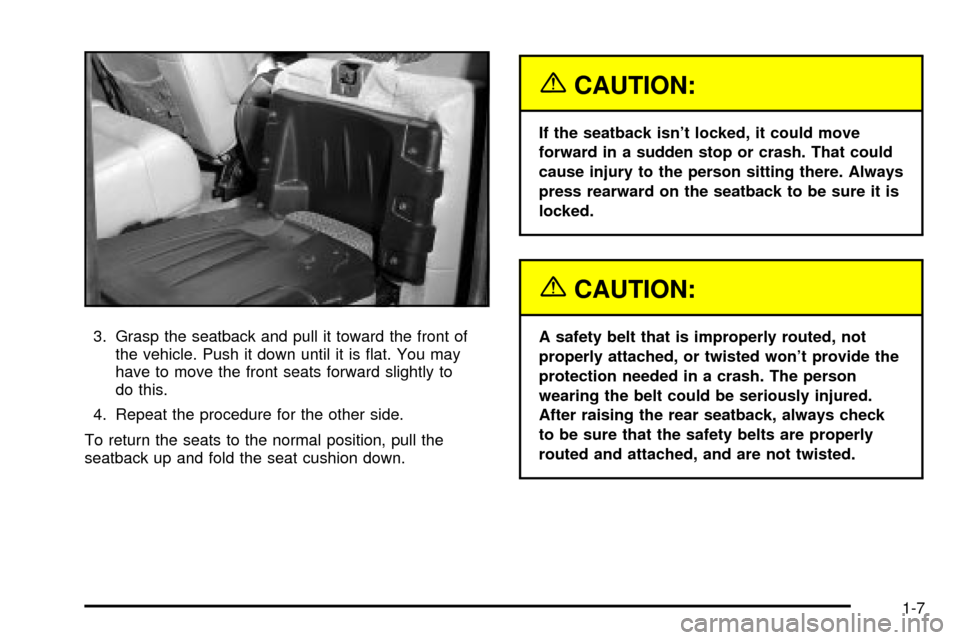
3. Grasp the seatback and pull it toward the front of
the vehicle. Push it down until it is ¯at. You may
have to move the front seats forward slightly to
do this.
4. Repeat the procedure for the other side.
To return the seats to the normal position, pull the
seatback up and fold the seat cushion down.
{CAUTION:
If the seatback isn't locked, it could move
forward in a sudden stop or crash. That could
cause injury to the person sitting there. Always
press rearward on the seatback to be sure it is
locked.
{CAUTION:
A safety belt that is improperly routed, not
properly attached, or twisted won't provide the
protection needed in a crash. The person
wearing the belt could be seriously injured.
After raising the rear seatback, always check
to be sure that the safety belts are properly
routed and attached, and are not twisted.
1-7
Page 28 of 478

The best way to protect the fetus is to protect the
mother. When a safety belt is worn properly, it's more
likely that the fetus won't be hurt in a crash. For
pregnant women, as for anyone, the key to making
safety belts effective is wearing them properly.
Right Front Passenger Position
To learn how to wear the right front passenger's safety
belt properly, seeDriver Position on page 1-14.
The right front passenger's safety belt works the same
way as the driver's safety belt Ð except for one
thing. If you ever pull the shoulder portion of the belt out
all the way, you will engage the child restraint locking
feature which may turn off the passenger's frontal
air bag. If this happens unintentionally, just let the belt
go back all the way and start again.
Rear Seat Passengers
It is very important for rear seat passengers to buckle
up! Accident statistics show that unbelted people in
the rear seat are hurt more often in crashes than those
who are wearing safety belts.
Rear passengers who are not safety belted can be
thrown out of the vehicle in a crash. And they can strike
others in the vehicle who are wearing safety belts.
1-22
Page 43 of 478
Where to Put the Restraint
Accident statistics show that children are safer if they
are restrained in the rear rather than the front seat.
General Motors recommends that child restraints
be secured in a rear seat, including an infant riding in a
rear-facing infant seat, a child riding in a forward-facing
child seat and an older child riding in a booster seat.
Your vehicle has a rear seat that will accommodate
a rear-facing child restraint. A label on your sun visor
says, ªNever put a rear-facing child seat in the
front.º This is because the risk to the rear-facing child is
so great, if the air bag deploys.
{CAUTION:
A child in a rear-facing child restraint can be
seriously injured or killed if the right front
passenger's air bag in¯ates. This is because
the back of the rear-facing child restraint
would be very close to the in¯ating air bag.
CAUTION: (Continued)
CAUTION: (Continued)
Even though the passenger sensing system is
designed to turn off the passenger's frontal air
bag if the system detects a rear-facing child
restraint, no system is fail-safe, and no one
can guarantee that an air bag will not deploy
under some unusual circumstance, even
though it is turned off. General Motors
recommends that rear-facing child restraints
be secured in the rear seat, even if the air bag
is off.
If you secure a forward-facing child restraint
in the right front seat, always move the front
passenger seat as far back as it will go. It is
better to secure the child restraint in a
rear seat.
Wherever you install it, be sure to secure the child
restraint properly.
Keep in mind that an unsecured child restraint can
move around in a collision or sudden stop and injure
people in the vehicle. Be sure to properly secure
any child restraint in your vehicle ± even when no child
is in it.
1-37
Page 50 of 478
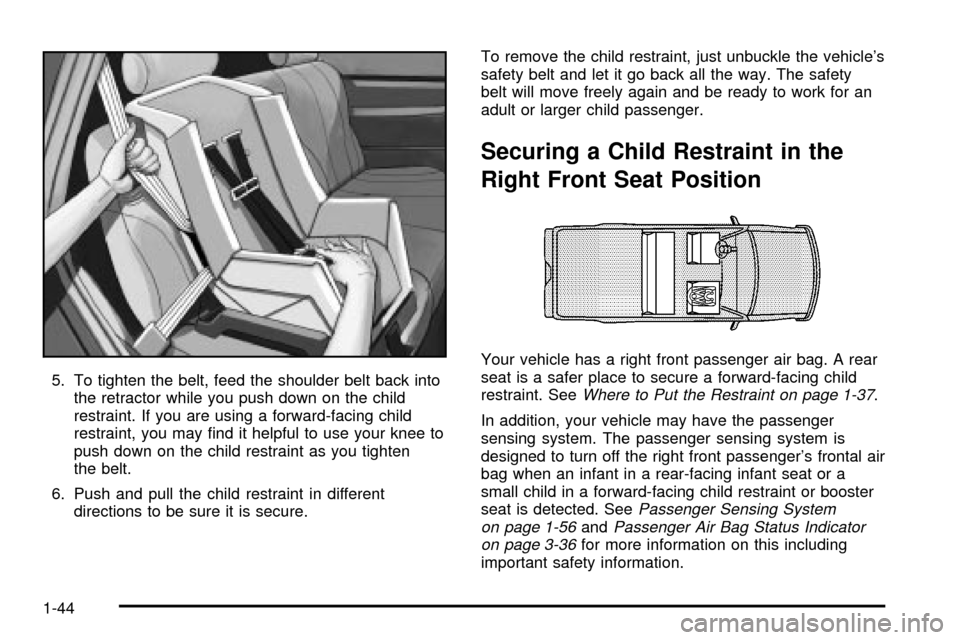
5. To tighten the belt, feed the shoulder belt back into
the retractor while you push down on the child
restraint. If you are using a forward-facing child
restraint, you may ®nd it helpful to use your knee to
push down on the child restraint as you tighten
the belt.
6. Push and pull the child restraint in different
directions to be sure it is secure.To remove the child restraint, just unbuckle the vehicle's
safety belt and let it go back all the way. The safety
belt will move freely again and be ready to work for an
adult or larger child passenger.
Securing a Child Restraint in the
Right Front Seat Position
Your vehicle has a right front passenger air bag. A rear
seat is a safer place to secure a forward-facing child
restraint. See
Where to Put the Restraint on page 1-37.
In addition, your vehicle may have the passenger
sensing system. The passenger sensing system is
designed to turn off the right front passenger's frontal air
bag when an infant in a rear-facing infant seat or a
small child in a forward-facing child restraint or booster
seat is detected. See
Passenger Sensing System
on page 1-56andPassenger Air Bag Status Indicator
on page 3-36for more information on this including
important safety information.
1-44
Page 51 of 478
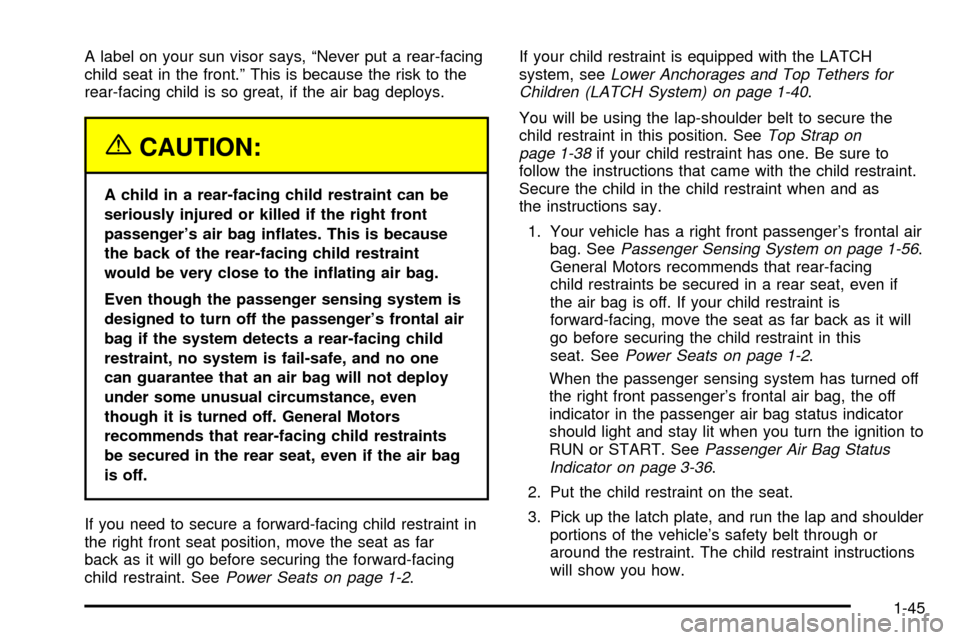
A label on your sun visor says, ªNever put a rear-facing
child seat in the front.º This is because the risk to the
rear-facing child is so great, if the air bag deploys.
{CAUTION:
A child in a rear-facing child restraint can be
seriously injured or killed if the right front
passenger's air bag in¯ates. This is because
the back of the rear-facing child restraint
would be very close to the in¯ating air bag.
Even though the passenger sensing system is
designed to turn off the passenger's frontal air
bag if the system detects a rear-facing child
restraint, no system is fail-safe, and no one
can guarantee that an air bag will not deploy
under some unusual circumstance, even
though it is turned off. General Motors
recommends that rear-facing child restraints
be secured in the rear seat, even if the air bag
is off.
If you need to secure a forward-facing child restraint in
the right front seat position, move the seat as far
back as it will go before securing the forward-facing
child restraint. See
Power Seats on page 1-2.If your child restraint is equipped with the LATCH
system, see
Lower Anchorages and Top Tethers for
Children (LATCH System) on page 1-40.
You will be using the lap-shoulder belt to secure the
child restraint in this position. See
Top Strap on
page 1-38if your child restraint has one. Be sure to
follow the instructions that came with the child restraint.
Secure the child in the child restraint when and as
the instructions say.
1. Your vehicle has a right front passenger's frontal air
bag. See
Passenger Sensing System on page 1-56.
General Motors recommends that rear-facing
child restraints be secured in a rear seat, even if
the air bag is off. If your child restraint is
forward-facing, move the seat as far back as it will
go before securing the child restraint in this
seat. See
Power Seats on page 1-2.
When the passenger sensing system has turned off
the right front passenger's frontal air bag, the off
indicator in the passenger air bag status indicator
should light and stay lit when you turn the ignition to
RUN or START. See
Passenger Air Bag Status
Indicator on page 3-36.
2. Put the child restraint on the seat.
3. Pick up the latch plate, and run the lap and shoulder
portions of the vehicle's safety belt through or
around the restraint. The child restraint instructions
will show you how.
1-45
Page 53 of 478
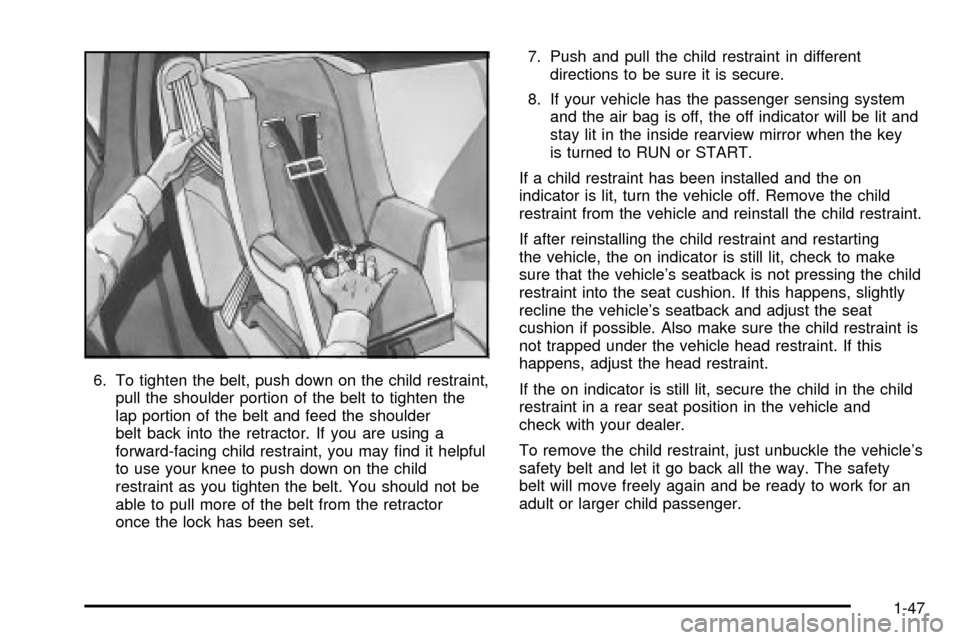
6. To tighten the belt, push down on the child restraint,
pull the shoulder portion of the belt to tighten the
lap portion of the belt and feed the shoulder
belt back into the retractor. If you are using a
forward-facing child restraint, you may ®nd it helpful
to use your knee to push down on the child
restraint as you tighten the belt. You should not be
able to pull more of the belt from the retractor
once the lock has been set.7. Push and pull the child restraint in different
directions to be sure it is secure.
8. If your vehicle has the passenger sensing system
and the air bag is off, the off indicator will be lit and
stay lit in the inside rearview mirror when the key
is turned to RUN or START.
If a child restraint has been installed and the on
indicator is lit, turn the vehicle off. Remove the child
restraint from the vehicle and reinstall the child restraint.
If after reinstalling the child restraint and restarting
the vehicle, the on indicator is still lit, check to make
sure that the vehicle's seatback is not pressing the child
restraint into the seat cushion. If this happens, slightly
recline the vehicle's seatback and adjust the seat
cushion if possible. Also make sure the child restraint is
not trapped under the vehicle head restraint. If this
happens, adjust the head restraint.
If the on indicator is still lit, secure the child in the child
restraint in a rear seat position in the vehicle and
check with your dealer.
To remove the child restraint, just unbuckle the vehicle's
safety belt and let it go back all the way. The safety
belt will move freely again and be ready to work for an
adult or larger child passenger.
1-47
Page 62 of 478
Passenger Sensing System
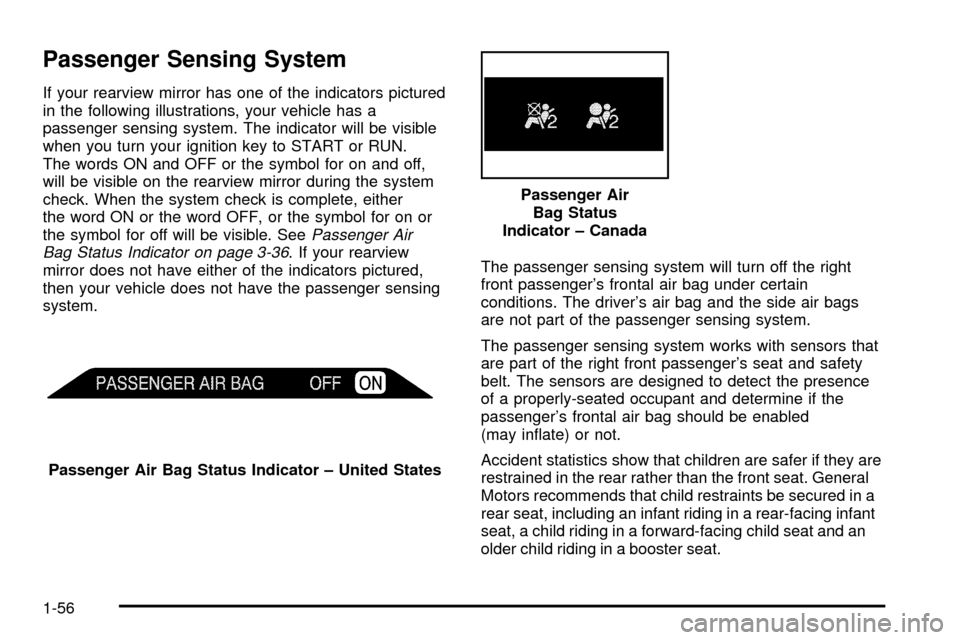
If your rearview mirror has one of the indicators pictured
in the following illustrations, your vehicle has a
passenger sensing system. The indicator will be visible
when you turn your ignition key to START or RUN.
The words ON and OFF or the symbol for on and off,
will be visible on the rearview mirror during the system
check. When the system check is complete, either
the word ON or the word OFF, or the symbol for on or
the symbol for off will be visible. See
Passenger Air
Bag Status Indicator on page 3-36. If your rearview
mirror does not have either of the indicators pictured,
then your vehicle does not have the passenger sensing
system.The passenger sensing system will turn off the right
front passenger's frontal air bag under certain
conditions. The driver's air bag and the side air bags
are not part of the passenger sensing system.
The passenger sensing system works with sensors that
are part of the right front passenger's seat and safety
belt. The sensors are designed to detect the presence
of a properly-seated occupant and determine if the
passenger's frontal air bag should be enabled
(may in¯ate) or not.
Accident statistics show that children are safer if they are
restrained in the rear rather than the front seat. General
Motors recommends that child restraints be secured in a
rear seat, including an infant riding in a rear-facing infant
seat, a child riding in a forward-facing child seat and an
older child riding in a booster seat. Passenger Air Bag Status Indicator ± United States
Passenger Air
Bag Status
Indicator ± Canada
1-56
Page 63 of 478
Your vehicle has a rear seat that will accommodate a
rear-facing child restraint. A label on your sun visor says,
ªNever put a rear-facing child seat in the front.º This
is because the risk to the rear-facing child is so great, if
the air bag deploys.
{CAUTION:
A child in a rear-facing child restraint can be
seriously injured or killed if the right front
passenger's air bag in¯ates. This is because
the back of the rear-facing child restraint
would be very close to the in¯ating air bag.
Even though the passenger sensing system is
designed to turn off the passenger's frontal air
bag if the system detects a rear-facing child
restraint, no system is fail-safe, and no one
can guarantee that an air bag will not deploy
under some unusual circumstance, even
though it is turned off. General Motors
recommends that rear-facing child restraints
be secured in the rear seat, even if the air bag
is off.The passenger sensing system is designed to turn off
the right front passenger's frontal air bag if:
·the right front passenger seat is unoccupied
·the system determines that an infant is present in a
rear-facing infant seat
·the system determines that a small child is present
in a forward-facing child restraint
·the system determines that a small child is present
in a booster seat
·a right front passenger takes his/her weight off of
the seat for a period of time
·the right front passenger seat is occupied by a
smaller person, such as a child who has outgrown
child restraints
·or if there is a critical problem with the air bag
system or the passenger sensing system.
When the passenger sensing system has turned off the
passenger's frontal air bag, the off indicator will light
and stay lit to remind you that the air bag is off.
If a child restraint has been installed and the on indicator
is lit, turn the vehicle off. Remove the child restraint
from the vehicle and reinstall the child restraint following
the child restraint manufacturer's directions and refer
to
Securing a Child Restraint in the Right Front
Seat Position on page 1-44.
1-57