warning CADILLAC ESCALADE HYBRID 2011 Owner's Manual
[x] Cancel search | Manufacturer: CADILLAC, Model Year: 2011, Model line: ESCALADE HYBRID, Model: CADILLAC ESCALADE HYBRID 2011Pages: 94, PDF Size: 1.83 MB
Page 68 of 94
Black plate (24,1)Cadillac Escalade Hybrid - 2011
10-24 Vehicle Care After repairing a tire with the tire
inflator kit, take your vehicle to an
authorized dealer to have the tire
inspected and repaired as soon as
possible. The tire sealant is a
temporary repair only. See Tire
Sealant and Compressor Kit on
page 10 ‑ 24 .
Tire Sealant and
Compressor Kit
{ WARNINGIdling a vehicle in an enclosed
area with poor ventilation is
dangerous. Engine exhaust may
enter the vehicle. Engine exhaust
contains Carbon Monoxide (CO)
which cannot be seen or smelled.
It can cause unconsciousness
and even death. Never run the
engine in an enclosed area that
has no fresh air ventilation. For
more information, see ” Engine
Exhaust ” in the owner manual. { WARNINGOver-inflating a tire could cause
the tire to rupture and you or
others could be injured. Be sure
to read and follow the tire sealant
and compressor kit instructions
and inflate the tire to its
recommended pressure. Do not
exceed the recommended
pressure.
{ WARNINGStoring the tire sealant and
compressor kit or other
equipment in the passenger
compartment of the vehicle could
cause injury. In a sudden stop or
collision, loose equipment could
strike someone. Store the tire
sealant and compressor kit in its
original location. If this vehicle has a tire sealant and
compressor kit, there may not be a
spare tire, tire changing equipment,
and on some vehicles there may not
be a place to store a tire.
The tire sealant and compressor
can be used to temporarily seal
punctures up to 6 mm (¼ inch) in
the tread area of the tire. It can also
be used to inflate an under
inflated tire.
If the tire has been separated from
the wheel, has damaged sidewalls,
or has a large puncture, the tire is
too severely damaged for the tire
sealant and compressor kit to be
effective. See “ Roadside Assistance
Program ” in the owner manual.
Read and follow all of the tire
sealant and compressor kit
instructions.
Page 70 of 94
Black plate (26,1)Cadillac Escalade Hybrid - 2011
10-26 Vehicle Care If a tire goes flat, avoid further tire
and wheel damage by driving slowly
to a level place. Turn on the hazard
warning flashers.
See If a Tire Goes Flat on
page 10 ‑ 23 for other important
safety warnings.
Do not remove any objects that
have penetrated the tire.
1. Remove the tire sealant and
compressor kit from its storage
location. See Storing the Tire
Sealant and Compressor Kit on
page 10 ‑ 31 .
Make sure the on/off button (D)
is in the off (O) position.
2. Unwrap the sealant/air hose (G)
and the power plug (C).
3. Place the kit on the ground.
Make sure the tire valve stem is
positioned close to the ground
so the hose will reach it.
4. Remove the valve stem cap from
the flat tire by turning it
counterclockwise. 5. Attach the sealant/air hose (G)
onto the tire valve stem. Turn it
clockwise until it is tight.
6. Plug the power plug (C) into the
accessory power outlet in the
vehicle. Unplug all items from
other accessory power outlets.
See “ Power Outlets ” in the
owner manual.
If the vehicle has an accessory
power outlet, do not use the
cigarette lighter.
If the vehicle only has a cigarette
lighter, use the cigarette lighter.
Do not pinch the power plug
cord in the door or window.
7. Start the vehicle. The vehicle
must be running while using the
air compressor.
8. Press the on/off (D) button to
turn the tire sealant and
compressor kit on.
The compressor will inject
sealant and air into the tire. The pressure gauge (E) will
initially show a high pressure
while the compressor pushes the
sealant into the tire. Once the
sealant is completely dispersed
into the tire, the pressure will
quickly drop and start to rise
again as the tire inflates with
air only.
9. Inflate the tire to the
recommended inflation pressure
using the pressure gauge (E).
The recommended inflation
pressure can be found on the
Tire and Loading Information
label. See Tire Pressure on
page 10 ‑ 17 .
The pressure gauge (E) may
read higher than the actual tire
pressure while the compressor is
on. Turn the compressor off to
get an accurate pressure
reading. The compressor may
be turned on/off until the correct
pressure is reached.
Page 72 of 94
Black plate (28,1)Cadillac Escalade Hybrid - 2011
10-28 Vehicle Care If the tire pressure has not
dropped more than 68 kPa
(10 psi) from the recommended
inflation pressure, inflate the
tire to the recommended
inflation pressure.
19. Wipe off any sealant from the
wheel, tire or vehicle.
20. Dispose of the used sealant
canister (B) and sealant/air
hose (G) assembly at a local
dealer or in accordance with
local state codes and practices.
21. Replace it with a new canister
available from your dealer.
22. After temporarily sealing a tire
using the tire sealant and
compressor kit, take the
vehicle to an authorized dealer
within a 161 km (100 miles) of
driving to have the tire repaired
or replaced. Using the Tire Sealant and
Compressor Kit without
Sealant to Inflate a Tire (Not
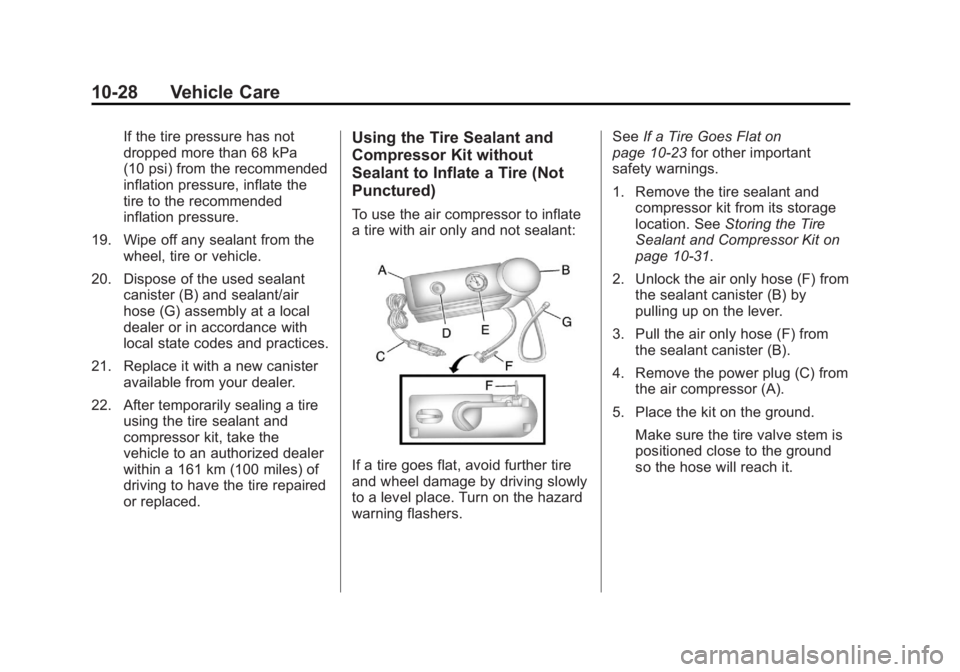
Punctured) To use the air compressor to inflate
a tire with air only and not sealant:
If a tire goes flat, avoid further tire
and wheel damage by driving slowly
to a level place. Turn on the hazard
warning flashers. See If a Tire Goes Flat on
page 10 ‑ 23 for other important
safety warnings.
1. Remove the tire sealant and
compressor kit from its storage
location. See Storing the Tire
Sealant and Compressor Kit on
page 10 ‑ 31 .
2. Unlock the air only hose (F) from
the sealant canister (B) by
pulling up on the lever.
3. Pull the air only hose (F) from
the sealant canister (B).
4. Remove the power plug (C) from
the air compressor (A).
5. Place the kit on the ground.
Make sure the tire valve stem is
positioned close to the ground
so the hose will reach it.
Page 75 of 94
Black plate (31,1)Cadillac Escalade Hybrid - 2011
Vehicle Care 10-31
Storing the Tire Sealant
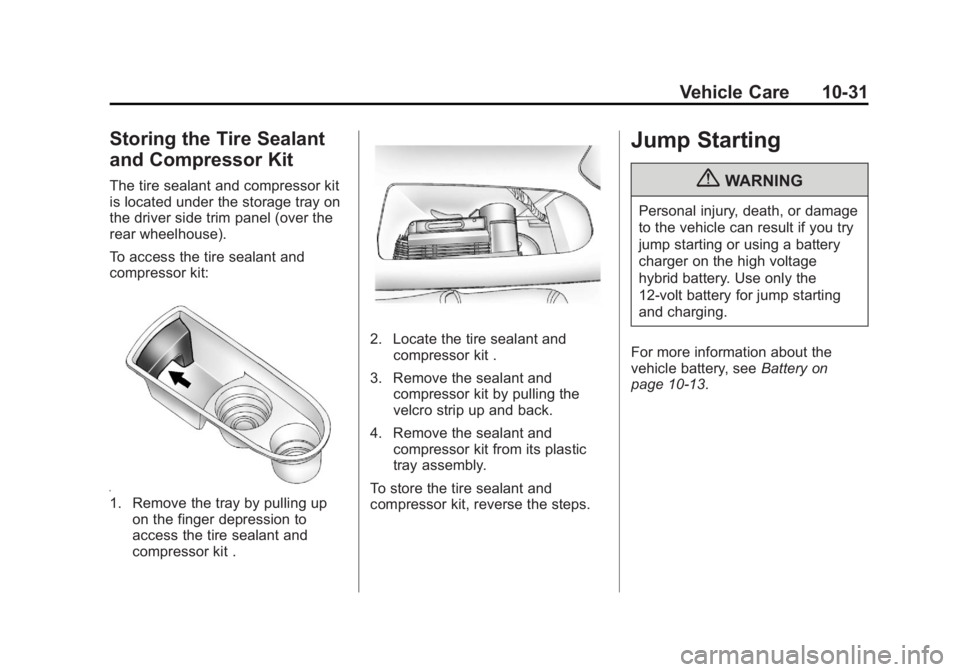
and Compressor Kit The tire sealant and compressor kit
is located under the storage tray on
the driver side trim panel (over the
rear wheelhouse).
To access the tire sealant and
compressor kit:
1. Remove the tray by pulling up
on the finger depression to
access the tire sealant and
compressor kit . 2. Locate the tire sealant and
compressor kit .
3. Remove the sealant and
compressor kit by pulling the
velcro strip up and back.
4. Remove the sealant and
compressor kit from its plastic
tray assembly.
To store the tire sealant and
compressor kit, reverse the steps. Jump Starting
{ WARNINGPersonal injury, death, or damage
to the vehicle can result if you try
jump starting or using a battery
charger on the high voltage
hybrid battery. Use only the
12-volt battery for jump starting
and charging.
For more information about the
vehicle battery, see Battery on
page 10 ‑ 13 .
Page 76 of 94
Black plate (32,1)Cadillac Escalade Hybrid - 2011
10-32 Vehicle Care If the vehicle's 12 ‐ volt battery has
run down, you may want to use
another vehicle and some jumper
cables to start your vehicle. Use the
following steps to do it safely.
{ WARNINGBatteries can hurt you. They can
be dangerous because: .
They contain acid that can
burn you. .
They contain gas that can
explode or ignite. .
They contain enough
electricity to burn you.
If you do not follow these steps
exactly, some or all of these
things can hurt you. Notice: Ignoring these steps
could result in costly damage to
the vehicle that would not be
covered by the warranty.
Trying to start the vehicle by
pushing or pulling it will not
work, and it could damage the
vehicle.
1. Check the other vehicle. It must
have a 12 ‐ volt battery with a
negative ground system.
Notice: Only use vehicles with
12-volt systems with negative
grounds to jump start your
vehicle. If the other vehicle's
system is not a 12-volt system
with a negative ground, both
vehicles can be damaged. 2. Get the vehicles close enough
so the jumper cables can reach,
but be sure the vehicles are not
touching each other. It could
cause a ground connection you
do not want. You would not be
able to start your vehicle, and
the bad grounding could damage
the electrical systems.
To avoid the possibility of the
vehicles rolling, set the parking
brake firmly on both vehicles
involved in the jump start
procedure. Put the automatic
transmission in P (Park) or a
manual transmission in
N (Neutral) before setting the
parking brake. If you have a
four-wheel-drive vehicle, be sure
the transfer case is in a drive
gear, not in N (Neutral).
Page 77 of 94
Black plate (33,1)Cadillac Escalade Hybrid - 2011
Vehicle Care 10-33Notice: If you leave the radio or
other accessories on during the
jump starting procedure, they
could be damaged. The repairs
would not be covered by the
warranty. Always turn off the
radio and other accessories when
jump starting the vehicle.
3. Turn off the ignition on both
vehicles. Unplug unnecessary
accessories plugged into the
cigarette lighter or the accessory
power outlets. Turn off the radio
and all the lamps that are not
needed.
This avoids sparks and helps
save both batteries. It could
save the radio!
4. Open the hood on the other
vehicle and locate the
positive (+) and negative ( − )
terminal locations on that
vehicle.
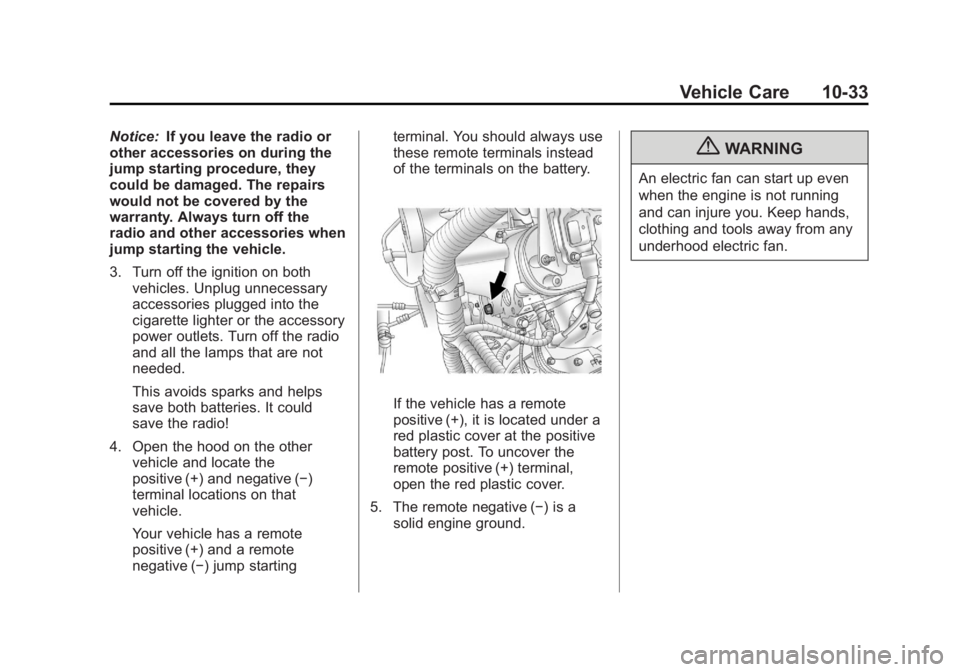
Your vehicle has a remote
positive (+) and a remote
negative ( − ) jump starting terminal. You should always use
these remote terminals instead
of the terminals on the battery.
If the vehicle has a remote
positive (+), it is located under a
red plastic cover at the positive
battery post. To uncover the
remote positive (+) terminal,
open the red plastic cover.
5. The remote negative ( − ) is a
solid engine ground.{ WARNINGAn electric fan can start up even
when the engine is not running
and can injure you. Keep hands,
clothing and tools away from any
underhood electric fan.
Page 78 of 94
Black plate (34,1)Cadillac Escalade Hybrid - 2011
10-34 Vehicle Care
{ WARNINGUsing an open flame near a
battery can cause battery gas to
explode. People have been hurt
doing this, and some have been
blinded. Use a flashlight if you
need more light.
Be sure the battery has enough
water. You do not need to add
water to the battery installed in
your new vehicle. But if a battery
has filler caps, be sure the right
amount of fluid is there. If it is low,
add water to take care of that
first. If you do not, explosive gas
could be present.
Battery fluid contains acid that
can burn you. Do not get it on
you. If you accidentally get it in
your eyes or on your skin, flush
the place with water and get
medical help immediately. { WARNINGFans or other moving engine
parts can injure you badly. Keep
your hands away from moving
parts once the engine is running.
6. Check that the jumper cables do
not have loose or missing
insulation. If they do, you could
get a shock. The vehicles could
be damaged too.
Before you connect the cables,
here are some basic things you
should know. Positive (+) goes to
positive (+) or to a remote
positive (+) terminal if the vehicle
has one. Negative ( − ) will go to a
heavy, unpainted metal engine
part or a solid engine ground.
Do not connect positive (+) to
negative ( − ) or you will get a
short that would damage the
battery and maybe other parts
too. Do not connect the
negative ( − ) cable to the negative ( − ) terminal on the dead
battery because this can cause
sparks.
7. Connect the red positive (+)
cable to the positive (+) terminal
of the vehicle with the dead
battery. Use a remote
positive (+) if the vehicle
has one.
8. Do not let the other end touch
metal. Connect it to the
positive (+) terminal of the good
battery. Use a remote
positive (+) if the vehicle
has one.
9. Now connect the black
negative ( − ) cable to the
negative ( − ) terminal of the good
battery. Use a remote
negative ( − ) if the vehicle
has one.
Do not let the other end touch
anything until the next step. The
other end of the negative ( − )
cable does not go to the dead
battery. It goes to a heavy,
unpainted metal engine part or
Page 81 of 94
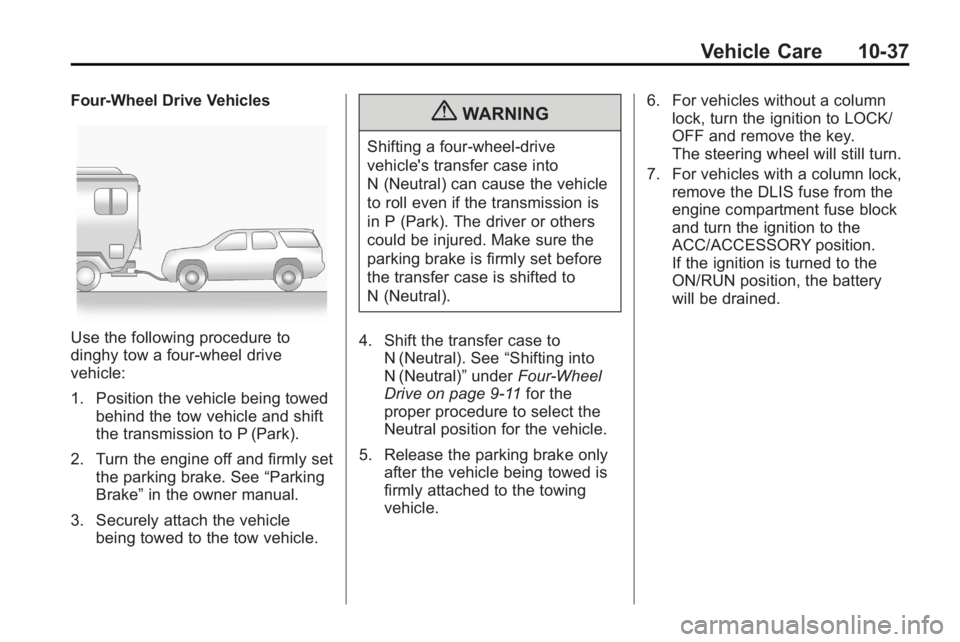
Vehicle Care 10-37Four-Wheel Drive Vehicles
Use the following procedure to
dinghy tow a four-wheel drive
vehicle:
1. Position the vehicle being towed
behind the tow vehicle and shift
the transmission to P (Park).
2. Turn the engine off and firmly set
the parking brake. See “ Parking
Brake ” in the owner manual.
3. Securely attach the vehicle
being towed to the tow vehicle. { WARNINGShifting a four-wheel-drive
vehicle's transfer case into
N (Neutral) can cause the vehicle
to roll even if the transmission is
in P (Park). The driver or others
could be injured. Make sure the
parking brake is firmly set before
the transfer case is shifted to
N (Neutral).
4. Shift the transfer case to
N (Neutral). See “ Shifting into
N (Neutral) ” under Four-Wheel
Drive on page 9 ‑ 11 for the
proper procedure to select the
Neutral position for the vehicle.
5. Release the parking brake only
after the vehicle being towed is
firmly attached to the towing
vehicle. 6. For vehicles without a column
lock, turn the ignition to LOCK/
OFF and remove the key.
The steering wheel will still turn.
7. For vehicles with a column lock,
remove the DLIS fuse from the
engine compartment fuse block
and turn the ignition to the
ACC/ACCESSORY position.
If the ignition is turned to the
ON/RUN position, the battery
will be drained.
Page 83 of 94
Black plate (39,1)Cadillac Escalade Hybrid - 2011
Vehicle Care 10-394. Firmly set the parking brake.
See “ Parking Brake ” in the
owner manual.
{ WARNINGShifting a four-wheel-drive
vehicle's transfer case into
N (Neutral) can cause the vehicle
to roll even if the transmission is
in P (Park). The driver or others
could be injured. Make sure the
parking brake is firmly set before
the transfer case is shifted to
N (Neutral).
5. Shift the transfer case to
N (Neutral). See “ Shifting into
N (Neutral) ” under Four-Wheel
Drive on page 9 ‑ 11 .
6. Secure the vehicle to the dolly
following the manufacturer's
instructions. 7. Release the parking brake only
after the vehicle being towed is
firmly attached to the towing
vehicle.
8. Turn the ignition to LOCK/OFF.
After towing, see “ Shifting Out of
N (Neutral) ” under Four-Wheel Drive
on page 9 ‑ 11 .
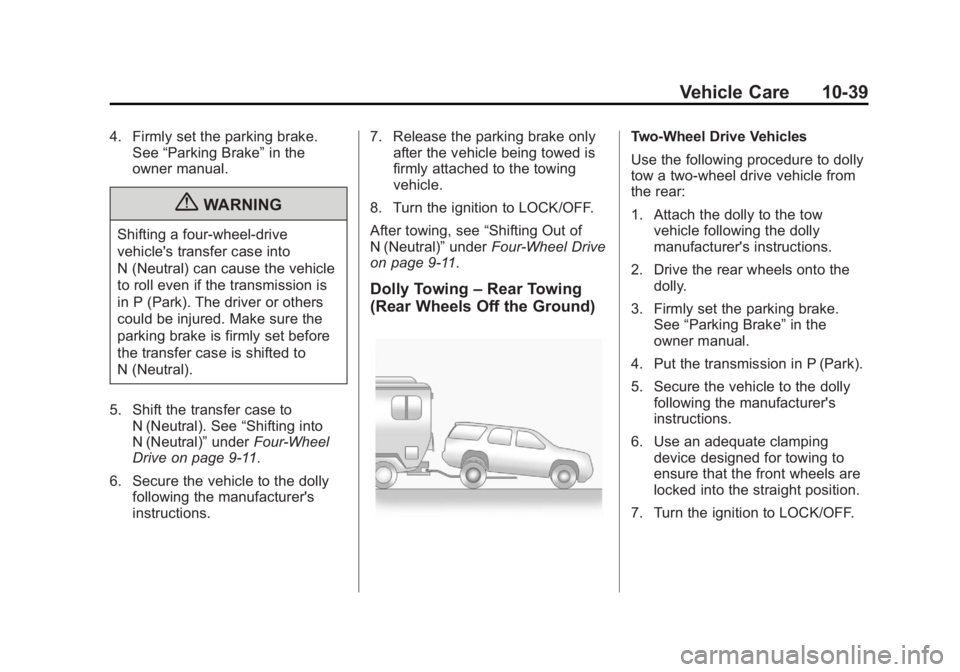
Dolly Towing – Rear Towing
(Rear Wheels Off the Ground) Two ‐ Wheel Drive Vehicles
Use the following procedure to dolly
tow a two-wheel drive vehicle from
the rear:
1. Attach the dolly to the tow
vehicle following the dolly
manufacturer's instructions.
2. Drive the rear wheels onto the
dolly.
3. Firmly set the parking brake.
See “ Parking Brake ” in the
owner manual.
4. Put the transmission in P (Park).
5. Secure the vehicle to the dolly
following the manufacturer's
instructions.
6. Use an adequate clamping
device designed for towing to
ensure that the front wheels are
locked into the straight position.
7. Turn the ignition to LOCK/OFF.
Page 84 of 94
Black plate (40,1)Cadillac Escalade Hybrid - 2011
10-40 Vehicle Care Four ‐ Wheel ‐ Drive Vehicles
Use the following procedure to dolly
tow a four-wheel-drive vehicle from
the rear:
1. Attach the dolly to the tow
vehicle following the dolly
manufacturer's instructions.
2. Drive the rear wheels onto the
dolly.
3. Firmly set the parking brake.
See “ Parking Brake ” in the
owner manual.
4. Put the transmission in P (Park).
5. Secure the vehicle to the dolly
following the manufacturer's
instructions.
6. Use an adequate clamping
device designed for towing to
ensure that the front wheels are
locked into the straight position. { WARNINGShifting a four-wheel-drive
vehicle's transfer case into
N (Neutral) can cause the vehicle
to roll even if the transmission is
in P (Park). The driver or others
could be injured. Make sure the
parking brake is firmly set before
the transfer case is shifted to
N (Neutral).
7. Shift the transfer case to
N (Neutral). See “ Shifting into
N (Neutral) ” under Four-Wheel
Drive on page 9 ‑ 11 .
8. Turn the ignition to LOCK/OFF.
After towing, see “ Shifting Out of
N (Neutral) ” under Four-Wheel Drive
on page 9 ‑ 11 .Appearance Care Exterior Care When scraping the windshield glass
to remove ice and snow, stay clear
of the hybrid decal.
To have the hybrid decals removed
from the vehicle, please see your
dealer.