warning CADILLAC ESCALADE HYBRID 2011 User Guide
[x] Cancel search | Manufacturer: CADILLAC, Model Year: 2011, Model line: ESCALADE HYBRID, Model: CADILLAC ESCALADE HYBRID 2011Pages: 94, PDF Size: 1.83 MB
Page 33 of 94
Black plate (7,1)Cadillac Escalade Hybrid - 2011
Driving and Operating 9-7
Engine Exhaust Running the Vehicle
While Parked It is better not to park with the
engine running. But if you ever have
to, here are some things to know.
{ WARNINGExiting the vehicle, without first
shifting into P (Park), may cause
the vehicle to move, and you or
others can be seriously injured.
Because the vehicle has the
Automatic Engine Start/Stop
feature, the vehicle ’ s engine
might seem to be shut off when
you come to a complete stop.
(Continued) WARNING (Continued) However, once the brake pedal is
released, the vehicle can move.
The vehicle ’ s engine can also
restart at any time.
Shift to P (Park) and turn the
ignition to LOCK/OFF, before
exiting the vehicle.
Follow the proper steps to be sure
the vehicle will not move. See
Shifting Into Park on page 9 ‑ 5 .
If pulling a trailer, see “ Driving
Characteristics and Towing Tips ” in
the owner manual. Automatic
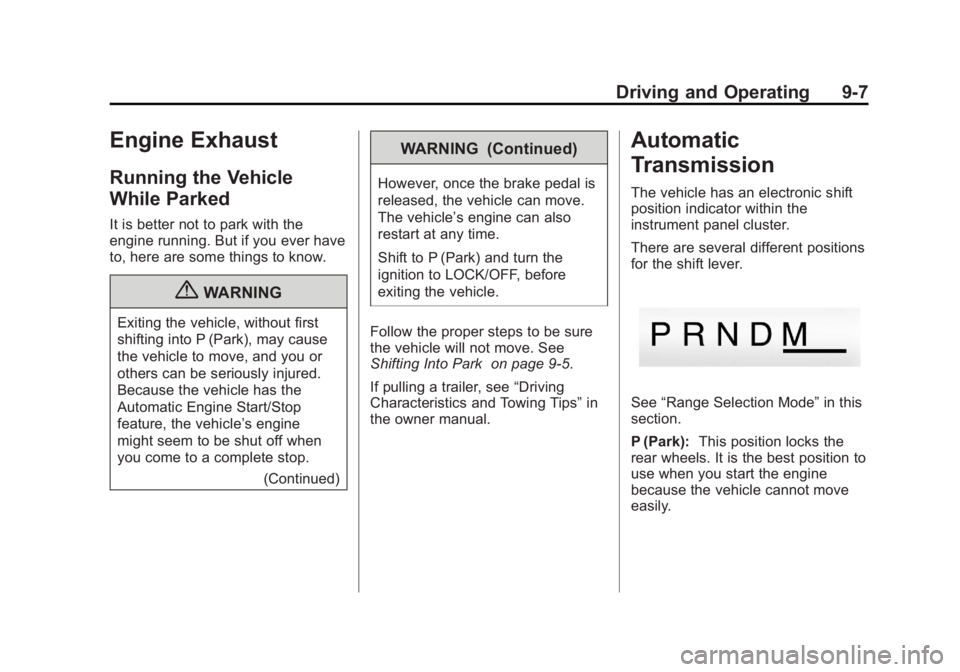
Transmission The vehicle has an electronic shift
position indicator within the
instrument panel cluster.
There are several different positions
for the shift lever.
See “ Range Selection Mode ” in this
section.
P (Park): This position locks the
rear wheels. It is the best position to
use when you start the engine
because the vehicle cannot move
easily.
Page 34 of 94
Black plate (8,1)Cadillac Escalade Hybrid - 2011
9-8 Driving and Operating When parked on a hill, especially
when the vehicle has a heavy load,
you may notice an increase in the
effort to shift out of P (Park). See
Shifting Into Park on page 9 ‑ 5 .
{ WARNINGIt is dangerous to get out of the
vehicle if the shift lever is not fully
in P (Park) with the parking brake
firmly set. The vehicle can roll.
Do not leave the vehicle when the
engine is running unless you
have to. If you have left the
engine running, the vehicle can
move suddenly. You or others
could be injured. To be sure the
vehicle will not move, even when
you are on fairly level ground,
always set the parking brake and
move the shift lever to P (Park).
See Shifting Into Park on
page 9 ‑ 5 . If you are pulling a
trailer, see “ Driving
Characteristics and Towing Tips ”
in the owner manual. { WARNINGIf you have Four-Wheel Drive, the
vehicle will be free to roll — even
if the shift lever is in P (Park) — if
the transfer case is in Neutral. So,
be sure the transfer case is in a
drive gear, Two-Wheel Drive High
or Four-Wheel Drive High or
Four-Wheel Drive Low — not in
Neutral. See Shifting Into Park
on page 9 ‑ 5 .
R (Reverse): Use this gear to
back up.
Notice: Shifting to R (Reverse)
while the vehicle is moving
forward could damage the
transmission. The repairs would
not be covered by the vehicle
warranty. Shift to R (Reverse) only
after the vehicle is stopped. To rock the vehicle back and forth to
get out of snow, ice, or sand without
damaging the transmission, see “ If
the Vehicle is Stuck ” in the owner
manual.
N (Neutral): In this position, the
engine and transmission are not
connected with the wheels. To
restart the engine when the vehicle
is already moving, use
N (Neutral) only.
{ WARNINGShifting into a drive gear while the
engine is running at high speed is
dangerous. Unless your foot is
firmly on the brake pedal, the
vehicle could move very rapidly.
You could lose control and hit
people or objects. Do not shift
into a drive gear while the engine
is running at high speed.
Page 38 of 94
Black plate (12,1)Cadillac Escalade Hybrid - 2011
9-12 Driving and Operating You can choose among five driving
settings:
Indicator lights in the switches show
you which setting you are in. The
indicator lights will come on briefly
when you turn on the ignition and
the last chosen setting will stay on.
If the lights do not come on, you
should take the vehicle to your
dealer for service. An indicator light
will flash while shifting. It will stay on
when the shift is completed. If for
some reason the transfer case
cannot make a requested shift, it will
return to the last chosen setting.
2
m (Two-Wheel Drive High): This
setting is used for driving in most
street and highway situations. The
front axle is not engaged in
two-wheel drive. This setting also
provides the best fuel economy.
AUTO (Automatic Four-Wheel
Drive): This setting is ideal for use
when road surface traction
conditions are variable. When
driving your vehicle in AUTO, the
front axle is engaged, but the vehicle's power is primarily sent to
the rear wheels. When the vehicle's
software determines a need for
more traction, the system will
transfer more power to the front
wheels. Driving in this mode results
in slightly lower fuel economy than
Two-Wheel Drive High.
4
m (Four-Wheel Drive High): Use
the four-wheel high position when
you need extra traction, such as on
snowy or icy roads or in most
off-road situations. This setting also
engages the front axle to help drive
the vehicle. This is the best setting
to use when plowing snow.
4
n (Four-Wheel Drive Low) : This
setting also engages the front axle
and delivers extra torque. You may
never need this setting. It sends
maximum power to all four wheels.
You might choose Four-Wheel Drive
Low if you are driving off-road in
deep sand, deep mud, deep snow,
and while climbing or descending
steep hills. The vehicle has StabiliTrak. Shifting
into Four-Wheel-Drive Low will turn
Traction Control and StabiliTrak off.
See “ StabiliTrak System ” in the
owner manual.
{ WARNINGShifting the transfer case to
N (Neutral) can cause the vehicle
to roll even if the transmission is
in P (Park). You or someone else
could be seriously injured. Be
sure to set the parking brake
before placing the transfer case in
N (Neutral). See “ Parking Brake ”
in the owner manual for more
information.
N (Neutral): Shift the vehicle's
transfer case to N (Neutral) only
when towing the vehicle. See
“ Recreational Vehicle Towing ” or
“ Towing Your Vehicle ” in the owner
manual.
Page 46 of 94
Black plate (2,1)Cadillac Escalade Hybrid - 2011
10-2 Vehicle Care
Vehicle Checks Doing Your Own
Service Work
{ WARNINGNever try to do your own service
on hybrid components. You can
be injured and the vehicle can be
damaged if you try to do your own
service work. Service and repair
of these hybrid components
should only be performed by a
trained service technician with the
proper knowledge and tools. { WARNINGYou can be injured and the
vehicle could be damaged if you
try to do service work on a vehicle
without knowing enough about it. .
Be sure you have sufficient
knowledge, experience, the
proper replacement parts,
and tools before attempting
any vehicle
maintenance task. .
Be sure to use the proper
nuts, bolts, and other
fasteners. English and metric
fasteners can be easily
confused. If the wrong
fasteners are used, parts can
later break or fall off. You
could be hurt. If doing some of your own service
work, use the proper service
manual. It tells you much more
about how to service the vehicle
than this manual can. To order the
proper service manual, see “ Service
Publications Ordering Information ”
in the owner manual.
This vehicle has an airbag system.
Before attempting to do your own
service work, see “ Airbag System
Check ” in the owner manual.
Keep a record with all parts receipts
and list the mileage and the date of
any service work performed. See
“ Maintenance Records ” in the owner
manual.
Page 55 of 94

Black plate (11,1)Cadillac Escalade Hybrid - 2011
Vehicle Care 10-11How to Add Coolant to the
DMCM Coolant Surge Tank
If no problem has been found yet,
check to see if coolant is visible in
the DMCM coolant surge tank.
If coolant is visible, add pre ‐ mixed
DEX-COOL coolant, available at
your dealer, at the DMCM coolant
surge tank, but be sure the DMCM
cooling system, including the DMCM
coolant surge tank pressure cap, is
cool before you do it. Use the
procedure following. { WARNINGSteam and scalding liquids from a
hot cooling system can blow out
and burn you badly. They are
under pressure, and if you turn
the coolant surge tank pressure
cap — even a little — they can
come out at high speed. Never
turn the cap when the cooling
system, including the coolant
surge tank pressure cap, is hot.
Wait for the cooling system and
coolant surge tank pressure cap
to cool if you ever have to turn
the pressure cap.
Notice: Using coolant other than
a pre ‐ mixed DEX-COOL, available
at your dealer, may damage your
vehicle. Any repairs would not be
covered by your warranty. Always
use a pre ‐ mixed DEX-COOL
(silicate-free) coolant in your
vehicle. { WARNINGYou can be burned if you spill
coolant on hot engine parts.
Coolant contains ethylene glycol
and it will burn if the engine parts
are hot enough. Do not spill
coolant on a hot engine.
If the DMCM coolant is empty , the
vehicle must be serviced by your
dealer and a special fill procedure
must be followed.
Notice: Attempting to fill the
DMCM cooling surge tank
yourself when the fluid level is
empty can damage your vehicle.
Your vehicle must be serviced.
Page 58 of 94
Black plate (14,1)Cadillac Escalade Hybrid - 2011
10-14 Vehicle Care Vehicle Storage
{ WARNINGBatteries have acid that can burn
you and gas that can explode.
You can be badly hurt if you are
not careful. See Jump Starting on
page 10 ‑ 31 for tips on working
around a battery without
getting hurt.
Infrequent Usage: Remove the
12 ‐ volt battery black, negative ( − )
cable from the battery to keep the
battery from running down.
Extended Storage: Remove the
12 ‐ volt battery black, negative ( − )
cable from the battery or use a
battery trickle charger.
Remember to reconnect the battery
when ready to drive the vehicle. Four-Wheel Drive Transfer Case When to Check Lubricant
Refer to the Scheduled
Maintenance on page 11 ‑ 1 to
determine how often to check the
lubricant.
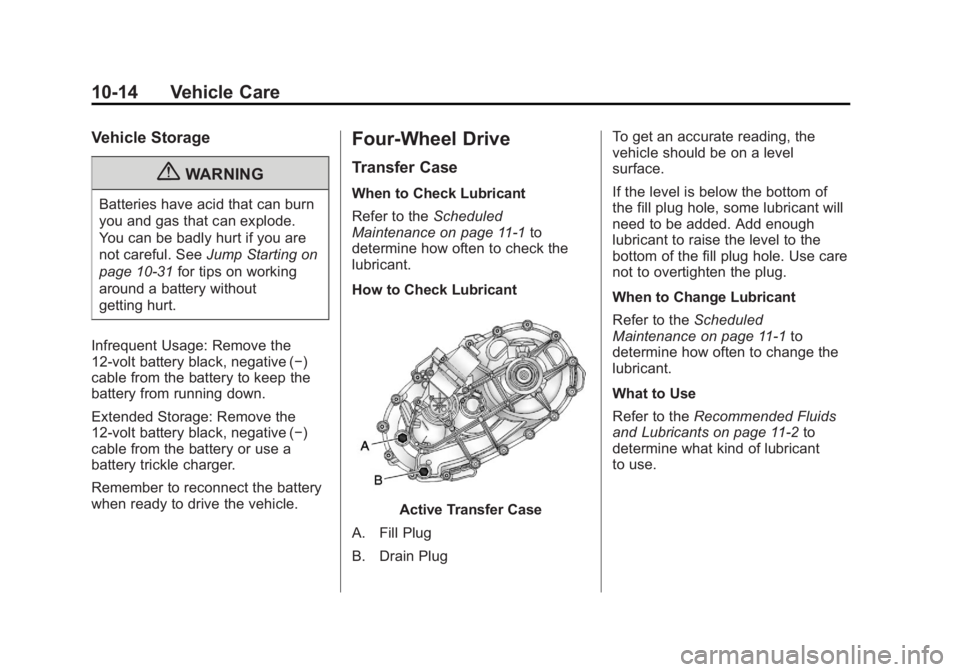
How to Check Lubricant
Active Transfer Case
A. Fill Plug
B. Drain Plug To get an accurate reading, the
vehicle should be on a level
surface.
If the level is below the bottom of
the fill plug hole, some lubricant will
need to be added. Add enough
lubricant to raise the level to the
bottom of the fill plug hole. Use care
not to overtighten the plug.
When to Change Lubricant
Refer to the Scheduled
Maintenance on page 11 ‑ 1 to
determine how often to change the
lubricant.
What to Use
Refer to the Recommended Fluids
and Lubricants on page 11 ‑ 2 to
determine what kind of lubricant
to use.
Page 59 of 94
Black plate (15,1)Cadillac Escalade Hybrid - 2011
Vehicle Care 10-15
Electrical System High Voltage Devices and
Wiring
{ WARNINGExposure to high voltage can
cause shock, burns, and even
death. The high voltage systems
in your vehicle can only be
serviced by technicians with
special training.
High voltage devices are
identified by labels. Do not
remove, open, take apart,
or modify these devices. High
voltage cable or wiring has
orange covering. Do not probe,
tamper with, cut, or modify high
voltage cable or wiring. Fuses and Circuit
Breakers The wiring circuits in the vehicle are
protected from short circuits by a
combination of fuses, circuit
breakers and fusible thermal links.
This greatly reduces the chance of
fires caused by electrical problems.
Be sure you replace a bad fuse with
a new one of the identical size and
rating.
If you ever have a problem on the
road and do not have a spare fuse,
you can borrow one that has the
same amperage. Just pick some
feature of the vehicle that you can
get along without, like the radio or
cigarette lighter, and use its fuse,
if it is the correct amperage.
Replace it as soon as you can.
The vehicle also has a special fuse
in the battery box for the 300-volt
batteries. If this fuse has failed and
needs to be replaced, the vehicle
will be disabled and you will need to have the vehicle repaired by your
dealer. Do not attempt to
self-service this fuse.
Engine Compartment
Fuse Block Hybrid Auxiliary Engine
Compartment Fuse Block The hybrid auxiliary engine
compartment fuse block is located
in the engine compartment near the
front of the vehicle. Lift the cover for
access to the fuse/relay block. See
Engine Compartment Overview on
page 10 ‑ 4 for more information on
its location. For more information on
the main underhood fuse block, see
“ Engine Compartment Fuse Block ”
in the owner manual.
Page 63 of 94
Black plate (19,1)Cadillac Escalade Hybrid - 2011
Vehicle Care 10-19
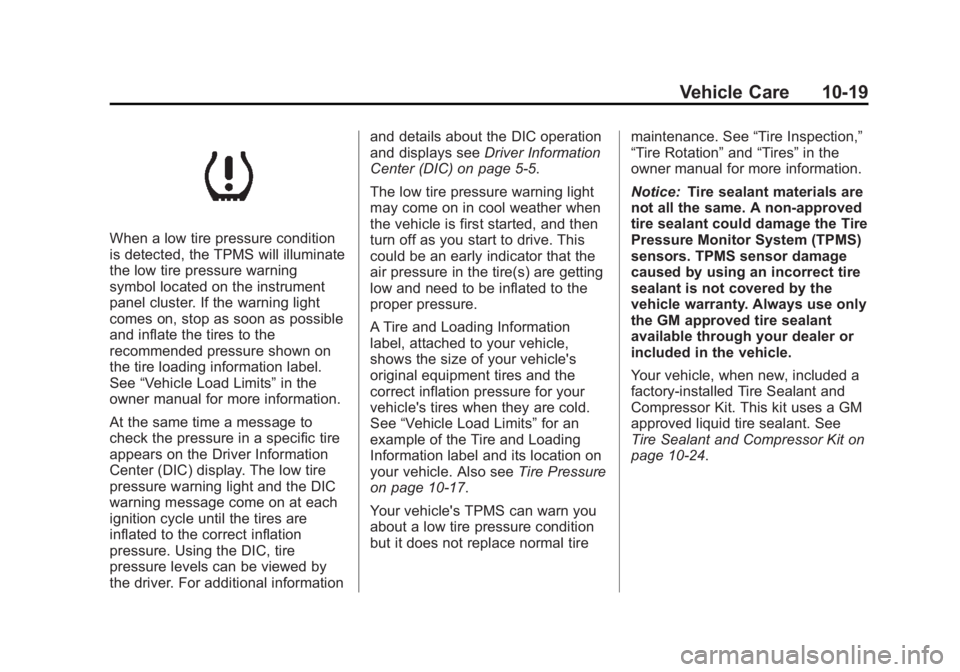
When a low tire pressure condition
is detected, the TPMS will illuminate
the low tire pressure warning
symbol located on the instrument
panel cluster. If the warning light
comes on, stop as soon as possible
and inflate the tires to the
recommended pressure shown on
the tire loading information label.
See “ Vehicle Load Limits ” in the
owner manual for more information.
At the same time a message to
check the pressure in a specific tire
appears on the Driver Information
Center (DIC) display. The low tire
pressure warning light and the DIC
warning message come on at each
ignition cycle until the tires are
inflated to the correct inflation
pressure. Using the DIC, tire
pressure levels can be viewed by
the driver. For additional information and details about the DIC operation
and displays see Driver Information
Center (DIC) on page 5 ‑ 5 .
The low tire pressure warning light
may come on in cool weather when
the vehicle is first started, and then
turn off as you start to drive. This
could be an early indicator that the
air pressure in the tire(s) are getting
low and need to be inflated to the
proper pressure.
A Tire and Loading Information
label, attached to your vehicle,
shows the size of your vehicle's
original equipment tires and the
correct inflation pressure for your
vehicle's tires when they are cold.
See “ Vehicle Load Limits ” for an
example of the Tire and Loading
Information label and its location on
your vehicle. Also see Tire Pressure
on page 10 ‑ 17 .
Your vehicle's TPMS can warn you
about a low tire pressure condition
but it does not replace normal tire maintenance. See “ Tire Inspection, ”
“ Tire Rotation ” and “ Tires ” in the
owner manual for more information.
Notice: Tire sealant materials are
not all the same. A non-approved
tire sealant could damage the Tire
Pressure Monitor System (TPMS)
sensors. TPMS sensor damage
caused by using an incorrect tire
sealant is not covered by the
vehicle warranty. Always use only
the GM approved tire sealant
available through your dealer or
included in the vehicle.
Your vehicle, when new, included a
factory ‐ installed Tire Sealant and
Compressor Kit. This kit uses a GM
approved liquid tire sealant. See
Tire Sealant and Compressor Kit on
page 10 ‑ 24 .
Page 64 of 94
Black plate (20,1)Cadillac Escalade Hybrid - 2011
10-20 Vehicle Care TPMS Malfunction Light and
Message The TPMS will not function properly
if one or more of the TPMS sensors
are missing or inoperable. When the
system detects a malfunction, the
low tire warning light flashes for
about one minute and then stays on
for the remainder of the ignition
cycle. A DIC warning message is
also displayed. The low tire warning
light and DIC warning message
come on at each ignition cycle until
the problem is corrected. Some of
the conditions that can cause the
malfunction light and DIC message
to come on are: .
The TPMS sensor matching
process was started but not
completed or not completed
successfully after rotating the
vehicle's tires. The DIC message
and TPMS malfunction light
should go off once the TPMS
sensor matching process is
performed successfully. See
“ TPMS Sensor Matching
Process ” later in this section. .
One or more TPMS sensors are
missing or damaged. The DIC
message and the TPMS
malfunction light should go off
when the TPMS sensors are
installed and the sensor
matching process is performed
successfully. See your dealer for
service. .
Replacement tires or wheels do
not match your vehicle's original
equipment tires or wheels. Tires
and wheels other than those
recommended for your vehicle
could prevent the TPMS from
functioning properly. See
“ Buying New Tires ” in the owner
manual. .
Operating electronic devices or
being near facilities using radio
wave frequencies similar to the
TPMS could cause the TPMS
sensors to malfunction. If the TPMS is not functioning it
cannot detect or signal a low tire
condition. See your dealer for
service if the TPMS malfunction
light and DIC message comes on
and stays on.
TPMS Sensor Matching
Process Each TPMS sensor has a unique
identification code. Any time you
rotate your vehicle's tires or replace
one or more of the TPMS sensors,
the identification codes will need to
be matched to the new tire/wheel
position. The sensors are matched
to the tire/wheel positions in the
following order: driver side front tire,
passenger side front tire, passenger
side rear tire, and driver side rear
tire using a TPMS diagnostic tool.
See your dealer for service.
Page 67 of 94
Black plate (23,1)Cadillac Escalade Hybrid - 2011
Vehicle Care 10-23
If a Tire Goes Flat Your vehicle has a tire inflator kit.
There is no spare tire, no tire
changing equipment, and no place
to store a tire.
It is unusual for a tire to blow out
while you are driving, especially if
you maintain your tires properly.
If air goes out of a tire, it is much
more likely to leak out slowly. But,
if you should ever have a blow out,
here are a few tips about what to
expect and what to do:
If a front tire fails, the flat tire
creates a drag that pulls the vehicle
toward that side. Take your foot off
the accelerator pedal and grip the
steering wheel firmly. Steer to
maintain lane position, and then
gently brake to a stop, well off the
road, if possible.
A rear blow out, particularly on a
curve, acts much like a skid and
may require the same correction
you would use in a skid. In any rear
blow out, remove your foot from the
accelerator pedal. Get the vehicle under control by steering the way
you want the vehicle to go. It may
be very bumpy and noisy, but you
can still steer. Gently brake to a
stop, well off the road, if possible.
{ WARNINGDriving on a flat tire will cause
permanent damage to the tire.
Re-inflating a tire after it has
been driven on while severely
under-inflated or flat may cause a
blowout and a serious crash.
Never attempt to re-inflate a tire
that has been driven on while
severely under-inflated or flat.
Have your dealer or an authorized
tire service center repair or
replace the flat tire as soon as
possible. If a tire goes flat, avoid further tire
and wheel damage by driving slowly
to a level place and stopping, well
off the road, if possible. Then
do this:
1. Turn on the hazard warning
flashers.
2. Park your vehicle. Set the
parking brake firmly and put the
shift lever in PARK (P).
3. Turn off the engine.
4. Inspect the flat tire.
If the tire has been separated from
the wheel or has damaged sidewalls
or large tears that allow rapid air
loss, call a tire repair facility. See
“ Roadside Assistance Program ” in
the owner manual.
If the flat tire is due to a slow leak
caused by a nail or other similar
road hazard, the tire inflator kit may
be used to repair the damaged tire
temporarily. The kit uses a liquid tire
sealant to seal small punctures in
the tread area of the tire.