tow CADILLAC FLEETWOOD 1994 User Guide
[x] Cancel search | Manufacturer: CADILLAC, Model Year: 1994, Model line: FLEETWOOD, Model: CADILLAC FLEETWOOD 1994Pages: 398, PDF Size: 19.19 MB
Page 115 of 398
TILT WHEEL
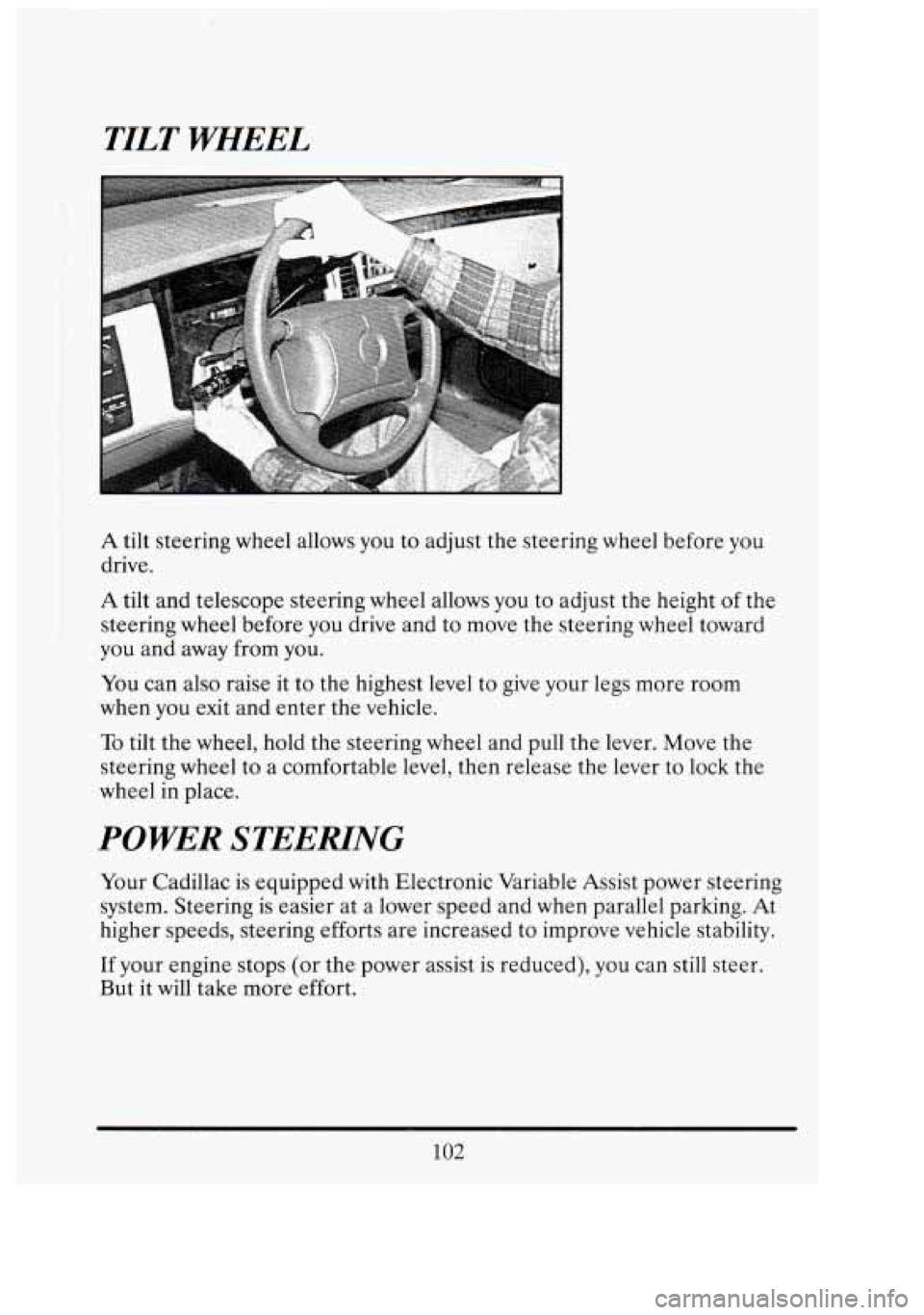
A tilt steering wheel allows you to adjust the steering wheel before you
drive.
A tilt and telescope steering wheel allows you to adjust the height of the
steering wheel before you drive and to move the steering wheel toward
you and away
from you.
You can also raise it to the highest level to give your legs more room
when you exit and enter the vehicle.
To tilt the wheel, hold the steering wheel and pull the lever. Move the
steering wheel to a comfortable level, then release the lever
to lock the
wheel
in place.
POWER STEERLNG
Your Cadillac is equipped with Electronic Variable Assist power steering
system. Steering is easier at a lower speed and when parallel parking. At
higher speeds, steering efforts are increased to improve vehicle stability.
If your engine stops (or the power assist is reduced),
you can still steer.
But it will take more effort.
102
GI
nr
Page 119 of 398
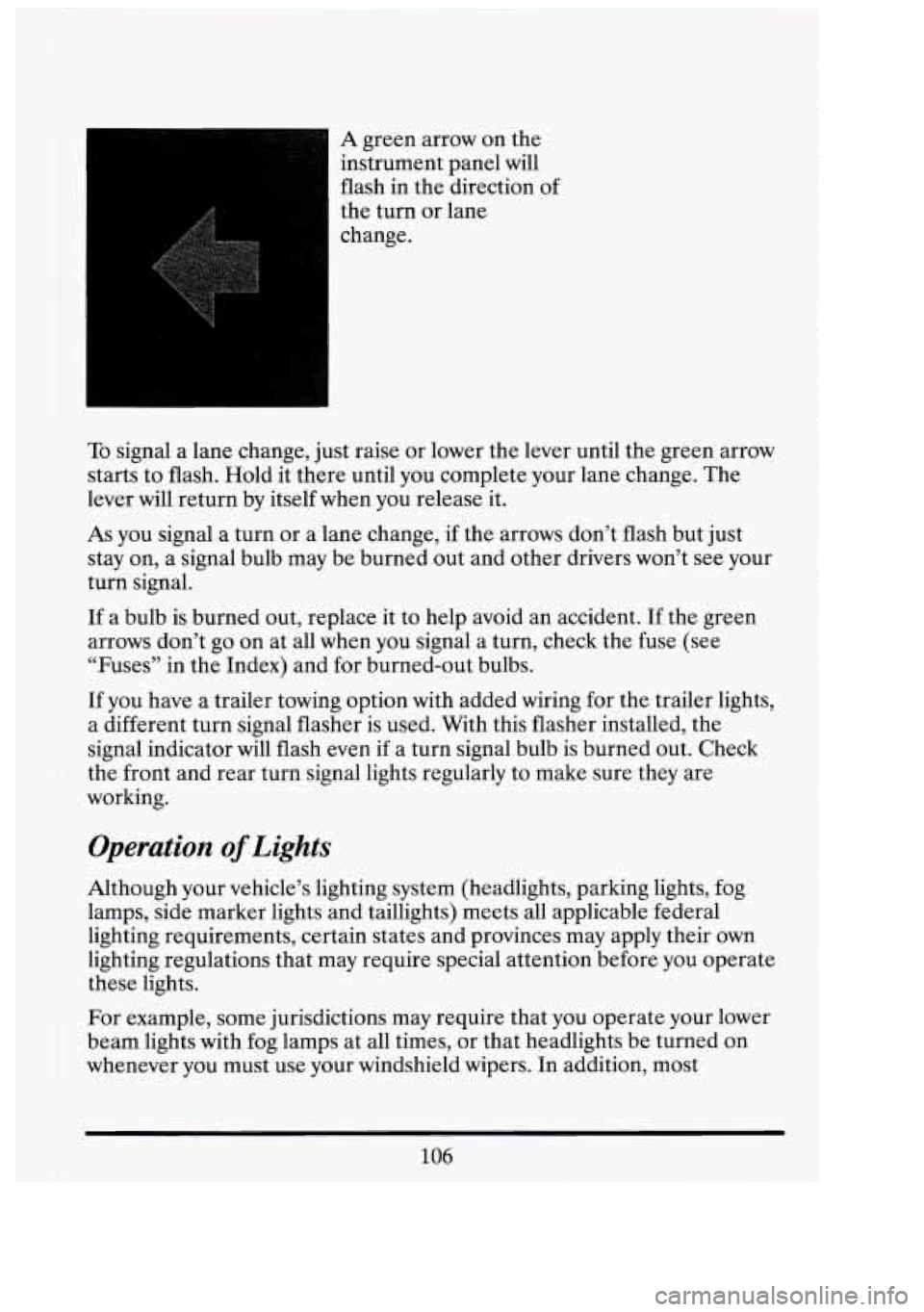
A green arrow on the
instrument panel will
flash in the direction
of
the turn or lane
change.
To signal a lane change, just raise or lower the lever until the green arrow
starts to flash. Hold it there until you complete your lane change. The
lever will return by itself when you release it.
As you signal a turn or a lane change, if the arrows don’t flash but just
stay on, a signal bulb may be burned out and other drivers won’t see your
turn signal.
If a bulb is burned out, replace it to help avoid an accident. If the green
arrows don’t go on at all when you signal a turn, check the fuse (see
“Fuses” in the Index) and for burned-out bulbs.
If you have
a trailer towing option with added wiring for the trailer lights,
a different turn signal flasher is used. With this flasher installed, the
signal indicator will flash even if a turn signal bulb is burned out. Check
the front and rear turn signal lights regularly to make sure they are
working.
Operation of Lights
Although your vehicle’s lighting system (headlights, parking lights, fog
lamps, side marker lights and taillights) meets all applicable federal
lighting requirements, certain states and provinces may apply their own
lighting regulations that may require special attention before you operate
these lights.
For example, some jurisdictions may require that you operate your lower
beam lights with fog lamps at all times, or that headlights be turned on
whenever you must use your windshield wipers. In addition, most
106
-1 I
E,
3’
ii
i
-I
J
Page 120 of 398
jurisdictions prohibit driving solely with parking lights, especially at dawn
or dusk. It is recommended that you check with your own state or
provincial highway authority for applicable lighting regulation.
Headlight High-Low Beam
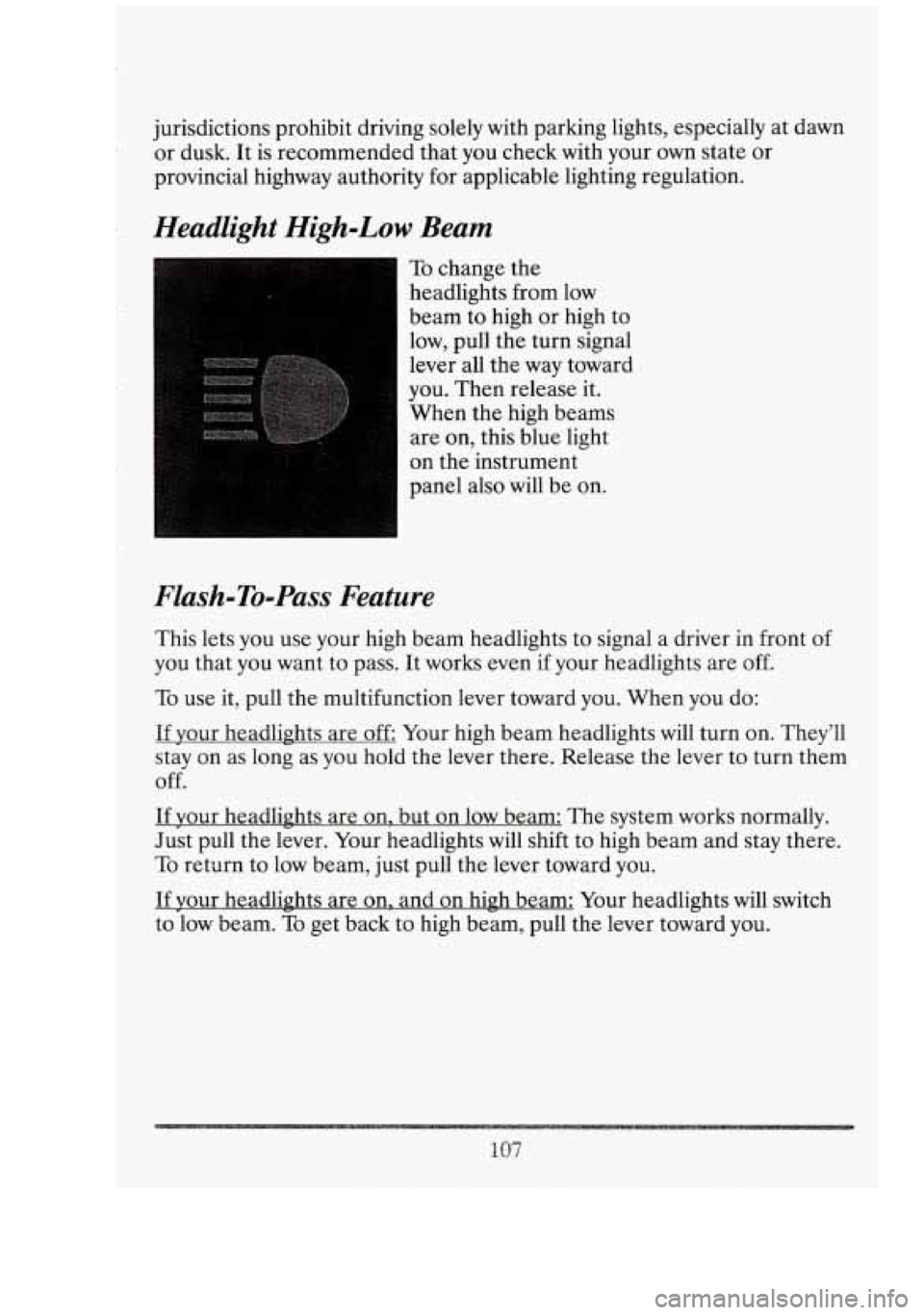
To change the
headlights from low
beam to high or high to
low, pull the turn signal
lever all the way toward
you. Then release it.
When the high beams
are on, this blue light
on the instrument
panel also will be on.
Flash-To-Pass Feature
This lets you use your high beam headlights to signal a driver in front of
you that you want to pass. It works even if your headlights are off.
To use it, pull the multifunction lever toward you. When you do:
If your headlights are off Your high beam headlights will turn on. They’ll
stay on as long as you hold the lever there. Release the lever to turn them
off.
If your headlights are on. but on low beam: The system works normally.
Just pull the lever. Your headlights will shift to high beam and stay there.
To return to low beam, just pull the lever toward you.
If your headlights are on. and on high beam: Your headlights will switch
to low beam.
To get back to high beam, pull the lever toward you.
107
Page 121 of 398
Windshield Wipers
g:
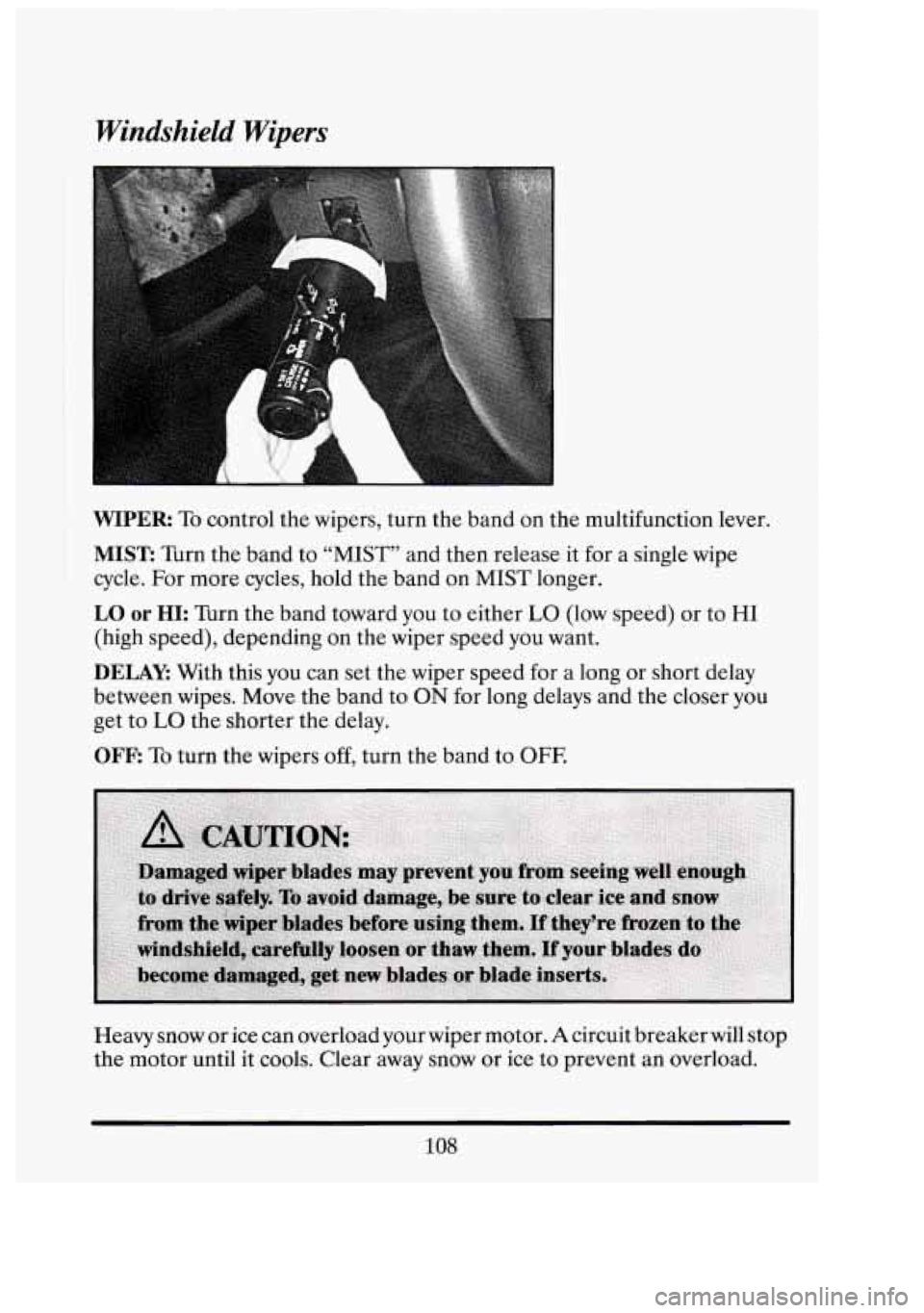
WIPER To control the wipers, turn the band on the multifunction lever.
MIST: Turn the band to “MIST” and then release it for a single wipe
cycle. For more cycles, hold the band on MIST longer.
LO or HI: Turn the band toward you to either LO (low speed) or to HI
(high speed), depending on the wiper speed you want.
DELAY: With this you can set the wiper speed for a long or short delay
between wipes. Move the band to
ON for long delays and the closer you
get to
LO the shorter the delay.
OFF: To turn the wipers off, turn the band to OFF.
Heavy snow
or ice can overload your wiper motor. A circuit breaker will stop
the motor until it cools. Clear away snow or ice to prevent an overload.
108
LJ
n,
i
Page 138 of 398
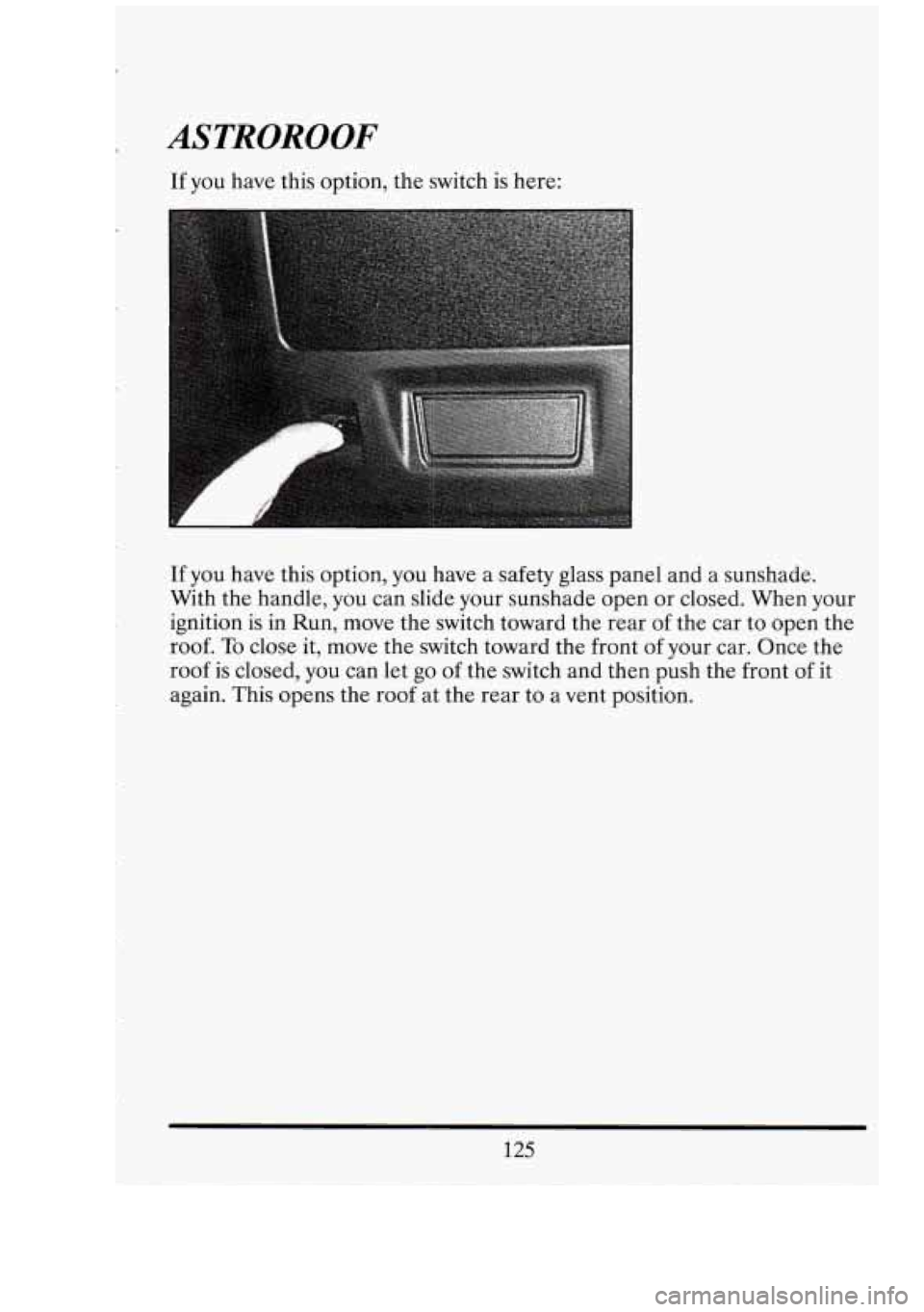
ASTROROOF
If you have this option, the switch is here:
If you have this option, you have a safety glass panel and a sunshade.
With the handle, you can slide your sunshade open or closed. When your
ignition
is in Run, move the switch toward the rear of the car to open the
roof.
To close it, move the switch toward the front of your car. Once the
roof is closed, you can let go of the switch and then push the front of it
again. This opens the roof at the rear to a vent position.
125
Page 142 of 398
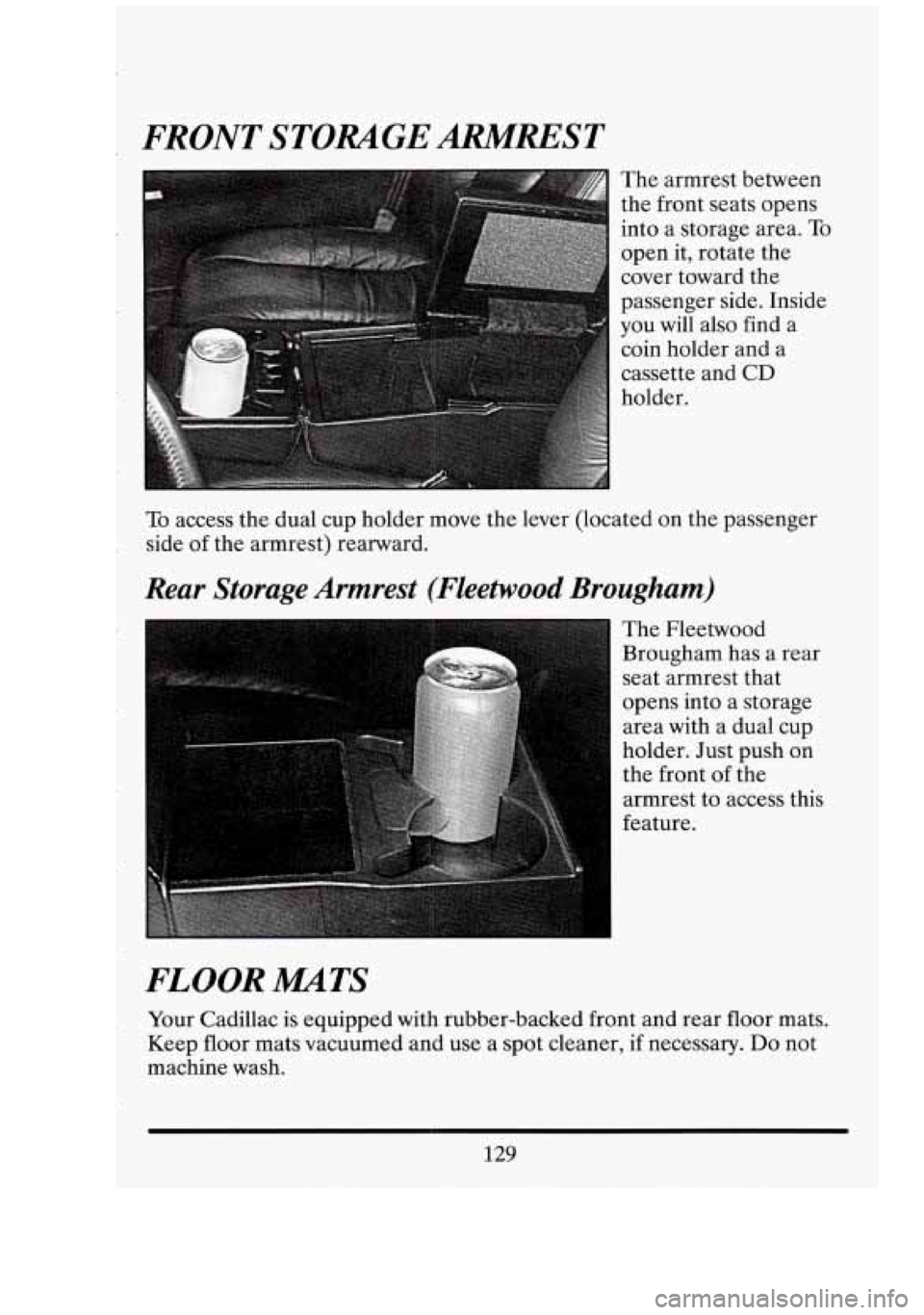
- FRONT STORAGE ARMREST
I
The armrest between
the front seats opens
into a storage area.
To
open it, rotate the
cover toward the
passenger side. Inside
you will also find a
coin holder and a
cassette and CD
__ holder.
-.
To access the dual cup holder move the lever (located on the passenger
side of the armrest) rearward.
Rear Storage Armrest (Fleetwood Brougham)
The Fleetwood
Brougham has a rear
seat armrest that
FLOOR IMATS
opens into a storage
area with a dual cup
holder. Just push on
the front of the
armrest to access this
feature.
Your Cadillac is equipped with rubber-backed front and rear floor mats.
Keep
floor mats vacuumed and use a spot cleaner, if necessary. Do not
machine wash.
129
Page 214 of 398

TOWING A TRAILER
NOTICE:
Pulling a trailer improperly can damage your vehicle and result\
in costly repairs not covered by your warranty.
To pull a trailer
correctly, follow the advice in this section.
Your Cadillac is a passenger vehicle. Trailer towing can change the way
your vehicle performs on the road. The loads and forces created when
trailering subject the vehicle
to significant levels of stress.
Load pulling components such as the engine, transmission, rear axle,
wheel assemblies, and tires are forced to work harder against the drag of
the added weight. The engine is required to operate at relatively higher
speeds and under greater loads, which generates extra heat. Trailer
towing adds considerably to wind resistance which increases pulling
requirements.
All this means changes in:
Handling
Durability
Fuel Economy
201
Page 215 of 398
I
If You Do Decide To Pull A Trailer
If you do, here are some important points.
There are many different laws including speed limit restrictions which
apply to trailering. Make sure your rig
will be legal, not only where
you live but also where you’ll be driving.
A good source for this
information can be state or provincial police.
You should always use a load equalizing hitch if your trailer will weigh
more than
2,000 pounds (900 kg). Consider using sway control if your
loaded trailer will weigh
2,000 pounds (900 kg) or less. If your loaded
trailer will weigh
2,000 pounds (900 kg.) or more you should use both
load equalizing hitch and sway control.
NOTICE:
Do not use sway control devices on trailers equipped with surge
brakes, i.e. boat trailers. Surge brakes
do not function properly
when used with most sway control devices.
Don’t tow a trailer during the first 1000 miles (1600 km) your new
vehicle is driven. The engine, axle or other parts could be damaged.
5 During the first 1,000 miles (1600 km) that you tow a trailer, don’t
drive over
50 mph (80 km/h) and avoid full throttle starts. This helps
the engine and other parts
of your vehicle wear in at the heavier loads.
Avoid continuous operation in mountainous areas that have grades
greater than
2% for longer than 5 miles.
A maximum highway speed to 55 mph (90 km/h) when trailering will
enhance the long term durability of your vehicle.
Change axle lubricant annually or every 7,500 miles (12,500 km) of
trailer towing, whichever occurs first.
0 Three important considerations have to do with weight:
202
o/
I
I
c
nl
I
‘p’
u,
Page 216 of 398
1. Weight of the ’hailer
How heavy can a trailer safely be? It should never weigh more than
2,000 pounds (907 kg) including the load. Unless you have one of
the optional Trailer Towing Packages.
Trailer weight
also depends on how you plan to use your rig. For example,
speed, altitude, road grades, outside temperature and how much \
your
vehicle is used to
pull a trailer are all important. It can also vary depending
on any special equipment that you have on your vehicle.
You can ask your dealer for trailering information or advice, or at
Cadillac, you can call 1-800-43FLEET
In Canada, write to General Motors of Canada Limited, Customer
Assistance Center, 1908 Colonel Sam Drive, Oshawa, Ontario
L1H
8P7.
2.
Weight of the ’hailer Tongue
The gross vehicle weight includes the weight of the vehicle, any
cargo you may carry in it, and the people who will be riding
in the
vehicle.
If you are towing a trailer, you must subtract the tongue load
from the vehicle’s capacity, because your vehicle will be carrying that
weight, too. See “Loading Your Vehicle” in the Index for more
information about your maximum vehicle’s load capacity.
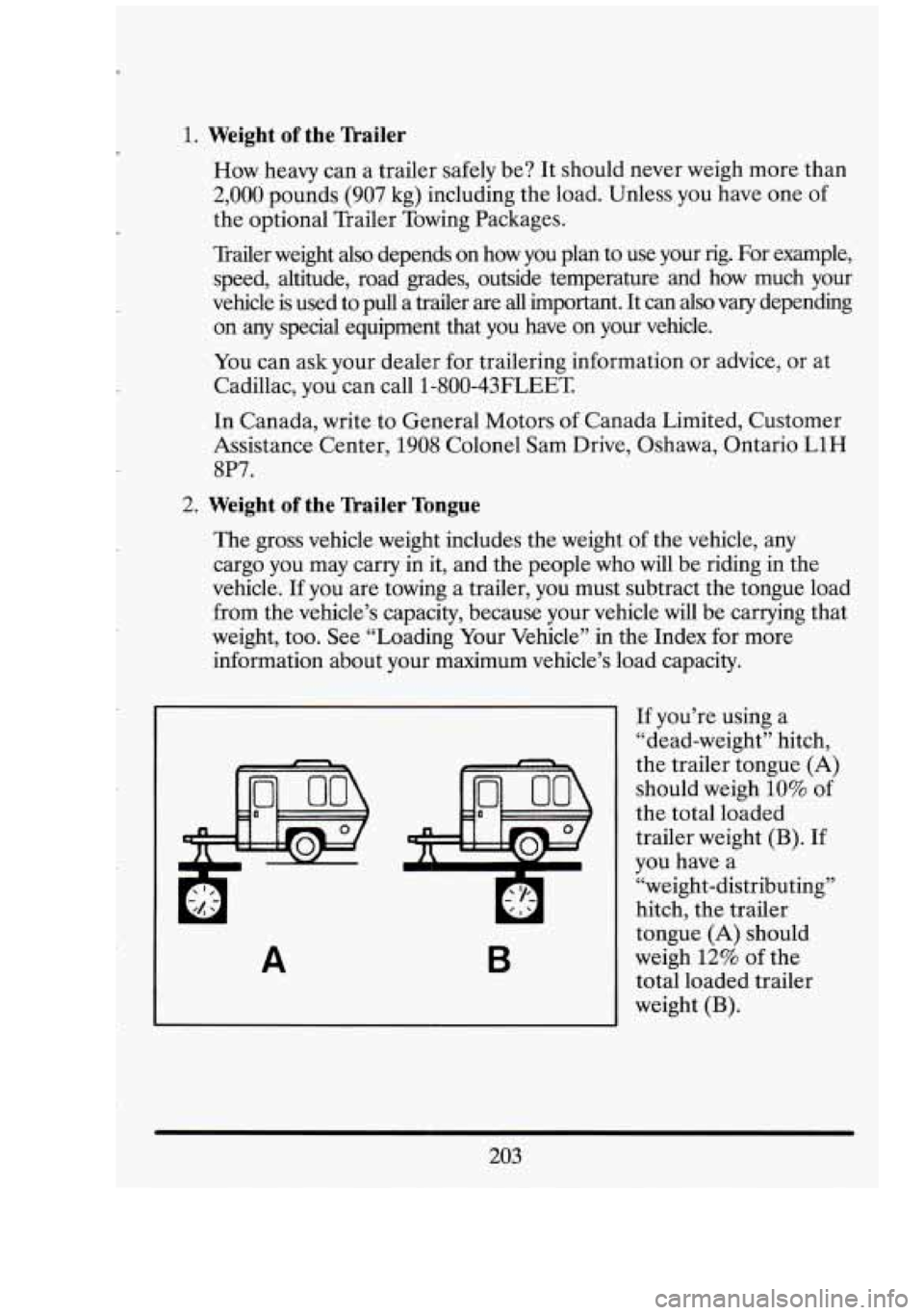
A B
If you’re using a
“dead-weight” hitch,
the trailer tongue (A)
should weigh 10% of
the total loaded
trailer weight
(B). If
you have a
“weight-distributing”
hitch, the trailer
tongue
(A) should
weigh 12% of the
total loaded trailer
weight
(B).
203
Page 217 of 398
I I
31 i
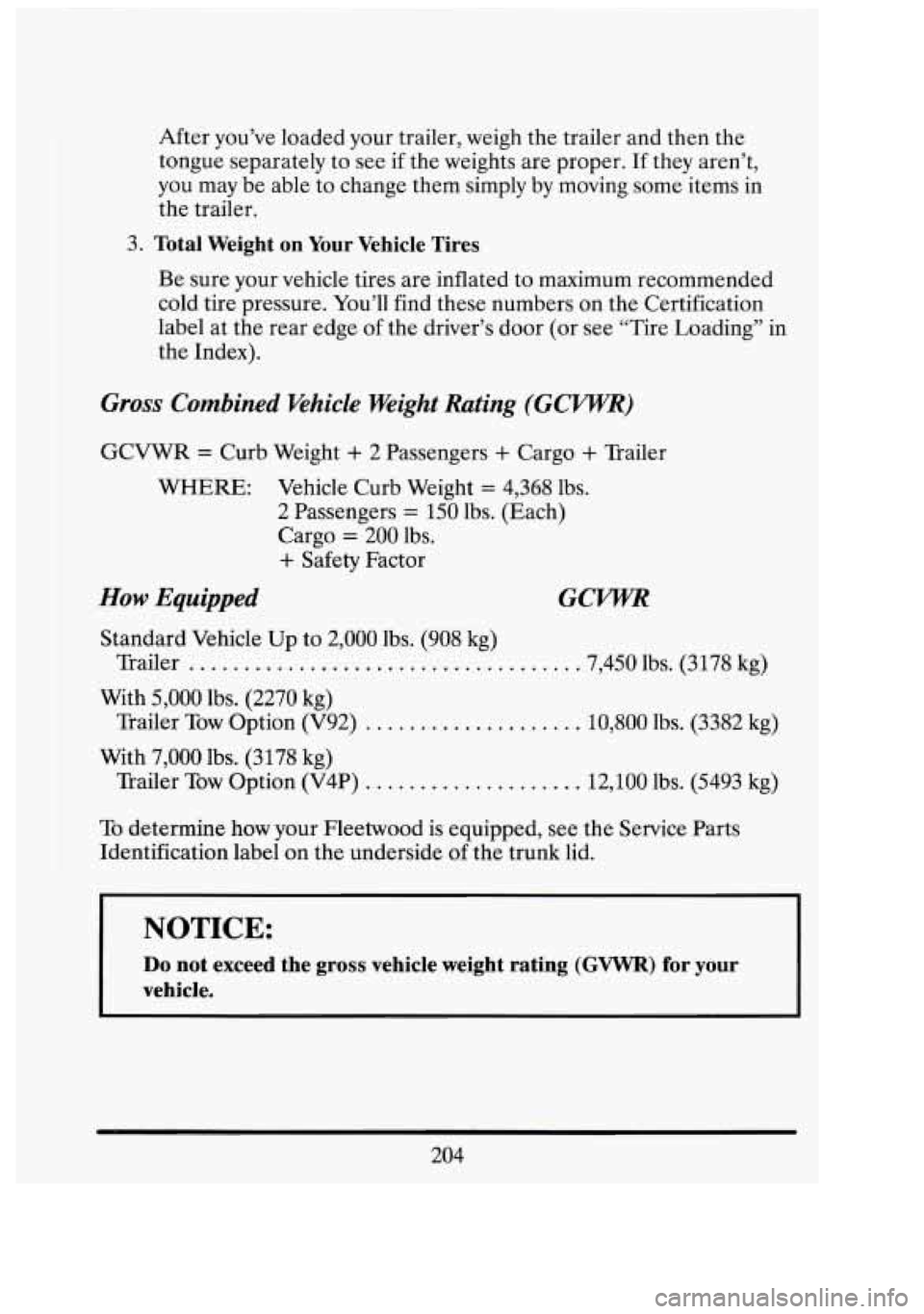
After you’ve loaded your trailer, weigh the trailer and then the
tongue separately to see if the weights are proper. If they aren’t,
you may be able to change them simply by moving some items in
the trailer.
3.
Total Weight on Your Vehicle Tires
Be sure your vehicle tires are inflated to maximum recommended
cold tire pressure. You’ll find these numbers on the Certification
label at the rear edge
of the driver’s door (or see “Tire Loading’’ in
the Index).
Gross Combined Vehicle Weight Rating (GCvmC)
GCVWR = Curb Weight + 2 Passengers + Cargo + Trailer
WHERE: Vehicle Curb Weight
= 4,368 lbs.
2 Passengers = 150 lbs. (Each)
Cargo
= 200 lbs.
+ Safety Factor
How Equipped GCWR
Standard Vehicle Up to 2,000 lbs. (908 kg)
With 5,000 lbs. (2270 kg)
With 7,000 lbs. (3178 kg) Trailer
................................... .7,450
lbs. (3178 kg)
Trailer Tow Option (V92)
.................... 10,800 lbs. (3382 kg)
Trailer Tow Option (V4P)
.................... 12,100 lbs. (5493 kg)
To determine how your Fleetwood is equipped, see the Service Parts
Identification label on the underside
of the trunk lid.
EI
nl
n I
NOTICE:
Do not exceed the gross vehicle weight rating (GVWR) for your
vehicle.
I I -
204