tow CADILLAC FLEETWOOD 1994 Owner's Manual
[x] Cancel search | Manufacturer: CADILLAC, Model Year: 1994, Model line: FLEETWOOD, Model: CADILLAC FLEETWOOD 1994Pages: 398, PDF Size: 19.19 MB
Page 219 of 398
Trailer Hitching Procedure Using A Weight
Distributing (Equalizing) Hitch
(Recommended for loaded trailers weighing 3,000 lbs. to 7,000 lbs.)
Your vehicle is equipped with an Electronic Level Control (ELC) feature.
When hooking up a trailer using a weight distributing hitch, always use
the following procedure:
0
0
0
0
0
Place the vehicle on a level surface without the trailer hitched. With
the ignition off, and all doors closed, allow the vehicle to level
automatically.
Disable the Electronic Level Control (ELC) by pulling
MAXI@
fuse #9 (30 AMP) from the underhood electrical center located on
the passenger side wheel housing in the engine compartment. Remove
the cover to gain access.
Attach the trailer to the vehicle. The trailer tongue should weight
12%
of the total loaded trailer weight.
Level the vehicle with the load leveling spring bars (equalizers).
Leave the fuse out while towing your trailer.
n It
I
I
E'
NOTICE:
Adjusting an equalizing hitch with the Electronic Level Control \
(ELC) system engaged will defeat the function of the load
equalizing hitch and may cause unsatisfactory handling.
Once you have completed towing your trailer, be sure to reinstall the
Electronic Level Control (ELC) fuse.
In Addition
Use two friction sway controls if your trailer is over 5,000 lbs. .(2270
kg) loaded weight, and/or is. over 24'. long..
0 Use at least one friction sway control if your trailer is over 2,000 lbs.
(908 kg) loaded weight, and consider using one for trailers under
2,000 lbs. (908 kg).
ill
i
3
206
Page 221 of 398
I
Trailer Wiring Harness
I
If your Fleetwood is equipped with one of the heavy duty trailering
options, a
5 wire trailering harness is located in the trunk. You may have
to have it wired to your vehicle.
These trailer harness color codes should be followed when connecting to
your trailer:
White: Direct Trailer Ground for Trailer Lights
Brown: Park Lamps
Yellow: Left Turn and Stop Lamps
Dark Green: Right Tuh and Stop Lights
Dark Blue: Auxiliary Circuit
DRIFTNG WTHA TWLER
Safe trailer towing requires a certain amount of experience. Before
setting out
for the open road, you'll want to get to know your rig.
Acquaint-yourself with the feel
of handling and braking with the added
weight of the trailer. Always keep in mind that the vehicle you are driving
is longer and not nearly as responsive as your vehicle is by itself.
Before you start, check the trailer hitch and safety chains, electrical
connector, lights, tires and mirror adjustment.
If the trailer has electric
brakes, start your vehicle and trailer moving and apply the trailer brakes
by hand to be sure the brakes are working. This also checks your
electrical connection at the same time.
During your trip check occasionally to be sure that the load is secure and
that the lights and trailer brakes are operating correctly.
Following Distance
Stay at least twice as far behind the vehicle ahead as you would when
driving your vehicle without a trailer. This can help you avoid situations
that require heavy braking and sudden turns.
208
I
I
Page 222 of 398
Passing
You’ll need more passing distance ahead when you’re towing a trailer.
Because you’re longer, you’ll need to go much farther beyond the passed
vehicle before you can return to your lane.
Backing Up
Hold the bottom of the steering wheel with one hand. Then, to move the
trailer to the left, just move that hand to the left.
To move the trailer to
the right, move your hand to the right. Always back up slowly and, if
possible, have someone guide you.
Making Turns
When you’re turning with a trailer, make wider turns than normal. Do
this so your trailer won’t strike soft shoulders, curbs, road signs, trees, or
other objects. Avoid jerky or sudden maneuvers. Signal well in advance.
Turn Signals When Towing a Trailer
When you tow a trailer, your vehicle has to have a different turn signal
flasher and extra wiring. The green arrows on your instrument panel will
flash whenever you signal a turn or lane change. Properly hooked up, the
trailer lights will also flash, telling other drivers you’re about to turn,
change lanes or stop.
When towing a trailer, the green arrows on your instrument panel will
flash for turns even if the bulbs on the trailer are burned out. Thus, you
may think drivers behind you are seeing your signal when they are not.
It’s important to check occasionally to be sure the trailer bulbs are still
working.
Driving On Grades
Reduce speed and shift to a lower gear before you start down a long or
steep downgrade.
If you don’t shift down, you might have to use your
brakes
so much that they get hot and no longer work well.
209
Page 224 of 398
Engine Cooling When Trailering
Your cooling system may temporarily overheat during severe operating
conditions such as;
Climbing grades steeper than 4% at ambient temperatures above
90’Fahrenheit (32O Celsius)
with a loaded vehicle and trailer.
0 Stopping after high-speed driving.
0 Idling for long periods in stop and go traffic.
If the “TEMP” warning light comes on, pull
to the side of the road as
soon as it is safe to do
so. When the vehicle is at a complete stop, shift the
transmission selector to P (Park) and allow the engine to idle. If your
Electronic Climate Control system is on, shut it
off. Do not turn off the
engine or increase engine speed above a normal idle. Within
two or three
minutes the system should cool sufficiently to allow A/C operation to
resume. At that time resume driving at a reduced speed. Return to
normal driving after
10 minutes if the “TEMP” warning light is not
displayed.
Maintenance when Trailer Towing
Your vehicle will need service more often when you’re pulling a trailer.
See the Maintenance Schedule for details. Things that are especially
important in trailer operation are automatic transmission fluid (don’t
overfill), engine oil, axle lubricant, engine drive belt, cooling system, and
brake adjustment. Each of these is covered in this manual. The Index will
help you find them quickly. If you’re trailering, it’s a good idea to review
these sections before you start your trip.
Check periodically to
see that all hitch attaching nuts and bolts are tight.
21
1
Page 233 of 398
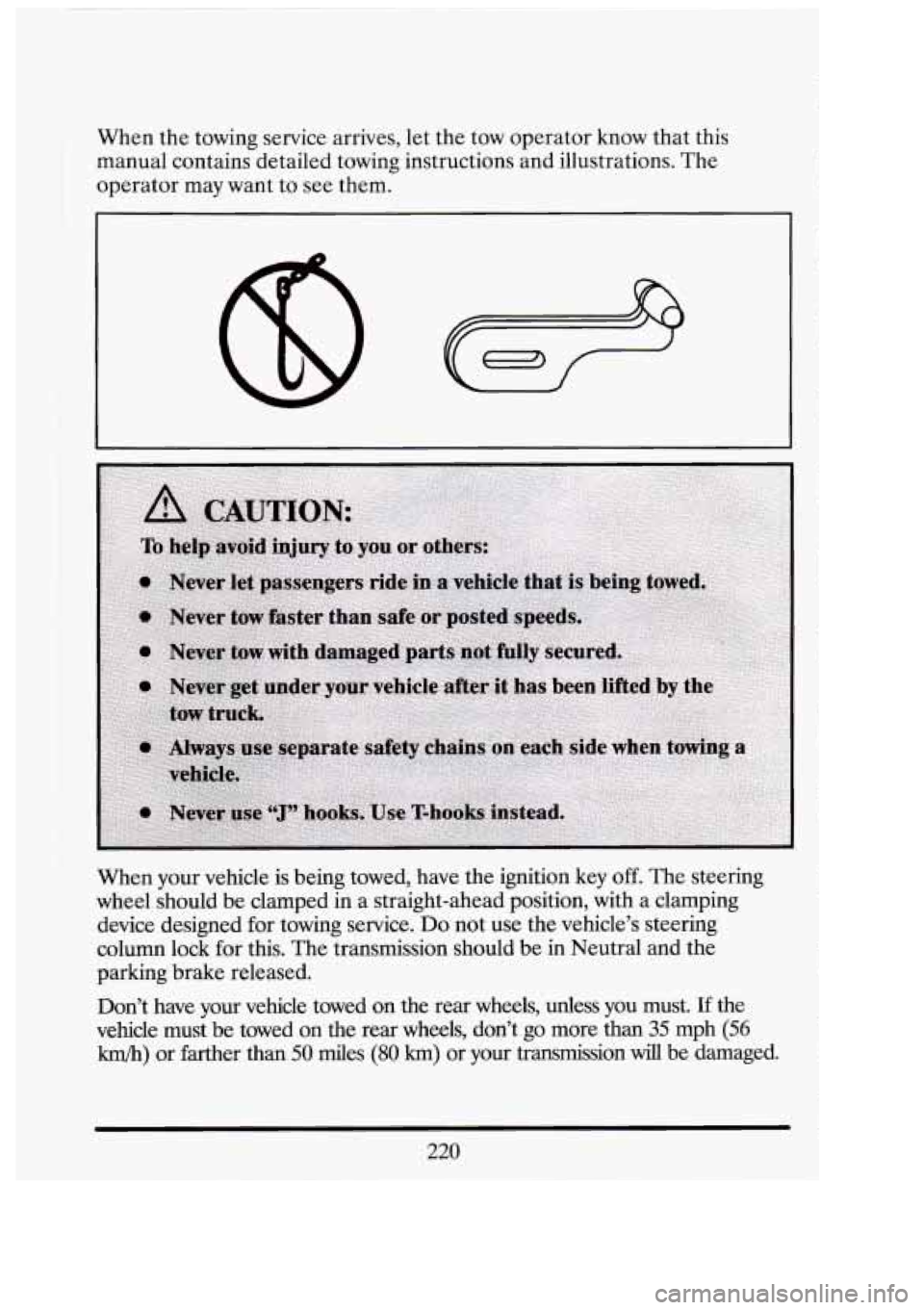
When the towing service arrives, let the tow operator know that this
manual contains detailed towing instructions and illustrations. The
operator may want to see them.
When your vehicle is being towed, have the ignition
key off. The steering
wheel should be clamped in a straight-ahead position, with a clamping
device designed for towing service.
Do not use the vehicle's steering
column lock
for this. The transmission should be in Neutral and the
parking brake released.
Don't have your vehicle towed on the rear wheels, unless you must. If the
vehicle must be towed
on the rear wheels, don't go more than 35 mph (56
km/h) or farther than 50 des (80 km) or your transmission will be damaged.
:!I
u 'I
f
220
Page 237 of 398

NOTICE:
If your engine catches fire because you keep driving with no
coolant, your vehicle can be badly damaged. The costly repairs \
would not be covered by your warranty.
IfNo Steam Is Coming From Your Engine
If you get the overheat warning but see or hear no steam, the problem
may not be too serious. Sometimes the engine can get a little too hot
when you:
0 Climb a long hill on a hot day.
Stop after high speed driving.
0 Idle for long periods in traffic.
Tow a trailer.
I
If you get the overheat warning with no sign of steam, try this for a
minute or
so:
i3‘ I
1. Turn off your air conditioner.
2. Turn on your heater to full hot at the highest fan speed and open the
3. If you’re in a traffic jam, shift to “N” (Neutral).
window
as necessary.
If you no longer have the overheat warning, you can drive. Just to be safe,
drive slower
for about ten minutes. If the warning doesn’t come back on,
you can drive normally.
If the warning continues, pull over, stop, and park your vehicle right
away.
If there’s still no sign of steam, you can idle the engine for two or three
minutes while you’re parked, to see if the warning stops. But then, if you
still have the warning, TURN
OFF THE ENGINE AND GET
EVERYONE OUT OF THE VEHICLE until it cools down.
You may decide not to lift the hood but to get service help right away.
3
224
Page 244 of 398
r IF A TIREGOES FLAT
It’s unusual for a tire to “blow out” while you’re driving, especially if you
maintain your tires properly. If air goes out of a tire, it’s much more likely
to leak out slowly. But
if you should ever have a “blowout,” here are a
few tips about what to expect and what to do:
If a front tire fails, the flat tire will create a drag that pulls the vehicle
toward that side. Take your foot off the accelerator pedal and grip the
steering wheel firmly. Steer to maintain lane position, then gently brake
to a stop well out of the traffic lane.
A rear blowout, particularly on a curve, acts much like a skid and may
require the same correction you’d use in a skid. In any rear blowout,
remove your foot from the accelerator pedal. Get the vehicle under
control by steering the way you want the vehicle to
go. It may be very
bumpy and noisy, but you can still steer. Gently brake to a stop, well off
the road
if possible.
If a tire goes flat, the next section shows how to use your jacking
equipment to change a flat tire safely.
231
Page 247 of 398
-1 L-
I
Rear Fender Skirt
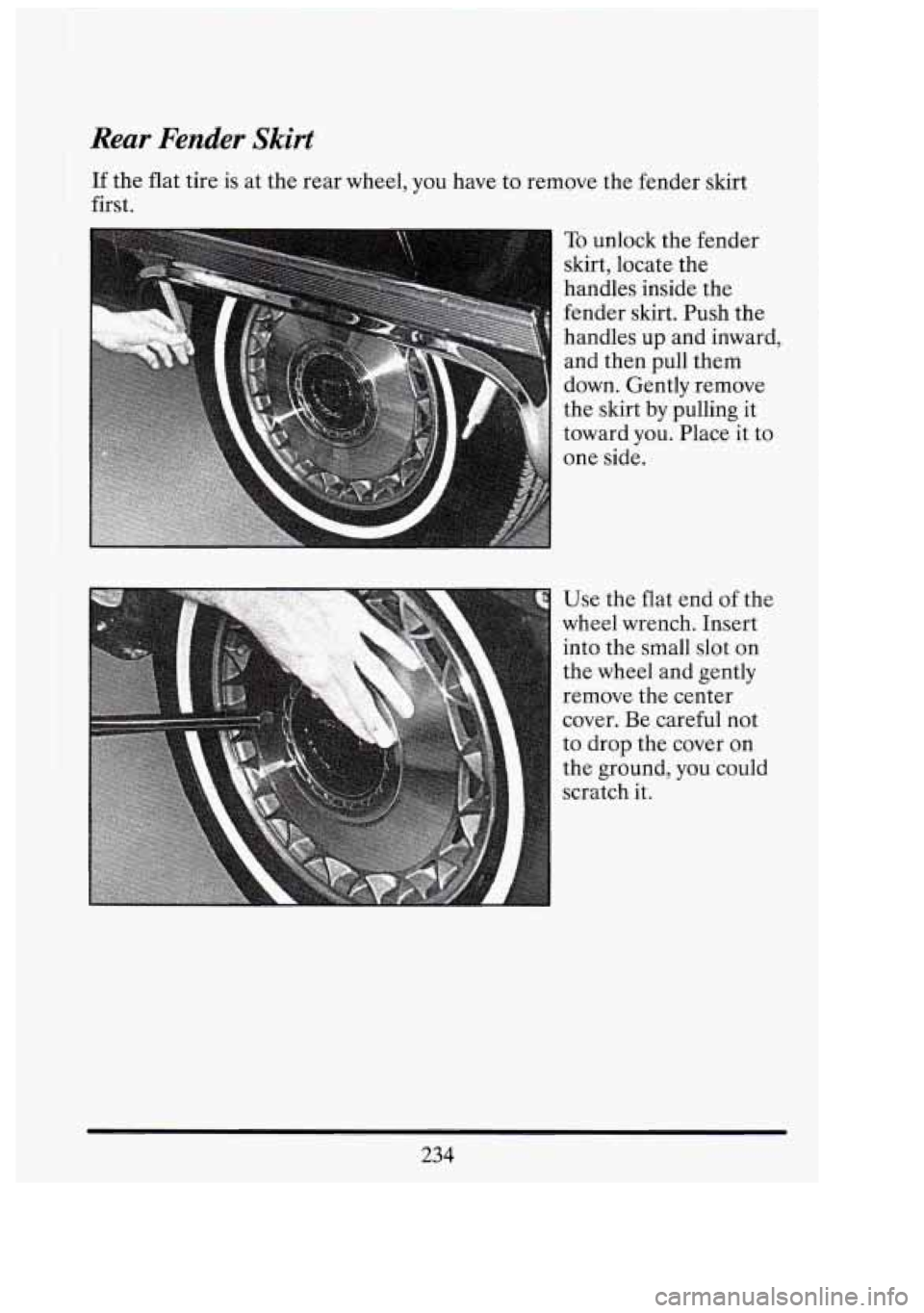
If the flat tire is at the rear wheel, you have to remove the fender skirt
first.
- To unlock the fender
skirt, locate the
handles inside the
fender skirt. Push the
handles up and inward,
and then pull them
down. Gently remove
the skirt by pulling it
toward you. Place it to
one side.
Use the flat end of the
wheel wrench. Insert
into the small slot
on
the wheel and gently
remove the center
cover. Be careful not
to drop the cover on
the ground,
you could
scratch it.
234
nl
I
qi il
Page 251 of 398
, .... .
I
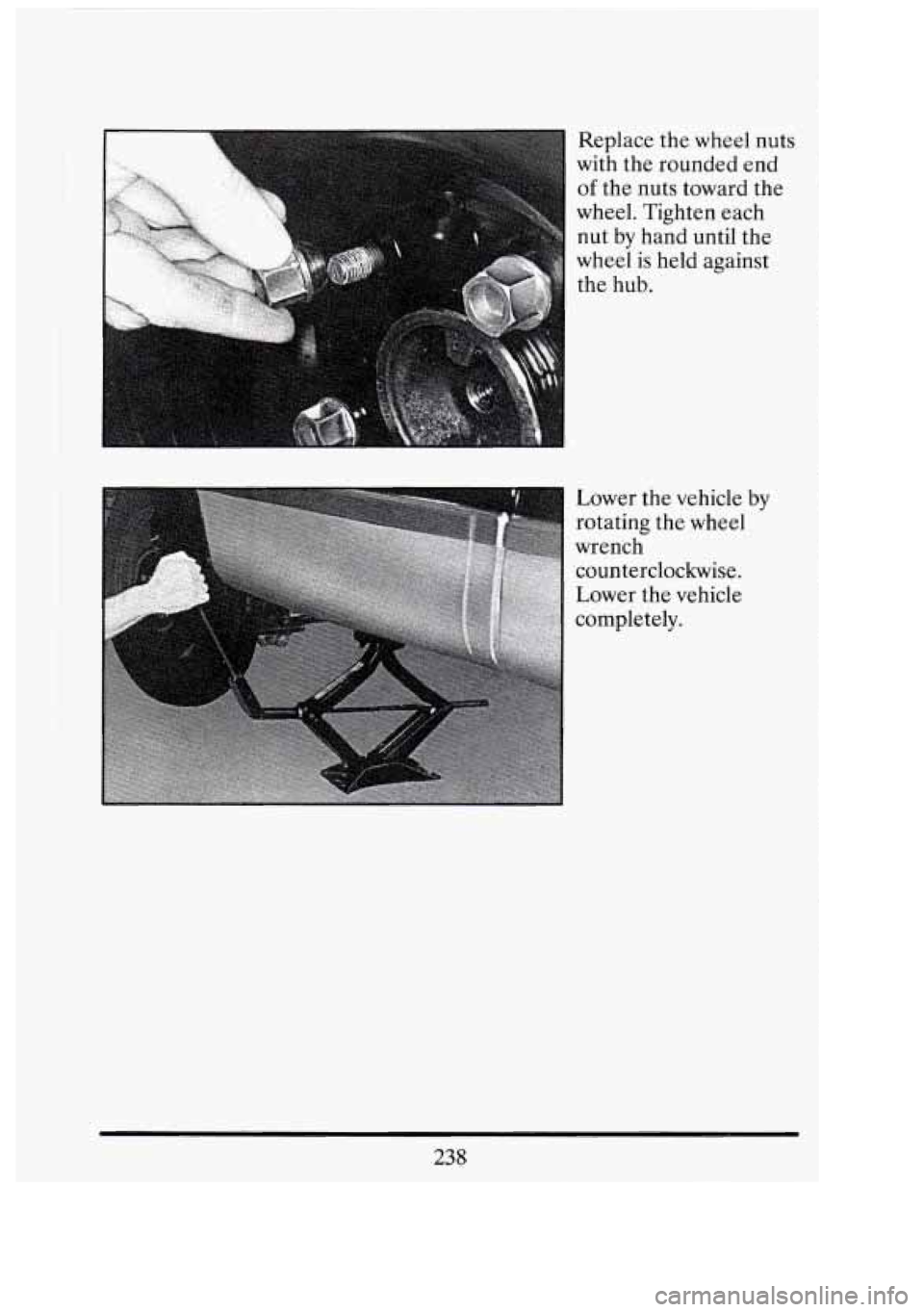
Replace the wheel nuts
with the rounded end
of the nuts toward the
wheel. Tighten each
nut by hand until the
wheel
is held against
the hub.
Lower the vehicle
rotating the wheel
wrench
counterclockwise.
Lower the vehicle
completely.
il
'I'
L
-1
v'
238
Page 257 of 398
I-
IF YOU’RE STUCK: IN SAND, MUD, ICE
OR SNOW
What you don’t want to do when your vehicle is stuck is to spin your
wheels. The method known as “rocking” can help you get out when
you’re stuck, but you must use caution.
I I NOTICE:
Spinning your wheels can destroy parts of your vehicle as well
as the tires. If you spin the wheels too fast while shifting your
transmission back and forth, you can destroy your
transmission.
Rocking your vehicle to get it out:
First, turn your steering wheel left and right. That will clear the area
around your front wheels. You should turn your traction control system
off. (See “Traction Control System”
in the Index.) Then shift back and ’ forth between “R’ (Reverse) and a forward gear, spinning the wheels as
little as possible. Release the accelerator pedal while you shift, and press
lightly on the accelerator pedal when the transmission is in gear.
If that
doesn’t get you out after a few tries, you may need to be towed out.
If you
do need to be towed out, see “Towing Your Vehicle” in the Index.
244
D/