trailer CADILLAC FLEETWOOD 1994 User Guide
[x] Cancel search | Manufacturer: CADILLAC, Model Year: 1994, Model line: FLEETWOOD, Model: CADILLAC FLEETWOOD 1994Pages: 398, PDF Size: 19.19 MB
Page 219 of 398
Trailer Hitching Procedure Using A Weight
Distributing (Equalizing) Hitch
(Recommended for loaded trailers weighing 3,000 lbs. to 7,000 lbs.)
Your vehicle is equipped with an Electronic Level Control (ELC) feature.
When hooking up a trailer using a weight distributing hitch, always use
the following procedure:
0
0
0
0
0
Place the vehicle on a level surface without the trailer hitched. With
the ignition off, and all doors closed, allow the vehicle to level
automatically.
Disable the Electronic Level Control (ELC) by pulling
MAXI@
fuse #9 (30 AMP) from the underhood electrical center located on
the passenger side wheel housing in the engine compartment. Remove
the cover to gain access.
Attach the trailer to the vehicle. The trailer tongue should weight
12%
of the total loaded trailer weight.
Level the vehicle with the load leveling spring bars (equalizers).
Leave the fuse out while towing your trailer.
n It
I
I
E'
NOTICE:
Adjusting an equalizing hitch with the Electronic Level Control \
(ELC) system engaged will defeat the function of the load
equalizing hitch and may cause unsatisfactory handling.
Once you have completed towing your trailer, be sure to reinstall the
Electronic Level Control (ELC) fuse.
In Addition
Use two friction sway controls if your trailer is over 5,000 lbs. .(2270
kg) loaded weight, and/or is. over 24'. long..
0 Use at least one friction sway control if your trailer is over 2,000 lbs.
(908 kg) loaded weight, and consider using one for trailers under
2,000 lbs. (908 kg).
ill
i
3
206
Page 220 of 398

r
NOTICE:
Do not use sway control devices on trailers equipped with surge
brakes, i.e. boat trailers. Surge brakes do not function proper\
ly
when used with most sway control devices.
0 Trailer brakes of adequate size are recommended on trailers over
1,000 lbs loaded weight.
If trailer is over 5,000 lbs. (2270 kg), adjust vehicle rear tire pressure
to (35 psi. cold tire pressure).
Use a Reese custom made weight distributing hitch or the equivalent
for your Cadillac Fleetwood. (Reese product part number 36042)
Safety Chains
You should always attach chains between your vehicle and your trailer.
Cross the safety chains under the. tongue of the trailer
so that the
tongue will not drop to the road
if it becomes separated from the hitch.
Instructions about safety chains may be provided by the hitch
manufacturer or by the trailer manufacturer. Follow the manufacturer’s
recommendation for attaching safety chains. Always leave just enough
slack
so you can turn with your rig. And, never allow safety chains to drag
on the ground.
Trailer Brakes
If your trailer weighs more than 1,000 pounds (450 kg) loaded, it needs to
be equipped with adequate brakes. Be sure to read and follow the
instructions for the trailer brakes
so you’ll be able to maintain them
properly.
Because you have anti-lock brakes, don’t try to tap into your vehicle
hydraulic brake system. If you do, both brake systems won’t work well, or
at all.
207
Page 221 of 398
I
Trailer Wiring Harness
I
If your Fleetwood is equipped with one of the heavy duty trailering
options, a
5 wire trailering harness is located in the trunk. You may have
to have it wired to your vehicle.
These trailer harness color codes should be followed when connecting to
your trailer:
White: Direct Trailer Ground for Trailer Lights
Brown: Park Lamps
Yellow: Left Turn and Stop Lamps
Dark Green: Right Tuh and Stop Lights
Dark Blue: Auxiliary Circuit
DRIFTNG WTHA TWLER
Safe trailer towing requires a certain amount of experience. Before
setting out
for the open road, you'll want to get to know your rig.
Acquaint-yourself with the feel
of handling and braking with the added
weight of the trailer. Always keep in mind that the vehicle you are driving
is longer and not nearly as responsive as your vehicle is by itself.
Before you start, check the trailer hitch and safety chains, electrical
connector, lights, tires and mirror adjustment.
If the trailer has electric
brakes, start your vehicle and trailer moving and apply the trailer brakes
by hand to be sure the brakes are working. This also checks your
electrical connection at the same time.
During your trip check occasionally to be sure that the load is secure and
that the lights and trailer brakes are operating correctly.
Following Distance
Stay at least twice as far behind the vehicle ahead as you would when
driving your vehicle without a trailer. This can help you avoid situations
that require heavy braking and sudden turns.
208
I
I
Page 222 of 398
Passing
You’ll need more passing distance ahead when you’re towing a trailer.
Because you’re longer, you’ll need to go much farther beyond the passed
vehicle before you can return to your lane.
Backing Up
Hold the bottom of the steering wheel with one hand. Then, to move the
trailer to the left, just move that hand to the left.
To move the trailer to
the right, move your hand to the right. Always back up slowly and, if
possible, have someone guide you.
Making Turns
When you’re turning with a trailer, make wider turns than normal. Do
this so your trailer won’t strike soft shoulders, curbs, road signs, trees, or
other objects. Avoid jerky or sudden maneuvers. Signal well in advance.
Turn Signals When Towing a Trailer
When you tow a trailer, your vehicle has to have a different turn signal
flasher and extra wiring. The green arrows on your instrument panel will
flash whenever you signal a turn or lane change. Properly hooked up, the
trailer lights will also flash, telling other drivers you’re about to turn,
change lanes or stop.
When towing a trailer, the green arrows on your instrument panel will
flash for turns even if the bulbs on the trailer are burned out. Thus, you
may think drivers behind you are seeing your signal when they are not.
It’s important to check occasionally to be sure the trailer bulbs are still
working.
Driving On Grades
Reduce speed and shift to a lower gear before you start down a long or
steep downgrade.
If you don’t shift down, you might have to use your
brakes
so much that they get hot and no longer work well.
209
Page 223 of 398
On a long uphill grade, shift down to a lower gear and reduce your speed
and reduce your speed to around
45 mph (70 km/h) to reduce the
possibility of engine and transmission overheating.
If your trailer weighs more than
2,000 pounds (908 kg), you should drive
in “D or 3” instead of Overdrive. This allows the torque convertor clutch
to engage and allowing the transmission to run cooler.
Parking on Hills
You really should not park your vehicle, and trailer on a hill. If something
goes wrong your rig could start to move. People can be injured and both
I your vehicle and the trailer can be damaged.
If you eve1 have to park your rig on a hill, here’s how to do it:
Apply your regular brakes, but don’t shift into “P7, (Park) yet.
I Have someone place chocks (tapered triangular blocks) under the
downhill side the trailer wheels.
When the wheel chocks are in place, release the regular brakes until
Reapply the regular brakes. Then shift into “P” (Park) and apply the
Release the regular brakes.
the
chocks absorb the load.
parking brake.
When You Are Ready to Leave Afier Parking on a Hill
1. Apply your regular brakes and hold the pedal down while you:
Start your engine;
Shift into a gear; and
Be sure the parking brake has released.
2. Release the brake pedal.
3. Drive slowly until the trailer is clear of the chocks.
iI;
n
Gi
I B
h I1
-1
l
U1
a‘ I
210
4. Stop and have someone pick up and store the chocks.
Page 224 of 398
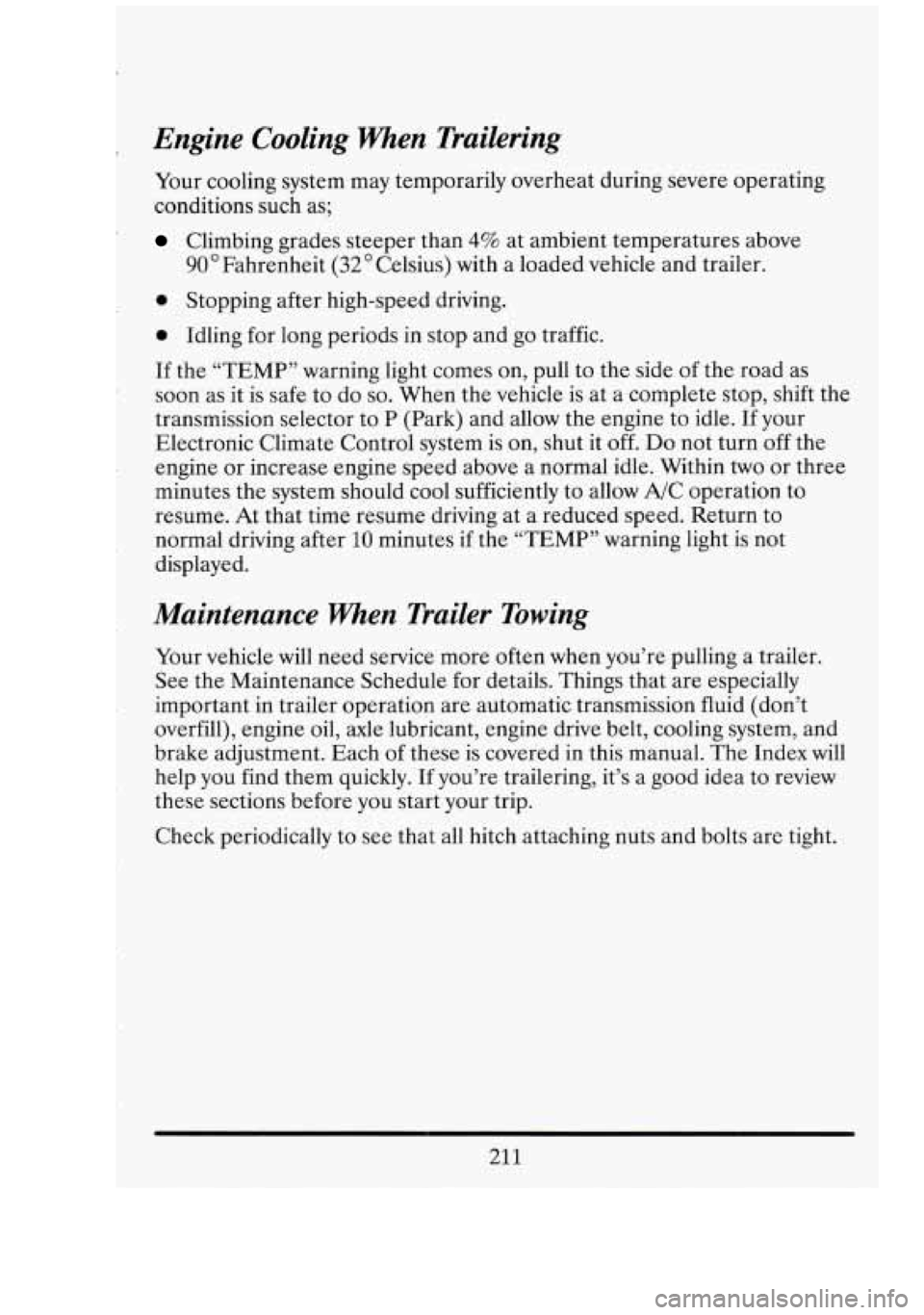
Engine Cooling When Trailering
Your cooling system may temporarily overheat during severe operating
conditions such as;
Climbing grades steeper than 4% at ambient temperatures above
90’Fahrenheit (32O Celsius)
with a loaded vehicle and trailer.
0 Stopping after high-speed driving.
0 Idling for long periods in stop and go traffic.
If the “TEMP” warning light comes on, pull
to the side of the road as
soon as it is safe to do
so. When the vehicle is at a complete stop, shift the
transmission selector to P (Park) and allow the engine to idle. If your
Electronic Climate Control system is on, shut it
off. Do not turn off the
engine or increase engine speed above a normal idle. Within
two or three
minutes the system should cool sufficiently to allow A/C operation to
resume. At that time resume driving at a reduced speed. Return to
normal driving after
10 minutes if the “TEMP” warning light is not
displayed.
Maintenance when Trailer Towing
Your vehicle will need service more often when you’re pulling a trailer.
See the Maintenance Schedule for details. Things that are especially
important in trailer operation are automatic transmission fluid (don’t
overfill), engine oil, axle lubricant, engine drive belt, cooling system, and
brake adjustment. Each of these is covered in this manual. The Index will
help you find them quickly. If you’re trailering, it’s a good idea to review
these sections before you start your trip.
Check periodically to
see that all hitch attaching nuts and bolts are tight.
21
1
Page 237 of 398

NOTICE:
If your engine catches fire because you keep driving with no
coolant, your vehicle can be badly damaged. The costly repairs \
would not be covered by your warranty.
IfNo Steam Is Coming From Your Engine
If you get the overheat warning but see or hear no steam, the problem
may not be too serious. Sometimes the engine can get a little too hot
when you:
0 Climb a long hill on a hot day.
Stop after high speed driving.
0 Idle for long periods in traffic.
Tow a trailer.
I
If you get the overheat warning with no sign of steam, try this for a
minute or
so:
i3‘ I
1. Turn off your air conditioner.
2. Turn on your heater to full hot at the highest fan speed and open the
3. If you’re in a traffic jam, shift to “N” (Neutral).
window
as necessary.
If you no longer have the overheat warning, you can drive. Just to be safe,
drive slower
for about ten minutes. If the warning doesn’t come back on,
you can drive normally.
If the warning continues, pull over, stop, and park your vehicle right
away.
If there’s still no sign of steam, you can idle the engine for two or three
minutes while you’re parked, to see if the warning stops. But then, if you
still have the warning, TURN
OFF THE ENGINE AND GET
EVERYONE OUT OF THE VEHICLE until it cools down.
You may decide not to lift the hood but to get service help right away.
3
224
Page 276 of 398
r
r
ec
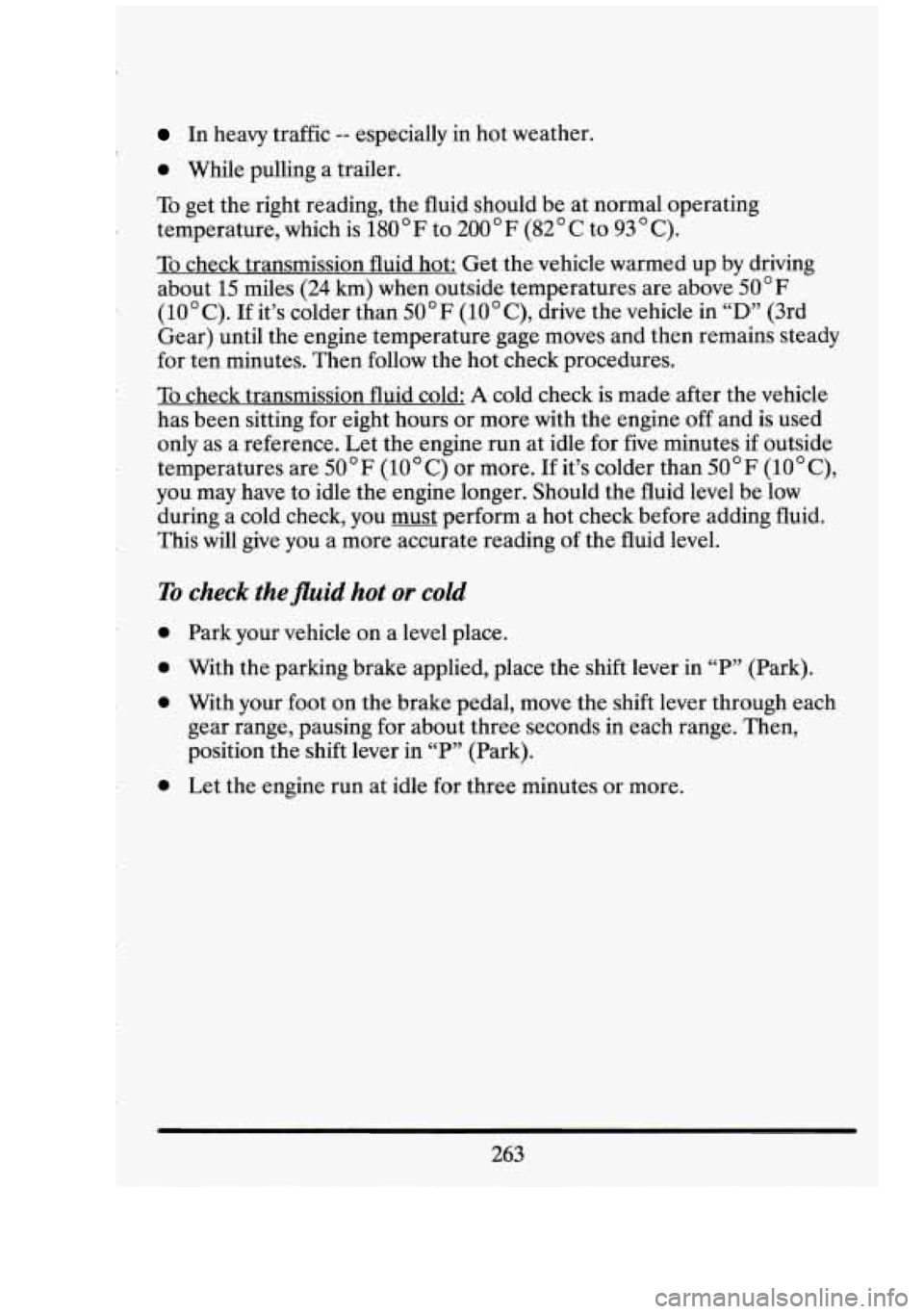
In heavy traffic -- especially in hot weather.
0 While pulling a trailer.
To get the right reading, the fluid should be at normal.operating
temperature, which is
180 " F .to -200 " F (82' C to 93 " C).
To check transmission fluid hot: Get the.vehicle warmed up by driving
about
15 miles (24 km) when outside temperatures are above 50°F
(10" C). If it's colder than 50°F (10" C), drive the vehicle in "D" (3rd
Gear) until the engine temperature gage moves and then remains steady
for ten minutes. Then follow the hot check procedures.
To check transmission fluid cold: A cold check is made after the vehicle
has been sitting for eight hours or more with the engine
off and is used
only as a reference. Let the engine run at idle for five minutes
if outside
temperatures are
50 " F (10 " C) or more. If it's colder than 50 " F (10 " C),
you may have to idle the engine longer. Should the fluid level be low
during a cold checkj you must perform a hot check before adding fluid.
This will give you a more accurate reading
of the fluid level.
To check thefluid hot or cold
0 Park your vehicle on a level place.
0 With the parking brake applied, place the shift lever in "P" (Park).
0 With your foot on the brake pedal, move the shift lever through each
gear range, pausing for about three seconds in each range. Then,
position the shift lever in "P" (Park).
0 Let the engine run at idle for three minutes or more.
263
Page 381 of 398
Automatic Transmission Fluid ........................ 262
Axle. Rear
........................................ 265
Baby Restraint
...................................... 50
Battery ........................................... 276
Battery Cables. Starting With
......................... 215
Beam. Headlight. High-Low Switch
................... 107
Belt Lap
............................................ 39
Lap-Shoulder
.................................... 21
RearSeat
.................................... 41. 42
Blizzard. If You’re Caught In
A ....................... 199
Block Heater. Engine
................................ 89
BloodAlcoholLevel
................................ 167
Boat. Towing A
.................................... 201
Brake Adjustment
................................. 178. 275
Master Cylinder
................................. 272
Parking
......................................... 94
Pedal Travel
................................ 178. 275
Brake System. Antilock. Warning Light
................ 133
Brake System Warning Light
......................... 132
Brake
To Shift Light ................................ 140
Brakes. Antilock
................................... 173
Brakes. Trailer
..................................... 207
Braking
........................................... 172
Braking
If Your Engine Stops ........................ 172
“Break.1n”. New Vehicle
............................. 85
Break-In Schedule. When Towing
A Trailer ............. 202
Bulb Chart
........................................ 317
Bulb. Center High Mounted Stop Lamp
................ 286
Bulb. Cornering Lamp Removal
...................... 278
Bulbs. Taillight Replacement
......................... 281
Bulbs. Turn Signal
.................................. 317
Fluid
.......................................... 273
Lining Replacement. How To Drive After
............ 276
Brakewear
................................... 177. 274
Brakes. Rear
...................................... 275
Braking in Emergencies
............................. 179
Bulbs. Halogen Removal
............................ 279
C
Cables. Battery. Starting With ......................... 215
Camper. Towing
A .................................. 201
Capacities. Fluid
................................... 322
Car Jack Instructions
............................... 235
I !
i3
I
31
nl
2
Page 384 of 398
.
n
I
.
.
.
1
. .
.
.
Drunken ....................................... 167
Hill and Mountain
............................... 194
In A Foreign Country
............................ 248
In Cities
........................................ 190
On Snow Or Ice
................................. 197
In The Rain
..................................... 187
InWinter
....................................... 196
On A Long Trip
................................. 192
On The Freeway
................................. 191
OnCurves
...................................... 179
Through Deep Standing Water
...................... 88
With A Trailer ................................... 208
Drunken Driving
................................... 167
Electric Outside Mirror Control
...................... 123
Electrical Equipment. Adding
.................... 152. 311
Electronic Climate Control
.......................... 147
Electronic Level Control
............................ 143
Electronic Solar Sensor
............................. 150
Emergencies. Braking in
............................. 179
Emergencies. Steering In
............................ 180
Emergency Starting. Discharged Battery ............... 214
Emergency Towing
................................. 219
Engine Block Heater
.................................... 89
Coolant
........................................ 266
Coolant Heater
................................... 89
Exhaust
........................................ 100
Oil
............................................ 254
Oil Additives
.................................... 260
Oil Pressure Light ............................... 137
Oil. When
To Change ............................. 260
Overheating
.................................... 223
Warning Light About Need For Service
............. 142
Englishwetric Button
............................... 130
Ethanol In Gasoline
................................ 247
Exhaust. Caution
................................... 100
Exhaust. Dangerous Gas In ...................... 100. 200
Exhaust. Engine
.................................... 100
Expectant Mothers. Use Of Safety Belts By
.............. 38
Explanation
of Maintenance Service ........ See Maint . Book
Express Down Window (Driver’s Side)
................. 103
Expressway Driving
................................. 191
Extender. Safety Belt
................................ 65
Coolant Temperature
Warning Lights
............... 136
StartingYour
.................................... 86
5