weight CADILLAC FLEETWOOD 1994 Owners Manual
[x] Cancel search | Manufacturer: CADILLAC, Model Year: 1994, Model line: FLEETWOOD, Model: CADILLAC FLEETWOOD 1994Pages: 398, PDF Size: 19.19 MB
Page 111 of 398
having Your Vehicle With the Engine Running
Torque Lock (Automatic Transmission)
If you are parking on a hill and you don’t shift your transmission into “P”
(Park) properly, the weight of the vehicle may put too much force
on the
parking pawl in the transmission.
You may find it difficult to pull the shift
lever out
of “P” (Park). This is called “torque lock.” To prevent torque
lock, always be sure to shift into “P” (Park) properly before you leave the
driver’s seat.
To find out how, see “Shifting Into ‘P’ (Park)” in the Index.
If “torque lock” does occur, you may need to have another vehicle push
yours a little uphill to take some of the pressure from the transmission,
so
you can pull the shift lever out of “P” (Park).
SHIFTING OUT OF “P” (PARK)
Your Cadillac has a brake-transmission shift interlock. You have to fully
apply your regular brake before you can shift from
“P” (Park) when the
ignition is in the “Run” position. See “Automatic Transmission”
in the
Index.
If you cannot shift out of “P” (Park), ease pressure on the shift lever --
push the shift lever all the way into “P” (Park) as you maintain brake
application. Then move the shift lever into the gear you want.
If you ever
hold the brake pedal down but still can’t shift out of “P” (Park), try this:
1. Turn the key to “Off.” Open and close the driver’s door to turn off the
Retained Accessory Power feature.
3
r
b 4
Ir
Eli
I
98
Page 180 of 398
0 How much alcohol is in the drink.
a The drinker's body weight.
* The amount of food that is consumed before and during drinking.
The length of time it has taken the drinker to consume the alcohol.
Page 182 of 398
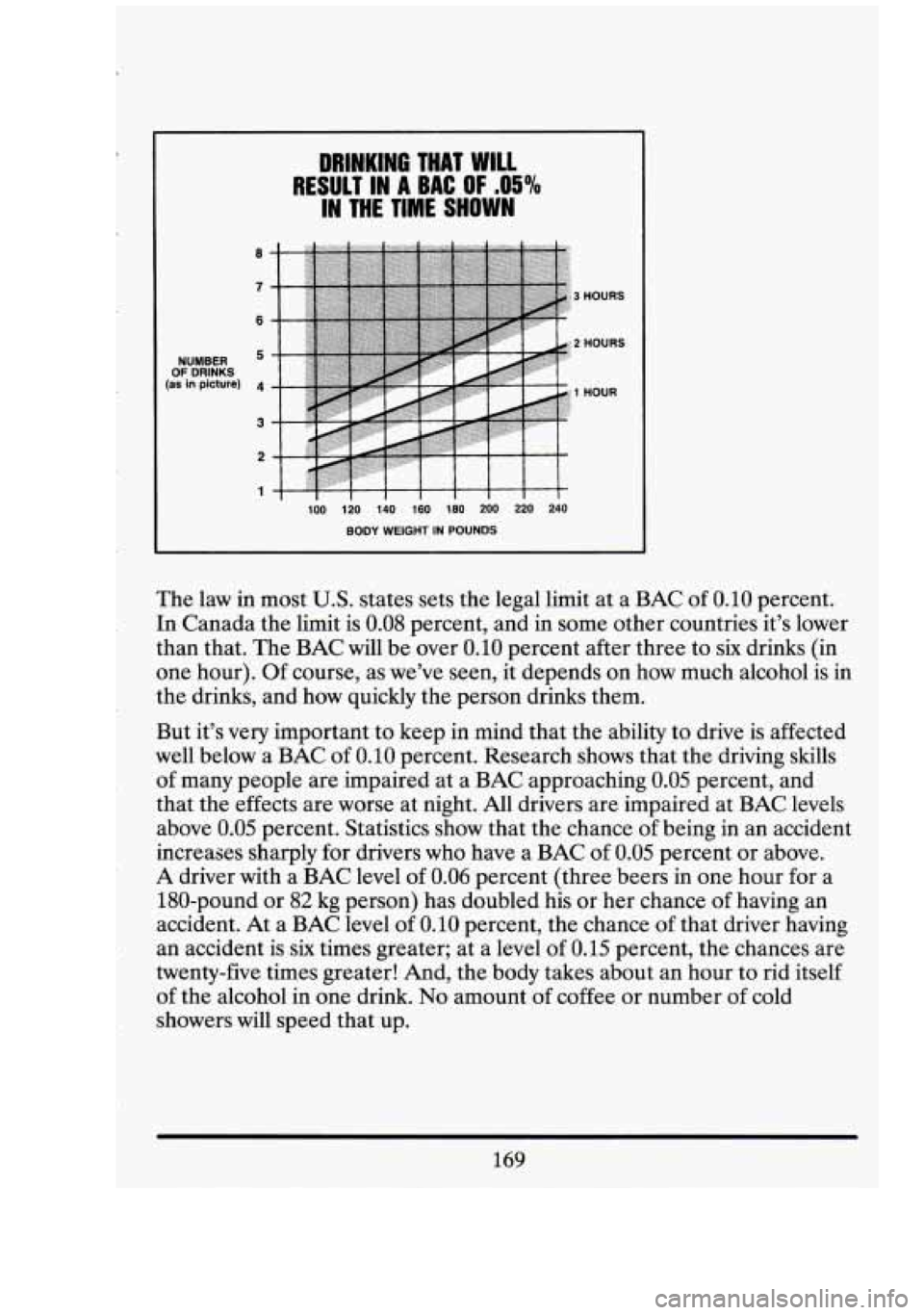
DRINKING THAT WILL
RESULT IN A BAC OF .O5%
IN THE TIME SHOWN
OF DRINKS
NUMBER (as in picture)
100 120 140
160 180 200 220 240
BODY WEIGHT IN POUNDS
The law in most U.S. states sets the legal limit at a BAC of 0.10 percent.
In Canada the limit is
0.08 percent, and in some other countries it’s lower
than that. The BAC will be over
0.10 percent after three to six drinks (in
one hour). Of course, as we’ve seen, it depends on how much alcohol is in
the drinks, and how quickly the person drinks them.
But it’s
very important to keep in mind that the ability to drive is affected
well below a BAC
of 0.10 percent. Research shows that the driving skills
of many people are impaired at a BAC approaching
0.05 percent, and
that the effects are worse at night. All drivers are impaired at BAC levels
above
0.05 percent. Statistics show that the chance of being in an accident
increases sharply for drivers who have a BAC of
0.05 percent or above.
A driver with a BAC level of
0.06 percent (three beers in one hour for a
180-pound or
82 kg person) has doubled his or her chance of having an
accident. At a BAC level
of 0.10 percent, the chance of that driver having
an accident is
six times greater; at a level of 0.15 percent, the chances are
twenty-five times greater! And, the body takes about an hour to rid itself
of the alcohol in one drink.
No amount of coffee or number of cold
showers will speed that up.
169
Page 214 of 398

TOWING A TRAILER
NOTICE:
Pulling a trailer improperly can damage your vehicle and result\
in costly repairs not covered by your warranty.
To pull a trailer
correctly, follow the advice in this section.
Your Cadillac is a passenger vehicle. Trailer towing can change the way
your vehicle performs on the road. The loads and forces created when
trailering subject the vehicle
to significant levels of stress.
Load pulling components such as the engine, transmission, rear axle,
wheel assemblies, and tires are forced to work harder against the drag of
the added weight. The engine is required to operate at relatively higher
speeds and under greater loads, which generates extra heat. Trailer
towing adds considerably to wind resistance which increases pulling
requirements.
All this means changes in:
Handling
Durability
Fuel Economy
201
Page 215 of 398
I
If You Do Decide To Pull A Trailer
If you do, here are some important points.
There are many different laws including speed limit restrictions which
apply to trailering. Make sure your rig
will be legal, not only where
you live but also where you’ll be driving.
A good source for this
information can be state or provincial police.
You should always use a load equalizing hitch if your trailer will weigh
more than
2,000 pounds (900 kg). Consider using sway control if your
loaded trailer will weigh
2,000 pounds (900 kg) or less. If your loaded
trailer will weigh
2,000 pounds (900 kg.) or more you should use both
load equalizing hitch and sway control.
NOTICE:
Do not use sway control devices on trailers equipped with surge
brakes, i.e. boat trailers. Surge brakes
do not function properly
when used with most sway control devices.
Don’t tow a trailer during the first 1000 miles (1600 km) your new
vehicle is driven. The engine, axle or other parts could be damaged.
5 During the first 1,000 miles (1600 km) that you tow a trailer, don’t
drive over
50 mph (80 km/h) and avoid full throttle starts. This helps
the engine and other parts
of your vehicle wear in at the heavier loads.
Avoid continuous operation in mountainous areas that have grades
greater than
2% for longer than 5 miles.
A maximum highway speed to 55 mph (90 km/h) when trailering will
enhance the long term durability of your vehicle.
Change axle lubricant annually or every 7,500 miles (12,500 km) of
trailer towing, whichever occurs first.
0 Three important considerations have to do with weight:
202
o/
I
I
c
nl
I
‘p’
u,
Page 216 of 398
1. Weight of the ’hailer
How heavy can a trailer safely be? It should never weigh more than
2,000 pounds (907 kg) including the load. Unless you have one of
the optional Trailer Towing Packages.
Trailer weight
also depends on how you plan to use your rig. For example,
speed, altitude, road grades, outside temperature and how much \
your
vehicle is used to
pull a trailer are all important. It can also vary depending
on any special equipment that you have on your vehicle.
You can ask your dealer for trailering information or advice, or at
Cadillac, you can call 1-800-43FLEET
In Canada, write to General Motors of Canada Limited, Customer
Assistance Center, 1908 Colonel Sam Drive, Oshawa, Ontario
L1H
8P7.
2.
Weight of the ’hailer Tongue
The gross vehicle weight includes the weight of the vehicle, any
cargo you may carry in it, and the people who will be riding
in the
vehicle.
If you are towing a trailer, you must subtract the tongue load
from the vehicle’s capacity, because your vehicle will be carrying that
weight, too. See “Loading Your Vehicle” in the Index for more
information about your maximum vehicle’s load capacity.
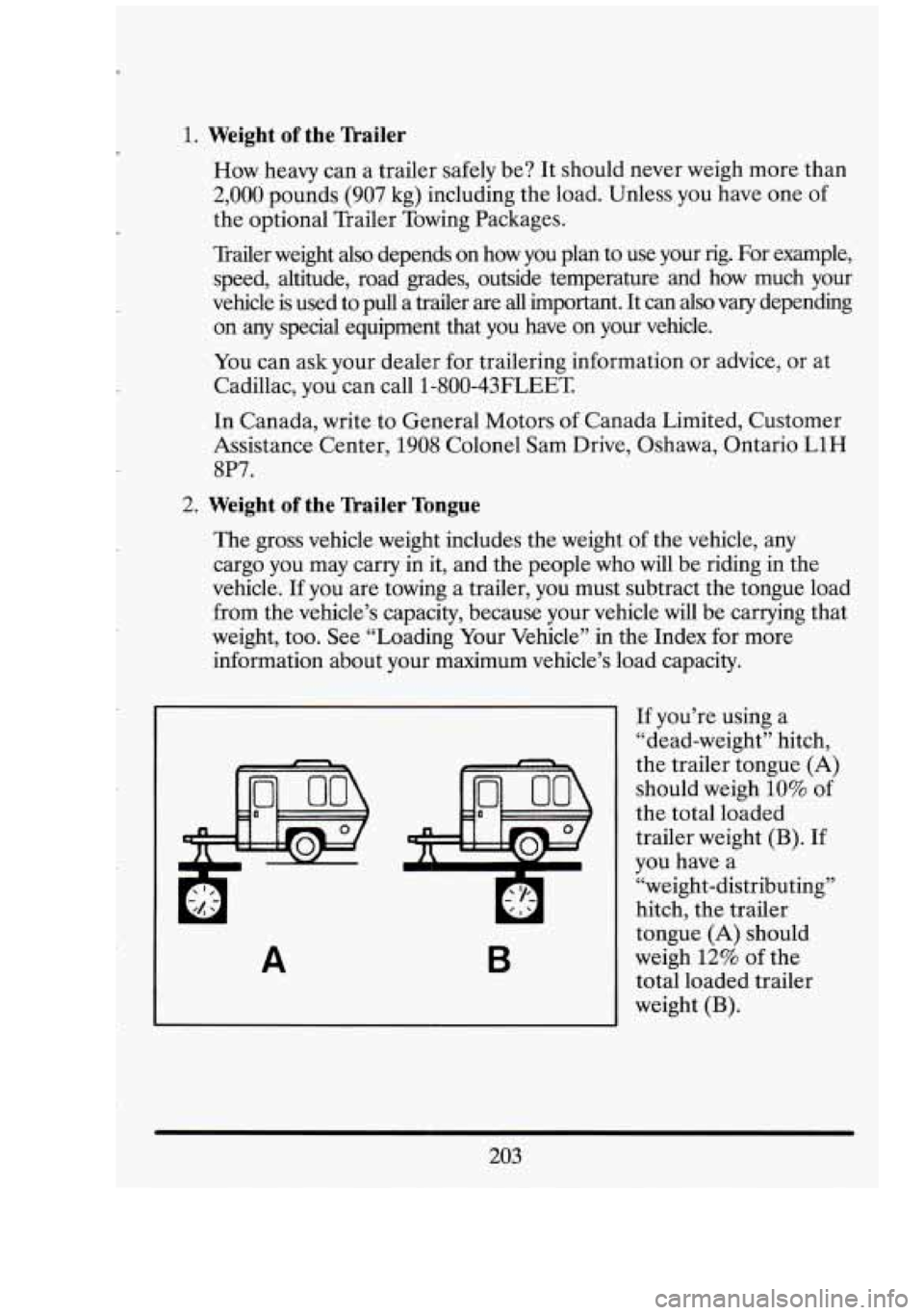
A B
If you’re using a
“dead-weight” hitch,
the trailer tongue (A)
should weigh 10% of
the total loaded
trailer weight
(B). If
you have a
“weight-distributing”
hitch, the trailer
tongue
(A) should
weigh 12% of the
total loaded trailer
weight
(B).
203
Page 217 of 398
I I
31 i
After you’ve loaded your trailer, weigh the trailer and then the
tongue separately to see if the weights are proper. If they aren’t,
you may be able to change them simply by moving some items in
the trailer.
3.
Total Weight on Your Vehicle Tires
Be sure your vehicle tires are inflated to maximum recommended
cold tire pressure. You’ll find these numbers on the Certification
label at the rear edge
of the driver’s door (or see “Tire Loading’’ in
the Index).
Gross Combined Vehicle Weight Rating (GCvmC)
GCVWR = Curb Weight + 2 Passengers + Cargo + Trailer
WHERE: Vehicle Curb Weight
= 4,368 lbs.
2 Passengers = 150 lbs. (Each)
Cargo
= 200 lbs.
+ Safety Factor
How Equipped GCWR
Standard Vehicle Up to 2,000 lbs. (908 kg)
With 5,000 lbs. (2270 kg)
With 7,000 lbs. (3178 kg) Trailer
................................... .7,450
lbs. (3178 kg)
Trailer Tow Option (V92)
.................... 10,800 lbs. (3382 kg)
Trailer Tow Option (V4P)
.................... 12,100 lbs. (5493 kg)
To determine how your Fleetwood is equipped, see the Service Parts
Identification label on the underside
of the trunk lid.
EI
nl
n I
NOTICE:
Do not exceed the gross vehicle weight rating (GVWR) for your
vehicle.
I I -
204
Page 218 of 398
r Hitches
It’s important to have the correct hitch equipment. Crosswinds, large
trucks going by, and rough roads are a few reasons
why you need the right
hitch. Here are some rules to follow:
If you pull a fully loaded trailer that will weigh more than 2,000
pounds
(900 kg), be sure to use a properly mounted,
weight-distributing hitch and sway control of the proper size. This
equipment is very important for proper vehicle loading and good
handling when you’re driving.
Will you have to make any holes in the body of your vehicle when you
install a trailer hitch?
If you do, be sure to seal the holes to prevent
deadly carbon monoxide (CO) from your exhaust from entering into
your vehicle (see Index under “Carbon Monoxide”).
Don’t let the steel in a hitch contact the aluminum on your bumper. If
you do, the
two will corrode. You can use a insulator such as paint or
plastic tape to separate the steel and aluminum. The same steel to
aluminum corrosion can happen with fasteners, too.
Using A Dead Weight Trailer Hitch
The trailer tongue should weigh 10% of the total trailer load
(maximum 300
lbs.) or as specified by the trailer manufacturer to
minimize sway.
Trailer brakes of adequate size are required on trailers over 1,000 lbs.
(450 kg) loaded weight.
0 If the trailer is over 5,000 lbs. (2270 kg) adjust vehicle rear tire
pressure to (35 psi cold tire pressure).
7
NOTICE:
Surge brakes do not function properly if used with most
equalizer hitches.
Page 219 of 398
Trailer Hitching Procedure Using A Weight
Distributing (Equalizing) Hitch
(Recommended for loaded trailers weighing 3,000 lbs. to 7,000 lbs.)
Your vehicle is equipped with an Electronic Level Control (ELC) feature.
When hooking up a trailer using a weight distributing hitch, always use
the following procedure:
0
0
0
0
0
Place the vehicle on a level surface without the trailer hitched. With
the ignition off, and all doors closed, allow the vehicle to level
automatically.
Disable the Electronic Level Control (ELC) by pulling
MAXI@
fuse #9 (30 AMP) from the underhood electrical center located on
the passenger side wheel housing in the engine compartment. Remove
the cover to gain access.
Attach the trailer to the vehicle. The trailer tongue should weight
12%
of the total loaded trailer weight.
Level the vehicle with the load leveling spring bars (equalizers).
Leave the fuse out while towing your trailer.
n It
I
I
E'
NOTICE:
Adjusting an equalizing hitch with the Electronic Level Control \
(ELC) system engaged will defeat the function of the load
equalizing hitch and may cause unsatisfactory handling.
Once you have completed towing your trailer, be sure to reinstall the
Electronic Level Control (ELC) fuse.
In Addition
Use two friction sway controls if your trailer is over 5,000 lbs. .(2270
kg) loaded weight, and/or is. over 24'. long..
0 Use at least one friction sway control if your trailer is over 2,000 lbs.
(908 kg) loaded weight, and consider using one for trailers under
2,000 lbs. (908 kg).
ill
i
3
206
Page 220 of 398

r
NOTICE:
Do not use sway control devices on trailers equipped with surge
brakes, i.e. boat trailers. Surge brakes do not function proper\
ly
when used with most sway control devices.
0 Trailer brakes of adequate size are recommended on trailers over
1,000 lbs loaded weight.
If trailer is over 5,000 lbs. (2270 kg), adjust vehicle rear tire pressure
to (35 psi. cold tire pressure).
Use a Reese custom made weight distributing hitch or the equivalent
for your Cadillac Fleetwood. (Reese product part number 36042)
Safety Chains
You should always attach chains between your vehicle and your trailer.
Cross the safety chains under the. tongue of the trailer
so that the
tongue will not drop to the road
if it becomes separated from the hitch.
Instructions about safety chains may be provided by the hitch
manufacturer or by the trailer manufacturer. Follow the manufacturer’s
recommendation for attaching safety chains. Always leave just enough
slack
so you can turn with your rig. And, never allow safety chains to drag
on the ground.
Trailer Brakes
If your trailer weighs more than 1,000 pounds (450 kg) loaded, it needs to
be equipped with adequate brakes. Be sure to read and follow the
instructions for the trailer brakes
so you’ll be able to maintain them
properly.
Because you have anti-lock brakes, don’t try to tap into your vehicle
hydraulic brake system. If you do, both brake systems won’t work well, or
at all.
207