mirror CADILLAC SEVILLE 1993 4.G User Guide
[x] Cancel search | Manufacturer: CADILLAC, Model Year: 1993, Model line: SEVILLE, Model: CADILLAC SEVILLE 1993 4.GPages: 407, PDF Size: 22.28 MB
Page 205 of 407

Downloaded from www.Manualslib.com manuals search engine 0
0 0
0
0
Don’t drink and drive. (See “Drunken Driving” in the Index for more
on this problem.)
Adjust your inside rearview mirror to reduce the glare from headlights
behind
you.
Since you can’t see as well, you may need to slow down and keep more
space between you and other vehicles. It’s hard to tell how fast the
vehicle ahead is going just by looking at its taillights.
Slow down, especially on higher speed roads. Your headlights can light
up only
so much road ahead.
In remote areas, watch for animals.
If you’re tired, pull off the road in a safe place and rest.
Night Vision
No one can see as well at night as in the daytime. But as we get older
these differences increase. A 50-year-old driver may require at least twice
as much light to see the same thing at night as a 20-year-old.
What you
do in the daytime can also affect your night vision. For
example, if you spend the day in bright sunshine you are wise to wear
sunglasses. Your eyes
will have less trouble adjusting to night.
But
if you’re driving, don’t wear sunglasses at night. They may cut down
on glare from headlights, but they also make a lot
of things invisible that
should remain visible
- such as parked cars, obstacles, pedestrians, or
even trains blocking railway crossings. You may want to put on your
sunglasses after you have pulled into a brightly-lighted service or
refreshment area. Eyes shielded from that glare may adjust more quickly
to darkness back
on the road. But be sure to remove your sunglasses
before you leave the service area.
You can be temporarily blinded by approaching lights. It can take a
second
or two, or even several seconds, for your eyes to readjust to the
dark. When
you are faced with severe glare (as from a driver who doesn’t
lower the high beams, or a vehicle with misaimed headlights), slow down
a little. Avoid staring directly into the approaching lights. If there is a line
of opposing traffic, make occasional glances over the line
of headlights to
make certain that
one of the vehicles isn’t starting to move into your lane.
191
Page 206 of 407
Downloaded from www.Manualslib.com manuals search engine Once YOU are past the bright lights, give your eyes time to readjust before
resuming speed.
High Beams
If the vehicle approaching you has its high beams on, signal by flicking
yours to high and
then back to low beam. This is the usual signal to lower
the headlight beams. If the other driver still doesn't lowcr thc beams,
resist the temptation to put your high beams on. This only makcs two
half-blinded drivers.
When you follow another
vehiclc on ii Irt'CHiI! or h1gh;n. uw I(VH
beams. True, most vehicles now have d;wnight mirror that cn;rblc rhc
driver to reduce glare. But outside mirrbrs arc' not of thi< typc i\d high
beams from behind can bother the driver ahcad.
A Few More Night Driving Suggestions
Keep your windshield and all the glass on your vehicle clean -- inside and
out. Glare at night is made much worse
by dirt on the glass. Even the
inside
of the glass can build up a film caused by dust. Tobacco smoke also
makes inside glass surfaces
very filmy and can be a vision hazard if it's left
there.
Dirty glass makes lights dazzle and flash more than clean glass would,
making the pupils
of your eyes contract repeatedly. You might even want
to keep a cloth and some glass cleaner
in your vehicle if you need to clean
your glass frequently.
Remember that your headlights light up far less
of a roadway when you
are in
a turn or curve.
Keep your eyes moving; that way, it's easier to pick out dimly lighted
objects.
Just as your headlights should be checked regularly for proper aim, so
should your eyes be examined regularly. Some drivers suffer from night
blindness
-- the inability to see in dim light -- and aren't even aware of it,
192
Page 213 of 407
Downloaded from www.Manualslib.com manuals search engine Obey all posted speed limits. But remember that they are for ideal
road, weather and visibility conditions.
You may need to drive below
the posted limit in bad weather or when visibility
is especially poor.
Pull to the right (with care) and stop clear of intersections when you
see or hear emergency vehicles.
FREEWAY DMNG
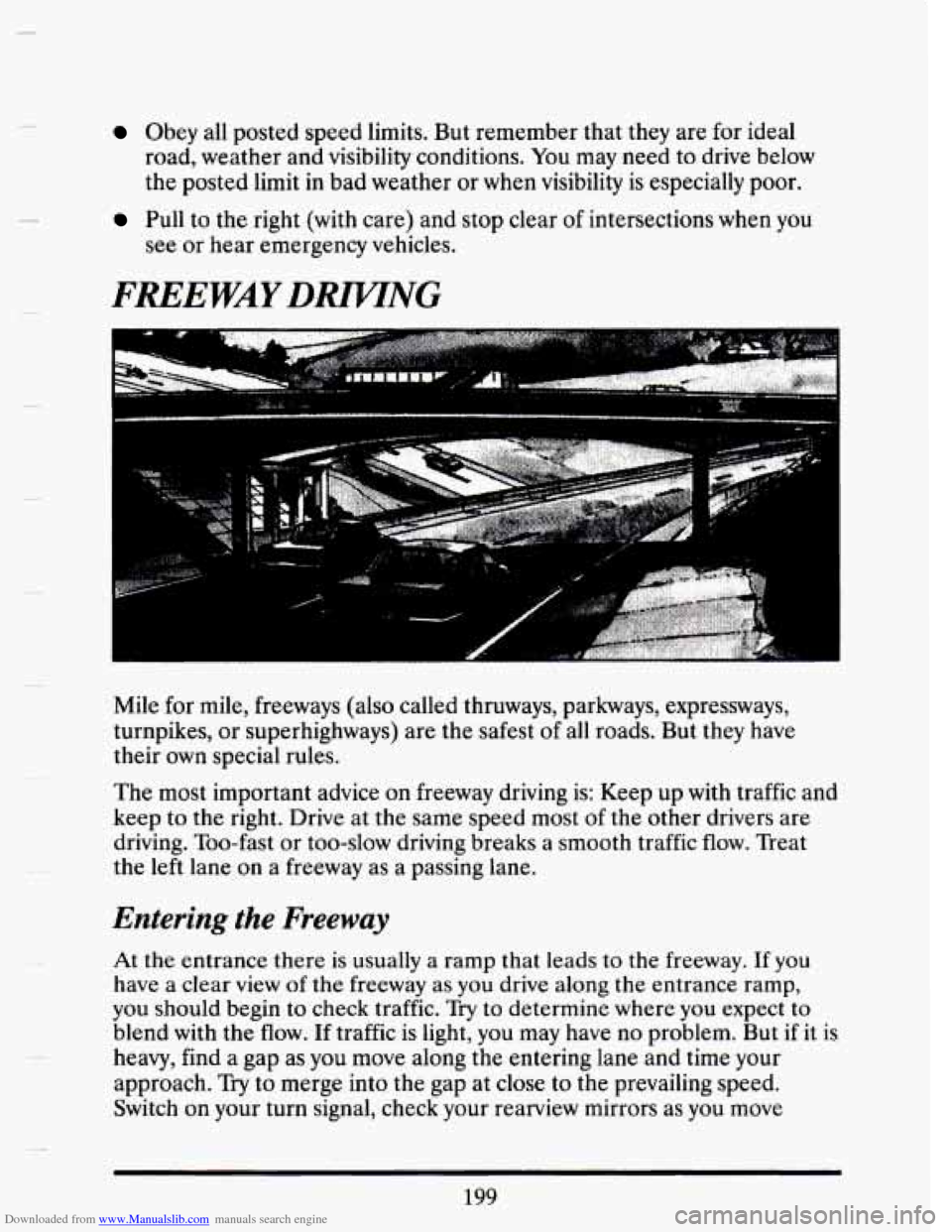
Mile for mile, freeways (also called thruways, parkways, expressways,
turnpikes, or superhighways) are the safest
of all roads. But they have
their own special rules.
The most important advice on freeway driving is: Keep up with traffic and
keep to the right. Drive at the same speed most
of the other drivers are
driving. Too-fast or too-slow driving breaks a smooth traffic
flow. Treat
the left lane on a freeway as a passing lane.
Entering the Freeway
At the entrance there is usually a ramp that leads to the freeway. If you
have a clear view of the freeway as you drive along the entrance ramp,
you should begin to check traffic. Try to determine where you expect to
blend with the flow. If traffic is light, you may have no problem. But if it is
heavy, find
a gap as you move along the entering lane and time your
approach.
Try to merge into the gap at close to the prevailing speed.
Switch on your turn signal, check your rearview mirrors as you move
199
Page 214 of 407
Downloaded from www.Manualslib.com manuals search engine along, and glance over your shoulder as often as necessary. Try to blend
smoothly
with the traffic flow.
Driving on the Freeway
Once you are on the freeway, adjust your speed to the posted limit or to
the prevailing rate
if it’s slower. Stay in the right lane unless you want to
pass.
If you are on a two-lane freeway, treat the right lane as the slow lane
and the left lane as the passing lane.
If you are on a three-lane freeway, treat the right lane as the slower-speed
through lane, the middle lane as the higher-speed through lane,\
and the left
lane as the passing lane.
Before changing lanes, check your rearview mirrors. Then use yo\
ur turn
signal.
Just before you leave the lane, glance quickly over your shoulder to make
sure there isn’t another vehicle in your “blind” spot.
If
you are moving from an outside to a center lane on a freeway having
more than
two lanes, make sure another vehicle isn’t about to move into
the same spot.
Look at the vehicles two lanes over and watch for telltale
signs: turn signals flashing, an increase
in speed, or moving toward the
edge
of the lane. Be prepared to delay your move.
Once you are moving on the freeway, make certain you allow a
reasonable following distance. Expect to move slightly slower at night.
Leaving the Freeway
When you want to leave the freeway, move to the proper lane well in
advance. Dashing across lanes at the last minute is dangerous.
If you miss
your exit do not, under any circumstances, stop and back up. Drive on to
the next exit.
At each exit point is a deceleration lane. Ideally it should \
be long enough
for you to enter it at freeway speed (after signaling, of course) and then
do your braking before moving onto the exit ramp. Unfortunately, not all
deceleration lanes are long enough
-- some are too short for all the
braking. Decide when to start braking.
If you must brake on the through
lane, and
if there is traffic close behind you, you can allow a little extra
200
Page 217 of 407
Downloaded from www.Manualslib.com manuals search engine Then here are some tips:
Make sure your vehicle is well ventilated, with a comfortably cool
Keep your eyes moving. Scan the road ahead and to the sides. Check
interior.
your rearview mirrors frequently and your instruments from time
to
time. This can help you avoid a fixed stare.
Wear good sunglasses in bright light. Glare can cause drowsiness. But
don't wear sunglasses at night. They will drastically reduce your
overall vision at the
very time you need all the seeing power you have.
If you get sleepy, pull off the road into a rest, service, or parking area
and take a nap, get some exercise,
or both. For safety, treat drowsiness
on the highway as an emergency.
As in any driving situation, keep pace with traffic and allow adequate
following distances.
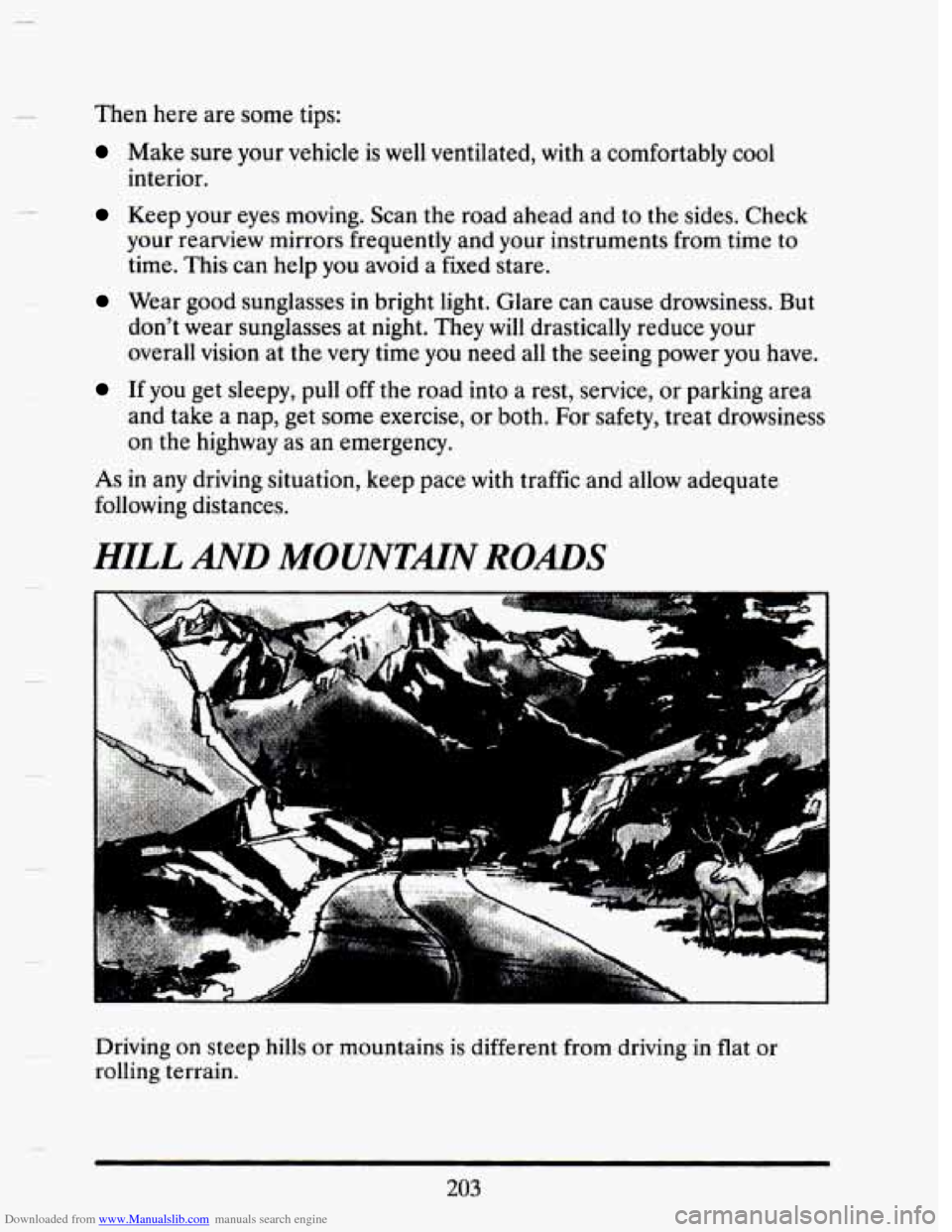
HILL AND MOUNTMN ROADS
Driving on steep hills or mountains is different from driving in flat or
rolling terrain.
203
Page 230 of 407
Downloaded from www.Manualslib.com manuals search engine Safety Chains
You should always attach chains between your vehicle and your trailer.
Cross the safety chains under the tongue
of the trailer so that the tongue
will not drop to the road if it becomes separated from the hitch. Follow
the manufacturer's recommendation for attaching safety chains. Always
leave just enough slack
so you can turn with your rig. And, never allow
safety chains to drag
on the ground.
Trailer Brakes
Does your trailer have its own brakcs'? He sure IO read and follow thc
instructions for the trailer brakes so you'll he ilblc to ir~ i~lI, ;rcliw an3
maintain them properly.
Driving with a Trailer
Towing a trailer requires a certain amount of experience. Before setting
out for the open road, you'll want to get to
know your rig. Acquaint
yourself with the feel of handling and braking with the added weight of
the trailer. And always keep
in mind that the vehicle you are driving is
now a good deal longer and not nearly so responsive as your vehicle is by
itself.
Before you start, check the trailer hitch and platform, safety chains,
electrical connector, lights, tires and mirror adjustment. If the trailer has
electric brakes, start your vehicle and trailer moving and then apply the
trailer brake controller by hand
to be sure the brakes are working. This
lets
you check your electrical connection at the same time.
During your trip, check occasionally to be sure that the load is secure,
and that the lights and any trailer brakes are still working.
216
L -4
c
L-
L-
C
Page 338 of 407

Downloaded from www.Manualslib.com manuals search engine MPERACE CAREIMATERL4LS ClYART
NUMBER
I 1050017 I 32 OZ. 10.946 Ll
1052277 12 02. (0.354 L)
10501 72 16 02. (0.473 L)
1050173 16 02. (0.473 L)
10501 74
32
OZ. (0.946 L) 1050214 16
OZ. (0.473 L)
1050244
6
LB. (2.72 KG) 1050429 23
02. (0.660 L) 1050427 16
OZ. (0.473 L)
1052349
8 OZ. (0.237 L) 1050729 12
02. (0.354 L)
+
1052870 16 OZ. (0.473 L)
1051
398 8 OZ. (0.237 L)
1 105151 5 I 32 02. (0.946 L)
+
1052367 16 02. (0.473 L)
1052753 1 GAL. (3.785 L)
1052271 I 23 02. (0.680 L)
1052358 I 12 OZ. 10.354 LI
I 1052535 I 16 OZ. (0.473 L)
DESCRIPTION
WASHER SOLVENT AND GAS
LINE DE-ICER
POWER STEERING FLUID SPRAY-A-SQUEAK
TAR AND ROAD OIL REMOVER
USAGE
WINDSHIELD WASHING SYSTEM AND GASCINE
POWER STEERING
WEATHER STRIPS-STOPS SQUEAKS ON METAL-TO-METAL AND METAL-TO-RUBBER CONTACT
REMOVES OLD WAXES, POLISHES,
I TAR AND ROAD OIL
CHROME CLEANER AND
I REMOVES RUST AND CORROSION
POLISH ON CHROMEAND STAINLESS I STEEL
WHITE SIDEWALL TIRE CLEANS WHITE AND BLACK TIRES
CLEANER
VINYULEATHER CLEANER
SPOT AND STAIN REMOVAL
ON FABRIC CLEANER SPOT AND STAIN REMOVAL
ON
. ___
LEATHER OR VINYL
CLOTH AND FABRIC
I
GLASS CLEANER I GLASS CLEANING AND SPOT I CLEANING ON VINYLS
MULTI-PURPOSE POWDERED
I CLEANS VINYL AND CLOTH ON
CLEANER
I DOOR TRIM, SEATS, AND
CARPET-ALSO. TIRES AND MATS
DOOR HINGES AND LATCHES
WASH-WAX (CONC.) EXTERIOR WASH
I CLOTH AND FABRIC
GM OPTIKLEEN
f WINDSHIELD WASHER SOLVENT
MAGIC MIRROR CLEANER
POLISH AND ANTI~FREEZE
EXTERIOR CLEANER AND POLISH
I
DEXRONQ HE I AUTOMATIC TRANSMISSION
GM ENGINE OIL
(ETHYLENE GLYCOL BASE) ANTI-FREEZE
ANTI-FREEZE COOLANT
YEAR ROUND COOLANT AND PERMANENT TYPE
USAGE
SUPPLEMENT (E.O.S.) SEE YOUR DEALER
FOR SPECIFIC
GM GEAR LUBRICANT
REAR AXLE
LIMITEDSLIP ADDITIVE I REAR AXLE
DELCO-SUPREME II BRAKE I BRAKE FLUID
324
I
Page 343 of 407

Downloaded from www.Manualslib.com manuals search engine c
P
___.__ HDIP Lo HDLP HI R H'C HI IGN 3 COOL FAN TRANSECS
i I
I FUSE CENTER IDENTIFICATION J
ENGINE COMPARTMENT FUSE BLOCK
COIL 20A - 4.9L DISTRIBUTOR - 4.6L IGNtTION CONTROL MODULE SIR 2OA
- DIAGNOSTIC ENERGY RESERVE - - - - - - -
LF4 DERM) SIR (AIR BAG) - MlNG SENSOR
PCM (IO 1.OA - POWE Y TRAIN CONTROL MODUL
INJ IOA - PASSKeyS DECODER MODULE MODULE
.E (PCM)
--FUEL INJECTORS 1,4,6,7 INJ 1OA - FUEL INJECTORS 2,3,5,8 ION 1OA - A/C COMPRESSOR - ELECTROCHROMIC MIRROR - INSTRUMENT PANEL CLUSTER - DIAGNOSTIC ENERGY RESERVE MODULE
- KEYLE &Pi S E TRY MO b ULE - CORNERING LIGHTS - CHIME MODULE - TWILIGHT SENTINEUDRL MODULE - BACKUP LIGHTS - BRAKE TRANSMISSION SHIFT INTERLOCK
- FUEL PUMP
(DERM SIR AIR BAG
FUEL
20A
PCU(&A IOA
AC IOI
MID W 8 101
$TOP LP ;Ku
fURNiHA2 20A
FQWERTWN CONTROL MOWlE
MI&€ a 7RAIFI CONTRO( uOMKE (PCM)
AC CCEUYellS3uA
HfArtO &NISH&AO
STOP LIGHTS
- HAZARD LIGHTS - TURN SIGNAL LIGHTS
DRL 1OA (CANADA)
DRL
10A (CANADA)
SUSPENSION 1OA
- DAYTIME RUNNING LIGHTS
- DAYTIME RUNNING LIGHTS
- ROAD SENSING SUSPENSION
- LNORTHSTW PEED SENSITIVE SUSPENSION (4.9L)
- R 6 AD SENSING SUSPENSION
- LEFT HEADIAMP LOW BEAM
- RT HEADLAMP LOW BEAM
- LEFT HEADIAMP HIGH BEAM
- RIGHT HEADIAMP HIGH BEAM
- HEATED WINDSHIELD - HEATER AND A/C PROGRAMMER
- ELECT. LEVEL CONTROL (ELC) - DEFOGGER RELAY "D"
- CRUISE CONTROL
- POWERTRAIN CONTROL MODULE
- COOLING FANS
- POWERTRAIN CONTROL MODULE 4.6L)
- FRONT AND REAR HEATED OXYGE L
RTD BAT) 20A
L HDLP LO 1OA (EXPORT)
R HDLP LO 1OA (EXPORT)
L HDLP HI 1OA (EXPORT)
R HDLP HI (EXPORT)
ION 3 1OA
COOLING FAN 1OA
SENSOR (4.6L) TRANSIECS 1 OA
SOLENOID -- EXHAUST GAS RECIRCULATION (EGR)
- POWERTRAIN CONTROL MODULE (PCM) - AUTOMATIC TRANSAXLE - EVAPORATIVE EMISSION CONTROL
- OVERSPEED ALERT MODULE (EXPOR
- POWER STEERING PRESSURE SWITC 3
SOLENOID
329
I
F
Page 344 of 407

Downloaded from www.Manualslib.com manuals search engine I
e
LH MAXI@ FUSE BLOCK
FUSE 1 (50 AMP)
- RETAINED ACCESSORY POWER (RADIOMIIPERS)
- STARTER
- TRUNK COMR FUSE AI 1
- ENGINE COME FUSES Al, A3, A5, A?, A9,
All,A13
FUSE 2 (60 AMP)
U.S.A./CANADA Z49lSAUDI
- TRUNK COMP FUSES C1, C3, C5, C7, C9, C11
- ROAD SENSING SUSPENSION FUSE 2 EXPORT EXCEPT SAUDI (Sa AMP)
- ROAD SENSING SUSPENSION
- REAR FOG LIGHT (EXPORT)
- TRUNK COMF! FUSES C1, C3, C5, C7, C9, Cll, C13
CIRCUIT BREAKER 3 (30 AMP)
- FUEL DOOR RELEASE
- TRUNK RELEASE
- LEFT AND RIGHT POWER SEAT
- LEFT AND RIGHT LUMBAR CONTROL
- KEYLESS ENTRY MODULE
- POWER DOOR LOCKS
- HORNS
FUSE 4 (30 AMP)
- POWERTRAIN CONTROL MODULE (PCM)
- ELECTRONIC CLIMATE CONTROL
- RAPtIUUMINATED ENTRY MODULE
- INSTRUMENT PANEL CLUSTER
- PASSWB DECODER MODULE
- THEFT DETERRENT
FUSE 5 (60 AMP)
- LEFT AND RIGHT HEATED SEATS
- ELECTRONIC LEVEL CONTROL (ELC)
- TRUNK LID PULL DOWN
- POWER ANTENNA
- REAR DEFOGGER
- LEFT AND RIGHT MIRROR DEFOGGERS
FUSE 6 (60 AMP)
- RETAINED ACCESSORY POWER
(SUNROOFtPOWER WINDOWS)
- ENGINE COW FUSES C7, Dl, 03, D5
- TRUNK COW FUSES Al, A3, A5, A7
RH MAXI@ FUSE BLOCK
FUSE 1 (40 AMP)
- TURN/HAZ STOP LP
- PARK LIGHTS
FUSE 2 (30 AMP)
- DELCO-BOSE@ SPEAKERS
- RADIO CONTROL HEAD
- REMOTE RADIO RECEIVER
CIRCUIT BREAKER 3 (30 AMP)
- FLASH TO PASS FEATURE
- DAYTIME RUNNING LIGHT (DRL)
- HEADLIGHTS
FUSE 4 (40 AMP) HAVAC BLOWER
- HVAC POWER MODULE
- A/C COMPRESSOR
FUSE 5 (SO AMP) ABS
FUSE
6 (50 AMP) COOLING FANS
- ANTILOCK BRAKE PRESSURE VALVE
- COOLING FANS
330
Page 346 of 407

Downloaded from www.Manualslib.com manuals search engine L PRK LP R PRK LP R HTD SEAT L HTD S
TRUNK COMPARTMENT FUSE BLOCK
CRANK 1OA - RAPIILLUMINATED ENTRY MODULE - DIAGNOSTIC ENERGY RESERVE MODULE
- L?.FTLR
IGN 3 IOA-. - CATALYTIC CONVERTER ALARM MODULE
- PPORT) UEL LEVEL SENSOR - ELECTROCHROMIC MIRROR - THEFT DETERRENT MODULE - KEYLESS ENTRY MODULE - TURN SIGNAL LIGHTS - RAP/ILLUMINATED ENTRY MODULE
- HEADLIGHTW k3 SHEA ODULE HDLP WASH 3OA EXPOR
IPC IGN 1OA
CNSL SW 1OA
- ILsdUMENT PANEL CLUSTER
. - REAR BLOWER MOTOR - CONSOLE SWITCH
- ELECTRONIC BRAKE CONTROL MODULE 4.9L) ABS 10A
- EECmONlC BRAKE AND mcmN CON(tROL
MODULE (NORTHSTAR)
WIPER 30A
RAD IGN) 1OA
R DEFOG 30A - REAR DEFOGGER HtD MIRR 1OA - RIGHT AND LEFT POWER MIRROR-DEFOGGER IPC BATT) 1OA
THEFT 1
OA
- WIPERWASHER SWITCH
- RLMOTE RADIO RECEIVER
- IhMENT PANEL CLUSTER
- PASS-ky@ DECODER MODULE - THEFT DETERRENT RELAY - THEFT DETERRENT MODULE HVACIDABIE 1 OA - HEATER AND NC PROGRAMMER - RAPALLUMINATED ENTRY MODULE REAR FOG 1 OA (EXPORT) - REAR FOG LIGHTS FOG LP 10A 4.6L)
CNSL FAN 1OA - FOG LIGk
- REAR BLOWER MOTOR
CIGAR 2OA - REAR CIGAR LIGHTERSSNILLE - FRONT CIGAR LIGHTER - CHIME MODULE
- POWER MIRROR SWITCH - RETAINED ACCESSORY POWER - TRUNK LIGHT - CONSOLE SWITCH - PANEL LIGHTS INHlBtT (EXPORT) - COURTESY UQHTS - KEYLESS ENTRY MODULE
BODY 2 1OA
ONLY
BODY 1 1OA - POWER DOOR LOCKS - DOOR LOCK CYLINDER ILLUMINATION - GLOVE BOX LIGHT - FOOTWELL LIGHTS - TWILIGHT SENTINEUDRL MODULE - HEADLIGHT SWITCH
- LEFT AND RIGHT VANITY MIRRORS - GARAGE DOOR OPENER - FRONT AND REAR HEADER LIGHTS
- RADIO DIMMING - HEADLIGHT SWITCH - INSTRUMENT PANEL CLUSTER - LEFT TAIUSTOPflURN LIGHTS - LEFT MARKER LIGHT - LEFT PARKITURN LIGHT
READ LP 1OA
L PRK LP 1OA
R PRK LP 1OA - RIGHT MARKER LIGHTS - LICENSE LIQI - RIGHT PARWTURN LIGHT - ENGINE COMPARTMENT LIGHT - RIGHT TAIUSTOP/TURN LIGHTS ITS
- REM& RADIO RECEIVER RAD EA 1OA
- RADIO CONTROL HEAD
ANTRRUNK
POA - TRUNK PULL DOWN - POWER ANTENNA
ELC
20A - ELECTRONIC LEVEL CONTROL
R HTD SEAT 1OA - PASSENGERS HEATED SEAT
L HTD SEAT 1OA - DRIVERS HEATED SEAT
332
I