check engine CADILLAC SEVILLE 1993 4.G Owner's Manual
[x] Cancel search | Manufacturer: CADILLAC, Model Year: 1993, Model line: SEVILLE, Model: CADILLAC SEVILLE 1993 4.GPages: 407, PDF Size: 22.28 MB
Page 202 of 407
Downloaded from www.Manualslib.com manuals search engine lane as oncoming traffic for several seconds. A miscalculation, an error in
judgment, or a brief surrender to frustration or anger can suddenly put
the passing driver face to face
with the worst of all traffic accidents -- the
head-on collision.
So here are some tips for passing:
0
0
0
0
a
“Drive ahead.” Look down the road, to the sides, and to crossroads
for situations that might affect your passing patterns.
If you have any
doubt whatsoever about making
a successful pass, wait for a better
time.
Watch
for traffic signs, pavement markings, and lines. If you can see a
sign up ahead that might indicate a turn or an intersection, delay your
pass.
A broken center line usually indicates it’s all right to pass
(providing the road ahead is clear). Never cross a solid line on your
side of the lane or a double solid line, even
if the road seems empty of
approaching traffic.
If you suspect that the driver of the vehicle you want
to pass isn’t
aware
of your presence, tap the horn a couple of times before passing.
Do not get too close to the vehicle you want to pass while you’re
awaiting an opportunity.
For one thing, following too closely reduces
your area of vision, especially
if you’re following a larger vehicle. Also,
you won’t have adequate space if the vehicle ahead suddenly slows or
stops. Keep back a reasonable distance.
When it looks like a chance to pass
is coming up, start to accelerate
but stay in the right lane and don’t get too close. Time your move so
you will be increasing speed as the time comes to move into the other
lane.
If the way is clear to pass, you will have a “running start” that
more than makes up for the distance you would
lose by dropping back.
And if something happens to cause you to cancel your pass, you need
only slow down and drop back again and wait for another opportunity.
If other cars are lined up to pass a slow vehicle, wait your turn. But
take care that someone isn’t trying to pass
you as you pull out to pass
the
slow vehicle. Remember to glance over your shoulder and check
the blind spot.
Check your mirrors
, glance over your shoulder, and start your left
lane change signal before moving out of the right lane to pass. When
you are far enough ahead of the passed vehicle to see its front in your
188
H
-.-
rc
Page 206 of 407
Downloaded from www.Manualslib.com manuals search engine Once YOU are past the bright lights, give your eyes time to readjust before
resuming speed.
High Beams
If the vehicle approaching you has its high beams on, signal by flicking
yours to high and
then back to low beam. This is the usual signal to lower
the headlight beams. If the other driver still doesn't lowcr thc beams,
resist the temptation to put your high beams on. This only makcs two
half-blinded drivers.
When you follow another
vehiclc on ii Irt'CHiI! or h1gh;n. uw I(VH
beams. True, most vehicles now have d;wnight mirror that cn;rblc rhc
driver to reduce glare. But outside mirrbrs arc' not of thi< typc i\d high
beams from behind can bother the driver ahcad.
A Few More Night Driving Suggestions
Keep your windshield and all the glass on your vehicle clean -- inside and
out. Glare at night is made much worse
by dirt on the glass. Even the
inside
of the glass can build up a film caused by dust. Tobacco smoke also
makes inside glass surfaces
very filmy and can be a vision hazard if it's left
there.
Dirty glass makes lights dazzle and flash more than clean glass would,
making the pupils
of your eyes contract repeatedly. You might even want
to keep a cloth and some glass cleaner
in your vehicle if you need to clean
your glass frequently.
Remember that your headlights light up far less
of a roadway when you
are in
a turn or curve.
Keep your eyes moving; that way, it's easier to pick out dimly lighted
objects.
Just as your headlights should be checked regularly for proper aim, so
should your eyes be examined regularly. Some drivers suffer from night
blindness
-- the inability to see in dim light -- and aren't even aware of it,
192
Page 212 of 407
Downloaded from www.Manualslib.com manuals search engine CIZYDRlWNG
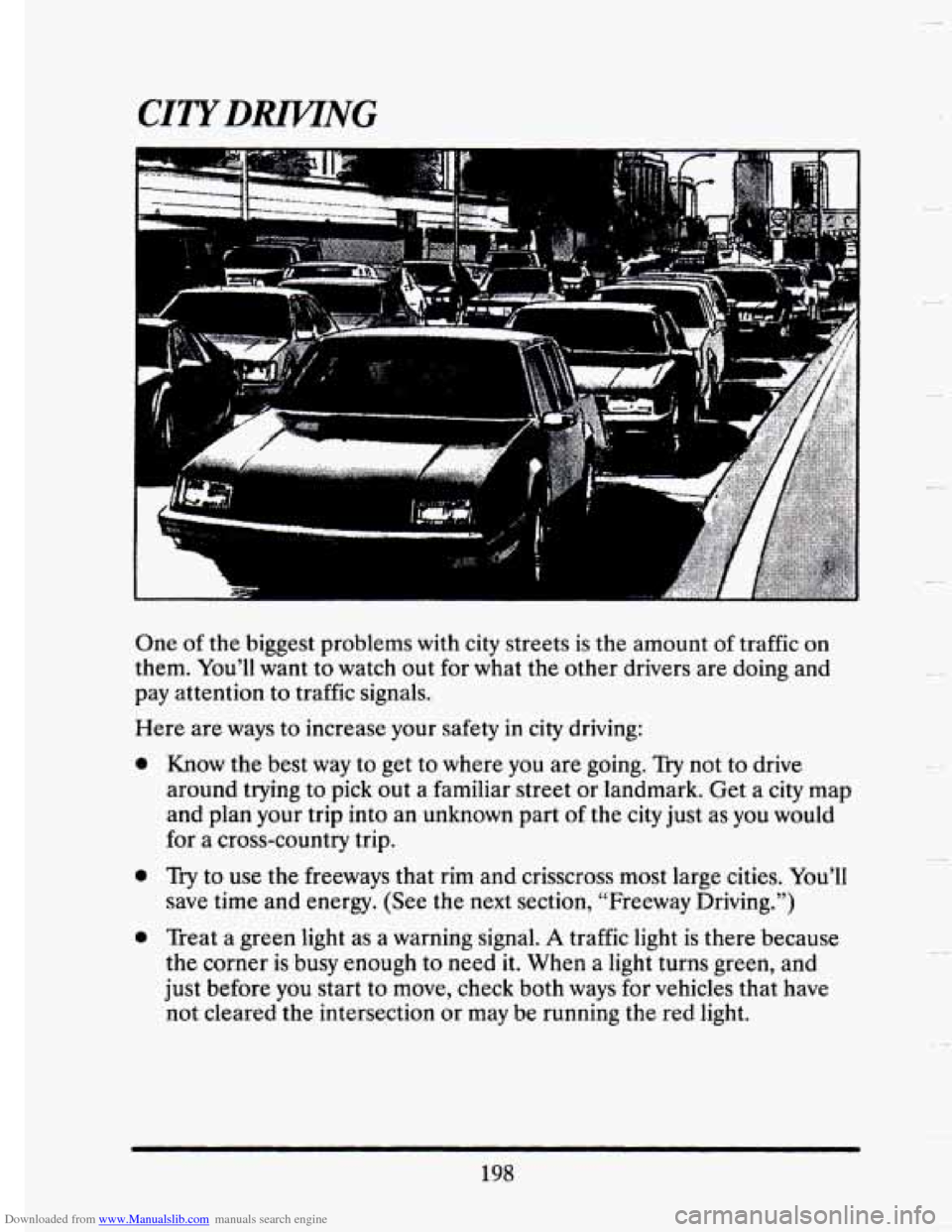
One of the biggest problems with city streets is the amount of traffic on
them. You’ll want to watch out for what the other drivers are doing and
pay attention to traffic signals.
Here are ways to increase your safety
in city driving:
a
a
0
Know the best way to get to where you are going. Try not to drive
around trying to pick out a familiar street or landmark. Get a
city map
and plan your trip into
an unknown part of the city just as you would
for a cross-country trip.
Try to use the freeways that rim and crisscross most large cities. You’ll
save time and energy. (See the next section, “Freeway Driving.”)
Treat a green light as a warning signal.
A traffic light is there because
the corner
is busy enough to need it. When a light turns green, and
just before you start to move, check both ways for vehicles that have
not cleared the intersection or may be running the red light.
198
Page 213 of 407
Downloaded from www.Manualslib.com manuals search engine Obey all posted speed limits. But remember that they are for ideal
road, weather and visibility conditions.
You may need to drive below
the posted limit in bad weather or when visibility
is especially poor.
Pull to the right (with care) and stop clear of intersections when you
see or hear emergency vehicles.
FREEWAY DMNG
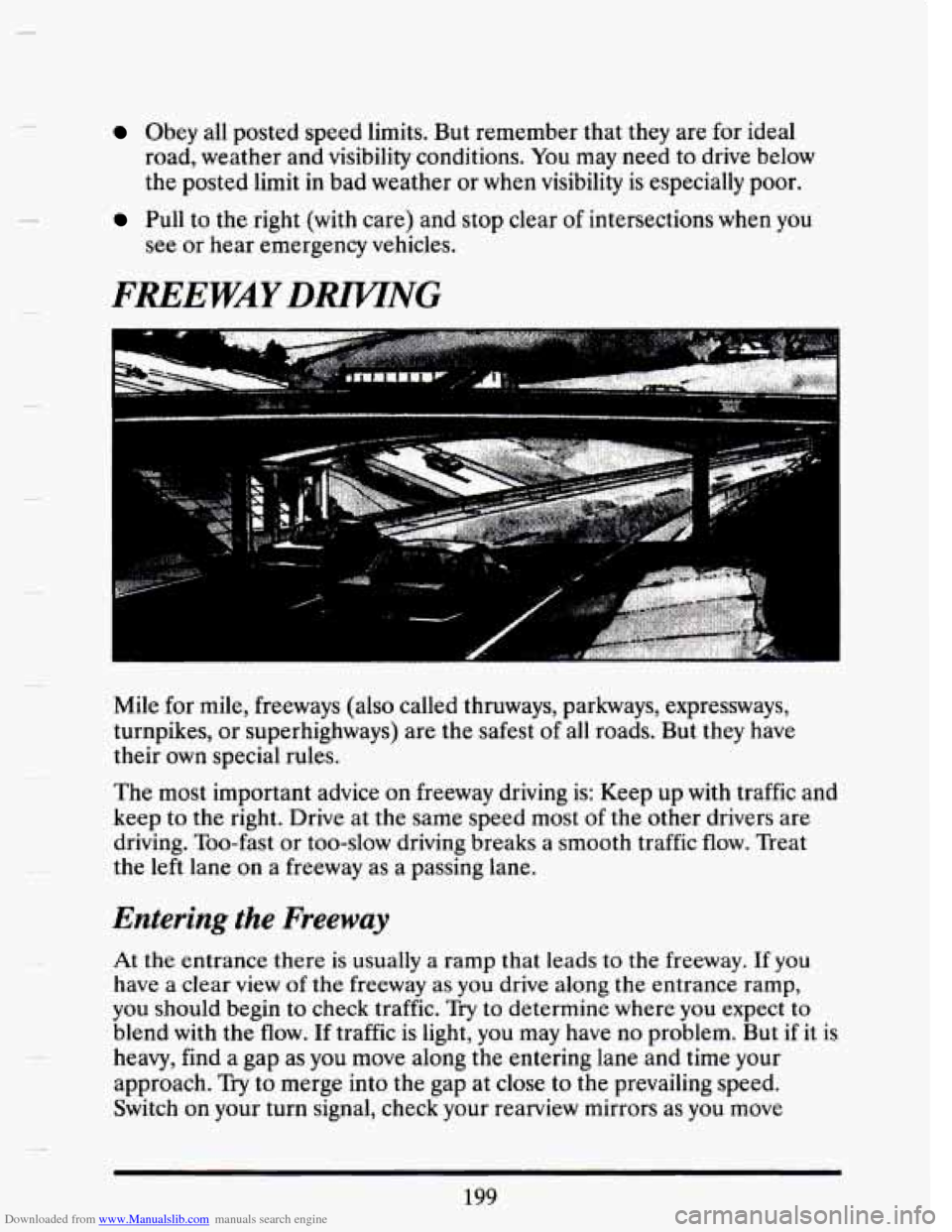
Mile for mile, freeways (also called thruways, parkways, expressways,
turnpikes, or superhighways) are the safest
of all roads. But they have
their own special rules.
The most important advice on freeway driving is: Keep up with traffic and
keep to the right. Drive at the same speed most
of the other drivers are
driving. Too-fast or too-slow driving breaks a smooth traffic
flow. Treat
the left lane on a freeway as a passing lane.
Entering the Freeway
At the entrance there is usually a ramp that leads to the freeway. If you
have a clear view of the freeway as you drive along the entrance ramp,
you should begin to check traffic. Try to determine where you expect to
blend with the flow. If traffic is light, you may have no problem. But if it is
heavy, find
a gap as you move along the entering lane and time your
approach.
Try to merge into the gap at close to the prevailing speed.
Switch on your turn signal, check your rearview mirrors as you move
199
Page 214 of 407
Downloaded from www.Manualslib.com manuals search engine along, and glance over your shoulder as often as necessary. Try to blend
smoothly
with the traffic flow.
Driving on the Freeway
Once you are on the freeway, adjust your speed to the posted limit or to
the prevailing rate
if it’s slower. Stay in the right lane unless you want to
pass.
If you are on a two-lane freeway, treat the right lane as the slow lane
and the left lane as the passing lane.
If you are on a three-lane freeway, treat the right lane as the slower-speed
through lane, the middle lane as the higher-speed through lane,\
and the left
lane as the passing lane.
Before changing lanes, check your rearview mirrors. Then use yo\
ur turn
signal.
Just before you leave the lane, glance quickly over your shoulder to make
sure there isn’t another vehicle in your “blind” spot.
If
you are moving from an outside to a center lane on a freeway having
more than
two lanes, make sure another vehicle isn’t about to move into
the same spot.
Look at the vehicles two lanes over and watch for telltale
signs: turn signals flashing, an increase
in speed, or moving toward the
edge
of the lane. Be prepared to delay your move.
Once you are moving on the freeway, make certain you allow a
reasonable following distance. Expect to move slightly slower at night.
Leaving the Freeway
When you want to leave the freeway, move to the proper lane well in
advance. Dashing across lanes at the last minute is dangerous.
If you miss
your exit do not, under any circumstances, stop and back up. Drive on to
the next exit.
At each exit point is a deceleration lane. Ideally it should \
be long enough
for you to enter it at freeway speed (after signaling, of course) and then
do your braking before moving onto the exit ramp. Unfortunately, not all
deceleration lanes are long enough
-- some are too short for all the
braking. Decide when to start braking.
If you must brake on the through
lane, and
if there is traffic close behind you, you can allow a little extra
200
Page 215 of 407
Downloaded from www.Manualslib.com manuals search engine time and flash your brake lights (in addition to your turn signal) as extra
warning that you are about to slow down and exit.
The exit ramp can be curved, sometimes quite sharply.
The exit speed is usually posted. Reduce your speed according
to your
speedometer, not to your sense
of motion. After driving for any distance
at higher speeds, you may tend to think you are going slower than you
actually are. For example,
40 mph (65 km/h) might seem like only 20 mph
(30 km/h). Obviously, this could lead to serious trouble on a ramp
designed for
20 mph (30 km/h)!
DMNG A LONG DISTANCE
Although most long trips today are made on freeways, there are still
many made
on regular highways.
Long-distance driving on freeways and regular highways is the same
in
some ways. The trip has to be planned and the vehicle prepared, you
drive at higher-than-city speeds, and there are longer turns behind
the
wheel. You’ll enjoy your trip more if you and your vehicle are in good
shape. Here are some tips for a successful long trip.
BEFORE LEAWNG ONA LONG THP
Make sure you’re ready. Try to be well rested. If you must start when
you’re not fresh
-- such as after a day’s work -- don’t plan to make too
many miles that first part of
the journey. Wear comfortable clothing and
shoes
you can easily drive in.
Is your vehicle ready for a long trip? If you keep it serviced and
maintained, it’s ready to
go. If it needs service, have it done before
starting out. Of course, you’ll find experienced and able service experts
in
Cadillac dealerships all across North America. They’ll be ready and
willing to help
if you need it.
Here are some things
you can check before a trip:
Windshield Washer Fluid: Is the reservoir full? Are all windows clean
inside and outside?
Wiper Blades: Are they in good shape?
0 Fuel. Enpine Oil. Other Fluids: Have you checked all levels?
201
Page 217 of 407
Downloaded from www.Manualslib.com manuals search engine Then here are some tips:
Make sure your vehicle is well ventilated, with a comfortably cool
Keep your eyes moving. Scan the road ahead and to the sides. Check
interior.
your rearview mirrors frequently and your instruments from time
to
time. This can help you avoid a fixed stare.
Wear good sunglasses in bright light. Glare can cause drowsiness. But
don't wear sunglasses at night. They will drastically reduce your
overall vision at the
very time you need all the seeing power you have.
If you get sleepy, pull off the road into a rest, service, or parking area
and take a nap, get some exercise,
or both. For safety, treat drowsiness
on the highway as an emergency.
As in any driving situation, keep pace with traffic and allow adequate
following distances.
HILL AND MOUNTMN ROADS
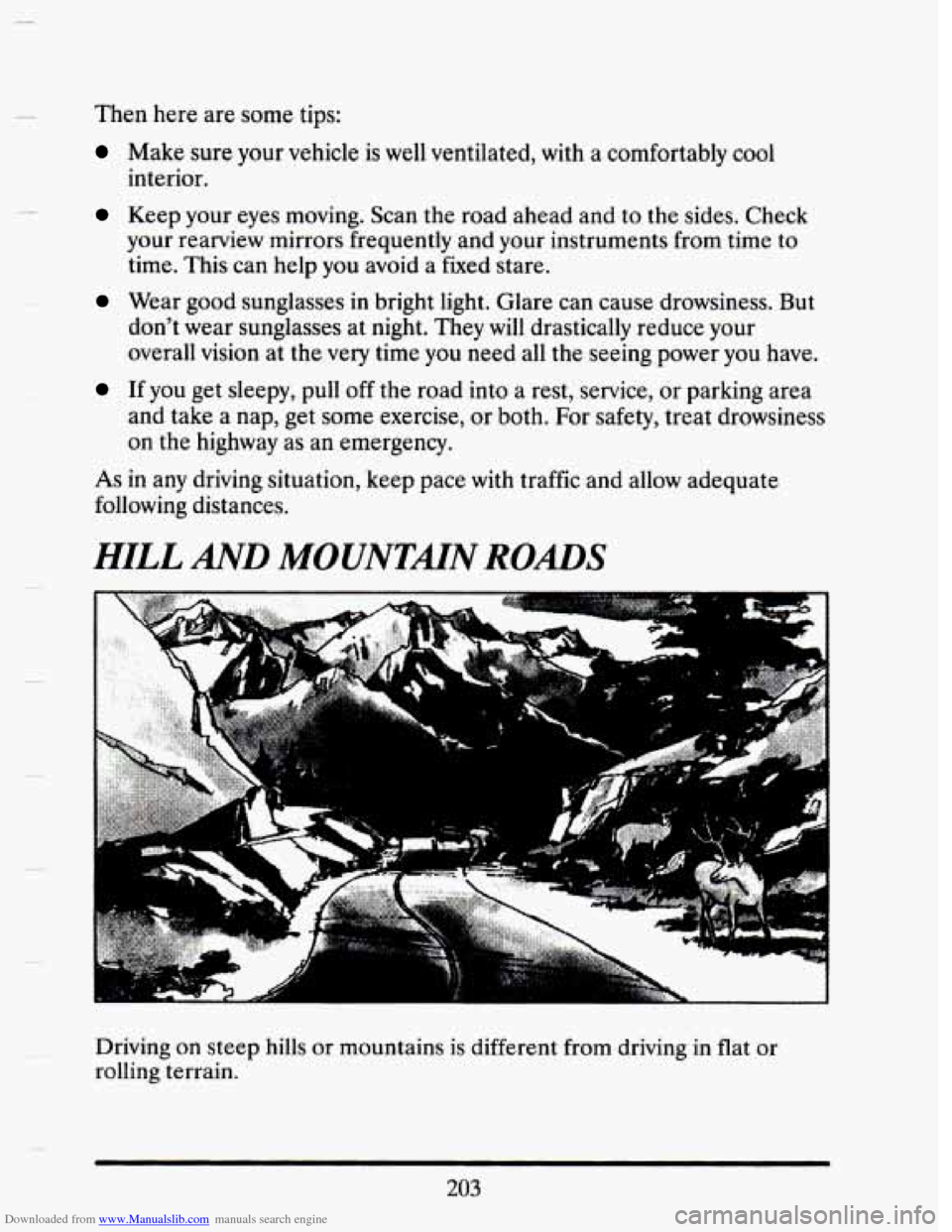
Driving on steep hills or mountains is different from driving in flat or
rolling terrain.
203
Page 218 of 407
Downloaded from www.Manualslib.com manuals search engine If you drive regularly in steep country, or if you’re planning to visit there,
here are some tips that can make your trips safer and more enjoyable.
Keep your vehicle in good shape. Check all fluid levels and also the
brakes, tires, cooling system and transaxle. These parts can work hard
on mountain roads.
Know how to go down hills. The most important thing to know is this:
let your engine do some of the slowing down. Don’t make your brakes
do it all. Shift to a lower gear when you go down a stcep or long hill.
That way, you will slow down without excessive we of !wr hrilkcs.
I
A CAUTION:
If you don’t shift down, your brakes could get so hot that tht?
wouldn’t work well. You would then have pr braking or men
none going down a hill. You could crash. Shin down to let your
engine assist your brakes on a steep downhill slope.
A CAUTION
Coasting downhill in “N” (Neutral) or with the ignition off is
dangerous. Your brakes will have
to do all the work of slowing
down. They could get
so hot that they wouldn’t work well. You
could crash. Always have your engine running and your vehicle
in
gear when you go downhill.
Know how to go uphill. You may want to shift down to a lower gear.
The lower gears help cool your engine and transaxle, and you can
climb the hill better.
Stay in your own lane when driving on two-lane roads in hills or
mountains. Don’t swing wide or cut across the center
of the road.
Drive at speeds that let you
stay in your own lane. That way, you won’t
be surprised
by a vehicle coming toward you in the same lane.
204
Page 225 of 407
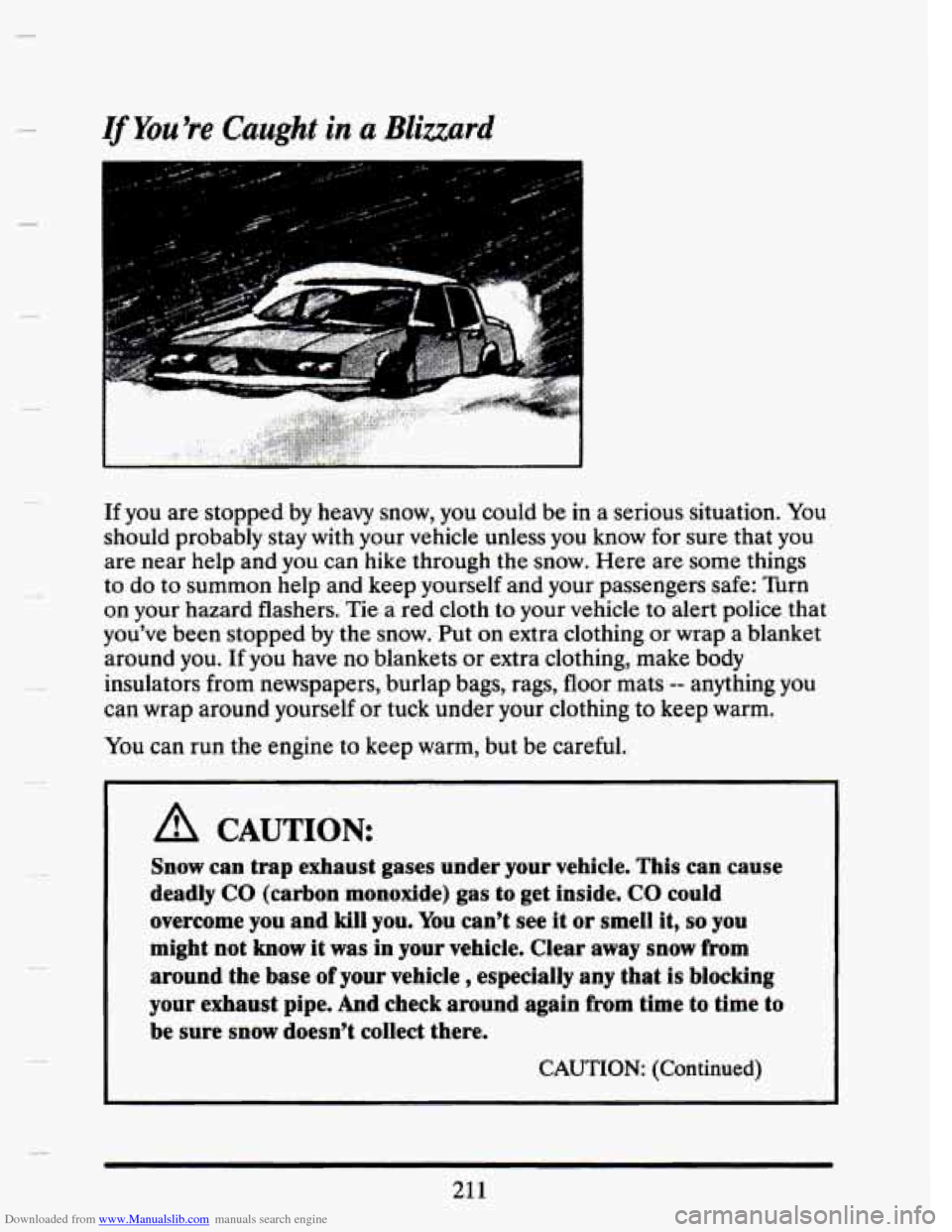
Downloaded from www.Manualslib.com manuals search engine If You're Caught in a Blizzard
If you are stopped by heavy snow, you could be in a serious situation. You
should probably stay with your vehicle unless you know for sure that you
are near help and you can
hike through the snow. Here are some things
to do to summon help and keep yourself and your passengers safe: Turn
on your hazard flashers. Tie a red cloth to your vehicle to alert police that
you've been stopped by the snow. Put
on extra clothing or wrap a blanket
around you. If you have no blankets or extra clothing, make body
insulators from newspapers, burlap bags, rags, floor mats
-- anything you
can wrap around yourself or tuck under your clothing to keep warm.
You can run the engine to keep warm, but be careful.
A CAUTION
Snow can trap exhaust gases under your vehicle. This can cause
deadly
CO (carbon monoxide) gas to get inside. CO could
overcome you and
kill you. You can't see it or smell it, so you
might not know it was in your vehicle. Clear away snow from
around the base
of your vehicle especially any that is blocking
your exhaust pipe. And check around again from time to time to
be sure snow doesn't collect there.
CAUTION: (Continued)
21 1
Page 230 of 407
Downloaded from www.Manualslib.com manuals search engine Safety Chains
You should always attach chains between your vehicle and your trailer.
Cross the safety chains under the tongue
of the trailer so that the tongue
will not drop to the road if it becomes separated from the hitch. Follow
the manufacturer's recommendation for attaching safety chains. Always
leave just enough slack
so you can turn with your rig. And, never allow
safety chains to drag
on the ground.
Trailer Brakes
Does your trailer have its own brakcs'? He sure IO read and follow thc
instructions for the trailer brakes so you'll he ilblc to ir~ i~lI, ;rcliw an3
maintain them properly.
Driving with a Trailer
Towing a trailer requires a certain amount of experience. Before setting
out for the open road, you'll want to get to
know your rig. Acquaint
yourself with the feel of handling and braking with the added weight of
the trailer. And always keep
in mind that the vehicle you are driving is
now a good deal longer and not nearly so responsive as your vehicle is by
itself.
Before you start, check the trailer hitch and platform, safety chains,
electrical connector, lights, tires and mirror adjustment. If the trailer has
electric brakes, start your vehicle and trailer moving and then apply the
trailer brake controller by hand
to be sure the brakes are working. This
lets
you check your electrical connection at the same time.
During your trip, check occasionally to be sure that the load is secure,
and that the lights and any trailer brakes are still working.
216
L -4
c
L-
L-
C