check engine CADILLAC SEVILLE 1996 4.G Owners Manual
[x] Cancel search | Manufacturer: CADILLAC, Model Year: 1996, Model line: SEVILLE, Model: CADILLAC SEVILLE 1996 4.GPages: 354, PDF Size: 20.21 MB
Page 22 of 354
Downloaded from www.Manualslib.com manuals search engine I A CAUTION:
Don’t let anyone ride where he or she can’t wear
a safety belt properly.
If you are in a crash and
you’re not wearing a safety belt, your injuries
can be much worse.
You can hit things inside the
vehicle or be ejected from
it. You can be seriously
injured or killed.
In the same crash, you might
not be
if you are buckled up. Always fasten your
safety belt, and check that your passengers’ belts
are fastened properly too.
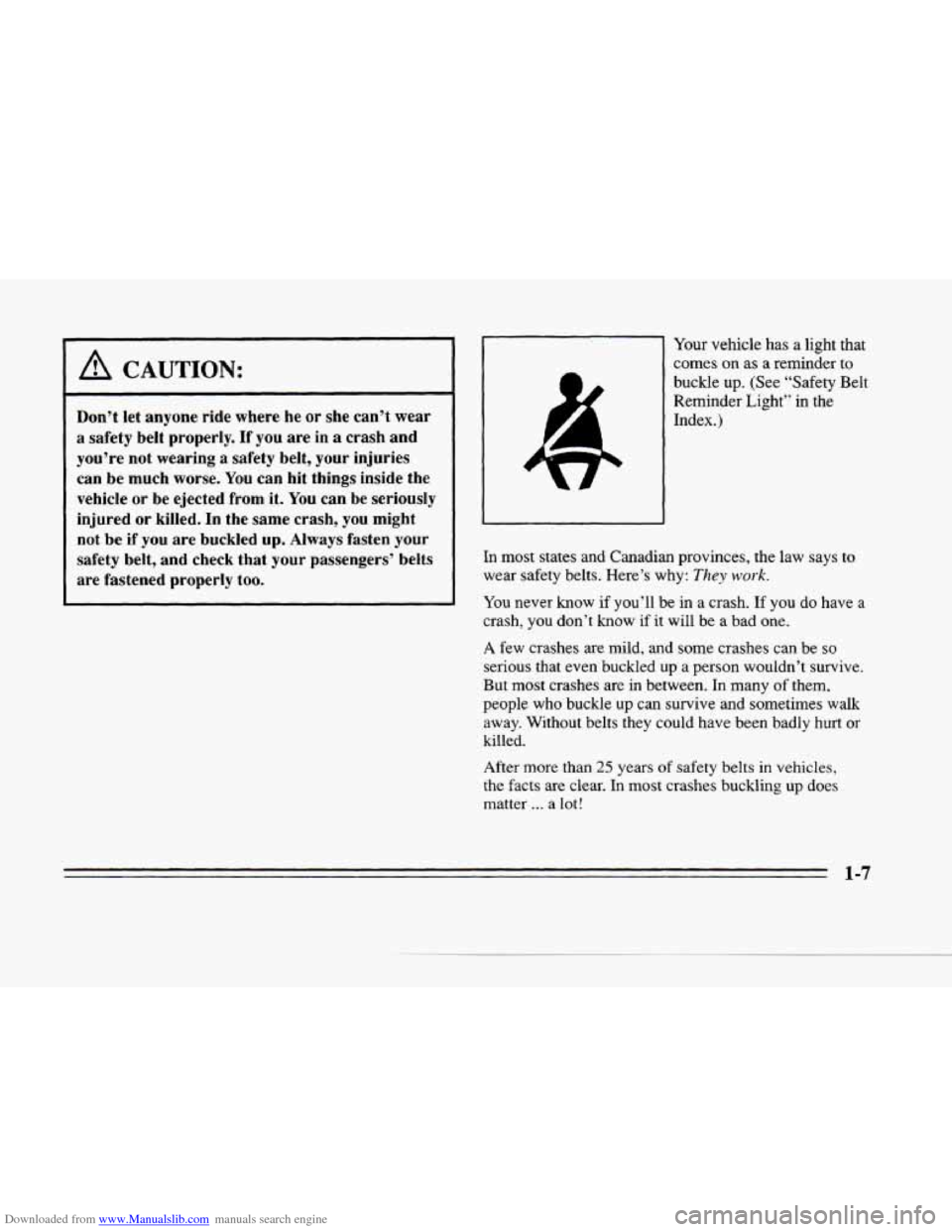
Your vehicle has a light that
comes on
as a reminder to
buckle up. (See “Safety Belt
Reminder Light” in
the
Index.)
In most states and Canadian provinces, the law says to
wear safety belts. Here’s why:
They work.
You never know if you’ll be in a crash. If you do have a
crash, you don’t know if it will be a bad one.
A few crashes are mild, and some crashes can be so
serious that even buckled up a person wouldn’t survive.
But most crashes are in between. In many
of them,
people
who buckle up can survive and sometimes walk
away. Without belts they could have been badly hurt or
killed.
After more than
25 years of safety belts in vehicles,
the facts are clear.
In most crashes buckling up does
matter ... a lot!
Page 36 of 354
Downloaded from www.Manualslib.com manuals search engine c
c
A CAUTION:
Air bags inflate with great force, faster than the
blink of an eye.
If you’re too close to an inflating
air bag, it could seriously injure you. Safety belts
help keep you
in position for an air bag inflation
in
a crash. Always wear your safety belt, even
with an
air bag. The driver should sit as far back
as possible while still maintaining control of the
vehicle.
I A CAUTION:
An inflating air bag can seriously injure small
children. Always secure children properly
in your
vehicle.
To read how, see the part of this manual
called “Children” and the caution label on the
right front passenger’s safety belt.
11 There is an air bag
AIR BAG
readiness light on the
instrument panel, which
shows AIR
BAG.
The system checks the air bag’s electrical system for
malfunctions. The light tells
you if there is an electrical
problem. See
“Air Bag Readiness Light” in the Index
for more information.
1 31
Page 59 of 354
Downloaded from www.Manualslib.com manuals search engine Safety Belt Extender
If the vehicle’s safety belt will fasten around you, you
should use it.
But if a safety belt isn’t long enough to fasten, your
dealer will order
you an extender. It’s free. When you go
in to order it, take the heaviest coat you will wear, so the
extender will be long enough for you. The extender will
be just for you, and
just for the seat in your vehicle that
you choose. Don’t let someone
else use it, and use it
only for the seat it is made to fit. To wear it, just attach it
to the regular safety belt.
Checking Your Restraint Systems
Now and then, make sure the safety belt reminder light
and
all your belts, buckles, latch plates, retractors and
anchorages are working properly. Look for any other
loose
or damaged safety belt system parts. If you see
anything that might keep a safety belt system from
doing its job, have
it repaired.
Torn or frayed safety belts may not protect you in a
crash. They can rip apart under impact forces. If a belt
is
tom or frayed, get a new one right away.
Also look for any opened
or broken air bag covers, and
have them repaired or replaced. (The air bag system
does not need regular maintenance.)
Replacing Restraint System Parts
After
a Crash
If you’ve had a crash, do you need new belts?
After a very minor collision, nothing may be necessary. But if the belts were stretched, as they would be if
worn
during a more severe crash, then you need new belts.
If belts are cut or damaged, replace them. Collision
damage also may mean
you will need to have safety belt
or seat parts repaired or replaced. New parts and repairs
may be necessary even
if the belt wasn’t being used at
the time of the collision.
If an air bag inflates, you’ll need
to replace air bag
system parts. See the
part on the air bag system earlier
in this section.
1-44
Page 66 of 354
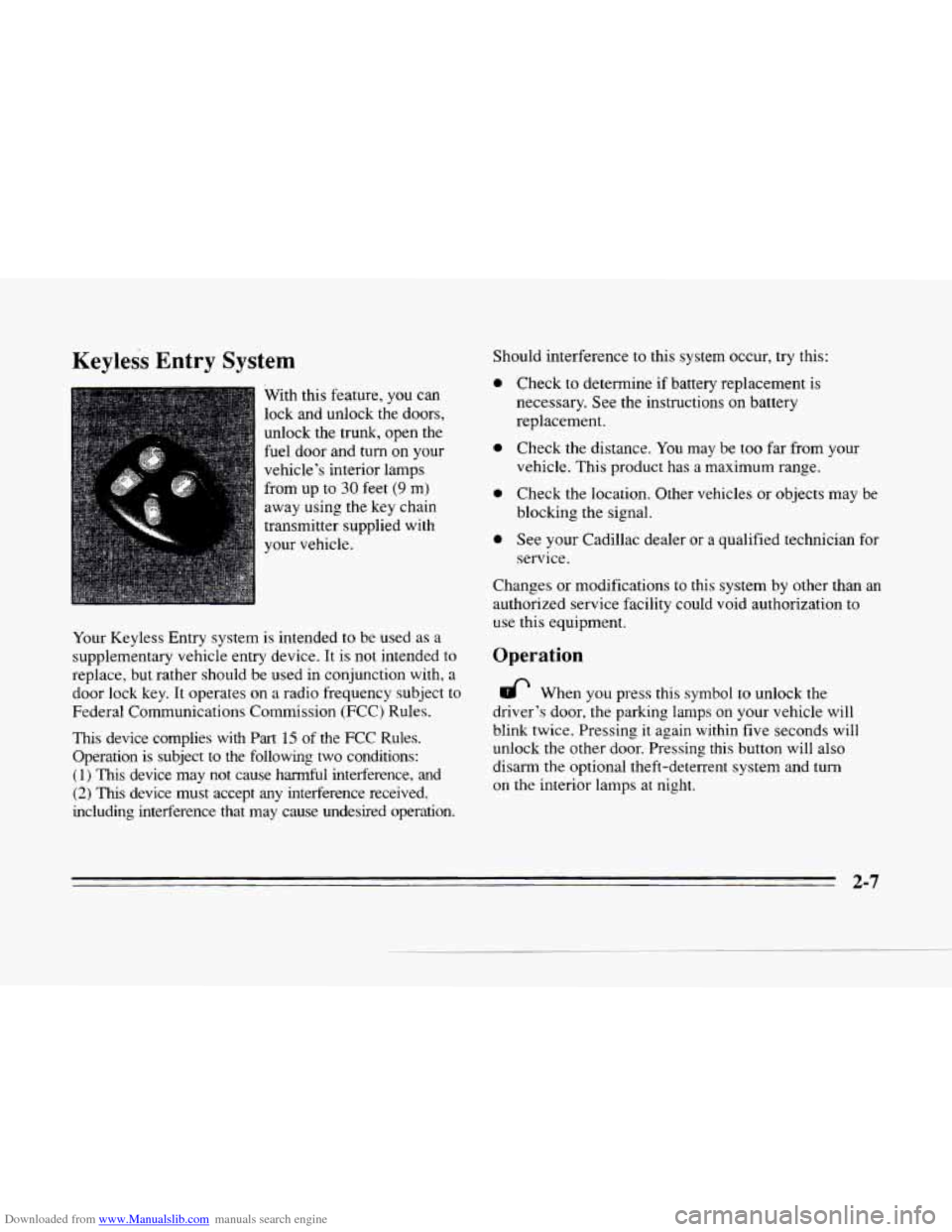
Downloaded from www.Manualslib.com manuals search engine Keyless Entry System
With this feature, you can
lock and unlock the doors,
unlock the trunk, open the
fuel door and turn on
your
vehicle’s interior lamps
from up to
30 feet (9 m)
away using the key chain
transmitter supplied with
your vehicle.
Your Keyless Entry system is intended
to be used as a
supplementary vehicle entry device. It is not intended to
replace, but rather should be used in conjunction with, a
door lock key. It operates on
a radio frequency subject to
Federal Communications Commission (FCC) Rules.
This device complies with
Part 15 of the FCC Rules.
Operation is subject
to the following two conditions:
( 1 ) This device may not cause harmful interference, and
(2) Tlus device must accept any interference received,
including interference that
may cause undesired operation. Should
interference
to this system occur, try this:
0
0
0
0
Check to determine if battery replacement is
necessary. See the instructions on battery
replacement.
Check the distance.
You may be too far from your
vehicle. This product has
a maximum range.
Check the location. Other vehicles or objects may be
blocking the signal.
See your Cadillac dealer
or a qualified technician for
service.
Changes
or modifications to this system by other than an
authorized service facility could void authorization
to
use this equipment.
Operation
65 When you press this symbol
driver’s door, the parking lamps on
to unlock the
your vehicle will
blink twice. Pressing it again within five seconds will
unlock the other door. Pressing
this button will also
disarm
the optional theft-deterrent system and turn
on the interior lamps at night.
Page 72 of 354
Downloaded from www.Manualslib.com manuals search engine F
c
Remember, the theft-deterrent system won’t activate if
you lock the doors with a key or use the manual door
lock. It activates only if you use a power door lock
switch or the Keyless Entry system.
To avoid activating the alarm by accident:
0 The vehicle should be locked with the door key after-
the doors are closed if you don’t want to activate the
theft-deterrent system.
Always unlock a door with a key or use the Keyless
Entry system. (Pressing the unlock button on the
Keyless Entry transmitter disables the theft-deterrent
system.) Unlocking a door any other way will
activate the alarm. Cycling the ignition without
disarming the theft-deterrent system will also
activate the alarm.
If you activate the alarm by accident, unlock any door
with your key.
You can also turn off the alarm by using
the Keyless Entry system. The alarm won’t stop if you
try to unlock a door any other way.
Testing the Alarm
1. From inside the vehicle, roll down the window, then
get out of the vehicle, keeping the door open.
2. From outside of the vehicle, with the door open, lock
the vehicle using the power door lock or the Keyless
Entry
system and close the door. Wait 30 seconds.
3. Reach in and unlock the door using the manual lock
and open the door. The horn will sound and the
headlamps will flash.
If the alarm does not sound when it should, check to
see if the horn works. The
horn fuse may be blown. To
replace the fuse, see “Fuses and Circuit Breakers” in
the Index. If the fuse does not need to be replaced, you
may need to have your Cadillac serviced.
To reduce the possibility of theft, always activate
the optional theft-deterrent system when leaving
your vehicle.
Page 73 of 354
Downloaded from www.Manualslib.com manuals search engine PASS-Key@II
Your vehicle is equipped
with the PASS-Key I1
theft-deterrent system. PASS-Key I1 is a passive
system. The system is
armed when the key is
removed from the ignition.
PASS-Key
I1 uses a resistor pellet in the ignition key
that
is read by a decoder module in your vehicle. If the
key resistor matches the code stored in the vehicle
module, the vehicle’s fuel and starting systems
will be
enabled.
If an incorrect key is used, the vehicle’s fuel
and starting systems are disabled
for three minutes.
Additional attempts during this lockout period will not
start the car. -If
the engine does not start and the STARTING
DISABLED
DUE TO THEFT SYSTEM, REMOVE
IGNITION KEY message is displayed in the Driver
Information Center, your key should be checked for
damage. Starting may
be attempted with an undamaged
key immediately. See your Cadillac dealer or a
locksmith for key service.
If the STARTING DISABLED DUE TO THEFT
SYSTEM, REMOVE
IGNITION KEY and WAIT
3 MINUTES messages are displayed, the key should
be cleaned and dried. After three minutes, try again.
A START CAR message will appear at this time.
If
the engine still does not start, wait 3 minutes and try a
duplicate key. At this time, fuses should be checked (see
“Fuses and Circuit Breakers” in the Index). If the engine
does not start with the duplicate key, your vehicle needs
service. See your Cadillac dealer
for service.
If the THEFT SYSTEM PROBLEM message is
displayed during vehicle operation, your vehicle needs servicing. Your vehicle will restart
if you turn it off;
however, your vehicle may be unprotected. See your
Cadillac dealer for service.
If an ignition key is lost or damaged, see your Cadillac
dealer or a locksmith
to have a new key made.
2-14
Page 77 of 354
Downloaded from www.Manualslib.com manuals search engine w
NOTICE:
Holding your key in START for longer than
15 seconds at a time will cause your battery to be
drained much sooner. And the excessive heat can
damage your starter motor.
2. If it doesn't start right away, hold your key in
START for about three seconds at a time until your
engine starts. Wait about
15 seconds between each
try to help avoid draining your battery.
3. If your engine still won't start (or starts but then
stops), it could be flooded with
too much gasoline.
Try pushing your accelerator pedal all the way to the
floor and holding
it there as you hold the key.in
START for about three seconds. If the vehicle starts
briefly but then stops again, do the same thing.
NOTICE:
Your engine is designed to work with the
electronics in your vehicle. If you add electrical
parts or accessories, you could change the way
the engine operates. Before adding electrical
equipment, check with
your dealer. If you don't,
your engine might not perform properly.
If you ever have to have your vehicle towed, see
the part
of this manual that tells how to do it
without damaging your vehicle. See "Towing
Your Vehicle'' in the Index.
2-18
Page 92 of 354
Downloaded from www.Manualslib.com manuals search engine rrr
xz
e
If the turn signal is left on, a warning chime will sound
and the
DIC will display TURN SIGNAL ON (after
driving about a mile) to remind you to turn it off.
Arrows that
flash rapidly when signaling for a turn or
lane change may be caused by
a burned out signal bulb.
Other drivers won’t see the turn signal.
Replace burned
out bulbs to help avoid possible
accidents. Check the fuse (see “Fuses and Circuit
Breakers”
in the Index) and for burned-out bulbs if the
arrow fails
to work when signaling a turn.
Headlamp High/Low Beam
Pull the turn signal lever all
the way toward you and
then release
it to change the
headlamps from low beam
to high or from high beam
to low. The blue light on the
instrument panel will be on
indicating high-beam usage.
Flash-To-Pass
This lets you use the high-beam headlamps to signal the
driver in front
of you that you want to pass. It works
even if
the headlamps are off.
Pull the turn signal lever toward you to use. When you do:
0 If the headlamps are off, the high-beam headlamps
will turn on. They’ll stay on as
long as you hold the
lever there. Release the lever to turn them off.
If the headlamps are on low beam, they will shift to
high beam and stay there. Pull
the lever toward you
to return to low beam.
0 If the headlamps are on high beam, they will switch
to low beam. To return to high beam, pull the lever
toward
you.
2-33
Page 95 of 354
Downloaded from www.Manualslib.com manuals search engine Windshield Washer
I A CAUTION:
In freezing weather, don't use your washer until
the windshield is warmed. Otherwise the washer
fluid can form ice on the windshield, blocking
your vision.
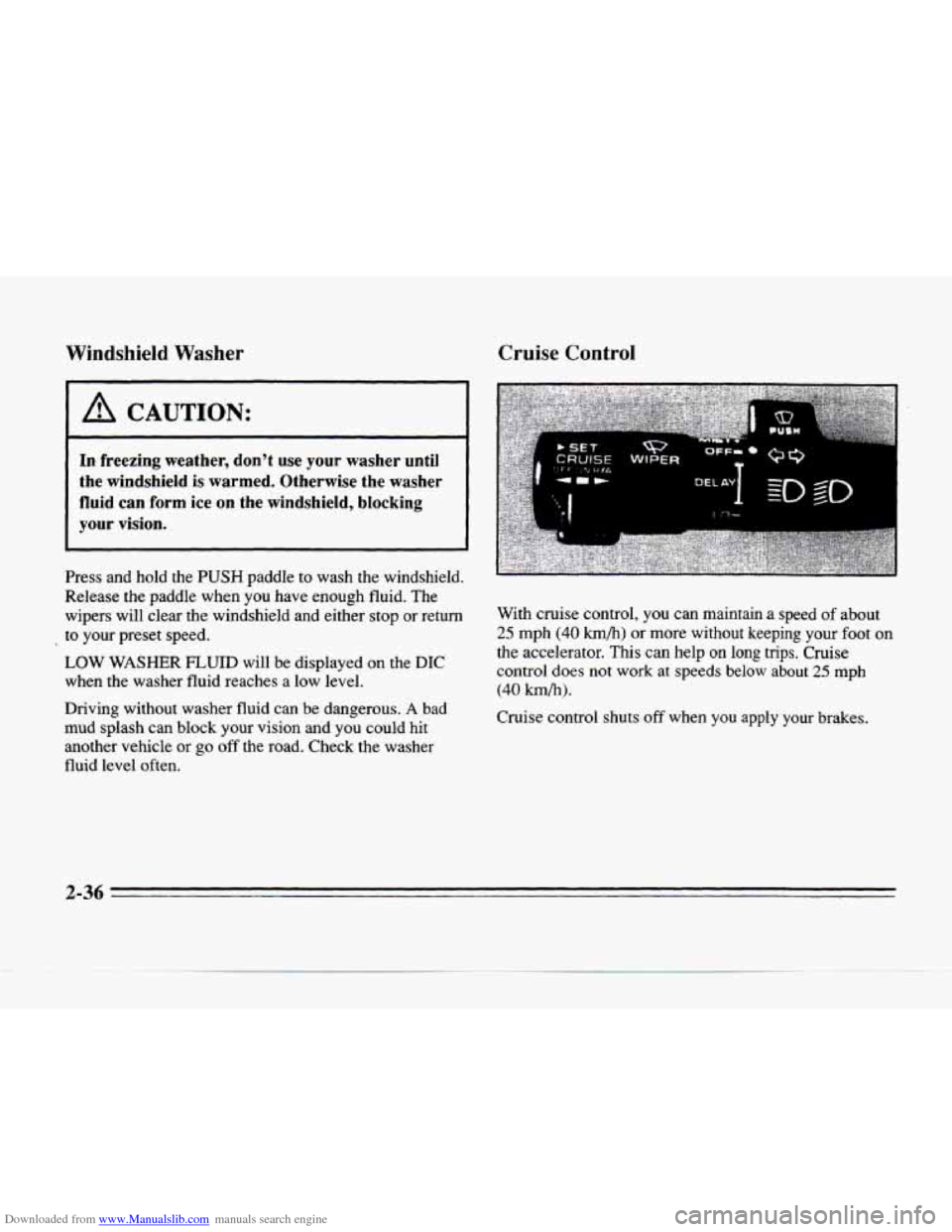
Press and hold the PUSH paddle to wash the windshield.
Release the paddle when you have enough fluid.
The
wipers will clear the windshield and either stop or return
to your preset speed.
LOW WASHER FLUID will be displayed on the DIC
when the washer fluid reaches a low level.
Driving without washer fluid can be dangerous.
A bad
mud splash can block your vision and you could hit
another vehicle
or go off the road. Check the washer
fluid level often.
Cruise Control
With cruise control, you can maintain a speed of about
25 mph (40 h/h) or more without keeping your foot on
the accelerator. This can help on long trips. Cruise
control does not
work at speeds below about 25 mph
(40 km/h).
Cruise control shuts off when you apply your brakes.
2-36
Page 110 of 354
Downloaded from www.Manualslib.com manuals search engine c
c
Power Remote Control Mirror
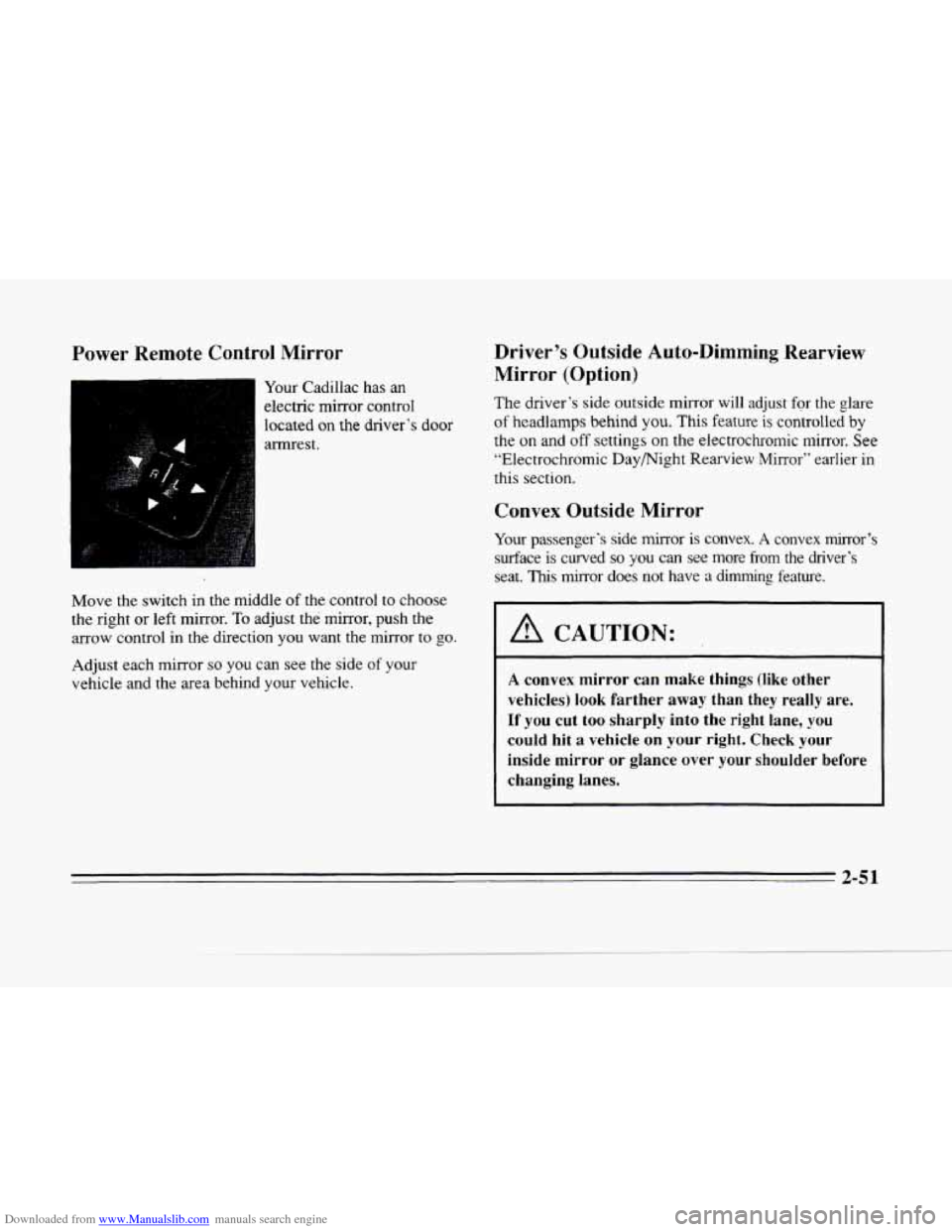
Your Cadillac has an
electric mirror control
located
on the driver’s door
armrest.
Move the sw.itch in the middle
of the control to choose
the right
or left mirror. To adjust the mirror, push the
arrow control in the direction you want the mirror to go.
Adjust each mirror so you can see the side of your
vehicle and the area behind your vehicle.
Driver’s Outside Auto-Dimming Rearview
Mirror (Option)
The driver’s side outside mirror will adjust for the glare
of headlamps behind you. This feature is controlled by
the
on and off settings on the electrochromic mirror. See
“Electrochromic Daymight Rearview Mirror” earlier in
this section.
Convex Outside Mirror
Your passenger‘s side mirror is convex. A convex mirror’s
surface is curved so you can see more from the driver’s
seat. This mirror does not have a dimming feature.
I A CAUTION:
A convex mirror can make things (like other
vehicles)
look farther away than they really are.
If
you cut too sharply into the right lane, you
could hit a vehicle on your right. Check your
inside mirror or glance over your shoulder before
changing lanes.
2-5 1