sensor CADILLAC SEVILLE 2001 5.G Owner's Manual
[x] Cancel search | Manufacturer: CADILLAC, Model Year: 2001, Model line: SEVILLE, Model: CADILLAC SEVILLE 2001 5.GPages: 371, PDF Size: 2.76 MB
Page 299 of 371
6-17
Engine Air Cleaner/Filter
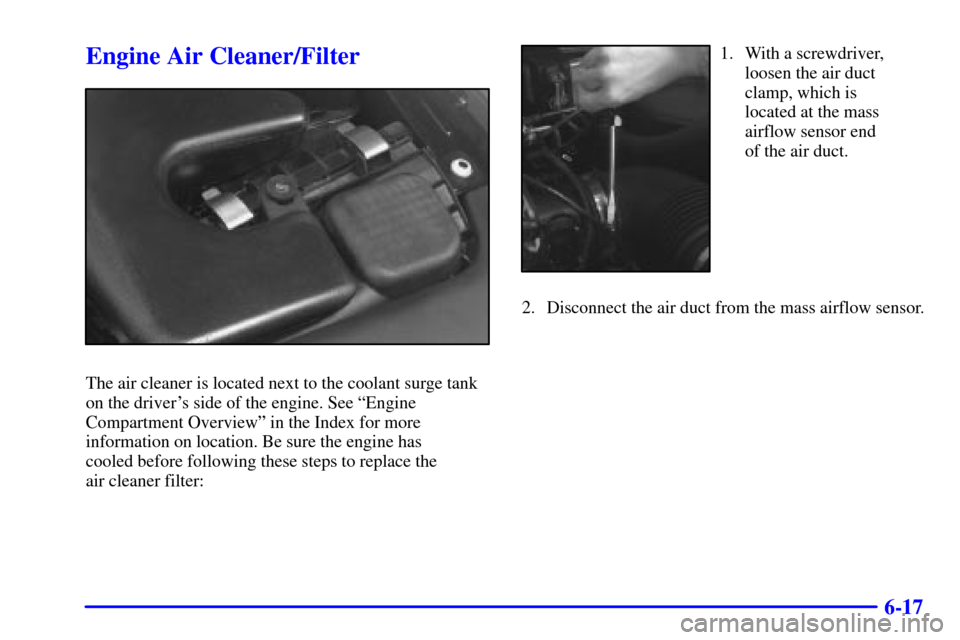
The air cleaner is located next to the coolant surge tank
on the driver's side of the engine. See ªEngine
Compartment Overviewº in the Index for more
information on location. Be sure the engine has
cooled before following these steps to replace the
air cleaner filter:
1. With a screwdriver,
loosen the air duct
clamp, which is
located at the mass
airflow sensor end
of the air duct.
2. Disconnect the air duct from the mass airflow sensor.
Page 301 of 371
6-19
Follow these steps to reinstall the air cleaner assembly:
1. Slide the air cleaner lid into the slots in the bottom of
the air cleaner base.
2. Close the cover and make sure that both latches are
secure and fully engaged.
3. Reinstall the clean air duct over the mass airflow
sensor. Make sure that the duct is secure around
the entire outer edge of the sensor.
4. Tighten the air duct clamp.
Refer to the Maintenance Schedule to determine when to
replace the air filter.
See ªScheduled Maintenance Servicesº in the
Maintenance Schedule booklet.
CAUTION:
Operating the engine with the air cleaner/filter
off can cause you or others to be burned. The air
cleaner not only cleans the air, it stops flame if
the engine backfires. If it isn't there, and the
engine backfires, you could be burned. Don't
drive with it off, and be careful working on the
engine with the air cleaner/filter off.
NOTICE:
If the air cleaner/filter is off, a backfire can
cause a damaging engine fire. And, dirt can
easily get into your engine, which will damage it.
Always have the air cleaner/filter in place when
you're driving.
Page 314 of 371
6-32 Brake Wear
Your vehicle has four-wheel disc brakes.
Disc brake pads have built
-in wear indicators that make
a high
-pitched warning sound when the brake pads are
worn and new pads are needed. The sound may come and
go or be heard all the time your vehicle is moving (except
when you are pushing on the brake pedal firmly).
CAUTION:
The brake wear warning sound means that soon
your brakes won't work well. That could lead to
an accident. When you hear the brake wear
warning sound, have your vehicle serviced.
Your vehicle also has electronic wear sensors that let you
know when the brake pads are significantly worn and
new pads are needed. The CHANGE BRAKE PADS
message will be displayed on the Driver Information
Center when the brake pads are worn and need to be
replaced. See ªChange Brake Pads Messageº in
the Index.
CAUTION:
The CHANGE BRAKE PADS message or the
high
-pitched warning sound means that soon
your brakes won't work well. That could lead to
an accident. When the CHANGE BRAKE PADS
message comes on and stays on, have your
vehicle serviced.
NOTICE:
Continuing to drive with worn-out brake pads
could result in costly brake repair.
Some driving conditions or climates may cause a brake
squeal when the brakes are first applied or lightly
applied. This does not mean something is wrong with
your brakes.
Page 331 of 371

6-49
When to Check
Check your tires once a month or more.
Don't forget your compact spare tire. It should be
at 60 psi (420 kPa).
How to Check
Use a good quality pocket
-type gage to check tire
pressure. You can't tell if your tires are properly inflated
simply by looking at them. Radial tires may look
properly inflated even when they're underinflated.
Be sure to put the valve caps back on the valve stems.
They help prevent leaks by keeping out dirt and moisture.
Tire Pressure Monitor (TPM) System
(If Equipped)
The Tire Pressure Monitor (TPM) system uses radio
and sensor technology to check tire pressure levels.
Sensors, mounted on each road wheel, transmit tire
pressure readings to a receiver located in the trunk. Tire
pressure status and tire pressure warnings are shown on
the Driver Information Center (DIC) display. See
ªDriver Information Center (DIC)º in the Index for
details regarding DIC controls and displays.The system operates on a radio frequency subject to
Federal Communications Commission (FCC) Rules
and with Industry and Science Canada.
This device complies with Part 15 of the FCC Rules.
Operation is subject to the following two conditions:
(1) this device may not cause harmful interference,
and (2) this device must accept any interference
received, including interference that may cause
undesired operation.
This device complies with RSS
-210 of Industry
and Science Canada. Operation is subject to the
following two conditions: (1) this device may not
cause interference, and (2) this device must accept any
interference received, including interference that may
cause undesired operation of the device.
Changes or modifications to this system by other than
an authorized service facility could void authorization to
use this equipment.
If the TPM system detects low tire pressure, below
24 psi (165 kPa), or high tire pressure, above 36 psi
(248 kPa), a message, CHECK TIRE PRESSURE, will
appear on the Driver Information Center (DIC) display.
Page 332 of 371
6-50
By pressing the INFO button, the DIC screen will show
which tire(s) has the low or high pressure condition.
See ªInflation
-- Tire Pressureº in the Index for
information regarding correct tire inflation. If a tire is
low, you should stop as soon as possible and check all
your tires for damage. If a tire is flat, see ªIf a Tire
Goes Flatº in the Index.
NOTICE:
Do not use a tire sealant if your vehicle is equipped
with Tire Pressure Monitors. The liquid sealant
can damage the tire pressure monitor sensors.
Once a low or high tire pressure condition is detected,
the TPM system will display the CHECK TIRE
MESSAGE each time the engine is started, until
the tire(s) are set to the correct inflation pressure.
The Tire Loading
-Information Label, which is located
on the rear edge of the driver's door, shows the correct
inflation pressure for the tires on your vehicle.The TPM system also allows the driver to check the
air pressure status of each road tire using the Driver
Information Center (DIC). Each tire's air pressure will
be listed individually, in the following order: LF (left
front or driver's side front tire), RF (right front or
passenger's side front tire), RR (right rear or passenger's
side rear tire) and LR (left rear or driver's side rear tire).
See ªInflation
-- Tire Pressureº in the Index for
information regarding correct tire inflation. Also, see
ªDriver Information Center (DIC)º in the Index for
information on the DIC controls and displays.
If the DIC display doesn't show tire pressures or
the SERVICE TPM SYSTEM message appears,
see your dealer for service. The TPM system may not
work properly while the compact spare tire is installed.
Anytime you replace one or more tires or rotate your
tires, the TPM system will need to be reset. A special
tool is needed to reset the sensor identification codes,
see your dealer for service.
The TPM system can alert you about a low or high tire
pressure condition, but it doesn't replace normal tire
maintenance. See ªTiresº in the Index.
Page 333 of 371
6-51 Tire Inspection and Rotation
Tires should be rotated every 6,000 to 8,000 miles
(10 000 to 13 000 km). Any time you notice unusual
wear, rotate your tires as soon as possible and check
wheel alignment. Also check for damaged tires or
wheels. See ªWhen It's Time for New Tiresº and
ªWheel Replacementº later in this section for
more information.
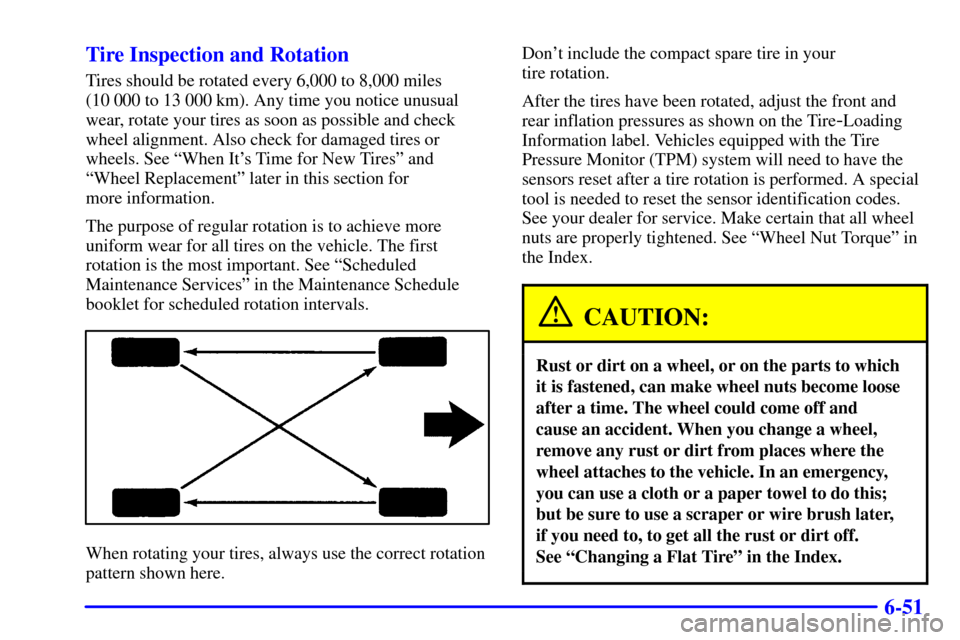
The purpose of regular rotation is to achieve more
uniform wear for all tires on the vehicle. The first
rotation is the most important. See ªScheduled
Maintenance Servicesº in the Maintenance Schedule
booklet for scheduled rotation intervals.
When rotating your tires, always use the correct rotation
pattern shown here.Don't include the compact spare tire in your
tire rotation.
After the tires have been rotated, adjust the front and
rear inflation pressures as shown on the Tire
-Loading
Information label. Vehicles equipped with the Tire
Pressure Monitor (TPM) system will need to have the
sensors reset after a tire rotation is performed. A special
tool is needed to reset the sensor identification codes.
See your dealer for service. Make certain that all wheel
nuts are properly tightened. See ªWheel Nut Torqueº in
the Index.
CAUTION:
Rust or dirt on a wheel, or on the parts to which
it is fastened, can make wheel nuts become loose
after a time. The wheel could come off and
cause an accident. When you change a wheel,
remove any rust or dirt from places where the
wheel attaches to the vehicle. In an emergency,
you can use a cloth or a paper towel to do this;
but be sure to use a scraper or wire brush later,
if you need to, to get all the rust or dirt off.
See ªChanging a Flat Tireº in the Index.
Page 350 of 371

6-68
Minifuses Usage
1 ALDL
2 Accessory
3 Windshield Wipers
4 Not Used
5 Headlamp Low Beam Left
6 Headlamp Low Beam RightMinifuses Usage
7 Instrument Panel
8 Powertrain Control
Module Battery
9 Headlamp High Beam Right
10 Headlamp High Beam Left
11 Ignition 1
12 Fog Lamps
13 Transmission
14 Cruise Control
15 Coil MDL
16 Injector Bank #2
17 Not Used
18 Not Used
19 Powertrain Control
Module Ignition
20 Oxygen Sensor
21 Injector Bank #1