reset CADILLAC SRX 2005 1.G User Guide
[x] Cancel search | Manufacturer: CADILLAC, Model Year: 2005, Model line: SRX, Model: CADILLAC SRX 2005 1.GPages: 442, PDF Size: 2.52 MB
Page 160 of 442
Traction Control System (TCS)
Warning Light
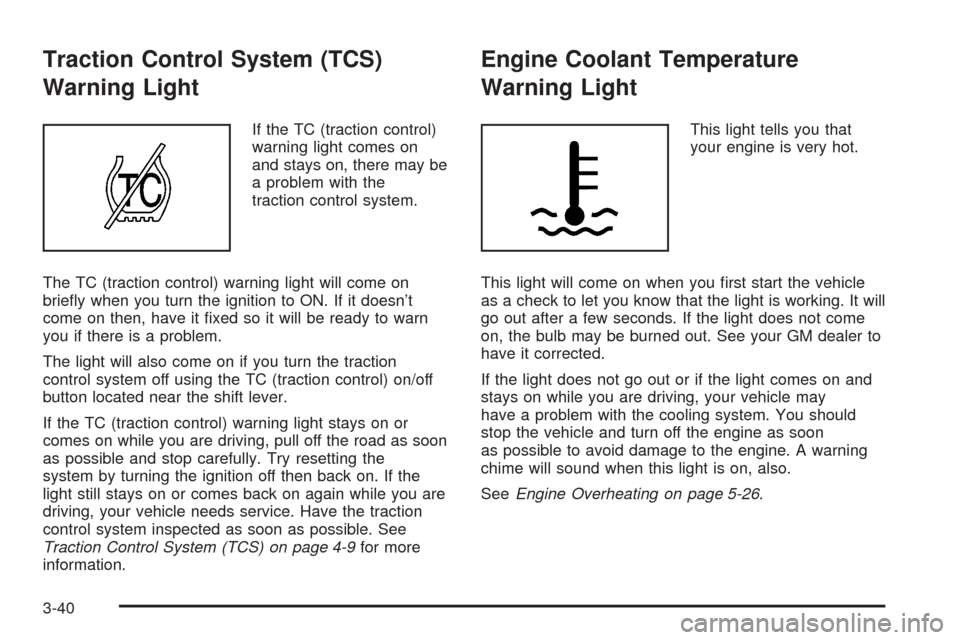
If the TC (traction control)
warning light comes on
and stays on, there may be
a problem with the
traction control system.
The TC (traction control) warning light will come on
briey when you turn the ignition to ON. If it doesn’t
come on then, have it xed so it will be ready to warn
you if there is a problem.
The light will also come on if you turn the traction
control system off using the TC (traction control) on/off
button located near the shift lever.
If the TC (traction control) warning light stays on or
comes on while you are driving, pull off the road as soon
as possible and stop carefully. Try resetting the
system by turning the ignition off then back on. If the
light still stays on or comes back on again while you are
driving, your vehicle needs service. Have the traction
control system inspected as soon as possible. See
Traction Control System (TCS) on page 4-9for more
information.
Engine Coolant Temperature
Warning Light
This light tells you that
your engine is very hot.
This light will come on when you rst start the vehicle
as a check to let you know that the light is working. It will
go out after a few seconds. If the light does not come
on, the bulb may be burned out. See your GM dealer to
have it corrected.
If the light does not go out or if the light comes on and
stays on while you are driving, your vehicle may
have a problem with the cooling system. You should
stop the vehicle and turn off the engine as soon
as possible to avoid damage to the engine. A warning
chime will sound when this light is on, also.
SeeEngine Overheating on page 5-26.
3-40
Page 168 of 442
Driver Information Center (DIC)
The DIC gives you the status of many of your vehicle’s
systems. It is also used to display driver personalization
features and warning/status messages.
If your vehicle has the base audio system, use the
information contained in this manual for instructions on
operating the DIC for your vehicle.
If your vehicle has the Navigation system, see the SRX
Navigation System manual for instructions on operating
the DIC for your vehicle.
System Controls
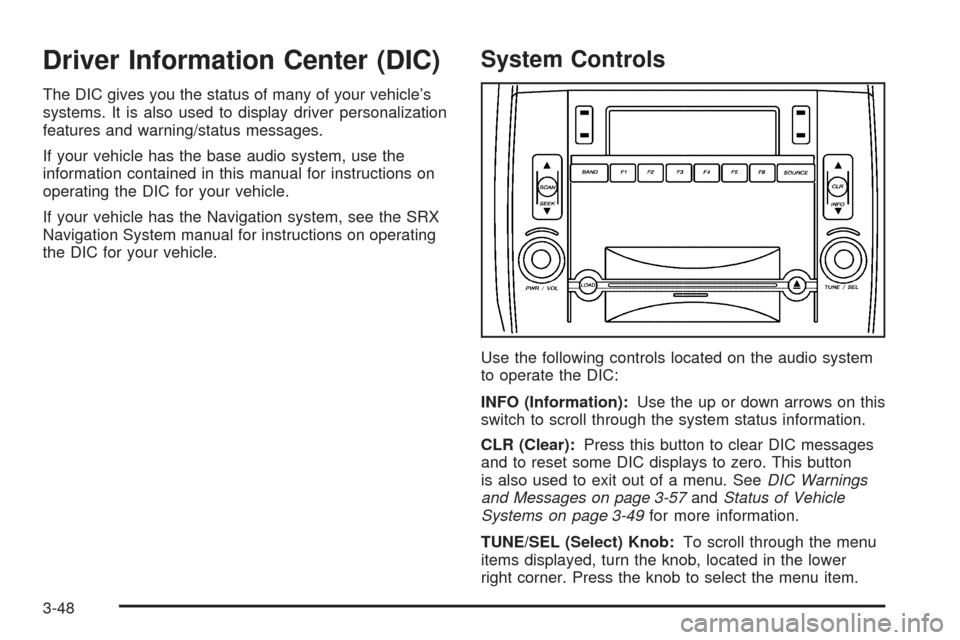
Use the following controls located on the audio system
to operate the DIC:
INFO (Information):Use the up or down arrows on this
switch to scroll through the system status information.
CLR (Clear):Press this button to clear DIC messages
and to reset some DIC displays to zero. This button
is also used to exit out of a menu. SeeDIC Warnings
and Messages on page 3-57andStatus of Vehicle
Systems on page 3-49for more information.
TUNE/SEL (Select) Knob:To scroll through the menu
items displayed, turn the knob, located in the lower
right corner. Press the knob to select the menu item.
3-48
Page 169 of 442

Status of Vehicle Systems
You can view the status of several vehicle systems
using the DIC.
Vehicle Information Menu
To access this menu, press the up or down arrow on
the INFO switch located to the right of the display.
The following items are available when the ignition is in
RUN. These items will not be available when the
ignition is in accessory. The tire pressure menu items
are only available if your vehicle has the Tire Pressure
Monitor (TPM) System:
OUTSIDE TEMP
MI TRIP A*
MI TRIP B*
MILES RANGE
MPG AVG*
MPG INST
GAL FUEL USED*
AVG MPH*
TIMER*
BATTERY VOLTS
ENGINE OIL LIFE*
TRANS FLUID LIFE*
PSI LF TIRE
PSI RF TIRE
PSI RR TIRE
PSI LR TIRE
BLANK LINE
*These items can be reset. Each one must be reset
individually. For a detailed description of the menu items
and how to reset them, see “Vehicle Information
Menu Item Descriptions” later in this section.
You can view any of these items at any time, but only
one item can be displayed at a time.
3-49
Page 170 of 442
Vehicle Information Menu Item
Descriptions
The following paragraphs contain a more detailed
description of each menu item:
OUTSIDE TEMP:If you select this item, the current
outside temperature is displayed at the top of the
screen. It will be in either degrees Fahrenheit or degrees
Celsius depending upon whether the system is set for
English or metric units. If you wish to change the
units, seeDIC Main Menu on page 3-53.
MI TRIP A and B:For information on the trip
odometers, seeTrip Odometers on page 3-35.
MILES RANGE:If you select this item, the approximate
number of remaining miles or kilometers you can
drive without refueling is displayed. This estimate is
based on the current driving conditions and will change
if the driving conditions change. For example, if you
are driving in traffic making frequent stops, the display
may read one number, but if you enter the freeway,
the number may change even though you still have the
same amount of gas in the gas tank. This is because
different driving conditions produce different fuel
economies. Generally, freeway driving produces better
fuel economy than city driving.If your vehicle is low on fuel, the Fuel Level Low
message will be displayed. See “Fuel Level Low” under
DIC Warnings and Messages on page 3-57for more
information.
MPG AVG:If you select this item, the approximate
average miles per gallon (mpg) or Liters per
100 kilometers (L/100km) is displayed. This number is
calculated based on the number of mpg (L/100km)
recorded since the last time this menu item was reset.
To reset the MPG AVG, press the CLR button located to
the right of the screen. The display will return to zero.
MPG INST:If you select this item, the current fuel
economy is displayed. This number reects only the fuel
economy that the vehicle has right now and will
change frequently as driving conditions change. Unlike
average fuel economy, this menu item cannot be
reset.
GAL FUEL USED:If you select this item, the number
of gallons or liters of fuel used since the last reset of this
menu item is displayed.
To reset GAL FUEL USED, press the CLR button
located to the right of the screen. The display will
return to zero.
3-50
Page 171 of 442

AVG MPH:If you select this item, the average speed of
the vehicle is displayed in miles per hour (mph) or
kilometers per hour (km/h). This average is calculated
based on the various vehicle speeds recorded since the
last reset of this menu item.
To reset AVG MPH, press the CLR button located to
the right of the screen. The display will return to zero.
TIMER:If you select this item, a timing feature is
displayed. The timer functions like a stopwatch in that
you can record the time it takes to travel from one point
to another.
To turn on the timer, press the CLR button located to
the right of the screen once. To turn off the timer, press
the CLR button again.
When the timer is off, the display will show the timer
value and TIMER OFF. The timing feature will stop.
To reset the timer, turn off the timer and then press and
hold the CLR button. The display will return to zero.
BATTERY VOLTS:If you select this item, the current
battery voltage is displayed. If the voltage is in the normal
range, the display will have OK after it. For example, the
display may read 13.2 Battery Volts OK.If there is a problem with the battery charging system,
there are four possible DIC messages that may be
displayed. SeeDIC Warnings and Messages on
page 3-57for more information.
ENGINE OIL LIFE:If you select this item, the
percentage of remaining oil life is displayed. If you see
99% Oil Life on the display, that means that 99% of
the current oil life remains.
When the oil life is depleted, the Change Engine Oil
message will appear on the display. See your GM dealer
for service. In addition to the engine oil life system
monitoring the oil life, additional maintenance is
recommended in the Maintenance Schedule in this
manual. SeeScheduled Maintenance on page 6-4and
Engine Oil on page 5-16for more information.
When you reset the Change Engine Oil message by
clearing it from the display, you still must reset the
engine oil life system separately. For more information
on resetting the engine oil life system, see “How to
Reset the Engine Oil Life System and the Oil Life
Indicator” underEngine Oil Life System on page 5-19.
3-51
Page 172 of 442
TRANS FLUID LIFE:If you select this item, the
percentage of remaining transmission uid life is
displayed. If you see 99% Trans Fluid Life on the
display, that means that 99% of the current transmission
uid life remains.
When the transmission uid life is depleted, the Change
Transmission Fluid message will appear on the
display. You should change the transmission uid as
soon as possible within 200 miles (320 km). Be sure to
keep a written record of the mileage and date of the
uid change so you will have it for future reference.
When you reset the Change Transmission Fluid message
by clearing it from the display, you still must reset the
transmission uid life monitor separately. For more
information on resetting the transmission uid life
monitor, seeAutomatic Transmission Fluid on page 5-22.
LF TIRE:If you select this item, the driver’s side front
tire pressure will be displayed. If the tire pressure is low,
LOW will be displayed with this item. The pressure
can be displayed in PSI or KPA. To change the units,
seeDIC Main Menu on page 3-53.RF TIRE:If you select this item, the passenger’s side
front tire pressure will be displayed. If the tire pressure is
low, LOW will be displayed with this item. The pressure
can be displayed in PSI or KPA. To change the
units, seeDIC Main Menu on page 3-53.
RR TIRE:If you select this item, the passenger’s side
rear tire pressure will be displayed. If the tire pressure
is low, LOW will be displayed with this item. The
pressure can be displayed in PSI or KPA. To change
the units, seeDIC Main Menu on page 3-53.
LR TIRE:If you select this item, the driver’s side rear
tire pressure will be displayed. If the tire pressure is low,
LOW will be displayed with this item. The pressure
can be displayed in PSI or KPA. To change the units,
seeDIC Main Menu on page 3-53.
3-52
Page 174 of 442
DIC Main Menu Item Descriptions
e
BASS - MID (Midrange) - TREBLE:This menu
item allows you to adjust the levels for the bass,
midrange, treble, balance, and fade features of the
audio system. For more information, see “Setting the
Tone (Bass/Treble)” and “Adjusting the Speakers
(Balance/Fade)” underRadio with CD on page 3-81.
eEQ (Equalizer):This menu item allows you
to choose among ve preset equalizations for the audio
system. See “Audio Equalizer” underRadio with CD
on page 3-81for more information.
DSP (Digital Signal Processing):This menu item
allows you to select the DSP type that you want on the
audio system. You may choose Normal, Talk,
Spacious, Rear Seat or Driver Seat. Press the
TUNE/SEL knob to scroll through these choices. Once
the desired choice is displayed, turn the knob to set
your DSP choice and continue scrolling through
the main menu.
See “Using DSP” underRadio with CD on page 3-81for
more information.DVD (Digital Versatile Disc):This menu item allows
you to turn the DVD on and off. Press the TUNE/SEL
knob once to turn DVD on and off. When DVD is on, an
X will be in the box next to DVD on the menu. The X
disappears when DVD is off.
SeeRear Seat Entertainment System on page 3-98for
more information.
AVC (Automatic Volume Compensation):This menu
item allows you to turn the AVC feature on and off.
Press the TUNE/SEL knob once to turn AVC on and off.
When AVC is on, an X will be in the box next to AVC
on the menu. The X disappears when AVC is off.
See “AVC (Automatic Volume Compensation)” under
Radio with CD on page 3-81for more information.
H/A (Home/Away Preset Stations):This menu item
allows you to switch back and forth between your home
and away preset radio stations. Press the TUNE/SEL
knob to switch between home and away.
See “Setting Preset Stations” underRadio with CD on
page 3-81for more information.
3-54
Page 175 of 442
AUTOSTORE:This menu item allows you to
automatically store radio stations with the strongest
signals as presets. See “Setting Preset Stations”Radio
with CD on page 3-81for more information.
CAT (Category):This menu item allows you to select
radio stations based on preset categories. To turn
the CAT feature on, press the TUNE/SEL knob once.
When CAT is on, an X will be in the box next to CAT on
the menu. The X disappears when CAT is off.
SeeRadio with CD on page 3-81for more information.
TA (Traffic Announcement):This menu item allows
you to turn the TA feature on and off. To turn the
TA feature on, press the TUNE/SEL knob once. When
TA is on, an X will be in the box next to TA on the
menu. The X disappears when TA is off.
See “RDS Messages” underRadio with CD on
page 3-81for more information.
RDS (Radio Data System) MSG (Message):This
menu item allows you to view an RDS radio station
message broadcast by a radio station. To view
the message, press the TUNE/SEL knob once. The
message will appear on the screen.
See “RDS Messages” underRadio with CD on
page 3-81for more information.AF (Alternate Frequency):This menu item allows you
to turn the AF feature on and off. To turn on AF,
press the TUNE/SEL knob once. When AF is on, an X
will be in the box next to AF on the menu. The X
disappears when AF is off.
See “Radio Data System (RDS)” underRadio with CD
on page 3-81for more information.
SEEK LOCAL/DISTANT:This feature instructs the
audio system to seek only local radio stations with the
strongest signal or to seek all radio stations with a strong
signal in a large area. Use LOCAL when you are in
urban areas where there are several strong radio station
signals and you want to limit the number of stations to
those with the strongest signals only. Use DISTANT
when you are in rural areas where there are fewer radio
station signals available.
To switch between LOCAL and DISTANT, press the
TUNE/SEL knob. Your choice will be set when you press
BACK and return to the main menu.
3-55
Page 178 of 442

Battery Voltage Low
This message will appear when the electrical system is
charging less than 10 volts or if the battery has been
drained.
If this message appears immediately after starting the
engine, it is possible that the generator can still recharge
the battery. The battery should recharge while driving
but may take a few hours to do so. Consider using
an auxiliary charger (be sure to follow the
manufacturer’s instructions) to boost the battery after
returning home or to a nal destination.
If this message appears while driving or after starting
your vehicle and stays on, have it checked by your
GM dealer immediately to determine the cause of this
problem.
To help the generator recharge the battery quickly, you
can reduce the load on the electrical system by
turning off the accessories.
The normal battery voltage range is 11.5 to 15.5 volts.
You can monitor battery voltage on the DIC by pressing
the INFO button until you nd BATTERY VOLTS.
Change Engine Oil
When this message comes on, it means that service is
required for your vehicle. See your GM dealer. See
Engine Oil on page 5-16andScheduled Maintenance
on page 6-4for more information.
When you reset the Change Engine Oil message by
clearing it from the display, you still must reset the
engine oil life system separately. For more information
on resetting the engine oil life system, seeEngine
Oil Life System on page 5-19.
Change Trans (Transmission) Fluid
This message indicates that the life of the transmission
uid has expired and it should be changed within
200 miles (320 km). SeeScheduled Maintenance on
page 6-4andRecommended Fluids and Lubricants on
page 6-11for the proper uid and change intervals.
When you reset the Change Trans Fluid message by
clearing it from the display, you still must reset the
transmission uid life monitor separately. For more
information on resetting the transmission uid life
monitor, seeAutomatic Transmission Fluid on
page 5-22.
3-58
Page 182 of 442
Service AC (Air Conditioning) System
This message appears when the electronic sensors that
control the air conditioning and heating systems are
no longer working. Have the climate control system
serviced by your GM dealer if you notice a drop
in heating and air conditioning efficiency.
Service Air Bag
There is a problem with the air bag system when this
message appears. Have your vehicle serviced at
your GM dealer immediately. SeeAirbag Readiness
Light on page 3-37for more information.
Service Charging System
This message will display when a problem with the
charging system has been detected. Have your vehicle
serviced at your GM dealer.
Service Electrical System
This message will display if an electrical problem has
occurred within the Powertrain Control Module (PCM) or
the ignition switch. Have your vehicle serviced at your
GM dealer.
Service Fuel System
The Powertrain Control Module (PCM) has detected a
problem within the fuel system when this message
appears. Have your vehicle serviced at your GM dealer.
Service Idle Control
A problem with the idle control has occurred when this
message displays. Have your vehicle serviced at
your GM dealer.
Service Stability System Message
Your vehicle is equipped with a vehicle stability
enhancement system called StabiliTrak®.
SeeStabiliTrak
®System on page 4-11. The Service
Stability System message will be displayed if there has
been a problem detected with StabiliTrak
®.
If the Service Stability System message comes on while
you are driving, pull off the road as soon as possible
and stop carefully. Try resetting the system by turning
the ignition off then back on. If the Service Stability
System message still stays on or comes back on again
while you are driving, your vehicle needs service.
Have the StabiliTrak
®System inspected at your
GM dealer as soon as possible.
3-62