lock CADILLAC SRX 2006 1.G Owners Manual
[x] Cancel search | Manufacturer: CADILLAC, Model Year: 2006, Model line: SRX, Model: CADILLAC SRX 2006 1.GPages: 456, PDF Size: 2.55 MB
Page 399 of 456
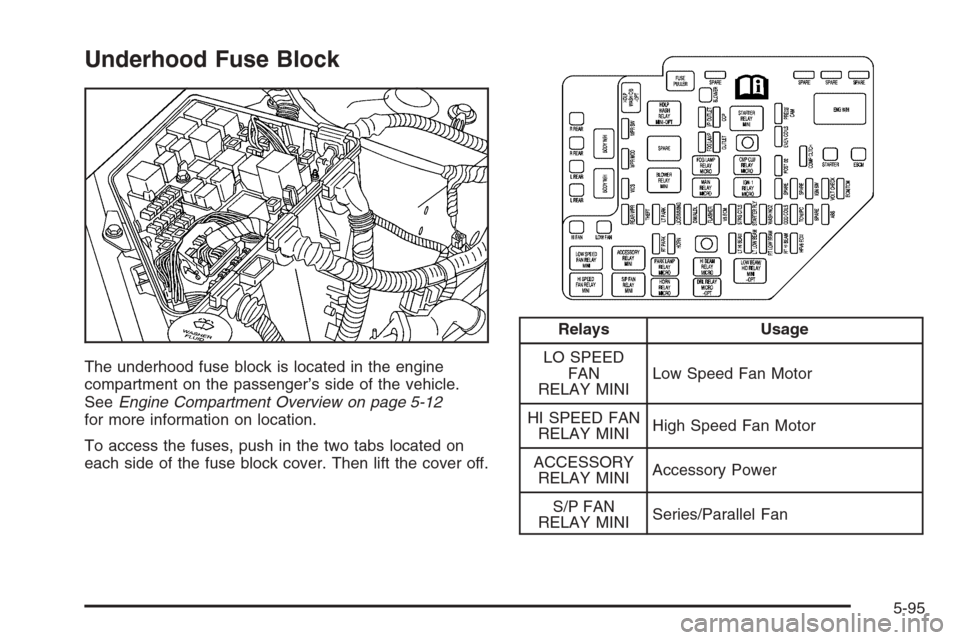
Underhood Fuse Block
The underhood fuse block is located in the engine
compartment on the passenger’s side of the vehicle.
SeeEngine Compartment Overview on page 5-12
for more information on location.
To access the fuses, push in the two tabs located on
each side of the fuse block cover. Then lift the cover off.
Relays Usage
LO SPEED
FAN
RELAY MINILow Speed Fan Motor
HI SPEED FAN
RELAY MINIHigh Speed Fan Motor
ACCESSORY
RELAY MINIAccessory Power
S/P FAN
RELAY MINISeries/Parallel Fan
5-95
Page 402 of 456
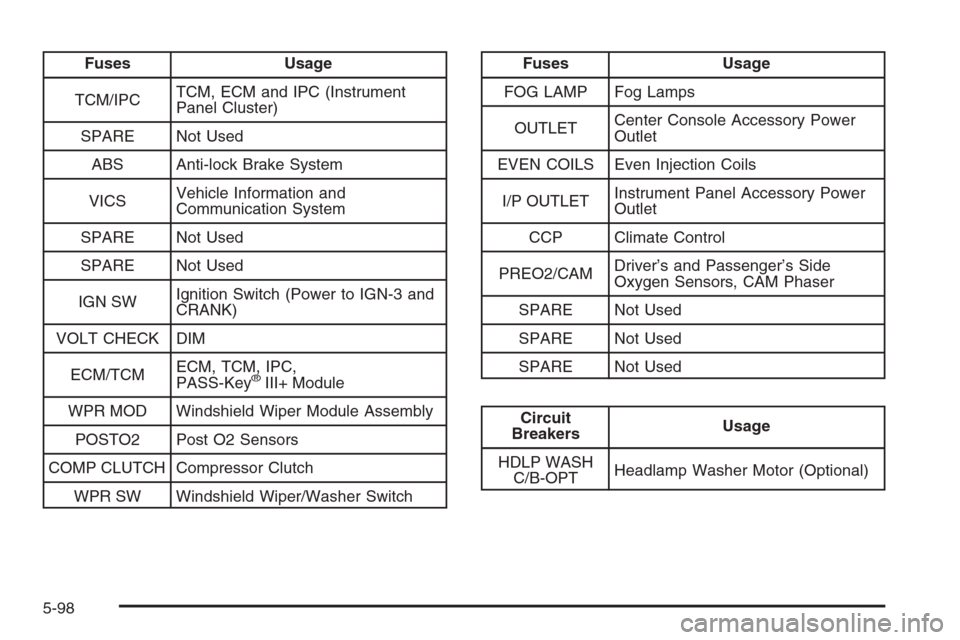
Fuses Usage
TCM/IPCTCM, ECM and IPC (Instrument
Panel Cluster)
SPARE Not Used
ABS Anti-lock Brake System
VICSVehicle Information and
Communication System
SPARE Not Used
SPARE Not Used
IGN SWIgnition Switch (Power to IGN-3 and
CRANK)
VOLT CHECK DIM
ECM/TCMECM, TCM, IPC,
PASS-Key
®III+ Module
WPR MOD Windshield Wiper Module Assembly
POSTO2 Post O2 Sensors
COMP CLUTCH Compressor Clutch
WPR SW Windshield Wiper/Washer Switch
Fuses Usage
FOG LAMP Fog Lamps
OUTLETCenter Console Accessory Power
Outlet
EVEN COILS Even Injection Coils
I/P OUTLETInstrument Panel Accessory Power
Outlet
CCP Climate Control
PREO2/CAMDriver’s and Passenger’s Side
Oxygen Sensors, CAM Phaser
SPARE Not Used
SPARE Not Used
SPARE Not Used
Circuit
BreakersUsage
HDLP WASH
C/B-OPTHeadlamp Washer Motor (Optional)
5-98
Page 403 of 456
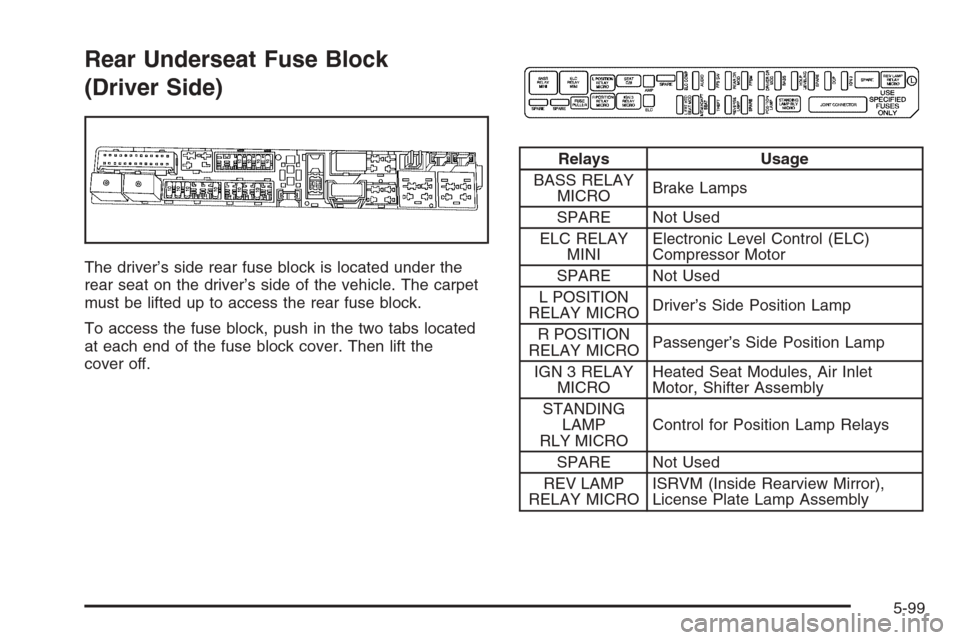
Rear Underseat Fuse Block
(Driver Side)
The driver’s side rear fuse block is located under the
rear seat on the driver’s side of the vehicle. The carpet
must be lifted up to access the rear fuse block.
To access the fuse block, push in the two tabs located
at each end of the fuse block cover. Then lift the
cover off.
Relays Usage
BASS RELAY
MICROBrake Lamps
SPARE Not Used
ELC RELAY
MINIElectronic Level Control (ELC)
Compressor Motor
SPARE Not Used
L POSITION
RELAY MICRODriver’s Side Position Lamp
R POSITION
RELAY MICROPassenger’s Side Position Lamp
IGN 3 RELAY
MICROHeated Seat Modules, Air Inlet
Motor, Shifter Assembly
STANDING
LAMP
RLY MICROControl for Position Lamp Relays
SPARE Not Used
REV LAMP
RELAY MICROISRVM (Inside Rearview Mirror),
License Plate Lamp Assembly
5-99
Page 405 of 456
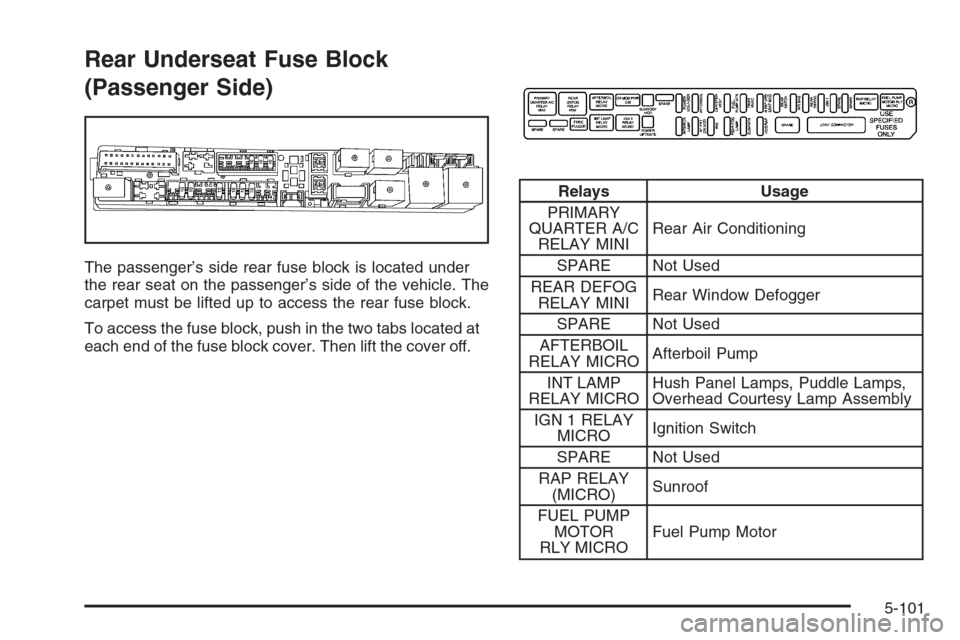
Rear Underseat Fuse Block
(Passenger Side)
The passenger’s side rear fuse block is located under
the rear seat on the passenger’s side of the vehicle. The
carpet must be lifted up to access the rear fuse block.
To access the fuse block, push in the two tabs located at
each end of the fuse block cover. Then lift the cover off.
Relays Usage
PRIMARY
QUARTER A/C
RELAY MINIRear Air Conditioning
SPARE Not Used
REAR DEFOG
RELAY MINIRear Window Defogger
SPARE Not Used
AFTERBOIL
RELAY MICROAfterboil Pump
INT LAMP
RELAY MICROHush Panel Lamps, Puddle Lamps,
Overhead Courtesy Lamp Assembly
IGN 1 RELAY
MICROIgnition Switch
SPARE Not Used
RAP RELAY
(MICRO)Sunroof
FUEL PUMP
MOTOR
RLY MICROFuel Pump Motor
5-101
Page 406 of 456
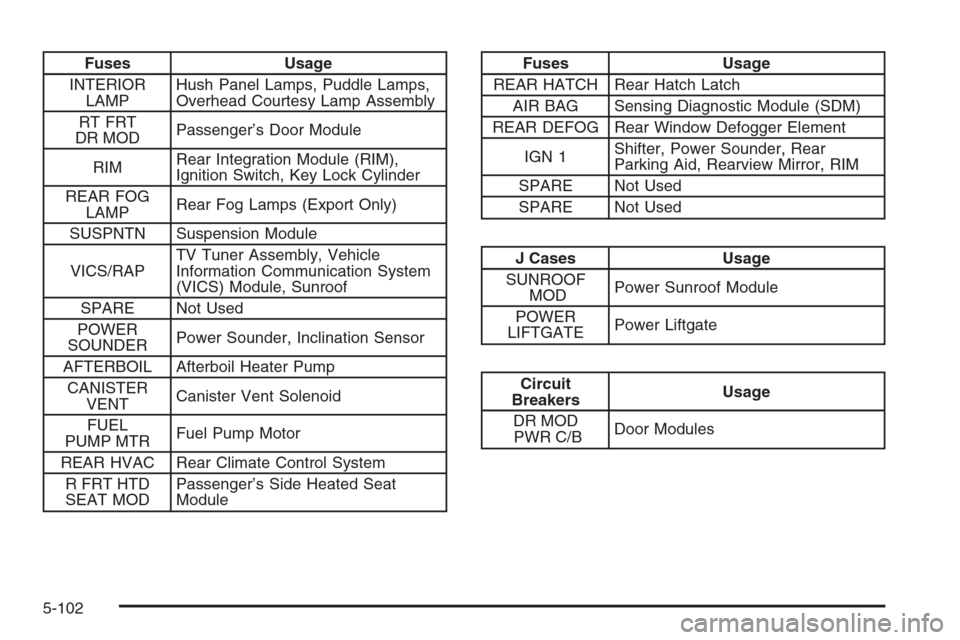
Fuses Usage
INTERIOR
LAMPHush Panel Lamps, Puddle Lamps,
Overhead Courtesy Lamp Assembly
RT FRT
DR MODPassenger’s Door Module
RIMRear Integration Module (RIM),
Ignition Switch, Key Lock Cylinder
REAR FOG
LAMPRear Fog Lamps (Export Only)
SUSPNTN Suspension Module
VICS/RAPTV Tuner Assembly, Vehicle
Information Communication System
(VICS) Module, Sunroof
SPARE Not Used
POWER
SOUNDERPower Sounder, Inclination Sensor
AFTERBOIL Afterboil Heater Pump
CANISTER
VENTCanister Vent Solenoid
FUEL
PUMP MTRFuel Pump Motor
REAR HVAC Rear Climate Control System
R FRT HTD
SEAT MODPassenger’s Side Heated Seat
ModuleFuses Usage
REAR HATCH Rear Hatch Latch
AIR BAG Sensing Diagnostic Module (SDM)
REAR DEFOG Rear Window Defogger Element
IGN 1Shifter, Power Sounder, Rear
Parking Aid, Rearview Mirror, RIM
SPARE Not Used
SPARE Not Used
J Cases Usage
SUNROOF
MODPower Sunroof Module
POWER
LIFTGATEPower Liftgate
Circuit
BreakersUsage
DR MOD
PWR C/BDoor Modules
5-102
Page 416 of 456

(d)Visually inspect wiper blades for wear or cracking.
Replace wiper blades that appear worn or damaged
or that streak or miss areas of the windshield.
(e)Make sure the safety belt reminder light and all your
belts, buckles, latch plates, retractors, and anchorages
are working properly. Look for any other loose or
damaged safety belt system parts. If you see anything
that might keep a safety belt system from doing its
job, have it repaired. Have any torn or frayed safety belts
replaced. Also look for any opened or broken airbag
coverings, and have them repaired or replaced.
The airbag system does not need regular maintenance.
(f)Lubricate all key lock cylinders, hood latch
assemblies, secondary latch, pivots, spring anchor,
release pawl, hood hinges, body door hinges, rear
compartment hinges, and any folding seat hardware.
More frequent lubrication may be required when
exposed to a corrosive environment. Applying silicone
grease on weatherstrips with a clean cloth will make
them last longer, seal better, and not stick or squeak.
See Weatherstrips on page 5-88.
(g)A uid loss in any vehicle system could indicate a
problem. Have the system inspected and repaired
and the uid level checked. Add uid if needed.(h)Change automatic transmission uid and lter if the
vehicle is mainly driven under one or more of these
conditions:
In heavy city traffic where the outside temperature
regularly reaches 90°F (32°C) or higher.
In hilly or mountainous terrain.
When doing frequent trailer towing.
Uses such as found in taxi, police,
or delivery service.
(i)Drain, ush, and rell cooling system. This service
can be complex; you should have your dealer perform
this service. See Engine Coolant on page 5-24 for
what to use. Inspect hoses. Clean radiator, condenser,
pressure cap, and ller neck. Pressure test the
cooling system and pressure cap.
(j)If you drive regularly under dusty conditions, the lter
may require replacement more often.
(k)If you drive regularly under dusty conditions, inspect
the lter at each engine oil change.
(l)Visually inspect belt for fraying, excessive cracks, or
obvious damage. Replace belt if necessary.
6-8
Page 418 of 456
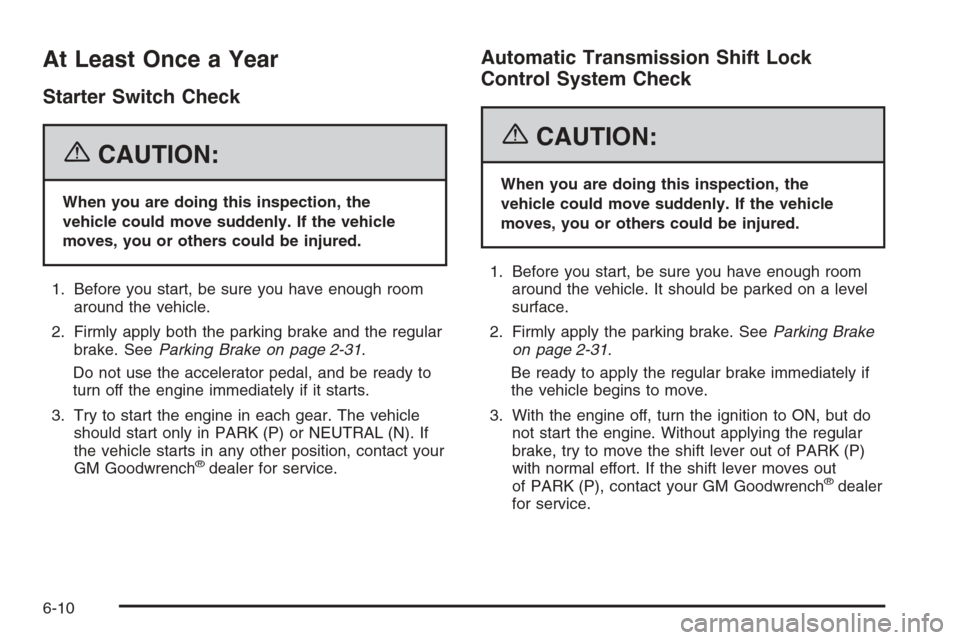
At Least Once a Year
Starter Switch Check
{CAUTION:
When you are doing this inspection, the
vehicle could move suddenly. If the vehicle
moves, you or others could be injured.
1. Before you start, be sure you have enough room
around the vehicle.
2. Firmly apply both the parking brake and the regular
brake. SeeParking Brake on page 2-31.
Do not use the accelerator pedal, and be ready to
turn off the engine immediately if it starts.
3. Try to start the engine in each gear. The vehicle
should start only in PARK (P) or NEUTRAL (N). If
the vehicle starts in any other position, contact your
GM Goodwrench
®dealer for service.
Automatic Transmission Shift Lock
Control System Check
{CAUTION:
When you are doing this inspection, the
vehicle could move suddenly. If the vehicle
moves, you or others could be injured.
1. Before you start, be sure you have enough room
around the vehicle. It should be parked on a level
surface.
2. Firmly apply the parking brake. SeeParking Brake
on page 2-31.
Be ready to apply the regular brake immediately if
the vehicle begins to move.
3. With the engine off, turn the ignition to ON, but do
not start the engine. Without applying the regular
brake, try to move the shift lever out of PARK (P)
with normal effort. If the shift lever moves out
of PARK (P), contact your GM Goodwrench
®dealer
for service.
6-10
Page 419 of 456

Ignition Transmission Lock Check
While parked, and with the parking brake set, try to turn
the ignition to OFF in each shift lever position.
The ignition should turn to OFF only when the shift
lever is in PARK (P).
The key should come out only in OFF.
Contact your GM Goodwrench
®dealer if service is
required.
Parking Brake and Automatic
Transmission Park (P) Mechanism Check
{CAUTION:
When you are doing this check, your vehicle
could begin to move. You or others could be
injured and property could be damaged. Make
sure there is room in front of your vehicle in
case it begins to roll. Be ready to apply the
regular brake at once should the vehicle begin
to move.Park on a fairly steep hill, with the vehicle facing
downhill. Keeping your foot on the regular brake, set the
parking brake.
To check the parking brake’s holding ability: With
the engine running and transmission in
NEUTRAL (N), slowly remove foot pressure from
the regular brake pedal. Do this until the vehicle is
held by the parking brake only.
To check the PARK (P) mechanism’s holding ability:
With the engine running, shift to PARK (P). Then
release the parking brake followed by the regular
brake.
Contact your GM Goodwrench
®dealer if service is
required.
Underbody Flushing Service
At least every spring, use plain water to ush any
corrosive materials from the underbody. Take care to
clean thoroughly any areas where mud and other debris
can collect.
6-11
Page 420 of 456

Recommended Fluids and
Lubricants
Fluids and lubricants identied below by name, part
number, or specication may be obtained from
your dealer.
Usage Fluid/Lubricant
Engine OilThe engine requires a special
engine oil meeting GM Standard
GM4718M. Oils meeting this
standard may be identied as
synthetic, and should also be
identied with the American
Petroleum Institute Certied for
Gasoline Engines starburst symbol.
However, not all synthetic API oils
with the starburst symbol will meet
this GM standard. You should look
for and use only an oil that meets
GM Standard GM4718M. GM
Goodwrench
®oil meets all the
requirements for your vehicle. For
the proper viscosity, seeEngine Oil
on page 5-16.
Usage Fluid/Lubricant
Engine Coolant50/50 mixture of clean, drinkable
water and use only DEX-COOL
®
Coolant. SeeEngine Coolant on
page 5-24.
Hydraulic
Brake SystemDelco
®Supreme 11 Brake Fluid or
equivalent DOT-3 brake uid.
Windshield
WasherGM Optikleen
®Washer Solvent.
Power
Steering
SystemGM Power Steering Fluid
(GM Part No. U.S. 89021184,
in Canada 89021186).
Automatic
TransmissionDEXRON
®-III Automatic
Transmission Fluid. Look for
“Approved for the H-Specication”
on the label.
Key Lock
CylindersMulti-Purpose Lubricant, Superlube
(GM Part No. U.S. 12346241, in
Canada 10953474).
Chassis
LubricationChassis Lubricant (GM
Part No. U.S. 12377985, in
Canada 88901242) or lubricant
meeting requirements of NLGI #2,
Category LB or GC-LB.
6-12
Page 433 of 456
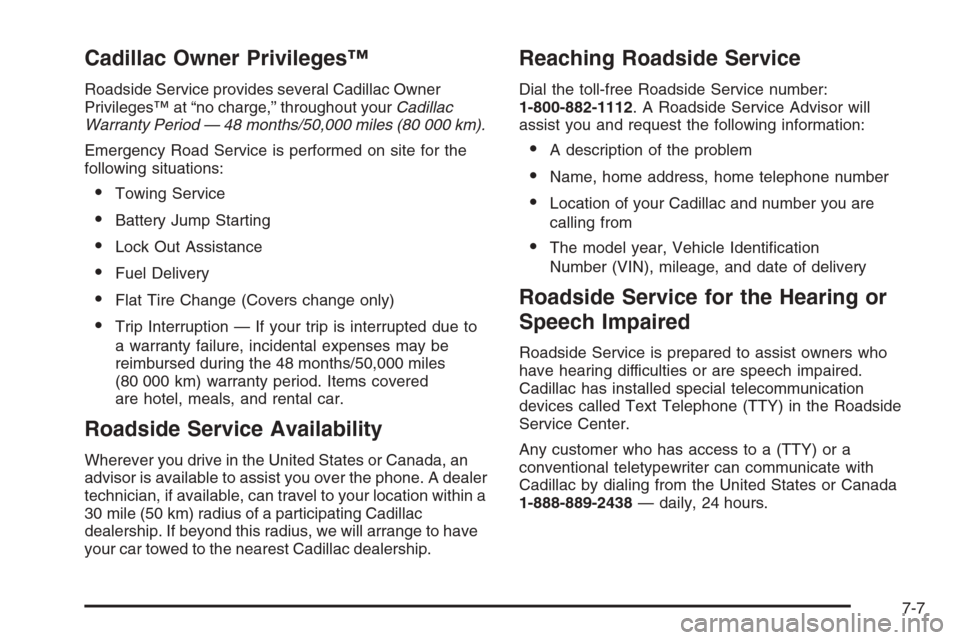
Cadillac Owner Privileges™
Roadside Service provides several Cadillac Owner
Privileges™ at “no charge,” throughout yourCadillac
Warranty Period — 48 months/50,000 miles (80 000 km).
Emergency Road Service is performed on site for the
following situations:
Towing Service
Battery Jump Starting
Lock Out Assistance
Fuel Delivery
Flat Tire Change (Covers change only)
Trip Interruption — If your trip is interrupted due to
a warranty failure, incidental expenses may be
reimbursed during the 48 months/50,000 miles
(80 000 km) warranty period. Items covered
are hotel, meals, and rental car.
Roadside Service Availability
Wherever you drive in the United States or Canada, an
advisor is available to assist you over the phone. A dealer
technician, if available, can travel to your location within a
30 mile (50 km) radius of a participating Cadillac
dealership. If beyond this radius, we will arrange to have
your car towed to the nearest Cadillac dealership.
Reaching Roadside Service
Dial the toll-free Roadside Service number:
1-800-882-1112. A Roadside Service Advisor will
assist you and request the following information:
A description of the problem
Name, home address, home telephone number
Location of your Cadillac and number you are
calling from
The model year, Vehicle Identication
Number (VIN), mileage, and date of delivery
Roadside Service for the Hearing or
Speech Impaired
Roadside Service is prepared to assist owners who
have hearing difficulties or are speech impaired.
Cadillac has installed special telecommunication
devices called Text Telephone (TTY) in the Roadside
Service Center.
Any customer who has access to a (TTY) or a
conventional teletypewriter can communicate with
Cadillac by dialing from the United States or Canada
1-888-889-2438— daily, 24 hours.
7-7