seats CADILLAC SRX 2006 1.G User Guide
[x] Cancel search | Manufacturer: CADILLAC, Model Year: 2006, Model line: SRX, Model: CADILLAC SRX 2006 1.GPages: 456, PDF Size: 2.55 MB
Page 34 of 456
Rear Safety Belt Comfort Guides
Rear shoulder belt comfort guides provide added safety
belt comfort for older children who have outgrown
booster seats and for small adults. When attached to a
shoulder belt, the comfort guide better positions the
belt away from the neck and head.
There is one guide available for each of the rear outside
passenger positions in the second row. Here is how
to attach the comfort guide to the shoulder belt.
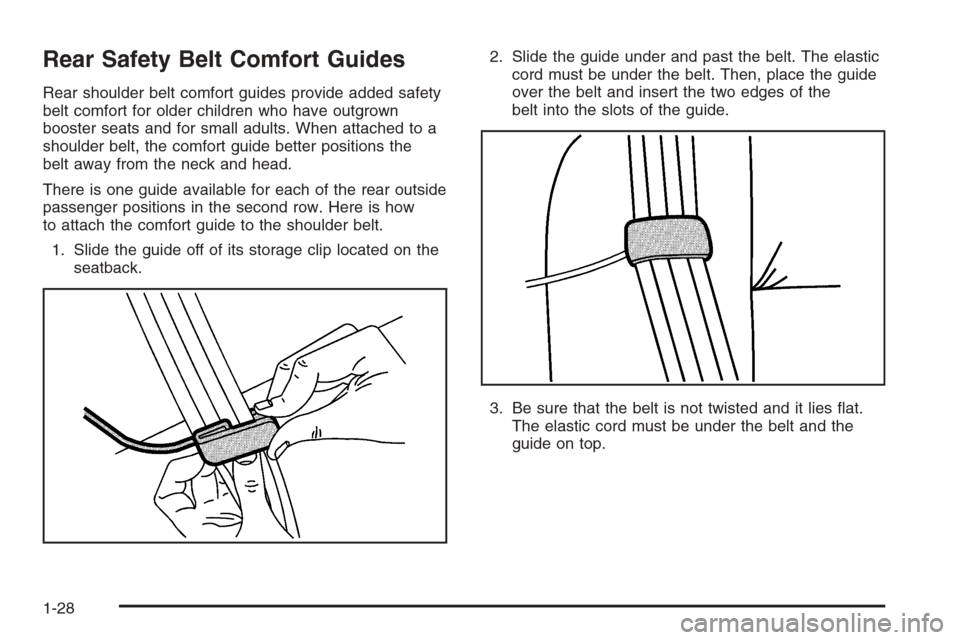
1. Slide the guide off of its storage clip located on the
seatback.2. Slide the guide under and past the belt. The elastic
cord must be under the belt. Then, place the guide
over the belt and insert the two edges of the
belt into the slots of the guide.
3. Be sure that the belt is not twisted and it lies at.
The elastic cord must be under the belt and the
guide on top.
1-28
Page 36 of 456
Safety Belt Extender
If the vehicle’s safety belt will fasten around you, you
should use it.
But if a safety belt is not long enough, your dealer will
order you an extender. It is free. When you go in to
order it, take the heaviest coat you will wear, so
the extender will be long enough for you. To help avoid
personal injury, do not let someone else use it, and
use it only for the seat it is made to t. The extender has
been designed for adults. Never use it for securing
child seats. To wear it, just attach it to the regular safety
belt. For more information, see the instruction sheet
that comes with the extender.
Child Restraints
Older Children
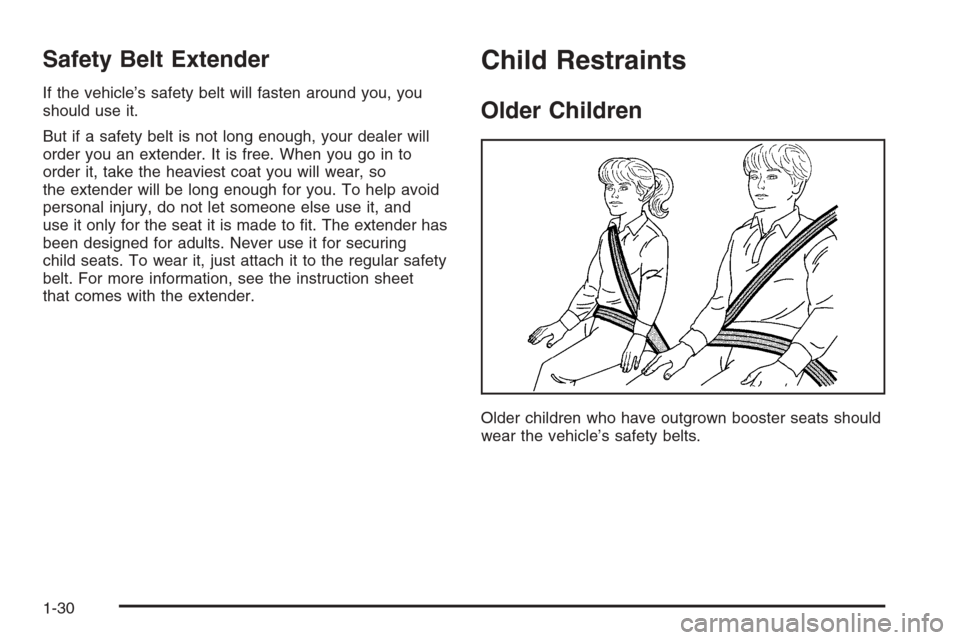
Older children who have outgrown booster seats should
wear the vehicle’s safety belts.
1-30
Page 43 of 456
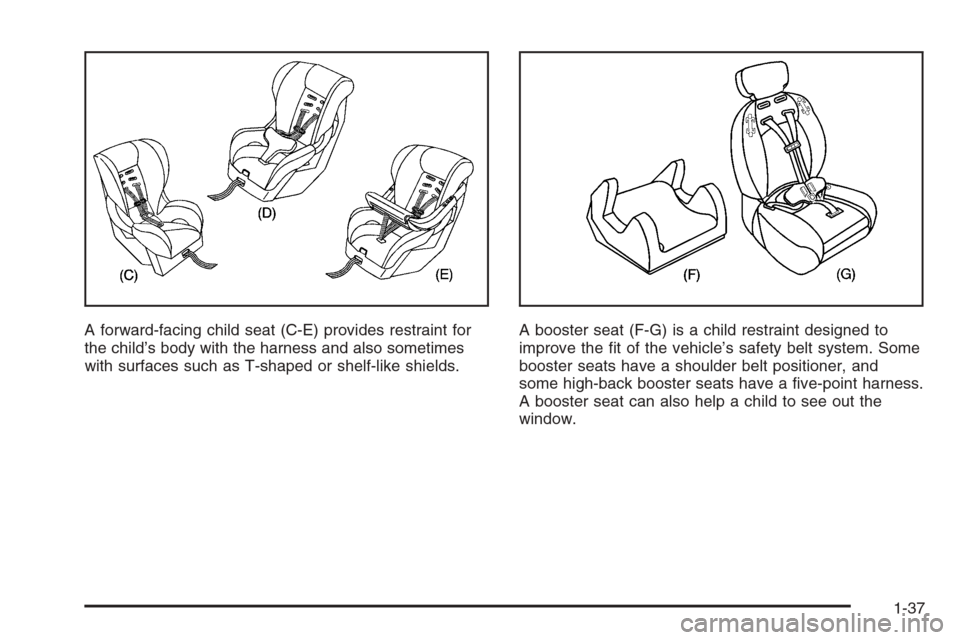
A forward-facing child seat (C-E) provides restraint for
the child’s body with the harness and also sometimes
with surfaces such as T-shaped or shelf-like shields.A booster seat (F-G) is a child restraint designed to
improve the t of the vehicle’s safety belt system. Some
booster seats have a shoulder belt positioner, and
some high-back booster seats have a ve-point harness.
A booster seat can also help a child to see out the
window.
1-37
Page 44 of 456
Q:How Should I Use a Child Restraint?
A:A child restraint system is any device designed for
use in a motor vehicle to restrain, seat, or position
children. A built-in child restraint system is a
permanent part of the motor vehicle. An add-on
child restraint system is a portable one, which
is purchased by the vehicle’s owner. To help reduce
injuries, an add-on child restraint must be secured
in the vehicle. With built-in or add-on child
restraints, the child has to be secured within the
child restraint.
When choosing an add-on child restraint, be sure
the child restraint is designed to be used in a
vehicle. If it is, it will have a label saying that it
meets federal motor vehicle safety standards. Then
follow the instructions for the restraint. You may
nd these instructions on the restraint itself or in a
booklet, or both.
Securing an Add-on Child Restraint in
the Vehicle
{CAUTION:
A child can be seriously injured or killed in a
crash if the child restraint is not properly
secured in the vehicle. Make sure the child
restraint is properly installed in the vehicle
using the vehicle’s safety belt or LATCH
system, following the instructions that came
with that restraint, and also the instructions in
this manual.
To help reduce the chance of injury, the child restraint
must be secured in the vehicle. Child restraint systems
must be secured in vehicle seats by lap belts or the
lap belt portion of a lap-shoulder belt, or by the LATCH
system. SeeLower Anchors and Tethers for Children
(LATCH) on page 1-40for more information. A child can
be endangered in a crash if the child restraint is not
properly secured in the vehicle.
1-38
Page 57 of 456
Securing a Child Restraint in the
Right Front Seat Position
If your child restraint has the LATCH system, seeLower
Anchors and Tethers for Children (LATCH) on page 1-40.
There is no top tether anchor in the right front
passenger’s position. Do not secure a child seat in this
position if a national or local law requires that the
top tether be anchored, or if the instructions that come
with the child restraint say that the top tether must
be anchored. SeeLower Anchors and Tethers
for Children (LATCH) on page 1-40if the child restraint
has a top tether.
Your vehicle has a right front passenger’s airbag.Never
put a rear-facing child restraint in this seat. Here is why:
{CAUTION:
A child in a rear-facing child restraint can be
seriously injured or killed if the right front
passenger’s airbag inates. This is because the
back of the rear-facing child restraint would be
very close to the inating airbag. Always secure
a rear-facing child restraint in a rear seat.A rear seat is a safer place to secure a forward-facing
child restraint. If you need to secure a forward-facing
child restraint in the right front seat, you will be using the
lap-shoulder belt to secure the child restraint in this
position. Be sure to follow the instructions that came with
the child restraint. Secure the child in the child restraint
when and as the instructions say.
1. Because your vehicle has a right front passenger’s
airbag, always move the seat as far back as it will
go before securing a forward-facing child restraint.
SeePower Seats on page 1-2orManual Passenger
Seat on page 1-2.
2. Put the child restraint on the seat.
3. Pick up the latch plate, and run the lap and shoulder
portions of the vehicle’s safety belt through or
around the restraint. The child restraint instructions
will show you how.
1-51
Page 70 of 456
Adding Equipment to Your
Airbag-Equipped Vehicle
Q:Is there anything I might add to the front or
sides of the vehicle that could keep the
airbags from working properly?
A:Yes. If you add things that change your vehicle’s
frame, bumper system, height, front end or side
sheet metal, they may keep the airbag system from
working properly. Also, the airbag system may
not work properly if you relocate any of the airbag
sensors. If you have any questions about this,
you should contact Customer Assistance before you
modify your vehicle. The phone numbers and
addresses for Customer Assistance are in Step Two
of the Customer Satisfaction Procedure in this
manual. SeeCustomer Satisfaction Procedure on
page 7-2.
Q:Because I have a disability, I have to get my
vehicle modied. How can I nd out whether
this will affect my airbag system?
A:Changing or moving any parts of the front seats,
safety belts, the airbag sensing and diagnostic
module, steering wheel, instrument panel, ceiling
headliner, ceiling and pillar garnish trim,
roof-mounted airbag modules, or airbag wiring can
affect the operation of the airbag system. If you
have questions, call Customer Assistance.
The phone numbers and addresses for Customer
Assistance are in Step Two of the Customer
Satisfaction Procedure in this manual. See
Customer Satisfaction Procedure on page 7-2.
1-64
Page 100 of 456

Automatic Transmission Operation
The shift lever is located on the center console between
the front seats.
There are several different
positions for the shift lever.
PARK (P):This position locks the rear wheels. It is the
best position to use when you start the engine
because your vehicle cannot move easily.{CAUTION:
It is dangerous to get out of your vehicle if the
shift lever is not fully in PARK (P) with the
parking brake rmly set. Your vehicle can roll.
Do not leave your vehicle when the engine is
running unless you have to. If you have left
the engine running, the vehicle can move
suddenly. You or others could be injured.
To be sure your vehicle will not move, even
when you are on fairly level ground, always
set your parking brake and move the shift
lever to PARK (P). SeeShifting Into Park (P)
on page 2-32. If you are pulling a trailer, see
Towing a Trailer on page 4-52.
Ensure the shift lever is fully in PARK (P) before starting
the engine. Your vehicle has an automatic transmission
shift lock control system. You must fully apply your
regular brakes before you can shift from PARK (P)
when the ignition key is in ON. If you cannot shift
out of PARK (P), ease pressure on the shift lever.
2-28
Page 120 of 456

Storage Areas
Glove Box
To open the glove box, lift up on the lever. Use your
door key to lock or unlock it.
Cupholder(s)
Your vehicle has cupholders located between the front
seats. Slide the cover back to expose them. There
are also cupholders in the armrest of the second row
seat. Press the panel on the front of the armrest
to expose the cupholders. On the outboard sides of
the third row there may also be cupholders.
Cell Phone Storage Area
Your vehicle has a closeable cell phone/sunglasses
storage area inside both of the front doors. Press
the button to open the door.
Front Storage Area
Your vehicle has a closeable storage area inside both of
the front doors. Press the button to open the door.
Center Console Storage Area
Your vehicle has a center console storage area located
between the front seats. It includes storage areas,
and accessory power outlet(s) on the rear of the
console.
2-48
Page 123 of 456

The vehicle may have an UltraView sunroof over the
rst two rows of seats. The ignition must be turned
to ON, or ACCESSORY, or the Retained Accessory
Power (RAP) must be active for to operate it. See
Retained Accessory Power (RAP) on page 2-24.
The sunroof/sunshade
switches are located in the
headliner between the
driver and front passenger.
One switch operates the sunroof and the other switch
operates the sunshade.
Press the back of the sunroof switch to open the
sunroof. When the switch is pressed to the rst stop
the sunroof will open to a desired position. Press
the switch to the second stop to express open the
sunroof to a preset comfort position. Press the second
stop again to fully express open the sunroof. Press
the front of the switch to close the sunroof. The rst stop
will close the sunroof at a desired position at normal
speed, and the second stop will express close the roof.Press the back of the sunshade switch to open the
sunshade. Press the front of the switch to the rst
stop to close the sunshade to a desired position at
a normal speed. Press the switch forward to the
second stop to express close the sunshade.
Anti-Pinch Feature
If an object is in the path of the sunroof when it is
closing, the anti-pinch feature will detect the object
and stop the sunroof from closing at the point of
the obstruction. The sunroof will then reverse. To
close the sunroof once it has re-opened, remove the
obstruction and press the front of the sunroof switch.
Resynchronization
To resynchronize the sunroof and sunshade, do the
following.
1. With the engine running, press and hold both
the sunroof switch in the open position and the
sunshade switch in the closed position for
six seconds.
2. Release both buttons.
3. When the sunroof reaches the fully closed position,
the sunshade will close.
4. After the sunroof and sunshade have fully closed,
continue to hold the sunroof switch in the closed
position for an additional three or four seconds
to complete the resynchronization process.
2-51
Page 124 of 456
Sunroof (UltraView Plus)
{CAUTION:
People who are in a crash and not wearing a
safety belt properly can suffer much worse
injuries. They can hit things inside the vehicle
or be ejected from it, and be seriously injured
or killed. This is true for any vehicle occupant,
in any motor vehicle, but if you have the
UltraView roof it is, if anything, even more
important. In a rollover or other crash, the
UltraView roof can be damaged or destroyed.
People who are unbelted would then be at
even greater risk of being ejected from the
vehicle. Always fasten your safety belt, and
check that your passengers’ belts are fastened
properly too.The vehicle may have an UltraView sunroof over the
rst two rows of seats and a smaller sunroof over
the third row seat. Both have sunshades, but the back
sunroof does not open. The ignition must be turned
to ON, or ACCESSORY, or the Retained Accessory
Power (RAP) must be active for to operate it. See
Retained Accessory Power (RAP) on page 2-24.
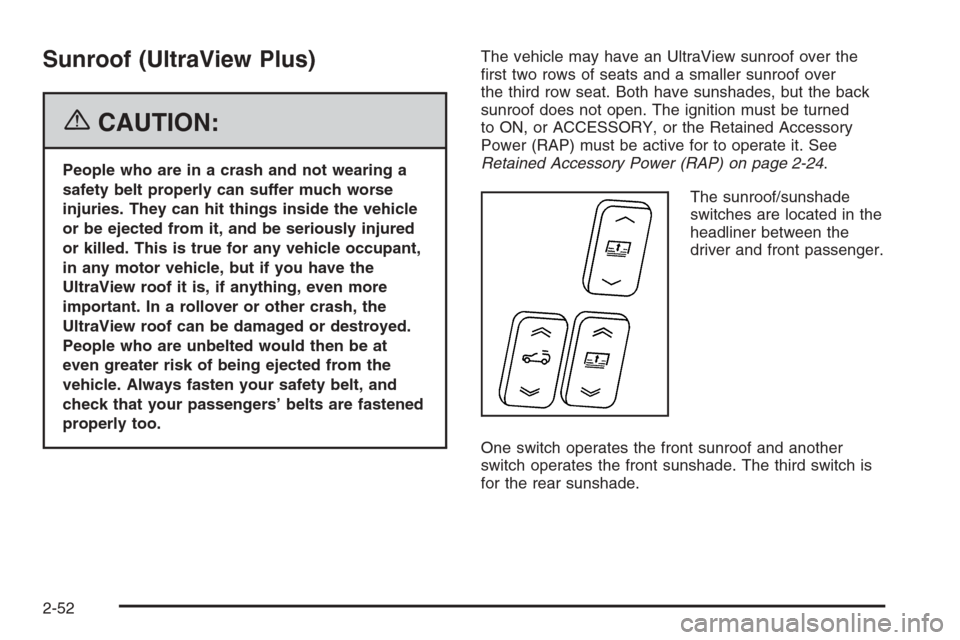
The sunroof/sunshade
switches are located in the
headliner between the
driver and front passenger.
One switch operates the front sunroof and another
switch operates the front sunshade. The third switch is
for the rear sunshade.
2-52