brake CADILLAC SRX 2007 1.G User Guide
[x] Cancel search | Manufacturer: CADILLAC, Model Year: 2007, Model line: SRX, Model: CADILLAC SRX 2007 1.GPages: 522, PDF Size: 2.71 MB
Page 130 of 522
Leaving Your Vehicle With the
Engine Running
{CAUTION:
It can be dangerous to leave your vehicle
with the engine running. Your vehicle
could move suddenly if the shift lever is
not fully in PARK (P) with the parking
brake rmly set. And, if you leave the
vehicle with the engine running, it could
overheat and even catch re. You or
others could be injured. Do not leave your
vehicle with the engine running.
If you have to leave your vehicle with the engine
running, be sure your vehicle is in PARK (P)
and your parking brake is rmly set before you
leave it. After you have moved the shift lever into
PARK (P), hold the regular brake pedal down.
Then, see if you can move the shift lever
away from PARK (P) without rst pushing the
button on the shift lever. If you can, it means that
the shift lever was not fully locked into PARK (P).
Torque Lock
If you are parking on a hill and you do not shift
your transmission into PARK (P) properly,
the weight of the vehicle may put too much force
on the parking pawl in the transmission. You
may nd it difficult to pull the shift lever out
of PARK (P). This is called “torque lock.” To
prevent torque lock, set the parking brake and then
shift into PARK (P) properly before you leave
the driver’s seat. To nd out how, see “Shifting Into
PARK (P)” listed previously.
If torque lock does occur, you may need to have
another vehicle push yours a little uphill to
take some of the pressure from the parking pawl
in the transmission, so you can pull the shift
lever out of PARK (P).
130
Page 131 of 522
Shifting Out of Park (P)
Your vehicle has an automatic transmission shift
lock control system.
To shift out of PARK (P):
1. Apply the regular brake pedal.
2. Then press the shift lever button.
3. Move the shift lever to the desired gear.
If you are still unable to shift out of PARK (P):
1. Fully release the shift lever button.
2. While holding down the brake pedal, press
the shift lever button again.
3. Move the shift lever to the desired gear.
If you still cannot move the shift lever from
PARK (P), consult your dealer.
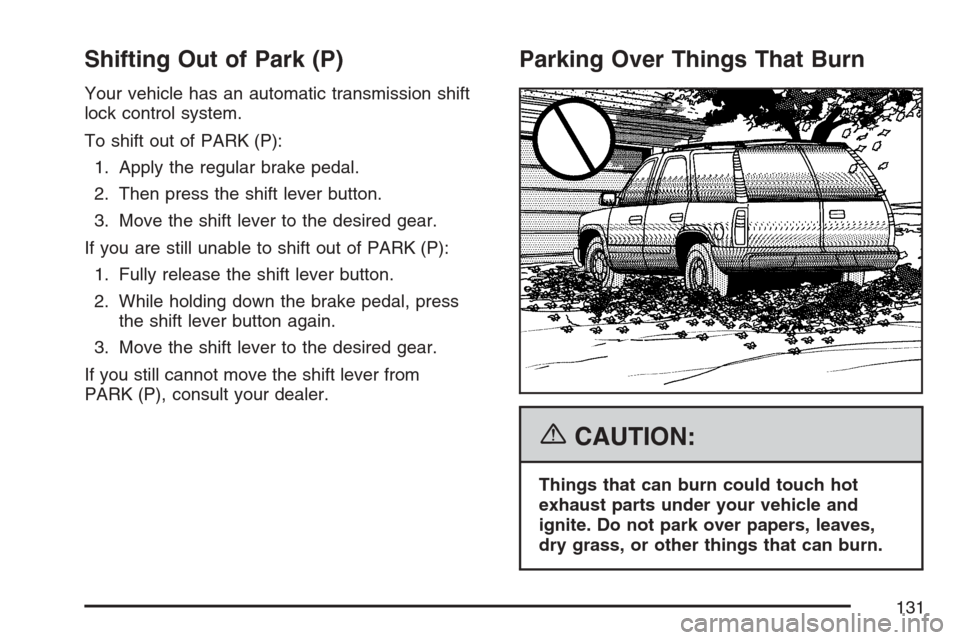
Parking Over Things That Burn
{CAUTION:
Things that can burn could touch hot
exhaust parts under your vehicle and
ignite. Do not park over papers, leaves,
dry grass, or other things that can burn.
131
Page 133 of 522
Running the Engine While Parked
It is better not to park with the engine running. But if
you ever have to, here are some things to know.
{CAUTION:
Idling the engine with the climate control
system off could allow dangerous exhaust
into your vehicle. See the earlier caution
underEngine Exhaust on page 132.
Also, idling in a closed-in place can let
deadly carbon monoxide (CO) into your
vehicle even if the climate control fan is at
the highest setting. One place this can
happen is a garage. Exhaust — with
CO — can come in easily. NEVER park in
a garage with the engine running.
Another closed-in place can be a blizzard.
SeeWinter Driving on page 317.
{CAUTION:
It can be dangerous to get out of your
vehicle if the shift lever is not fully in
PARK (P) with the parking brake rmly
set. Your vehicle can roll. Do not leave
your vehicle when the engine is running
unless you have to. If you have left the
engine running, the vehicle can move
suddenly. You or others could be injured.
To be sure your vehicle will not move,
even when you are on fairly level ground,
always set your parking brake and move
the shift lever to PARK (P).
Follow the proper steps to be sure your vehicle
will not move. SeeShifting Into Park (P) on
page 129.
If you are pulling a trailer, seeTowing a Trailer on
page 331.
133
Page 162 of 522
Passenger Airbag Status Indicator............. 202
Charging System Light.............................. 204
Brake System Warning Light..................... 204
Anti-Lock Brake System Warning Light...... 205
Traction Control System (TCS) Warning
Light...................................................... 206
Engine Coolant Temperature Warning
Light...................................................... 206
Engine Coolant Temperature Gage............ 207
Tire Pressure Light.................................... 207
Malfunction Indicator Lamp........................ 208
Oil Pressure Light..................................... 211
Security Light............................................ 212
Fog Lamp Light......................................... 212
Lights On Reminder.................................. 212
Cruise Control Light.................................. 212
Highbeam On Light................................... 213
Tow/Haul Mode Light................................ 213
Fuel Gage................................................. 213
Driver Information Center (DIC).................. 214
DIC Controls and Displays........................ 215
DIC Warnings and Messages.................... 220
DIC Vehicle Customization........................ 231Audio System(s)......................................... 240
Setting the Time (Radio with Single
CD Player)............................................. 242
Setting the Time (Radio with Six-Disc
CD Player)............................................. 244
Radio with CD........................................... 246
Using an MP3........................................... 257
XM Radio Messages................................. 264
Navigation/Radio System........................... 266
Rear Seat Entertainment System............... 266
Rear Seat Audio (RSA)............................. 266
Theft-Deterrent Feature............................. 268
Audio Steering Wheel Controls.................. 269
Radio Reception........................................ 270
Care of Your CDs..................................... 271
Care of the CD Player.............................. 271
Diversity Antenna System.......................... 272
XM™ Satellite Radio Antenna System....... 272
Section 3 Instrument Panel
162
Page 165 of 522
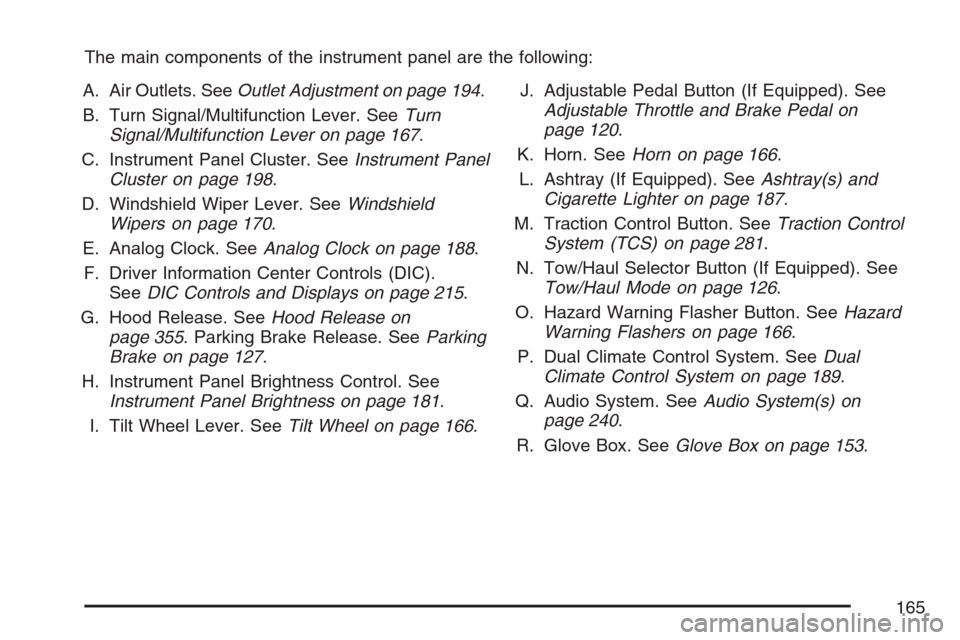
The main components of the instrument panel are the following:
A. Air Outlets. SeeOutlet Adjustment on page 194.
B. Turn Signal/Multifunction Lever. SeeTurn
Signal/Multifunction Lever on page 167.
C. Instrument Panel Cluster. SeeInstrument Panel
Cluster on page 198.
D. Windshield Wiper Lever. SeeWindshield
Wipers on page 170.
E. Analog Clock. SeeAnalog Clock on page 188.
F. Driver Information Center Controls (DIC).
SeeDIC Controls and Displays on page 215.
G. Hood Release. SeeHood Release on
page 355. Parking Brake Release. SeeParking
Brake on page 127.
H. Instrument Panel Brightness Control. See
Instrument Panel Brightness on page 181.
I. Tilt Wheel Lever. SeeTilt Wheel on page 166.J. Adjustable Pedal Button (If Equipped). See
Adjustable Throttle and Brake Pedal on
page 120.
K. Horn. SeeHorn on page 166.
L. Ashtray (If Equipped). SeeAshtray(s) and
Cigarette Lighter on page 187.
M. Traction Control Button. SeeTraction Control
System (TCS) on page 281.
N. Tow/Haul Selector Button (If Equipped). See
Tow/Haul Mode on page 126.
O. Hazard Warning Flasher Button. SeeHazard
Warning Flashers on page 166.
P. Dual Climate Control System. SeeDual
Climate Control System on page 189.
Q. Audio System. SeeAudio System(s) on
page 240.
R. Glove Box. SeeGlove Box on page 153.
165
Page 174 of 522
Cruise Control
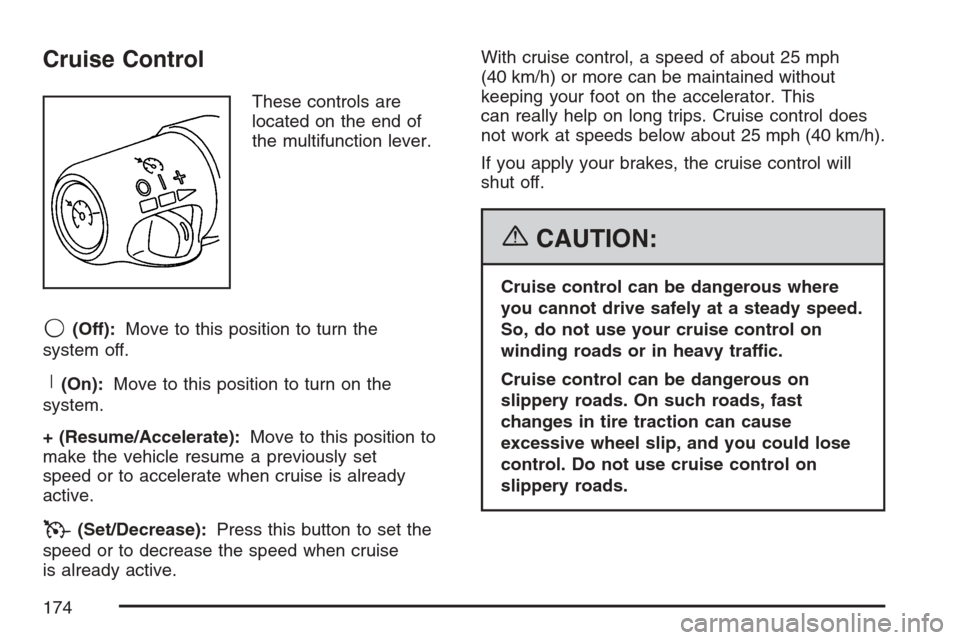
These controls are
located on the end of
the multifunction lever.
9(Off):Move to this position to turn the
system off.
R(On):Move to this position to turn on the
system.
+ (Resume/Accelerate):Move to this position to
make the vehicle resume a previously set
speed or to accelerate when cruise is already
active.
T(Set/Decrease):Press this button to set the
speed or to decrease the speed when cruise
is already active.With cruise control, a speed of about 25 mph
(40 km/h) or more can be maintained without
keeping your foot on the accelerator. This
can really help on long trips. Cruise control does
not work at speeds below about 25 mph (40 km/h).
If you apply your brakes, the cruise control will
shut off.
{CAUTION:
Cruise control can be dangerous where
you cannot drive safely at a steady speed.
So, do not use your cruise control on
winding roads or in heavy traffic.
Cruise control can be dangerous on
slippery roads. On such roads, fast
changes in tire traction can cause
excessive wheel slip, and you could lose
control. Do not use cruise control on
slippery roads.
174
Page 176 of 522
Resuming a Set Speed
Suppose you set the cruise control at a desired
speed and then you apply the brake. This, of
course, disengages the cruise control. But it does
not need to be reset.
Once you are going about 25 mph (40 km/h) or
more, you can move the cruise control switch
briey from on to resume/accelerate.
You will go right back up to your chosen speed
and stay there.
If you hold the switch at resume/accelerate the
vehicle will keep going faster until you release the
switch or apply the brake. Do not hold the
switch at resume/accelerate, unless you want the
vehicle to go faster.
Increasing Speed While Using Cruise
Control
There are two ways to go to a higher speed:
Use the accelerator pedal to get to the higher
speed. Press the set button at the end of the
lever, then release the button and the
accelerator pedal. You will now cruise at the
higher speed.
Move the cruise switch from on to resume/
accelerate. Hold it there until you get up to the
desired speed, and then release the switch. To
increase your speed in very small amounts,
move the switch briey to resume/accelerate.
Each time you do this, your vehicle will go
about 1 mph (1.6 km/h) faster.
If using the accelerator pedal and the set button at
end of the lever to increase cruise set speed,
your new set speed must be at least 5 mph higher
than current speed for this method to work. If it
is not 5 mph higher, switch cruise switch off, then
on, and then reset your speed using the set
button.
176
Page 177 of 522
Reducing Speed While Using Cruise
Control
There are two ways to reduce your speed while
using cruise control:
Press in the button at the end of the lever until
you reach the lower speed desired, then
release it.
To slow down in very small amounts, briey
press the set button. Each time you do this,
you will go about 1 mph (1.6 km/h) slower.
Passing Another Vehicle While Using
Cruise Control
Use the accelerator pedal to increase your speed.
When you take your foot off the pedal, the
vehicle will slow down to the cruise control speed
you set earlier.
Using Cruise Control on Hills
How well the cruise control works on hills depends
upon the vehicle speed, load, and the steepness of
the hills. When going up steep hills, you might have
to step on the accelerator pedal to maintain the
vehicle’s speed. When going downhill, you might
have to brake to keep the vehicle’s speed down.
Applying the brake will turn off the cruise control. If
you need to apply the brake due to the grade of the
downhill slope, you might not want to attempt to use
your cruise control feature.
Ending Cruise Control
To end a cruise control session, step lightly on the
brake pedal.
Stepping on the brake pedal will end the current
cruise control session only. Move the cruise control
switch to off to turn off the system completely.
Erasing Speed Memory
When you turn off the cruise control or the ignition,
the cruise control set speed memory is erased.
177
Page 180 of 522
When the exterior lamp control is in AUTO and it is
dark enough outside, the DRL will turn off and the
low-beam headlamps will turn on. When it is bright
enough outside, the low-beam headlamps will go
off, and the DRL will turn back on. If you start the
vehicle in a dark garage, the automatic headlamp
system will come on immediately. Once you leave
the garage, it will take about one minute for the
automatic headlamp system to change to DRL if it
is light outside. During that delay, the instrument
panel cluster may not be as bright as usual. Make
sure the instrument panel brightness lever is in the
full bright position. SeeInstrument Panel Brightness
on page 181.
To drive the vehicle with the DRL off, turn the
exterior lamp control off. Then turn on the
fog lamps or parking lamps, and the DRL will turn
off. This will work regardless of gear position
and whether or not the parking brake is set.
As with any vehicle, you should turn on the regular
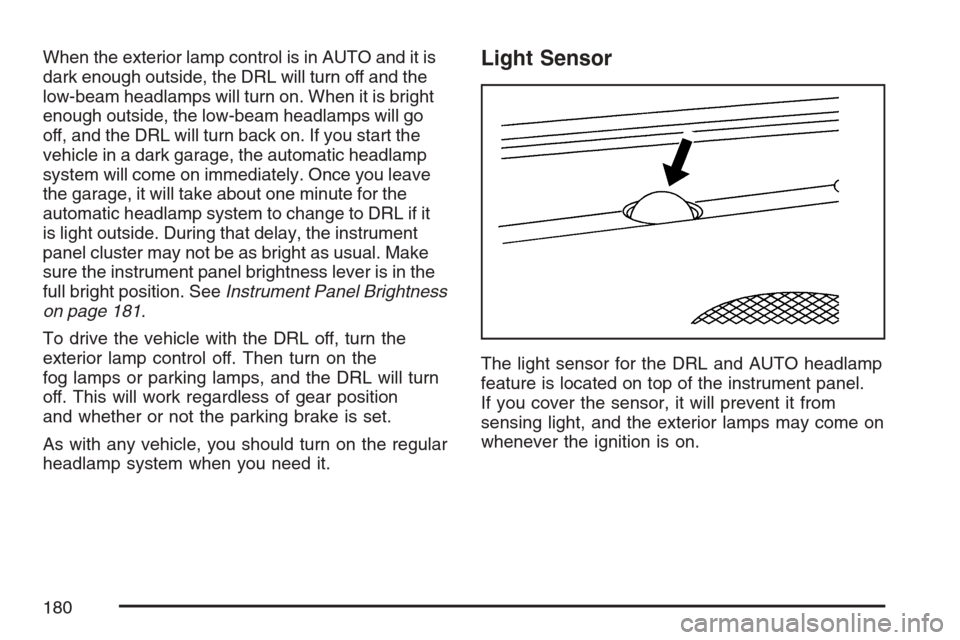
headlamp system when you need it.Light Sensor
The light sensor for the DRL and AUTO headlamp
feature is located on top of the instrument panel.
If you cover the sensor, it will prevent it from
sensing light, and the exterior lamps may come on
whenever the ignition is on.
180
Page 186 of 522
When the System Does Not Seem to Work
Properly
The light may ash red when the vehicle is in
REVERSE (R), if the ultrasonic sensors are not
kept clean. So be sure to keep your rear bumper
free of mud, dirt, snow, ice and slush. Other
conditions that may affect system performance
include things like the vibrations from a jackhammer
or the compression of air brakes on a very large
truck. If after cleaning the rear bumper and then
driving forward at least 15 mph (25 km/h), the
display continues to ash red, see your dealer.
If a trailer was attached to your vehicle, or a
bicycle or an object was on the back of, or hanging
out of your liftgate during your last drive cycle,
the light may also ash red. The light will continue
to ash whenever in REVERSE (R) until your
vehicle is driven forward at least 15 mph (25 km/h)
without any obstructions behind the vehicle.
For cleaning instructions, seeWashing Your
Vehicle on page 447.
Accessory Power Outlet(s)
The accessory power outlets can be used to plug
in electrical equipment such as a cellular
telephone, CB radio, etc.
The vehicle has one outlet in front of the center
console on the instrument panel and one in
the rear compartment. Your vehicle may have
one or two outlets in the rear of the center console.
There is a small cap that must be removed to
access the accessory power outlet. When
not using the outlet be sure to cover it with the
protective cap.
Notice:Leaving electrical equipment plugged
in for an extended period of time while the
vehicle is off will drain the battery. Power is
always supplied to the outlets. Always unplug
electrical equipment when not in use and
do not plug in equipment that exceeds
the maximum 20 ampere rating.
186