trailer CADILLAC SRX 2007 1.G Owner's Manual
[x] Cancel search | Manufacturer: CADILLAC, Model Year: 2007, Model line: SRX, Model: CADILLAC SRX 2007 1.GPages: 522, PDF Size: 2.71 MB
Page 337 of 522
Because your rear axle now weighs 3,100 lbs
(1 406 kg), you can only put 900 lbs (408 kg) on the
rear axle without exceeding RGAWR. The effect of
tongue weight is about
1.5 times the actual weight. Dividing the 900 lbs
(408 kg) by 1.5 leaves you with being able to
handle only 600 lbs (272 kg) of tongue weight.
Since tongue weight is usually at least 10 percent of
total loaded trailer weight, you can expect that the
largest trailer your vehicle can properly handle is
6,000 lbs (2 721 kg).
It is important that you make sure your vehicle
does not exceed any of its ratings — GCWR,
GVWR, RGAWR, Maximum Trailer Rating
or Tongue Weight. The only way to be sure you
are not exceeding any of these ratings is to weigh
your vehicle and trailer.
Total Weight on Your Vehicle’s Tires
Be sure your vehicle’s tires are inated to the
upper limit for cold tires. You’ll nd these numbers
on the Certication/Tire label. SeeLoading
Your Vehicle on page 322. Then be sure you don’t
go over the GVW limit for your vehicle, including
the weight of the trailer tongue.
Hitches
It’s important to have the correct hitch equipment.
Crosswinds, large trucks going by and rough
roads are a few reasons why you’ll need the right
hitch. Here are some rules to follow:
The rear bumper on your vehicle is not
intended for hitches. Do not attach rental
hitches or other bumper-type hitches to it. Use
only a frame-mounted hitch that does not
attach to the bumper.
Will you have to make any holes in the body
of your vehicle when you install a trailer
hitch? If you do, then be sure to seal the holes
later when you remove the hitch. If you
don’t seal them, deadly carbon monoxide (CO)
from your exhaust can get into your vehicle.
SeeEngine Exhaust on page 132. Dirt
and water can, too.
337
Page 338 of 522
Safety Chains
You should always attach chains between your
vehicle and your trailer. Cross the safety
chains under the tongue of the trailer so that the
tongue will not drop to the road if it becomes
separated from the hitch. Instructions about safety
chains may be provided by the hitch manufacturer
or by the trailer manufacturer. Follow the
manufacturer’s recommendation for attaching
safety chains and do not attach them to the
bumper. Always leave just enough slack so you
can turn with your rig. And, never allow safety
chains to drag on the ground.
Trailer Brakes
If you tow more than 1,000 lbs (450 kg), use trailer
brakes. Because your vehicle has anti-lock
brakes, don’t try to tap into your vehicle’s hydraulic
brake system. If you do, both brake systems
won’t work well, or at all.
Be sure to read and follow the instructions for the
trailer brakes so you’ll be able to install, adjust
and maintain them properly.
Driving with a Trailer
Towing a trailer requires a certain amount of
experience. Before setting out for the open road,
you’ll want to get to know your rig. Acquaint
yourself with the feel of handling and braking with
the added weight of the trailer. And always
keep in mind that the vehicle you are driving is
now a good deal longer and not nearly as
responsive as your vehicle is by itself.
Before you start, check all trailer hitch parts and
attachments, safety chains, electrical connector,
lamps, tires and mirror adjustment. If the trailer has
electric brakes, start your vehicle and trailer
moving and then apply the trailer brake controller
by hand to be sure the brakes are working.
This lets you check your electrical connection at
the same time.
During your trip, check occasionally to be sure
that the load is secure, and that the lamps and any
trailer brakes are still working.
338
Page 339 of 522
Following Distance
Stay at least twice as far behind the vehicle ahead
as you would when driving your vehicle without
a trailer. This can help you avoid situations
that require heavy braking and sudden turns.
Passing
You’ll need more passing distance up ahead when
you’re towing a trailer. And, because you’re a
good deal longer, you’ll need to go much farther
beyond the passed vehicle before you can
return to your lane.
Backing Up
Hold the bottom of the steering wheel with one
hand. Then, to move the trailer to the left,
just move that hand to the left. To move the trailer
to the right, move your hand to the right. Always
back up slowly and, if possible, have someone
guide you.
Making Turns
Notice:Making very sharp turns while
trailering could cause the trailer to come in
contact with the vehicle. Your vehicle could be
damaged. Avoid making very sharp turns while
trailering.
When you’re turning with a trailer, make wider
turns than normal. Do this so your trailer
won’t strike soft shoulders, curbs, road signs,
trees or other objects. Avoid jerky or sudden
maneuvers. Signal well in advance.
Turn Signals When Towing a Trailer
When you tow a trailer, your vehicle may need a
different turn signal asher and/or extra wiring.
Check with your dealer. The arrows on your
instrument panel will ash whenever you signal a
turn or lane change. Properly hooked up, the
trailer lamps will also ash, telling other drivers
you’re about to turn, change lanes or stop.
When towing a trailer, the arrows on your
instrument panel will ash for turns even if the bulbs
on the trailer are burned out. Thus, you may think
drivers behind you are seeing your signal when
they are not. It’s important to check occasionally to
be sure the trailer bulbs are still working.
339
Page 340 of 522
Driving on Grades
Reduce speed and shift to a lower gear before you
start down a long or steep downgrade. If you don’t
shift down, you might have to use your brakes so
much that they would get hot and no longer
work well.
On a long uphill grade, shift down and reduce
your speed to around 45 mph (70 km/h) to reduce
the possibility of the engine and the transmission
overheating.
Parking on Hills
{CAUTION:
You really should not park your vehicle,
with a trailer attached, on a hill. If
something goes wrong, your rig could
start to move. People can be injured, and
both your vehicle and the trailer can be
damaged.But if you ever have to park your rig on a hill,
here’s how to do it:
1. Apply your regular brakes, but don’t shift into
PARK (P).
When parking uphill, turn your wheels away
from the curb. When parking downhill,
turn your wheels into the curb.
2. Have someone place chocks behind the trailer
wheels.
3. When the chocks are in place, release the
regular brakes until the chocks absorb the load.
4. Reapply the regular brakes. Then apply your
parking brake and shift into PARK (P).
5. Release the regular brakes.
340
Page 341 of 522
When You Are Ready to Leave After
Parking on a Hill
1. Apply your regular brakes and hold the pedal
down while you:
start your engine,
shift into a gear, and
release the parking brake.
2. Let up on the brake pedal.
3. Drive slowly until the trailer is clear of the
chocks.
4. Stop and have someone pick up and store the
chocks.
Maintenance When Trailer Towing
Your vehicle will need service more often when
you’re pulling a trailer. SeeScheduled
Maintenance on page 471for more information.
Things that are especially important in trailer
operation are automatic transmission uid (don’t
overll), engine oil, axle lubricant, drive belt,
cooling system and brake system. Each of these
is covered in this manual, and the Index will
help you nd them quickly. If you’re trailering, it’s
a good idea to review this information before
you start your trip.
Check periodically to see that all hitch nuts and
bolts are tight.
Engine Cooling When Trailer Towing
Your cooling system may temporarily overheat
during severe operating conditions. SeeEngine
Overheating on page 372.
341
Page 349 of 522
Fuel
Use of the recommended fuel is an important part
of the proper maintenance of your vehicle. To
help keep your engine clean and maintain optimum
vehicle performance, GM recommends the use
of gasoline advertised as TOP TIER Detergent
Gasoline.
The 8th digit of your Vehicle Identication Number
(VIN) shows the code letter or number that
identies your engine. You will nd the VIN at the
top left of the instrument panel. SeeVehicle
Identication Number (VIN) on page 453.
Gasoline Octane
If your vehicle has the 3.6L V6 engine
(VIN Code 7), use regular unleaded gasoline
with a posted octane rating of 87 or higher. For best
performance or trailer towing, you may choose to
use middle grade 89 octane unleaded gasoline.If the octane rating is less than 87, you may notice
an audible knocking noise when you drive,
commonly referred to as spark knock. If this occurs,
use a gasoline rated at 87 octane or higher as soon
as possible. If you are using gasoline rated at
87 octane or higher and you hear heavy knocking,
your engine needs service.
If your vehicle has the 4.6L V8 engine (VIN Code
A), use premium unleaded gasoline with a posted
octane rating of 91 or higher. You may also use
regular unleaded gasoline rated at 87 octane or
higher, but your vehicle’s acceleration may be
slightly reduced, and you may notice a slight
audible knocking noise, commonly referred to as
spark knock. If the octane is less than 87, you may
notice a heavy knocking noise when you drive. If
this occurs, use a gasoline rated at 87 octane or
higher as soon as possible. Otherwise, you might
damage your engine. If you are using gasoline
rated at 87 octane or higher and you hear heavy
knocking, your engine needs service.
349
Page 373 of 522
If No Steam Is Coming From Your
Engine
An overheat warning, can indicate a serious
problem.
If you get an engine overheat warning but see or
hear no steam, the problem might not be too
serious. Sometimes the engine can get a little too
hot when you:
Climb a long hill on a hot day.
Stop after high-speed driving.
Idle for long periods in traffic.
Tow a trailer.
If you get the overheat warning with no sign of
steam, try this for a minute or so:
1. In heavy traffic, let the engine idle in
NEUTRAL (N) while stopped. If it is safe to
do so, pull off the road, shift to PARK (P)
or NEUTRAL (N) and let the engine idle.
2. Set the climate controls to the highest heat
setting and fan speed and open the windows,
as necessary.If the coolant warning light is not on or the coolant
temperature gage does not indicate the engine
is overheating, you can drive. Just to be safe, drive
slower for about 10 minutes. If the warnings do
not come back on, drive normally.
If the warnings continue and you have not stopped,
pull over, stop, and park the vehicle right away.
If there is still no sign of steam, idle the engine for
three minutes while parked. If the warnings are
still indicated, turn off the engine and get everyone
out of the vehicle until it cools down. Also, see
“Overheated Engine Protection Operating Mode”
later in this section.
You might decide not to lift the hood but to get
service help right away.
373
Page 374 of 522
Overheated Engine Protection
Operating Mode
This operating mode allows your vehicle to be
driven to a safe place in an emergency. Should an
hot engine condition exist, an overheat protection
mode which alternates ring groups of cylinders
helps prevent engine damage. In this mode, there is
a loss in power and engine performance. Driving
extended miles (km) and/or towing a trailer in the
overheat protection mode should be avoided.
Notice:After driving in the overheated engine
protection operating mode, to avoid engine
damage, allow the engine to cool before
attempting any repair. The engine oil will be
severely degraded. Repair the cause of coolant
loss and change the oil. SeeEngine Oil on
page 360.
Cooling System
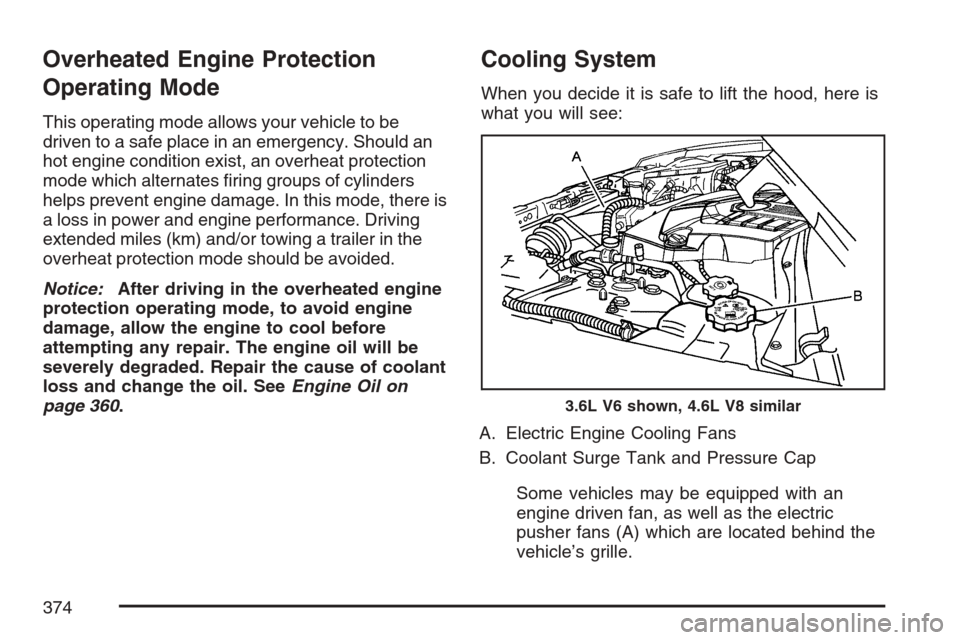
When you decide it is safe to lift the hood, here is
what you will see:
A. Electric Engine Cooling Fans
B. Coolant Surge Tank and Pressure Cap
Some vehicles may be equipped with an
engine driven fan, as well as the electric
pusher fans (A) which are located behind the
vehicle’s grille.
3.6L V6 shown, 4.6L V8 similar
374
Page 461 of 522
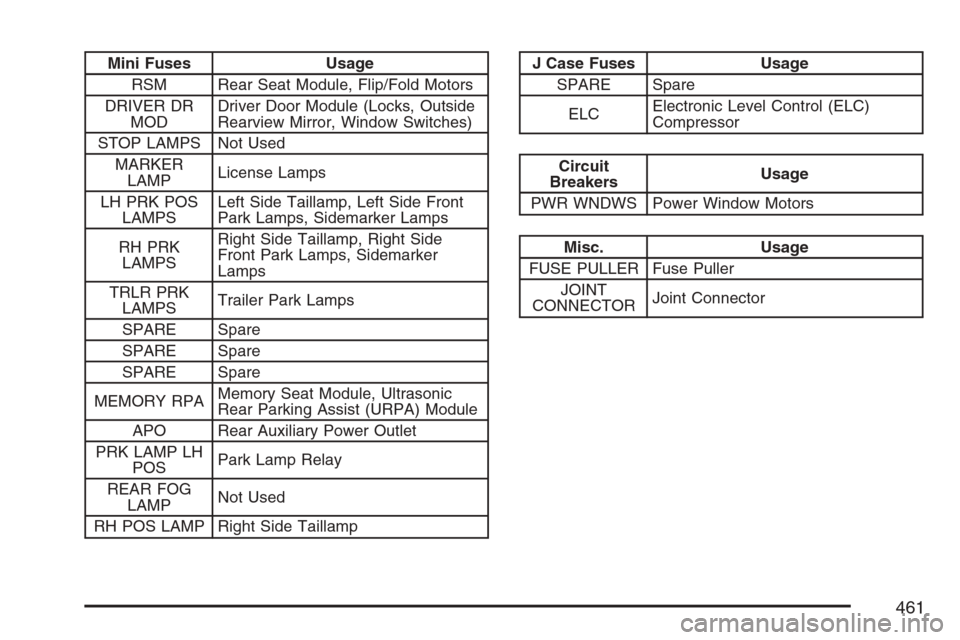
Mini Fuses Usage
RSM Rear Seat Module, Flip/Fold Motors
DRIVER DR
MODDriver Door Module (Locks, Outside
Rearview Mirror, Window Switches)
STOP LAMPS Not Used
MARKER
LAMPLicense Lamps
LH PRK POS
LAMPSLeft Side Taillamp, Left Side Front
Park Lamps, Sidemarker Lamps
RH PRK
LAMPSRight Side Taillamp, Right Side
Front Park Lamps, Sidemarker
Lamps
TRLR PRK
LAMPSTrailer Park Lamps
SPARE Spare
SPARE Spare
SPARE Spare
MEMORY RPAMemory Seat Module, Ultrasonic
Rear Parking Assist (URPA) Module
APO Rear Auxiliary Power Outlet
PRK LAMP LH
POSPark Lamp Relay
REAR FOG
LAMPNot Used
RH POS LAMP Right Side TaillampJ Case Fuses Usage
SPARE Spare
ELCElectronic Level Control (ELC)
Compressor
Circuit
BreakersUsage
PWR WNDWS Power Window Motors
Misc. Usage
FUSE PULLER Fuse Puller
JOINT
CONNECTORJoint Connector
461
Page 473 of 522
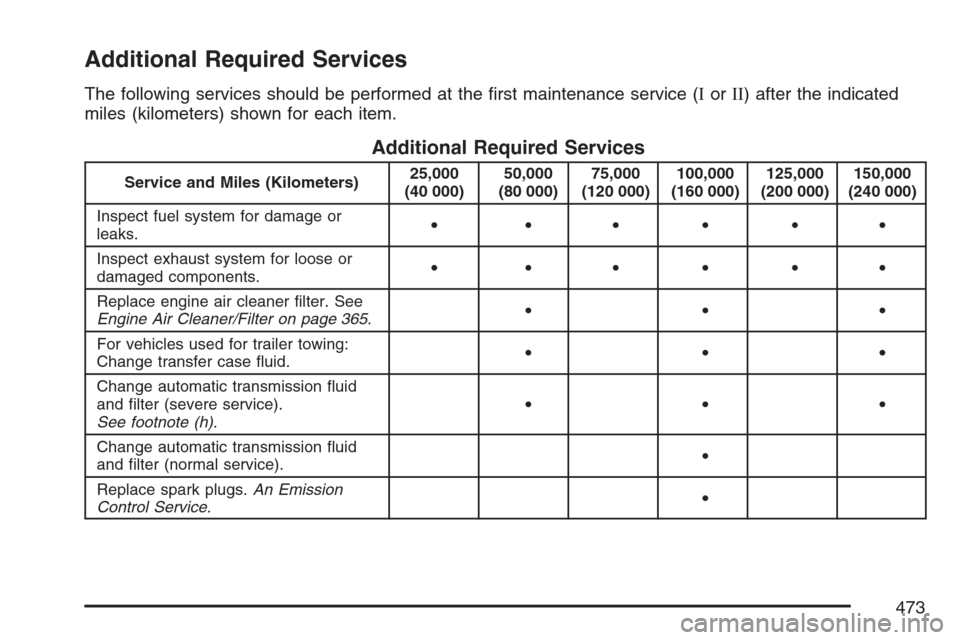
Additional Required Services
The following services should be performed at the rst maintenance service (IorII) after the indicated
miles (kilometers) shown for each item.
Additional Required Services
Service and Miles (Kilometers)25,000
(40 000)50,000
(80 000)75,000
(120 000)100,000
(160 000)125,000
(200 000)150,000
(240 000)
Inspect fuel system for damage or
leaks.• •••••
Inspect exhaust system for loose or
damaged components.• •••••
Replace engine air cleaner lter. See
Engine Air Cleaner/Filter on page 365.•••
For vehicles used for trailer towing:
Change transfer case uid.•••
Change automatic transmission uid
and lter (severe service).
See footnote (h).•••
Change automatic transmission uid
and lter (normal service).•
Replace spark plugs.An Emission
Control Service.•
473