lock CADILLAC SRX 2008 1.G Owners Manual
[x] Cancel search | Manufacturer: CADILLAC, Model Year: 2008, Model line: SRX, Model: CADILLAC SRX 2008 1.GPages: 448, PDF Size: 5.61 MB
Page 394 of 448
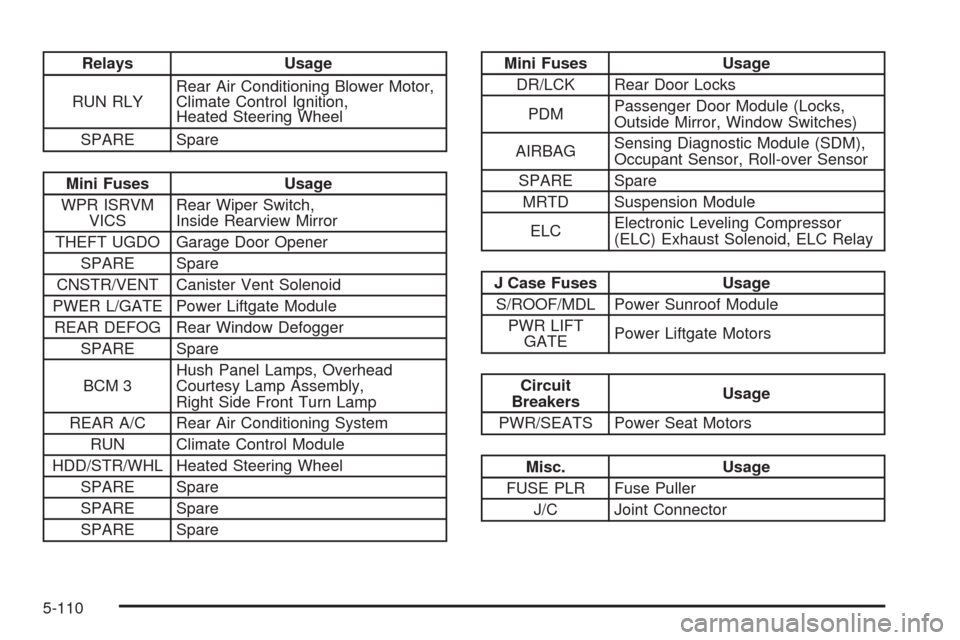
Relays Usage
RUN RLYRear Air Conditioning Blower Motor,
Climate Control Ignition,
Heated Steering Wheel
SPARE Spare
Mini Fuses Usage
WPR ISRVM
VICSRear Wiper Switch,
Inside Rearview Mirror
THEFT UGDO Garage Door Opener
SPARE Spare
CNSTR/VENT Canister Vent Solenoid
PWER L/GATE Power Liftgate Module
REAR DEFOG Rear Window Defogger
SPARE Spare
BCM 3Hush Panel Lamps, Overhead
Courtesy Lamp Assembly,
Right Side Front Turn Lamp
REAR A/C Rear Air Conditioning System
RUN Climate Control Module
HDD/STR/WHL Heated Steering Wheel
SPARE Spare
SPARE Spare
SPARE Spare
Mini Fuses Usage
DR/LCK Rear Door Locks
PDMPassenger Door Module (Locks,
Outside Mirror, Window Switches)
AIRBAGSensing Diagnostic Module (SDM),
Occupant Sensor, Roll-over Sensor
SPARE Spare
MRTD Suspension Module
ELCElectronic Leveling Compressor
(ELC) Exhaust Solenoid, ELC Relay
J Case Fuses Usage
S/ROOF/MDL Power Sunroof Module
PWR LIFT
GATEPower Liftgate Motors
Circuit
BreakersUsage
PWR/SEATS Power Seat Motors
Misc. Usage
FUSE PLR Fuse Puller
J/C Joint Connector
5-110
Page 404 of 448
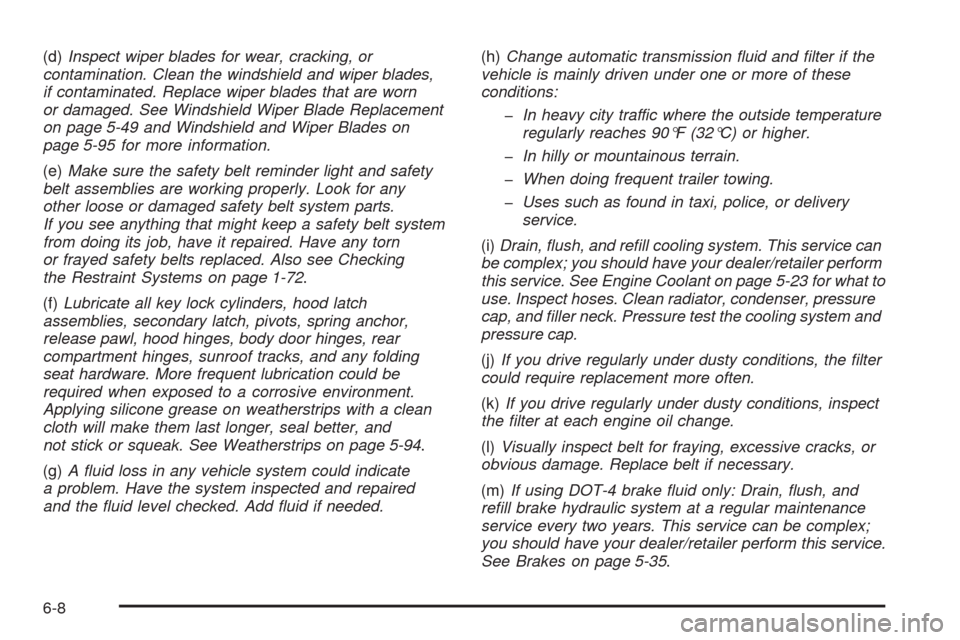
(d)Inspect wiper blades for wear, cracking, or
contamination. Clean the windshield and wiper blades,
if contaminated. Replace wiper blades that are worn
or damaged. See Windshield Wiper Blade Replacement
on page 5-49 and Windshield and Wiper Blades on
page 5-95 for more information.
(e)Make sure the safety belt reminder light and safety
belt assemblies are working properly. Look for any
other loose or damaged safety belt system parts.
If you see anything that might keep a safety belt system
from doing its job, have it repaired. Have any torn
or frayed safety belts replaced. Also see Checking
the Restraint Systems on page 1-72.
(f)Lubricate all key lock cylinders, hood latch
assemblies, secondary latch, pivots, spring anchor,
release pawl, hood hinges, body door hinges, rear
compartment hinges, sunroof tracks, and any folding
seat hardware. More frequent lubrication could be
required when exposed to a corrosive environment.
Applying silicone grease on weatherstrips with a clean
cloth will make them last longer, seal better, and
not stick or squeak. See Weatherstrips on page 5-94.
(g)A fluid loss in any vehicle system could indicate
a problem. Have the system inspected and repaired
and the fluid level checked. Add fluid if needed.(h)Change automatic transmission fluid and filter if the
vehicle is mainly driven under one or more of these
conditions:
In heavy city traffic where the outside temperature
regularly reaches 90°F (32°C) or higher.
In hilly or mountainous terrain.
When doing frequent trailer towing.
Uses such as found in taxi, police, or delivery
service.
(i)Drain, flush, and refill cooling system. This service can
be complex; you should have your dealer/retailer perform
this service. See Engine Coolant on page 5-23 for what to
use. Inspect hoses. Clean radiator, condenser, pressure
cap, and filler neck. Pressure test the cooling system and
pressure cap.
(j)If you drive regularly under dusty conditions, the filter
could require replacement more often.
(k)If you drive regularly under dusty conditions, inspect
the filter at each engine oil change.
(l)Visually inspect belt for fraying, excessive cracks, or
obvious damage. Replace belt if necessary.
(m)If using DOT-4 brake fluid only: Drain, flush, and
refill brake hydraulic system at a regular maintenance
service every two years. This service can be complex;
you should have your dealer/retailer perform this service.
See Brakes on page 5-35.
6-8
Page 406 of 448
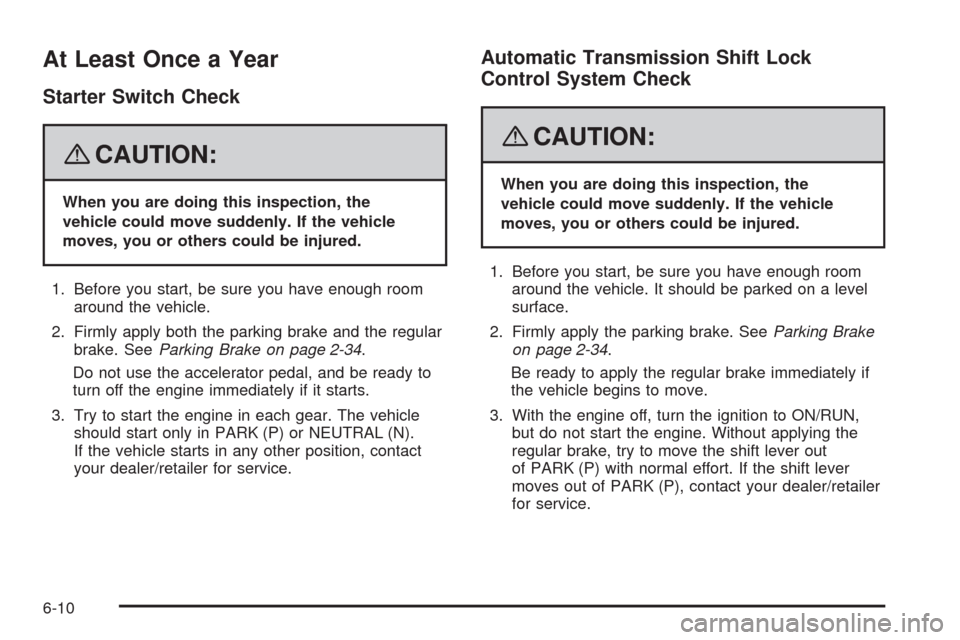
At Least Once a Year
Starter Switch Check
{CAUTION:
When you are doing this inspection, the
vehicle could move suddenly. If the vehicle
moves, you or others could be injured.
1. Before you start, be sure you have enough room
around the vehicle.
2. Firmly apply both the parking brake and the regular
brake. SeeParking Brake on page 2-34.
Do not use the accelerator pedal, and be ready to
turn off the engine immediately if it starts.
3. Try to start the engine in each gear. The vehicle
should start only in PARK (P) or NEUTRAL (N).
If the vehicle starts in any other position, contact
your dealer/retailer for service.
Automatic Transmission Shift Lock
Control System Check
{CAUTION:
When you are doing this inspection, the
vehicle could move suddenly. If the vehicle
moves, you or others could be injured.
1. Before you start, be sure you have enough room
around the vehicle. It should be parked on a level
surface.
2. Firmly apply the parking brake. SeeParking Brake
on page 2-34.
Be ready to apply the regular brake immediately if
the vehicle begins to move.
3. With the engine off, turn the ignition to ON/RUN,
but do not start the engine. Without applying the
regular brake, try to move the shift lever out
of PARK (P) with normal effort. If the shift lever
moves out of PARK (P), contact your dealer/retailer
for service.
6-10
Page 407 of 448
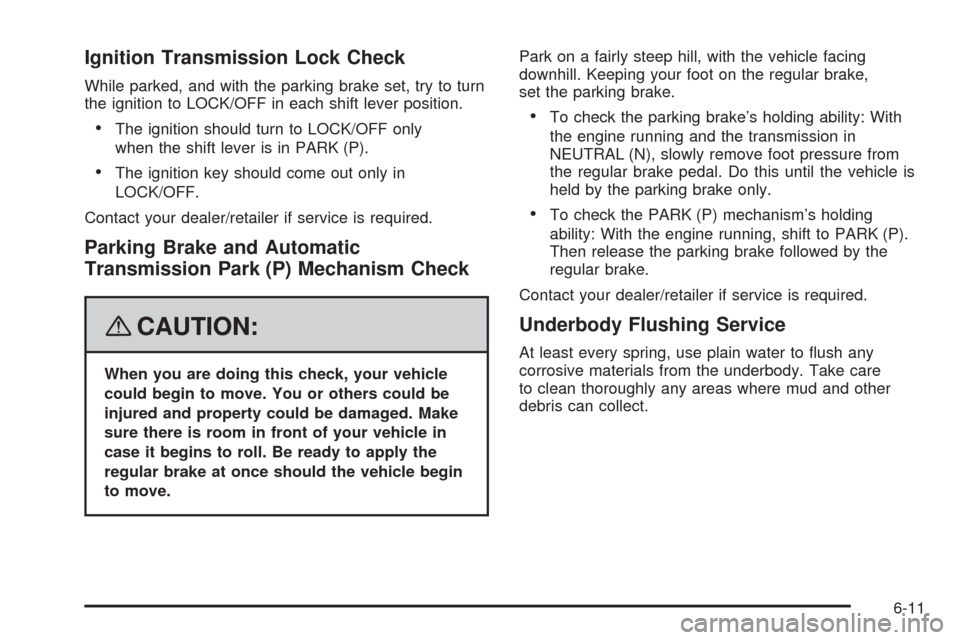
Ignition Transmission Lock Check
While parked, and with the parking brake set, try to turn
the ignition to LOCK/OFF in each shift lever position.
The ignition should turn to LOCK/OFF only
when the shift lever is in PARK (P).
The ignition key should come out only in
LOCK/OFF.
Contact your dealer/retailer if service is required.
Parking Brake and Automatic
Transmission Park (P) Mechanism Check
{CAUTION:
When you are doing this check, your vehicle
could begin to move. You or others could be
injured and property could be damaged. Make
sure there is room in front of your vehicle in
case it begins to roll. Be ready to apply the
regular brake at once should the vehicle begin
to move.Park on a fairly steep hill, with the vehicle facing
downhill. Keeping your foot on the regular brake,
set the parking brake.
To check the parking brake’s holding ability: With
the engine running and the transmission in
NEUTRAL (N), slowly remove foot pressure from
the regular brake pedal. Do this until the vehicle is
held by the parking brake only.
To check the PARK (P) mechanism’s holding
ability: With the engine running, shift to PARK (P).
Then release the parking brake followed by the
regular brake.
Contact your dealer/retailer if service is required.
Underbody Flushing Service
At least every spring, use plain water to ush any
corrosive materials from the underbody. Take care
to clean thoroughly any areas where mud and other
debris can collect.
6-11
Page 408 of 448
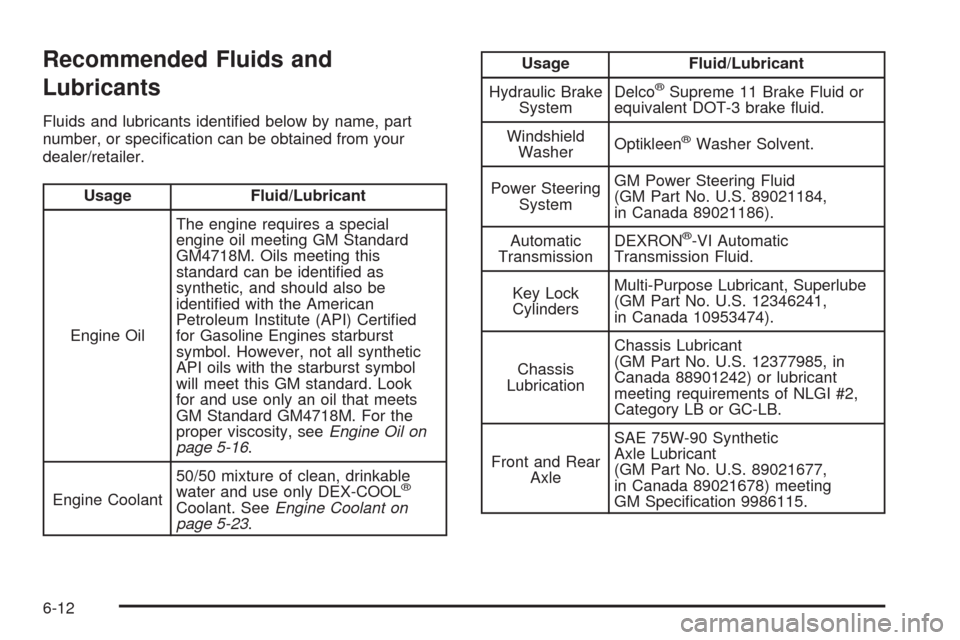
Recommended Fluids and
Lubricants
Fluids and lubricants identied below by name, part
number, or specication can be obtained from your
dealer/retailer.
Usage Fluid/Lubricant
Engine OilThe engine requires a special
engine oil meeting GM Standard
GM4718M. Oils meeting this
standard can be identied as
synthetic, and should also be
identied with the American
Petroleum Institute (API) Certied
for Gasoline Engines starburst
symbol. However, not all synthetic
API oils with the starburst symbol
will meet this GM standard. Look
for and use only an oil that meets
GM Standard GM4718M. For the
proper viscosity, seeEngine Oil on
page 5-16.
Engine Coolant50/50 mixture of clean, drinkable
water and use only DEX-COOL
®
Coolant. SeeEngine Coolant on
page 5-23.
Usage Fluid/Lubricant
Hydraulic Brake
SystemDelco
®Supreme 11 Brake Fluid or
equivalent DOT-3 brake uid.
Windshield
WasherOptikleen
®Washer Solvent.
Power Steering
SystemGM Power Steering Fluid
(GM Part No. U.S. 89021184,
in Canada 89021186).
Automatic
TransmissionDEXRON
®-VI Automatic
Transmission Fluid.
Key Lock
CylindersMulti-Purpose Lubricant, Superlube
(GM Part No. U.S. 12346241,
in Canada 10953474).
Chassis
LubricationChassis Lubricant
(GM Part No. U.S. 12377985, in
Canada 88901242) or lubricant
meeting requirements of NLGI #2,
Category LB or GC-LB.
Front and Rear
AxleSAE 75W-90 Synthetic
Axle Lubricant
(GM Part No. U.S. 89021677,
in Canada 89021678) meeting
GM Specication 9986115.
6-12
Page 422 of 448
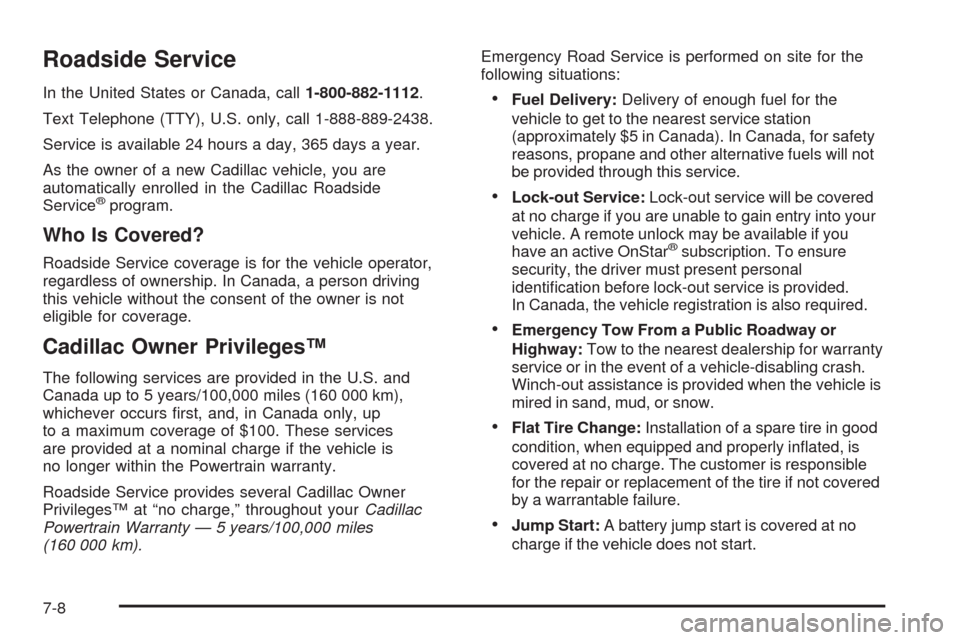
Roadside Service
In the United States or Canada, call1-800-882-1112.
Text Telephone (TTY), U.S. only, call 1-888-889-2438.
Service is available 24 hours a day, 365 days a year.
As the owner of a new Cadillac vehicle, you are
automatically enrolled in the Cadillac Roadside
Service
®program.
Who Is Covered?
Roadside Service coverage is for the vehicle operator,
regardless of ownership. In Canada, a person driving
this vehicle without the consent of the owner is not
eligible for coverage.
Cadillac Owner Privileges™
The following services are provided in the U.S. and
Canada up to 5 years/100,000 miles (160 000 km),
whichever occurs rst, and, in Canada only, up
to a maximum coverage of $100. These services
are provided at a nominal charge if the vehicle is
no longer within the Powertrain warranty.
Roadside Service provides several Cadillac Owner
Privileges™ at “no charge,” throughout yourCadillac
Powertrain Warranty — 5 years/100,000 miles
(160 000 km).Emergency Road Service is performed on site for the
following situations:
Fuel Delivery:Delivery of enough fuel for the
vehicle to get to the nearest service station
(approximately $5 in Canada). In Canada, for safety
reasons, propane and other alternative fuels will not
be provided through this service.
Lock-out Service:Lock-out service will be covered
at no charge if you are unable to gain entry into your
vehicle. A remote unlock may be available if you
have an active OnStar
®subscription. To ensure
security, the driver must present personal
identication before lock-out service is provided.
In Canada, the vehicle registration is also required.
Emergency Tow From a Public Roadway or
Highway:Tow to the nearest dealership for warranty
service or in the event of a vehicle-disabling crash.
Winch-out assistance is provided when the vehicle is
mired in sand, mud, or snow.
Flat Tire Change:Installation of a spare tire in good
condition, when equipped and properly inated, is
covered at no charge. The customer is responsible
for the repair or replacement of the tire if not covered
by a warrantable failure.
Jump Start:A battery jump start is covered at no
charge if the vehicle does not start.
7-8
Page 432 of 448
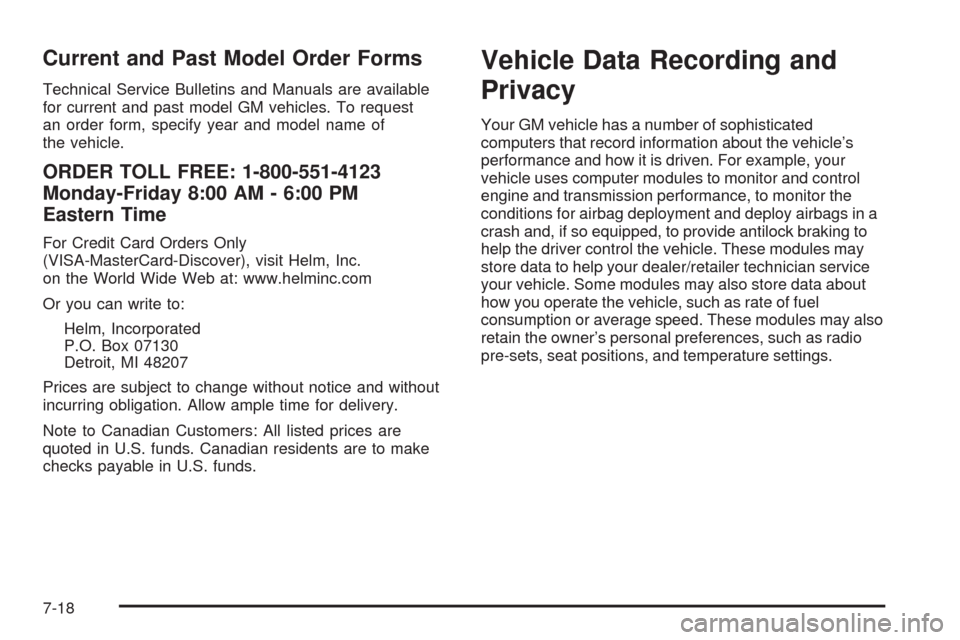
Current and Past Model Order Forms
Technical Service Bulletins and Manuals are available
for current and past model GM vehicles. To request
an order form, specify year and model name of
the vehicle.
ORDER TOLL FREE: 1-800-551-4123
Monday-Friday 8:00 AM - 6:00 PM
Eastern Time
For Credit Card Orders Only
(VISA-MasterCard-Discover), visit Helm, Inc.
on the World Wide Web at: www.helminc.com
Or you can write to:
Helm, Incorporated
P.O. Box 07130
Detroit, MI 48207
Prices are subject to change without notice and without
incurring obligation. Allow ample time for delivery.
Note to Canadian Customers: All listed prices are
quoted in U.S. funds. Canadian residents are to make
checks payable in U.S. funds.
Vehicle Data Recording and
Privacy
Your GM vehicle has a number of sophisticated
computers that record information about the vehicle’s
performance and how it is driven. For example, your
vehicle uses computer modules to monitor and control
engine and transmission performance, to monitor the
conditions for airbag deployment and deploy airbags in a
crash and, if so equipped, to provide antilock braking to
help the driver control the vehicle. These modules may
store data to help your dealer/retailer technician service
your vehicle. Some modules may also store data about
how you operate the vehicle, such as rate of fuel
consumption or average speed. These modules may also
retain the owner’s personal preferences, such as radio
pre-sets, seat positions, and temperature settings.
7-18
Page 434 of 448
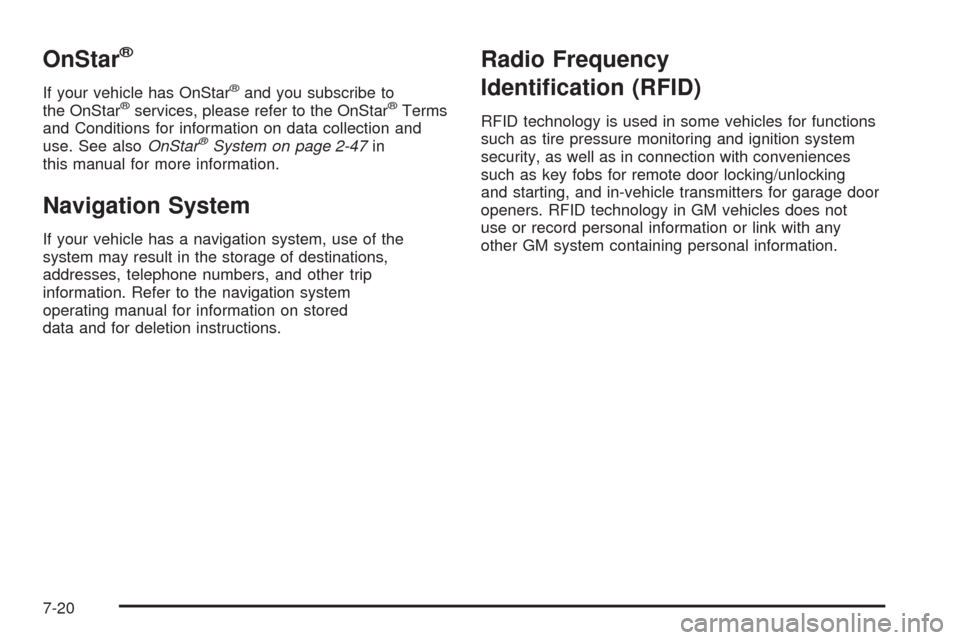
OnStar®
If your vehicle has OnStar®and you subscribe to
the OnStar®services, please refer to the OnStar®Terms
and Conditions for information on data collection and
use. See alsoOnStar
®System on page 2-47in
this manual for more information.
Navigation System
If your vehicle has a navigation system, use of the
system may result in the storage of destinations,
addresses, telephone numbers, and other trip
information. Refer to the navigation system
operating manual for information on stored
data and for deletion instructions.
Radio Frequency
Identication (RFID)
RFID technology is used in some vehicles for functions
such as tire pressure monitoring and ignition system
security, as well as in connection with conveniences
such as key fobs for remote door locking/unlocking
and starting, and in-vehicle transmitters for garage door
openers. RFID technology in GM vehicles does not
use or record personal information or link with any
other GM system containing personal information.
7-20
Page 435 of 448
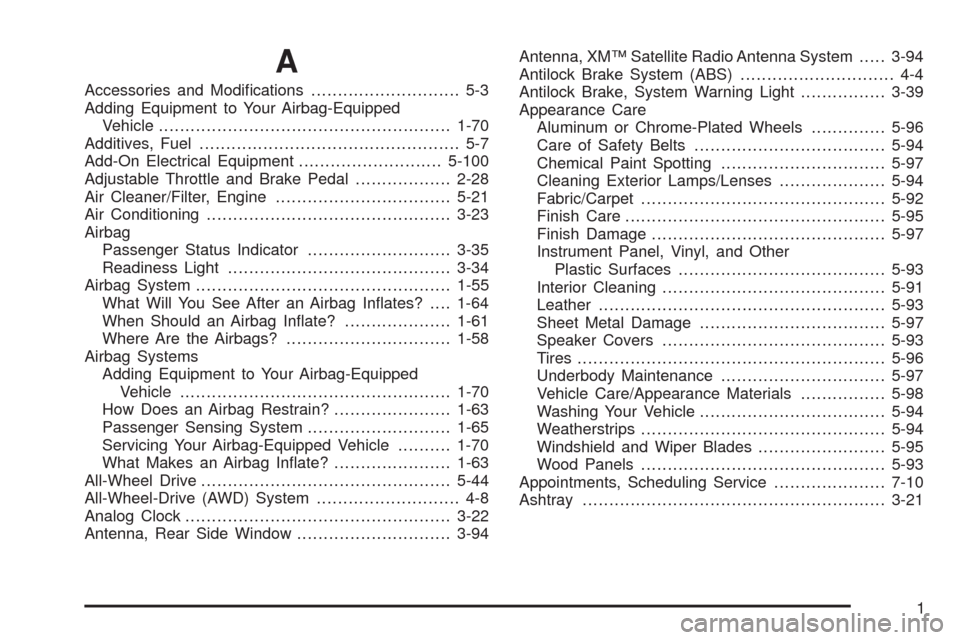
A
Accessories and Modications............................ 5-3
Adding Equipment to Your Airbag-Equipped
Vehicle.......................................................1-70
Additives, Fuel................................................. 5-7
Add-On Electrical Equipment...........................5-100
Adjustable Throttle and Brake Pedal..................2-28
Air Cleaner/Filter, Engine.................................5-21
Air Conditioning..............................................3-23
Airbag
Passenger Status Indicator...........................3-35
Readiness Light..........................................3-34
Airbag System................................................1-55
What Will You See After an Airbag Inates?....1-64
When Should an Airbag Inate?....................1-61
Where Are the Airbags?...............................1-58
Airbag Systems
Adding Equipment to Your Airbag-Equipped
Vehicle...................................................1-70
How Does an Airbag Restrain?......................1-63
Passenger Sensing System...........................1-65
Servicing Your Airbag-Equipped Vehicle..........1-70
What Makes an Airbag Inate?......................1-63
All-Wheel Drive...............................................5-44
All-Wheel-Drive (AWD) System........................... 4-8
Analog Clock..................................................3-22
Antenna, Rear Side Window.............................3-94Antenna, XM™ Satellite Radio Antenna System.....3-94
Antilock Brake System (ABS)............................. 4-4
Antilock Brake, System Warning Light................3-39
Appearance Care
Aluminum or Chrome-Plated Wheels..............5-96
Care of Safety Belts....................................5-94
Chemical Paint Spotting...............................5-97
Cleaning Exterior Lamps/Lenses....................5-94
Fabric/Carpet..............................................5-92
Finish Care.................................................5-95
Finish Damage............................................5-97
Instrument Panel, Vinyl, and Other
Plastic Surfaces.......................................5-93
Interior Cleaning..........................................5-91
Leather......................................................5-93
Sheet Metal Damage...................................5-97
Speaker Covers..........................................5-93
Tires..........................................................5-96
Underbody Maintenance...............................5-97
Vehicle Care/Appearance Materials................5-98
Washing Your Vehicle...................................5-94
Weatherstrips..............................................5-94
Windshield and Wiper Blades........................5-95
Wood Panels..............................................5-93
Appointments, Scheduling Service.....................7-10
Ashtray.........................................................3-21
1
Page 437 of 448
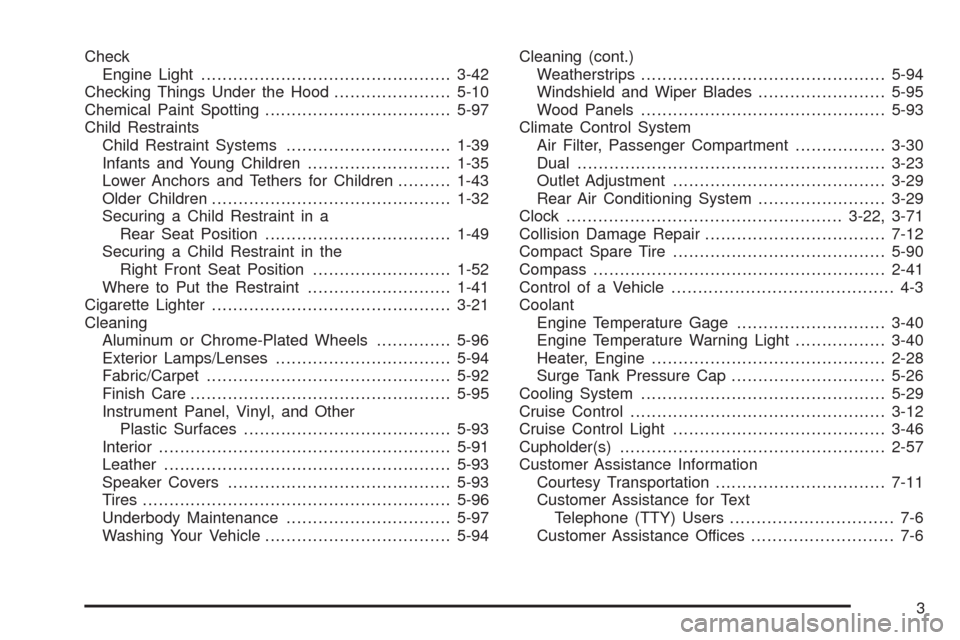
Check
Engine Light...............................................3-42
Checking Things Under the Hood......................5-10
Chemical Paint Spotting...................................5-97
Child Restraints
Child Restraint Systems...............................1-39
Infants and Young Children...........................1-35
Lower Anchors and Tethers for Children..........1-43
Older Children.............................................1-32
Securing a Child Restraint in a
Rear Seat Position...................................1-49
Securing a Child Restraint in the
Right Front Seat Position..........................1-52
Where to Put the Restraint...........................1-41
Cigarette Lighter.............................................3-21
Cleaning
Aluminum or Chrome-Plated Wheels..............5-96
Exterior Lamps/Lenses.................................5-94
Fabric/Carpet..............................................5-92
Finish Care.................................................5-95
Instrument Panel, Vinyl, and Other
Plastic Surfaces.......................................5-93
Interior.......................................................5-91
Leather......................................................5-93
Speaker Covers..........................................5-93
Tires..........................................................5-96
Underbody Maintenance...............................5-97
Washing Your Vehicle...................................5-94Cleaning (cont.)
Weatherstrips..............................................5-94
Windshield and Wiper Blades........................5-95
Wood Panels..............................................5-93
Climate Control System
Air Filter, Passenger Compartment.................3-30
Dual..........................................................3-23
Outlet Adjustment........................................3-29
Rear Air Conditioning System........................3-29
Clock....................................................3-22, 3-71
Collision Damage Repair..................................7-12
Compact Spare Tire........................................5-90
Compass.......................................................2-41
Control of a Vehicle.......................................... 4-3
Coolant
Engine Temperature Gage............................3-40
Engine Temperature Warning Light.................3-40
Heater, Engine............................................2-28
Surge Tank Pressure Cap.............................5-26
Cooling System..............................................5-29
Cruise Control................................................3-12
Cruise Control Light........................................3-46
Cupholder(s)..................................................2-57
Customer Assistance Information
Courtesy Transportation................................7-11
Customer Assistance for Text
Telephone (TTY) Users............................... 7-6
Customer Assistance Offices........................... 7-6
3