instrument panel CADILLAC SRX 2008 1.G User Guide
[x] Cancel search | Manufacturer: CADILLAC, Model Year: 2008, Model line: SRX, Model: CADILLAC SRX 2008 1.GPages: 448, PDF Size: 5.61 MB
Page 98 of 448
Sun Visors
Swing down the primary visor to block out glare. It can
also be detached from the center mount and moved
to the side to block glare from that direction.
The driver’s sunshade may also have buttons for a
built-in garage door opener. SeeUniversal Home
Remote System on page 2-50for more information.
Lighted Visor Vanity Mirror
Pull the visor down and lift the cover. The light will
automatically come on. The light will go out when you
close the cover.
Theft-Deterrent Systems
Vehicle theft is big business, especially in some cities.
Although your vehicle has a number of theft-deterrent
features, we know that nothing we put on it can make
it impossible to steal.
Theft-Deterrent System
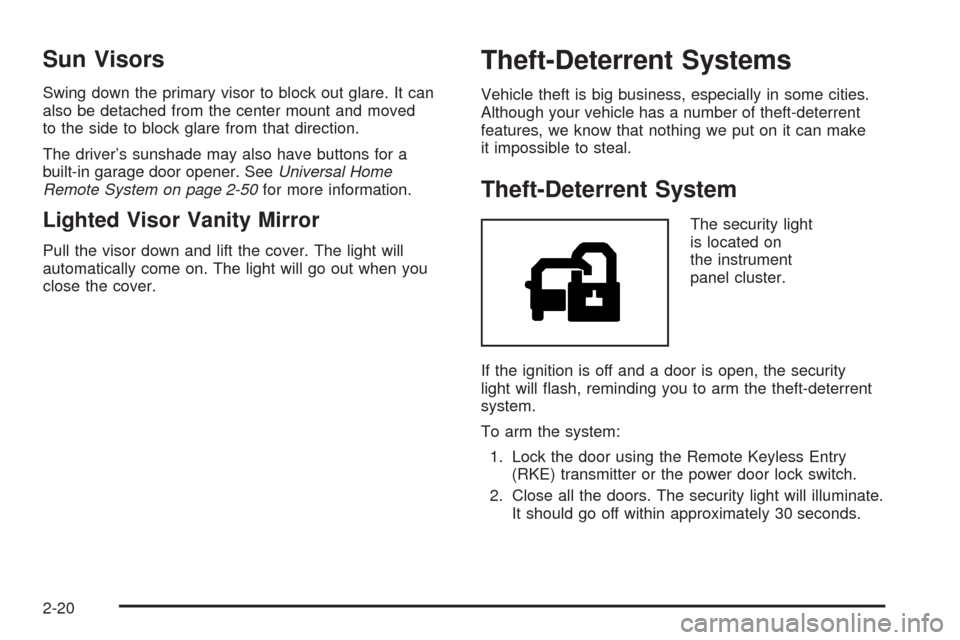
The security light
is located on
the instrument
panel cluster.
If the ignition is off and a door is open, the security
light will ash, reminding you to arm the theft-deterrent
system.
To arm the system:
1. Lock the door using the Remote Keyless Entry
(RKE) transmitter or the power door lock switch.
2. Close all the doors. The security light will illuminate.
It should go off within approximately 30 seconds.
2-20
Page 101 of 448
If the engine does not start and the security light on
the instrument panel cluster comes on when trying to
start the vehicle, there may be a problem with your
theft-deterrent system. Turn the ignition off and try again.
If the engine still does not start, and the key appears
to be undamaged, try another ignition key. At this
time, you may also want to check the fuse, see
Fuses and Circuit Breakers on page 5-101. If the engine
still does not start with the other key, your vehicle
needs service. If your vehicle does start, the rst key
may be faulty. See your dealer/retailer who can service
the PASS-Key
®III+ to have a new key made. In an
emergency, contact Roadside Assistance.
It is possible for the PASS-Key
®III+ decoder to learn
the transponder value of a new or replacement key.
Up to eight additional keys may be programmed for
the vehicle. The following procedure is for programming
additional keys only. If all the currently programmed
keys are lost or do not operate, you must see your
dealer/retailer or a locksmith who can service
PASS-Key
®III+ to have keys made and programmed
to the system.See your dealer/retailer or a locksmith who can service
PASS-Key
®III+ to get a new key blank that is cut
exactly as the ignition key that operates the system.
To program the new additional key:
1. Verify that the new key has a
1stamped on it.
2. Insert the original, already programmed, key in
the ignition and start the engine. If the engine
will not start, see your dealer/retailer for service.
3. After the engine has started, turn the key to
LOCK/OFF, and remove the key.
4. Insert the new key to be programmed and turn it
to ON/RUN within ve seconds of the original key
being turned to LOCK/OFF.
The security light will turn off once the key has
been programmed.
5. Repeat Steps 1 through 4 if additional keys are
to be programmed.
If you lose or damage your PASS-Key
®III+ key, see
your dealer/retailer or a locksmith who can service
PASS-Key
®III+ to have a new key made.
Do not leave the key or device that disarms or
deactivates the theft deterrent system in the vehicle.
2-23
Page 106 of 448
Adjustable Throttle and Brake Pedal
If your vehicle has this feature, you can change the
position of the throttle and brake pedals. This feature is
designed for shorter drivers, since the pedals cannot
move farther away from the standard position, but can
move closer for better pedal reach.
No adjustment to the pedals can be made when
the vehicle is in REVERSE (R) or while using the
cruise control.
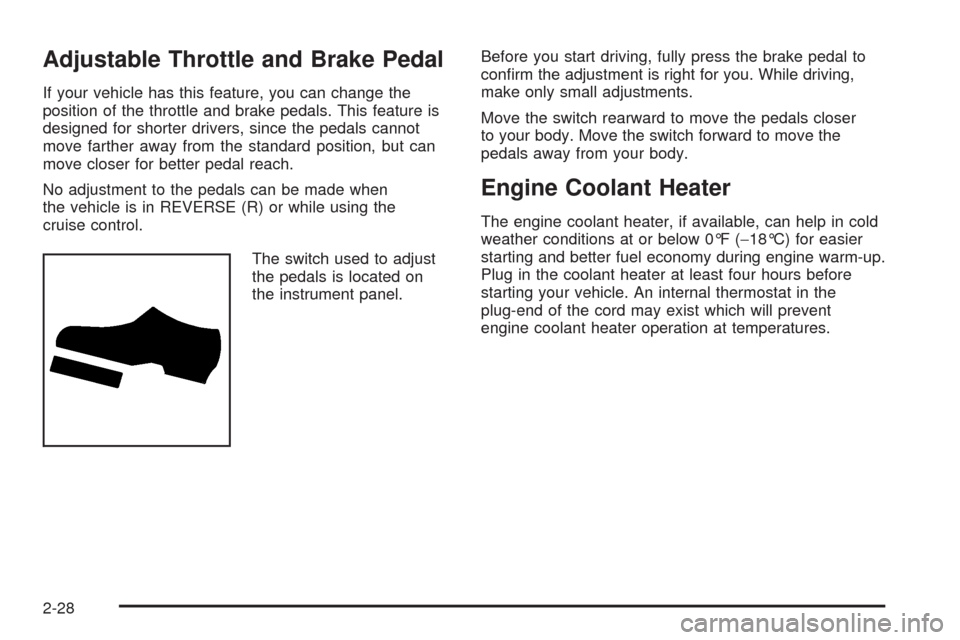
The switch used to adjust
the pedals is located on
the instrument panel.Before you start driving, fully press the brake pedal to
conrm the adjustment is right for you. While driving,
make only small adjustments.
Move the switch rearward to move the pedals closer
to your body. Move the switch forward to move the
pedals away from your body.
Engine Coolant Heater
The engine coolant heater, if available, can help in cold
weather conditions at or below 0°F (−18°C) for easier
starting and better fuel economy during engine warm-up.
Plug in the coolant heater at least four hours before
starting your vehicle. An internal thermostat in the
plug-end of the cord may exist which will prevent
engine coolant heater operation at temperatures.
2-28
Page 111 of 448
The transmission will only allow you to shift into
gears appropriate for the vehicle speed and engine
Revolutions Per Minute (RPM). The transmission will not
automatically shift to the next higher gear if the engine
RPM is too high.
If shifting is prevented for any reason, the currently
selected gear will ash multiple times, indicating that
the transmission has not shifted gears.
While in the DSC mode, the transmission will
automatically downshift when the vehicle comes to a stop
and while quickly applying the accelerator to increase
speed. This will allow for more power during take-off.
When accelerating your vehicle from a stop in snowy and
icy conditions, you may want to shift into second gear.
A higher gear ratio allows you to gain more traction on
slippery surfaces.Tow/Haul Mode
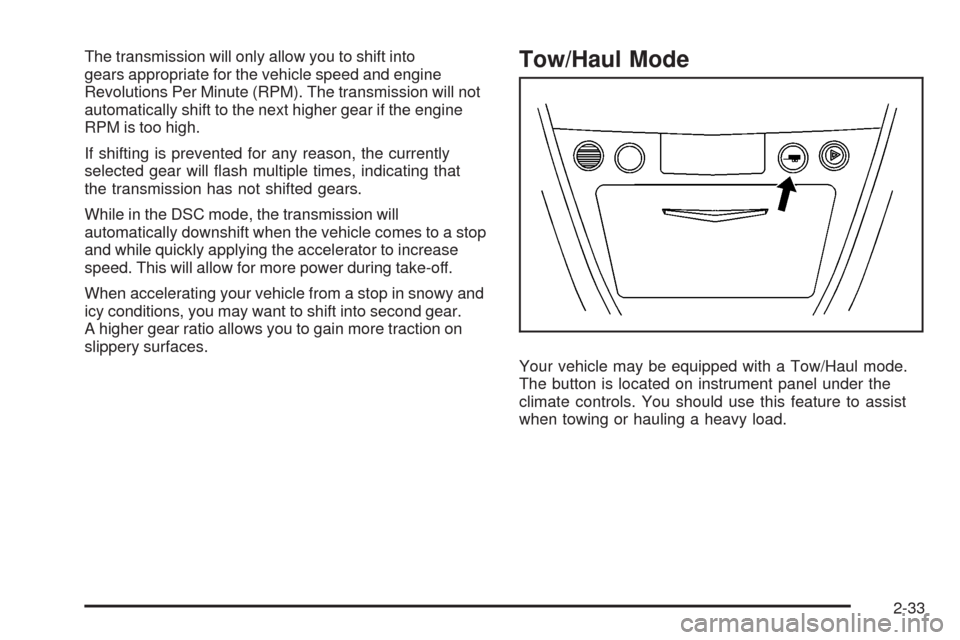
Your vehicle may be equipped with a Tow/Haul mode.
The button is located on instrument panel under the
climate controls. You should use this feature to assist
when towing or hauling a heavy load.
2-33
Page 112 of 448
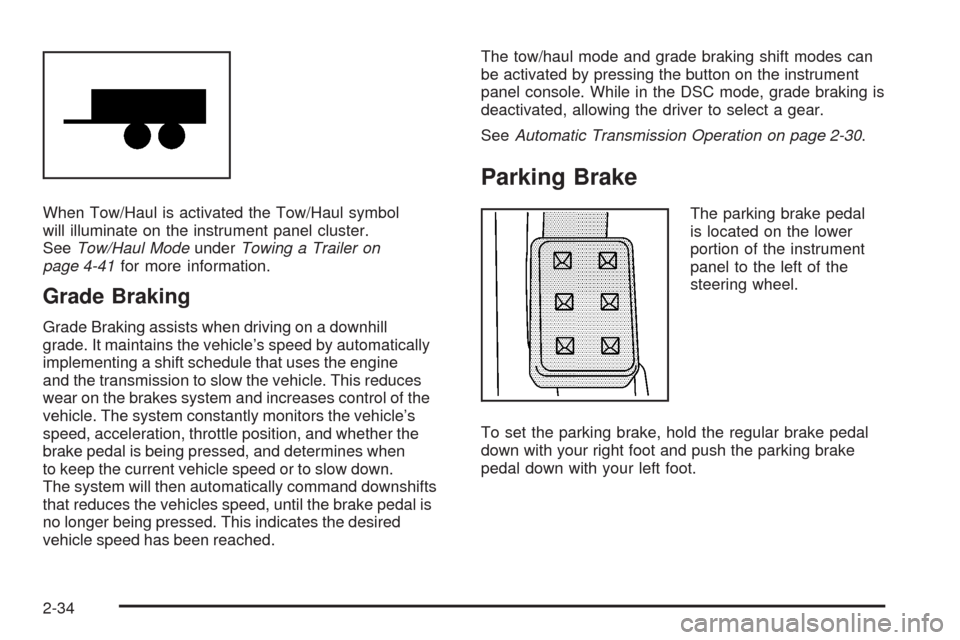
When Tow/Haul is activated the Tow/Haul symbol
will illuminate on the instrument panel cluster.
SeeTow/Haul ModeunderTowing a Trailer on
page 4-41for more information.
Grade Braking
Grade Braking assists when driving on a downhill
grade. It maintains the vehicle’s speed by automatically
implementing a shift schedule that uses the engine
and the transmission to slow the vehicle. This reduces
wear on the brakes system and increases control of the
vehicle. The system constantly monitors the vehicle’s
speed, acceleration, throttle position, and whether the
brake pedal is being pressed, and determines when
to keep the current vehicle speed or to slow down.
The system will then automatically command downshifts
that reduces the vehicles speed, until the brake pedal is
no longer being pressed. This indicates the desired
vehicle speed has been reached.The tow/haul mode and grade braking shift modes can
be activated by pressing the button on the instrument
panel console. While in the DSC mode, grade braking is
deactivated, allowing the driver to select a gear.
SeeAutomatic Transmission Operation on page 2-30.
Parking Brake
The parking brake pedal
is located on the lower
portion of the instrument
panel to the left of the
steering wheel.
To set the parking brake, hold the regular brake pedal
down with your right foot and push the parking brake
pedal down with your left foot.
2-34
Page 113 of 448
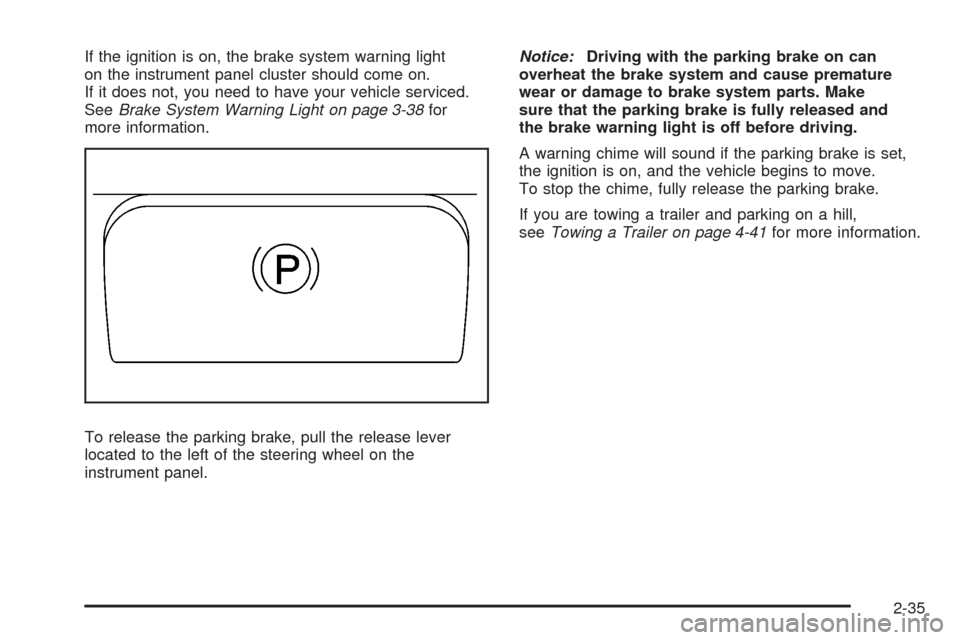
If the ignition is on, the brake system warning light
on the instrument panel cluster should come on.
If it does not, you need to have your vehicle serviced.
SeeBrake System Warning Light on page 3-38for
more information.
To release the parking brake, pull the release lever
located to the left of the steering wheel on the
instrument panel.Notice:Driving with the parking brake on can
overheat the brake system and cause premature
wear or damage to brake system parts. Make
sure that the parking brake is fully released and
the brake warning light is off before driving.
A warning chime will sound if the parking brake is set,
the ignition is on, and the vehicle begins to move.
To stop the chime, fully release the parking brake.
If you are towing a trailer and parking on a hill,
seeTowing a Trailer on page 4-41for more information.
2-35
Page 141 of 448
Instrument Panel Overview...............................3-4
Hazard Warning Flashers................................3-6
Other Warning Devices...................................3-6
Horn.............................................................3-6
Tilt Wheel.....................................................3-6
Heated Steering Wheel...................................3-7
Turn Signal/Multifunction Lever.........................3-7
Turn and Lane-Change Signals........................3-8
Headlamp High/Low-Beam Changer..................3-8
Flash-to-Pass.................................................3-9
Windshield Wipers..........................................3-9
Windshield Washer.......................................3-10
Rear Window Wiper/Washer...........................3-11
Headlamp Washer........................................3-12
Cruise Control..............................................3-12
Headlamps..................................................3-16
Wiper Activated Headlamps............................3-16Headlamps on Reminder................................3-16
Daytime Running Lamps (DRL).......................3-17
Fog Lamps..................................................3-18
Exterior Lighting Battery Saver........................3-19
Instrument Panel Brightness...........................3-19
Entry Lighting...............................................3-19
Parade Dimming...........................................3-19
Reading Lamps............................................3-20
Electric Power Management...........................3-20
Accessory Power Outlet(s).............................3-21
Ashtray(s) and Cigarette Lighter......................3-21
Analog Clock...............................................3-22
Climate Controls............................................3-23
Dual Climate Control System..........................3-23
Outlet Adjustment.........................................3-29
Rear Air Conditioning System.........................3-29
Passenger Compartment Air Filter..................
.3-30
Section 3 Instrument Panel
3-1
Page 142 of 448
Warning Lights, Gages, and Indicators............3-31
Instrument Panel Cluster................................3-32
Speedometer and Odometer...........................3-33
Tachometer.................................................3-33
Engine Speed Limiter....................................3-33
Safety Belt Reminders...................................3-33
Airbag Readiness Light..................................3-34
Passenger Airbag Status Indicator...................3-35
Charging System Light..................................3-37
Brake System Warning Light..........................3-38
Antilock Brake System Warning Light...............3-39
Traction Control System (TCS) Warning Light......3-39
Engine Coolant Temperature Warning Light......3-40
Engine Coolant Temperature Gage..................3-40
Tire Pressure Light.......................................3-41
Malfunction Indicator Lamp.............................3-42
Oil Pressure Light.........................................3-44
Security Light...............................................3-45
Fog Lamp Light............................................3-45
Lights On Reminder......................................3-46
Cruise Control Light......................................3-46Highbeam On Light.......................................3-46
Tow/Haul Mode Light....................................3-46
Fuel Gage...................................................3-47
Driver Information Center (DIC).......................3-47
DIC Operation and Displays...........................3-48
DIC Warnings and Messages.........................3-53
DIC Vehicle Customization.............................3-62
Audio System(s).............................................3-70
Setting the Time...........................................3-71
Radio(s) (MP3).............................................3-75
Using an MP3..............................................3-84
XM Radio Messages.....................................3-89
Navigation/Radio System..............................
.3-90
Rear Seat Entertainment (RSE) System...........3-90
Rear Seat Audio (RSA).................................3-90
Theft-Deterrent Feature..................................3-92
Audio Steering Wheel Controls.......................3-92
Radio Reception...........................................3-93
Rear Side Window Antenna...........................3-94
XM™ Satellite Radio Antenna System.............3-94
Section 3 Instrument Panel
3-2
Page 144 of 448
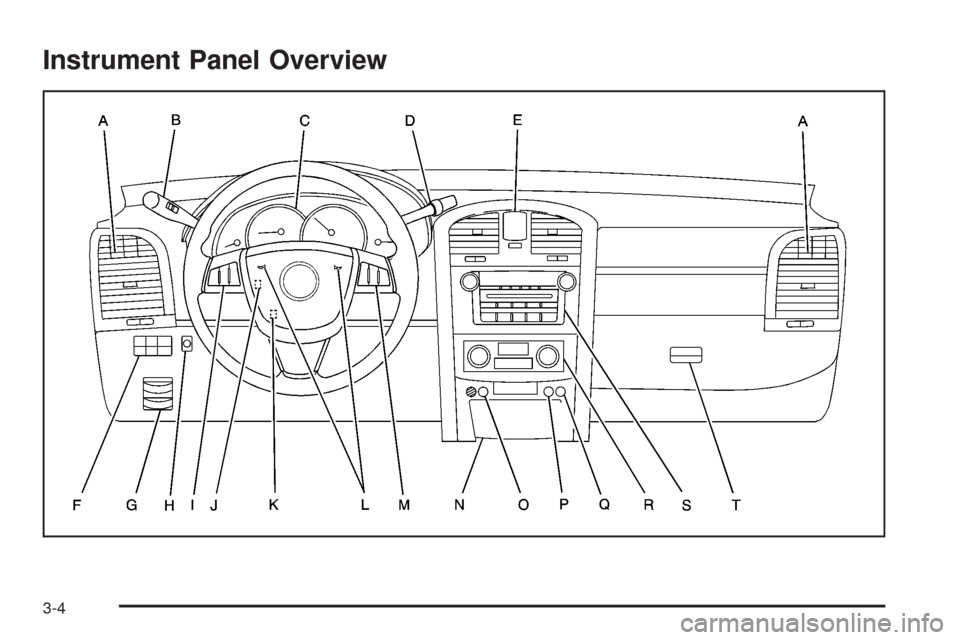
Instrument Panel Overview
3-4
Page 145 of 448
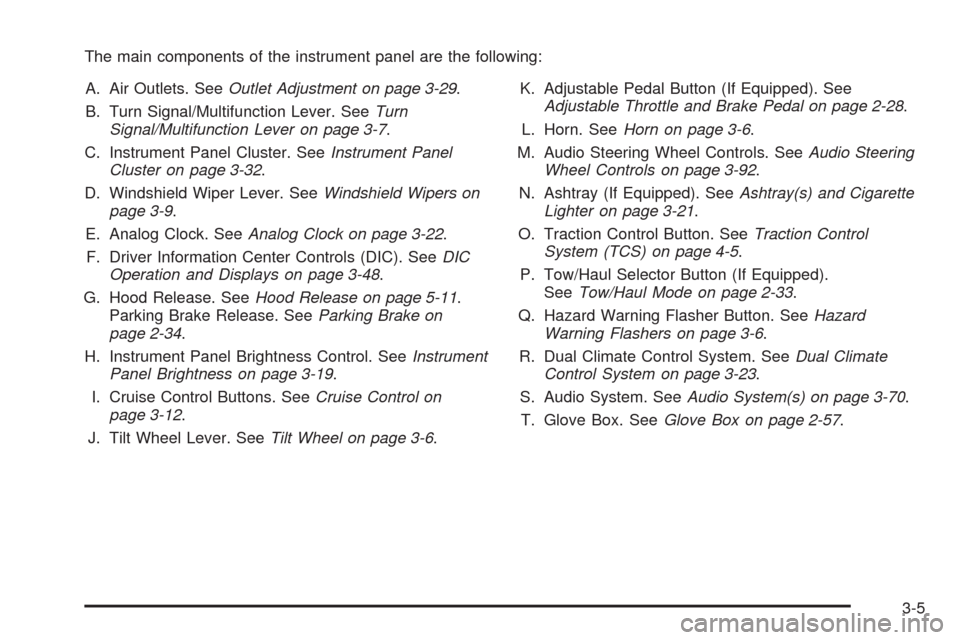
The main components of the instrument panel are the following:
A. Air Outlets. SeeOutlet Adjustment on page 3-29.
B. Turn Signal/Multifunction Lever. SeeTurn
Signal/Multifunction Lever on page 3-7.
C. Instrument Panel Cluster. SeeInstrument Panel
Cluster on page 3-32.
D. Windshield Wiper Lever. SeeWindshield Wipers on
page 3-9.
E. Analog Clock. SeeAnalog Clock on page 3-22.
F. Driver Information Center Controls (DIC). SeeDIC
Operation and Displays on page 3-48.
G. Hood Release. SeeHood Release on page 5-11.
Parking Brake Release. SeeParking Brake on
page 2-34.
H. Instrument Panel Brightness Control. SeeInstrument
Panel Brightness on page 3-19.
I. Cruise Control Buttons. SeeCruise Control on
page 3-12.
J. Tilt Wheel Lever. SeeTilt Wheel on page 3-6.K. Adjustable Pedal Button (If Equipped). See
Adjustable Throttle and Brake Pedal on page 2-28.
L. Horn. SeeHorn on page 3-6.
M. Audio Steering Wheel Controls. SeeAudio Steering
Wheel Controls on page 3-92.
N. Ashtray (If Equipped). SeeAshtray(s) and Cigarette
Lighter on page 3-21.
O. Traction Control Button. SeeTraction Control
System (TCS) on page 4-5.
P. Tow/Haul Selector Button (If Equipped).
SeeTow/Haul Mode on page 2-33.
Q. Hazard Warning Flasher Button. SeeHazard
Warning Flashers on page 3-6.
R. Dual Climate Control System. SeeDual Climate
Control System on page 3-23.
S. Audio System. SeeAudio System(s) on page 3-70.
T. Glove Box. SeeGlove Box on page 2-57.
3-5