ABS CADILLAC SRX 2009 1.G User Guide
[x] Cancel search | Manufacturer: CADILLAC, Model Year: 2009, Model line: SRX, Model: CADILLAC SRX 2009 1.GPages: 442, PDF Size: 2.42 MB
Page 278 of 442
Driving on Grades
Reduce speed and shift to a lower gearbeforestarting
down a long or steep downgrade. If the transmission is
not shifted down, the brakes might have to be used so
much that they would get hot and no longer work well.
On a long uphill grade, shift down and reduce the
vehicle’s speed to around 45 mph (70 km/h) to reduce
the possibility of the engine and the transmission
overheating.
Vehicles can tow in D (Drive). Shift the transmission to
a lower gear if the transmission shifts too often under
heavy loads and/or hilly conditions.
The tow/haul mode may be used if the transmission
shifts too often. See Tow/Haul Mode previously.
When towing at high altitude on steep uphill grades,
consider the following: Engine coolant will boil at a lower
temperature than at normal altitudes. If the engine is
turned off immediately after towing at high altitude on
steep uphill grades, the vehicle may show signs similar to
engine overheating. To avoid this, let the engine run while
parked, preferably on level ground, with the automatic
transmission in P (Park) for a few minutes before turning
the engine off. If the overheat warning comes on, see
Engine Overheating on page 5-29.
Parking on Hills
{CAUTION:
Parking the vehicle on a hill with the trailer
attached can be dangerous. If something goes
wrong, the rig could start to move. People can be
injured, and both the vehicle and the trailer can be
damaged. When possible, always park the rig on a
at surface.
If parking the rig on a hill:
1. Press the brake pedal, but do not shift into P (Park)
yet. Turn the wheels into the curb if facing downhill
or into traffic if facing uphill.
2. Have someone place chocks under the trailer
wheels.
3. When the wheel chocks are in place, release the
regular brakes until the chocks absorb the load.
4. Reapply the brake pedal. Then apply the parking
brake and shift into P (Park).
5. Release the brake pedal.
4-48
Page 370 of 442
Do not clean the vehicle using:
A knife or any other sharp object to remove a soil
from any interior surface.
A stiff brush. It can cause damage to the vehicle’s
interior surfaces.
Heavy pressure or aggressive rubbing with a
cleaning cloth. Use of heavy pressure can damage
the interior and does not improve the effectiveness
of soil removal.
Laundry detergents or dishwashing soaps with
degreasers can leave residue that streaks and
attracts dirt. For liquid cleaners, about 20 drops
per gallon (3.78 L) of water is a good guide.
Use only mild, neutral-pH soaps.
Too much cleaner that saturates the upholstery.
Organic solvents such as naptha, alcohol, etc. that
can damage the vehicle’s interior.
Fabric/Carpet
Use a vacuum cleaner with a soft brush attachment
frequently to remove dust and loose dirt. A canister
vacuum with a beater bar in the nozzle may only be used
on oor carpet and carpeted oor mats. For any soil,
always try to remove it rst with plain water or club soda.
Before cleaning, gently remove as much of the soil as
possible using one of the following techniques:
For liquids: gently blot the remaining soil with a paper
towel. Allow the soil to absorb into the paper towel
until no more can be removed.
For solid dry soils: remove as much as possible and
then vacuum.
To clean:
1. Saturate a lint-free, clean white cloth with water or
club soda.
2. Wring the cloth to remove excess moisture.
3. Start on the outside edge of the soil and gently rub
toward the center. Continue cleaning, using a clean
area of the cloth each time it becomes soiled.
5-90
Page 379 of 442
Fuses and Circuit Breakers
The wiring circuits in your vehicle are protected from
short circuits by a combination of fuses and circuit
breakers. This greatly reduces the chance of res
caused by electrical problems.
Look at the silver-colored band inside the fuse. If the
band is broken or melted, replace the fuse. Be sure you
replace a bad fuse with a new one of the identical
size and rating.
If you ever have a problem on the road and don’t have
a spare fuse, you can borrow one that has the same
amperage. Just pick some feature of your vehicle
that you can get along without — like the radio or
cigarette lighter — and use its fuse, if it is the correct
amperage. Replace it as soon as you can.
Underhood Fuse Block
The underhood fuse block is located in the engine
compartment on the right side of the vehicle. SeeEngine
Compartment Overview on page 5-12for more
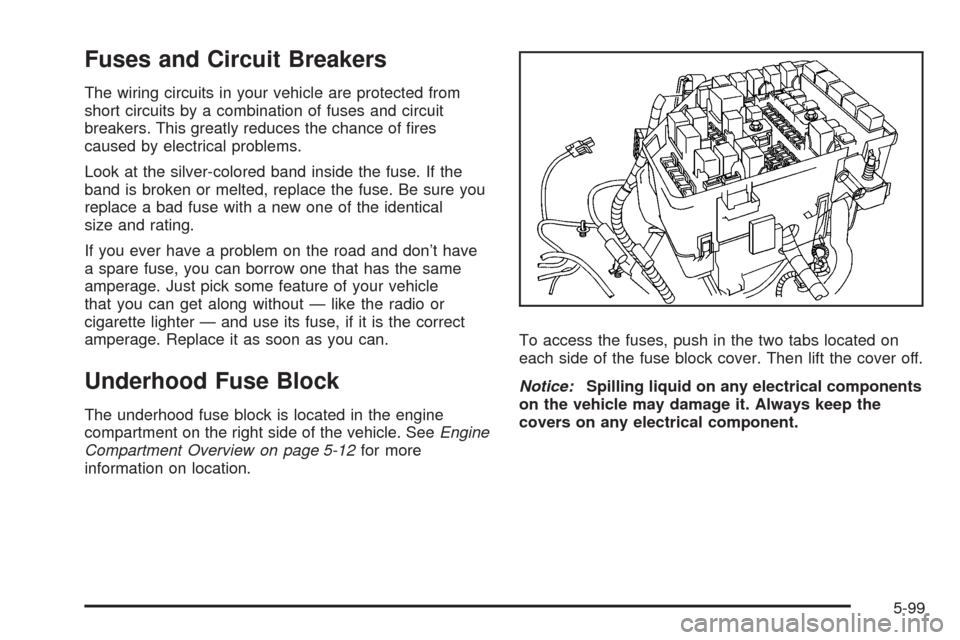
information on location.To access the fuses, push in the two tabs located on
each side of the fuse block cover. Then lift the cover off.
Notice:Spilling liquid on any electrical components
on the vehicle may damage it. Always keep the
covers on any electrical component.
5-99
Page 381 of 442
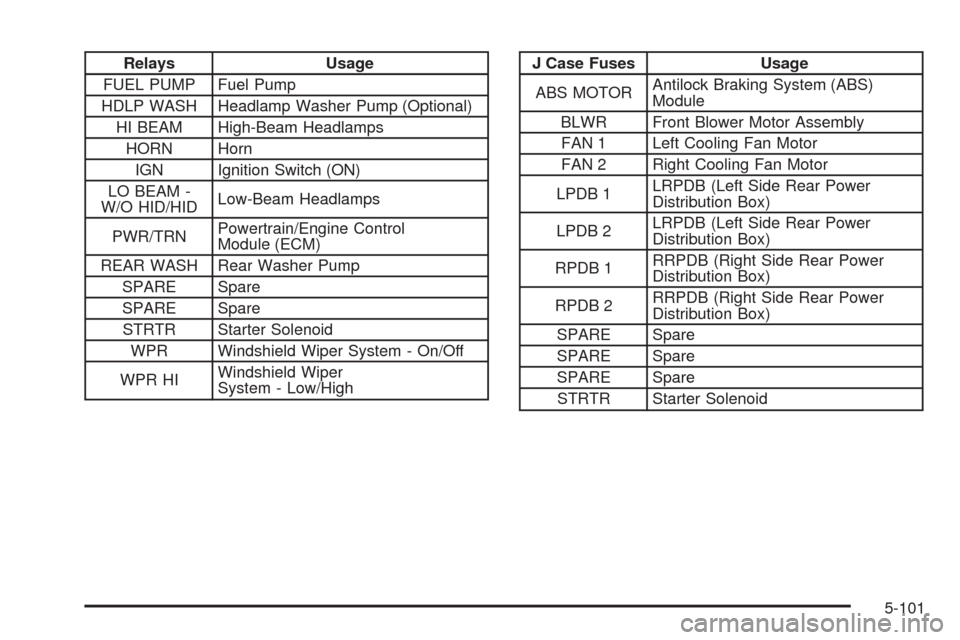
Relays Usage
FUEL PUMP Fuel Pump
HDLP WASH Headlamp Washer Pump (Optional)
HI BEAM High-Beam Headlamps
HORN Horn
IGN Ignition Switch (ON)
LO BEAM -
W/O HID/HIDLow-Beam Headlamps
PWR/TRNPowertrain/Engine Control
Module (ECM)
REAR WASH Rear Washer Pump
SPARE Spare
SPARE Spare
STRTR Starter Solenoid
WPR Windshield Wiper System - On/Off
WPR HIWindshield Wiper
System - Low/HighJ Case Fuses Usage
ABS MOTORAntilock Braking System (ABS)
Module
BLWR Front Blower Motor Assembly
FAN 1 Left Cooling Fan Motor
FAN 2 Right Cooling Fan Motor
LPDB 1LRPDB (Left Side Rear Power
Distribution Box)
LPDB 2LRPDB (Left Side Rear Power
Distribution Box)
RPDB 1RRPDB (Right Side Rear Power
Distribution Box)
RPDB 2RRPDB (Right Side Rear Power
Distribution Box)
SPARE Spare
SPARE Spare
SPARE Spare
STRTR Starter Solenoid
5-101
Page 382 of 442
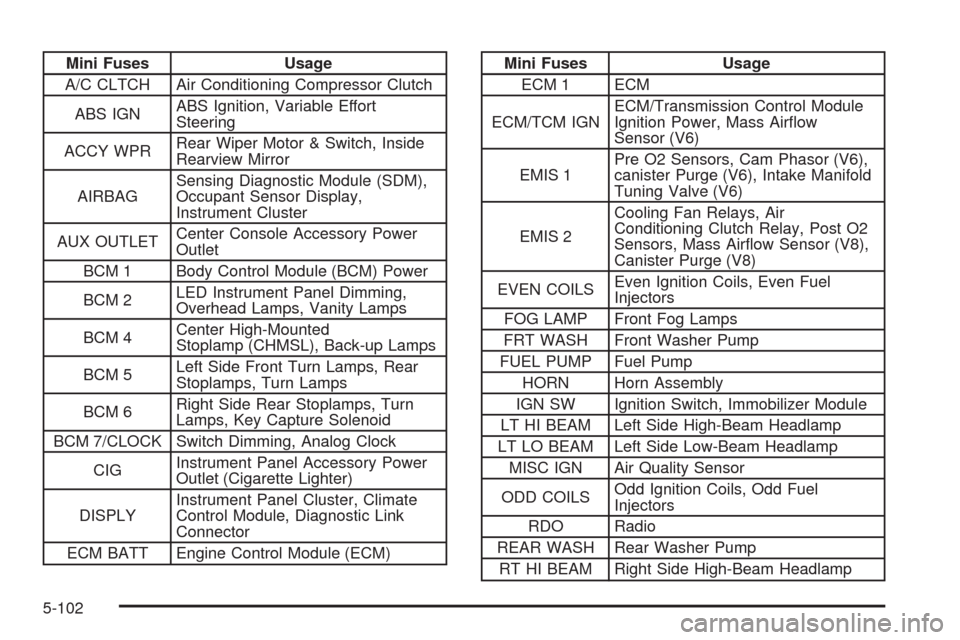
Mini Fuses Usage
A/C CLTCH Air Conditioning Compressor Clutch
ABS IGNABS Ignition, Variable Effort
Steering
ACCY WPRRear Wiper Motor & Switch, Inside
Rearview Mirror
AIRBAGSensing Diagnostic Module (SDM),
Occupant Sensor Display,
Instrument Cluster
AUX OUTLETCenter Console Accessory Power
Outlet
BCM 1 Body Control Module (BCM) Power
BCM 2LED Instrument Panel Dimming,
Overhead Lamps, Vanity Lamps
BCM 4Center High-Mounted
Stoplamp (CHMSL), Back-up Lamps
BCM 5Left Side Front Turn Lamps, Rear
Stoplamps, Turn Lamps
BCM 6Right Side Rear Stoplamps, Turn
Lamps, Key Capture Solenoid
BCM 7/CLOCK Switch Dimming, Analog Clock
CIGInstrument Panel Accessory Power
Outlet (Cigarette Lighter)
DISPLYInstrument Panel Cluster, Climate
Control Module, Diagnostic Link
Connector
ECM BATT Engine Control Module (ECM)Mini Fuses Usage
ECM 1 ECM
ECM/TCM IGNECM/Transmission Control Module
Ignition Power, Mass Airow
Sensor (V6)
EMIS 1Pre O2 Sensors, Cam Phasor (V6),
canister Purge (V6), Intake Manifold
Tuning Valve (V6)
EMIS 2Cooling Fan Relays, Air
Conditioning Clutch Relay, Post O2
Sensors, Mass Airow Sensor (V8),
Canister Purge (V8)
EVEN COILSEven Ignition Coils, Even Fuel
Injectors
FOG LAMP Front Fog Lamps
FRT WASH Front Washer Pump
FUEL PUMP Fuel Pump
HORN Horn Assembly
IGN SW Ignition Switch, Immobilizer Module
LT HI BEAM Left Side High-Beam Headlamp
LT LO BEAM Left Side Low-Beam Headlamp
MISC IGN Air Quality Sensor
ODD COILSOdd Ignition Coils, Odd Fuel
Injectors
RDO Radio
REAR WASH Rear Washer Pump
RT HI BEAM Right Side High-Beam Headlamp
5-102
Page 383 of 442
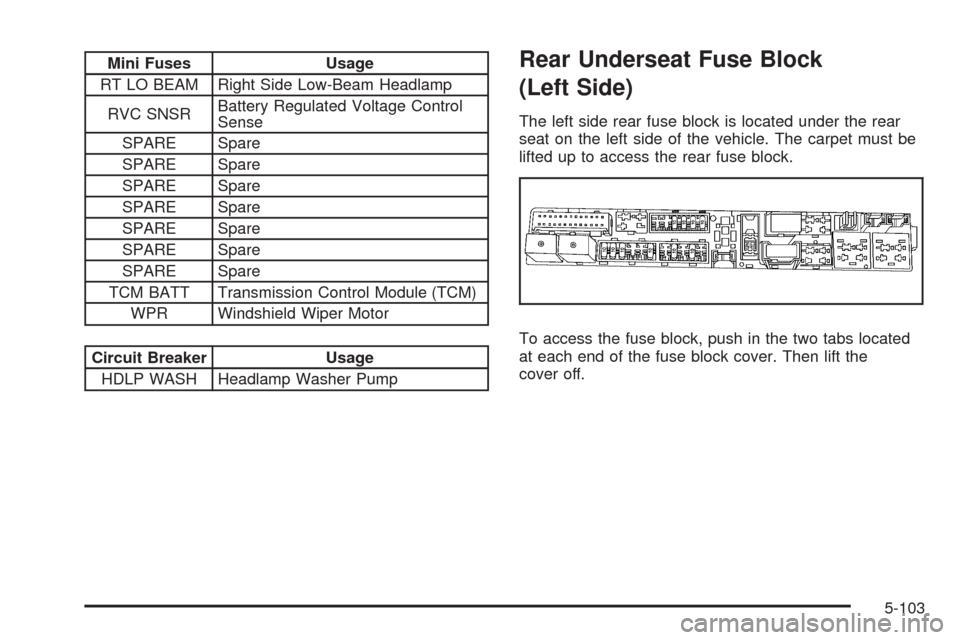
Mini Fuses Usage
RT LO BEAM Right Side Low-Beam Headlamp
RVC SNSRBattery Regulated Voltage Control
Sense
SPARE Spare
SPARE Spare
SPARE Spare
SPARE Spare
SPARE Spare
SPARE Spare
SPARE Spare
TCM BATT Transmission Control Module (TCM)
WPR Windshield Wiper Motor
Circuit Breaker Usage
HDLP WASH Headlamp Washer Pump
Rear Underseat Fuse Block
(Left Side)
The left side rear fuse block is located under the rear
seat on the left side of the vehicle. The carpet must be
lifted up to access the rear fuse block.
To access the fuse block, push in the two tabs located
at each end of the fuse block cover. Then lift the
cover off.
5-103
Page 386 of 442
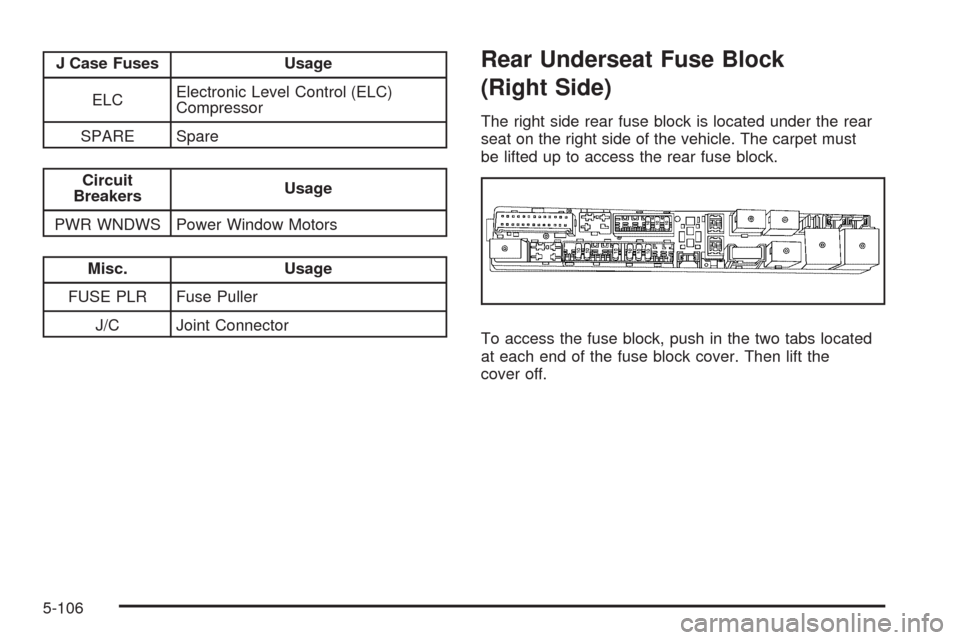
J Case Fuses Usage
ELCElectronic Level Control (ELC)
Compressor
SPARE Spare
Circuit
BreakersUsage
PWR WNDWS Power Window Motors
Misc. Usage
FUSE PLR Fuse Puller
J/C Joint Connector
Rear Underseat Fuse Block
(Right Side)
The right side rear fuse block is located under the rear
seat on the right side of the vehicle. The carpet must
be lifted up to access the rear fuse block.
To access the fuse block, push in the two tabs located
at each end of the fuse block cover. Then lift the
cover off.
5-106
Page 429 of 442
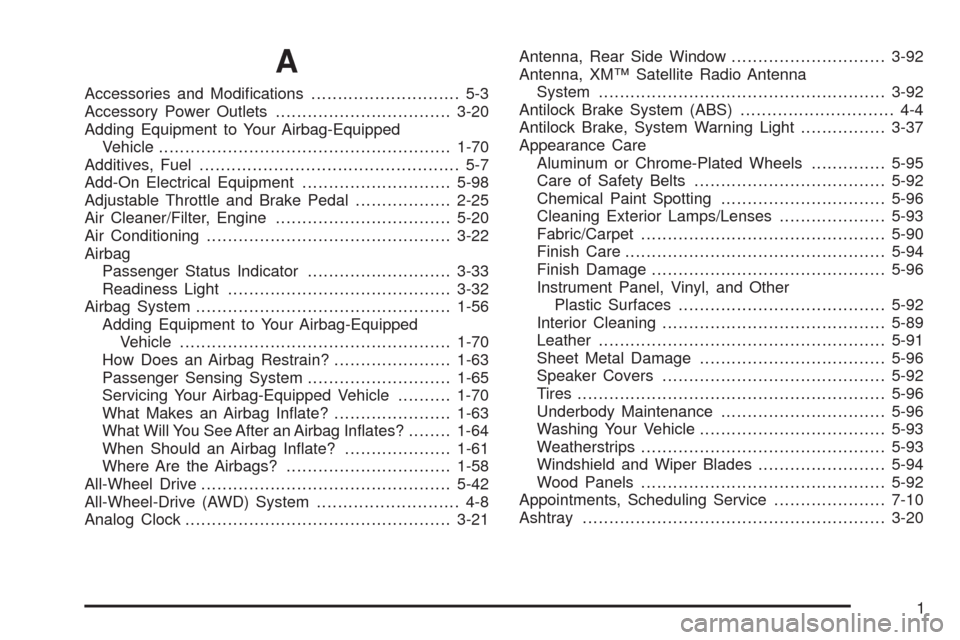
A
Accessories and Modications............................ 5-3
Accessory Power Outlets.................................3-20
Adding Equipment to Your Airbag-Equipped
Vehicle.......................................................1-70
Additives, Fuel................................................. 5-7
Add-On Electrical Equipment............................5-98
Adjustable Throttle and Brake Pedal..................2-25
Air Cleaner/Filter, Engine.................................5-20
Air Conditioning..............................................3-22
Airbag
Passenger Status Indicator...........................3-33
Readiness Light..........................................3-32
Airbag System................................................1-56
Adding Equipment to Your Airbag-Equipped
Vehicle...................................................1-70
How Does an Airbag Restrain?......................1-63
Passenger Sensing System...........................1-65
Servicing Your Airbag-Equipped Vehicle..........1-70
What Makes an Airbag Inate?......................1-63
What Will You See After an Airbag Inates?........1-64
When Should an Airbag Inate?....................1-61
Where Are the Airbags?...............................1-58
All-Wheel Drive...............................................5-42
All-Wheel-Drive (AWD) System........................... 4-8
Analog Clock..................................................3-21Antenna, Rear Side Window.............................3-92
Antenna, XM™ Satellite Radio Antenna
System......................................................3-92
Antilock Brake System (ABS)............................. 4-4
Antilock Brake, System Warning Light................3-37
Appearance Care
Aluminum or Chrome-Plated Wheels..............5-95
Care of Safety Belts....................................5-92
Chemical Paint Spotting...............................5-96
Cleaning Exterior Lamps/Lenses....................5-93
Fabric/Carpet..............................................5-90
Finish Care.................................................5-94
Finish Damage............................................5-96
Instrument Panel, Vinyl, and Other
Plastic Surfaces.......................................5-92
Interior Cleaning..........................................5-89
Leather......................................................5-91
Sheet Metal Damage...................................5-96
Speaker Covers..........................................5-92
Tires..........................................................5-96
Underbody Maintenance...............................5-96
Washing Your Vehicle...................................5-93
Weatherstrips..............................................5-93
Windshield and Wiper Blades........................5-94
Wood Panels..............................................5-92
Appointments, Scheduling Service.....................7-10
Ashtray.........................................................3-20
1
Page 435 of 442
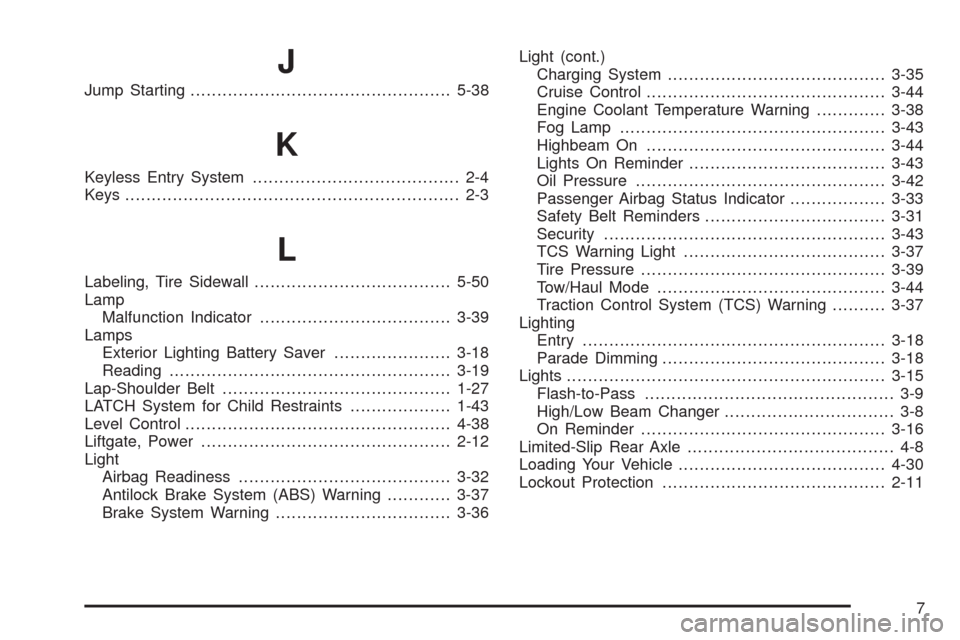
J
Jump Starting.................................................5-38
K
Keyless Entry System....................................... 2-4
Keys............................................................... 2-3
L
Labeling, Tire Sidewall.....................................5-50
Lamp
Malfunction Indicator....................................3-39
Lamps
Exterior Lighting Battery Saver......................3-18
Reading.....................................................3-19
Lap-Shoulder Belt...........................................1-27
LATCH System for Child Restraints...................1-43
Level Control..................................................4-38
Liftgate, Power...............................................2-12
Light
Airbag Readiness........................................3-32
Antilock Brake System (ABS) Warning............3-37
Brake System Warning.................................3-36Light (cont.)
Charging System.........................................3-35
Cruise Control.............................................3-44
Engine Coolant Temperature Warning.............3-38
Fog Lamp ..................................................3-43
Highbeam On.............................................3-44
Lights On Reminder.....................................3-43
Oil Pressure...............................................3-42
Passenger Airbag Status Indicator..................3-33
Safety Belt Reminders..................................3-31
Security.....................................................3-43
TCS Warning Light......................................3-37
Tire Pressure..............................................3-39
Tow/Haul Mode...........................................3-44
Traction Control System (TCS) Warning..........3-37
Lighting
Entry.........................................................3-18
Parade Dimming..........................................3-18
Lights............................................................3-15
Flash-to-Pass............................................... 3-9
High/Low Beam Changer................................ 3-8
On Reminder..............................................3-16
Limited-Slip Rear Axle....................................... 4-8
Loading Your Vehicle.......................................4-30
Lockout Protection
..........................................2-11
7