brake light CADILLAC SRX 2009 1.G Owners Manual
[x] Cancel search | Manufacturer: CADILLAC, Model Year: 2009, Model line: SRX, Model: CADILLAC SRX 2009 1.GPages: 442, PDF Size: 2.42 MB
Page 5 of 442
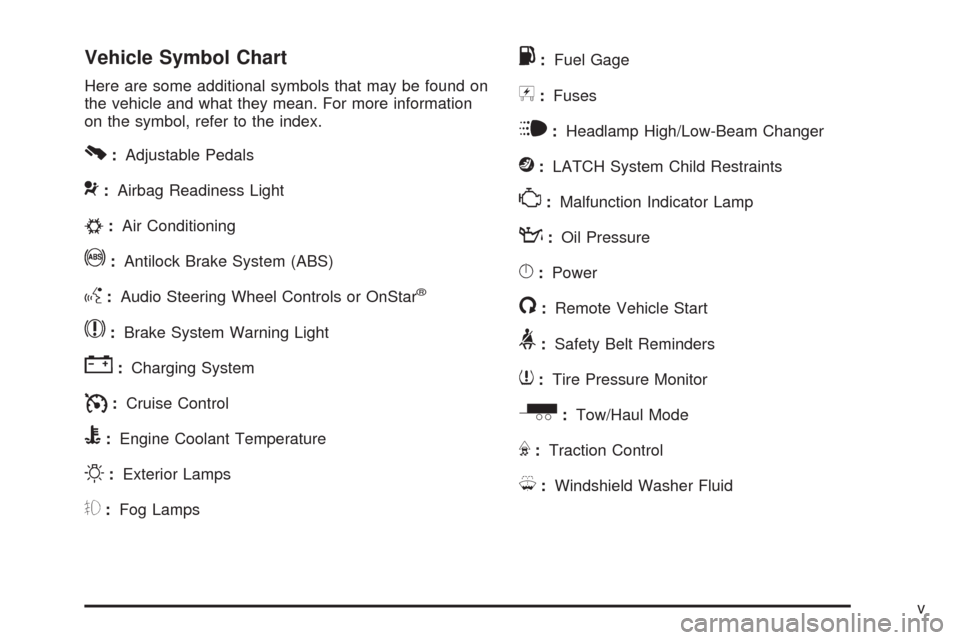
Vehicle Symbol Chart
Here are some additional symbols that may be found on
the vehicle and what they mean. For more information
on the symbol, refer to the index.
0:Adjustable Pedals
9:Airbag Readiness Light
#:Air Conditioning
!:Antilock Brake System (ABS)
g:Audio Steering Wheel Controls or OnStar®
$:Brake System Warning Light
":Charging System
I:Cruise Control
B:Engine Coolant Temperature
O:Exterior Lamps
#:Fog Lamps
.:Fuel Gage
+:Fuses
i:Headlamp High/Low-Beam Changer
j:LATCH System Child Restraints
*:Malfunction Indicator Lamp
::Oil Pressure
}:Power
/:Remote Vehicle Start
>:Safety Belt Reminders
7:Tire Pressure Monitor
_:Tow/Haul Mode
F:Traction Control
M:Windshield Washer Fluid
v
Page 102 of 442
See your dealer/retailer or a locksmith who can service
PASS-Key®III+ to get a new key blank that is cut
exactly as the ignition key that operates the system.
To program the new additional key:
1. Verify that the new key has a
1stamped on it.
2. Insert the original, already programmed, key in the
ignition and start the engine. If the engine will not
start, see your dealer/retailer for service.
3. After the engine has started, turn the key to
LOCK/OFF, and remove the key.
4. Insert the new key to be programmed and turn it to
ON/RUN within ve seconds of the original key
being turned to LOCK/OFF.
The security light will turn off once the key has
been programmed.
5. Repeat Steps 1 through 4 if additional keys are to
be programmed.
If you lose or damage your PASS-Key
®III+ key, see
your dealer/retailer or a locksmith who can service
PASS-Key
®III+ to have a new key made.
Do not leave the key or device that disarms or
deactivates the theft deterrent system in the vehicle.
Starting and Operating Your
Vehicle
New Vehicle Break-In
Notice:Your vehicle does not need an elaborate
break-in. But it will perform better in the long
run if you follow these guidelines for the rst
500 miles (805 km):
Do not drive at any one constant speed,
fast or slow.
Do not exceed 70 mph (113 km/h).
Do not make full-throttle starts; also refrain
from using the full throttle while driving.
Avoid downshifting to brake or slow the vehicle.
If these procedures are not followed, the engine,
axle, or other parts could be damaged.
Avoid making hard stops for the rst 200 miles
(322 km) or so. During this time the new brake linings
are not yet broken in. Hard stops with new linings
can mean premature wear and earlier replacement.
Follow this break-in guideline every time you get
new linings.
2-22
Page 103 of 442
Do not tow a trailer during break-in. SeeTowing a
Trailer on page 4-39for the trailer towing capabilities
of your vehicle and more information.
Following break-in, engine speed and load can be
gradually increased.
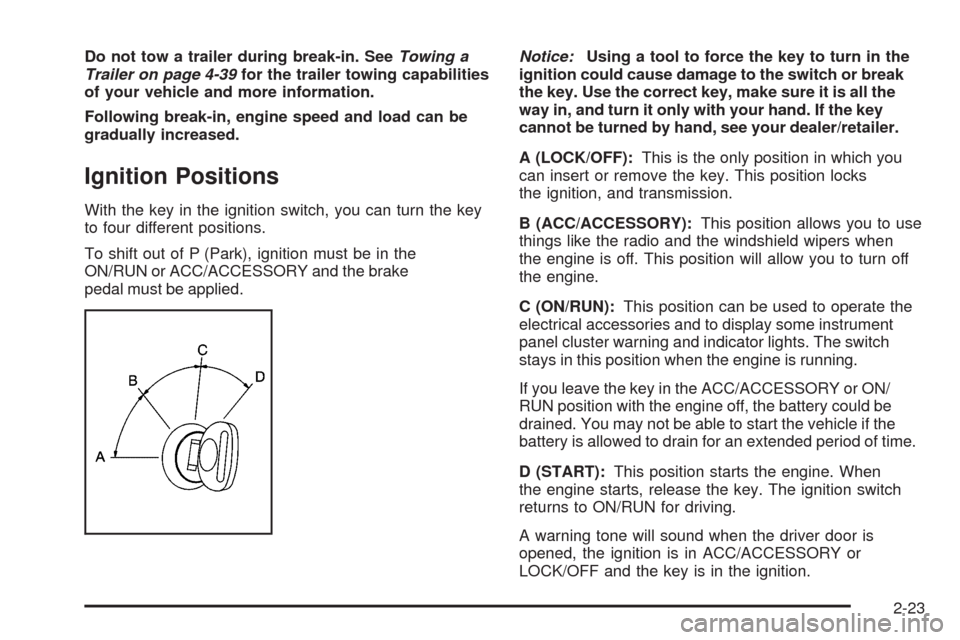
Ignition Positions
With the key in the ignition switch, you can turn the key
to four different positions.
To shift out of P (Park), ignition must be in the
ON/RUN or ACC/ACCESSORY and the brake
pedal must be applied.Notice:Using a tool to force the key to turn in the
ignition could cause damage to the switch or break
the key. Use the correct key, make sure it is all the
way in, and turn it only with your hand. If the key
cannot be turned by hand, see your dealer/retailer.
A (LOCK/OFF):This is the only position in which you
can insert or remove the key. This position locks
the ignition, and transmission.
B (ACC/ACCESSORY):This position allows you to use
things like the radio and the windshield wipers when
the engine is off. This position will allow you to turn off
the engine.
C (ON/RUN):This position can be used to operate the
electrical accessories and to display some instrument
panel cluster warning and indicator lights. The switch
stays in this position when the engine is running.
If you leave the key in the ACC/ACCESSORY or ON/
RUN position with the engine off, the battery could be
drained. You may not be able to start the vehicle if the
battery is allowed to drain for an extended period of time.
D (START):This position starts the engine. When
the engine starts, release the key. The ignition switch
returns to ON/RUN for driving.
A warning tone will sound when the driver door is
opened, the ignition is in ACC/ACCESSORY or
LOCK/OFF and the key is in the ignition.
2-23
Page 112 of 442
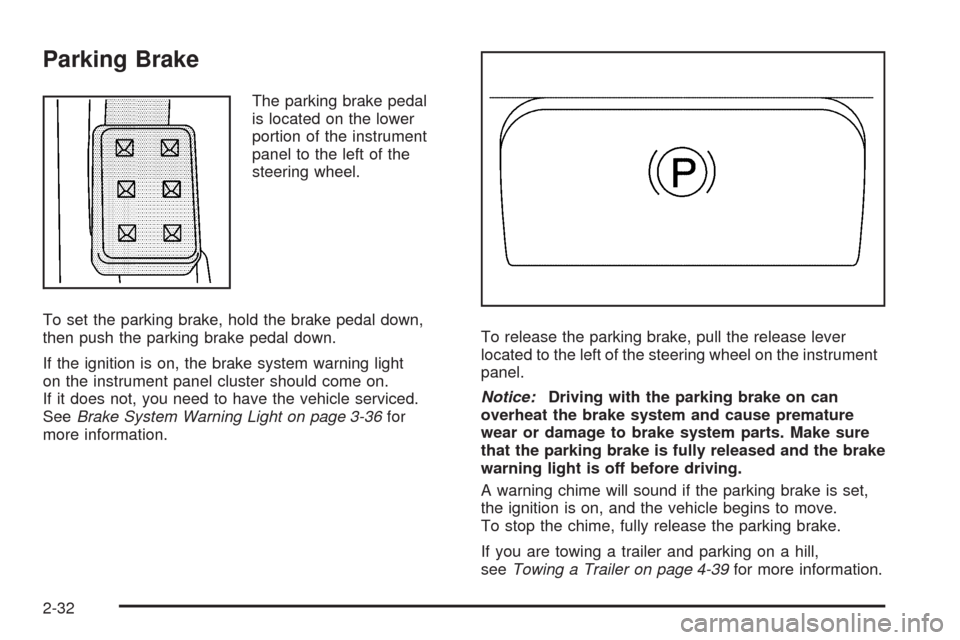
Parking Brake
The parking brake pedal
is located on the lower
portion of the instrument
panel to the left of the
steering wheel.
To set the parking brake, hold the brake pedal down,
then push the parking brake pedal down.
If the ignition is on, the brake system warning light
on the instrument panel cluster should come on.
If it does not, you need to have the vehicle serviced.
SeeBrake System Warning Light on page 3-36for
more information.To release the parking brake, pull the release lever
located to the left of the steering wheel on the instrument
panel.
Notice:Driving with the parking brake on can
overheat the brake system and cause premature
wear or damage to brake system parts. Make sure
that the parking brake is fully released and the brake
warning light is off before driving.
A warning chime will sound if the parking brake is set,
the ignition is on, and the vehicle begins to move.
To stop the chime, fully release the parking brake.
If you are towing a trailer and parking on a hill,
seeTowing a Trailer on page 4-39for more information.
2-32
Page 123 of 442
When the System Does Not Seem to
Work Properly
If the URPA system will not activate due to a temporary
condition, the message PARK ASSIST OFF will be
displayed on the DIC and a red light will be shown on
the rear URPA display when the shift lever is moved into
R (Reverse). This occurs under the following conditions:
The driver disables the system.
The ultrasonic sensors are not clean. Keep the
vehicle’s rear bumper free of mud, dirt, snow,
ice and slush. For cleaning instructions, see
Washing Your Vehicle on page 5-93.
A trailer was attached to the vehicle, or a bicycle or
an object was hanging out of the liftgate during the
last drive cycle, the red light may illuminate. Once
the attached object is removed, URPA will return to
normal operation.
A tow bar is attached to the vehicle.
The vehicle’s bumper is damaged. Take the vehicle
to your dealer/retailer to repair the system.
Other conditions may affect system performance,
such as vibrations from a jackhammer or the
compression of air brakes on a very large truck.
If the system is still disabled, after driving forward at
least 15 mph (25 km/h), take the vehicle to your
dealer/retailer.
OnStar®System
OnStar uses several innovative technologies and live
advisors to provide a wide range of safety, security,
information, and convenience services. If the airbags
deploy, the system is designed to make an automatic
call to OnStar Emergency advisors who can request
emergency services be sent to your location. If the keys
are locked in the vehicle, call OnStar at 1-888-4-ONSTAR
to have a signal sent to unlock the doors. OnStar
Hands-Free Calling, including 30 trial minutes good
for 60 days, is available on most vehicles. OnStar
Turn-by-Turn Navigation service, with one trial route,
is available on most vehicles. Press the OnStar button
to have an OnStar advisor contact Roadside Service.
OnStar service is provided subject to the OnStar Terms
and Conditions included in the OnStar Subscriber
glove box literature.
2-43
Page 139 of 442
Instrument Panel Overview...............................3-4
Hazard Warning Flashers................................3-6
Horn .............................................................3-6
Tilt Wheel.....................................................3-6
Heated Steering Wheel...................................3-7
Turn Signal/Multifunction Lever.........................3-7
Turn and Lane-Change Signals........................3-8
Headlamp High/Low-Beam Changer..................3-8
Flash-to-Pass.................................................3-9
Windshield Wipers..........................................3-9
Windshield Washer.......................................3-10
Rear Window Wiper/Washer...........................3-11
Headlamp Washer........................................3-12
Cruise Control..............................................3-12
Headlamps..................................................3-15
Wiper Activated Headlamps............................3-16
Headlamps on Reminder................................3-16
Daytime Running Lamps (DRL).......................3-16
Fog Lamps ..................................................3-17
Exterior Lighting Battery Saver........................3-18
Instrument Panel Brightness...........................3-18
Entry Lighting...............................................3-18
Parade Dimming...........................................3-18
Reading Lamps............................................3-19
Electric Power Management...........................3-19Accessory Power Outlet(s).............................3-20
Ashtray(s) and Cigarette Lighter......................3-20
Analog Clock...............................................3-21
Climate Controls............................................3-22
Dual Climate Control System..........................3-22
Outlet Adjustment.........................................3-26
Rear Air Conditioning System.........................3-27
Passenger Compartment Air Filter...................3-28
Warning Lights, Gages, and Indicators............3-29
Instrument Panel Cluster
................................3-30
Speedometer and Odometer...........................3-31
Tachometer.................................................3-31
Engine Speed Limiter....................................3-31
Safety Belt Reminders...................................3-31
Airbag Readiness Light..................................3-32
Passenger Airbag Status Indicator...................3-33
Charging System Light..................................3-35
Brake System Warning Light..........................3-36
Antilock Brake System (ABS) Warning Light.....3-37
Traction Control System (TCS) Warning Light . . .3-37
Engine Coolant Temperature Warning Light......3-38
Engine Coolant Temperature Gage..................3-38
Tire Pressure Light.......................................3-39
Malfunction Indicator Lamp.............................3-39
Section 3 Instrument Panel
3-1
Page 143 of 442
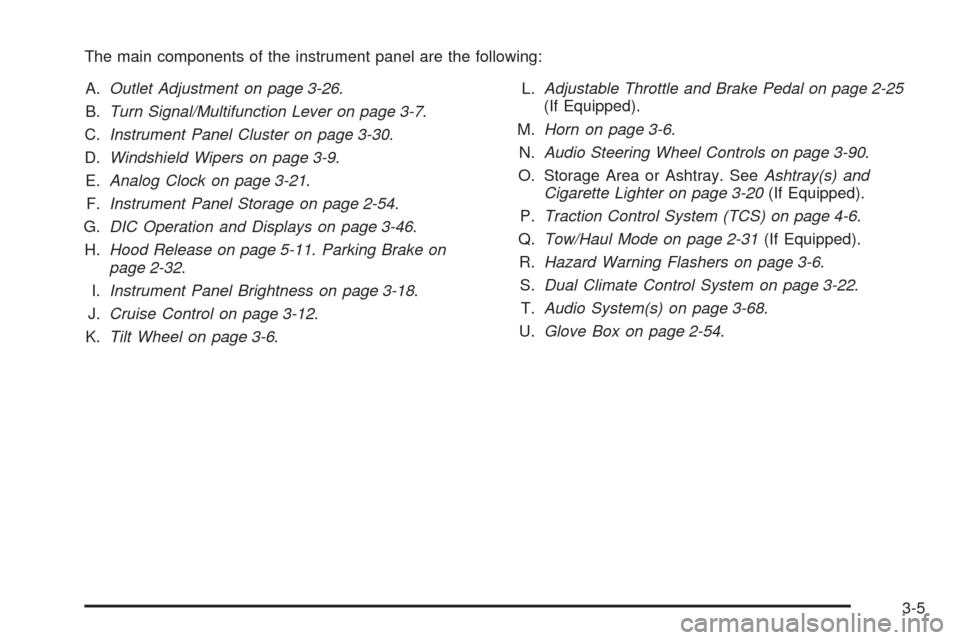
The main components of the instrument panel are the following:
A.Outlet Adjustment on page 3-26.
B.Turn Signal/Multifunction Lever on page 3-7.
C.Instrument Panel Cluster on page 3-30.
D.Windshield Wipers on page 3-9.
E.Analog Clock on page 3-21.
F.Instrument Panel Storage on page 2-54.
G.DIC Operation and Displays on page 3-46.
H.Hood Release on page 5-11.Parking Brake on
page 2-32.
I.Instrument Panel Brightness on page 3-18.
J.Cruise Control on page 3-12.
K.Tilt Wheel on page 3-6.L.Adjustable Throttle and Brake Pedal on page 2-25
(If Equipped).
M.Horn on page 3-6.
N.Audio Steering Wheel Controls on page 3-90.
O. Storage Area or Ashtray. SeeAshtray(s) and
Cigarette Lighter on page 3-20(If Equipped).
P.Traction Control System (TCS) on page 4-6.
Q.Tow/Haul Mode on page 2-31(If Equipped).
R.Hazard Warning Flashers on page 3-6.
S.Dual Climate Control System on page 3-22.
T.Audio System(s) on page 3-68.
U.Glove Box on page 2-54.
3-5
Page 151 of 442
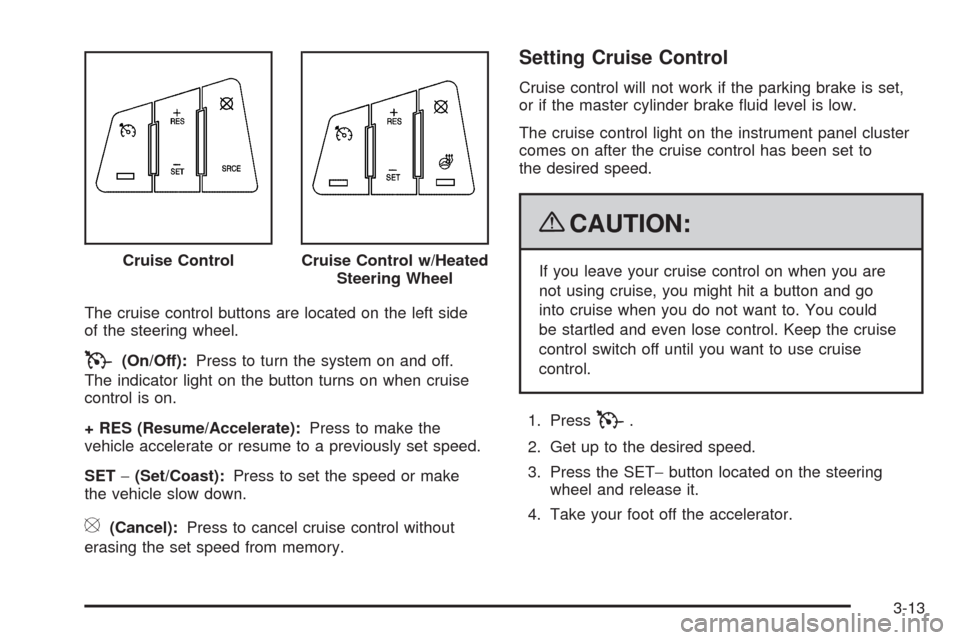
The cruise control buttons are located on the left side
of the steering wheel.
T(On/Off):Press to turn the system on and off.
The indicator light on the button turns on when cruise
control is on.
+ RES (Resume/Accelerate):Press to make the
vehicle accelerate or resume to a previously set speed.
SET−(Set/Coast):Press to set the speed or make
the vehicle slow down.
[(Cancel):Press to cancel cruise control without
erasing the set speed from memory.
Setting Cruise Control
Cruise control will not work if the parking brake is set,
or if the master cylinder brake uid level is low.
The cruise control light on the instrument panel cluster
comes on after the cruise control has been set to
the desired speed.
{CAUTION:
If you leave your cruise control on when you are
not using cruise, you might hit a button and go
into cruise when you do not want to. You could
be startled and even lose control. Keep the cruise
control switch off until you want to use cruise
control.
1. Press
T.
2. Get up to the desired speed.
3. Press the SET−button located on the steering
wheel and release it.
4. Take your foot off the accelerator. Cruise Control
Cruise Control w/Heated
Steering Wheel
3-13
Page 153 of 442
Using Cruise Control on Hills
How well your cruise control will work on hills depends
upon your speed, load, and the steepness of the hills.
When going up steep hills, you might have to step
on the accelerator pedal to maintain the vehicle speed.
When going downhill, you might have to brake or
shift to a lower gear to keep the vehicle speed down.
If the brake is applied the cruise control is disengage.
Ending Cruise Control
There are three ways to end cruise control:
Step lightly on the brake pedal.
Press the[button on the steering wheel.
Press theTbutton on the steering wheel.
Erasing Speed Memory
The cruise control set speed memory is erased,
when the cruise control or the ignition is turned off.
Headlamps
The exterior lamp control is located in the middle of the
turn signal/multifunction lever.
O(Exterior Lamp Control):Turn the control with this
symbol on it to operate the exterior lamps.
The exterior lamp control has four positions:
O(Off):Turns off all lamps, except the Daytime
Running Lamps (DRL).
AUTO (Automatic):Turns the exterior lamps on and
off automatically depending upon how much light is
available outside of the vehicle.
;(Parking Lamps):Turns on the parking lamps
together with the following:
Sidemarker Lamps
Taillamps
License Plate Lamps
Instrument Panel Lights
5(Headlamps):Turns on the headlamps, together
with the previously listed lamps and lights.
3-15
Page 155 of 442
To drive the vehicle with the DRL off, turn the exterior
lamp control off. Then turn on the fog lamps or
parking lamps, and the DRL will turn off. This works
regardless of gear position and whether or not the
parking brake is set.
The regular headlamp system should be turned on when
needed.
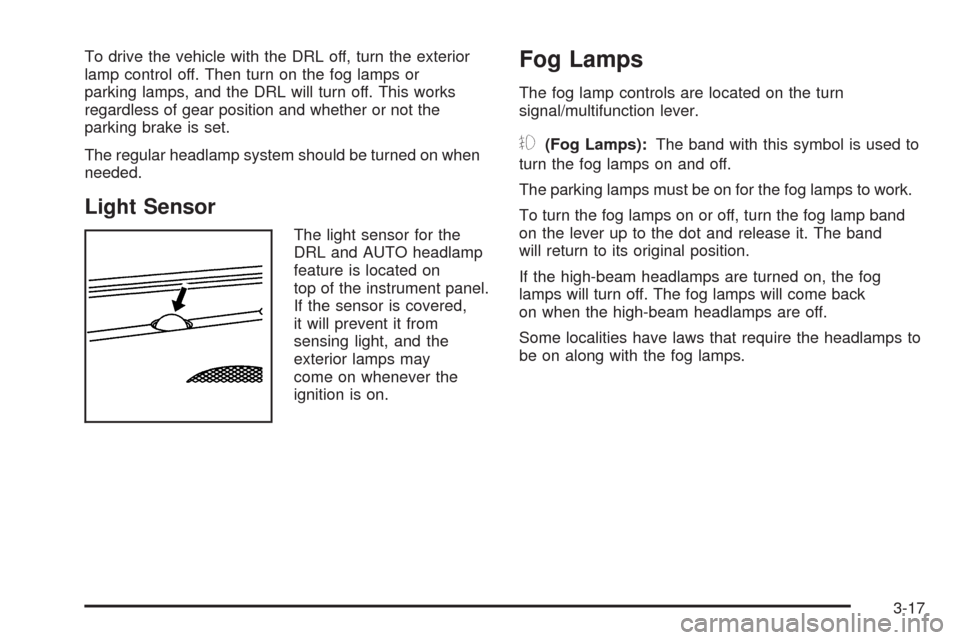
Light Sensor
The light sensor for the
DRL and AUTO headlamp
feature is located on
top of the instrument panel.
If the sensor is covered,
it will prevent it from
sensing light, and the
exterior lamps may
come on whenever the
ignition is on.
Fog Lamps
The fog lamp controls are located on the turn
signal/multifunction lever.
#(Fog Lamps):The band with this symbol is used to
turn the fog lamps on and off.
The parking lamps must be on for the fog lamps to work.
To turn the fog lamps on or off, turn the fog lamp band
on the lever up to the dot and release it. The band
will return to its original position.
If the high-beam headlamps are turned on, the fog
lamps will turn off. The fog lamps will come back
on when the high-beam headlamps are off.
Some localities have laws that require the headlamps to
be on along with the fog lamps.
3-17