warning CADILLAC SRX 2011 2.G Owners Manual
[x] Cancel search | Manufacturer: CADILLAC, Model Year: 2011, Model line: SRX, Model: CADILLAC SRX 2011 2.GPages: 498, PDF Size: 7.62 MB
Page 417 of 498
Black plate (79,1)Cadillac SRX Owner Manual - 2011
Vehicle Care 10-79
Tire Sealant and
Compressor Kit
{WARNING
Idling a vehicle in an enclosed
area with poor ventilation is
dangerous. Engine exhaust may
enter the vehicle. Engine exhaust
contains Carbon Monoxide (CO)
which cannot be seen or smelled.
It can cause unconsciousness
and even death. Never run the
engine in an enclosed area
that has no fresh air ventilation.
For more information, seeEngine
Exhaust on page 9‑24.
{WARNING
Over-inflating a tire could cause
the tire to rupture and you
or others could be injured.
Be sure to read and follow the
tire sealant and compressor kit
instructions and inflate the tire
to its recommended pressure.
Do not exceed the recommended
pressure.
{WARNING
Storing the tire sealant and
compressor kit or other
equipment in the passenger
compartment of the vehicle could
cause injury. In a sudden stop or
collision, loose equipment could
strike someone. Store the tire
sealant and compressor kit in
its original location. If this vehicle has a tire sealant and
compressor kit, there may not be a
spare tire, tire changing equipment,
and on some vehicles there may not
be a place to store a tire.
The tire sealant and compressor
can be used to temporarily seal
punctures up to 6 mm (¼ in) in the
tread area of the tire. It can also be
used to inflate an under inflated tire.
If the tire has been separated from
the wheel, has damaged sidewalls,
or has a large puncture, the tire is
too severely damaged for the tire
sealant and compressor kit to be
effective. See
Roadside Service
(U.S. and Canada) on page 13‑8
or Roadside Service (Mexico) on
page 13‑10.
Read and follow all of the tire
sealant and compressor kit
instructions.
Page 419 of 498
Black plate (81,1)Cadillac SRX Owner Manual - 2011
Vehicle Care 10-81
When using the tire sealant
and compressor kit during cold
temperatures, warm the kit in a
heated environment for five minutes.
This will help to inflate the tire
faster.
If a tire goes flat, avoid further tire
and wheel damage by driving slowly
to a level place. Turn on the hazard
warning flashers. SeeHazard
Warning Flashers on page 6‑5.
See If a Tire Goes Flat on
page 10‑77 for other important
safety warnings.
Do not remove any objects that
have penetrated the tire.
1. Remove the tire sealant and compressor kit from its storage
location. See Storing the Tire
Sealant and Compressor Kit on
page 10‑86.
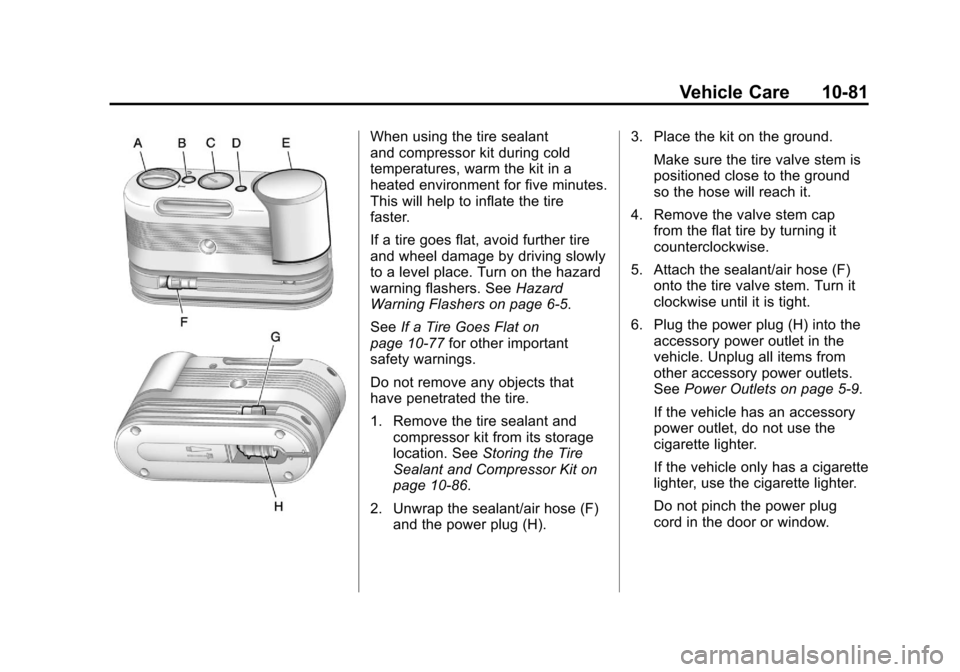
2. Unwrap the sealant/air hose (F) and the power plug (H). 3. Place the kit on the ground.
Make sure the tire valve stem is
positioned close to the ground
so the hose will reach it.
4. Remove the valve stem cap from the flat tire by turning it
counterclockwise.
5. Attach the sealant/air hose (F) onto the tire valve stem. Turn it
clockwise until it is tight.
6. Plug the power plug (H) into the accessory power outlet in the
vehicle. Unplug all items from
other accessory power outlets.
See Power Outlets on page 5‑9.
If the vehicle has an accessory
power outlet, do not use the
cigarette lighter.
If the vehicle only has a cigarette
lighter, use the cigarette lighter.
Do not pinch the power plug
cord in the door or window.
Page 422 of 498
Black plate (84,1)Cadillac SRX Owner Manual - 2011
10-84 Vehicle Care
If a tire goes flat, avoid further tire
and wheel damage by driving slowly
to a level place. Turn on the hazard
warning flashers. SeeHazard
Warning Flashers on page 6‑5.
See If a Tire Goes Flat on
page 10‑77 for other important
safety warnings.
1. Remove the tire sealant and compressor kit from its storage
location. See Storing the Tire
Sealant and Compressor Kit on
page 10‑86.
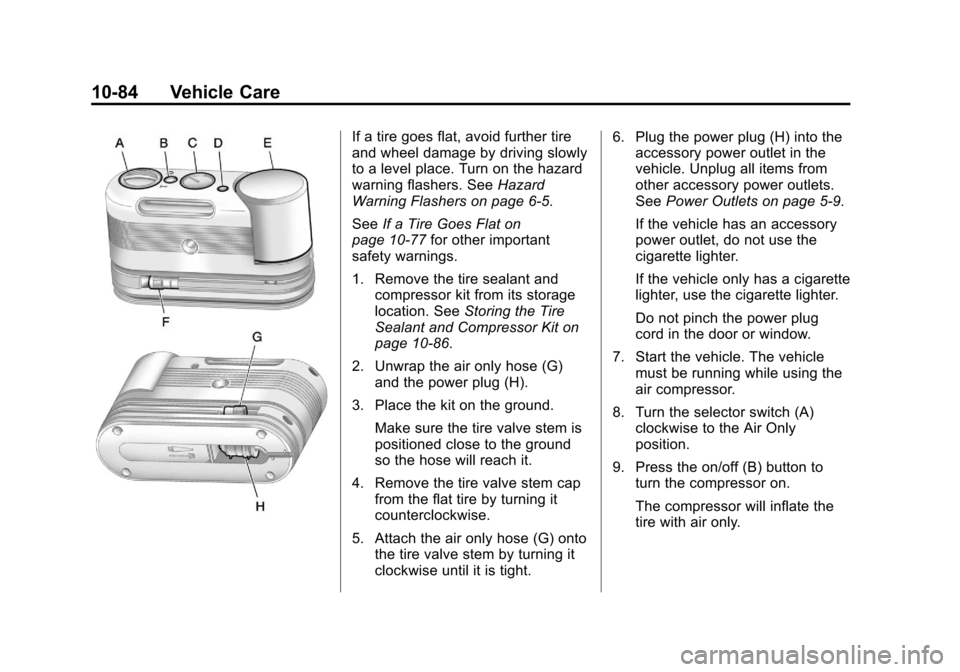
2. Unwrap the air only hose (G) and the power plug (H).
3. Place the kit on the ground. Make sure the tire valve stem is
positioned close to the ground
so the hose will reach it.
4. Remove the tire valve stem cap from the flat tire by turning it
counterclockwise.
5. Attach the air only hose (G) onto the tire valve stem by turning it
clockwise until it is tight. 6. Plug the power plug (H) into the
accessory power outlet in the
vehicle. Unplug all items from
other accessory power outlets.
See Power Outlets on page 5‑9.
If the vehicle has an accessory
power outlet, do not use the
cigarette lighter.
If the vehicle only has a cigarette
lighter, use the cigarette lighter.
Do not pinch the power plug
cord in the door or window.
7. Start the vehicle. The vehicle must be running while using the
air compressor.
8. Turn the selector switch (A) clockwise to the Air Only
position.
9. Press the on/off (B) button to turn the compressor on.
The compressor will inflate the
tire with air only.
Page 427 of 498
Black plate (89,1)Cadillac SRX Owner Manual - 2011
Vehicle Care 10-89
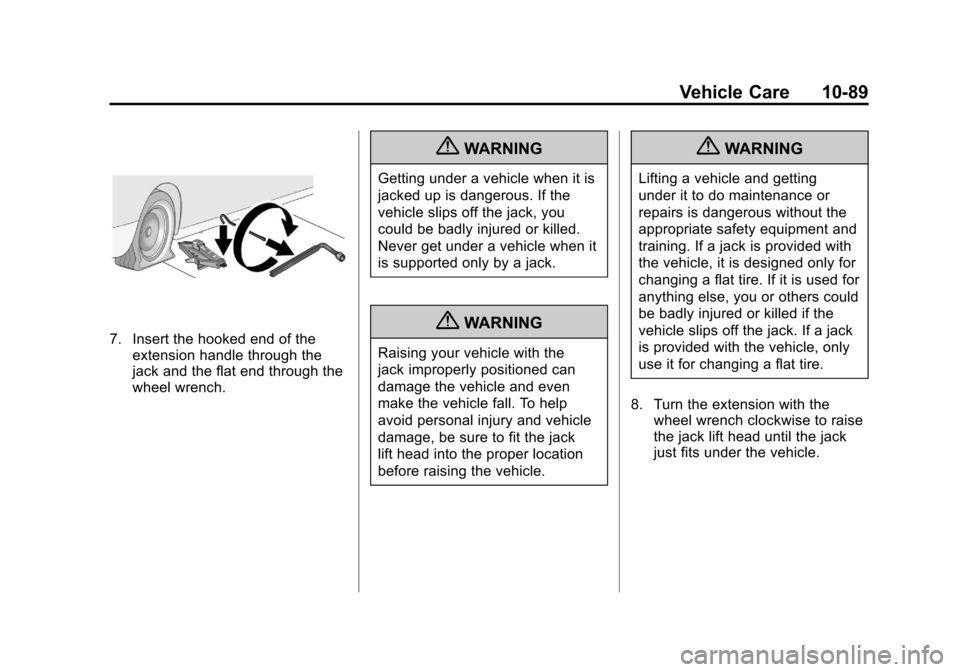
7. Insert the hooked end of theextension handle through the
jack and the flat end through the
wheel wrench.
{WARNING
Getting under a vehicle when it is
jacked up is dangerous. If the
vehicle slips off the jack, you
could be badly injured or killed.
Never get under a vehicle when it
is supported only by a jack.
{WARNING
Raising your vehicle with the
jack improperly positioned can
damage the vehicle and even
make the vehicle fall. To help
avoid personal injury and vehicle
damage, be sure to fit the jack
lift head into the proper location
before raising the vehicle.
{WARNING
Lifting a vehicle and getting
under it to do maintenance or
repairs is dangerous without the
appropriate safety equipment and
training. If a jack is provided with
the vehicle, it is designed only for
changing a flat tire. If it is used for
anything else, you or others could
be badly injured or killed if the
vehicle slips off the jack. If a jack
is provided with the vehicle, only
use it for changing a flat tire.
8. Turn the extension with the wheel wrench clockwise to raise
the jack lift head until the jack
just fits under the vehicle.
Page 428 of 498
Black plate (90,1)Cadillac SRX Owner Manual - 2011
10-90 Vehicle Care
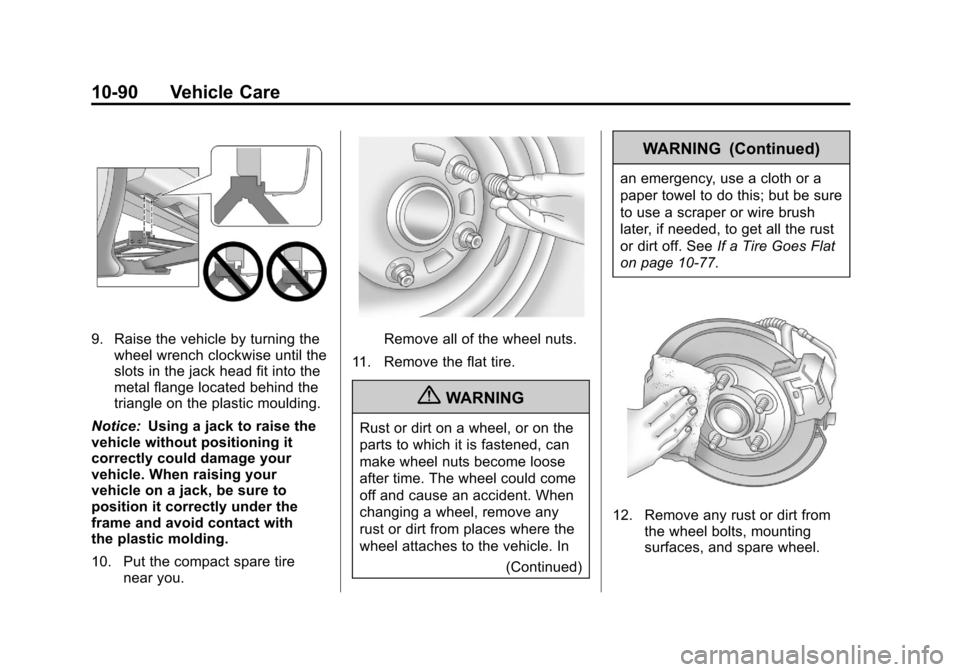
9. Raise the vehicle by turning thewheel wrench clockwise until the
slots in the jack head fit into the
metal flange located behind the
triangle on the plastic moulding.
Notice: Using a jack to raise the
vehicle without positioning it
correctly could damage your
vehicle. When raising your
vehicle on a jack, be sure to
position it correctly under the
frame and avoid contact with
the plastic molding.
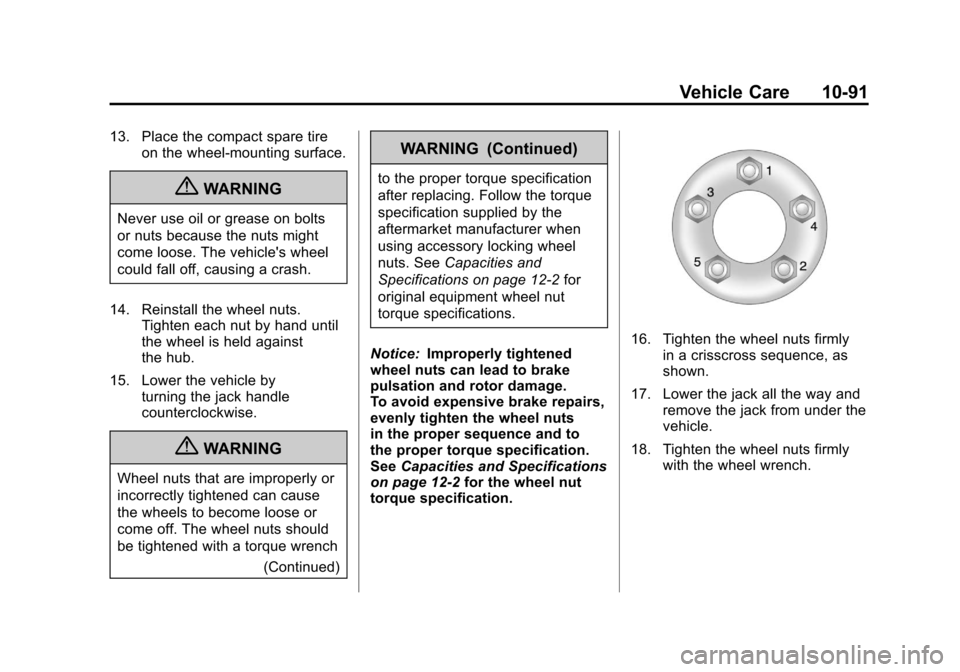
10. Put the compact spare tire near you.Remove all of the wheel nuts.
11. Remove the flat tire.
{WARNING
Rust or dirt on a wheel, or on the
parts to which it is fastened, can
make wheel nuts become loose
after time. The wheel could come
off and cause an accident. When
changing a wheel, remove any
rust or dirt from places where the
wheel attaches to the vehicle. In (Continued)
WARNING (Continued)
an emergency, use a cloth or a
paper towel to do this; but be sure
to use a scraper or wire brush
later, if needed, to get all the rust
or dirt off. SeeIf a Tire Goes Flat
on page 10‑77.
12. Remove any rust or dirt from the wheel bolts, mounting
surfaces, and spare wheel.
Page 429 of 498
Black plate (91,1)Cadillac SRX Owner Manual - 2011
Vehicle Care 10-91
13. Place the compact spare tireon the wheel-mounting surface.
{WARNING
Never use oil or grease on bolts
or nuts because the nuts might
come loose. The vehicle's wheel
could fall off, causing a crash.
14. Reinstall the wheel nuts. Tighten each nut by hand until
the wheel is held against
the hub.
15. Lower the vehicle by turning the jack handle
counterclockwise.
{WARNING
Wheel nuts that are improperly or
incorrectly tightened can cause
the wheels to become loose or
come off. The wheel nuts should
be tightened with a torque wrench
(Continued)
WARNING (Continued)
to the proper torque specification
after replacing. Follow the torque
specification supplied by the
aftermarket manufacturer when
using accessory locking wheel
nuts. SeeCapacities and
Specifications on page 12‑2 for
original equipment wheel nut
torque specifications.
Notice: Improperly tightened
wheel nuts can lead to brake
pulsation and rotor damage.
To avoid expensive brake repairs,
evenly tighten the wheel nuts
in the proper sequence and to
the proper torque specification.
See Capacities and Specifications
on page 12‑2 for the wheel nut
torque specification.
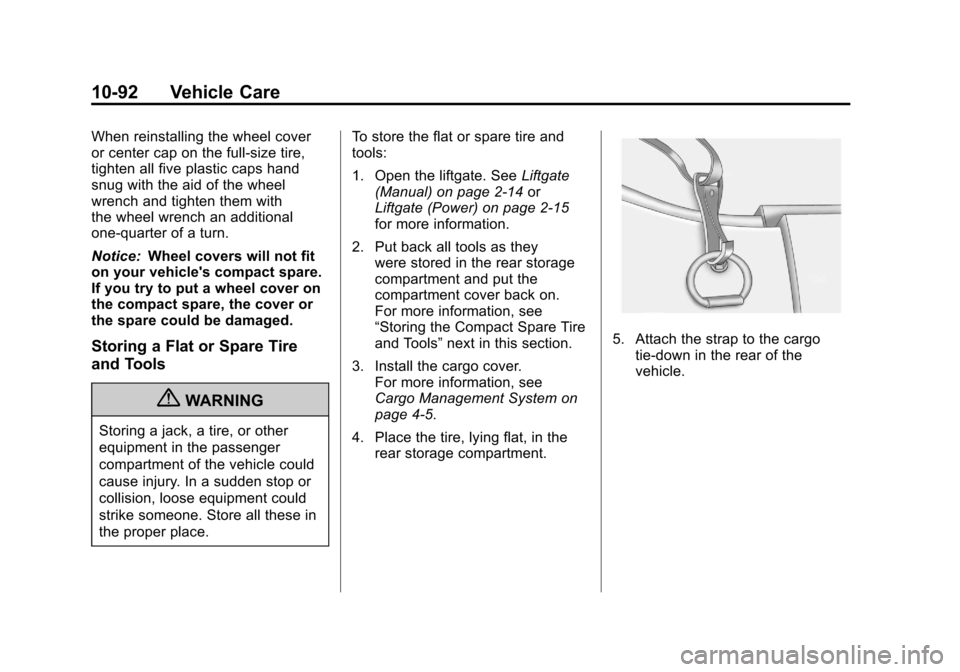
16. Tighten the wheel nuts firmly
in a crisscross sequence, as
shown.
17. Lower the jack all the way and remove the jack from under the
vehicle.
18. Tighten the wheel nuts firmly with the wheel wrench.
Page 430 of 498
Black plate (92,1)Cadillac SRX Owner Manual - 2011
10-92 Vehicle Care
When reinstalling the wheel cover
or center cap on the full-size tire,
tighten all five plastic caps hand
snug with the aid of the wheel
wrench and tighten them with
the wheel wrench an additional
one‐quarter of a turn.
Notice:Wheel covers will not fit
on your vehicle's compact spare.
If you try to put a wheel cover on
the compact spare, the cover or
the spare could be damaged.
Storing a Flat or Spare Tire
and Tools
{WARNING
Storing a jack, a tire, or other
equipment in the passenger
compartment of the vehicle could
cause injury. In a sudden stop or
collision, loose equipment could
strike someone. Store all these in
the proper place. To store the flat or spare tire and
tools:
1. Open the liftgate. See
Liftgate
(Manual) on page 2‑14 or
Liftgate (Power) on page 2‑15
for more information.
2. Put back all tools as they were stored in the rear storage
compartment and put the
compartment cover back on.
For more information, see
“Storing the Compact Spare Tire
and Tools” next in this section.
3. Install the cargo cover. For more information, see
Cargo Management System on
page 4‑5.
4. Place the tire, lying flat, in the rear storage compartment.
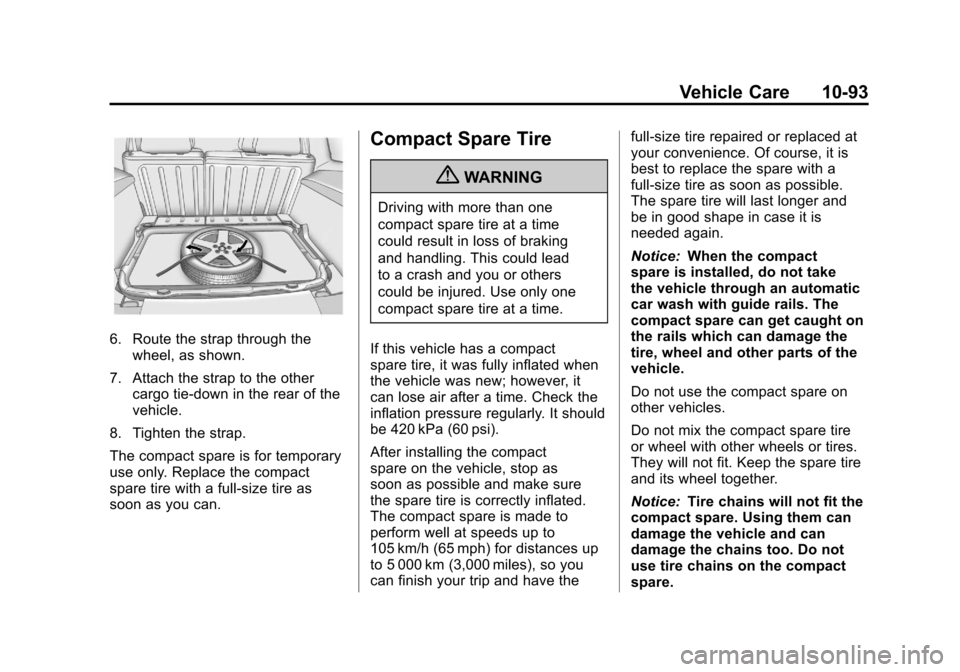
5. Attach the strap to the cargotie-down in the rear of the
vehicle.
Page 431 of 498
Black plate (93,1)Cadillac SRX Owner Manual - 2011
Vehicle Care 10-93
6. Route the strap through thewheel, as shown.
7. Attach the strap to the other cargo tie-down in the rear of the
vehicle.
8. Tighten the strap.
The compact spare is for temporary
use only. Replace the compact
spare tire with a full-size tire as
soon as you can.
Compact Spare Tire
{WARNING
Driving with more than one
compact spare tire at a time
could result in loss of braking
and handling. This could lead
to a crash and you or others
could be injured. Use only one
compact spare tire at a time.
If this vehicle has a compact
spare tire, it was fully inflated when
the vehicle was new; however, it
can lose air after a time. Check the
inflation pressure regularly. It should
be 420 kPa (60 psi).
After installing the compact
spare on the vehicle, stop as
soon as possible and make sure
the spare tire is correctly inflated.
The compact spare is made to
perform well at speeds up to
105 km/h (65 mph) for distances up
to 5 000 km (3,000 miles), so you
can finish your trip and have the full-size tire repaired or replaced at
your convenience. Of course, it is
best to replace the spare with a
full-size tire as soon as possible.
The spare tire will last longer and
be in good shape in case it is
needed again.
Notice:
When the compact
spare is installed, do not take
the vehicle through an automatic
car wash with guide rails. The
compact spare can get caught on
the rails which can damage the
tire, wheel and other parts of the
vehicle.
Do not use the compact spare on
other vehicles.
Do not mix the compact spare tire
or wheel with other wheels or tires.
They will not fit. Keep the spare tire
and its wheel together.
Notice: Tire chains will not fit the
compact spare. Using them can
damage the vehicle and can
damage the chains too. Do not
use tire chains on the compact
spare.
Page 432 of 498
Black plate (94,1)Cadillac SRX Owner Manual - 2011
10-94 Vehicle Care
Jump Starting
For more information about the
vehicle battery, seeBattery on
page 10‑28.
If the vehicle battery has run down,
you may want to use another
vehicle and some jumper cables to
start your vehicle. Be sure to use
the following steps to do it safely.
{WARNING
Batteries can hurt you. They can
be dangerous because:
.They contain acid that can
burn you.
.They contain gas that can
explode or ignite.
.They contain enough
electricity to burn you.
If you do not follow these steps
exactly, some or all of these
things can hurt you. Notice:
Ignoring these steps
could result in costly damage to
the vehicle that would not be
covered by the warranty.
Trying to start the vehicle by
pushing or pulling it will not
work, and it could damage the
vehicle.
1. Check the other vehicle. It must
have a 12-volt battery with a
negative ground system.
Notice: Only use vehicles with
12-volt systems with negative
grounds to jump start your
vehicle. If the other vehicle's
system is not a 12-volt system
with a negative ground, both
vehicles can be damaged.
2. Get the vehicles close enough so the jumper cables can reach,
but be sure the vehicles are not
touching each other. If they
are, it could cause a ground
connection you do not want.
You would not be able to start your vehicle, and the bad
grounding could damage the
electrical systems.
To avoid the possibility of the
vehicles rolling, set the parking
brake firmly on both vehicles
involved in the jump start
procedure. Put the transmission
in P (Park) before setting the
parking brake.
Notice: If you leave the radio or
other accessories on during the
jump starting procedure, they
could be damaged. The repairs
would not be covered by the
warranty. Always turn off the
radio and other accessories
when jump starting the vehicle.
3. Turn off the ignition on both vehicles. Unplug unnecessary
accessories plugged into the
cigarette lighter or the accessory
power outlet. Turn off the radio
and all lamps that are not
needed. This will avoid sparks,
helping save both batteries and
the radio.
Page 433 of 498
Black plate (95,1)Cadillac SRX Owner Manual - 2011
Vehicle Care 10-95
4. Open the hood on theother vehicle and locate the
positive (+) and negative (−)
terminal locations on that
vehicle.
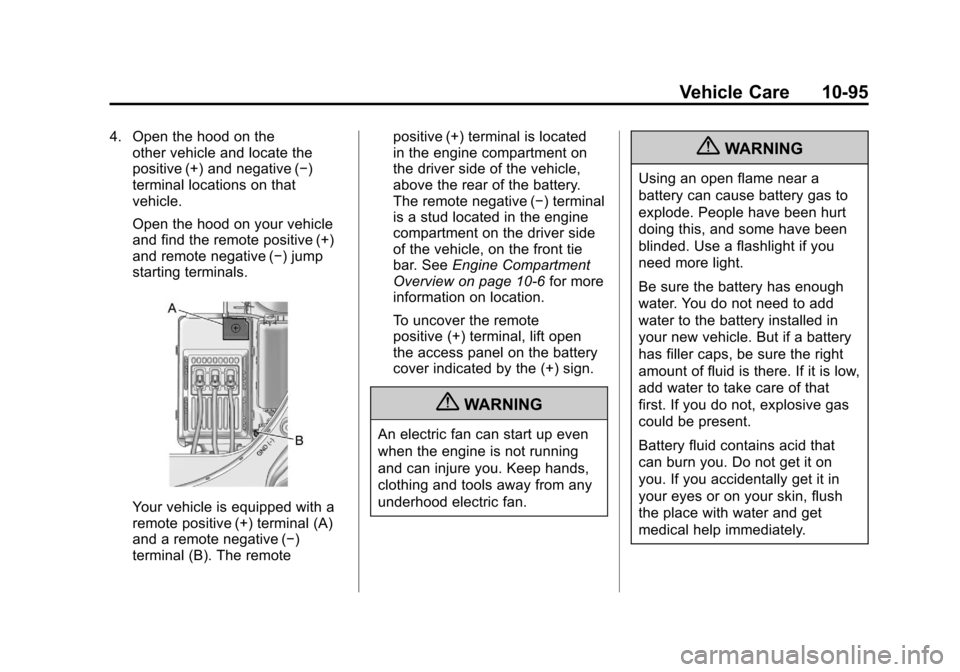
Open the hood on your vehicle
and find the remote positive (+)
and remote negative (−) jump
starting terminals.
Your vehicle is equipped with a
remote positive (+) terminal (A)
and a remote negative (−)
terminal (B). The remote positive (+) terminal is located
in the engine compartment on
the driver side of the vehicle,
above the rear of the battery.
The remote negative (−) terminal
is a stud located in the engine
compartment on the driver side
of the vehicle, on the front tie
bar. See
Engine Compartment
Overview on page 10‑6 for more
information on location.
To uncover the remote
positive (+) terminal, lift open
the access panel on the battery
cover indicated by the (+) sign.
{WARNING
An electric fan can start up even
when the engine is not running
and can injure you. Keep hands,
clothing and tools away from any
underhood electric fan.
{WARNING
Using an open flame near a
battery can cause battery gas to
explode. People have been hurt
doing this, and some have been
blinded. Use a flashlight if you
need more light.
Be sure the battery has enough
water. You do not need to add
water to the battery installed in
your new vehicle. But if a battery
has filler caps, be sure the right
amount of fluid is there. If it is low,
add water to take care of that
first. If you do not, explosive gas
could be present.
Battery fluid contains acid that
can burn you. Do not get it on
you. If you accidentally get it in
your eyes or on your skin, flush
the place with water and get
medical help immediately.