transmission CADILLAC STS 2007 1.G Owner's Manual
[x] Cancel search | Manufacturer: CADILLAC, Model Year: 2007, Model line: STS, Model: CADILLAC STS 2007 1.GPages: 560, PDF Size: 2.92 MB
Page 258 of 560

Driver Information Center (DIC)
The Driver Information Center (DIC) gives you the
status of many of your vehicle’s systems. The DIC
is also used to display warning/status messages.
All messages will appear in the DIC display located
at the bottom of the instrument panel cluster, below
the tachometer and speedometer. The DIC buttons
are located on the instrument panel, to the left of
the steering wheel.
The DIC comes on when the ignition is on. After a
short delay, the DIC will display the current
driver and the information that was last displayed
before the engine was turned off.
The top line of the DIC display shows the vehicle
system information and the warning/status
messages. The bottom line of the DIC display
shows either the odometer, the trip odometer A or
the trip odometer B information on the left side.
Only one odometer can appear at a time. See “Trip
Information” underDIC Controls and Displays
on page 258for information on changing the
display to show the odometer or trip odometer
information. The bottom line of the DIC display
also shows the outside temperature on the
right side and the shift lever position indicator inthe center. SeeAutomatic Transmission Operation
on page 116for more information on the shift
lever positions.
When the sport mode is active, an S will appear
next to the shift position indicator on the center of
the DIC display. When the manual mode is
active, an M will appear on the DIC display. When
the normal mode is active, only the shift position
indicator will appear. While the Driver Shift
Control (DSC) feature is active, the DIC will
change to show the selected gear. See “Driver
Shift Control (DSC)” underAutomatic Transmission
Operation on page 116for more information.
If a problem is detected, a warning message will
appear on the display. Be sure to take any
message that appears on the display seriously and
remember that clearing the message will only make
the message disappear, not correct the problem.
DIC Controls and Displays
The Driver Information Center (DIC) has different
modes which can be accessed by pressing
the four DIC buttons located on the instrument
panel, to the left of the steering wheel.
258
Page 259 of 560
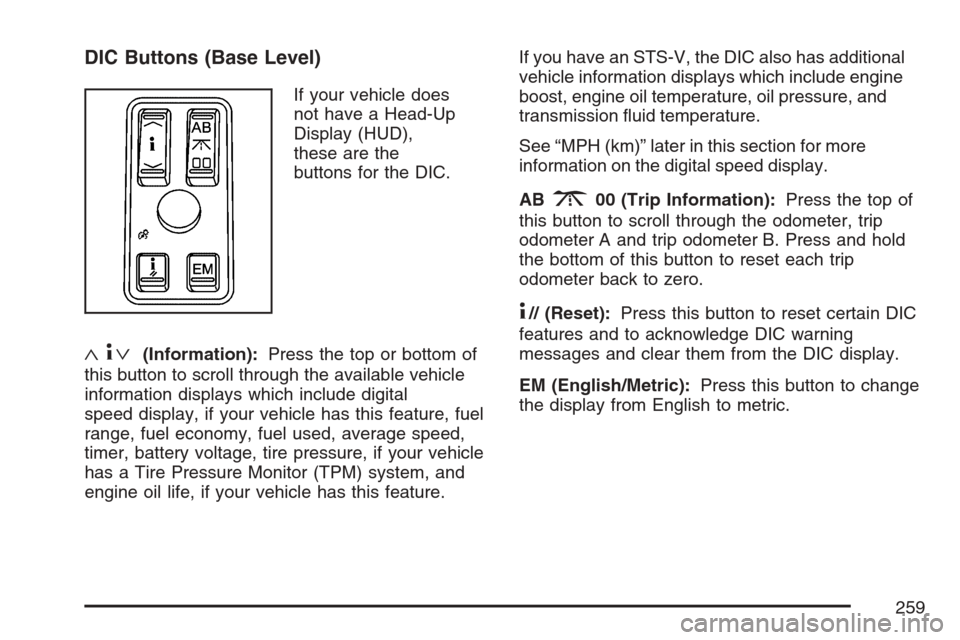
DIC Buttons (Base Level)
If your vehicle does
not have a Head-Up
Display (HUD),
these are the
buttons for the DIC.
«4ª(Information):Press the top or bottom of
this button to scroll through the available vehicle
information displays which include digital
speed display, if your vehicle has this feature, fuel
range, fuel economy, fuel used, average speed,
timer, battery voltage, tire pressure, if your vehicle
has a Tire Pressure Monitor (TPM) system, and
engine oil life, if your vehicle has this feature.If you have an STS-V, the DIC also has additional
vehicle information displays which include engine
boost, engine oil temperature, oil pressure, and
transmission uid temperature.
See “MPH (km)” later in this section for more
information on the digital speed display.
AB
300 (Trip Information):Press the top of
this button to scroll through the odometer, trip
odometer A and trip odometer B. Press and hold
the bottom of this button to reset each trip
odometer back to zero.
4// (Reset):Press this button to reset certain DIC
features and to acknowledge DIC warning
messages and clear them from the DIC display.
EM (English/Metric):Press this button to change
the display from English to metric.
259
Page 264 of 560

OIL PRESSURE (STS-V Only)
This display shows the oil pressure in either
pounds per square inch (psi) or kilopascals (kPa).
TRANS (Transmission) FLUID TEMP
(Temperature) (STS-V Only)
This display shows the transmission uid
temperature in either degrees Fahrenheit (°F) or
degrees Celsius (°C).
Trip Information Display Menu Items
The following display menu items can be displayed
by pressing the trip Information button.
Odometer
Press the trip information button until the odometer
appears on the DIC display. The odometer
shows the total distance the vehicle has been
driven in either miles (mi) or kilometers (km).
Trip Odometer
Press the trip information button until trip
odometer A or B appears on the DIC display.
The trip odometer shows the current distance
traveled since the last reset for each trip odometer
in either miles (mi) or kilometers (km). Both
odometers can be used at the same time.For base level vehicles, each trip odometer can be
reset to zero separately by pressing and holding
the bottom of the trip information button while
the desired trip odometer is displayed. For uplevel
vehicles, reset each trip odometer by pressing
the reset button or by pressing and holding the trip
information button while the desired trip odometer
is displayed.
DIC Warnings and Messages
These messages appear if there is a problem
detected in one of your vehicle’s systems. The text
messages are the same for both the base audio
and Navigation systems unless otherwise
indicated.
You must acknowledge a message to clear it from
the screen for further use. To clear a message,
press the reset button.
Be sure to take any message that appears on the
screen seriously and remember that clearing
the message will only make the message
disappear, not the problem.
264
Page 276 of 560

SERVICE TIRE MONITOR
If your vehicle has a Tire Pressure Monitor (TPM)
system, this message displays if a part on the
system is not working properly. If you drive your
vehicle while any of the four sensors are
missing or inoperable, the warning comes on in
about 20 minutes. A sensor would be missing, for
example, if you put different wheels on your
vehicle without transferring the sensors. If the
warning comes on and stays on, there may be a
problem with the TPM. See your dealer.
SERVICE THEFT SYSTEM
This message displays when there is a problem
with the hood open and closed switches. The
switches may need to be replaced. When
this message is displayed, the theft-deterrent
system will still be protecting the interior of
the vehicle, however, the hood area will not be
protected at this time. Also, the remote start
function will not work when this message appears.
See your dealer for service.
SERVICE TRANSMISSION
This message displays when there is a problem
with the transmission of your vehicle. Have
your vehicle serviced by your dealer.
SERVICE VEHICLE SOON
This message displays when a non-emissions
related malfunction occurs. Have your vehicle
serviced by your dealer as soon as possible.
SPEED LIMITED TO XXX
This message displays when your vehicle speed is
limited to XXX, mph in English mode and km/h
in Metric mode, because the vehicle detects
a problem in the suspension system. Have your
vehicle serviced by your dealer.
STABILITY SYS (System) ACTIVE
This message displays any time the StabiliTrak®
System is actively assisting you with directional
control of the vehicle. Slippery road conditions may
exist when this message is displayed, so adjust
your driving accordingly. This message may
stay on for a few seconds after StabiliTrak
®stops
assisting you with directional control of the
vehicle. SeeStabiliTrak
®System on page 326for
more information.
276
Page 278 of 560
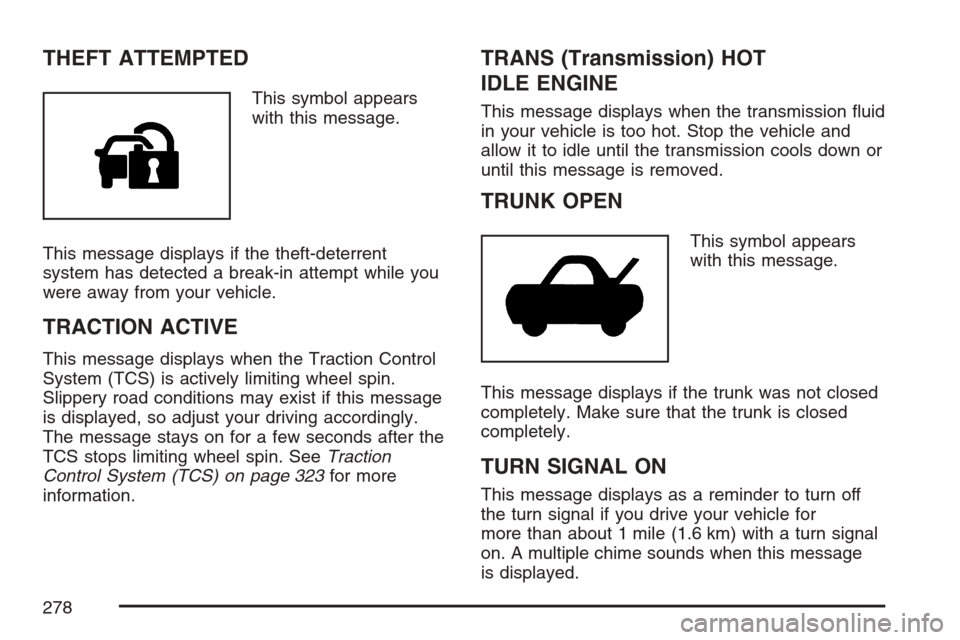
THEFT ATTEMPTED
This symbol appears
with this message.
This message displays if the theft-deterrent
system has detected a break-in attempt while you
were away from your vehicle.
TRACTION ACTIVE
This message displays when the Traction Control
System (TCS) is actively limiting wheel spin.
Slippery road conditions may exist if this message
is displayed, so adjust your driving accordingly.
The message stays on for a few seconds after the
TCS stops limiting wheel spin. SeeTraction
Control System (TCS) on page 323for more
information.
TRANS (Transmission) HOT
IDLE ENGINE
This message displays when the transmission uid
in your vehicle is too hot. Stop the vehicle and
allow it to idle until the transmission cools down or
until this message is removed.
TRUNK OPEN
This symbol appears
with this message.
This message displays if the trunk was not closed
completely. Make sure that the trunk is closed
completely.
TURN SIGNAL ON
This message displays as a reminder to turn off
the turn signal if you drive your vehicle for
more than about 1 mile (1.6 km) with a turn signal
on. A multiple chime sounds when this message
is displayed.
278
Page 328 of 560
The traction you can get in a curve depends on
the condition of your tires and the road surface, the
angle at which the curve is banked, and your
speed. While you are in a curve, speed is the
one factor you can control.
Suppose you are steering through a sharp curve.
Then you suddenly accelerate. Both control
systems — steering and acceleration — have to
do their work where the tires meet the road.
Adding the sudden acceleration can demand too
much of those places. You can lose control.
SeeTraction Control System (TCS) on page 323
andStabiliTrak
®System on page 326.
What should you do if this ever happens? Ease up
on the accelerator pedal, steer the vehicle the
way you want it to go, and slow down.
Since your vehicle is equipped with StabiliTrak
®,
the system may be active. SeeDIC Warnings and
Messages on page 264andStabiliTrak
®System
on page 326.
Speed limit signs near curves warn that you
should adjust your speed. Of course, the posted
speeds are based on good weather and road
conditions. Under less favorable conditions you will
want to go slower.If you need to reduce your speed as you approach
a curve, do it before you enter the curve, while
your front wheels are straight ahead.
Try to adjust your speed so you can “drive”
through the curve. Maintain a reasonable, steady
speed. Wait to accelerate until you are out of
the curve, and then accelerate gently into
the straightaway.
To help you steer in the direction you want to go,
during certain sharp or sudden cornering
maneuvers, gear selection is controlled. This will
maximize the available drive wheel torque and
minimize the transmission response time and shift
activity. During this kind of maneuver, the
transmission shifts automatically as vehicle
speed changes.
Adding non-GM accessories can affect your
vehicle’s performance. SeeAccessories and
Modications on page 363.
328
Page 342 of 560
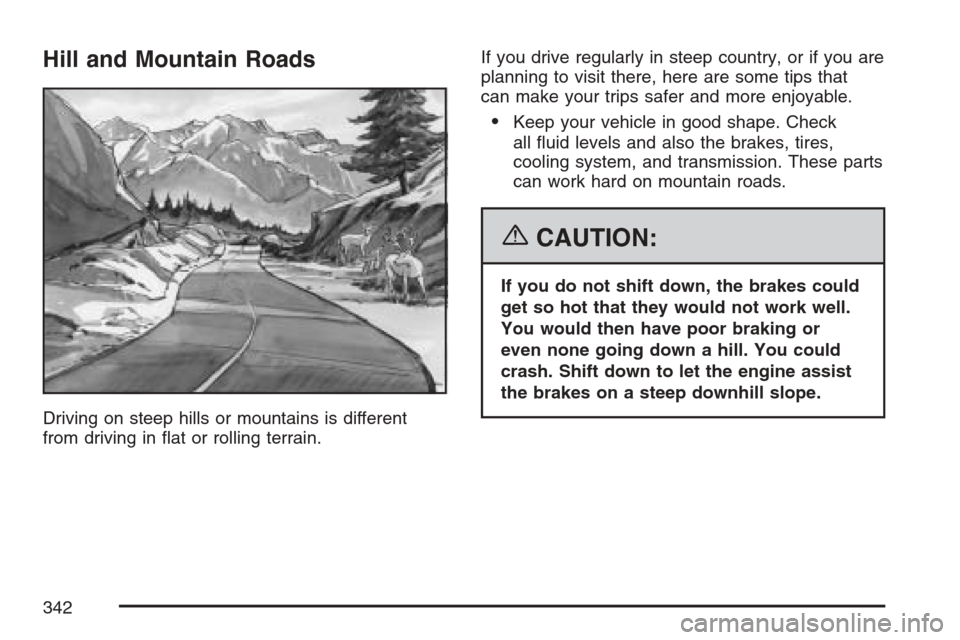
Hill and Mountain Roads
Driving on steep hills or mountains is different
from driving in at or rolling terrain.If you drive regularly in steep country, or if you are
planning to visit there, here are some tips that
can make your trips safer and more enjoyable.
Keep your vehicle in good shape. Check
all uid levels and also the brakes, tires,
cooling system, and transmission. These parts
can work hard on mountain roads.
{CAUTION:
If you do not shift down, the brakes could
get so hot that they would not work well.
You would then have poor braking or
even none going down a hill. You could
crash. Shift down to let the engine assist
the brakes on a steep downhill slope.
342
Page 343 of 560

{CAUTION:
Coasting downhill in NEUTRAL (N) or with
the ignition off is dangerous. The brakes
will have to do all the work of slowing
down. They could get so hot that they
would not work well. You would then have
poor braking or even none going down a
hill. You could crash. Always have the
engine running and your vehicle in gear
when you go downhill.
Know how to go down hills. The most important
thing to know is this: let the engine do some of
the slowing down. Shift to a lower gear when
you go down a steep or long hill.
Know how to go uphill. You may want to shift
down to a lower gear. The lower gears help
cool the engine and transmission, and you can
climb the hill better.
Stay in your own lane when driving on two-lane
roads in hills or mountains. Do not swing wide
or cut across the center of the road. Drive at
speeds that let you stay in your own lane.
As you go over the top of a hill, be alert. There
could be something in your lane, like a stalled
car or an accident.
You may see highway signs on mountains that
warn of special problems. Examples are long
grades, passing or no-passing zones, a falling
rocks area, or winding roads. Be alert to these
and take appropriate action.
343
Page 348 of 560

You will need a well-charged battery to restart the
vehicle, and possibly for signaling later on with
your headlamps. Let the heater run for a while.
Then, shut the engine off and close the window
almost all the way to preserve the heat. Start
the engine again and repeat this only when you
feel really uncomfortable from the cold. But do it as
little as possible. Preserve the fuel as long as
you can. To help keep warm, you can get out of
the vehicle and do some fairly vigorous exercises
every half hour or so until help comes.
If Your Vehicle is Stuck in Sand,
Mud, Ice, or Snow
In order to free your vehicle when it is stuck,
you need to spin the wheels, but you do not
want to spin the wheels too fast. The method
known as rocking can help you get out when you
are stuck, but you must use caution.
{CAUTION:
If you let your vehicle’s tires spin at high
speed, they can explode, and you or
others could be injured. And, the
transmission or other parts of the vehicle
can overheat. That could cause an engine
compartment re or other damage. When
you are stuck, spin the wheels as little as
possible. Do not spin the wheels above
35 mph (55 km/h) as shown on the
speedometer.
Notice:Spinning the wheels can destroy
parts of your vehicle as well as the tires. If you
spin the wheels too fast while shifting the
transmission back and forth, you can destroy
the transmission.
For information about using tire chains on your
vehicle, seeTire Chains on page 447.
348
Page 349 of 560
Rocking Your Vehicle to Get It Out
First, turn the steering wheel left and right.
That will clear the area around the front wheels.
You should turn the traction control system
off. SeeTraction Control System (TCS) on
page 323. Then shift back and forth between
REVERSE (R) and a forward gear, spinning the
wheels as little as possible. Release the
accelerator pedal while you shift, and press lightly
on the accelerator pedal when the transmission
is in gear. By slowly spinning the wheels in
the forward and reverse directions, you will cause
a rocking motion that may free your vehicle. If
that does not get your vehicle out after a few tries,
it may need to be towed out. If your vehicle
does need to be towed out, seeTowing Your
Vehicle on page 355.
Loading Your Vehicle
It is very important to know how much weight your
vehicle can carry. This weight is called the vehicle
capacity weight and includes the weight of all
occupants, cargo, and all nonfactory-installed
options. Two labels on your vehicle show how much
weight it may properly carry, the Tire and Loading
Information label, and the Certication label.
{CAUTION:
Do not load your vehicle any heavier than
the Gross Vehicle Weight Rating (GVWR),
or either the maximum front or rear Gross
Axle Weight Rating (GAWR). If you do,
parts on your vehicle can break, and it
can change the way your vehicle handles.
These could cause you to lose control
and crash. Also, overloading can shorten
the life of your vehicle.
349