remote start CADILLAC STS 2009 1.G User Guide
[x] Cancel search | Manufacturer: CADILLAC, Model Year: 2009, Model line: STS, Model: CADILLAC STS 2009 1.GPages: 514, PDF Size: 2.73 MB
Page 138 of 514
REMOTE RECALL MEMORY
If your vehicle has the optional memory package, you
will have this feature. When this feature is turned on, you
can recall any previously programmed seat position and
mirror position when the unlock button on the keyless
access transmitter is pressed.
Programmable Modes
Mode 1:ON
Mode 2:OFF (default)
The exception to the default is the recall seat to driver
position which is on.
To program the vehicle to a different mode:
1. Enter the PERSONAL SETTINGS MENU by
following the instructions listed previously under
“Entering the Personal Settings Menu.”
2. Turn the tune/select knob until REMOTE RECALL
MEMORY is highlighted.
3. Press the tune/select knob to switch back and forth
between on and off.
When the mode is turned on, a check mark will
appear next to the feature name.
If this feature is selected, START BUTTON RECALL
cannot be selected.
The mode you selected is now set. You can either exit the
programming mode by following the instructions later in
this section or program the next feature available on your
vehicle.
START BUTTON RECALL
If your vehicle has the optional memory package, you
will have this feature. When this feature is turned on, you
can recall any previously programmed seat, mirror, and
steering column position when the start button on the
ignition is pressed.
Programmable Modes
Mode 1:ON
Mode 2:OFF (default)
To program the vehicle to a different mode:
1. Enter the PERSONAL SETTINGS MENU by
following the instructions listed previously under
“Entering the Personal Settings Menu.”
2. Turn the tune/select knob until START BUTTON
RECALL is highlighted.
3. Press the tune/select knob to switch back and forth
between on and off.
When the mode is turned on, a check mark will
appear next to the feature name.
If this feature is selected, REMOTE RECALL MEMORY
cannot be selected.
The mode you selected is now set. You can either exit
the programming mode by following the instructions
later in this section or program the next feature available
on your vehicle.
2-66
Page 149 of 514
SUSPENSION MODE
If your vehicle has this feature, you can select between
performance or touring modes. Performance mode is
used where road conditions or personal preference
demand more control. Touring mode is used for normal
city and highway driving.
Programmable Modes
Mode 1:PERFORMANCE
Mode 2:TOURING (default)
To program the vehicle to a different mode:
1. Enter the PERSONAL SETTINGS MENU by
following the instructions listed previously under
“Entering the Personal Settings Menu.”
2. Turn the tune/select knob until SUSPENSION
MODE is highlighted.
3. Press the tune/select knob to enter the
SUSPENSION MODE submenu.
4. Turn the tune/select knob to highlight TOURING or
PERFORMANCE.
5. Press the tune/select knob to select the setting.
The mode you selected is now set. You can either exit
the programming mode by following the instructions
later in this section or program the next feature available
on your vehicle by pressing the F6 (BACK) button,
located on the radio, to return to the PERSONAL
SETTINGS MENU.
Exiting the Personal Settings Menu
Once you have nished making your selections on the
base audio system, you will automatically return to
the main audio screen after 15 seconds. You can also
press the F6 (BACK) button, located on the radio,
to return to the main audio screen.
Memory Seat, Mirrors and Steering
Wheel
If the vehicle has the memory feature, you can program
and recall memory settings for the following features
for up to two drivers:
The driver’s seat position
The outside rearview mirrors position
The power tilt wheel and telescopic steering column
position
The following settings and presets are set automatically:
The language, radio and XM™ presets, tone,
volume, playback mode (AM/FM or CD), last
displayed stations, and compact disc position
The last climate control setting
The Head-Up Display (HUD) position, if your
vehicle has this feature
Other personalization settings, for example, remote
start settings
SeeVehicle Personalization on page 2-61.
2-77
Page 151 of 514

Driver Selection Submenu Items
DRIVER 1/DRIVER 2
The numbers on the back of each keyless access
transmitter correspond to DRIVER 1 and DRIVER 2.
If you would like to recall or store driver settings for
the driver that does not correspond to the number on
the back of the keyless access transmitter that you
are using:
1. Enter the memory programming mode for your
driver settings by following the instructions listed
previously under “Entering the Driver Selection
Submenu.”
2. From the DRIVER SELECTION submenu, turn the
tune/select knob to highlight the driver number that
you want, either DRIVER 1 or DRIVER 2.
3. Set your choice by pressing in the tune/select knob.
If you would like to recall or store driver settings for
the selected driver, see “RECALL DRIVER SETTINGS”
or “STORE DRIVER SETTINGS” later in this section.
If you would like to recall or store exit settings for
the selected driver, see “RECALL EXIT SETTINGS”
or “STORE EXIT SETTINGS” later in this section.
RECALL DRIVER SETTINGS
To recall driver settings:
1. Enter the memory programming mode for your
driver settings by following the instructions listed
previously under “Entering the Driver Selection
Submenu.”
2. From the DRIVER SELECTION submenu, turn the
tune/select knob to scroll to RECALL DRIVER
SETTINGS and press in the knob.
If the vehicle is in P (Park), one beep will sound
and your previously saved driving position will then
be recalled.
If the vehicle is not in P (Park), three beeps will
sound and your previously saved driving position
will not be recalled.
A memory recall can be stopped by pressing any
memory seat or mirror position button.
If you would like the stored driving positions to be
recalled when unlocking your vehicle with the keyless
access transmitter or when starting your vehicle, see
“REMOTE RECALL MEMORY” or “START BUTTON
RECALL” underVehicle Personalization on page 2-61.
2-79
Page 205 of 514
Rear Window Defogger
The rear window defogger uses a warming grid to
remove fog or frost from the rear window.
The defogger only works when the ignition is on or
during remote start, if programmed. See “Personal
Settings Menu” underVehicle Personalization on
page 2-61for additional information.
=(Rear Window Defogger):Press to turn the rear
window defogger on or off. The rear window defogger
stays on for 10 minutes, before turning off.
If the vehicle’s speed is above 30 mph (48 km/h), the
rear defogger stays on continuously. If turned on again,
the defogger only runs for about ve minutes before
turning off. The defogger can also be turned off by
turning off the engine.The heated outside rearview mirrors also heat to help
clear fog or frost from the surface of the mirror when
the rear window defogger is on. SeeOutside Heated
Mirrors on page 2-41.
Notice:Do not use a razor blade or sharp object to
clear the inside rear window. Do not adhere anything
to the defogger grid lines in the rear glass. These
actions may damage the rear defogger. Repairs
would not be covered by your warranty.
{(Ventilated Seat):If the vehicle has this feature,
press to turn the driver or passenger side ventilated seat
on. SeeHeated and Ventilated Seats on page 1-3.
J(Heated Seat):If the vehicle has this feature, press
to turn the driver or passenger side heated seat and
seatback on. SeeHeated and Ventilated Seats on
page 1-3.
3-51
Page 213 of 514

{CAUTION:
If the airbag readiness light stays on after the
vehicle is started or comes on while driving, it
means the airbag system might not be working
properly. The airbags in the vehicle might not
inate in a crash, or they could even inate
without a crash. To help avoid injury, have the
vehicle serviced right away.
If there is a problem with the airbag system, an airbag
Driver Information Center (DIC) message can also come
on. SeeDIC Warnings and Messages on page 3-79
for more information.
Passenger Airbag Status Indicator
Your vehicle has the passenger sensing system.
Your overhead console has a passenger airbag status
indicator.
When you start the vehicle, the passenger airbag status
indicator will light ON and OFF, or the symbol for on
and off, for several seconds as a system check. If you
use remote start to start your vehicle from a distance,
if your vehicle has this feature, you may not see
the system check.United States
Canada
3-59
Page 240 of 514
LANE DEPARTURE SYSTEM
UNAVAILABLE
If your vehicle has the Lane Departure Warning (LDW)
system, this message may display if the LDW system
does not activate due to a temporary condition. See the
Index in the Navigation manual for more information.
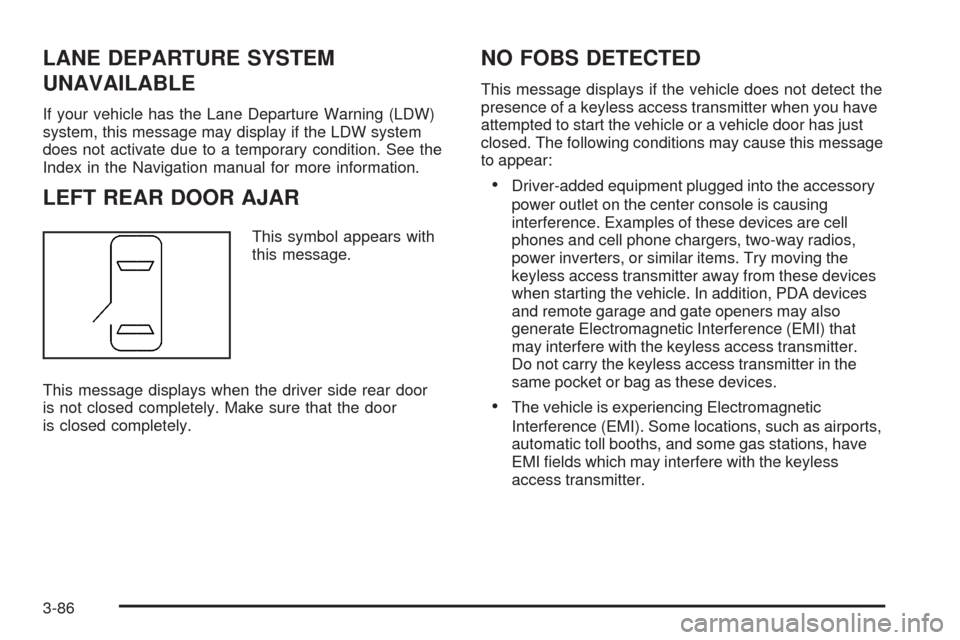
LEFT REAR DOOR AJAR
This symbol appears with
this message.
This message displays when the driver side rear door
is not closed completely. Make sure that the door
is closed completely.
NO FOBS DETECTED
This message displays if the vehicle does not detect the
presence of a keyless access transmitter when you have
attempted to start the vehicle or a vehicle door has just
closed. The following conditions may cause this message
to appear:
Driver-added equipment plugged into the accessory
power outlet on the center console is causing
interference. Examples of these devices are cell
phones and cell phone chargers, two-way radios,
power inverters, or similar items. Try moving the
keyless access transmitter away from these devices
when starting the vehicle. In addition, PDA devices
and remote garage and gate openers may also
generate Electromagnetic Interference (EMI) that
may interfere with the keyless access transmitter.
Do not carry the keyless access transmitter in the
same pocket or bag as these devices.
The vehicle is experiencing Electromagnetic
Interference (EMI). Some locations, such as airports,
automatic toll booths, and some gas stations, have
EMI elds which may interfere with the keyless
access transmitter.
3-86
Page 246 of 514

SERVICE THEFT SYSTEM
This message displays when there is a problem with the
hood open and closed switches. The switches may need
to be replaced. When this message is displayed, the
theft-deterrent system will still be protecting the interior of
the vehicle, however, the hood area will not be protected
at this time. Also, the remote start function will not work
when this message appears. See your dealer/retailer for
service.
SERVICE TRANSMISSION
This message displays when there is a problem with
the transmission. Have your vehicle serviced by
your dealer/retailer.
SERVICE VEHICLE SOON
This message displays when a non-emissions related
malfunction occurs. Have your vehicle serviced by your
dealer/retailer as soon as possible.
SIDE BLIND ZONE ALERT
SYSTEM OFF
If your vehicle has the Side Blind Zone Alert (SBZA)
system, this message displays when the SBZA system
has been turned off. SeeSide Blind Zone Alert (SBZA) on
page 2-44andDIC Operation and Displays on page 3-72
for more information.
SIDE BLIND ZONE SYSTEM
UNAVAILABLE
If your vehicle has the Side Blind Zone Alert (SBZA)
system, this message displays when the SBZA system
is disabled because the sensor is blocked and cannot
detect vehicles in your blind zone. The sensor may be
blocked by mud, dirt, snow, ice, or slush. This message
may also display during heavy rain or due to road spray.
Your vehicle does not need service. For cleaning
instructions, seeWashing Your Vehicle on page 5-118.
SeeSide Blind Zone Alert (SBZA) on page 2-44for more
information.
SPEED LIMIT: XXX MPH (KM/H)
This message displays when the Speed Alert has been
turned on through the DIC Information Menu and the
vehicle is at or above the speed limit. SeeDIC Operation
and Displays on page 3-72for more information.
SPEED LIMITED TO XXX
This message displays when the vehicle speed is
limited to XXX, mph in English mode and km/h in
Metric mode, because the vehicle detects a problem
in the steering, stability control, or suspension system.
Have your vehicle serviced by your dealer/retailer.
3-92
Page 339 of 514
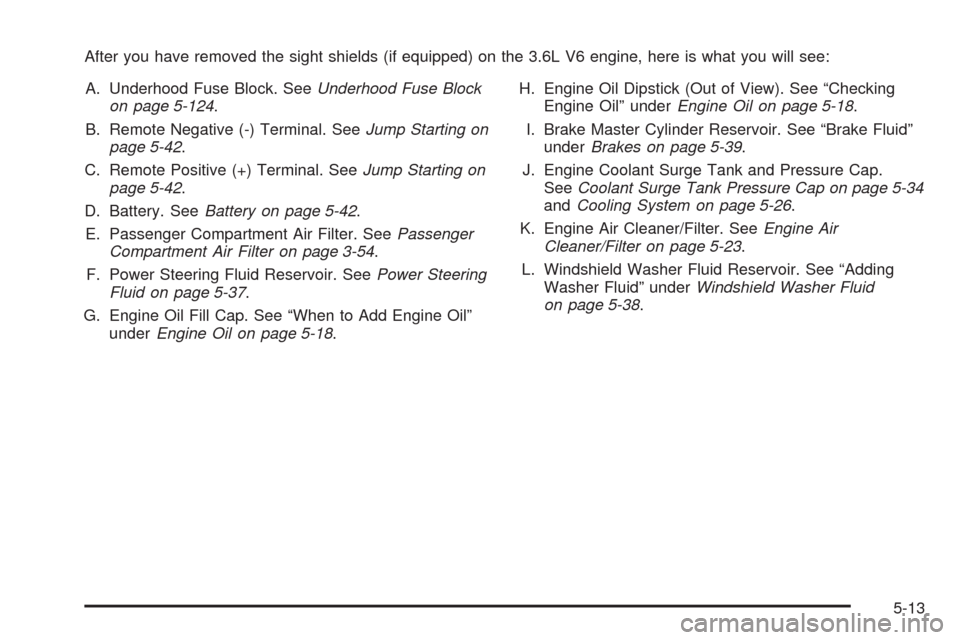
After you have removed the sight shields (if equipped) on the 3.6L V6 engine, here is what you will see:
A. Underhood Fuse Block. SeeUnderhood Fuse Block
on page 5-124.
B. Remote Negative (-) Terminal. SeeJump Starting on
page 5-42.
C. Remote Positive (+) Terminal. SeeJump Starting on
page 5-42.
D. Battery. SeeBattery on page 5-42.
E. Passenger Compartment Air Filter. SeePassenger
Compartment Air Filter on page 3-54.
F. Power Steering Fluid Reservoir. SeePower Steering
Fluid on page 5-37.
G. Engine Oil Fill Cap. See “When to Add Engine Oil”
underEngine Oil on page 5-18.H. Engine Oil Dipstick (Out of View). See “Checking
Engine Oil” underEngine Oil on page 5-18.
I. Brake Master Cylinder Reservoir. See “Brake Fluid”
underBrakes on page 5-39.
J. Engine Coolant Surge Tank and Pressure Cap.
SeeCoolant Surge Tank Pressure Cap on page 5-34
andCooling System on page 5-26.
K. Engine Air Cleaner/Filter. SeeEngine Air
Cleaner/Filter on page 5-23.
L. Windshield Washer Fluid Reservoir. See “Adding
Washer Fluid” underWindshield Washer Fluid
on page 5-38.
5-13
Page 341 of 514
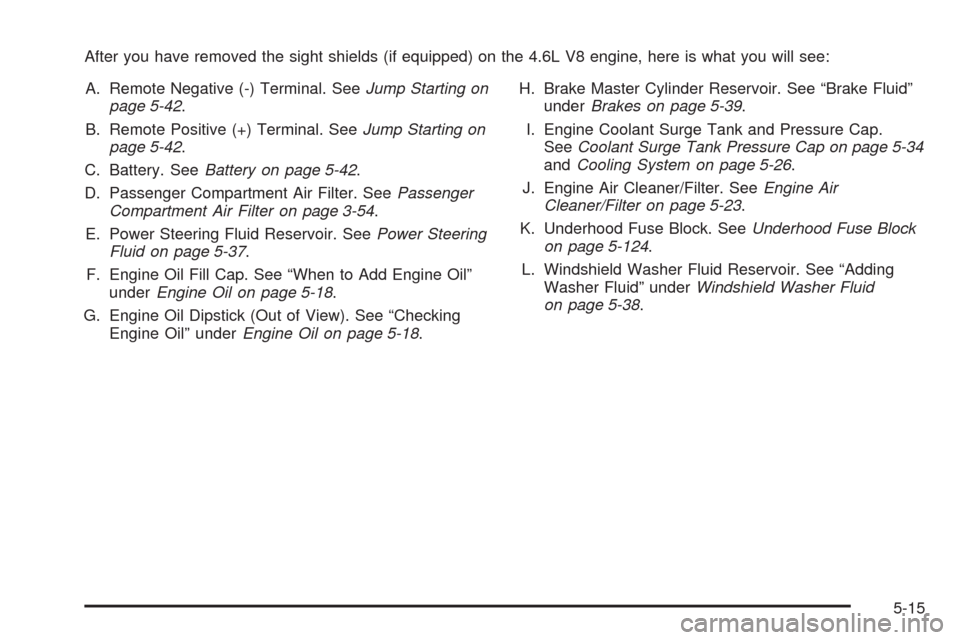
After you have removed the sight shields (if equipped) on the 4.6L V8 engine, here is what you will see:
A. Remote Negative (-) Terminal. SeeJump Starting on
page 5-42.
B. Remote Positive (+) Terminal. SeeJump Starting on
page 5-42.
C. Battery. SeeBattery on page 5-42.
D. Passenger Compartment Air Filter. SeePassenger
Compartment Air Filter on page 3-54.
E. Power Steering Fluid Reservoir. SeePower Steering
Fluid on page 5-37.
F. Engine Oil Fill Cap. See “When to Add Engine Oil”
underEngine Oil on page 5-18.
G. Engine Oil Dipstick (Out of View). See “Checking
Engine Oil” underEngine Oil on page 5-18.H. Brake Master Cylinder Reservoir. See “Brake Fluid”
underBrakes on page 5-39.
I. Engine Coolant Surge Tank and Pressure Cap.
SeeCoolant Surge Tank Pressure Cap on page 5-34
andCooling System on page 5-26.
J. Engine Air Cleaner/Filter. SeeEngine Air
Cleaner/Filter on page 5-23.
K. Underhood Fuse Block. SeeUnderhood Fuse Block
on page 5-124.
L. Windshield Washer Fluid Reservoir. See “Adding
Washer Fluid” underWindshield Washer Fluid
on page 5-38.
5-15
Page 343 of 514
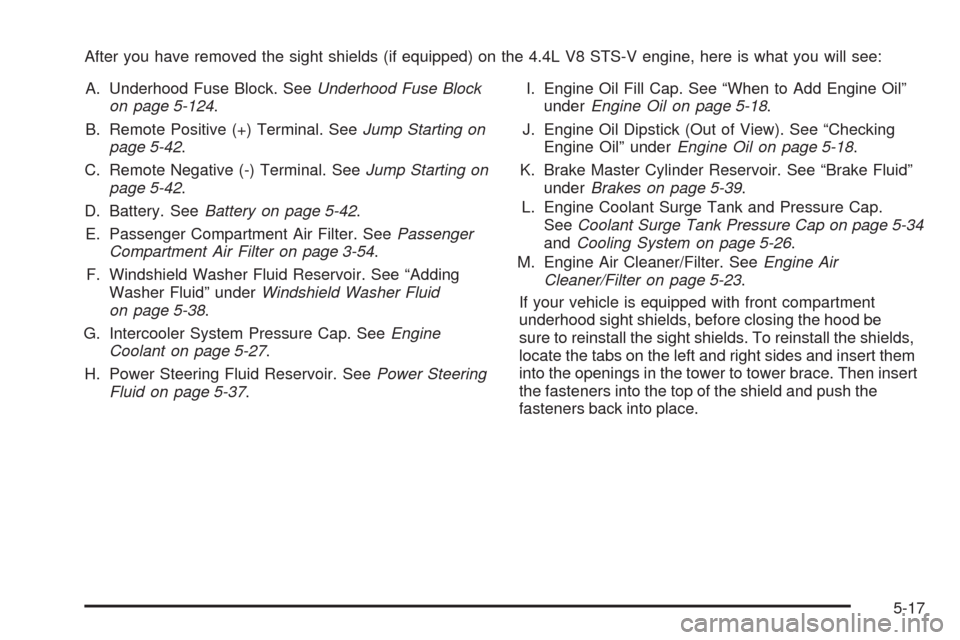
After you have removed the sight shields (if equipped) on the 4.4L V8 STS-V engine, here is what you will see:
A. Underhood Fuse Block. SeeUnderhood Fuse Block
on page 5-124.
B. Remote Positive (+) Terminal. SeeJump Starting on
page 5-42.
C. Remote Negative (-) Terminal. SeeJump Starting on
page 5-42.
D. Battery. SeeBattery on page 5-42.
E. Passenger Compartment Air Filter. SeePassenger
Compartment Air Filter on page 3-54.
F. Windshield Washer Fluid Reservoir. See “Adding
Washer Fluid” underWindshield Washer Fluid
on page 5-38.
G. Intercooler System Pressure Cap. SeeEngine
Coolant on page 5-27.
H. Power Steering Fluid Reservoir. SeePower Steering
Fluid on page 5-37.I. Engine Oil Fill Cap. See “When to Add Engine Oil”
underEngine Oil on page 5-18.
J. Engine Oil Dipstick (Out of View). See “Checking
Engine Oil” underEngine Oil on page 5-18.
K. Brake Master Cylinder Reservoir. See “Brake Fluid”
underBrakes on page 5-39.
L. Engine Coolant Surge Tank and Pressure Cap.
SeeCoolant Surge Tank Pressure Cap on page 5-34
andCooling System on page 5-26.
M. Engine Air Cleaner/Filter. SeeEngine Air
Cleaner/Filter on page 5-23.
If your vehicle is equipped with front compartment
underhood sight shields, before closing the hood be
sure to reinstall the sight shields. To reinstall the shields,
locate the tabs on the left and right sides and insert them
into the openings in the tower to tower brace. Then insert
the fasteners into the top of the shield and push the
fasteners back into place.
5-17