mirror CADILLAC STS 2009 1.G Owner's Manual
[x] Cancel search | Manufacturer: CADILLAC, Model Year: 2009, Model line: STS, Model: CADILLAC STS 2009 1.GPages: 514, PDF Size: 2.73 MB
Page 153 of 514
Driver Exit Settings Submenu Items
RECALL EXIT SETTINGS
To recall exit settings:
1. Enter the memory programming mode for your exit
settings by following the instructions listed previously
under “Entering the Driver Exit Settings Submenu.”
2. From the DRIVER EXIT SETTINGS submenu,
turn the tune/select knob to scroll to RECALL
EXIT SETTINGS and press in the knob.
If the vehicle is in P (Park), one beep will sound
and your previously saved exit position will then be
recalled.
If the vehicle is not in P (Park), three beeps will
sound and your previously saved exit position will
not be recalled.
A memory recall can be stopped by pressing any
memory seat or mirror position button.
If you would like the stored exit positions to be recalled
when your vehicle is in P (Park), the vehicle is off, and
the driver’s door is opened, see “AUTO EXIT SEAT” and
“AUTO EXIT COLUMN” underVehicle Personalization
on page 2-61.
STORE EXIT SETTINGS
To store exit settings:
1. Adjust your settings for the driver’s seat, the outside
rearview mirrors, and the steering column to a
comfortable exit position.
2. Enter the memory programming mode for your exit
settings by following the instructions listed previously
under “Entering the Driver Exit Settings Submenu.”
3. From the DRIVER EXIT SETTINGS submenu,
turn the tune/select knob to scroll to STORE EXIT
SETTINGS and press in the knob. Two beeps will
sound to conrm that your new exit settings are
saved.
4. Repeat the procedure for a second driver by
programming the other driver number.
2-81
Page 161 of 514
Push the control forward or rearward to move the
steering wheel towards the front or rear of the vehicle.
To set the memory position, seeVehicle Personalization
on page 2-61andMemory Seat, Mirrors and Steering
Wheel on page 2-77.
Heated Steering Wheel
For vehicles with a heated steering wheel, the button for
this feature is located on the steering wheel.
(:Press to turn the heated steering wheel on or off.
A light on the button displays when the feature is
turned on.
The steering wheel takes about three minutes to start
heating.
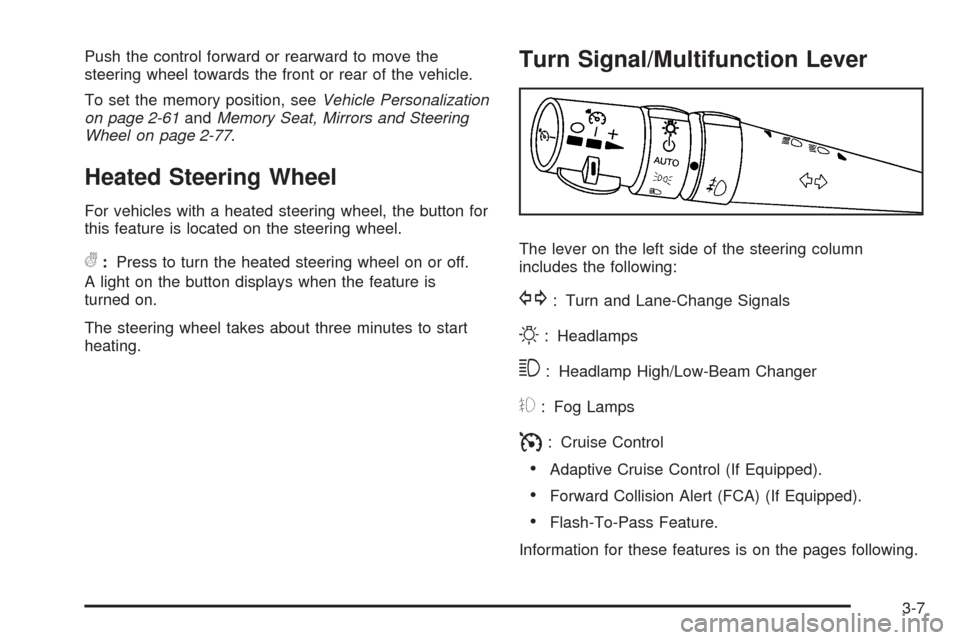
Turn Signal/Multifunction Lever
The lever on the left side of the steering column
includes the following:
G: Turn and Lane-Change Signals
O: Headlamps
3: Headlamp High/Low-Beam Changer
#: Fog Lamps
I: Cruise Control
Adaptive Cruise Control (If Equipped).
Forward Collision Alert (FCA) (If Equipped).
Flash-To-Pass Feature.
Information for these features is on the pages following.
3-7
Page 168 of 514
x(Delay Adjustment):Use this band to set the
length of the delay between wipes when using the delay
feature. The closer the band is moved toward mist,
the longer the delay. The windshield wiper lever must
be in delay for this feature to work.
6(Low Speed):For slow, steady wiping cycles.
1(High Speed):For rapid wiping cycles.
If the windshield wipers are in use for about six seconds
while you are driving, the exterior lamps will come on
automatically if the exterior lamp control is in AUTO.
SeeWiper Activated Headlamps on page 3-36for
more information.
Clear snow and ice from the wiper blades before using
them. If the blades are frozen to the windshield, loosen or
thaw them. If they become damaged, install new blades.
For more information, seeWindshield Wiper Blade
Replacement on page 5-52.
Heavy snow or ice can overload the wiper motor.
A circuit breaker will stop the motor until it cools down.
For STS-V, the vehicle is equipped with a feature
that disables the wiper system when the hood is open
and the vehicle is stopped. Opening the hood will
automatically park the wipers if they are not parked.
Rainsense™ II Wipers
For vehicles with this feature, the moisture sensor is
mounted on the interior side of the windshield behind the
rearview mirror. It is used to automatically operate the
wipers by monitoring the amount of moisture build-up
on the windshield. Wipes occur as needed to clear the
windshield depending on driving conditions and the
sensitivity setting. In light rain or snow, fewer wipes will
occur. In heavy rain or snow, wipes will occur more
frequently. The Rainsense wipers operate in a delay
mode as well as a continuous low or high speed as
needed. If the system is left on for long periods of time,
occasional wipes may occur without any moisture on
the windshield. This is normal and indicates that the
Rainsense system is activated.
To activate the Rainsense system, turn the wiper band
to delay mode and select one of the four sensitivity levels
indicated on the wiper stalk. The position closest to off is
the lowest sensitivity setting, level one. This allows more
rain or snow to collect on the windshield between wipes.
Turning the wiper band away from you to higher
sensitivity levels increases the sensitivity of the system
and frequency of wipes. The highest sensitivity setting,
level four, is closest to low. A single wipe occurs each
time the wiper stalk is turned to a higher sensitivity level
to indicate that the sensitivity level has been increased.
3-14
Page 187 of 514

;(Parking Lamps):Turns on the parking lamps
together with the following:
Sidemarker Lamps
Taillamps
License Plate Lamps
Instrument Panel Lights
5(Headlamps):Turns on the headlamps, together
with the previously listed lamps and lights.
IntelliBeam™ Intelligent High-Beam
Headlamp Control System
For vehicles with IntelliBeam, read this entire section
before using this feature.
IntelliBeam is an enhancement to the vehicle’s
headlamp system. It uses a light sensor located on
the back of the rearview mirror to turn the high-beam
headlamps on and off depending on approaching traffic.
The IntelliBeam system turns the high-beam headlamps
on when it is dark enough, there is no other traffic
present, and the IntelliBeam system is enabled.
Turning On and Enabling IntelliBeam
AUTO3(IntelliBeam On/Off):Press and release
the IntelliBeam button on the inside rear view mirror.
The indicator on the mirror turns on. Once the system
has been turned on, it remains on each time the vehicle
is started. Additionally, the IntelliBeam system must be
enabled.
To enable the System, turn the exterior lamp control
to AUTO, with the turn signal/multifunction lever in its
starting position. The High-Beam On Light appears on
the instrument panel cluster when the high-beams are on.
SeeHighbeam On Light on page 3-70. The vehicle has
variable intensity high-beams. The high-beam indicator
on the instrument panel cluster comes on as soon as the
high-beams start to come on, and remains on until the
high-beams have completely turned off. Vehicles with
IntelliBeam quickly turn off the high-beams if the system
detects the sudden presence of vehicle lights ahead.
3-33
Page 188 of 514

Driving with IntelliBeam
IntelliBeam only activates the high-beams when driving
over 20 mph (32 km/h).
The high-beam headlamps remain on, under the control
of IntelliBeam, until any of the following situations occur:
The system detects an approaching vehicle’s
headlamps.
The system detects a preceding vehicle’s taillamps.
The outside light is bright enough that high-beam
headlamps are not required.
The high-beam headlamps are manually turned on
or you use the ash-to-pass feature. SeeHeadlamp
High/Low-Beam Changer on page 3-9and
Flash-to-Pass on page 3-13.
When either of these conditions occur, the IntelliBeam
feature is temporarily disabled until the high-beam
stalk is returned to its starting position. If either of
these conditions occur and IntelliBeam already has
the high-beam headlamps on, the feature is disabled
and the light in the mirror turns off.
The exterior lamp control is turned to any setting
except AUTO.
When this occurs, IntelliBeam is disabled until the
control is turned back to the AUTO position and the
AUTOMATIC LIGHTS ON message displays on
the DIC.
The IntelliBeam system is turned off at the inside
rearview mirror.
The vehicle’s speed drops below 15 mph (24 km/h).
IntelliBeam may not turn off the high-beams if the
system cannot detect other vehicle’s lamps because
of any of the following:
The others vehicle’s lamp(s) are missing, damaged,
obstructed from view, or otherwise undetected.
The other vehicle’s lamp(s) are covered with dirt,
snow and/or road spray.
The other vehicle’s lamp(s) cannot be detected due
to dense exhaust, smoke, fog, snow, road spray,
mist, or other airborne obstructions.
Your vehicle’s windshield is dirty, cracked, or
obstructed by something that blocks the view of
the IntelliBeam light sensor.
Your vehicle’s windshield is covered with ice, dirt,
haze, or other obstructions.
Your vehicle is loaded such that the front end of
the vehicle points upward, causing the IntelliBeam
sensor to aim high and not detect headlamps
and taillamps.
You are driving on winding or hilly roads.
You might need to manually disable or cancel the
high-beam headlamps by turning the low-beam
headlamps on, if any of the above conditions exist.
3-34
Page 189 of 514

Disabling and Resetting IntelliBeam at the
Rearview Mirror
IntelliBeam can be disabled and reset to the original
factory setting by using the controls on the inside
rearview mirror.
AUTO
3(IntelliBeam On/Off):To disable the
system, press this button on the inside rearview mirror.
The IntelliBeam indicator turns off and does not come
back on until the IntelliBeam button is pressed again.
When IntelliBeam has turned on the high-beams, pull or
push the high-beam stalk. This disables IntelliBeam and
the IntelliBeam indicator on the rearview mirror turns off.
To re-enable IntelliBeam, press the IntelliBeam button on
the mirror.
A different sensitivity setting is available for dealer
diagnostics. This is done by pushing and holding this
button for 20 seconds until the light ashes three times.
If you accidentally activate this, the vehicle’s setting
automatically resets each time the ignition is turned off
and then on again; otherwise, refer to the text above for
resetting the system.
Cleaning the IntelliBeam Light Sensor
The light sensor is located
on the inside of the vehicle
at the back of the
rearview mirror.
Clean the light sensor window, periodically, using glass
cleaner on a soft cloth. Gently wipe the sensor window.
Do not spray glass cleaner directly on the surface of the
sensor window.
3-35
Page 205 of 514
Rear Window Defogger
The rear window defogger uses a warming grid to
remove fog or frost from the rear window.
The defogger only works when the ignition is on or
during remote start, if programmed. See “Personal
Settings Menu” underVehicle Personalization on
page 2-61for additional information.
=(Rear Window Defogger):Press to turn the rear
window defogger on or off. The rear window defogger
stays on for 10 minutes, before turning off.
If the vehicle’s speed is above 30 mph (48 km/h), the
rear defogger stays on continuously. If turned on again,
the defogger only runs for about ve minutes before
turning off. The defogger can also be turned off by
turning off the engine.The heated outside rearview mirrors also heat to help
clear fog or frost from the surface of the mirror when
the rear window defogger is on. SeeOutside Heated
Mirrors on page 2-41.
Notice:Do not use a razor blade or sharp object to
clear the inside rear window. Do not adhere anything
to the defogger grid lines in the rear glass. These
actions may damage the rear defogger. Repairs
would not be covered by your warranty.
{(Ventilated Seat):If the vehicle has this feature,
press to turn the driver or passenger side ventilated seat
on. SeeHeated and Ventilated Seats on page 1-3.
J(Heated Seat):If the vehicle has this feature, press
to turn the driver or passenger side heated seat and
seatback on. SeeHeated and Ventilated Seats on
page 1-3.
3-51
Page 284 of 514
DRIVER SELECTION
The following submenu displays when this item is
selected:
DRIVER 1
DRIVER 2
RECALL DRIVER SETTINGS
STORE DRIVER SETTINGS
For more information on the DRIVER SELECTION
submenu item, see “Recalling Driver Settings”
and “Storing Driver Settings” underMemory Seat,
Mirrors and Steering Wheel on page 2-77.
DRIVER EXIT SETTINGS
The following submenu displays when this item is
selected:
RECALL EXIT SETTINGS
STORE EXIT SETTINGSFor more information on the DRIVER EXIT SETTINGS
submenu item, see “Recalling Exit Settings” and “Storing
Exit Settings” underMemory Seat, Mirrors and Steering
Wheel on page 2-77.
CONFIGURE DISPLAY KEYS
(Base Audio System)
This item allows the four congurable keys located to
the left and right of the audio display to be customized.
See “Congurable Radio Display Keys” underRadio(s)
on page 3-98for programming information.
Theft-Deterrent Feature
THEFTLOCK®is designed to discourage theft of the
vehicle’s radio by learning a portion of the Vehicle
Identication Number (VIN). The radio does not operate
if it is stolen or moved to a different vehicle.
3-130
Page 304 of 514
Skidding
In a skid, a driver can lose control of the vehicle.
Defensive drivers avoid most skids by taking reasonable
care suited to existing conditions, and by not overdriving
those conditions. But skids are always possible.
The three types of skids correspond to your vehicle’s
three control systems. In the braking skid, the wheels
are not rolling. In the steering or cornering skid, too
much speed or steering in a curve causes tires to slip
and lose cornering force. And in the acceleration
skid, too much throttle causes the driving wheels
to spin.
Remember: Any traction control system helps avoid
only the acceleration skid. If your traction control system
is off, then an acceleration skid is best handled by
easing your foot off the accelerator pedal.
If your vehicle starts to slide, ease your foot off the
accelerator pedal and quickly steer the way you want
the vehicle to go. If you start steering quickly enough,
your vehicle may straighten out. Always be ready
for a second skid if it occurs.You might see the STABILITY SYS ACTIVE message
on the Driver Information Center. SeeDIC Warnings and
Messages on page 3-79andStabiliTrak®System on
page 4-6orEnhanced StabiliTrak®on page 4-6.
Of course, traction is reduced when water, snow, ice,
gravel, or other material is on the road. For safety,
you will want to slow down and adjust your driving to
these conditions. It is important to slow down on slippery
surfaces because stopping distance will be longer and
vehicle control more limited.
While driving on a surface with reduced traction, try your
best to avoid sudden steering, acceleration, or braking,
including reducing vehicle speed by shifting to a lower
gear. Any sudden changes could cause the tires to
slide. You may not realize the surface is slippery until
your vehicle is skidding. Learn to recognize warning
clues — such as enough water, ice, or packed snow on
the road to make a mirrored surface — and slow down
when you have any doubt.
Remember: Any Antilock Brake System (ABS) helps
avoid only the braking skid.
4-16
Page 305 of 514

Competitive Driving
See your warranty book before using your vehicle for
competitive driving.
Notice:If you use your vehicle for competitive
driving, the engine may use more oil than it would
with normal use. Low oil levels can damage the
engine. Be sure to check the oil level often during
competitive driving and keep the level at or near the
upper mark that shows the proper operating range
on the engine oil dipstick. For information on how to
add oil, seeEngine Oil on page 5-18.
Driving at Night
Night driving is more dangerous than day driving
because some drivers are likely to be impaired — by
alcohol or drugs, with night vision problems, or by
fatigue.
Night driving tips include:
Drive defensively.
Do not drink and drive.
Reduce headlamp glare by adjusting the inside
rearview mirror.
Slow down and keep more space between you and
other vehicles because headlamps can only light up
so much road ahead.
Watch for animals.
When tired, pull off the road.
Do not wear sunglasses.
Avoid staring directly into approaching headlamps.
Keep the windshield and all glass on your vehicle
clean — inside and out.
Keep your eyes moving, especially during turns or
curves.
No one can see as well at night as in the daytime.
But, as we get older, these differences increase.
A 50-year-old driver might need at least twice as much
light to see the same thing at night as a 20-year-old.
4-17